Business shifts and RTOs cause concern; “It’s better if the authorities can do adequate due diligence beforehand.”

Business shifts and RTOs cause concern

Friday, Oct 11, 2013

Reuters

Reverse takeovers and shifting business strategies involving firms on Singapore’s stock market have come under the spotlight in the wake of the recent collapse in share prices of three companies listed on South-east Asia’s biggest bourse. One of the companies, Blumont Group, lost as much as $6.2 billion in market value in the past week. Prior to that, it had surged as much as 12-fold this year, making it Singapore’s top performer. The company, which listed in mid-2000, has shifted its focus between investment (most recently in mining companies), property development and sterilised-food and medicine packaging. Read more of this post


“Fee-sucking, evergreen income.” That’s how Bill Michaels describes the financial industry’s reliance on asset allocation.

Updated October 10, 2013, 10:35 a.m. ET

Vonnegut: Wealth Management’s New Dinosaurs

Investors don’t need us to diversify. ETFs are easy to buy, easy to use, and easy to understand

NORB VONNEGUT

“Fee-sucking, evergreen income.” That’s how Bill Michaels describes our industry’s reliance on asset allocation. The problem, he says, is that it doesn’t make money for clients. But here’s what “diwussification”–his play on diversification–does for advisers: It minimizes risk, locks in annuity revenues, and frees them “to go play golf.” Mr. Michaels, now retired, was the kind of risk-loving stockbroker that has all but disappeared from financial services. During the 1990s, through options and a staggering margin balance, he built a 1,150,000-share position in Dell. It paid off big-time. Read more of this post

Secret deal brokered by daughter of ‘Butcher of Tiananmen Square’ for insurance giant Zurich Insurance to break into the Chinese market could come under investigation

Daughter of ‘Butcher of Tiananmen Square’ brokered secret deal for insurance giant

EXCLUSIVE: A secret deal that helped Zurich Insurance break into the Chinese market could come under investigation

Li_Xiaolin_2698776b

Li Xiaolin, who brokered the multi-million pound deal Photo: GETTY IMAGES

By Malcolm Moore, in Beijing and Raf Sanchez in Fairfax County, Virginia

7:05PM BST 10 Oct 2013

A secret multi-million pound deal to carve up China’s insurance market, brokered by the daughter of the country’s former prime minister, has been sent to anti-corruption investigators. The deal guaranteed Zurich Insurance, one of the world’s largest financial institutions, a hugely lucrative stake in a major Chinese insurance company at a time when foreign firms were barred from investing in the sector. The deal, which came to light during a court case in the United States, was cut at the very highest level of the Communist party, by the daughter of the prime minister at the time, Li Peng. Read more of this post

Sound the retweet: When investors make irrational decisions

Sound the retweet: When investors make irrational decisions

Oct 12th 2013 |From the print edition

20131012_FND001_0

FOR want of a letter, a fortune was lost. Shares in Tweeter, a bankrupt electronics retailer, briefly soared 1,800% on October 4th because some investors mistook its ticker symbol TWTRQ for TWTR, the shorthand chosen by Twitter ahead of the microblogging service’s planned stockmarket flotation. Trading was halted after the regulator stepped in. But those who bought at the peak price will be regretting their foolishness. Read more of this post

Rivers are disappearing in China. Building canals is not the solution

Oct 12th 2013 |From the print edition

20131012_LDP004_0

CHINA’S emperors regarded control over water as one of the principal ways of controlling the country. They poured their kingdom’s resources into vast projects such as the Grand Canal between Beijing and Hangzhou, which was finished in about 500AD. The country’s Communist leaders have inherited this passion. Eight of the nine members of the previous Politburo’s standing committee were engineers and a former president, Hu Jintao, was a water engineer. The country has built as many large dams as the rest of the world put together. Read more of this post

African governance: Too many dinosaurs; The survival of ancient tyrants spoils Africa’s record of improving democracy

African governance: Too many dinosaurs; The survival of ancient tyrants spoils Africa’s record of improving democracy

Oct 12th 2013 |From the print edition

BETWEEN independence from colonial rule in the early 1960s and the end of the cold war in 1991, not a single African ruler was peacefully ousted at the ballot box, except in the Indian Ocean island of Mauritius. But since Mathieu Kérékou of Benin and Zambia’s Kenneth Kaunda bowed out graciously in 1991, at least 30 African leaders or ruling parties have let their countries’ voters kick them out. Multiparty systems in Africa now far outnumber single-party ones. This contrasts strikingly with the Arab world, where so far almost no incumbent-ejecting elections have taken place anywhere. Read more of this post

New Monopoly Board Features Brands Instead Of Atlantic City Streets

New Monopoly Board Features Brands Instead Of Atlantic City Streets

AARON TAUBE OCT. 10, 2013, 3:17 PM 1,686 1

Hasbro has released its latest themed Monopoly game, and it’s sure to be a hit in AdLand. Monopoly Empire features some of the world’s biggest brands in the spaces that are traditionally named after Atlantic City streets (or, if you’re British, London streets). In the new game, Coca-Cola and Samsung occupy the game’s most valuable real estate, the spots labeled Boardwalk and Park Place in the original game. Here’s what the new board looks like:

monopoly empire game board (1) Read more of this post

The Dangers of Pseudoscience: What’s the harm in believing in unproven concepts like Chinese medicine’s theory of Qi if its remedies seem to help?

OCTOBER 10, 2013, 10:00 PM

The Dangers of Pseudoscience

By MASSIMO PIGLIUCCI and MAARTEN BOUDRY

Philosophers of science have been preoccupied for a while with what they call the “demarcation problem,” the issue of what separates good science from bad science and pseudoscience (and everything in between). The problem is relevant for at least three reasons. The first is philosophical: Demarcation is crucial to our pursuit of knowledge; its issues go to the core of debates on epistemology and of the nature of truth and discovery. The second reason is civic: our society spends billions of tax dollars on scientific research, so it is important that we also have a good grasp of what constitutes money well spent in this regard. Should the National Institutes of Health finance research on “alternative medicine”? Should the Department of Defense fund studies on telepathy? Third, as an ethical matter, pseudoscience is not — contrary to popular belief — merely a harmless pastime of the gullible; it often threatens people’s welfare, sometimes fatally so. For instance, millions of people worldwide have died of AIDS because they (or, in some cases, their governments) refuse to accept basic scientific findings about the disease, entrusting their fates to folk remedies and “snake oil” therapies. Read more of this post

Jack Dorsey’s Reputation Is Crushed In Nick Bilton’s Book On The Early Days Of Twitter

Jack Dorsey’s Reputation Is Crushed In Nick Bilton’s Book On The Early Days Of Twitter

JIM EDWARDS OCT. 9, 2013, 8:15 AM 19,144 14

Twitter’s Jack Dorsey has overhyped his role as founder, and he was often more of a distraction than a leader at the company, according to Nick Bilton’s new book, “Hatching Twitter: A True Story of Money, Power, Friendship, and Betrayal.” Bilton’s treatment of Dorsey’s role at the company is brutal. He describes him as an NYU dropout with a ring through his nose, who listened to punk on his laptop in coffee shops and couldn’t even get a job at a shoe store. It begins in 2006, noting Dorsey’s initial disinterest in the company that created Twitter, and saying that his real ambition was in fashion: Read more of this post

Grave Problem: Nothing Is Rotting in the State of Norway; In a Macabre Twist, Plastic Buries Chance to Reuse Plots

Grave Problem: Nothing Is Rotting in the State of Norway

In a Macabre Twist, Plastic Buries Chance to Reuse Plots

ELLEN EMMERENTZE JERVELL

Oct. 10, 2013 10:30 p.m. ET

OSLO—Oslo’s funeral director has long wrestled with the particularly morbid job of dealing with Norway’s longtime insistence on “plastic graves.” Now, she is using technology to fight back. Shortly after World War II, Norwegians began a three-decade-long practice of wrapping their dead in plastic before laying them to rest in wooden caskets, believing the practice was more sanitary. Hundreds of thousands of burials later, gravediggers realized the airtight conditions kept the corpses from decomposing. Read more of this post

‘Chinese coffee’ gaining popularity overseas; Many foreigners mistake the brown dark liquid made from Chinese herbs for “Chinese coffee.”

‘Chinese coffee’ gaining popularity overseas

Staff Reporter

2013-10-11

“If the effect is good, many foreigners who are used to sipping coffee will be lured to accepting traditional Chinese medicine, too,” Cao Hongxin, a member of the Chinese People’s Political Consultative Conference, once said. With Chinese populations emigrating throughout the world, traditional Chinese medicine has also been introduced in foreign lands. Traditional Chinese medicine had been practiced for thousands of years. But in recent years, it has been offered outside China and has become recognized by other countries. Over 160 countries now permit the legal use of traditional Chinese medicine. Chinese medicine shops, with their bitter Chinese herb smell permeating the air, used to be a unique scene in many Chinatowns. Many foreigners mistake the brown dark liquid made from Chinese herbs for “Chinese coffee.” Read more of this post

Peter Phillips: Unit Roots in Life — A Graduate Student Story

Unit Roots in Life — A Graduate Student Story

Peter C. B. Phillips Yale University – Cowles Foundation; University of Auckland; University of Southampton; Singapore Management University – School of Economics

January 5, 2013
Cowles Foundation Discussion Paper No. 1913

Abstract: 
This is a graduate student story. It mixes personal reflections with recollections of the extraordinary New Zealanders who shaped my thinking as a graduate student and beginning researcher — people who have had an enduring impact on my work and career as an econometrician. The story traces out these human initial conditions and unit roots that figure in my early life of teaching and research.

GoPro’s Nick Woodman on Early Signs of Success

GoPro’s Nick Woodman on Early Signs of Success

October 10, 2013

Nick Woodman

Chief executive officer, GoPro
Net worth: $1.73 billion

Was there a moment early on when you thought, “OK, this is going to work”?
@bubbaandroski

I was still a one-person company, and we’d just launched our first camera, the Hero. It was a big, bulky film camera to wear on your wrist. We sold them for $19.99 in surf shops, and I used to wear one everywhere—to the supermarket, to go get coffee—as a way of promoting it. One morning I went to Santa Cruz to check out the surf, and I had my camera on. There were these two kids going out surfing. As they jogged by me in wet suits, one of them nudged his friend and went, “Hey, look, dude, he’s wearing a GoPro.” And they turned around and yelled, “GoPro, be a hero!” and gave me a little shake. We hadn’t done any advertising, and I remember thinking, “They know our name—and our slogan? It’s working!”

More Than Billion People Live on Less Than $1.25 a Day

October 10, 2013, 4:33 PM

More Than Billion People Live on Less Than $1.25 a Day

NEIL SHAH

The last three decades have seen unprecedented progress when it comes to reducing extreme poverty around the world—but there’s still an awful lot more to do. Roughly 721 million people were lifted out of extreme poverty — defined internationally as living on less than $1.25 a day — between 1981 and 2010, according to a new report by the World Bank released Thursday. The United Nations’ Millennium Development Goal of halving the share of people in extreme poverty between 1990 and 2015—an aim set at a summit in 2000—was reached in 2010, five years early. Read more of this post

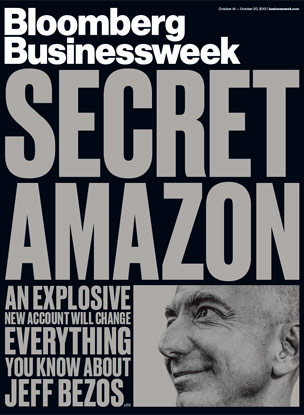
The Secrets of Bezos: How Amazon Became the Everything Store

The Secrets of Bezos: How Amazon Became the Everything Store

By Brad Stone October 10, 2013

current_304x415


Amazon.com rivals Wal-Mart as a store, Apple as a device maker, and IBM as a data services provider. It will rake in about $75 billion this year. For his book, Bloomberg Businessweek’s Brad Stone spoke to hundreds of current and former friends of founder Jeff Bezos. In the process, he discovered the poignant story of how Amazon became the Everything Store.

Within Amazon.com (AMZN) there’s a certain type of e-mail that elicits waves of panic. It usually originates with an annoyed customer who complains to the company’s founder and chief executive officer. Jeff Bezos has a public e-mail address, jeff@amazon.com. Not only does he read many customer complaints, he forwards them to the relevant Amazon employees, with a one-character addition: a question mark. When Amazon employees get a Bezos question mark e-mail, they react as though they’ve discovered a ticking bomb. They’ve typically got a few hours to solve whatever issue the CEO has flagged and prepare a thorough explanation for how it occurred, a response that will be reviewed by a succession of managers before the answer is presented to Bezos himself. Such escalations, as these e-mails are known, are Bezos’s way of ensuring that the customer’s voice is constantly heard inside the company.

Read more of this post

When Amazon Employees Receive These One-Character Emails From Jeff Bezos, They Go Into A Frenzy; These Are The Sarcastic Things Amazon’s Jeff Bezos Tells Employees When He Gets Angry

When Amazon Employees Receive These One-Character Emails From Jeff Bezos, They Go Into A Frenzy

ALYSON SHONTELL OCT. 10, 2013, 7:38 AM 15,915 18

Jeff Bezos may run Amazon and he may be a billionaire. But he is very accessible to his customers with an easy-to-find email address, jeff@amazon.com. And when his customers aren’t pleased, Bezos isn’t either. Businessweek’s Brad Stone has written a lengthy cover story on Amazon that opens with a bit about Bezos’ email style and shows how important customer service is to him. When a customer sends Bezos an email complaining about something Amazon-related, Bezos forwards the message to the appropriate person at the company. The only addition Bezos makes to the email is one character:

“?”

The recipient then scrambles to solve the issue and must get his or her reply approved by multiple people before responding to Bezos. Read more of this post

Singapore diplomat bitten by graft charges over pineapple tarts

Singapore diplomat bitten by graft charges over pineapple tarts

5:49am EDT

SINGAPORE (Reuters) – First it was sex, then casinos. Now, a Singapore diplomat has been charged with inflating the number of pineapple tarts and bottles of wine carried on official visits in the latest corruption case to hit the squeaky clean city-state. Lim Cheng Hoe, former chief of protocol at the Ministry of Foreign Affairs, allegedly overbilled authorities by around S$89,000 ($71,100) by overstating the amount of gifts bought for official purposes between 2008 and 2012. Read more of this post

The Amazing Apline Swift Bird Fly For Nearly Six Months Straight Without Stopping

These Amazing Birds Fly For Nearly Six Months Straight Without Stopping

LAURA POPPICKLIVESCIENCE OCT. 9, 2013, 6:50 PM 2,766 2

Scientists have long suspected that the Alpine swift — a swallowlike bird that has a wingspan of about 22 inches (57 centimeters) and a body length of about 8 inches (20 cm) — spends much of its life in flight, based on field observations and radar data collected during its migration. But, until now, researchers have not been able to prove just how long these birds fly without taking a rest. Researchers at the Swiss Ornithological Institute and the Bern University of Applied Sciences in Burgdorf, Switzerland, have collected data showing that the birds take little to no breaks during their migration from breeding grounds in Switzerland to wintering grounds in Western Africa and back again the following year. The team details their findings today (Oct. 8) in the journal Nature Communications. [Quest for Survival: Incredible Animal Migrations] Read more of this post

Tongyang chief, wife on travel ban for alleged fraud and breach of trust

Tongyang chief, wife on travel ban

Oct 10,2013

TY

A woman cries at a rally protesting the financial regulator’s lax oversight of the Tongyang Group’s sales of commercial paper and bonds yesterday at the Financial Supervisory Service in Yeouido, western Seoul.

Prosecutors Tuesday prohibited Tongyang Group Chairman Hyun Jae-hyun and Tongyang Securities CEO Chung Jin-seok from leaving the country, a day after the Citizens’ Coalition of Economic Justice, a civic group, filed a complaint against them for alleged fraud and breach of trust. Hyun’s wife, group vice chairwoman Lee Hae-kyung, and Tongyang Networks CEO Kim Chul are also forbidden from going overseas. Hyun and Lee, daughter of group founder Lee Yang-koo, as well as senior executives at the group, are suspected of selling high-risk bonds to individual investors until just before the financial collapse of five affiliates that filed for court receivership last week.  Read more of this post

Dilbert Creator Scott Adams Presents His 10 Favorite Strips

Dilbert Creator Scott Adams Presents His 10 Favorite Strips

JENNA GOUDREAU OCT. 9, 2013, 6:12 PM 14,194 12

Dilbert, the well-known comic strip by cartoonist Scott Adams about the office everyman and his crew of incompetent colleagues, was the first syndicated comic that focused primarily on the workplace when it launched in 1989. Five years later, it had become so successful that Adams quit his corporate career to work on it full-time.  It wasn’t a straight line to success. Early versions of the comic were rejected by several publications, including The New Yorker and Playboy. It wasn’t until an editor at United Media saw it and recognized her own husband in the character that it finally got its start, says Adams in his upcoming book “How to Fail at Almost Everything and Still Win Big.” Ever since, the comic has explored topics like the inefficiency of meetings, the uselessness of management, and the absurdity of office politics. Exclusively for Business Insider, Adams looked through the archives and shared his 10 favorite Dilbert comics. Below, he explains why he chose each and counts them down to his absolute favorite of all-time.

10) Oct. 10, 2009: “Dream job”

dream job

Courtesy of Scott Adams

“This comic causes the reader to imagine a funny future in which Wally will only pretend to do the assignment. Humor sometimes works best when one suggests what is coming without showing it. People laugh harder when they need to use their imaginations to complete the joke. “I also like comics in which characters are unusually happy about something trivial, evil, or selfish. That juxtaposition is always funny to me. “Another technique I often use involves characters saying things that should only be thought. That creates the inappropriateness that gives it an edge.” Read more of this post

Why Are Hundreds of Harvard Students Studying Ancient Chinese Philosophy?

Why Are Hundreds of Harvard Students Studying Ancient Chinese Philosophy?

By Christine Gross-Loh

Picture a world where human relationships are challenging, narcissism and self-centeredness are on the rise, and there is disagreement on the best way for people to live harmoniously together.  It sounds like 21st-century America. But the society that Michael Puett, a tall, 48-year-old bespectacled professor of Chinese history at Harvard University, is describing to more than 700 rapt undergraduates is China, 2,500 years ago. Read more of this post

No, dear, it’s still Jimmy’s Choos: Tamara Mellon built the brand but didn’t get the credit. Here’s why.

Updated: Wednesday October 9, 2013 MYT 12:41:31 PM

No, dear, it’s still Jimmy’s Choos: She built the brand but didn’t get the credit. Here’s why.

SOUR grapes. That’s the handy idiom that means “unfair criticism that comes from someone who is disappointed about not getting something”. That’s the spot-on description of Tamara Mellon’s autobiography. If you thinking, “Tamara who?” – that is exactly why she is sour as hell. Okay, how about Jimmy Choo? Yes, our famous Malaysian Datuk and the brand of expensive shoes that bears his name. For the uninitiated, Tamara Mellon is a 46-year-old British woman who co-founded Jimmy Choo Ltd in May 1996 with Choo and developed it into the mega brand it is today. She has just released her tell-all book called In My Shoes this month. Even though she sold the company for £100mil (RM514mil) in 2011, it doesn’t seem to have cured her of long pent-up frustration and bitterness over many people. Read more of this post

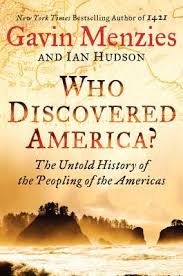
Who Discovered America?: The Untold History of the Peopling of the Americas

Who Discovered America?: The Untold History of the Peopling of the Americas Hardcover – Deckle Edge
by Gavin Menzies  (Author) , Ian Hudson (Author)

Who discovered America

Greatly expanding on his blockbuster 1421, distinguished historian Gavin Menzies uncovers the complete untold history of how mankind came to the Americas—offering new revelations and a radical rethinking of the accepted historical record in Who Discovered America? The iconoclastic historian’s magnum opus, Who Discovered America? calls into question our understanding of how the American continents were settled, shedding new light on the well-known “discoveries” of European explorers, including Christopher Columbus. In Who Discovered America?he combines meticulous research and an adventurer’s spirit to reveal astounding new evidence of an ancient Asian seagoing tradition—most notably the Chinese—that dates as far back as 130,000 years ago. Menzies offers a revolutionary new alternative to the “Beringia” theory of how humans crossed a land bridge connecting Asia and North America during the last Ice Age, and provides a wealth of staggering claims, that hold fascinating and astonishing implications for the history of mankind.

Read more of this post

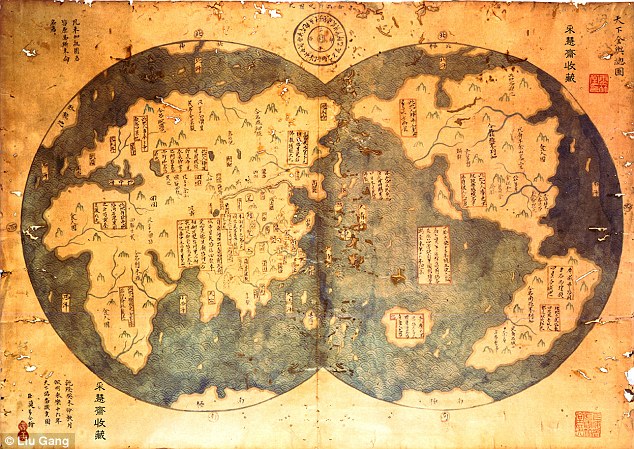
Does this map from 1418 prove historian’s controversial claim that the New World was discovered by the Chinese 70 years before Columbus?

Does this map from 1418 prove historian’s controversial claim that the New World was discovered by the CHINESE 70 years before Columbus?

Gavin Menzies, a British historian, claims Chiense Admiral Zheng He set up colonies and sailed round South America before Columbus

Menzies’ new book, ‘Who Discovered America?’ also claims the Chinese have been sailing to the New World since 40,000 BC across the Pacific Ocean

His theories are not widely accepted by academia and he has been labeled a ‘pseudo-historian’

By MICHAEL ZENNIE

PUBLISHED: 12:42 GMT, 8 October 2013 | UPDATED: 14:06 GMT, 9 October 2013

A copy of a 600-year-old map found in a second-hand book shop is the key to proving that the Chinese, not Christopher Columbus, were the first to discover the New World, a controversial British historian claims.  The document is purportedly an 18th century copy of a 1418 map charted by Chinese Admiral Zheng He, which appears to show the New World in some detail. This purported evidence that a Chinese sailor mapped the Western Hemisphere more than seven decades before Columbus is just one of Earth-shattering claims that author Gavin Menzies makes in his new book ‘Who Discovered America?’ – out today, just in time for the Columbus Day holiday. ‘The traditional story of Columbus discovering the New World is absolute fantasy, it’s fairy tales,’ Mr Menzies told MailOnline.

article-2449265-189801FF00000578-147_634x449

Mr Menzies believes that this portion of the map depicts the Chinese mapping of North and South America in 1418 – showing major rivers.

article-2449265-1896334500000578-303_634x384

Explorer: Chinese Admiral Zheng He is known to have sailed the to Europe and Africa with a massive fleet of ships. Historian Gavin Menzies says he also reached the New World Read more of this post

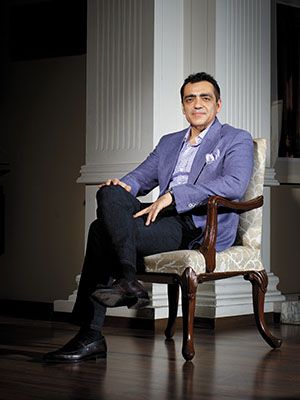
Ajay Bijli, the owner of PVR Cinemas, lives the good life but on three principles: It must be understated, serve a functional purpose and have aesthetic value

Ajay Bijli’s Pursuit Of Simple Luxury

by Ashish K Mishra | Oct 9, 2013

topimg_22615_ajay_bijli_300x400

Ajay Bijli, the owner of PVR Cinemas, lives the good life but on three principles: It must be understated, serve a functional purpose and have aesthetic value

A diamond-studded watch, a private island, a business jet, a chauffer-driven super luxurious car, bespoke anything—luxury is limited only by the imagination. And by the depths of your pocket. Ajay Bijli, 46, an entrepreneur who has made a fortune for himself building PVR Cinemas into India’s largest chain of multiplexes (with a turnover of around Rs 1,100 crore) has no such constraints. But, he says, “I am just very reluctant to talk about it because there is no end to luxury.”  Read more of this post

On idioms and political speech: Shooting skinned cats in a barrel

On idioms and political speech: Shooting skinned cats in a barrel

Oct 9th 2013, 15:32 by L.D. | NEW YORK

FLULA BORG, a German DJ and comedian, has recently attracted millions of hits on YouTube with his hilariously confused rants about English idioms. In a video about the expression “shooting fish in a barrel”, Mr Borg seems utterly perplexed. “If I can catch all of the fishes and then put them in barrel, I don’t need to shoot them…that is like, ‘Oh, you know, I have some cake, but I do not just eat it. No, no. I put the cake in a barrel, then I shoot it then I eat it. Those are…two steps addition that you do not need.” He was also particularly upset after he received a text from a girl and his friend said, “Aww, Flula got a booty call!” It was not a booty that was calling him, Mr Borg insisted; it was a person who was texting him. “Booties make call? How the possible of this? … In a science way, show to me how it working.” Read more of this post

Forecasting beset by tendency to think we are good at predictions

Last updated: October 9, 2013 8:13 pm

Forecasting beset by tendency to think we are good at predictions

By Claire Jones, Economics reporter

When it comes to predictions about the economy, our judgments are flawed partly because human beings tend to think they can predict the future better than they can. A speech in May by Ben Broadbent, an external member of the Bank of England’s Monetary Policy Committee, made reference to research by psychologist Daniel Kahneman that highlights the human predilection for seeing patterns in randomness, and drawing inferences from these “patterns” to say what will happen next. Read more of this post

From sideline to livelihood: Four business founders talk about turning a personal interest into their main source of income

October 9, 2013 3:59 pm

From sideline to livelihood

By Ian Sanders

In a warehouse on a former pig farm in rural England, Matt Lane is packing up boxes of beer. The founder of BeerBods, a beer club that sends subscribers a selection of beers from independent breweries, was a marketing executive at a small UK phone company until he quit at the start of the year to become a full-time entrepreneur. When he started, Mr Lane had no intentions for the club for friends and family to become a business. “I threw a website up and it ran away with itself – in six months we had 1,000 subscribers,” he says.

Read more of this post

The case of the CEO who didn’t like young people: Real-life leadership dilemmas to learn from

The case of the CEO who didn’t like young people: Real-life leadership dilemmas to learn from

Rick Spence | Published: 09/10/13
Did you hear the one about the CEO who didn’t like young people? Sorry, this isn’t a joke. It’s a true story, and not very funny. This CEO was so convinced that today’s Generation Y workers are lazy, disloyal, and spending all their time on “Spacebook,” that he endangered the future of his business. The cranky CEO’s story is one of 28 real-life, two-page case studies adapted from the files of Vancouver coach and consultant Nancy MacKay. The founder and CEO of MacKay CEO Forums has compiled these vignettes, from her own coaching experience, into a free e-book entitled What Great CEOs Do: How to Learn from Mistakes and Move On. While the book was presumably published to promote her CEO-roundtable business, it’s also a highly readable guide to solving many of today’s toughest leadership challenges. Read more of this post

Without Test Tubes, 3 Win Nobel in Chemistry; Martin Karplus, Michael Levitt and Arieh Warshel were recognized for computer simulations that enable closer study of complex reactions like photosynthesis and the design of new drugs

October 9, 2013

Without Test Tubes, 3 Win Nobel in Chemistry

By KENNETH CHANG

10nobel-articleLarge

From left: Arieh Warshel, Martin Karplus and Michael Levitt shared the 2013 Nobel Prize in Chemistry.

Chemistry, meet computer science. This year’s Nobel Prize in Chemistry was awarded to three researchers for work that did not involve test tubes or lab coats. Instead, they explored the world of molecules virtually, with computers. Such numerical simulations enable the closer study of complex reactions like photosynthesis and combustion, as well as the design of new drugs. Read more of this post