Fund managers find responsible investing comes with big risks

October 7, 2013 11:57 am

Fund managers find responsible investing comes with big risks

By Pauline Skypala

Long-term investments to support a low-carbon economy are out of fashion

There is a lot you can do with $34tn, for good or ill. In theory, the $34tn of assets backing the UN’s Principles for Responsible Investment should be invested to take account of environmental, social and governance factors. In practice, it is hard to see what difference the UNPRI is making to the world. On environmental grounds alone, the report from the Intergovernmental Panel on Climate Change suggests investors are either unwilling or unable to push companies they invest in to reduce carbon emissions. Concentrations of greenhouse gases in the atmosphere have risen to levels not seen in “at least the last 800,000 years”, the report says. Read more of this post
Here’s why everything Malcolm Gladwell writes is so compelling

Here’s why everything Malcolm Gladwell writes is so compelling

By Adam Grant October 7, 2013

This originally appeared on LinkedIn. You can follow Adam Grant here.

I used to dread going to parties. I stood around struggling with small talk, waiting for an opening to debate about big ideas. That changed 13 years ago, the day I read The Tipping PointSuddenly, everyone wanted to talk about Malcolm Gladwell’s ideas, and I felt right at home. He made social science cool in watercooler chatter, spawning an entire genre of books that blend stories and studies to explain how the world works. He carried me through a decade of dinner parties with Blink and Outliers. With last week’s release of David and Goliath, I’ll be set for a while. Read more of this post

Why so many powerful people think rules are for someone else; People in positions of power tend to think they are entitled to break society’s rules

Fiona Smith Columnist

Why so many powerful people think rules are for someone else

People in positions of power tend to think they are entitled to break society’s rules.

Published 07 October 2013 11:58, Updated 08 October 2013 07:12

The airwaves and social media are throbbing with outrage about politicians claiming allowances for private trips and businesses using bribes to win valuable work. This is the kind of behaviour that most people know they would never get away with – even if they wanted to. What makes it worse, in the mind of the average person, is that the people being exposed are already so privileged and powerful. Tony Abbott can easily afford to fly to Wangaratta for the wedding of a colleague, why would he charge the taxpayer $1094.64 for the trip? Sydney Morning Herald columnist Peter Fitzsimons made a good point over the weekend, when writing about Attorney-General George Brandis charging the taxpayers for the cost of a trip to a radio host’s wedding. Read more of this post

How to handle a major fail

How to handle a major fail

October 8, 2013

Christine Long

So you’ve stuffed up – now what?

Mistakes: we all make them. What really matters is what happens next. If handled well, a cock-up can actually be an opportunity to get closer to a customer. When Ben Crowley, managing director of Bulk Nutrients started his supplements company, he didn’t want cheap to mean nasty. If you can contact the person to let them know that there’s been a problem before they even get a chance for it to come up on their radar, you will have happier customers.  “My philosophy from the start has always been that while our prices are extremely competitive, cheap pricing does not have to mean a compromise on service.” So if an order goes pear-shaped, as it did recently, the company swings into rapid response mode. Read more of this post

The danger of a rush of power to the head; There are numerous perils when business leaders allow autocratic tendencies to take over

October 7, 2013 4:14 pm

The danger of a rush of power to the head

By Andrew Hill

There are numerous perils when business leaders allow autocratic tendencies to take over

Silvio Berlusconi and Jack Ma do not have much in common. The 77-year-old Italian politician is at the end of his leadership path; at 49, the Chinese founder of ecommerce group Alibaba may be barely halfway along it. Yet both have tested, or are testing, the limits of autocracy. One has determinedly clung to power over nearly 20 years in Italian politics; the other is trying to embed control of Alibaba through a core “partnership” of shareholding senior executives after the Chinese company’s public listing. My message to Mr Ma: be careful what you wish for. Read more of this post

How Good Management Stifles Breakthrough Innovation

How Good Management Stifles Breakthrough Innovation

by Markus Lorenz  |   8:00 AM October 7, 2013

We hear a lot these days about how big companies fail to innovate, but the truth is more complicated. A lot of companies excel at developing better products, yet these improvements are incremental. They’re not the breakthrough offerings that can jump-start growth and profitability. And companies’ success at cranking out these enhancements hampers them from getting better at the radical projects. If you closely analyze unsuccessful attempts at developing breakthrough products, perhaps the most common trouble you find is not one of the usual suspects, such as lack of top-management commitment. Instead, you’ll see that efficiency-minded project managers are inadvertently discouraging the explorations – and therefore the learning – that make radical ideas practical. Read more of this post

Entrepreneur, Fire Thyself

Entrepreneur, Fire Thyself

by Kerrie MacPherson  |   2:00 PM October 7, 2013

When entrepreneurs first start their businesses, they are usually involved in everything: running operations, keeping the books, and making sales calls. But as a company grows, one of the smartest things an owner can do is to fire herself from role after role. Letting go of anything critical to business outcomes is a challenge, but successful entrepreneurs have all learned to replace themselves – and serial entrepreneurs even develop it as a skill. Why be in a hurry to hand off important work? By building a team to handle operational responsibilities, entrepreneurs can find more time to focus on strategic priorities and even bigger goals. Read more of this post

Public speaking, private fears; As giving a good talk becomes more important, experts offer advice on coping with stage fright

October 7, 2013 4:34 pm

Public speaking, private fears

By Rhymer Rigby

The comedian Jerry Seinfeld once joked about a study that suggested people’s number one fear was public speaking: “Go to a funeral, you’re better off in the casket than doing the eulogy.” There is no shortage of research suggesting that the fear of public speaking – otherwise known as glossophobia – enjoys a prominent place in most hierarchies of dread. “It is significantly outside the average person’s comfort zone,” says Michael Crom, chief learning officer of Dale Carnegie Training. “You need to be prepared for anything.” He recalls giving a talk to a medical conference: “I was the last speaker. It was late and the person before me ran over and they were starting to shut things down. So I suddenly had no PowerPoint or visuals.” Read more of this post

Business Models for an Era of Innovation Glut

Business Models for an Era of Innovation Glut

by Alistair Davidson | Oct 7, 2013

It seems that innovation today goes to the company that simply says that its product or service is “innovative.” The real problem for the client or consumer, is that each supposedly new innovation has a “me too” look. As this author writes, knowing your market and differentiating sharply on value will enable your product or service to stand out in the crowd. He describes the steps to take in this article

Some research on innovation that succeeds suggests two particularly important insights: First, the single largest predictor of new product success offers a differentiated high-value product/service. Second, the single largest predictor of new product failure is inadequate market research and customer knowledge. (Cooper, Robert: Winning at New Products, Basic Books, Fourth Edition, 2011)  Read more of this post

The simple reason products fail: Consumers don’t understand what they do

The simple reason products fail: Consumers don’t understand what they do

By Jesper Sørensen October 7, 2013

The Holy Grail for innovators often is not simply to win in an existing market, but also to create an entirely new product category. But doing so raises a critical question for the entrepreneur: How do you get potential customers and investors to understand what it is you are doing? It’s harder than it sounds. Consumers make sense of unfamiliar products by mapping them onto categories of things they already understand. So when Apple comes out with its iPhone 6, for example, it’s pretty easy for customers to understand that it’s a lot like the previous iterations. But genuinely novel products don’t fit neatly into one category or another. Indeed, their novelty stems from the very fact that the ideas and technologies that came together to create the new concept existed previously in domains or categories that were thought to be entirely distinct. Read more of this post

Korea’s plan to shred a jellyfish plague with robots could spawn millions more

Korea’s plan to shred a jellyfish plague with robots could spawn millions more

By Christopher Mims @mims October 7, 2013

Some jellyfish only become stronger after being attacked by robots. Specifically, the jellyfish-shredding robots of the Jellyfish Elimination Robotic Swarm, or JEROS, developed by researchers at the Korea Science Academy. In theory, using semi-autonomous robots to round up jellyfish in nets and shred thousands per hour is one of the few ways to eliminate these otherwise virtually unstoppable beasts, which earlier this week shut down a nuclear reactor in Sweden, which sounds exotic but is actually a fairly common problem. But turning some species of these creatures into jellyfish gazpacho could actually lead to more of them, notes jellyfish biologist Rebecca Helm. Cutting open sea nettles, for example, is actually one way to artificially fertilize them. Read more of this post

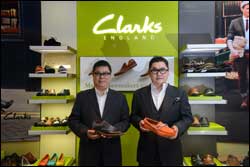
Chu brothers, the second-generation masters behind S Culture (1255), the exclusive distributor of European casual footwear brands – such as Clarks – in the Greater China region

Dash of culture
Grace Cao
Monday, October 07, 2013

6_2013100621470270930Leader

The Chu brothers, Dominic and Haeta, radiate such enthusiasm and liveliness that even those century-old shoe brands they market look vibrant. They are the second-generation masters behind S Culture International Holdings (1255), the exclusive distributor of European casual footwear brands – such as Clarks – in the Greater China region. Dominic Chu Chun-ho, 41, who always has a smile on his face, is especially buoyant when it comes to showing off Clarks’ shoe line for next season. “Here is the special one,” he enthused, picking up a pair of bright orange men’s suede shoes. “It’s Haeta’s favorite, specially made.” Read more of this post

Why we’re all reeling from the dramatic bribery allegations surrounding Leighton’s Wal King

Leo D’Angelo Fisher Columnist

Why we’re all reeling from the dramatic bribery allegations surrounding Wal King

Published 03 October 2013 11:58, Updated 08 October 2013 07:12

As spectacular front-page headlines go, when it comes to media coverage of Australian business, this may prove the one to beat for 2013 and for some time thereafter: Wal King “approved Iraq bribe”, in The Australian Financial Review. Equally devastating was the overhead line that spelt out the jaw-dropping Fairfax Media exclusive: “Former Leighton CEO knew $700m project won through inflated contractor payment, notes allege”. Read more of this post

What to expect before accepting the offer to become Engineer #1 at a startup

What to expect before accepting the offer to become Engineer #1 at a startup

By Eugenia Koo, 15 hours ago

“It kinda sucks to be engineer #1.” That’s what a couple of my friends – engineers at Google and Bloomberg who have been following the rise of startup culture with intrigue – told me recently. They were referring to non-founder engineers, most commonly the first hire for technology businesses. Often difficult to get, the first engineer sets the tone for the rest of the development team. He or she is also often recruited without much, if any, cash in the bank. In exchange, the engineer is likely offered the promise that his or her option shares will one day turn into big money. Read more of this post

The 5 Most Amazing Chess Sacrifices Of All Time

The 5 Most Amazing Chess Sacrifices Of All Time

JOE WEISENTHAL OCT. 7, 2013, 12:00 PM 2,917 2

In chess, a “sacrifice” is when one player willingly loses material to gain a positional advantage. That positional advantage can turn either into a very fast mate, or an overwhelming strategic edge that allows the player to grind down the opponent, even with less material. This YouTube vid explores the five greatest sacrifices in chess history. If you have any idea how chess is played, then sit back and enjoy!

100 Books Every Kid Should Read By Age 14

100 Books Every Kid Should Read By Age 14

MICHAEL KELLEY OCT. 7, 2013, 11:08 AM 5,774 7

The British reading and writing charity Booktrust has released an “ultimate list” of the 100 children’s books every kid should read by the time he’s 14. It’s a pretty good breakdown of key reading material for anyone who is growing up. It also differs considerably from The New York Public Library’s new list of 100 greatest children’s books, which was released late last month and faced considerable controversy over “missing” titles. Here are the top 100 kids’ books, according to Booktrust: Read more of this post

16 Year-Old New Zealander Ella Yelich-O’Connor: The Youngest Singer To Be No.1 On The Billboard Chart In 26 Years; “Culturally, Lorde is hitting a chord. People are hungry for something different”

MEET LORDE: The Youngest Singer To Be No.1 On The Billboard Chart In 26 Years

ALY WEISMAN OCT. 7, 2013, 12:01 PM 5,925 4

lorde-1

By now you’ve probably heard singer Lorde’s hit song, “Royals”:

But what many don’t realize while listening to the mature vocals is that Lorde, whose real name is Ella Yelich-O’Connor, is just 16-years old. Last week, the The New Zealand singer became the youngest performer in 26 years to take the number one spot on the Billboard Hot 100 chart. Subsequently, she also became the first New Zealand solo artist to have a number one song in the United States. Claiming the top spot means Lorde took the title from Miley Cyrus, whose “Wrecking Ball” held the number one position for two weeks prior. Billboard calls the ascent of “Royals” “stunning.”In fact, Lorde is the youngest solo artist to perch atop the Hot 100 since Tiffany, who was 16-years-old old when “Could’ve Been” took over at No. 1 the week of Feb. 6, 1988.

Read more of this post

Why It’s So Hard For Some Companies To Cut Out ‘The Middle Man’

Why It’s So Hard For Some Companies To Cut Out ‘The Middle Man’

IRA KALBMARSHALL SCHOOL OF BUSINESS, USC OCT. 7, 2013, 6:05 PM 1,316 1

When most people talk about distribution, they focus on economic issues. That is, to make money, most manufacturers need to sell their products in sizeable quantities. Most end buyers (consumers, businesses, and government) typically need just one (or a few) at a time. Therefore, an opportunity for middle people, or resellers, is created. Distributors, also known as wholesalers, are willing to buy products in quantity, and put them in warehouses to eventually sell them to many dealers, also known as retailers. Dealers, in turn, have stores and websites from which they are willing to sell one or a few to lots of end buyers. Therefore, a typical distribution system looks like a pyramid with each manufacturer selling their products through a number of distributors that sell them to many dealers, who turn around and sell them to a larger number of end buyers. Read more of this post

Here’s The Best Way To Beat A Bully; the bully wants to provoke a response that makes him feel powerful, so showing emotion and fighting back are exactly what the bully feeds off

Here’s The Best Way To Beat A Bully

PAMELA ENGEL OCT. 7, 2013, 6:07 PM 2,546 6

Six out of 10 teenagers say they witness bullying in school once a day, and 160,000 students miss school every day due to fear of attack or intimidation by other students, according to bullying statistics. Bullying is a big problem in America’s schools, and for National Bullying Prevention Month, education groups are trying to inform kids and adults about what they can do to stop bullies. Popular wisdom often portrayed in movies and TV shows would have you believe that kids should fight back against bullies, but the U.S. Department of Health and Human Services’ bullying website says that’s not a good idea. Here’s their advice: Read more of this post

Ryanair Has Finally Realized It Can’t Treat People Terribly Forever

Ryanair Has Finally Realized It Can’t Treat People Terribly Forever

JON PICOULTCONTRIBUTOR OCT. 7, 2013, 6:15 PM 2,058 1

14-photos-of-ryanair-ceo-michael-oleary-looking-utterly-bizarre

The company that pioneered ultra-low cost, no-hospitality air travel is encountering some turbulence with its strategy. For years, Ireland’s Ryanair has prided itself on being the ultimate no-frills airline with unapologetically poor customer service.  They lead with low fares, and then layer on an endless series of fees for everything from speaking to a live representative to printing your boarding pass at the airport. Their CEO, Michael O’Leary, once called his customers idiots, and has also floated the idea of charging people to use the lavatory.  (Thankfully, lavatory use is still free – what a bargain!) The low-cost, no-service strategy had legs. Ryanair’s passenger volumes, and profits, grew rapidly for years. Read more of this post

TV shows such as The Apprentice portray entrepreneurs as “greedy, self-regarding and . . . dim-witted” and could put people off starting a business

October 7, 2013 11:07 pm

TV shows misrepresent entrepreneurs, says PizzaExpress founder

By Andrew Bounds, Enterprise Editor

TV shows such as The Apprentice portray entrepreneurs as “greedy, self-regarding and . . . dim-witted” and could put people off starting a business, according to Luke Johnson, who is launching a think-tank to improve the image and influence of entrepreneurs. Mr Johnson, the PizzaExpress founder who is a Financial Times columnist and prominent investor in start-ups, launches the Centre for Entrepreneurship on Thursday. Read more of this post

AirAsia CEO teases APEC moderators for using Garuda

AirAsia CEO teases APEC moderators for using Garuda

Satria Sambijantoro, The Jakarta Post, Nusa Dua,Bali | Business | Mon, October 07 2013, 10:37 AM

AirAsia Group’s CEO, Tony Fernandes, became the center of attention and drew in much laughter when he spoke as one of the panelists during the Asia-Pacific Economic Cooperation (APEC) CEO Summit in Nusa Dua, Bali on Monday. Fernandes was given time to speak by moderator Pieter Gontha, the publisher of BeritaSatu Media Holdings, on the issues of connectivity in the Asia Pacific region, but the Malaysian-born entrepreneur was initially hesitant to present his answers because he knew that the man asking him questions rarely boarded his plane. “Just to let you all to know, Pieter Gontha uses my competitors, Garuda [Indonesia] and Citilink, so please discount 50 percent of his questions,” Tony said, to which business executives in attendance responded with laughter. Read more of this post

Cheating’s Surprising Thrill: New research shows that, contrary to feeling guilty, cheaters tend to feel an emotional boost that those who are honest do not

OCTOBER 7, 2013, 4:05 PM

Cheating’s Surprising Thrill

By JAN HOFFMAN

When was the last time you cheated? Not on the soul-scorching magnitude of, say, Bernie Madoff, Lance Armstrong or John Edwards. Just nudge-the-golf-ball cheating. Maybe you rounded up numbers on an expense report. Let your eyes wander during a high-stakes exam. Or copied a friend’s expensive software. And how did you feel afterward? You may recall nervousness, a twinge of guilt. But new research shows that as long as you didn’t think your cheating hurt anyone, you may have felt great. The discomfort you remember feeling then may actually be a response rewritten now by your inner moral authority, your “should” voice. Read more of this post

China’s ‘Basketball girl’ gets a new set of legs; the story of Qian Hongyan, a girl from Yunnan is a classic example of how determination can overcome overwhelming odds

China’s ‘Basketball girl’ gets a new set of legs

20131007_hongyan_main_reuters

Monday, Oct 07, 2013
The New Paper

CHINA – At first glance, she looks like any other beautiful teenager enjoying life without a care in the world. But the story of Qian Hongyan, a girl from Luliang county in Yunnan, China, is a classic example of how determination can overcome overwhelming odds. It was eight years ago that the world got a glimpse of her. Then 10 years old, Hongyan had no legs – they were amputated after a car accident when she was four. She learned to walk on her hands, using a basketball cut in half to steady herself. The locals began calling her “basketball girl”. Read more of this post

Purpose-driven work

Updated: Tuesday October 8, 2013 MYT 7:53:56 AM

Purpose-driven work

BY JEANISHA WAN

A friend who has held a regional marketing role in a multinational company for the past eight years had a long chat with me recently. Although enjoying a very good salary, the opportunity to travel and the flexibility to work from home, she was unsure of her career and was thinking of leaving the company. You must wonder why. After all, is that not the kind of dream job that most people would want? But, I can empathise with her as I have felt the same before. When we first enter the corporate world, many have the following checklist for a dream career: high salary, multinational company, travel opportunities, flexibility to work from home, and perks for family members. Then, as we progress in our career, we start to look less at the material benefits and more into the meaning of what we do. Read more of this post

A Tiny Pronoun Says a Lot About You: How Often You Say ‘I’ Says More Than You Realize

A Tiny Pronoun Says a Lot About You

How Often You Say ‘I’ Says More Than You Realize

ELIZABETH BERNSTEIN

Oct. 7, 2013 7:04 p.m. ET

It’s a common belief that people who say “I” a lot are full of themselves, maybe even narcissists. Surprising new research turns that assumption on it’s head. Elizabeth Bernstein and University of Texas researcher James Pennebaker explain. Photo: AP.

You probably don’t think about how often you say the word “I.” You should. Researchers say that your usage of the pronoun says more about you than you may realize. Surprising new research from the University of Texas suggests that people who often say “I” are less powerful and less sure of themselves than those who limit their use of the word. Frequent “I” users subconsciously believe they are subordinate to the person to whom they are talking. Read more of this post

Is Chinese Contemporary Ink Painting the Next Big Thing?

October 7, 2013, 4:15 PM

Is Chinese Contemporary Ink Painting the Next Big Thing?

By Wei Gu and Jason Chow

OB-ZE495_liu_F_20131007030853

Liu Guosong’s ink painting ‘Midnight Sun’ achieved HK$6.3 million at Sotheby’s, several times above its pre-sale high estimate.

The biggest names in Chinese contemporary art, from Zeng Fanzhi to Yue Minjun and Liu Ye, have all made their mark in oil paintings. But the foundation of Chinese art isn’t oil, but ink, a traditional art form that has informed Chinese aesthetics and culture through the ages. Art dealers and auction houses are saying the traditional is new again, marketing contemporary ink paintings to mainland Chinese buyers. Their hope is to expand and diversify the art market in China by tapping into an art form that domestic audiences are familiar with. Read more of this post

Supreme Owner Made a Billionaire Feeding U.S. War Machine

Supreme Owner Made a Billionaire Feeding U.S. War Machine

Chemical warfare and car bombings are just a few of the hazards working in war-torn countries such as Iraq and Syria. For Supreme Group BV, it’s the cost of doing business. Dubai-based Supreme delivers fuel and food — 100,000 meals a day — to troops stationed in some of the most inhospitable parts of the world, including Liberia, Mali and Sudan. The perilous business, where contractors dodge bullets fired by the Taliban and explosives set by insurgents, has made the company’s majority owner, Stephen Orenstein, a billionaire. “Our mantra is to provide the same quality of service in Rwanda or Somalia as we do for restaurant chains in Germany,” Orenstein, 49, said in a phone interview from his office in Dubai. “We took a developed world standard and brought it to the developing world.” Read more of this post

Just what is in that chicken nugget? Stand-up comedians have long joked that some things, like the actual components of chicken nuggets, are better left mysterious

Just what is in that chicken nugget?

Fri, Oct 4 2013

By Kathryn Doyle

NEW YORK (Reuters Health) – Stand-up comedians have long joked that some things, like the actual components of chicken nuggets, are better left mysterious. Recently, Mississippi researchers found out why: two nuggets they examined consisted of 50 percent or less chicken muscle tissue, the breast or thigh meat that comes to mind when a customer thinks of “chicken.” The nuggets came from two national fast food chains in Jackson. The three researchers selected one nugget from each box, preserved, dissected and stained the nuggets, then looked at them under a microscope. Read more of this post

Value Investing and the Two Wolves in Asia: The Case of the Collapse of Singapore’s Speculative Stocks (Bamboo Innovator Insight)

The following article is extracted from the Bamboo Innovator Insight weekly column blog related to the context and thought leadership behind the stock idea generation process of Asian wide-moat businesses that are featured in the monthly entitled The Moat Report Asia. Fellow value investors get to go behind the scene to learn thought-provoking timely insights on key macro and industry trends in Asia, as well as benefit from the occasional discussion of potential red flags, misgovernance or fraud-detection trails ahead of time to enhance the critical-thinking skill about the myriad pitfalls of investing in Asia at the microstructure- and firm-level.

Spore Syndicate