How the Bamfords dig deeper to propel JCB clear of rivals; Family, business and politics are controversially entwined at the UK’s most successful construction equipment maker

How the Bamfords dig deeper to propel JCB clear of rivals

Family, business and politics are controversially entwined at the UK’s most successful construction equipment maker.
jcb-bamford_2664976f

Digger history: JCB chief Sir Anthony Bamford with his son, Jo. Photo: David Marsden

By Louise Armitstead, Chief business correspondent

9:00PM BST 08 Sep 2013

While Sir Anthony Bamford is accused of using his JCB fortune to bulldoze his way into British politics, his father had precisely the opposite complaint. Politics, in the form of trade unions, burrowed into his digger company in the 1970s and ultimately drove Joseph Cyril Bamford to quit. The soon-to-be Lord Bamford, who was made a life peer last month, remembers the day his father stood on a trailer to address workers as a wave of union militancy swept the country. Read more of this post
Hamlet and the secrets of decision-making; Simple guidelines exist for better decision-making but don’t expect a formula

September 6, 2013 7:13 pm

Hamlet and the secrets of decision-making

By Julian Baggini

Simple guidelines exist for better decision-making but don’t expect a formula

Eyes Wide Open: How to Make Smart Decisions in a Confusing World, by Noreena Hertz, William Collins, RRP£14.99/$26.99, 352 pages

Touching a Nerve: The Self as Brain, by Patricia S Churchland, WW Norton, RRP£17.99/$27.95, 304 pages

The Hamlet Doctrine: Knowing Too Much, Doing Nothing, by Simon Critchley and Jamieson Webster, Verso, RRP£14.99, 288 pages

I Don’t Know: In Praise of Admitting Ignorance (Except When You Shouldn’t), by Leah Hager Cohen, Riverhead Books, RRP$17.95, 128 pages

Decisions, decisions. It has become a truism that we increasingly face far too many of them. There are plenty of books offering to help you through this morass but, such is the choice, they only seem to make the headache worse. Read more of this post

The west needs a replacement for the warrior spirit; Warfare and welfare have long been connected

September 6, 2013 7:24 pm

The west needs a replacement for the warrior spirit

By Mark Mazower

Warfare and welfare have long been connected, writes Mark Mazower

The memory of Iraq, and the anger that war still provokes, loom large over the defeat of the British government over Syria in the House of Commons, and the wrangling in the US Congress and the French parliament. The doubts surfacing in these legislatures suggest that public opinion on both sides of the Atlantic is a lot more sceptical than it once was about the efficacy of military action and more worried at the tendency of so-called surgical strikes to turn into unwinnable wars. Read more of this post

Shhhhhh! German parties appeal to voters’ aversion to noise

Shhhhhh! German parties appeal to voters’ aversion to noise

Sun, Sep 8 2013

By Alexandra Hudson

BERLIN (Reuters) – “One in two Germans feels troubled by noise,” Angela Merkel’s Christian Democrats (CDU) state in their election manifesto. “We want to change this”. Germany already has some of the world’s most stringent noise regulations and citizens only too eager to reprimand neighbors for loud children or taking out rubbish too early on a Sunday. Chancellor Merkel’s husband Joachim Sauer famously filed a complaint about an open-air theatre group performing opposite the couple’s apartment in central Berlin back in 2001 for violating a 60-decibel noise limit by eight decibels. Read more of this post

London’s Walkie-Talkie ‘Fryscraper’ Draws Crowds in Heat

London’s Walkie-Talkie ‘Fryscraper’ Draws Crowds in Heat

For the next three weeks, Londoners and tourists will have the chance to marvel at the city’s latest attraction: A beam of light so hot it melted parts of a Jaguar sports car and sparked a fire at a local barber shop. On the hottest September day in seven years, office workers and tourists jostled for space yesterday on Eastcheap in the City of London financial district to see the curved 37-story Walkie Talkie skyscraper focus a ray of light that was measured at more than 110 degrees Celsius (230 degrees Fahrenheit). Read more of this post

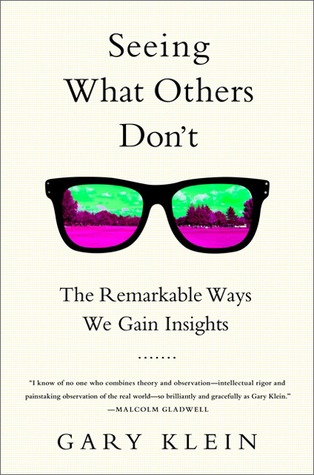
Seeing What Others Don’t: The Remarkable Ways We Gain Insights

Seeing What Others Don’t: The Remarkable Ways We Gain Insights Hardcover

by Gary Klein (Author)

16043549

Insights—like Darwin’s understanding of the way evolution actually works, and Watson and Crick’s breakthrough discoveries about the structure of DNA—can change the world. We also need insights into the everyday things that frustrate and confuse us so that we can more effectively solve problems and get things done. Yet we know very little about when, why, or how insights are formed—or what blocks them. In Seeing What Others Don’t, renowned cognitive psychologist Gary Klein unravels the mystery. Klein is a keen observer of people in their natural settings—scientists, businesspeople, firefighters, police officers, soldiers, family members, friends, himself—and uses a marvelous variety of stories to illuminate his research into what insights are and how they happen. What, for example, enabled Harry Markopolos to put the finger on Bernie Madoff? How did Dr. Michael Gottlieb make the connections between different patients that allowed him to publish the first announcement of the AIDS epidemic? What did Admiral Yamamoto see (and what did the Americans miss) in a 1940 British attack on the Italian fleet that enabled him to develop the strategy of attack at Pearl Harbor? How did a “smokejumper” see that setting another fire would save his life, while those who ignored his insight perished? How did Martin Chalfie come up with a million-dollar idea (and a Nobel Prize) for a natural flashlight that enabled researchers to look inside living organisms to watch biological processes in action? Klein also dissects impediments to insight, such as when organizations claim to value employee creativity and to encourage breakthroughs but in reality block disruptive ideas and prioritize avoidance of mistakes. Or when information technology systems are “dumb by design” and block potential discoveries. Both scientifically sophisticated and fun to read, Seeing What Others Don’t shows that insight is not just a “eureka!” moment but a whole new way of understanding.

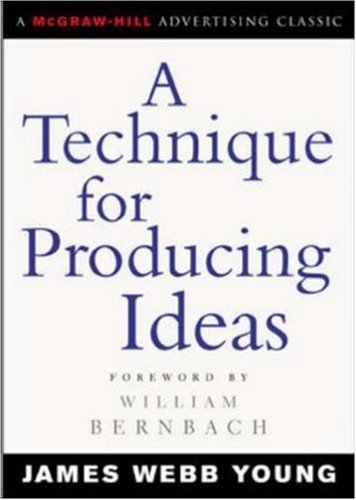
A Technique for Producing Ideas

A Technique for Producing Ideas

by SHANE PARRISH on SEPTEMBER 4, 2013

5347551

In the foreward to James Webb Young’s book, A Technique for Producing Ideas, Keith Reinhard asks “How can a book first published in the 1940′s be important to today’s creative people on the cutting edge?” The answer lies in the question that inspired Webb’s book, “How do you get ideas?” The book is a concise description of the creative process. Young offers both guidance and assures that coming up with an idea is a process, not an accident.

The production of ideas.

[T]he production of ideas is just as definite a process as the production of Fords; that the production of ideas, too, runs on an assembly line; that in this production the mind follows an operative technique which can be learned and controlled; and that its effective use is just as much a matter of practice in the technique as is the effective use of any tool. Read more of this post

Finding Time to Read

Finding Time to Read

by SHANE PARRISH on SEPTEMBER 2, 2013

“The rich invest in time, the poor invest in money.” — Warren Buffett

Charlie Munger, voracious reader, billionaire, and vice chairman of Berkshire Hathaway, one commented “In my whole life, I have known no wise people (over a broad subject matter area) who didn’t read all the time – none, zero.” Read more of this post

The Surprisingly Simple Mix Of Qualities That Make People Influential

The Surprisingly Simple Mix Of Qualities That Make People Influential

JENNA GOUDREAU SEP. 6, 2013, 11:31 AM 4,610 3

How does Oprah Winfrey captivate millions? What’s the secret behind Bill Clinton’s infectious charisma or Richard Branson’s powerful charm?  According to one new book, “Compelling People: The Hidden Qualities That Make Us Influential” by John Neffinger and Matthew Kohut, the art and science of influencing people comes down to a surprisingly simple combination: seeming at once strong and warm. “When you meet someone, they’re sizing you up on two fundamental qualities: strength and warmth,” says Kohut, a founding partner of Washington, D.C.-based KNP Communications, which specializes in preparing public figures for speaking events. “Strength measures how much people can affect the world, and warmth shows how much people are concerned about our interests.”  Read more of this post

The Art of Thinking Clearly: Guard Against Chauffeur Knowledge; Guarding Against Survivorship Bias

The Art of Thinking Clearly

by SHANE PARRISH on SEPTEMBER 6, 2013

Rolf Dobelli’s book, The Art of Thinking Clearly, is a compendium of systematic errors in decision making. While the list of fallacies is not complete, it’s a great launching pad into the best of what others have already figured out.

To avoid frivolous gambles with the wealth I had accumulated over the course of my literary career, I began to put together a list of … systematic cognitive errors, complete with notes and personal anecdotes — with no intention of ever publishing them. The list was originally designed to be used by me alone. Some of these thinking errors have been known for centuries; others have been discovered in the last few years. Some came with two or three names attached to them. … Soon I realized that such a compilation of pitfalls was not only useful for making investing decisions but also for business and personal matters. Once I had prepared the list, I felt calmer and more levelheaded. I began to recognize my own errors sooner and was able to change course before any lasting damage was done. And, for the first time in my life, I was able to recognize when others might be in the thrall of these very same systematic errors. Armed with my list, I could now resist their pull — and perhaps even gain an upper hand in my dealings. Read more of this post

The Value of Suffering? Calamity cracks you open, moves you to change your ways. Sometimes.

September 7, 2013

The Value of Suffering

By PICO IYER

08SUFFERING-articleLarge

NARA, Japan — Hundreds of Syrians are apparently killed by chemical weapons, and the attempt to protect others from that fate threatens to kill many more. A child perishes with her mother in a tornado in Oklahoma, the month after an 8-year-old is slain by a bomb in Boston. Runaway trains claim dozens of lives in otherwise placid Canada and Spain. At least 46 people are killed in a string of coordinated bombings aimed at an ice cream shop, bus station and famous restaurant in Baghdad. Does the torrent of suffering ever abate — and can one possibly find any point in suffering?

Read more of this post

Find the Loan Behind the Loans; dubious actors can’t operate without the help of their financiers. Investigators should follow the money

September 7, 2013

Find the Loan Behind the Loans

By GRETCHEN MORGENSON

ONLINE lenders who charge borrowers stratospheric interest rates are coming under pressure from state regulators — and it’s about time. But to get at the root of the problem, the regulators may need to dig much deeper. Last month, for example, the New York attorney general followed other states’ regulators in suing Western Sky Financial and its affiliate Cash Call Inc. The lawsuit contended that rates charged to borrowers by the companies — from 89 to 343 percent, depending on loan size — far exceed the caps determined by the state’s civil and criminal usury laws. A borrower receiving $1,000 could wind up owing almost $5,000 in finance charges, fees and principal over two years, the complaint said. Read more of this post

A better understanding of the workings of the brain means that psychiatric disorders are increasingly seen as being based in biology

September 6, 2013

The New Science of Mind

By ERIC R. KANDEL

THESE days it is easy to get irritated with the exaggerated interpretations of brain imaging — for example, that a single fMRI scan can reveal our innermost feelings — and with inflated claims about our understanding of the biological basis of our higher mental processes. Such irritation has led a number of thoughtful people to declare that we can never achieve a truly sophisticated understanding of the biological foundation of complex mental activity. Read more of this post

Alexandre Ricard, the heir to the Pernod Ricard empire talks about his unusual path to the top, how it has influenced his leadership and what’s next for the business

Pernod Ricard’s chief-in-waiting toasts a deal-filled decade

Alexandre Ricard, the heir to the Pernod Ricard empire talks about his unusual path to the top, how it has influenced his leadership and what’s next for the business .

ricard_2663749b

Alexandre Ricard will take over from the current boss in January 2015 Photo: David Rose

By Nathalie Thomas

9:10PM BST 07 Sep 2013

As the grandson of one of Pernod Ricard’s founders, Alexandre Ricard always knew there would be a role for him at the world’s second biggest drinks company. He was told as much when he turned up, fresh from being a student, for his first interview at the group in 1996 – despite a somewhat disastrous performance. “That interview with Pernod Ricard was bad,” says the 41-year-old Frenchman in a soft American accent, gained during his studies at the University of Pennsylvania. “The HR director basically looked at me and said: ‘Listen, given your name, obviously we’re going to find a position for you’.” Ricard could have been forgiven for taking the easy route and accepting the – albeit lacklustre – offer. But he had different ideas. Read more of this post
Attack of the Giant Art Galleries; Driven by a booming art market and demand for oversize ‘trophy’ works, the world’s top art galleries are opening vast new spaces, upending the economics of the business

August 29, 2013, 8:31 p.m. ET

Attack of the Giant Art Galleries

Driven by a booming art market and demand for oversize ‘trophy’ works, the world’s top art galleries are opening vast new spaces, upending the economics of the business

KELLY CROW

As artists and wealthy collectors have gravitated toward ever-bigger art trophies, the galleries that serve them both have ballooned in size well beyond their typical townhouse proportions to something entirely more vast. Kelly Crow explains. Photo: Sarah Morris/White Cube Bermondsey.

This fall, New York artist Roxy Paine is heading to Chicago to exhibit his life-size diorama of a fast-food restaurant carved from birch wood, down to the straws. In Paris, German artist Georg Baselitz is about to unveil his show of 12-foot-tall bronze women. Next week in New York, Matthew Day Jackson will roll out his latest creation—a 13-foot-long roadster designed by his uncle, built by his cousin and wrecked, temporarily, by his crew on a New Jersey track. Just don’t look for any of this art in a museum—yet. Thanks to a resurgent global-art market, some of the world’s top dealers are feeling flush and fueling a new gallery building boom—transforming factories, roller rinks and airplane hangars into showrooms for contemporary art. As a result, some of the most highly anticipated shows of the season are set to open in galleries, not museums. Read more of this post

Gold, silver mooncakes enjoying hot sales in Beijing

Gold, silver mooncakes enjoying hot sales in Beijing

Staff Reporter

2013-09-08

C823N0033H_2013資料照片_N71_copy1

Silver mooncakes are a hot item leading up to the Mid-Autumn Festival this year. (Photo/CNS)

Mooncakes made of gold and silver are selling like crazy in Beijing as gifts for the Mid-Autumn Festival, which falls on Sept. 19, the website of the state-owned China News Service reports. Several banks were selling various types of heavy metal mooncakes as collectible gifts, the report stated. The Agricultural Bank of China launched a silver mooncake weighing 16 grams for 248 yuan (US$40), a 32g set for 480 yuan (US$80) and another for 628 yuan (US$100). A silver mooncake gift package being sold by another bank is priced at 398 yuan (US$65), while a gold gift package is priced at 3,380 yuan (US$550). In addition to metal cakes, crabs made of gold and walnuts made of silver have also appeared on the gift market. Only a limited number of walnut products are available, with a pair of silver walnuts priced at 1,500 yuan (US$250), a banker said. Read more of this post

Stephen Hawking’s Brief History of a Best Seller; A literary agent told him a book about the universe could never become popular

September 6, 2013, 8:35 p.m. ET

Stephen Hawking’s Brief History of a Best Seller

Theoretical physicist Stephen Hawking describes the rocky origins of his popular science book

RV-AL525_HAWKIN_DV_20130906162404

Theoretical physicist Stephen Hawking, around 1988. A literary agent told him a book about the universe could never become popular.

STEPHEN HAWKING

I first had the idea of writing a popular book about the universe in 1982. My intention was partly to earn money to pay my daughter’s school fees. But the main reason was that I wanted to explain how far we had come in our understanding of the universe: how we might be near finding a complete theory that would describe the universe and everything in it. If I was going to spend the time and effort to write a book, I wanted it to have as many readers as possible. I contacted a literary agent and gave him a draft of the first chapter, explaining that I wanted it to be the sort of book that would sell in airport bookstores. He told me there was no chance of that. It might sell well to academics and students, but a book like that couldn’t break into best-seller territory. I gave the agent a first draft of the book in 1984. He sent it to several publishers, and I decided to take an offer from Bantam Books. Bantam’s interest was probably due to one of their editors, Peter Guzzardi, who took his job very seriously and made me rewrite the book so that it would be understandable to nonscientists. Each time I sent him a rewritten chapter, he sent back a long list of objections and questions. At times I thought the process would never end. But he was right: It is a much better book as a result. Read more of this post

Faces of Life

James Dyson: Britain’s next industrial revolution

September 6, 2013 7:20 pm

Britain stands on the cusp of a new industrial revolution

By James Dyson

British engineers could be building power stations across the globe, writes James Dyson

After a buoyant summer, the economy seems to be returning to health. Manufacturing is coming to the fore as a driver of the economic recovery. We need to nourish, not ignore, the power behind exports and the creator of long-term and sustained wealth: exportable technology. The data ought to be good for confidence (as well as headlines), but short-term numbers must not alter long-term thinking. That is what got us into this mess. National economic output is still a long way below the levels of 2008 and our export markets are more competitive than ever. Let’s stick to the plan. We must remain steadfast in our ambition to put the development of exportable technology back at the core of the economy, and once again kindle the ambition that made the Victorians world-beaters. Our total focus must be on developing the best products and technologies of our own – to sell to the world. Read more of this post

The Society for Useful Knowledge

September 6, 2013, 4:19 p.m. ET

Book Review: ‘The Society for Useful Knowledge’ by Jonathan Lyons

Benjamin Franklin did far more for science than simply fly a kite.

LAURA J. SNYDER

Benjamin Franklin once led a party of merry picnickers who, with electrified gilt goblets, toasted the international community of scientists studying electricity. The group then slaughtered a turkey with an electrical charge and roasted it with electrical fire. Franklin observed: “Birds killed in this Manner eat uncommonly tender.” Franklin was one of the foremost “electricians” of his day, winning the prestigious Copley Medal of the Royal Society of London for his theoretical and practical accomplishments in the field. Connections between Franklin’s scientific work and his role in early American politics have been explored in a number of biographies and scholarly studies. In “The Society for Useful Knowledge,” Jonathan Lyons takes a provocative turn: He claims that Franklin’s notion of “useful knowledge”—gleaned from the charter of the Royal Society—spread throughout the colonies and “made possible the Revolution and . . . America’s characteristic political and economic systems.” Read more of this post

Ice Melting Faster in Greenland and Antarctica in UN Leak

Ice Melting Faster in Greenland and Antarctica in UN Leak

Ice in Antarctica and Greenland is disappearing faster and may drive sea levels higher than predicted this century, according to leaked United Nations documents. Greenland’s ice added six times more to sea levels in the decade through 2011 than in the prior 10 years, according to a draft of the UN’s most comprehensive study on climate change. Antarctica had a fivefold increase, and the UN is raising its forecast for how much the two ice sheets will add to Earth’s oceans by 2100. Read more of this post

Montessori management: The backlash against running firms like progressive schools has begun

Montessori management: The backlash against running firms like progressive schools has begun

Sep 7th 2013 |From the print edition

20130907_WBD000_0

“THE INTERNSHIP”, a film about two middle-aged no-hopers who land work experience at Google, is a dire offering even by the standards of Hollywood summer comedies. But it does get one thing right: that it is rather absurd for a technology firm to provide slides for staff to play on, and to let them wear silly propeller-hats. Google is not alone in its juvenile tastes. Box, a Silicon Valley company, has installed swings in its headquarters. Red Bull, an energy-drinks firm, has a reception desk in the shape of a giant skateboard in its London office. Businesses of all types have moved towards sitting workers in groups in open-plan rooms, just like at nursery school. Time was when firms modelled themselves on the armed forces, with officers (who thought about strategy) and chains of command. Now many model themselves on learning-through-play “Montessori” schools. Read more of this post

The Lewis Model Explains Every Culture In The World

The Lewis Model Explains Every Culture In The World

GUS LUBIN 7 MINUTES AGO 0

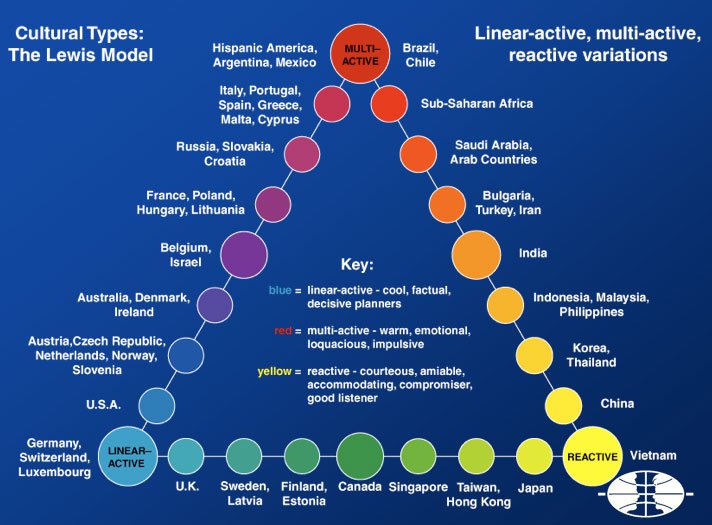
A world traveler who speaks ten languages, British linguist Richard Lewis decided he was qualified to plot the world’s cultures on a chart.  Many people think he nailed it, as his book “When Cultures Collide,” now in its third edition, has sold more than one million copies since it was first published in 1996 and was called “an authoritative roadmap to navigating the world’s economy,” by the Wall Street Journal. Lewis plots countries in relation to three categories:

Linear-actives — those who plan, schedule, organize, pursue action chains, do one thing at a time. Germans and Swiss are in this group.

Multi-actives — those lively, loquacious peoples who do many things at once, planning their priorities not according to a time schedule, but according to the relative thrill or importance that each appointment brings with it. Italians, Latin Americans and Arabs are members of this group.

Reactives — those cultures that prioritize courtesy and respect, listening quietly and calmly to their interlocutors and reacting carefully to the other side’s proposals. Chinese, Japanese and Finns are in this group.

He says that this categorization of national norms does not change significantly over time:

The behavior of people of different cultures is not something willy-nilly. There exist clear trends, sequences and traditions. Reactions of Americans, Europeans, and Asians alike can be forecasted, usually justified and in the majority of cases managed. Even in countries where political and economic change is currently rapid or sweeping (Russia, China, Hungary, Poland, Korea, Malaysia, etc.) deeply rooted attitudes and beliefs will resist a sudden transformation of values when pressured by reformists, governments or multinational conglomerates.

Here’s the chart that explains the world:

the_lewis_model_712

The Internet Is Having A Field Day With This Gigantic Billboard Of Angela Merkel’s Hands

The Internet Is Having A Field Day With This Gigantic Billboard Of Angela Merkel’s Hands

MICHAEL KELLEY SEP. 6, 2013, 7:24 AM 1,942 2

rtx138ug

A giant mosaic showing the hands of German Chancellor Angela Merkel is seen on September 5, 2013.

Eyeing re-election, German Chancellor Angela Merkel and Christian Democratic Union (CDU) leader put up a new billboard next to Berlin’s main train station. It immediately became a meme. The giant mosaic shows Merkel’s hands composed of smaller photographs of hands. The orange banner on the left reads “Germany’s future is in good hands.” The tumblr Merkel-Raute or “Merkel Hash,” has been compiling them under the tag “The hands of the Merkel – Germany’s future is in good hands” in German.

Here are a few:

tumblr_msnc1ntla51shd00xo1_1280 tumblr_msnghixlfv1shd00xo1_1280 tumblr_msnrbtp60i1shd00xo1_1280 tumblr_msnrinslte1shd00xo1_1280 tumblr_msnmq5dspu1shd00xo1_1280


The Fatal Human Flaw That Keeps Us From An Economy Based On Happiness

The Fatal Human Flaw That Keeps Us From An Economy Based On Happiness

In theory, happiness is a better indicator of prosperity in a country than traditional economic measurements. But human psychology has a tendency to get in the way. Measuring and comparing the overall happiness of societies has become a pop discipline that we’ve covered more than a few times (see here and here). Bhutan, with its “gross national happiness” indicator, helped kicked off the trend. But what if a country like Costa Rica (number six on this list of the world’s happiest countries) suddenly got competitive and wanted to raise its overall happiness? You’d think it would make sense for the government to start implementing policies–whether in education, taxes, or crime–that maximize the total happiness in society. What portion of ‘happiness’ can be attributed to living in the smog of Los Angeles versus the pristine air of Honolulu? In fact, this is exactly what a growing number of “happiness” economists think about. Traditionally, economists assist policymakers in deciding how to make tough policy tradeoffs by trying to put a monetary value on people’s preferences: how much taxpayer money they should spend to, say, make the air a bit cleaner or the crime rate lower. Happiness economists are taking a slightly different approach. They ask a large number of people about their overall happiness, and by comparing the answers, tease out what portion of “happiness” can be attributed to living in the smog of Los Angeles versus the pristine air of Honolulu versus, say, getting a lower tax rate or a raise at work. The tactic can be used to help answer policy questions like: How much parkland should a city provide? Or, is it worth investing public resources in sports teams? Do the benefits of increased police patrols outweigh the costs? One of the first studies to use this kind of happiness analysis found that, for people living near an airport in Amsterdam, a 50% increase in noise reduces well-being by “as much as a 2.2% drop in income.” If you ask people about their long-term outlook on life on sunny days, you’ll get happier answers. A new paper by Georgetown University economist Arik Levinson points out some major problems with using “happiness” as a way to answer these questions. The two biggest are the flip side of the same coin, and have to do with underlying aspects of human psychology: Read more of this post

Stagecoach in America: How one British company helped persuade Americans to ride buses again

Stagecoach in America: How one British company helped persuade Americans to ride buses again

Sep 7th 2013 | PERTH |From the print edition

20130907_BRP002_0

FEW people like long bus journeys. For many, they involve cramped seats, tiresome fellow passengers and hanging around empty stations in the early hours of the morning. Unsurprisingly, then, in America the number of bus services has been falling for many years. But this is starting to change. And a British company is helping to lead the way. Stagecoach Group is currently the largest bus operator in Britain. Based in Perth, a city in Scotland, its revenue was £2.8 billion ($4.4 billion) up to April this year. Each year 980m passengers are carried around on its British bus network. The company also owns 49% of Virgin Rail, one of the largest train operators, and runs the South West Trains service, a busy commuter franchise in south-west England. Read more of this post

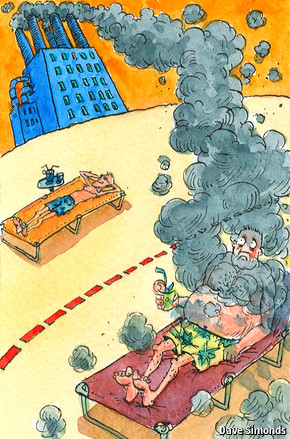
Interstate pollution: How much should upwind states care if their filth blows next door?

Interstate pollution: How much should upwind states care if their filth blows next door?

Sep 7th 2013 | WASHINGTON, DC |From the print edition

20130907_USD002_0

“ON SOME days even if we shut down the entire state, we would be in violation of some health standards because of pollution coming over from other states.” Thus the late Senator Frank Lautenberg griped about foul air blowing into New Jersey. For years, upwind states could dump part of the cost of pollution onto their neighbours, while reaping all the benefits of the factories that caused it. Though banned by the Clean Air Act, such smother-my-neighbour policies persist. Read more of this post

‘Most Expensive Bed in the World’ Now Sold in Beijing; You’re bound to get a good night’s sleep on this 1.2 million RMB bed, unless you’re footing the bill

‘Most Expensive Bed in the World’ Now Sold in Beijing

09-05 16:27 Caijing

You’re bound to get a good night’s sleep on this 1.2 million RMB bed, unless you’re footing the bill

113264211

Ever heard the saying ‘you’re better off putting your money under your mattress’? Well, this probably isn’t exactly what they meant. Still, with China’s luxury product market booming – and, if this launch is anything to go by, bigger than ever – who needs to be frugal? The headline-grabbing ‘Royal State Bed’, priced at 125,000 GBP (1,186,600 RMB), is the latest in a series of models being introduced to the Chinese market by esteemed British brand Savoir Beds. Originally exclusive bed makers for London’s prestigious Savoy Hotel, Savoir has over a century of experience giving its customers a sound night’s sleep. Read more of this post

Faith In Humanity: 10 Studies To Restore Your Hope For The Future

SEPTEMBER 5, 2013 by ERIC BARKER

Faith In Humanity: 10 Studies To Restore Your Hope For The Future

Reading a lot about the science of human behavior can make you cynical, sometimes deservedly so, but cynical nonetheless. On this blog I try to be accurate and useful and, as I have posted, research shows there is great power in optimism and hopeSo I want to take a second to step back from brass tacks and take a look at some studies that can renew a faith in humanity. The world is not always fair. The bad are not always punished and the good do not always prevail. But there are plenty of reasons, scientifically tested, to have hope and be positive about the future.

1) You Bounce Back Better From Tougher Problems

From a study by Harvard happiness expert Daniel Gilbert, author of Stumbling on Happiness: People rationalize divorces, demotions, and diseases, but not slow elevators and uninspired burgundies. The paradoxical consequence is that people may sometimes recover more quickly from truly distressing experiences than from slightly distressing ones (Aronson & Mills, 1958; Gerard & Mathewson, 1966; Zimbardo, 1966)… Read more of this post

Great entrepreneurs do not know their audiences; “the fun part is launching a great product, making it better, and finding your audience along the journey”

Great entrepreneurs do not know their audiences

BY BRYAN GOLDBERG 
ON SEPTEMBER 5, 2013

There’s nothing like a trip to Kansas to remind you. I happened to be here for a wedding this weekend, and I slept during my flight from LaGuardia to KCIA. It takes me a few minutes to really wake up from a great nap, and so my first cogent memory was of hopping into the cab. The taxi driver asked me where I was going, and then he moved onto the more important question at hand…

“You cool with the Christian Rock station?”

I wasn’t sure that I had ever listened to one of those, so I told the man to go ahead and pump it up. I may be Jewish, but I’m cool with a few power ballads about Jesus.  At some point, he asked me where I was from, and he asked me what I did, and when Bleacher Report finally entered the conversation, he told me how much he liked the site. And when I got to the wedding, Bleacher Report came up a lot. Most of the guests were strangers to me, but somehow they seemed to know about my past and wanted to hear more. Read more of this post