Political Incentives to Suppress Negative Financial Information in China? Moat Report Asia: Bamboo Innovator Insight

The following article is extracted from the Bamboo Innovator Insight weekly column blog related to the context and thought leadership behind the stock idea generation process of Asian wide-moat businesses that are featured in the upcoming monthly Moat Report Asia. Fellow value investors get to go behind the scene to learn thought-provoking timely insights on key macro and industry trends in Asia as well as benefit from the occasional discussion of potential red flags, misgovernance or fraud-detection trails ahead of time to enhance the critical-thinking skill about the myriad pitfalls of investing in Asia at the microstructure- and firm-level.

  • Political Incentives to Suppress Negative Financial Information in China? Sep 4, 2013 (BeyondProxy, Moat Report Asia)

Political Incentives to Suppress Negative Financial News

How to Let 999 Flowers Die: For innovation to flourish, variation must go hand in hand with selection

August 27, 2013

How to Let 999 Flowers Die

For innovation to flourish, variation must go hand in hand with selection.

by Freek Vermeulen

00203_thumb2_220x244

Illustration by Sam Brewster

When it comes to innovation, most executives place a high value on variation. They set up formalized systems that encourage employees to generate ideas and submit them to their superiors. Even firms without a formal mechanism frequently empower their people to experiment without fear of punishment for failure. This approach is based on the knowledge that innovation is often a bottom-up process: Managers should cultivate many promising seeds to let a thousand flowers bloom. Read more of this post

Five Principles to Turbocharge Innovation

Posted: August 2, 2013

Eric McNulty is the director of research at the National Preparedness Leadership Initiative and writes frequently about leadership and resilience.

Five Principles to Turbocharge Innovation

Why do some teams consistently come up with great new ideas while others languish with little to show but time around a table? How do some organizations operate nimbly in the face of fast-evolving markets while others freeze like deer in headlights? What can you do, as a leader, to build positive, productive energy that fuels creative thinking and breakthrough innovation? I recently had the pleasure of spending two days at The City Resilient, a conference and design charrette hosted by PopTech, an organization known for convening in-person gatherings of innovators, along with the Rockefeller Foundation and others interested in resilience. As PopTech founder Andrew Zolli noted, every person present in the diverse, hand-picked group had great expertise and could be a keynote speaker at most conferences. However, the members of this group hadn’t been convened to lecture, but rather to tackle a vexing problem in short order: creating cities that could survive the stresses of the 21st century, from extreme weather to income inequality. They were charged with working together to actually get something done. Read more of this post

The Big Bite of Small Brands: Upstarts are gaining market share across consumer packaged goods categories. Here’s how incumbents can respond

August 27, 2013

The Big Bite of Small Brands

Upstarts are gaining market share across consumer packaged goods categories. Here’s how incumbents can respond.

by Elisabeth Hartley, Steffen Lauster, and J. Neely

00197_ex01

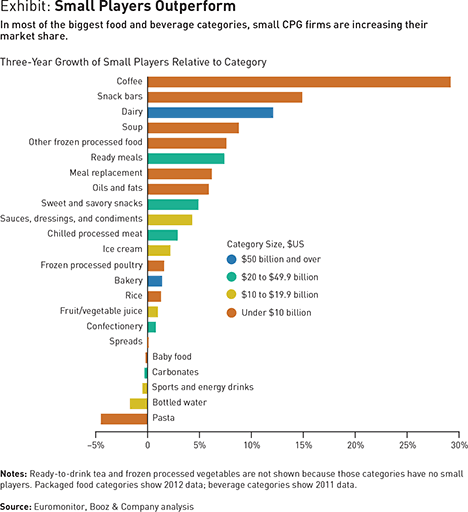
Small consumer packaged goods (CPG) companies in the U.S. are steadily gaining market share these days, often at the expense of larger competitors. Booz & Company recently analyzed the food and beverage industry and found that small players (those with sales of less than US$1 billion) are outperforming the competition in 18 of the top 25 categories, including the largest and most consolidated ones, such as bakery, dairy, snacks, and ready meals (see Exhibit). From 2009 to 2012 in packaged foods and from 2008 to 2011 in beverages, small players grew revenue about three times faster than the overall category. Specifically, in packaged foods, small players ex-perienced a three-year compound annual growth rate (CAGR) of 6.2 percent, and gained 1.7 percent of market share. Meanwhile, large players increased sales by just 1.6 percent CAGR and saw their market share decline 0.7 percent. Read more of this post

Watch LG Terrify Job Applicants Into Thinking Their Flat Screens Are Really Office Windows

Watch LG Terrify Job Applicants Into Thinking Their Flat Screens Are Really Office Windows

AARON TAUBE SEP. 4, 2013, 5:17 PM 9,531 9

What better way to demonstrate the life-like quality of your televisions than by using them to scare the bejesus out of people? That’s what LG Chile did in a prankvertisement promoting its 82-inch “Ultra HD” TVs. The commercial, which surfaced Monday on YouTube, shows the LG team rigging up the TVs to look like windows. Then, they sat job applicants across from the televisions under the premise that they were being interviewed for a position with the company. When the tranquil cityscape displayed on the televisions erupts into a series of explosions, hidden cameras capture the applicants’ outrageous reactions: The stunt is not the first time advertisers have launched prankvertisements aimed at job applicants. LG has previously been accused of faking its stunts. In February, we told you about a Heineken campaign in which the company subjected internship hopefuls to a variety of bizarre behaviors, ranging from excessive hand-holding to feigned medical emergencies. That treatment pales in comparison to the comically austere accommodations  Brussels ad agency Mortierbrigade told interns they’d be getting in the agency’s basement. LG’s latest take on the genre seems to be a success. The video already has more than 500,000 views on YouTube.


Why are good managers such a rare species?

September 4, 2013 4:57 pm

Why are good managers such a rare species?

Review by Stefan Stern

Becoming a better boss: Why good management is so difficult, by Julian Birkinshaw, Wiley, RRP£18.99

How likely is it that you would recommend your line manager to a colleague as someone they should work for in the future? This is the question that senior executives at the Swiss pharmaceutical company Roche started asking in staff surveys three years ago. The idea was to spot which managers were really good at building engaged, higher performing teams. It is not just about the feelgood factor. According to a Wharton business school study, money invested in America’s 100 “best companies to work for” over a 25-year period would have generated returns 3.5 per cent a year higher than those achieved by the average fund manager. Read more of this post

The four stages of life every successful startup must go through

The four stages of life every successful startup must go through

BY GIRISH SHENOY 
ON SEPTEMBER 4, 2013

butterfly

If you’ve ever been to a startup event, you’d be awed by the intriguing ideas entrepreneurs come up with — revolutionary jumps that change the way we think about the world, or small incremental ideas that make us relearn everything we know about friends, work, or even coffee. It’s pretty hard not to be awed. But for all their brilliance, most startup entrepreneurs have distorted ideas about customer service, and what it means to their seedling ventures. After all, when you are a garage startup trying to change the world, the first and most important thing you need is traction, and the second: staying alive. Most startups procrastinate on servicing customers to keep them happy until they have gone mainstream. No surprise that a good chunk of these startups don’t survive very long.

Read more of this post

Games we play make us better at work; Plenty of ways to hone the entrepreneurial edge but none compares with the real experience

September 3, 2013 4:47 pm

Games we play make us better at work

By Luke Johnson

Plenty of ways to hone the entrepreneurial edge but none compares with the real experience

This summer my elder son and daughter (six and eight respectively) became obsessed by the board game Monopoly. I saw it anew through their eyes and was reminded that games can be a useful introduction to the world of business. As with life, success in Monopoly is down to a combination of luck and skill. Players learn to handle money, make investments and plan for the future. They find out about strategy, winning and losing, trading and leverage. Read more of this post

The insecurities that torment some people at work and render them risk-averse need to be understood

September 4, 2013 5:01 pm

That fear of being found out

By Naomi Shragai

Many people wear a mask at work – of competency and of being in control. But sometimes behind this lies the anxiety that they are incapable of doing their job and a fear of being found out. As a result they go to unhealthy extremes to ensure they get things right in an effort to avoid what they imagine could be a catastrophic outcome if exposed. Most people will have experienced these feelings in their working lives, and such self-doubt can be healthy. Reflecting on one’s strengths and limitations is essential and makes people strive harder at work. Furthermore, the damaging consequences of the extreme opposite characteristics – stubbornness, arrogance and denying one’s limitations – have been seen in the chief executives who led their companies to irresponsible risk-taking and ruin. Feelings of insecurity are particularly common when people are promoted to a leadership position. Read more of this post

Could This New Technology Destroy The Value Of All Famous Art?

Could This New Technology Destroy The Value Of All Famous Art?

MEGAN WILLETT SEP. 4, 2013, 3:39 PM 6,112 16

10. korenvelden van-gogh-3d-relievos-copy-korenvelden-detail

Relievo of Van Gogh’s “Wheatfield under Thunderclouds” (1890).

A new 3D printing technique in Europe could threaten the value of the world’s most prized works of art. The proprietary technique is being used by the Van Gogh Museum in Amsterdam, which has partnered with Fujifilm to produce three-dimensional reproductions of Vincent Van Gogh’s masterpieces. Called “Relievos” by the museum, the replicas are of extremely high quality and will set you back £22,000, or just under $29,000. The museum is planning to sell 260 limited edition copies — all numbered and stamped — for both collectors and educational purposes. Read more of this post

Bezos to Washington Post: ‘Don’t be boring’

Bezos to Washington Post: ‘Don’t be boring’

4:14pm EDT

(Reuters) – Jeff Bezos, the soon-to-be owner of The Washington Post, does not plan to cut his way to profitability and says the only path to success is growth, according to an account in the Washington Post on Wednesday. The Amazon.com chief executive is visiting the newspaper for the first time this week since he agreed to purchase the Washington Post Co newspaper unit for $250 million on Aug 5. Read more of this post

Study Says Yelling Is As Hurtful as Hitting; Parents Who Yell at Teens Can Increase Risk of Depression and Aggression

September 4, 2013, 7:21 p.m. ET

Study Says Yelling Is As Hurtful as Hitting

Parents Who Yell at Teens Can Increase Risk of Depression and Aggression

ANDREA PETERSEN

Parents who yell at their adolescent children for misbehaving can cause some of the same problems as hitting them would, including increased risk of depression and aggressive behavior, according to a new study. A good, warm relationship with Mom and Dad doesn’t protect teens from the negative effects of parents’ yelling, cursing or lobbing insults, such as calling teens “lazy” or “stupid,” the study found. Conducted by researchers at the University of Pittsburgh and the University of Michigan, the study was published Wednesday on the journal Child Development’s website. Read more of this post

The complicated relationship between man and cow in India; India is the world’s largest exporter of beef – ironic, in a country where the cow is considered sacred

The complicated relationship between man and cow in India

By Zain Awan
POSTED: 05 Sep 2013 10:52 AM
India is the world’s largest exporter of beef — ironic, in a country where the cow is considered sacred. A visit to India remains somewhat incomplete without bumping into cows and cattle on the roads.  

NEW DELHI: With a frail body and a strong will, Gopal Das launched a fast-unto-death. His cause — cows and their welfare. Such is the importance of the relationship that exists between man and cow in India. Gopal Das said: “I have donated my property worth billions of dollars to the Haryana province government. If they want, they can have it but they should help the mute animals. Cows are wandering in the streets without food.” Cows are considered sacred in India where their slaughter is banned. There are believed to be more than 300 million cows in India and critics argue that they compete with people for food in a country where some 20 per cent of the population live below the poverty line. Read more of this post

Weitz Buffett-Malone Bets Best in Value

Weitz Buffett-Malone Bets Best in Value: Riskless Return

Wally Weitz likes to invest with billionaires he’s known a long time. He’s been a shareholder for more than 35 years in Berkshire Hathaway Inc. (BRK/A), run by his Omaha, Nebraska, neighbor Warren Buffett, and has held stakes in companies run by media mogul John Malone for more than 20. The investments helped Weitz’s Partners III Opportunity Fund (WPOPX) produce the best risk-adjusted performance among U.S. value funds in the past five years, according to the BLOOMBERG RISKLESS RETURN RANKING. The $901 million fund had below-average volatility and the second-highest absolute return among 283 vehicles with at least $500 million in assets. Weitz has always looked for companies whose stocks are cheap compared with the cash flow he expects them to generate, a common metric for value investors. Over time, he has come to believe that finding management teams that know how to redeploy any excess cash intelligently is critical to investment success. “Warren Buffett and John Malone could not be more different, but both of them know how to create more than a dollar of value for every dollar they reinvest,” Weitz, 64, said in a telephone interview. Read more of this post

Deb Weidenhamer built her company, Auction Systems Auctioneers & Appraisers, to more than $100 million in annual revenue by adding new formats and seeking new opportunities

September 4, 2013

A Pioneering Auction Company Keeps Innovating

By JOHN GROSSMANN

05sbiz-articleLarge

Deb Weidenhamer built her company, Auction Systems Auctioneers & Appraisers, to more than $100 million in annual revenue by adding new formats and seeking new opportunities.

Deb Weidenhamer is happy to say she practices the world’s oldest profession — it’s just not the one that occurs to most people. “Auctions are truly the oldest known profession,” she said. “They’ve got a longer recorded history than even prostitution.” When Ms. Weidenhamer first picked up a gavel in 1995, there were few female auctioneers. Since then, she has helped invigorate the ancient profession and built her company, Auction Systems Auctioneers & Appraisers, to more than $100 million in annual revenue. She has added new formats, like simulcasting her live auctions, and she has helped establish that auctions are not just for liquidations and closeouts. Seeking new opportunities, she has even taken her gavel to China, where she has mastered enough Mandarin to handle auction chants and where she is creating a new channel for Western companies to introduce products into the vast Chinese market. She discussed all of that, from a dozen time zones away in Shanghai, in a conversation that has been condensed and edited. Read more of this post

This Logo Change Caused Tropicana Sales To Plunge

This Logo Change Caused Tropicana Sales To Plunge

MAX NISEN SEP. 3, 2013, 12:46 PM 6,377 10

People rarely consciously look at logos. Their shopping habits were formed years ago, and don’t change, especially for essentials. But when packaging suddenly changes in a big way, they definitely notice. When Tropicana tried to change things up, customers revolted, and they lost a fifth of their sales in a matter of weeks. Bloomberg’s Market Makers brought on Olson Chief Creative Officer Dennis Ryan, a veteran of campaigns for Target and Budweiser, to discuss Yahoo’s logo strategy. He reminded viewers of Tropicana’s efforts to modernize its classic straw-in-orange packaging. “About five years ago [Tropicana] went to this very clean but kind of cold-looking logo, and their sales dropped 20% in one month. Some pundits said they weren’t recognizable,” Ryan said. “Tropicana has something like eight feet in the refrigerated section. People recognized it. They didn’t trust [the new logo].” Here’s the offending logo, alongside the one that preceded it:

screen shot 2013-09-03 at 10.56.23 am

People don’t like change. And when a logo or packaging  for a favorite product changes, it creates trust issues. The package has changed and they wonder if what’s inside has, too. The generic logo made people expect a generic product. It’s one of the reasons Yahoo has chosen to ease people in and experiment rather than up and change things without some preparation.

How Industry Giants Can Create Corporate Breakthroughs

How Industry Giants Can Create Corporate Breakthroughs

by Scott Anthony  |   9:00 AM September 4, 2013

Most large corporations will admit to struggling with innovation. But in reality most companies, particularly those that manage to last for any reasonable period of time, do day-to-day innovation extremely well. After all, your laptop (if you still use one) is much more reliable than it was a decade ago. Your television picture quality is significantly better. Your cellphone sounds clearer and drops fewer calls. Your shampoo leaves your hair feeling cleaner. Your toothpaste leaves your mouth feeling that much fresher. Read more of this post

Trihatma Haliman’s lesson: The roots of failure lie in fear, greed

Trihatma’s lesson: The roots of failure lie in fear, greed

The Jakarta Post | Business | Tue, September 03 2013, 12:36 PM

HATMA

Sixty one-year-old property mogul Trihatma Haliman values the principal of prudent management highly, as after more than four decades it has kept his Agung Podomoro Group empire immune from tribulations such as financial crises in 1998 and 2008.

The group’s aggressive expansion in the business, which includes the Rp 50 trillion (US$5 billion) flagship construction of a city islandnorth of Jakarta, hinges on such a principal. “If you ask me how we managed to get through all the troubles and expand, the answer is simple. Don’t be greedy,” said Trihatma in a recent interview at his office in the 44th floor of the APL Tower in West Jakarta. “Don’t force yourself to launch two or three big projects at the same time. If something happens, you will put your financial capabilities at risk.” “In the property business, if you have excessively high expectations, the result usually won’t turn out good. So it’s important to remain prudent,” Trihatma said. Read more of this post

The More Things Change, the More Our Objections to Change Stay the Same

The More Things Change, the More Our Objections to Change Stay the Same

by Bill Taylor  |  11:00 AM September 4, 2013

One of the very first articles in the very first issue of Fast Company, a magazine I started 20 years ago with Alan Webber, is a smart and entertaining list compiled by E.F. Borish, product manager at a long-established outfit called Milwaukee Gear Company. Borish’s article was titled, “50 Reasons Why We Cannot Change,” and it offered a clever and entertaining collection of objections to and worries about the hard work of making real progress. Reason #1: “We’ve never done it before.” Reasons #4: “We tried it before.” Reasons #13: “Our competitors are not doing it.” Reason #17: “Sales says it can’t be done.” Reason #18: “The service department won’t like it.” Reason #45: “We’re doing all right as it is.” Reason #50: “It’s impossible.” Now here’s the punch line: E.F. Borish compiled his list back in 1959, and published it in an obscure journal called Product Engineering. What we found so amazing about the list when we reprinted it in 1993 — and what remains just as amazing 20 years later — is that most leaders in most organizations face precisely the same set of worries and pushbacks today. The more things change, it seems, the more the objections to change remain the same. So what have we learned in the twenty years since Fast Company was created, or the 54 years since E.F. Borish compiled his list? Let me suggest five simple principles to change how we make change: Read more of this post

8 Reasons Why Apple’s Co-Founder Woz Still Matters

8 Reasons Why Woz Still Matters

DYLAN LOVE SEP. 3, 2013, 8:56 PM 25,532 4

all-the-evidence-says-wozniak-is-an-all-around-nice-guy

Woz waiting in line at an Apple launch

Of the three Apple cofounders, the two we know best couldn’t have been more different from each other – Steve Wozniak was the yin to Steve Jobs’ yang. Where one was noted for his aggressive, driven behavior, the other is commonly known to be a humble, affable guy. Where one was marketing-minded, the other was obsessively tech-minded. Steve Jobs liked LSD. Steve Wozniak used to run a dial-a-joke phone service. Despite these disparate qualities, the two leaned on each other to get some incredible work done in the early days of Apple. It was there, in Wozniak’s hands, that one of the first modern personal computers came together before Jobs brought incomparable passion to finding the best way to sell it. If Steve Jobs is the heart of Apple, Steve Wozniak is the brain. Here’s why this brain still matters some 30 years after those early days of Apple, which has seen him in many different roles, philanthropic, technological, and business-related alike.  Read more of this post

The Most Important Negotiation in Your Life

The Most Important Negotiation in Your Life

by Erica Ariel Fox  |  11:00 AM September 3, 2013

Life is a series of negotiations.

You negotiate all day, every day, from the time you wake up to the time you go to sleep. Contract terms and conditions. Hiring, managing performance, and firing. Defining deadlines, scope, and deliverables. Collecting fees. Seeking alignment about business strategy. Enlisting stakeholders. Creating partnerships and joint ventures. Dissolving them. You make offers, counteroffers, and agreements to settle. You say yes. You say no. You stall for time. Finally, lunch. When you go home, the negotiations continue. Over buying a new car, switching carpool days, or how much screen time the kids are allowed. The stakes of negotiating at home can feel sky-high: which medical advice to follow; how much to spend or save; how long your aging parents can live at home; whether to stay together. From the major to the mundane, negotiating is the way we get things done. One of my clients told me, “my toughest negotiations are with my dog.” If you’re like most people, when you think about negotiation, you picture people talking to “the other side.” Whether they’re pitching to a customer in an office, brokering a peace deal at Camp David, or arguing over curfew at the kitchen table, negotiators are people trying to persuade other people of their point of view.

That’s only half the story.

After nearly 20 years of teaching negotiation at Harvard Law School, and the same years spent advising and training thousands of executives, public sector leaders, consultants and lawyers from all over the world, I see things differently. Actually, the most important negotiations we have — the ones that determine the quality of our lives and the impact of our actions — are the ones we have with ourselves. Learning to communicate well and to influence other people are essential skills in business. But even more fundamental to your success is learning to negotiate effectively with yourself.

Negotiating with yourself?

Yes. Better results, stronger relationships, and more of life’s deeper rewards, all come from learning to negotiate with yourself. Read more of this post

Ronald H. Coase challenged conventional economic wisdom

Ronald H. Coase challenged conventional economic wisdom

Pierre Lemieux, Special to Financial Post | 13/09/03 | Last Updated:13/09/03 4:16 PM ET

obit_ronald_coase

AP Photo/Courtesy of the University of Chicago Law SchoolThis undated photo provided by the University of Chicago Law School shows professor Ronald Coase. Coase, a Nobel Prize winner and pioneer in

Coase taught us why companies make sense, and why the polluter-pay principle doesn’t

It has been said of Ronald Coase, who died on Monday aged 102, that he wrote two articles in his career, and that each of them changed economics. In truth, Coase wrote several dozen articles and a few books, but a couple of his articles especially stand out as unique contributions.

The first seminal article was “The Nature of the Firm,” published in 1937. Why, asked Coase, does the firm exist? Why is not all production organized by arms-length contractors under the coordination of the market? Why does the authoritarian firm exist within the anarchistic context of the free market? Coase’s answer was that “there is a cost of using the price mechanism.” This cost relates to what were later labelled “transaction costs” — the costs of “discovering what the relevant prices are,” and of “negotiating and concluding a separate contract for each exchange transaction.” A firm is created when these transaction costs are higher than the costs of organizing and managing the firm. Read more of this post

Trevor Baylis, the inventor of the wind-up radio is calling on young people to consider the so-called “oily rag” trade

British inventor: Trevor Baylis calls for schools to teach importance of invention

The inventor of the wind-up radio is calling on young people to consider the so-called “oily rag” trade. “Britain needs more engineers,” says Trevor Baylis.

trevor_2483322c

Trevor Baylis in his garden, which overlooks the Thames Photo: PAUL GROVER

By Rebecca Burn-Callander

6:00AM BST 03 Sep 2013

“You don’t have to be a genius to be an inventor,” according to the serial entrepreneur and founder of Trevor Baylis Brands, which has helped over 9,000 inventors bring products to market. “I don’t wake up every morning thinking, ‘I’m going to invent something today’.” Mr Baylis OBE, 76, developed the world’s first wind-up radio in the early nineties. More recently, he has invented a mobile phone that is charged by a special pair of shoes as you walk. “Unfortunately, people are a bit nervous of the shoes because they look a bit like a bomb,” he admits. Read more of this post

Anxious and approaching 40: the high-flyers of the GFC left behind

Anxious and approaching 40: the high-flyers of the GFC left behind

PUBLISHED: 17 HOURS 13 MINUTES AGO | UPDATE: 4 HOURS 38 MINUTES AGO

Many middle-aged men feel their career is not moving and this depresses them. 

JILL MARGO

In the long, slow aftermath of the GFC, many careers have stalled. But it now appears that one group of bright young men have been hit particularly hard. These are the promising youngsters who were powering through the ranks of the financial services industry before the crisis hit. With the wind behind them and bonuses in front of them, their expectations were high. Now, they are still employed but almost five years have passed with hardly any upward movement. Read more of this post

Kyobo Life Insurance will hold an event to commemorate the 10th anniversary of the insurance firm’s founder Shin Yong-ho’s death; known by his penname Daesan, Shin was a pioneer in the local insurance industry by creating the world’s first ‘education insurance policy”

2013-09-03 17:50

Kyobo to commemorate founder

By Kim Tae-jong

K2013090300222-450

The late Kyobo Life Insurance founder Shin Yong-ho, left, receives the Founders’ Award from the International Insurance Society in this file photo taken on June 27 in 1983

Kyobo Life Insurance will hold an event tonight to commemorate the 10th anniversary of the insurance firm’s founder Shin Yong-ho’s death at the Sejong Center for the Performing Arts in downtown Seoul, the company said Tuesday.
Also known by his penname Daesan, he was a legendary figure in the local insurance industry and devoted himself to the promotion of education here after the Korean War.
The event, which takes place between 6 p.m. and 8:30 p.m., consists of a photo exhibition, a commemoration ceremony and several performances. Distinguished guests will be in attendance, including International Insurance Society (IIS) CEO Michael Morrissey, Korean Poets Association Chairwoman Shin Dal-ja and ex-president of Sejong University, Yang Seung-kyu as well as other officials from the insurance industry. Read more of this post

Wang Wei, the soft-spoken billionaire head of SF Express, is finally opening his company to outside investments, a full 20 years after first founding his delivery service business

09.03.2013 19:04

Courier Service Firm Finally Takes Delivery of Outside Investment

For years SF Express resisted taking other people’s money, but a desire to remain an industry leader has seen it accept boxes of cash lately

By staff reporters Zhu Yishi and Zheng Fei

(Beijing) — Wang Wei, the soft-spoken head of SF Express, is finally opening his company to outside investments, a full 20 years after first founding his delivery service business. On August 19, executives at SF Express (Group) Co. Ltd. confirmed the company had entered a strategic investment agreement with state-backed investors Oriza Holdings of Suzhou, Jiangsu Province; China Merchants Group; and CITIC Capital. The three investors will own a little less than 25 percent of SF Express after the deal. Read more of this post

More than one million families have been forced to sell their home in just five years to meet the cost of elderly care

Elderly care crisis claims a million family homes

More than one million families have been forced to sell their home in just five years to meet the cost of paying for residential care, new figures have revealed.

Number of homes sold to pay for care ‘could be higher than previously thought’ Photo: IAN JONES

By John Bingham, Social Affairs Editor

10:00PM BST 03 Sep 2013

The estimate, based on polling measuring families’ individual experiences, is far higher than Government projections have previously suggested. But charities and pensions experts said it represented one of the first realistic attempts to quantify the scale of the hidden care funding crisis in the UK. And they claimed that it showed that the Government’s long-awaited overhaul of the social care system in England – including the introduction of a cap on bills – does not go far or fast enough to address the crisis thousands of families are facing. Read more of this post

Singapore: Why pay $12 million for quiet coffee shop? “The coffee shop is like an art piece – its worth will appreciate over time.”

Why pay $12 million for quiet coffee shop?

Wednesday, September 4, 2013 – 09:40

Linette Heng

The Straits Times

You will still see the same old faces here every day, jokes the regulars at a quiet coffee shop in Tampines. The place was put up for sale late last month, with an asking price of $10 to 12 million. This tender exercise comes just months after a coffee shop in Hougang was reportedly sold for a record price of $23.8 million. But patrons and stall owners are puzzled by the asking price of this particular Tampines coffee shop, DE 131. Read more of this post

Most Influential 50’s New Names Show Shakeup: Bloomberg Markets

Most Influential 50’s New Names Show Shakeup: Bloomberg Markets

They shape economies, move markets, do deals — and change the world. They hold sway by virtue of the money the manage, the companies they control, the policies they enact and the ideas they propound. The people on the third annual 50 Most Influential list, to be published in the October issue of Bloomberg Markets magazine, command attention as masters of the global financial system. Some work the strings of power in the courtroom or the halls of government, while others campaign for access to education, equal opportunities or the alleviation of poverty. These are people with clout. To find candidates for our list, we tap the expertise of reporters and editors in 146 Bloomberg News bureaus around the globe. Rankings published in Bloomberg Markets throughout the year help shape our decisions. Recent achievements count for more than long careers, although Warren Buffett, 83, and Carl Icahn, 77, show that it’s possible to have both. In all, 36 of our 50 are new to the list this year. Only seven — including Buffett, Lloyd Blankfein, Jamie Dimon and Larry Fink — have been on it all three years. We’ve grouped our influencers into five categories: Bankers, Policy Makers, Money Managers, Corporate Power Brokers and Thinkers. As in prior years, we excluded heads of government from the Policy Makers rubric, favoring instead the cabinet officials, regulators and central bankers who actually make things happen. Read more of this post

Hello Kitty jet flies into Los Angeles

Hello Kitty jet flies into Los Angeles

000_hkg20051020.b6fc3155414.original

EVA air plane decorated with “Hello Kitty”

11 hours ago

The most famous cat in the world will be making its maiden voyage into the US this month, when Taiwanese airline Eva Air sends its first Hello Kitty-emblazoned jet into Los Angeles. After accompanying passengers on Asian routes to Japan, Hong Kong, South Korea, China and Guam for years, the cartoon kitten that has become fetishized for generations the world over will make her first North American journey later this month on a B777-300, reports Business Traveller Asia-Pacific. The service is also likewise to enter Europe in the future. Read more of this post