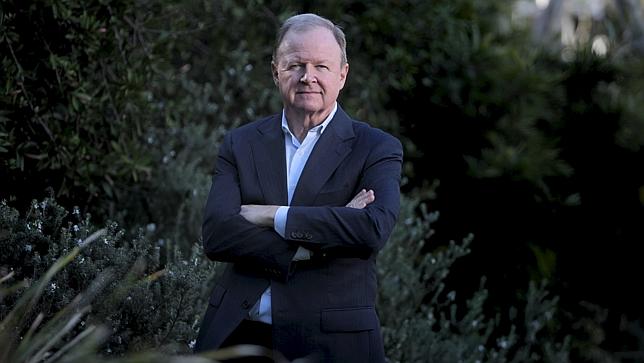
Hailed as a Clausewitz for our times, former soldier Emile Simpson talks about military strategy, the Afghanistan conflict and ‘armed politics’

August 9, 2013 1:54 pm

Lunch with the FT: Emile Simpson

By John Thornhill

Hailed as a Clausewitz for our times, the former soldier talks to John Thornhill about military strategy, the Afghanistan conflict and ‘armed politics’

When the veteran military historian Professor Michael Howard raves about a book by a little-known, 30-year-old ex-Gurkha officer and declares it to be comparable to Clausewitz, it is surely worth snapping to attention. And after reading War From the Ground Up, I am all the more intrigued to meet its author, Emile Simpson. Drawing on his experience of fighting in Afghanistan, Simpson has written an engrossing account of the 12-year conflict that challenges the way we think about war and suggests how we might better fight the next one. “War From the Ground Up is a work of such importance that it should be compulsory reading at every level in the military,” Howard concluded in his Times Literary Supplement review. Read more of this post

Connecticut Man Is The Warren Buffett Of Bass Fish. Myerson reached the pinnacle by methodically studying his prey and developing devices to lure the fish to him and, perhaps, change how people fish. “That’s what all these great catches are attributed to, knowledge of the fish. You gotta think like them.”

Connecticut Man Is The Warren Buffett Of Bass

JOHN CHRISTOFFERSENASSOCIATED PRESS AUG. 12, 2013, 12:24 PM 3,045 4

connecticut-bass-fisher

NORTH BRANFORD, Conn. (AP) — When Greg Myerson heads out in his boat, some fishermen will follow him. The famous want to fish with him. He’s the Warren Buffett of the fishing world, giving seminars in which he’ll tell some but not all his secrets. The Connecticut man has achieved a rare feat: He consistently catches striped bass 50 pounds and much larger. Myerson set the world record two years ago by catching a striped bass that weighed 81.8 pounds off the Connecticut coast. Last year he set the striped bass length record of about 44 inches. Just last month he caught a 73-pound bass. “I’m just going to go ahead and say it: Greg Myerson is the greatest living striper fisherman,” declared Rick Bach in an account last month in The Fish Report. Chris Megan, owner of On the Water magazine, said he doesn’t know anyone who’s caught so many large striped bass.

Myerson reached the pinnacle by methodically studying his prey and developing devices to lure the fish to him and, perhaps, change how people fish. “I’ve gotten it down to a science,” Myerson said. “That’s what all these great catches are attributed to, knowledge of the fish. You gotta think like them.” Read more of this post

How to be a tough mudder and lead ugly

Fiona Smith Columnist

How to be a tough mudder and lead ugly

Published 05 August 2013 11:41, Updated 09 August 2013 12:14

When you are going through hell, it doesn’t help to try to pretend you are impervious. Corporate coach Peter Barr says emotions in businesses are seen as “ugly”, but they can be recognised and channelled and put to good use. “We all know the term ‘winning ugly’ in sport when things aren’t going that well, when somehow you get through anyway,” he says. “You might be muddy and dirty at the end of the game, but you end up winning. Leading ugly is about that.” Read more of this post

Organisational rain: Employees rebel against administrivia

Fiona Smith Columnist

Organisational rain: Employees rebel against administrivia

Published 06 August 2013 10:27, Updated 07 August 2013 06:52

Some employees are finding the ‘organisational rain’ they have to deal with is becoming too much to bear. So they’re fighting back. Photo: Tamara Voninski

Employer groups are like a dog with a bone when it comes to worrying away at productivity, but maybe they should just get out of the way and let people get on with the job. Workplaces are undergoing massive change and disruption. Everywhere you look, someone has found a new way to cut costs and each time it seems to make it harder for people to do their work. They may be taking away people’s desks, giving them inferior technology to work with, piling on tasks from people who have been sacked, making them beg to be reimbursed for expenses, infuriating them with poorly-designed performance review processes, and setting up even more complex reporting systems. Most people just want a job that is meaningful – and they want to do it well. We get a sense of self-worth from the work we do, and it is not because we think we will get a bonus if we “outperform”. But people are being pushed past their limits and what I am observing is a groundswell of people finding their own way of fighting back. Fed up with nonsensical edicts, administrivia and “organisational rain”, they are refusing to comply. Read more of this post

How the rise of A2 milk in an industry that has been reshaped by low-cost generic milk from big supermarkets is adding millions to the fortune of Rich Lister Tony Perich and provides a powerful lesson about the importance of brand differentiation; A2 is 26 per cent-owned by health food company Freedom Foods

Andrew Heathcote Rich Lists editor

How the rise of A2 milk is adding millions to the fortune of Rich Lister Tony Perich

Published 13 August 2013 09:53, Updated 13 August 2013 10:31

cdf189f2-ffe4-11e2-b753-b5ebb80452f8_755991595--646x363

A2 Corporation chief executive Geoff Babidge expects some slowdown after the Fonterra scare.Sasha Woolley

The rise of milk group A2 Corporation in an industry that has been reshaped by low-cost generic milk from big supermarkets Coles and Woolworths provides a powerful lesson about the importance of brand differentiation in a highly competitive market. Having claimed a strong foothold in the domestic milk market, A2 is eyeing lucrative opportunities overseas but recent events in the Chinese infant formula market highlight the difficulties of entering new territories. A2, which is listed on the New Zealand sharemarket, is 26 per cent-owned by health food company Freedom Foods, one of the best performers on the ASX in the last 12 months. In the year to August 5, Freedom Foods’s share price rose from 56¢ to $1.98 – a 230 per cent increase. Few listed companies can lay claim to such a big rise, which has lifted Freedom Foods’s market capitalisation to $230 million. Read more of this post

How to Be a Better Conversationalist; Good Small Talk Makes Us Likable, But It’s Easy to Get Rusty—How to Avoid Dominating and Being Dominated in a Conversation

Updated August 12, 2013, 10:16 p.m. ET

How to Be a Better Conversationalist

Good Small Talk Makes Us Likable, But It’s Easy to Get Rusty—How to Avoid Dominating and Being Dominated in a Conversation

ELIZABETH BERNSTEIN

BettersmalltalkV20813

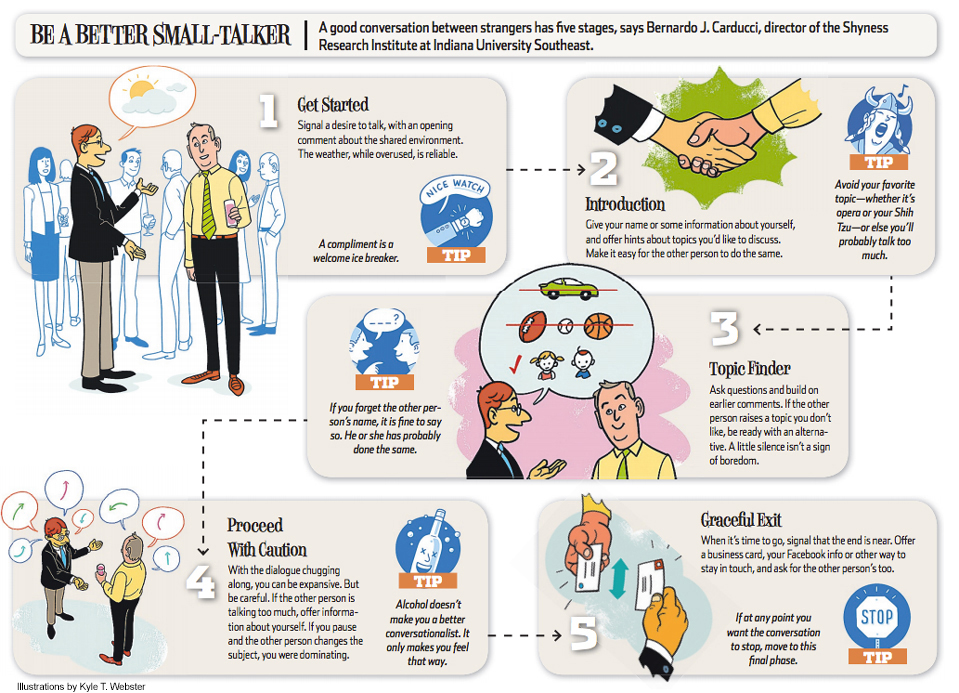
Jason Swett still cringes when he remembers the party in Atlanta 10 years ago, where, drink in hand, he tried “to impress the local Southern belles,” he says, by talking—nonstop. He told the six or so people he’d just met the tale of how once at a grocery store he helped apprehend a thief who’d stuffed steaks down his pants. And the story about the time he spotted a bike at the bottom of a pond in a local park and jumped in to retrieve it. And then the one about how he smoked himself out of his own basement by setting off illegal fireworks. Eventually, Mr. Swett asked the group, “Wanna hear another one?” The reply was unanimous. “No!” six people shouted in unison. Read more of this post

Presentation Techniques: 6 Secrets To Giving Amazing Presentations

AUGUST 12, 2013 by ERIC BARKER

Presentation Techniques: 6 Secrets To Giving Amazing Presentations

Presentations can be unbearable. We average 5.6 hours each week in meetings and 69 percent of us feel they aren’t productive.

Which presentation techniques can help you improve your delivery and convince your audience?

1) To Inspire, Start With “Why” not “What”

What magic do both the speeches of Martin Luther King and the marketing of Apple have that move us to believe and act? Simon Sinek, author of Start with Why: How Great Leaders Inspire Everyone to Take Action, has an interesting theory:

People don’t buy what you do. They buy why you do it… Start with “Why.”

Start with the goal, the messianic mission, and get them on board emotionally. Then when you describe the solution, they’re already sold. Read more of this post

So Much for Serendipity in Personalized News

So Much for Serendipity in Personalized News

The Graham family’s sale of the Washington Post to Amazon.com Inc. (AMZN) founder Jeff Bezos has prompted intense discussion of the future of journalism. That discussion has yet to focus on a remarkable feature of the Post and other old-fashioned newspapers: They provide people with a great deal of content that they wouldn’t have chosen in advance.

Newspapers create what we might call an architecture of serendipity, in which readers encounter all sorts of stories, facts, ideas and opinions that they didn’t select. Much of what they encounter seems boring, irritating, wrong or offensive, but on occasion it turns out to be surprising, delightful, alarming, important and even life-changing. Read more of this post

The Making of McPaper: The Inside Story of USA Today

The Making of McPaper: The Inside Story of USA Today [Hardcover]

Peter S. Prichard (Author)

making-mcpaper-inside-story-how-usa-today-made-david-paperback-cover-art

Publication Date: September 1987

In 1982 the Gannett Company, the nation’s biggest newspaper chain, launched USA TODAY. USA TODAY celebrates its 25th anniversary in 2007. The brainchild of Al Neuharth, it was the most expensive, most closely watched newspaper debut in history. Journalists called it “McPaper,” the “titan of tidbits,” and “junk-food journalism.” No newspaper executive had ever put so many millions and so many careers on the line. This updated edition of Peter S. Prichard’s acclaimed 1987 release includes an afterward by longtime USA TODAY writer and editor David Colton. This updated section completes the story of the first century of “The Nation’s Newspaper.” Colton catches up with the founders and examines the journalistic achievements that have gained “McPaper” respect. Readers of USA TODAY – millions of them – will find this a fascinating, behind-the-scenes story of the battle to build a newspaper that has grown to redefine modern journalism. Readers of business histories will find it a classic case study of a bigrisk, big-reward business start-up. Read more of this post

The Best Of Jeff Bezos’ Lessons In Innovation From His Amazon Shareholder Letters

The Best Of Jeff Bezos’ Lessons In Innovation From His Amazon Shareholder Letters

TIM KASTELLEINNOVATION FOR GROWTH AUG. 12, 2013, 6:53 AM 4,653 2

With Jeff Bezos in a news a fair bit right now, I thought it would a good time to look at some of the important innovation lessons that we can draw from his annual letters to Amazon shareholders.  It’s worthwhile to read them all, but here are some highlights:

 It’s All About the Long Term

The first letter is from 1997, and Bezos has included it as an appendix to every other annual letter that Amazon has sent out because it includes a summary of the firm’s long-run view. Here are a couple of the key parts of that:

We will continue to make investment decisions in light of long-term market leadership considerations rather than short-term profitability considerations or short-term Wall Street reactions.

We will continue to measure our programs and the effectiveness of our investments analytically, to jettison those that do not provide acceptable returns, and to step up our investment in those that work best. We will continue to learn from both our successes and our failures. Read more of this post

Crises Often Intrude When Presidents Take Vacation Breaks

Crises Often Intrude When Presidents Take Vacation Breaks

Call it the curse of the presidential vacation: Surf, sun, sand and crises.

It’s a ritual that Barack Obama became a part of during his first summer as president in 2009: He interrupted his August vacation in Martha’s Vineyard to reappoint Federal Reserve Chairman Ben S. Bernanke, protests against his health-care plan erupted at town-hall meetings across the U.S., and Massachusetts Senator Edward Kennedy, a Democratic Party icon, died. Obama, 52, returned to the resort island this week during another period of unrest. Facing growing tension with Russia before a Group of 20 summit in St. Petersburg, new concerns about al-Qaeda terrorism, and across-the-board budget cuts in military and domestic programs, Obama and his team are preparing for the unexpected. Read more of this post

That difficult conversation: Managers who put off having awkward discussions with staff can make matters worse

August 12, 2013 5:35 pm

That difficult conversation

By Naomi Shragai

A young entrepreneur owns and runs a thriving company. His job involves taking enormous financial risks, which he tackles with confidence and even excitement. Yet it is the prospect of having a difficult conversation with a colleague that keeps him awake at night. He has to tell one of his partners that their Amsterdam office is going to have to close, leaving her without a role in the business. However rational the decision, he is terrified of having to face her sadness and anger as well as his own guilty feelings. He rehearses the conversation in his head and the imagined scenario makes him panic. As a result, he keeps putting it off. Read more of this post

Lee Kuan Yew on fate of S’pore in 100 years’ time

Lee Kuan Yew on fate of S’pore in 100 years’ time

Tuesday, August 13, 2013 – 10:00

The Sunday Times

SINGAPORE – Former prime minister Lee Kuan Yew’s new book launched last Tuesday, One Man’s View Of The World, presents what he thinks about the future of major powers and regions. In these extracts, he speaks about death and dying, a younger generation of Singaporeans who have known only a thriving Singapore, as well as Japan’s ageing society and Europe’s currency woes. Read more of this post

Hang Seng Bank Ex-Chairman Li Quo-Wei Has Died at Age 95; After joining the lender in 1946, Lee was among those who transformed Hang Seng into the second-largest Hong Kong-based lender from a money-changing shop founded 13 years earlier

Hang Seng Bank Ex-Chairman Li Quo-Wei Has Died at Age 95

Lee Quo-wei, the former chairman of Hong Kong’s Hang Seng Bank Ltd. who fended off a bank run, helped peg the local currency to the U.S. dollar and rebuilt the reputation of the city’s stock exchange, has died. He was 95. Lee died on Aug. 10 at Prince of Wales Hospital in the city’s Shatin district, the unit of HSBC Holdings Plc said in an e-mailed statement on behalf of his family yesterday, without giving a cause of death. After joining the lender in 1946, Lee was among those who transformed Hang Seng into the second-largest Hong Kong-based lender from a money-changing shop founded 13 years earlier. Lee helped Hang Seng end a bank run in 1965 with a capital injection from Hongkong & Shanghai Banking Corp., later to become HSBC. Four years later he was part of the team that created the Hang Seng Index, the city’s benchmark stock gauge.

Read more of this post

Is Paul Krugman the Kim Kardashian of economics?

Paul Krugman and ‘reality TV economics’

I have been thinking a lot about whether to write this blog post or not because by doing so I will get involved in what I am trying to criticize – the emergence of what we could term ‘reality TV economics’. Even those of us who hate reality TV know about the Kardashians – not because we go looking for news of the reality TV family, but because the media around the world would write so much about the family that it is impossible not to come across “news” of the family. In fact every country in the world has a “Kardashian” – somebody who is only famous because they are famous. They are not famous because of their intellectual capacities or because they have been successful in business or sports. In fact many reality stars are reality stars because they have failed in what they aspired to do in the first place. Just think about the number of failed actors who today have their own reality TV show, but who are also unable to get an acting job. When your agent stops calling you will try to get your own reality TV show – it is unemployment insurance for Hollywood actors. One of the things that makes reality TV stars “interesting” is that they will do and say outrageous things. It seems like there is a genuine demand for this kind of thing. I must say I personally hate it and I try not to watch any form of reality TV, but it is not going away. In fact it seems like we are getting more and more of it every year. I am tempted to say it is market failure, but growing up in Scandinavia I have tried purely government run TV. I prefer bad reality TV to that.

Is Paul Krugman the Kim Kardashian of economics?

Unfortunately the reality TV phenomenon is spreading to the field of economics – or at least to economics blogs. The best example of this trend is Paul Krugman. He is surely the Kim Kardashian of the economic blogosphere. Read more of this post

GenSpring Family Office’s reputation revamp after client arbitrations related to a 2008-09 strategy of selling hedge funds with “bond-like risk with equity-like returns.” The hedge funds apparently didn’t perform that way, and outraged clients want their money back

August 12, 2013, 12:49 P.M. ET

GenSpring’s Reputation Revamp

By Robert Milburn

After years of management missteps atGenSpring Family Offices, freshly-minted chief executive officer Thomas Carroll, 39, is tasked with cleaning up the mess. Departed CEO Mel Lagomasino left Carroll holding the bag on client arbitrations related to a 2008-2009 strategy of selling hedge funds with “bond-like risk with equity-like returns.” The hedge funds apparently didn’t perform that way, and outraged clients want their money back, claiming GenSpring “mishandled” their investment accounts. Furthermore, a Penta investigation last year discovered GenSpring was inflating its assets on a seemingly reputable yet deeply conflicted ranking of wealth managers. Read more of this post

Black Hole Mystery: A paradox around matter leaking from black holes puts into question various scientific axioms: Either information can be lost; Einstein’s principle of equivalence is wrong; or quantum field theory needs fixing

August 12, 2013

A Black Hole Mystery Wrapped in a Firewall Paradox

By DENNIS OVERBYE

This time, they say, Einstein might really be wrong.

A high-octane debate has broken out among the world’s physicists about what would happen if you jumped into a black hole, a fearsome gravitational monster that can swallow matter, energy and even light. You would die, of course, but how? Crushed smaller than a dust mote by monstrous gravity, as astronomers and science fiction writers have been telling us for decades? Or flash-fried by a firewall of energy, as an alarming new calculation seems to indicate? Read more of this post

New York Times Chairman Arthur Sulzberger Jr. sold 50,000 shares in the company, according to an SEC filing, a day after the Ochs-Sulzberger family said the namesake newspaper is “not for sale.”

Updated August 12, 2013, 7:51 p.m. ET

Sulzberger Sells Tiny Slice of Times Stock

Deal Follows Family’s Declaration That Flagship Newspaper Isn’t for Sale

WILLIAM LAUNDER

New York Times Co. NYT +0.84% Chairman Arthur Sulzberger Jr. sold 50,000 shares in the company, according to a filing with the Securities and Exchange Commission, in a deal just one day after the Ochs-Sulzberger family declared the company’s namesake newspaper was “not for sale.” Mr. Sulzberger sold the shares Aug. 8 at $12 a share, raising a total of $600,000, the filing said. The stock represented a tiny portion of his overall stake. A spokeswoman for Times Co. said the stock sale was part of Mr. Sulzberger’s “regular estate planning.” Read more of this post

A brave new world in a melting Arctic; Opportunities bring challenges that require collaboration

August 12, 2013 6:25 pm

A brave new world in a melting Arctic

Opportunities bring challenges that require collaboration

Business adapts more quickly to changing times than politicians update their policies. Climate change is no different, as a burst of activity in the Arctic attests. Melting has cleared large ocean stretches of ice for much of the year. This is opening up new shipping lanes as well as prospects for resource exploitation in a part of the world that only years ago was deemed too inhospitable. Read more of this post

Surge of brain activity may explain near-death experiences

Surge of brain activity may explain near-death experiences

BY MEERI KIM

THE WASHINGTON POST

AUG 13, 2013

WASHINGTON – You feel yourself float up and out of your physical body. You glide toward the entrance of a tunnel, and a searing bright light envelops your field of vision. Rather than an ascent into the afterlife, a new study says these features of a near-death experience may just be a bunch of neurons in your brain going nuts. “A lot of people believed that what they saw was heaven,” said lead researcher and neurologist Jimo Borjigin. “Science hadn’t given them a convincing alternative.” Read more of this post

He risks death to keep his moustache

He risks death to keep his moustache

20130810_moustache_afp

Monday, August 12, 2013 – 03:00

The New Paper

PAKISTAN – Pakistani businessman Malik Amir Mohammad Khan Afridi has been kidnapped, threatened with death, forcibly displaced and lives apart from his family: All because of his enormous moustache. Impeccably trimmed to 76cm, Mr Afridi spends 30 minutes daily washing, combing, oiling and twirling his facial hair into two gravity-defying arches that reach to his forehead. “People give me a lot of respect. It’s my identity,” said the 48-year-old grandfather in the north-western city of Peshawar, when asked why he was prepared to risk his life for his whiskers. “I feel happy. When it’s ordinary, no one gives me any attention. I got used to all the attention and I like it a lot,” he told AFP. Read more of this post

‘Then I was the king. Now I’m a pauper’: Former playboy Raja reduced to living in a ‘mud hut’ in India

‘Then I was the king. Now I’m a pauper’: Former playboy Raja reduced to living in a ‘mud hut’ in India

Dean Nelson, The Telegraph | 13/08/13 3:19 AM ET

Raja Brajraj Kshatriya Birbar Chamupati Singh, 92, is the erstwhile king of Tigiria.

M_Id_409623_orissa_king.jpg

A former playboy Raja of one of India’s princely states is living as a pauper on the charity of commoners who were once his subjects.

Raja Brajraj Kshatriya Birbar Chamupati Singh, Mahapatra of Tigiria, the last surviving former ruler in Orissa, was once the life and soul of India’s royal party circuit. He kept a fleet of 25 vintage luxury cars and lived in a palace with 30 servants. He married a princess and was known throughout India for his prowess as a “shikari” – a big game hunter – who shot 13 tigers and 28 leopards. I would drink to my heart’s content and have a good time. But today, aged 92, he lives alone in a home described as a “mud hut” with a leaking roof and curtains of cobwebs, left by his wife and six children to the mercy of the villagers who bring him rice and lentils for lunch. A fellow royal, Jayant Madaraj, Raja of neighbouring Nilgiri, said he had known the former Raja of Tigiria since childhood when he was a close friend of his father. He had been known then for his generosity, his love of whisky jaunts to Calcutta, and his passion for fast cars and motorbikes. But his fortunes waned after Indian independence when he lost his state’s tax revenues and was given a privy purse of pounds 130 a year instead. He was forced to sell his palace in 1960 for pounds 900 and later separated from his wife. In 1975, the then prime minister, Indira Gandhi, withdrew the last remaining royal privileges and he lost his annual income. Read more of this post

Richard Branson: Forget the elevator – have your ‘anywhere pitch’ read to go

Richard Branson Contributor

Richard Branson: Forget the elevator – have your ‘anywhere pitch’ read to go

Published 08 August 2013 00:47, Updated 08 August 2013 11:08

When you’re preparing to tell investors about your idea for a business, people are going to tell you to prepare an elevator pitch, the standard summary selling a business idea in a minute or less. But there are many more locations and situations in which you may encounter a potential investor – anyone from a business leader in the industry to a family member – and you’ll need to be able to convince that person that your business will be game-changing. Why limit yourself or your imagination to elevators?

You need to think of it as your anywhere pitch. Read more of this post

Automakers Should Be Very Careful About Changing The Name Of A Car

Automakers Should Be Very Careful About Changing The Name Of A Car

MARTY PADGETTTHE CAR CONNECTION AUG. 12, 2013, 4:04 PM 2,335 2

Would car buyers love the Lincoln MKS if it were more Continental?

Should the Acura RLX give in to ego and pronounce, “I Am Legend”?

Does an Infiniti G37 by any other name sound as sweet?

Car names aren’t just clever or memorable. They’re a critical piece of multi-million-dollar marketing strategies meant to influence the way you think about a car before you’ve ever driven it. As such, new car names are decisions not taken lightly. When a name isn’t resurrected or simply carried over, it can turn into an onomastic quest for the holy grail. Sometimes millions of dollars are spent, and dozens of names are generated, in the pursuit of one good one–a simple, non-copyrighted, inoffensive, catchy, short, numerologically favorable, pleasant-sounding noun or alphanumeric combination. Read more of this post

Law-School Professors Face Less Job Security; Changes Promise to Make It Easier to Pare Faculty as Enrollment Declines

August 11, 2013, 7:18 p.m. ET

Law-School Professors Face Less Job Security

Changes Promise to Make It Easier to Pare Faculty as Enrollment Declines

JENNIFER SMITH

SAN FRANCISCO—The main body that accredits U.S. law schools is moving to reduce job protections for law professors, who have long enjoyed the security of academic tenure. The shift comes at a time of plunging student enrollment, and could make it easier for law schools to trim the ranks of full-time faculty, whose salaries consume a considerable share of tuition dollars. Some law schools that are struggling to balance their budgets have dismissed administrative staff in recent months. Others are offering buyouts to reduce the number of tenured professors or are leaving empty posts unfilled. Read more of this post

9 Surprising Things Legendary Trader Jesse Livermore Said About Timing

9 Surprising Things Legendary Trader Jesse Livermore Said About Timing

JOSHUA BROWNTHE REFORMED BROKER AUG. 11, 2013, 1:11 PM 5,001 7

There are those who would convince you that it is somehow smart or in your best interest to be manically switching your investments around, back and forth, long and short, on a daily basis. To pay attention to this kind of overstimulation is the height of madness, even for professional traders. The most storied and important trader who ever lived, Jesse Livermore, would be tuning these daily buy and sell calls out were he alive and operating today. Because while he was a trader, he was not of the mindset that there was always some kind of action to be taking. Jesse Livermore’s legacy is a bit of a double-edged sword… On the one hand, he was the first to codify the ancient language of supply and demand that is every bit as relevant 100 years later as it was when he first relayed it to biographer Edwin Lefèvre. Livermore himself sums it up thusly: “I learned early that there is nothing new in Wall Street. There can’t be because speculation is as old as the hills. Whatever happens in the stock market today has happened before and will happen again. I’ve never forgotten that.” Read more of this post

It Pays To Be With DC: Co-Creators of Wolverine Say Marvel Gave Them Just $350

It Pays To Be With DC: Co-Creators of Wolverine Say Marvel Gave Them Just $350

TIM MOLLOYTHE WRAP AUG. 11, 2013, 10:11 AM 1,879 2

Marvel doesn’t pay the co-creators of Wolverine for movies where the character’s name isn’t the title — even “X Men Origins: Wolverine” doesn’t make the cut.

Wolverine creator Len Wein

What does it pay to create a superhero like Wolverine or the Punisher? Initially, about $350. After that, it kind of depends on whether you’re working with DC (more generous to artists) or Marvel (less so). In interviews with TheWrap on Wednesday, Wolverine co-creator Len Wein and Punisher co-creator Gerry Conway said they only received $15 to $20 for each page they wrote of the comic books that debuted their iconic characters. For years, that was it. Wein said he also recently received a “not unreasonable” check for the new film “The Wolverine.” Conway hasn’t gotten anything for “The Punisher” films, but Marvel has tried over the years to repay him, he said. The “X Men” franchise, anchored by Wolverine, has earned more than $1 billion — about $280 million of which came from the Wolverine films. The two Punisher films earned more than $40 million. Read more of this post

Harry Houdini, Lock Picking, And Entrepreneurship; Developing Expertise Through Focus

Harry Houdini, Lock Picking, And Entrepreneurship

SEMIL SHAH

posted 12 hours ago

Editor’s Note: Semil Shah is a contributor to TechCrunch. You can follow him on Twitter at @semil.

It’s summer here in Silicon Valley, and for my column this month, I’ll try to finally polish and publish some of the old posts that have been collecting dust in my “drafts” folder. Usually, I try to make the column timely, but not this time. Almost two years ago now, my wife and I visited a museum in San Francisco to an exhibit called “Art of Magic,” honoring Harry Houdini. I dragged my wife to the museum to see this because I had been watching “Pawn Stars” (favorite show!) on the History Channel and was obsessed with the program. In one episode, a customer came in with original handcuffs and a straightjacket used by Houdini. The show’s characters all marveled at the legend of Houdini, the nostalgia, the myths. While all this information is available onWikipedia, the art exhibit highlighted an interesting theme: Houdini’s masterful command of new mediums and platforms to manipulate and leverage his audience’s deepest hopes and fears. Read more of this post

John Smedley stitches rebound into 200-year-old knitwear brand; Toyota’s ‘kaizen’ philosophy of efficiency has helped Smedley achieve productivity gains of 5 per cent in a year

August 11, 2013 12:53 pm

John Smedley stitches rebound into 200-year-old knitwear brand

By Jonathan Moules, Enterprise Correspondent

AGM-74

Toyota’s ‘kaizen’ philosophy of efficiency has helped Smedley achieve productivity gains of 5 per cent in a year

John Smedley’s descendent has revived the fortunes of his eponymous 229-year-old luxury knitwear brand by embracing the productivity improvement techniques of the Japanese car industry. Ian Maclean, a seventh generation offspring of Smedley’s 18th century founder and namesake, is now its managing director. He was persuaded by an ex-managing director at the Derby factory of Toyota UK to adopt the Japanese company’s “kaizen” philosophy of making multiple incremental efficiency gains along a production line. “Our business is quite like the car industry in that, like the car companies that build different cars on the same chassis, we can make different garments from the same basic body shape,” Mr Maclean says. “What is amazing about manufacturing is that if you squeeze a little bit more profit from each step, the overall profit gain can be very large.” Read more of this post

Rich And Poor People Have Different Toxins In Their Bodies

Rich And Poor People Have Different Toxins In Their Bodies

JOHN JOHNSONNEWSER AUG. 11, 2013, 11:08 AM 6,240 6

It might be the weirdest indicator of wealth, or lack thereof, yet: Generally speaking, rich people and poor people have different toxins in their bodies, according to a new study spotted by Quartz. For example, rich people tend to have greater levels of things such as mercury and arsenic, probably because they eat more sushi and fancy shellfish. They also show higher levels of the main ingredient in sunscreen, oxybenzone, perhaps because they’re more likely to slather it on and spend time at the beach or on their boats. But researchers at the University of Exeter found that lower-income people have the market on toxins of their own. The worst are lead and cadmium, which the study chalked up to higher levels of smoking among the poor, reports the Daily Mail. They also have higher levels of BPA, the toxin sometimes found in plastic food containers and cans. The clear difference in income groups surprised even the researchers, notes Salon, which has a chart. Read more of this post