Profiting from adversity: Maria Xynias’s brilliant start-up idea Ladies Running Errands, the “extra helping hand for people who need an extra pair of hands”

Profiting from adversity: Maria Xynias’s brilliant start-up idea

PUBLISHED: 1 HOUR 9 MINUTES AGO | UPDATE: 1 HOUR 9 MINUTES AGO

009e01ac-ed19-11e2-8b13-fa19f3af555d_749190184--646x363

Entrepreneur Maria Xynias’s clients range from the elderly and people living alone to young parents: “I get a lot of baby-boomer clients who are working or time-poor and need someone to take their elderly parent to the doctor”.

ANNE FULWOOD

When Maria Xynias suffered a serious illness which left her unable to work for two years, she relied on her network of family for support, transport and sustenance. Time in convalescence gave her pause for thought: “I have a big Greek family network and lots of support but I wonder what happens to ­people who aren’t as lucky as me.” Therein lies the genesis of her start-up business, Ladies Running Errands , which is what Xynias calls the “extra helping hand for people who need an extra pair of hands”. – rather like a trusted family member without being a member of the family. She is one of the growing number of Australian women who take a break from long-term employment for a range of reasons, then work for themselves as sole traders. Xynias had worked her way up through store manager ranks at Target for 15 years, followed by a stint in a duty-free store at ­Sydney Airport. She launched Ladies Running Errands in January 2011. “It’s a very personal service and covers anything to make people’s daily lives easier. I take my responsibility very seriously.” Read more of this post

The biggest decision most of us leave to chance

The biggest decision most of us leave to chance

BY FRANCISCO DAO 
ON JULY 18, 2013

mponeydoney_bw1

Recently, a friend of mine told me his goal was to make some “fuck you money.” This was a new development for him, as he had never before prioritized a big score. As we talked about his options, he described several promising opportunities that he decided not to pursue, because they weren’t interesting to him. Despite his proclamation that making money was his new priority, he couldn’t change the fact that he wasn’t strictly wired to be financially motivated. I’ve seen many people try to convince themselves that making money was their primary goal even when it wasn’t. I’ve been guilty of doing it myself. Truthfully, I think life would be much simpler if I were coin operated, but I’m not. And despite what others like my friend might claim, the vast majority of people aren’t either. Most people don’t realize it, but the pull of non-financial motivations creates one of the biggest decisions many of us face in life. Unless you’re one of the lucky ones whose interests are naturally lucrative, here is the choice you face. Do you do something you care about which might be more difficult, or even impossible, to make financially lucrative? Or do you set aside your personal motivations and pursue whatever provides the best opportunity for making the most money with the fewest obstacles? I’m sure you’ve thought about this question before, but you probably did so only as a philosophical exercise. Did you really think about it when you accepted your last job? For the entrepreneurs reading this, do you really love your startup? Or did a random opportunity present itself, and you just went along with it while you convinced yourself that mailing stuff in a box is your dream company?

The decision often seems one-sided because there’s no external measure of our internal motivations. Only you know how much they matter to you. In contrast, we’re bombarded with messages that correlate financial success with absolute success. We end up losing sight of the decision because one side of the equation is screaming at us with big houses, fancy cars, and the respect of our peers, while the other side offers nothing that the rest of the world can even measure. Considered this way, there hardly seems to be a decision at all. But just because one side speaks more quietly than the other doesn’t mean it carries any less weight. Despite the fact that this decision determines the course of our lives, very few of us really take it seriously. We hypocritically quote Confucius and tell people to, “Choose a job you love, and you will never have to work a day in your life,” while we spend our own days at jobs we honestly don’t care for that much. Somehow, when it came time to make this decision for ourselves, we probably didn’t really think about it. Most likely, we let circumstance or convenience make the choice for us and ended up with whatever was put in front of us instead of choosing our own path.

Unless my friend gets lucky with a really fast score, I don’t think he’ll be able to follow through on his goal of making, “fuck you money.” He just isn’t built that way and I don’t think he can force himself to pursue the cash if his heart isn’t in it. For me, it took a string of choices that left me wondering, “Why the hell am I doing this?” before I decided all of my work decisions would be guided solely by my personal interests and nothing more. It’s a decision that has made me happy, but without question I’ve left a lot of financial opportunities on the table. How about you? Have you made the choice for yourself? Or have you let the decision fall to chance?

Head of another Taobao online retail outlet dies due to overwork at age 36

Head of another Taobao outlet dies due to overwork

Staff Reporter 2013-07-19

W020130717411257268165-164813_copy1

Wu Lijun was 36. (Internet photo)

Wu Lijun, who was president of Yunifang, an online retailer that sells mud masks and skincare products on Taobao, one of China’s largest e-commerce platforms, died on July 15. The cause of death is suspected to be overwork, a situation that is becoming worringly common among people who earn their living by selling goods online, reports the Beijing Youth Daily, the official newspaper of the Communist Youth League committee in Beijing. Yunifang had become the leading seller of cosmetic mask products on Taobao after only six months on the platform. The retailer was later listed on Taobao’s top 50 outlets. Wu died due to a brain condition in Changsha in south-central China at the age of only 36. There have been several cases of death due to overwork in the online retail sector. Taobao reportedly conducted a survey into the health of 74 of their retails and are said to have found the results worrying. The earlier death of a 24-year-old Taobao retailer in Hangzhou was the first to prompt discussion about how hard people in the industry were working to sell tehir goods and promote their outlet. Taobao posted an official expression of condolences on that occasion and reminded its retailers to take care of their health. It has been taken for granted that to succeed in the emerging e-commerce business, it is necessary to work hard and for long hours to process and shipp orders and ensure customers are satisfied. Overwork has become an acknowledged feature of the industry.

Picasso’s Determined Granddaughter has been writing a new inventory of her grandfather’s sculptures that could ignite prices and add tens of millions of dollars to the Picasso market

July 18, 2013, 6:51 p.m. ET

Picasso’s Determined Granddaughter Catalogs His Sculptures

Diana Widmaier-Picasso has been writing a new inventory of her grandfather’s sculptures that could ignite prices and add tens of millions of dollars to the Picasso market

KELLY CROW

OB-YG026_0718sh_G_20130718191011 AR-AD076_Picass_G_20130718212721 

Diana in the sculpture garden of New York’s Museum of Modern Art with her grandfather’s ‘She-Goat’ earlier this month.

The heirs of Pablo Picasso keep a family office in an unassuming Parisian building near Place Vendôme, behind a tall wooden door wedged between a bistro and a travel agency. Inside, up a creaky gated elevator, the artist’s descendants gather in a row of book-lined rooms to take stock of their empire—including a trove of Picassos and several million dollars a year in related resale and licensing fees. Read more of this post

Nivea chief nourishes brand’s roots; Heidenreich bent on keeping identity of skincare brand; Herz family now own 50.5 per cent of Beiersdorf; it is hard to imagine that political and business interests in Hamburg would ever let them hand Nivea to foreigners

July 18, 2013 4:10 pm

Nivea chief nourishes brand’s roots

By Tony Barber

Heidenreich bent on keeping identity of skincare brand

Beiersdorf, the German cosmetics and adhesive tapes company, is more than just Nivea. But not much more. For almost 90 years, Nivea has been one of the world’s strongest skincare brands, recognisable in its comforting blue tins and tubes to almost everyone who has visited a shop selling skin cream. Without Nivea, it is inconceivable that Beiersdorf would be a member of Germany’s blue-chip Dax 30 index, boast a market capitalisation of more than €17bn and employ more than 16,000 people worldwide. This is the essential context for understanding why Stefan Heidenreich, Beiersdorf’s chief executive, decided last August to get rid of Rihanna as the face of Nivea. The sizzling Barbadian pop star was, Mr Heidenreich observed austerely, “a no-go . . . Nivea stands for trust, family and reliability”. Read more of this post

17 Ways Successful People Keep Work From Destroying Their Lives

17 Ways Successful People Keep Work From Destroying Their Lives

ALEXANDRA MONDALEK AND MAX NISEN JUL. 18, 2013, 6:50 PM 50,005 1

Working incessantly to achieve career success is  frequently prioritized above mental health and personal obligations.  While balancing work and life might not be easy early in one’s career, figuring it out is necessary to lifelong satisfaction. We’ve rounded up ways CEOs and other leaders find balance, stay sharp, stay happy, and don’t burn out.

LinkedIn CEO Jeff Weiner: Make sure there’s empty time in your schedule

Via LinkedIn:

“If you were to see my calendar, you’d probably notice a host of time slots greyed out but with no indication of what’s going on. There is no problem with my Outlook or printer. The grey sections reflect ‘buffers,’ or time periods I’ve purposely kept clear of meetings. “In aggregate, I schedule between 90 minutes and two hours of these buffers every day (broken down into 30- to 90-minute blocks). It’s a system I developed over the last several years in response to a schedule that was becoming so jammed with back-to-back meetings that I had little time left to process what was going on around me or just think. “… Above all else, the most important reason to schedule buffers is to just catch your breath. There is no faster way to feel as though your day is not your own, and that you are no longer in control, than scheduling meetings back to back from the minute you arrive at the office until the moment you leave. I’ve felt the effects of this and seen it with colleagues. Not only is it not fun to feel this way, it’s not sustainable.” Read more of this post

Review: The Perfect Swarm, from Victor Niederhoffer

Review: The Perfect Swarm, from Victor Niederhoffer

July 18, 2013 | 1 Comment

The Perfect Swarm by Len Fisher is a model of a what a good quasi scientific book simplifying recent findings in the theory of complexity, chaos, crowd behavior, decision making, swarm intelligence, group think and social behavior in humans and insects should be. The author is a physical scientist and inventor with uncommon insight into many subjects that are relevant to our everyday and market life. Typical is his perfect one sentence summary of the Madoff fraud: “Investors collectively deluded themselves into thinking that he must be cheating on their behalf rather than his own.” Exactly. There was always the hope that he would front run the limit orders of the over the counter market making operation he ran on their behalf and this led many to gloss over the complexities and fuzzy explanations of how he purportedly made profits for the investors, marks, and stooges. What’s surprising is that someone not close to the markets could see this so clearly. It’s typical of the Fisher insights and laser ray reporting of many of the studies and anecdotes in the complexity field. Read more of this post

The Perfect Swarm: The Science of Complexity in Everyday Life

The Perfect Swarm: The Science of Complexity in Everyday Life [Bargain Price] [Hardcover]

Len Fisher (Author)

51WT9Dfj+9L

Publication Date: December 8, 2009

One of the greatest discoveries of recent times is that the complex patterns we find in life are often produced when all of the individuals in a group follow the same simple rule. This process of “self-organization” reveals itself in the inanimate worlds of crystals and seashells, but as Len Fisher shows, it is also evident in living organisms, from fish to ants to human beings. The coordinated movements of fish in shoals, for example, arise from the simple rule: “Follow the fish in front.” Traffic flow arises from simple rules: “Keep your distance” and “Keep to the right.” Now, in his new book, Fisher shows how we can manage our complex social lives in an ever more chaotic world. His investigation encompasses topics ranging from “swarm intelligence” to the science of parties and the best ways to start a fad. Finally, Fisher sheds light on the beauty and utility of complexity theory. An entertaining journey into the science of everyday life, The Perfect Swarm will delight anyone who wants to understand the complex situations in which we so often find ourselves.

Read more of this post

Wirapol Sukphol, jet-setting fugitive Buddhist monk, stuns Thailand; “We have never seen a case this widespread, where a monk has caused so much damage to so many people and to Thai society.”

Wirapol Sukphol, jet-setting fugitive Buddhist monk, stuns Thailand

July 19, 2013 – 7:24AM

Jocelyn Gecker

monk-n-300x0

Fugitive ex-monk Wirapol Sukpho is at the centre of the biggest religious scandal Thailand has seen in years.Photo: AP

Bangkok: He’s known as Thailand’s jet-setting fugitive monk, and his story has riveted the country with daily headlines of lavish excess, promiscuity and alleged crimes ranging from statutory rape to manslaughter.

Until a month ago, 33-year old Wirapol Sukphol was relatively unknown in Thailand. Now he is at the centre of the biggest religious scandal the predominantly Buddhist country has seen in years. Despite the vows he took to lead a life of celibacy and simplicity, Wirapol had a taste for luxury, police say. His excesses first came to light in June with a YouTube video that went viral. It showed the orange-robed monk in aviator sunglasses taking a private jet ride with a Louis Vuitton carry-on. Read more of this post

The Inspiring Story Of The Astronaut Who Was Rejected By NASA 15 Times Before Finally Reaching The Skies

The Inspiring Story Of The Astronaut Who Was Rejected By NASA 15 Times Before Finally Reaching The Skies

VIVIAN GIANG JUL. 17, 2013, 8:58 PM 1,269 5

clay-anderson-2

In 1998, Clayton Anderson was a 29-year-old aerospace engineer who wanted to fulfill his childhood dream of going to space. One agency was stopping him from getting there: NASA. The government agency had rejected Anderson’s application for its astronaut training program 15 times. But Anderson is one of those people whose dogged perseverance is inspiring.  Anderson didn’t feel depressesd after getting yet another rejection letter from NASA. He said he actually felt “hope” whenever he received one: “Most applicants receive postcards; a letter sent on stationary meant something.” But so many rejections after so many years can wear on a man, and Anderson decided that his 16th attempt would be his last one. Fortunately, that last attempt was all he needed. In August of 1998, Anderson reported for training, which included “numerous scientific and technical briefings, intensive instruction in Shuttle and International Space Station (ISS) systems, physiological training, ground school to prepare for T-38 flight training, as well as learning water and wilderness survival techniques.” In 2007, Anderson boarded the Space Shuttle Atlantis for a trip to the International Space Station as a flight engineer on his father’s birthday and returned to earth five months later on his wedding anniversary. Three years later, he went to space a second time as a mission specialist on STS-131. Anderson is the first and only astronaut from Nebraska and has logged 167 days in space, including more than 38 hours in spacewalks. You can read his expedition journals here. In January of 2013, the 54-year-old retired from NASA and is now turning his attention to education. David Hendee writes at the World-Herald that Anderson has opportunities at the University of Nebraska at Omaha and Iowa State University’s aerospace engineering program. If this story doesn’t embody the “never give up” motto, we’re not sure what does. Below is one of Anderson’s rejection letters featured in the book “Other People’s Rejection Letters“:

clayrjection

Surprises Are the New Normal; Resilience Is the New Skill

Surprises Are the New Normal; Resilience Is the New Skill

by Rosabeth Moss Kanter  |  10:00 AM July 17, 2013

The difference between winners and losers is how they handle losing. That’s a key finding from my ongoing research on great companies and effective leaders: no one can completely avoid troubles and potential pitfalls are everywhere, so the real skill is the resilience to climb out of the hole and bounce back. Volatile times bring disruptions, interruptions, and setbacks, even for the most successful among us. Companies at the top of the heap still have times when they are blindsided by a competing product and must play catch-up. Sports teams that win regularly are often behind during the game. Writers can face dozens of rejections before finding a publisher that puts them on the map. Some successful politicians get caught with their pants down (so to speak) and still go on to lead, although such self-inflicted wounds are harder to heal. Resilience is the ability to recover from fumbles or outright mistakes and bounce back. But flexibility alone is not enough. You have to learn from your errors. Those with resilience build on the cornerstones of confidence — accountability (taking responsibility and showing remorse), collaboration (supporting others in reaching a common goal), and initiative (focusing on positive steps and improvements). As outlined in my book Confidence, these factors underpin the resilience of people, teams, and organizations that can stumble but resume winning. Read more of this post

SuperCorp: How Vanguard Companies Create Innovation, Profits, Growth, and Social Good

SuperCorp: How Vanguard Companies Create Innovation, Profits, Growth, and Social Good [Hardcover]

supercorp-how-vanguard-companies-create-innovation-profits-growth-and-social-good-184668207x

Release date: August 25, 2009

Rosabeth Moss Kanter on the answer to the global crisis of business and American-style capitalism. Out of the ashes of conventional business models arises a set of companies using their power not only for profits and sustainable growth but also social good. If you think business corporations are doomed to be lumbering, bloated, and corrupt, think again. Based on an extraordinary three-year investigation, interviewing more than 350 key people at major companies around the world, Rosabeth Moss Kanter provides encouraging and astounding evidence that this assumption is completely outdated. The businesses that are agile, keeping ahead of the curve in terms of market changes and customer needs, are the businesses that are also progressive, socially responsible human communities. Take IBM. When the tsunami and earthquake struck Asia, IBM didn’ t just cut a check for relief funds and call it a day. The company used its technological expertise and skilled people to create what government and relief agencies could not: information systems to effectively track relief supplies and reunite families. While IBM did this with no commercial motive, its employees’ desire to serve people suffering during these crises stimulated innovations that later benefited the company. Or Proctor & Gamble. Despite a decade-long commitment to research and development of a water purification product, commercial prospects were unpromising. But because it was so consistent with P&G’s statement of purpose, people within the company persevered. And when the tsunami struck, it was then able to deliver roughly a billion glasses of drinking water for the victims, earning plaudits from aid partners, the media, governments, and crucially, P&G employees. SuperCorp captures the zeitgeist of the emerging twenty-first-century business. For example:

• The strong potential synergy between financial performance and attention to community and social needs
• The unique competitive advantage from embracing the values and expectations of a new generation of professionals
• The growth opportunities that result from stressing values and supressing executive egos when seeking partners and integrating acquisitions

SuperCorp is a remarkable look at the business of the future and the management skills required to get there. IBM, Banco Real, P&G, Cemex, Omron, and other companies reported on now move with the rapidity and creativity of much smaller enterprises. These companies are not perfect, but when people are empowered and values drive decisions, everything can come together in magical “Rubik’s Cube moments” of deep satisfaction. Kanter’s compelling and inspiring stories show that people are more inclined to be creative when their company values innovation that helps the world. Read more of this post

Beca Asia Emeritus Chairman Chuan Seng Lee presided over a business which grew to 40 times its original size in 25 years. In that time, the Msian-born Kiwi learnt many things about developing a NZ company in the ASEAN region

PERSEVERANCE BUILDS PROSPERITY IN ASEAN

15 July 2013

By NZTE

CSLee

Beca Asia Emeritus Chairman Chuan Seng Lee presided over a business which grew to 40 times its original size in 25 years. In that time, the Malaysian-born Kiwi learnt many things about developing a New Zealand company in the ASEAN region. He says New Zealanders relate well with Asia, but need to have passion and perseverance to survive. It can be hard to convince a potential client of the value of your product or service, so you need the desire for success and a gutsy determination to keep going if you encounter slow initial progress. Lee says many ASEAN companies have been burnt by foreign companies who talked them into deals, then made ungraciously swift exits when the going got tough. “There are foreign firms that bail and leave everybody in the lurch. (That’s why) they will be cautious.” Read more of this post

Nike’s Crazy New $160 Running Shoe Is Basically A Sock

Nike’s Crazy New Running Shoe Is Basically A Sock

TONY MANFRED JUL. 17, 2013, 12:03 PM 5,665 11

nike-free-flyknit-sock

Nike released a bunch of information this week about its next running shoe — the Nike Free Flyknit. To put it crudely, it’s basically a sock with the sole of a running shoe attached to the bottom of it. It retails for $160, and goes on sale August 1st. Nike has been trying to make running shoes that mimic what it’s like to run barefoot (“naturally”) for a while. The current Nike Free has a flexible sole that curves to the motion of your foot as it hits the ground, and the support on the upper parts of the shoe is less bulky than traditional running shoes. The sole of this new Nike Free Flyknit is the same as the Nike Free, but the upper is a knitted material that’s really sock-like.  It seems pretty wild, but we’re guessing it might be a little too extreme for non-hardcore runners who don’t want to drop $160 on a shoe they’ve never experienced before. Read more of this post

How To Break The Sound Barrier With A Ping Pong Ball

How To Break The Sound Barrier With A Ping Pong Ball

KARIN HEINEMANINSIDE SCIENCE JUL. 17, 2013, 1:46 PM 2,535 5

Getting students excited about science isn’t always easy, but having a live demonstration that uses ping pong balls traveling at supersonic speeds will get almost any kid’s attention. Mechanical engineering and technology students at Purdue University built a supersonic, air-powered cannon that shoots ping pong balls at speeds so fast they break the sound barrier. “We figured out it was coming out at about 919 miles an hour, and it was just mind-blowing,” said Craig Zehrung, a Ph.D. student at Purdue. That is faster than an F-16 fighter jet at low speeds. Drawing upon his experience in the air force, mechanical engineer Mark French designed the cannon and turned a mundane class in to a fun learning experience. Read more of this post

Chengguan local officials allegelly beats street vendor to death in China’s Hunan Province; reporters mauled by police for vendor’s death coverage

Chengguan allegelly beats street vendor to death in Hunan Province

2013-07-18 00:38:09 GMT2013-07-18 08:38:09(Beijing Time)  SINA English

U166P5029DT20130718100236U166P5029DT20130718100248

Several urban management officials, more popularly known as Chengguan in China, were accused of beating a street vendor to death in Chenzhou city, South China’s Hunan Province, according to a Weibo blast on Wednesday. The blast said the husband of a couple, who sold watermelon near a bridge, died after he had a dispute with the Chengguan. Witness said the husband was beaten in the head by an iron weight during the brawl. The families of the victim fought against the government officials who planned to loot the vendor’s corpse, which attracted crowd of onlookers. “The government dispatched over 200 armed police and finally snatched the corpse,” a reporter with CCTV revealed on his Sina Weibo.

Reporters mauled by police for vendor’s death coverage

2013-07-18 07:36:04 GMT2013-07-18 15:36:04(Beijing Time)  SINA English

By Jia Xiaoguang, Sina English

Two reporters of a local TV station in southern Hunan Province were violently assaulted by a handful of policemen when they were doing an on-scene report of the death of the watermelon dealer in Hunan’s Linwu county last night. Li Haitao and Lei Kai, two reporters of Huanan Economic TV Station, arrived at the site where a street vendor selling watermelon was beaten to death during a brawl with several chengguan, or urban law enforcement officials yesterday morning, at around 23 o’clock last night. On seeing them, about five or six policemen who were carrying out mission there soon walked towards them, yelling “No filming here! You’re dead men if you dare to film.” According to Li’s description, he then stayed in their news van while Lei got off and prepared for the report. Lei was beaten up fiercely by the charging policemen, who quickly closed in on them, thrusting wooden clubs into the van window and hitting Li in the head. Injuries of varying degrees were found on their heads, shoulders and backs after the atrocity, while Lei’s mobile phone was also taken away during their fight. They are currently writing news report in a local hotel.

Embrace Innovations Founder Jane Chen on Keeping Indian Infants Warm

Embrace Innovations Founder on Keeping Indian Infants Warm

by Jane Marie Chen | Jul 18, 2013

topimg_22061_jane_chen_600x400

We met this woman who had lost her first baby and used our product for her second baby who was born prematurely

Jane Chen’s Embrace Innovations sells low-cost infant warmers. She says the challenges in India force one to be entrepreneurial

Jane Marie Chen
Age:
 32
Designation: CEO and co-founder, Embrace Innovations. It sells low-cost infant warmers for low-birth-weight and premature babies in developing nations. It has partnered with multinationals like GE Healthcare to address infant mortality. Read more of this post

Distinguishing Alpha from Noise: Resurrecting the Role of Investment Philosophy in Evaluating Investment Managers; “In the long run X always wins”, where X could be dividend yield, earnings growth, quality of management, yet managers are unable cite a reason why X should be systematically under-priced by the market.

17 Jul

Distinguishing Alpha from Noise

David J. Merkel

I read a paper today that I thought was pretty interesting — A Consultant’s Perspective on Distinguishing Alpha from Noise. [8 pages PDF]  I have been on both sides of the table in my life.  I have hired managers, and I have tried to sell my equity management services. In general, managers that thought would offer value would venture off the beaten path.  They might own some well-known names, but they would own far more that would make me say, “Who is that?”  The companies would be less known because they are smaller, foreign, have a control investor, etc. Those portfolios would look a lot different than an index fund.  They would be more concentrated by sector, industry and company.  They would have a process that analyzes what the market is misvaluing, whether by sector, industry, or company.  They would stick to their discipline through thick and thin, realizing that all anomalies in the market go in and out of favor. Read more of this post

The Wealth Management Whine: The wealth management industry is on the eve of a major consolidation. Are the woes self-inflicted?

July 15, 2013, 5:36 P.M. ET

The Wealth Management Whine

By Robert Milburn

Steven Crosby, senior managing director at PricewaterhouseCoopers, predicts a five-fold, global increase in mergers and acquisitions in the wealth industry – during just the next two years. In Europe, meanwhile, he’s expecting a ten-fold increase in mergers among wealth management firms.

Crosby’s startling call is largely determined by the raw data found buried in PwC’s 2013 Global Private Banking and Wealth Management Survey. The PwC survey, now in its 20th edition, is drawn from interviews with senior banking executives. A third of the survey’s 200-plus participating wealth management companies expect “significant consolidation” in the next two years, versus just 7% in 2011. Read more of this post

Conquering the Chaos: Win in India, Win Everywhere

Conquering the Chaos: Win in India, Win Everywhere [Hardcover]

Ravi Venkatesan (Author)

conquering-the-chaos-win-in-india-win-everywhere-400x400-imadjcd7ggzqyhkv

Publication Date: June 18, 2013

India: A Defining Choice for Your Business

India is on the minds of business leaders everywhere. Within a few decades, India will be the world’s most populous nation and one of its largest economies. But it is also a complex and challenging market, with a reputation for corruption, uncertainty, and stultifying bureaucracy. The initial infatuation with India is over and reality has set in. But India is not a market that can be ignored. So why take a chance in this extraordinary and complex region? What does it take to win in India? How do you deal with the chaos—and even prosper from it? Ravi Venkatesan, the former Chairman of Microsoft India, offers inside advice on how your firm can overcome the unique challenges of the Indian market. He argues that chaotic India is in fact an archetype for most emerging markets, many of which present similar challenges but not the same potential. Succeeding in India therefore becomes a litmus test for your ability to succeed in other emerging markets. If you can win in India, you can win everywhere. Hard as these markets are, Venkatesan says, for most multinational firms the bigger challenge to success in emerging markets may well be the internal culture and mind-set at headquarters. The unwillingness to make a long-term commitment to the new market or to adequately trust local leadership, combined with the propensity to rigidly replicate the products, business models, and operating systems that have worked at home drives many companies to a “midway trap” that results in India remaining an irrelevantly small contributor to global growth and profits. Combining his personal experience with in-depth research and interviews with CEOs and senior leaders at dozens of companies—including Nokia, GE, JCB, Dell, Honeywell, Volvo, Bosch, Deere, Unilever, and Nestlé—Venkatesan shows you how to tackle slowing growth, policy uncertainty, and corruption and enable your firm to thrive in India. He proves that you can break through successfully, but it takes a very different type of leadership, both locally and at headquarters. If you want to succeed in the twenty-first century, you must succeed in emerging markets. This practical book, written by one of India’s most respected CEOs, will give you the keys to win in India, other emerging markets, and beyond. Read more of this post

Superstars still reign over publishing; The decline of retail chains has made book publishers warier of taking risks on new authors

July 17, 2013 7:16 pm

The superstar still reigns supreme over publishing

By John Gapper

The decline of retail chains has made book publishers warier of taking risks on new authors

Alfred Marshall, the economist, wrote in 1947 that changes in technology and trade meant that “the operations in which a man exceptionally favoured by genius and good luck can take part are so extensive as to enable him to amass a large fortune with a rapidity hitherto unknown”. Robert Galbraith is a man exceptionally favoured by genius but it was only when Galbraith was revealed this week to be the nom de plume of a woman called JK Rowling that his supposed debut novel, The Cuckoo’s Calling , ascended the bestseller list with rapidity. As Marshall noted of the phenomenon of the superstar, a big name makes a big difference.

Read more of this post

Pete Flint, co-founder and CEO of Trulia, talks about what it takes to build a business and what’s next for the online real-estate marketplace

July 17, 2013, 7:25 p.m. ET

How Trulia’s CEO Built the Business

After Struggling to Find Off-Campus Housing, Co-Founder Creates Online Real-Estate Service

SARAH E. NEEDLEMAN

Pete Flint, of Chigwell, England, struggled to find off-campus housing while pursuing an M.B.A. at Stanford University.

MK-CE815_HIBI_DV_20130717171725

Pete Flint says aspiring entrepreneurs need to be ‘customer-obsessed.’

Frustrated by the situation, he spent his entire second school year in 2003 researching a solution, which later developed into a business plan for an online home-search service. He and his classmate, Sami Inkinen, created TruliaInc. TRLA +2.86% in 2004 after raising $2 million in funding from prominent Silicon Valley investors such as Ron Conway, Greg Waldorf and Kevin Hartz. They launched Trulia.com the following year. Read more of this post

Tesla CEO Musk Morphs From Tony Stark to Henry Ford

Tesla CEO Musk Morphs From Tony Stark to Henry Ford

Elon Musk inspired Robert Downey Jr.’s portrayal of comic-book billionaire industrialist Tony Stark in the “Iron Man” films. The role model for Musk, a billionaire industrialist for real, appears to be Henry Ford.

The Ford Motor Co. (F) (F) founder’s mastery of mass-production made the Model T the first affordable car, revolutionizing transportation. Musk, who named Tesla Motors Inc. (TSLA) (TSLA)’s sedan the Model S as a tip-of-the-cap to Henry’s car, sees himself similarly as an engineer, a tinkerer, a nitty-gritty entrepreneur. Read more of this post

Why U.S. Students Don’t Major in Science

Why U.S. Students Don’t Major in Science

In recent years, a lot of people have been concerned about the relatively low numbers of science majors among American college students. The percentage of science and engineering graduates in the U.S. has been far below that in China and Japan. On various math and science tests, the performance of U.S. students has fallen below that of students in South Korea, Singapore, Japan, England, Finland, Israel, Australia and Russia.

This is a real problem, because science majors can contribute to economic growth and because many of them end up with especially good jobs after graduation. In the employment market, students with degrees in STEM (science, technology, engineering and math) can be at a comparative advantage. The relatively low number of American graduates in these fields has created what some people call “the STEM crisis.” Read more of this post

Lasting Legacy: Nelson Mandela’s Evolution as a Strategic Leader

Lasting Legacy: Nelson Mandela’s Evolution as a Strategic Leader

Published: July 09, 2013 in Knowledge@Wharton

Paul J. H. Schoemaker is research director of Wharton’s Mack Institute for Innovation Management, executive chairman of Decision Strategies International and the author of numerous books and articlesHe recently visited South Africa, where he met with government and business leaders to discuss Nelson Mandela’s legacy. In the following opinion piece, Schoemaker describes three decisions that illustrate Mandela’s leadership, and he analyzes early political events that influenced Mandela’s career.

The life story of Nelson Mandela is well known, and has elevated him to the level of such widely recognized heroes as Mahatma Gandhi and Mother Teresa. There is indeed much courage, sacrifice, wisdom and nobility in his life — attributes that demand our deep respect and have much to teach us. What is less well-known is how Mandela evolved into the kind of strategic leader who, from prisons on Robben Island and elsewhere, helped to bring genuine democracy to South Africa. For example, while isolated from his fellow prisoners by force, he steered secret government meetings toward the abolishment of apartheid and free elections. Subsequent to that, he became the country’s first democratically elected black president.

Read more of this post

Economic uncertainty is ‘tremendously positive’: Jim Collins; “We are returning to normal. Normal is chaos, disruption, uncertainty and change. That’s actually the human condition.”

Economic uncertainty is ‘tremendously positive’: Jim Collins

PUBLISHED: 3 HOURS 59 MINUTES AGO | UPDATE: 3 HOURS 2 MINUTES AGO

The turbulence is likely to gather pace, with technology and globalisation acting as accelerators to speed up the boom and bust cycles. Photo: Reuters

JAMES THOMSON

Jim Collins starts with a history lesson that will send chills down the spines of entrepreneurs and executives struggling with the chaos and turmoil of the past five years. “In the developed world, we grew up in a period of very unusual stability and prosperity. Obviously there were disruptions – fuel shocks etcetera – but from the 1950s up until around 2000, it was a period of stability and prosperity,” he tells me from his New York office. Collins, the highly regarded management thinker, consultant and researcher famous for books including Built to Last and Good to Great, says the lesson from his most recent work, Great by Choice, is that the longer sweep of human history is not marked by lengthy periods of prosperity. “We are returning to normal. Normal is chaos, disruption, uncertainty and change. That’s actually the human condition.” Read more of this post

Prozac World: These Are The Most Stressed Out Countries

Prozac World: These Are The Most Stressed Out Countries

Tyler Durden on 07/17/2013 21:23 -0400

20130717_stress_0

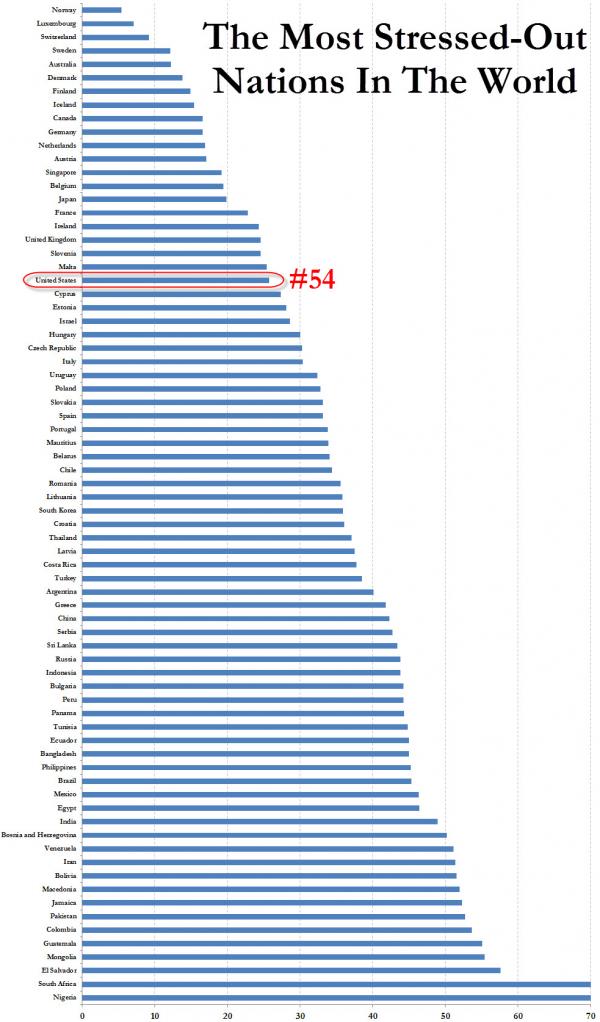
While anti-depressant use is surging in Sweden (up 1000% since 1980), bursting in Britain (up 495% since 1991), and up an astounding 400% since 1994 in the USA (with 1 in 10 on some kind of ‘prozac’), it is the poor-old Nigerians that should really be complaining. Based on seven variables,Bloomberg has scored 74 nations around the world for their “stressed-out” factor and finds the USA to be 54th (so stop whining and suck it up), Norway the least stressed-out of all and El Salvador and South Africa at the top with Nigeria (with the roiling Egyptians ranking 15th). Bloomberg ranked countries based on the stressfulness of their living environments. Read more of this post

Members of Italy’s Ligresti family, who once controlled insurer Fondiaria-SAI SpA (FSA), were arrested today on charges of false accounting and market manipulation

Ligresti Family Members Arrested in Fondiaria-SAI Probe

Members of Italy’s Ligresti family, who once controlled insurer Fondiaria-SAI SpA (FSA), were arrested today on charges of false accounting and market manipulation, police said. The family’s patriarch, Salvatore Ligresti, and his two daughters, were among seven people taken into custody by Italy’s financial police, according to an e-mailed statement from its Turin office. They are accused of misleading at least 12,000 investors by concealing 600 million euros ($789 million) of losses at Fondiaria-SAI in its 2010 accounts. Ligresti is under house arrest, while his daughters Giulia Maria and Jonella are being detained at an undisclosed jail, police said. Three former Fondiaria executives, Emanuele Erbetta, Antonio Talarico and Fausto Marchionni also have been charged. An arrest warrant was issued for Gioacchino Paolo Ligresti, one of Salvatore Ligresti’s sons, is in Switzerland, police said. Gian Luigi Tizzoni, a defense attorney for the Ligrestis, wasn’t immediately available to comment on the case. According to the police statement, the Ligrestis underestimated the company’s reserves for outstanding insurance claims, allowing it to distribute 253 million euros of earnings to the family holding company Premafin Finanziaria SpA (PF), instead of losses.

To contact the reporter on this story: Daniele Lepido in Milan at dlepido1@bloomberg.net

Fraud widespread in New Jersey free lunch program: state official

Fraud widespread in New Jersey free lunch program: state official

11:30am EDT

By Hilary Russ

(Reuters) – New Jersey will refer 109 names to criminal investigators after a probe allegedly found pervasive fraud in the federal free and low-cost lunch program in the state’s schools, a state official said on Wednesday. The alleged fraudsters are all public employees, their spouses or members of their households, accused of lying about their income so that their children would qualify for federally subsidized reduced-price lunches, according to New Jersey Comptroller Matthew Boxer. Six of the names, which were not released, are elected school board officials. The 109 people underreported their household income by more than $13 million altogether over the three years of records and 15 school districts that Boxer’s office examined, according to his report. Read more of this post

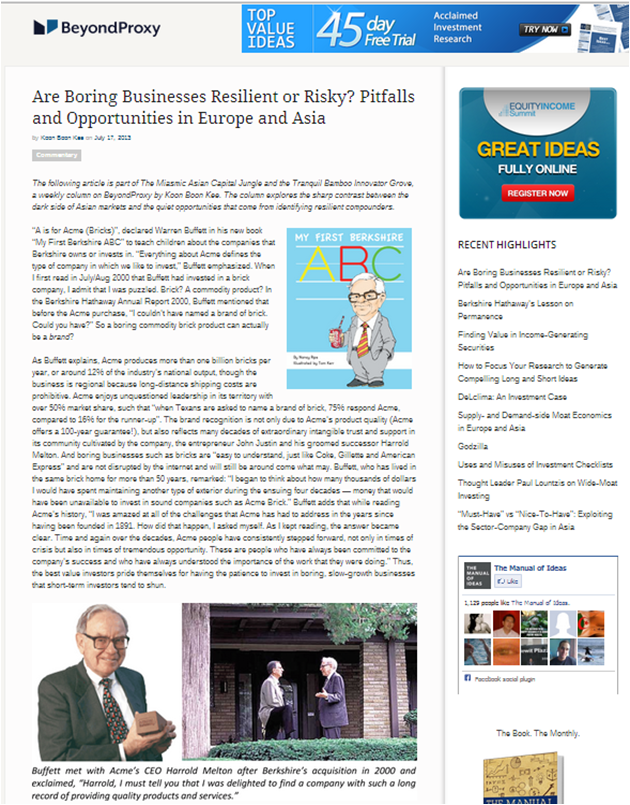
Are Boring Businesses Resilient or Risky? Pitfalls and Opportunities in Europe and Asia. Bamboo Innovator is featured in BeyondProxy.com, where value investing lives

Bamboo Innovator is featured in BeyondProxy.com, where value investing lives:

  • Are Boring Businesses Resilient or Risky? Pitfalls and Opportunities in Europe and Asia, July 17, 2013 (BeyondProxy)

BoringBusiness