Lessons from Mavericks: Staying Big by Acting Small
by Martin Reeves, George Stalk, and Jussi Lehtinen
JUNE 17, 2013
In an era in which scale-based leadership is both less durable and less valuable than it once was, many large corporations find themselves looking over their shoulders for the next disruption—the iPhone equivalent that could reshape their industry. In many cases, these disruptions come from mavericks—small outlier companies that think and act differently from incumbents. Read more of this post
By Jonathan Ford, Sally Gainsbury and Vanessa Houlder
The beloved British confectioner ran aggressive tax avoidance schemes at odds with its image
It was a deal that provoked visceral reactions in Britain. Even before Kraftcompleted its contentious £11.5bn purchase of Cadbury three years ago, politicians were warning the US group against trying to make a “fast buck” out of the UK confectioner. Read more of this post
In thisgroundbreaking book, two economists explain why economic imbalances cause civilcollapse and why the United States could be next.
From theMing Dynasty to Ottoman Turkey to imperial Spain, the Great Powers of the worldemerged as the greatest economic, political, and military forces of theirtimeonly to collapse into rubble and memory. What is at the root of their demiseandhow can the United States stop this pattern from happening again?
Aquarter century after Paul Kennedys The Rise and Fall of the Great Powers,Glenn Hubbard and Tim Kane present a bold, sweeping account of why powerful nationsand civilizations break down under the heavy burden of economic imbalance.Introducing a profound new measure of economic power, Balance traces thetriumphs and mistakes of imperial Britain, the paradox of superstateCalifornia, the long collapse of Rome, and the limits of the Japanese model of growth.Most importantly, Hubbard and Kane compare the twenty-first-century UnitedStates to the empires of old and challenge Americans to address the realproblems of our countrys dysfunctional fiscal imbalance. If there is not a neweconomics and politics of balance, they show that there will be an inevitable demiseahead. Read more of this post
Our great, global cities are turning into vast gated citadels where the elite reproduces itself
Two mournful friends dropped by our flat in Paris last Sunday. They are a well-paid couple from the caste known in Paris as “bobos”: people with bourgeois incomes and bohemian tastes. In the popular narrative, bobos have invaded Paris, driving out pure bohemians and the working class. But my bobo friends had a new story: they themselves were being driven out of Paris. To get enough space for their kids, they were leaving for the suburbs. When they’d told the headmaster at the children’s school, he had looked sad and said: “Everyone is leaving.” Paris is pricing out even the upper middle-class. Read more of this post
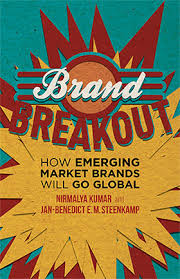
Brand Breakout: How Emerging Market Brands Will Go Global
By Nirmalya Kumar and Jan-Benedict Steenkamp Palgrave Macmillan, £16.99/$28
Unless you have been living in a world where you reject the notion of product identities, you are a sucker for brands. You may not be aware of it, but branding is why you bought the Financial Times today. It is why you drive the car you drive and it is why you don’t say: “Let me just Bing [rather than Google] that.”
So, given that emerging markets account for more than 40 per cent of global output, why are there no really well-known global emerging market brands?
That is the question put by Nirmalya Kumar of London Business School and UNC Kenan-Flagler’s Jan-Benedict Steenkamp. They think they have the answer. In Brand Breakout, they identify the factors they believe have stopped a big emerging market brand becoming a household name from Rio de Janeiro to Paris to Shanghai. Read more of this post
As I toured Israel Kirschner’s Bronx paintbrush factory earlier this month, I couldn’t stop feeling amazed that it was still in business. Many days, Kirschner feels the same way. The charming, energetic 69-year-old joked about his ancient equipment (“That could be 100 years old,” he said of a bristle-cleaning machine); his two least-committed employees, his son and daughter (“They come late, they leave early”); and how his business has been increasingly undercut by Chinese manufacturers. After introducing me to his star brush maker, Fermin Gil, a Mexican immigrant who “can just see” when a brush isn’t right, Kirschner handed me a one-inch boar-bristle brush with a wooden handle. A Chinese manufacturer sells it for 30 cents. If he made it himself, he told me, it would cost significantly more. Read more of this post
Ingenuity and ambition are all that the pioneer needs to take on established businesses
Is it harder to succeed as an entrepreneur because big companies control more industries than they did? This was the suggestion of a recent article by Ben Casselman in the Wall Street Journal. He made the case that start-ups are declining because animal spirits are fading in the US. Read more of this post
Katy Perry wears a dress by Domenico Dolce, left, and Stefano Gabbana, right at New York’s Met Museum.
MILAN—An Italian court on Wednesday sentenced Italian fashion designers Domenico Dolce and Stefano Gabbana to one year and eight months in prison for tax evasion.
The pair’s lawyer, Massimo Dinoia, said they planned to appeal, adding that the case is “groundless.” The designers, known for their sexy styles favored by celebrities such as Madonna, Naomi Campbell and Katy Perry, have denied the charges. Read more of this post
Ticket Master Schulenberg Becomes Billionaire in Germany
Selling tickets to Depeche Mode concerts and the 2014 Winter Olympics in Sochi, Russia, has made Klaus-Peter Schulenberg a billionaire. The founder and chairman of Munich-based CTS Eventim AG (EVD), Europe’s largest ticketing service, has seen his fortune soar as shares of Eventim have risen almost 40 percent in the past seven months. Schulenberg owns half of Eventim, according to the company’s annual report, a stake that is valued at about $975 million based on yesterday’s closing price. He also has collected more than $150 million in dividends and proceeds from stocks sales since the company’s 2000 initial public offering. That gives the 62-year-old a net worth of about $1.1 billion, according to the Bloomberg Billionaires Index.
Don’t fret, English majors: There are employers out there looking for you. One such empolyer is Bracken Darrell, the CEO of Logitech. He loves hiring English majors. In fact, he thinks graduates of the liberal arts are so rare that he calls them “endangered species.” “If you find one, you need to run over and catch them in a conversation,” he tells Business Insider. Read more of this post
Craig Dowden, Special to Financial Post | 13/06/21 | Last Updated:13/06/21 9:50 AM ET
The sheer volume and diversity of recent scandals in the corporate world, various levels of government, and even the media, has been astounding. Even though initiatives to get tough on corporate malfeasance were introduced and promoted in the early 2000s, it seems the only lesson learned is how to shield bad deeds more effectively while keeping up the appearance of compliance. Read more of this post
If you have ever experienced a job interview with Google, you know it can be grueling. Until a few years ago, Google was infamous for asking brainteasers such as, “How much should you charge to wash all the windows in Seattle?” and “Why are manholes round?” It now admits that those questions were useless. “We found that brainteasers are a complete waste of time,” Laszlo Bock, Google’s Senior VP of People Operations, tells The New York Times. “How many golf balls can you fit into an airplane? How many gas stations in Manhattan? A complete waste of time. They don’t predict anything. They serve primarily to make the interviewer feel smart.” In addition to trashing brainteasers, Google is also moving away from GPA requirements. Bock says there is a correlation between good employees and high GPAs and test scores if you’re just a few years out of school. But for every other candidate, Google no longer asks for that information. What’s Google’s hiring tactic now? Bock says his team uses behavioral interviews and asks for examples of how a person acted in a particular situation. It no longer asks hypothetical questions. Google also uses structured behavior interviews with a consistent rubric for assessing each person. “The interesting thing about the behavioral interview is that when you ask somebody to speak to their own experience, and you drill into that, you get two kinds of information,” Bock says. “One is you get to see how they actually interacted in a real-world situation, and the valuable “meta” information you get about the candidate is a sense of what they consider to be difficult.” Google also looks for leadership examples among candidates.
Google HR Boss Explains Why GPA And Most Interviews Are Useless
Google likely sees more data than any company on the planet. And that obsession carries through to hiring and management, where every decision and practice is endlessly studied and analyzed. Read more of this post
Hiring decisions have always been limited to a few imperfect factors, including what appears on a resume and what impression a candidate gives off in an informal interview. That’s all changing. As Dan Shapero, LinkedIn‘s VP of Talent Solutions and Insights puts it, “Recruiting has always been an art, but it’s becoming a science.” Read more of this post
Rapid Expansion the Way Forward for Barbeque Nation
by Shravan Bhat | Jun 21, 2013
Kayum Dhanani’s Barbeque Nation has grown from a tier 2 city restaurant to a tier 1 chain. And it is scaling fast
In Indore, it can get quite chilly in November. The temperature by the poolside at Sayaji Hotel was hovering around 7ºC, and restaurant manager Prosenjit Choudhury was getting complaints that kebabs served to the guests were going cold. One evening at home, Choudhury saw a television programme about nomads facing a similar problem while camping on riverbanks. They erected a grill using stacked armour, and roasted meat on it. Choudhury began serving kebabs, which were 90 percent cooked, on mini-grills at the tables. It was a hit. After a successful stint in Sayaji Hotel’s banquets division—he had started with parent company Sayaji Hotels as a management trainee in 1995—Choudhury got the go-ahead from Sajid Dhanani, then MD of Sayaji Hotels, to enter food retail. As CEO of Barbeque Nation, Choudhury brought the idea from Indore to Mumbai in 2006, with the city’s first Barbeque Nation at Pali Hill, in Bandra. Between 2006 and 2008, Barbeque Nation grew from a single outlet to 13. Today, it has 35 outlets, 18 of them opening in the last year alone. With a revenue of Rs 200 crore last year (it is expected to touch Rs 350 crore this fiscal), the chain brings in roughly Rs 9 crore per store, one of the highest for restaurant chains in India. Profit margins are 19 percent, which, for a buffet service serving unlimited meat and seafood, is remarkable.
Science may be humankind’s greatest success as a species. Thanks to the scientific revolution that began in the 17th century, humans today enjoy instant communication, rapid transportation, a rich and diverse diet, and effective prevention and treatment for once-fatal illnesses.
11 HOURS 20 MIN AGO
Science may be humankind’s greatest success as a species. Thanks to the scientific revolution that began in the 17th century, humans today enjoy instant communication, rapid transportation, a rich and diverse diet, and effective prevention and treatment for once-fatal illnesses. Read more of this post
Abstract:
Although economic and social relationships can involve deception (Gneezy 2005), such relationships are often governed by informal contracts that require trust (Berg et al.1995). While important advances have been made concerning deception in economics, the research has focused little on written forms of communication. Are there certain systematic cues that signal written communications as dishonest? Are those signals accurately detected and used by message receivers? We fill this gap by studying messages written in a novel three-person trust game; (we call it the “Mistress Game”). We find that: (1) messages that use encompassing terms, or a greater number of words, are significantly more likely to be viewed as promises; and (2) promises that mention money are significantly more likely to be trusted. Notwithstanding the latter finding, we find senders who mention money within their promises to be significantly less likely to keep their word than those who do not; observers respond to cues but in the wrong way.
Abstract:
Business schools have the responsibility to inspire professional culture in future managers. This means that they have to provide them not only with the expertise, knowledge and skills required in their field of specialization, but also with a sense of responsibility toward others and society at large. This need has been increasingly evident during the period of the global financial crisis, and a number of initiatives have been reported by business schools worldwide to address the issue. In this paper we examine the issue of professionalism in business management from two perspectives: business practice, and relation to ancient philosophy. Drawing from the literature, we propose a framework defining professionalism as composed of three patterns: a) possession of a systematic body of knowledge, b) commitment to a good broader than self-interest, and c) an overall ethical character of the activity and ethical conduct. We show how these patterns are reflected to the expectations that corporations have from business practitioners. We further demonstrate that substantial elements of business professionalism are strongly related to core values and principles introduced in the social and political thought of ancient philosophers, and thus suggest that ancient philosophy could be used as a means for inspiring professionalism in business managers.
Some Autistic Children Don’t Find Pleasure in Voices
Children with autism spectrum disorder may not perceive human voices as pleasurable because of a physical disconnect between the brain regions involved in speaking and those linked to rewards, a study suggests.
Brain imaging determined that the connections between the two brain regions were stronger in children who don’t have the disorder than in those diagnosed with it, said Daniel Abrams, the lead author. That’s important because communication problems are key diagnostic criteria for autism.
One in 50 U.S. children are diagnosed with autism or a related disorder, according to the Centers for Disease Control and Prevention. The majority have difficulty using language effectively, including being unable to grasp nuances of speech such as rhythm and tone, according to the National Institutes of Health. The newest research, published in the Proceedings of the National Academy of Sciences, is the first to suggest why. Read more of this post
Abstract: Do the laws of economics apply in the magical world of Harry Potter? We argue that even though J.K Rowling placed her characters in a world of magic, wizards remain subject to the implications of scarcity and must obey economic principles. As a result, the series is abundant with illustrations of choice within constraint, marginal thinking, the power of incentives, and the role of institutions. The contents of the books, along with their extraordinary popularity, provide a tool powerful enough to inspire students to adopt the economic way of thinking for life. We demonstrate the pedagogical potential of the series by providing examples for each of Mankiw’s Ten Key Principles of Economics.
Hirschman was a planner who saw virtue in the fact that nothing went as planned. Illustration by Ricardo Martinez.
In the mid-nineteenth century, work began on a crucial section of the railway line connecting Boston to the Hudson River. The addition would run from Greenfield, Massachusetts, to Troy, New York, and it required tunnelling through Hoosac Mountain, a massive impediment, nearly five miles thick, that blocked passage between the Deerfield Valley and a tributary of the Hudson.
James Hayward, one of New England’s leading railroad engineers, estimated that penetrating the Hoosac would cost, at most, a very manageable two million dollars. The president of Amherst College, an accomplished geologist, said that the mountain was composed of soft rock and that tunnelling would be fairly easy once the engineers had breached the surface. “The Hoosac . . . is believed to be the only barrier between Boston and the Pacific,” the project’s promoter, Alvah Crocker, declared. Read more of this post
The success of failure of a business can come down to one single bold decision. A recent thread on Quora asked users to name the “the shrewdest, smartest maneuver you’ve ever seen in business.” We’ve broken out some of the best answers, including critical decisions by Bill Gates, Steve Jobs, and Henry Ford. Bill Gates originally wrote a PC operating system for IBM. He convinced them to let him sell it to others, starting him on the way to becoming the richest man in the world.
Bill Gates using an early version of Microsoft Excel
Back in the 1980s, IBM asked Bill Gates to produce the operating system for its PCs. He licensed an operating system from Tim Patterson (QDOS) for $50,000, modified it, named it MS-DOS, and sold it to IBM. Gates managed to convince IBM to let him market the system separately, because IBM thought all of the money was in hardware. When other companies started to build their own PCs, MS-DOS was the standard, and Microsoft made a fortune. Read more of this post
In business and in life, the most critical choices we make relate to people. Yet being a good judge of people is difficult. How do we get better at sizing up first impressions, at avoiding hiring mistakes, at correctly picking (and not missing) rising stars?
The easy thing to do is focus on extrinsic markers — academic scores, net worth, social status, job titles. Social media has allowed us to add new layers of extrinsic scoring: How many friends do they have on Facebook? Who do we know in common through LinkedIn? How many Twitter followers do they have?
But such extrinsic credentials and markers only tell one part of a person’s story. They are necessary, but not sufficient. What they miss are the “softer” and more nuanced intrinsic that are far more defining of a person’s character. You can teach skills; character and attitude, not so much. Read more of this post
In the Google age, approach to education needs a rethink
Would a person with good handwriting, spelling and grammar and instant recall of multiplication tables be considered a better candidate for a job than, say, one who knows how to configure a peer-to-peer network of devices, set up an organisation-wide Google calendar and find out where the most reliable sources of venture capital are, I wonder? The former set of skills is taught in schools, the latter is not.
BY SUGATA MITRA –
4 HOURS 32 MIN AGO
Would a person with good handwriting, spelling and grammar and instant recall of multiplication tables be considered a better candidate for a job than, say, one who knows how to configure a peer-to-peer network of devices, set up an organisation-wide Google calendar and find out where the most reliable sources of venture capital are, I wonder? The former set of skills is taught in schools, the latter is not.
In school examinations, learners must reproduce facts from memory, solve problems using their minds and paper alone. They must not talk to anyone or look at anyone else’s work. They must not use any educational resources, certainly not the Internet. Read more of this post
Montreal Mayor Arrested by Quebec Anti-Corruption Police
Montreal Mayor Michael Applebaum faces 14 criminal charges, including fraud and breach of trust, after being arrested today by Quebec’s anti-corruption task force as part of a bribery case.
The charges are linked to two real-estate transactions that involved “tens of thousands of dollars” in illegal payments between 2006 and 2011, Robert Lafreniere, head of Quebec’s anti-corruption unit, told reporters at a televised press conference in Montreal today. Applebaum was arrested at his home, police said in a statement posted on the provincial government’s website. Read more of this post
The Bank of England governor talks to the FT’s Martin Wolf about exits, euro solutions and the ‘audacity of pessimism’
Sir Mervyn King, who is to end 10 years as governor of the Bank of England at the end of the month, has organised this lunch himself. Uli in Notting Hill, he has explained in advance, is a favourite local restaurant, specialising in east Asian food. It is normally closed on Saturday lunchtime but Sir Mervyn has arranged for it to be opened especially for us. He has also asked the owner, Michael, to choose the food. The result is as excellent as it is excessive: soft-shelled crab; spicy scallops; Mongolian lamb, Singaporean laksa (a soup); steamed turbot; lamb curry; special fried rice; aubergine in sweet chilli; and seafood udon (noodles). The meal is devastatingly large. Read more of this post
Fashion designer Lisa Ho’s (L) label is reportedly riddled with $11m in debt.
WELL-REGARDED industry stalwart and a star performance at the recent Australian fashion week weren’t enough to keep designer brand Lisa Ho in business, with stores set to close.
Today, administrators for the Lisa Ho Group, Barry Taylor and Todd Gammel of HLB Mann Judd, announced that despite considerable interest, ‘a sale of the Lisa Ho Group business as a going concern has not been achieved within the sale program’.
Discussions are continuing with a number of interested parties in relation to the purchase of intellectual property, stock and other assets of the Lisa Ho Group.
“The Administrators are now focused on an orderly closure of the remaining Lisa Ho Group stores.”
For the past 30 years the Lisa Ho label followed a modern, fashion-now aesthetic but like most fashion retailers, particularly following the GFC, there has been thwarted demand growth and increased competition of numerous online retailers. Read more of this post
Peter Cundill, a philanthropist and investor whose work has been praised by the likes of Warren Buffett, found his life changed forever when he discovered the value investment principles of Benjamin Graham and began to put them into action. There’s Always Something to Do tells the story of Cundill’s voyage of discovery, with all its ups and downs, as he developed his immensely successful investment strategies. In the context of recent financial upheavals and ongoing uncertainty, Peter Cundill’s wise and frequently funny reflections are more important than ever. In a seamlessly assembled narrative drawn from interviews, speeches, and exclusive access to the daily journal Cundill kept for forty-five years, Christopher Risso-Gill outlines Cundill’s investment approach and provides accounts of his investments and the analytical process that led to their selection. A book for everyday investors as much as professional investors and investment gurus, There’s Always Something to Do offers a compelling perspective on global financial markets and on how we can avoid their worst pitfalls and grow our hard-earned capital.
A cup of tea may be the best way to engage employees
By Lucy Kellaway
People may come to dislike their jobs a little less, but seldom learn to love them
Last week I met a professor of office design who talked excitedly about creating visionary spaces for people to work in and filling the air with the scent of fresh linen. After a bit, I protested that surely all we wanted from an office building was natural light and something relatively comfortable to sit on.
“It’s all very well for you to say that,” he snapped. “You don’t care about your surroundings because you love your job. Most people don’t love theirs.”
It is true that I do like my job. It’s also true that most people don’t like theirs one bit. (I’m avoiding the word “love” here, let alone “passion”, as both are unseemly in an employee.) Every week brings another survey telling how occupational dislike rules in offices. Last week there was a study showing that 77 per cent of UK workers felt they had chosen the wrong career. In the US, a recent report stated that only 19 per cent of workers professed themselves satisfied with their jobs. Read more of this post
Jet-set monks warned after video exposes lavish lifestyle
Monday, June 17, 2013 – 12:26 PM
Thailand’s Buddhist monks are under investigation following complaints sparked by a video showing some flying on a private jet. The YouTube video showed one of the monks was wearing stylish aviator sunglasses, carrying a luxury brand travel bag and sporting a pair of modern-looking wireless headphones. It attracted criticism from Buddhists nationwide. Office of National Buddhism director-general Nopparat Benjawatananun said that the agency saw the video and had warned the monks from a monastery in Thailand’s north-east not to repeat the lavish behaviour. It plans to monitor monks nationwide. With the world’s largest Buddhist population, Thailand has attempted to help Buddha’s 2,600-year-old doctrine stand the test of time through a variety of means, including imposing a ban on the sale of alcohol on religious holidays. The efforts, however, are sometimes tainted by the monks themselves. Last year, about 300 out of 61,416 Buddhist monks and novices in Thailand were reprimanded – in several cases removed from the monkhood – because of their misconduct, ranging from alcohol consumption, having sex with women, to extortion. The office also received complaints about monks driving cars, and scams and false claims of black magic uses by monks. Mr Nopparat said the Buddhist monks in the video were acting “inappropriately, not composed and not adhering to Buddha’s teachings of simplicity and self-restraint.” Monruedee Bantoengsuk, an administrative officer at Khantitham Temple in Sisaket province, confirmed that the monks on the private plane lived at the temple but refused to give details about the trip. “We can explain this, but not now,” she said, saying that the abbot, who appeared in the video, is currently on a religious tour in France. The images from the video contrasted with the abbot’s message on the temple’s homepage that read: “The true core of those who preach Buddha’s teachings is to not to own any objects at all.” “When Lord Buddha was alive, there wasn’t anything like this. There were no cars, smart phones or cameras, so the rules were much simpler,” said Mr Nopparat. “While the monks need to keep themselves abreast of new knowledge, current events and technology, they are restrained to choose the appropriate tools.” He said one way to prevent the monks from misbehaving is for followers not to spoil them with valuable objects or vices. “In many cases, it was the followers who gave the monks the luxury. Some bought them sports cars. This is by no means necessary.”
H.E.R.O. stands for “Honorable. Exponential. Resilient. Organization.” and is operationalized into a unique, systematic 4-step investment process to identify the winners. The investment objective seeks to capture long-term investment returns created by disruptive forces and innovation by focusing on high-quality and liquid listed equities in the Asia-Pacific region that ride on and benefit from them. Through our cross-sector and in-depth fundamental research process, the Fund aim to provide access to companies whom we believe are run by high-integrity, honorable and far-sighted owner-operators with a higher sense of purpose in solving High-Value Problems for their target customers and society, and have unique, scalable and wide-moat business models with sustainable competitive advantages and innovative products, services, and processes to create, expand and service their total addressable market, including the resiliency and balance sheet strength to maintain or grow profitability, pricing power and market positions through up/downturns in the economy.