The Downside of Entrepreneurial Success; They hit the jackpot once, and then think they have the magic

June 7, 2013, 1:57 p.m. ET

The Downside of Entrepreneurial Success

They hit the jackpot once, and then think they have the magic. It’s up to financial advisers to burst their bubble.

By DAISY MAXEY

WE-AA509_ENTREP_G_20130607161951

Sometimes, the worst thing that can happen to an entrepreneur is being successful.

So say many financial advisers who tell tales of entrepreneurs who hit it big—only to let success go their heads. It’s then up to the advisers to somehow keep their clients from taking subsequent risks that threaten their financial future. Financial adviser Tony DaRoza, for instance, remembers all too well the client who did so well he ended up losing $100 million. After selling his first technology company and taking his second public, the client took only enough money off the table to ensure that his family would be fine and that his children could go to college, recalls Mr. DaRoza, a managing director at the Merrill Lynch Wealth Management unit of Bank of America Corp. BAC +1.36% in San Francisco. Most of the rest disappeared when the tech bubble burst, he says. The problem, Mr. DaRoza says, rests with the “gambling mentality” of some entrepreneurs. A bit of a risk-taking bent is a good thing; it’s how entrepreneurs make their fortune. But after one or several successful business ventures, entrepreneurs may begin to believe they’re infallible. And for some it isn’t just their own endeavors they’re certain of; their confidence in taking risks may kick in when they are approached by a persuasive colleague, acquaintance or family member seeking money for a new venture. Read more of this post

How We Spend Our Days Is How We Spend Our Lives: Annie Dillard on Presence Over Productivity

How We Spend Our Days Is How We Spend Our Lives: Annie Dillard on Presence Over Productivity

“The life of sensation is the life of greed; it requires more and more. The life of the spirit requires less and less.”

The meaning of life has been pondered by such literary icons as Leo Tolstoy (1904), Henry Miller (1918), Anaïs Nin (1946), Viktor Frankl (1946), Italo Calvino (1975), and David Foster Wallace (2005). And though some have argued that today’s age is one where “the great dream is to trade up from money to meaning,” there’s an unshakable and discomfiting sense that, in our obsession with optimizing our creative routines and maximizing our productivity, we’ve forgotten how to be truly present in the gladdening mystery of life. From The Writing Life (public library) by Annie Dillard – a wonderful addition to the collected wisdom of beloved writers – comes this beautiful and poignant meditation on the life well lived, reminding us of the tradeoffs between presence and productivity that we’re constantly choosing to make, or not:

How we spend our days is, of course, how we spend our lives. What we do with this hour, and that one, is what we are doing. A schedule defends from chaos and whim. It is a net for catching days. It is a scaffolding on which a worker can stand and labor with both hands at sections of time. A schedule is a mock-up of reason and order—willed, faked, and so brought into being; it is a peace and a haven set into the wreck of time; it is a lifeboat on which you find yourself, decades later, still living. Each day is the same, so you remember the series afterward as a blurred and powerful pattern.

She goes on to illustrate this existential tension between presence and productivity with a fine addition to history’s great daily routines and daily rituals:

The most appealing daily schedule I know is that of a turn-of-the-century Danish aristocrat. He got up at four and set out on foot to hunt black grouse, wood grouse, woodcock, and snipe. At eleven he met his friends, who had also been out hunting alone all morning. They converged “at one of these babbling brooks,” he wrote. He outlined the rest of his schedule. “Take a quick dip, relax with a schnapps and a sandwich, stretch out, have a smoke, take a nap or just rest, and then sit around and chat until three. Then I hunt some more until sundown, bathe again, put on white tie and tails to keep up appearances, eat a huge dinner, smoke a cigar and sleep like a log until the sun comes up again to redden the eastern sky. This is living…. Could it be more perfect?”

Dillard juxtaposes the Danish aristocrat’s revelry in everyday life with the grueling routine of a couple of literary history’s most notorious self-disciplinarians:

Wallace Stevens in his forties, living in Hartford, Connecticut, hewed to a productive routine. He rose at six, read for two hours, and walked another hour—three miles—to work. He dictated poems to his secretary. He ate no lunch; at noon he walked for another hour, often to an art gallery. He walked home from work—another hour. After dinner he retired to his study; he went to bed at nine. On Sundays, he walked in the park. I don’t know what he did on Saturdays. Perhaps he exchanged a few words with his wife, who posed for the Liberty dime. (One would rather read these people, or lead their lives, than be their wives. When the Danish aristocrat Wilhelm Dinesen shot birds all day, drank schnapps, napped, and dressed for dinner, he and his wife had three children under three. The middle one was Karen.)

[…]

Jack London claimed to write twenty hours a day. Before he undertook to write, he obtained the University of California course list and all the syllabi; he spent a year reading the textbooks in philosophy and literature. In subsequent years, once he had a book of his own under way, he set his alarm to wake him after four hours’ sleep. Often he slept through the alarm, so, by his own account, he rigged it to drop a weight on his head. I cannot say I believe this, though a novel like The Sea-Wolf is strong evidence that some sort of weight fell on his head with some sort of frequency – but you wouldn’t think a man would claim credit for it. London maintained that every writer needed a technique, experience, and a philosophical position.

At the heart of these anecdotes of living is a dynamic contemplation of life itself:

There is no shortage of good days. It is good lives that are hard to come by. A life of good days lived in the senses is not enough. The life of sensation is the life of greed; it requires more and more. The life of the spirit requires less and less; time is ample and its passage sweet. Who would call a day spent reading a good day? But a life spent reading – that is a good life. A day that closely resembles every other day of the past ten or twenty years does not suggest itself as a good one. But who would not call Pasteur’s life a good one, or Thomas Mann’s?

The Writing Life is sublime in its entirety, the kind of book that stays with you for lifetimes.
How do you build a culture of innovation? Tim Brown, CEO of IDEO, describes why empathy is an important part of the equation

How do you build a culture of innovation?

by SHANE PARRISH on JUNE 2, 2013

http://bcove.me/v25prnc1

How does a successful company maintain a climate in which new ideas and risk-taking are encouraged? In this interview, Tim Brown, CEO and president of the design consultancy IDEO, describes how he thinks about innovation and why empathy is an important part of the equation. Organizations are well intentioned. They put people in charge of innovation. They hold meetings on innovation. They mandate innovation. Yet, despite all of these words and actions, to no one’s surprise, they largely fail to innovate. That’s because innovation is cultural. A 2009 study in the Journal of Marketing set out to identify the factors that predicated whether a firm would innovate or not. While there are a lot of variables at play, the study found, the most important driver of innovation was internal corporate culture. An article in Sloan MIT Management Review identifies a series of “building blocks” for an innovative culture, including hard-to-measure characteristics such as values, behavior, and climate. “An innovative climate,” the authors write, “cultivates engagement and enthusiasm, challenges people to take risks within a safe environment, fosters learning, and encourages independent thinking.” Here’s the transcript of the Interview with Tim Brown. Read more of this post

How to Make Mistakes; “Instead of turning away in denial when you make a mistake, you should become a connoisseur of your own mistakes, turning them over in your mind as if they were works of art, which in a way they are.”

How to Make Mistakes

by SHANE PARRISH on JUNE 6, 2013

In Intuition Pumps And Other Tools for Thinking, Daniel Dennett, one of the world’s leading philosophers offers a trove of mind-stretching thought experiments, which he calls “imagination-extenders and focus-holders” (intuition pumps). They allow us to “think reliably and even gracefully about really hard questions.”

The first intuition pump is on mistakes.

History Rhymes

The history of philosophy is in large measure the history of very smart people making very tempting mistakes, and if you don’t know the history, you are doomed to making the same darn mistakes all over again.

Learning

Mistakes are not just opportunities for learning; they are, in an important sense, the only opportunity for learning or making something truly new. Before there can be learning, there must be learners. There are only two non-miraculous ways for learners to come into existence: they must either evolve or be designed and built by learners that evolved. Biological evolution proceeds by a grand, inexorable process of trial and error — and without the errors the trials wouldn’t accomplish anything.

Evolution is the Enabling Process of Knowledge

Evolution is one of the central themes of this book, as all my books, for the simple reason that it is the central, enabling process not only of life but also of knowledge and learning and understanding. If you attempt to make sense of the world of ideas and meanings, free will and morality, art and science and even philosophy itself without a sound and quite detailed knowledge of evolution, you have one hand tied behind your back. … For evolution, which knows nothing, the steps into novelty are blindly taken by mutations, which are random copying “errors” in DNA.

The Key to Good Mistakes

The chief trick to making good mistakes is not to hide them — especially not from yourself. Instead of turning away in denial when you make a mistake, you should become a connoisseur of your own mistakes, turning them over in your mind as if they were works of art, which in a way they are. The fundamental reaction to any mistake ought to be this: “Well, I won’t do that again!” Natural selection doesn’t actually think the thought; it just wipes out the goofers before they can reproduce; natural selection won’t do that again, at least not as often. Animals that can learn—learn not to make that noise, touch that wire, eat that food—have something with a similar selective force in their brains. (B. F. Skinner and the behaviorists understood the need for this and called it “reinforcement” learning; that response is not reinforced and suffers “extinction.”) We human beings carry matters to a much more swift and efficient level. We can actually think the thought, reflecting on what we have just done: “Well, I won’t do that again!” And when we reflect, we confront directly the problem that much be solved by any mistake-maker: what, exactly, is that? What was it about what I just did that got me into all this trouble? The trick is to take advantage of the particular details of the mess you’ve made, so that your next attempt will be informed by it and not just another blind stab in the dark. Read more of this post

Negative Emotions Are Key to Well-Being; Feeling sad, mad, critical or otherwise awful? Surprise: negative emotions are essential for mental health

Negative Emotions Are Key to Well-Being

Feeling sad, mad, critical or otherwise awful? Surprise: negative emotions are essential for mental health

By Tori Rodriguez  | Wednesday, June 5, 2013 | 40

A client sits before me, seeking help untangling his relationship problems. As a psychotherapist, I strive to be warm, nonjudgmental and encouraging. I am a bit unsettled, then, when in the midst of describing his painful experiences, he says, “I’m sorry for being so negative.”

A crucial goal of therapy is to learn to acknowledge and express a full range of emotions, and here was a client apologizing for doing just that. In my psychotherapy practice, many of my clients struggle with highly distressing emotions, such as extreme anger, or with suicidal thoughts. In recent years I have noticed an increase in the number of people who also feel guilty or ashamed about what they perceive to be negativity. Such reactions undoubtedly stem from our culture’s overriding bias toward positive thinking. Although positive emotions are worth cultivating, problems arise when people start believing they must be upbeat all the time. Read more of this post

Can Positive Thinking Be Negative? Research suggests limits to looking on the sunny side of life

Can Positive Thinking Be Negative?

Research suggests limits to looking on the sunny side of life

By Scott O. Lilienfeld and Hal Arkowitz  | Tuesday, June 7, 2011 | 9

“Accentuate the positive,” the 1944 song by Johnny Mercer and Harold Arlen cheerfully implored us. From Benjamin Franklin’s 1750 Poor Richard’s Almanack(which advised readers that “sorrow is good for nothing but sin”) to today’s parade of motivational speakers, Americans have long embraced an optimistic, “can-do” attitude toward life. Plug “positive thinking” into Amazon.com, and you will find a never-ending supply of products designed to help us see life through rose-colored lenses, including a “Power of Positive Thinking” wall calendar and an “Overcoming Adversity with Encouragement and Affirmation” poster series.

In fact, however, positivity is not all it is cracked up to be. Although having an upbeat attitude undoubtedly has its benefits, gains such as better health and wealth from high spirits remain largely undemonstrated. What is more, research suggests that optimism can be detrimental under certain circumstances. Read more of this post

Demand For Lunch with Warren Buffett Crashes By 71% As Charity Lunch Raises Least In 6 Years

Demand For Warren Buffett’s Company Crashes By 71% As Charity Lunch Raises Least In 6 Years

Tyler Durden on 06/08/2013 12:20 -0400

Warren Buffet Glide Foundation Lunch_0

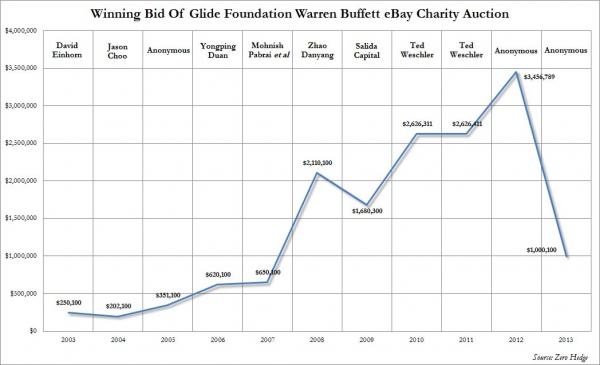
Demand for Warren Buffett, the investor, peaked in 2012 when an anonymous donor bid $3,456,789 for the annual Glide Foundation’s eBay lunch with the Octogenarian of Omaha. Demand for Warren Buffett, 82, the Obama tax and fairness advisor, however, is a mere fraction as the stunned Glide Foundation found out last night when the final bid for the “Power Lunch for 8 with Warren Buffett to Benefit GLIDE Foundation” auction closed at the lowest possible 6 digit increment, or an embarrassing $1,000,100. This was the lowest demand to have lunch with Buffett since 2007.This is a stunning result considering that with every passing year, for obvious reasons, the likelihood of many more such “power lunches” drops exponentially. We hope Buffett-demand is not a proxy leading indicator for the stock market or else a 71% plunge is coming. The San Francisco Business Times reports on the stunned response:

Glide stunned as Warren Buffett lunch raises just $1 million

The last few minutes of bidding for the annual charity lunch with Warren Buffett are normally happy ones for supporters of San Francisco’s Glide Foundation. In recent years, last-minute bidding has regularly pushed the price to record levels. Last year’s lunch for eight almost tripled in the final minute of bidding, closing at $3.46 million. With bidding nearing the $1 million mark by mid-afternoon Friday, expectations ran high that the lunch with the Berkshire Hathaway Chairman and CEO could cross $4 million for the first time. But as the auction closed at just $1,000,100, some attending the invitation-only countdown party at Restaurant Lulu in San Francisco could be heard speculating that a glitch must have occurred. At the party, I asked Alan Marks, eBay’s communications chief, about the possibility of a glitch. He defended the integrity of the auction. Read more of this post

The business lessons behind Disney’s magical experiences

The business lessons behind Disney’s magical experiences

Caitlyn Coverly, Special to Financial Post | 13/06/07 | Last Updated:13/06/06 12:16 PM ET

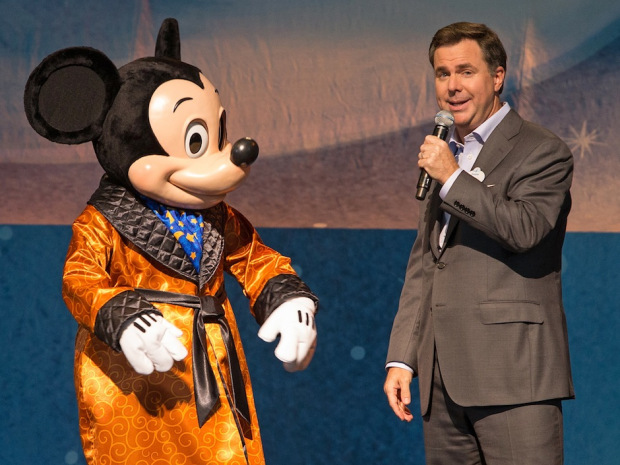
Premiere Of Disneyland's "Mickey And The Magical Map" New Stage Show

Michael Colglazier, President of Disneyland Resort, speaks prior to the premiere of Disney’s new stage show “Mickey and the Magical Map” at Disneyland on May 23, 2013 in Anaheim, California.

Last week, 250 GTA business professionals participated in “Disney’s Approach to Business Excellence,” an all day workshop offered through the Disney Institute and organized by McMaster University’s DeGroote School of Business in partnership with the Certified General Accountants of Ontario (CGA).

Workshop attendees watched case studies, answered questions, and participated in several group exercises led by Bryan Tabler and Amy Rossi, two facilitators from the Disney Institute and veteran employees of Disney.  The goal of the day was to learn the strategies Disney believes are key to the successful maintenance of The Walt Disney Company. These strategies are regarded as Disney’s five universal assets of a successful business — also known as the Disney Chain of Excellence — made up of leadership excellence, cast excellence, guest satisfaction and financial results/repeat business. Read more of this post

Truly Great Companies Add More Than They Extract

JUNE 7, 2013, 11:52 AM

Truly Great Companies Add More Than They Extract

By TONY SCHWARTZ

Perhaps no business consultant enjoys higher esteem in the corporate world than Jim Collins. Over three decades, he has sold millions of copies of his books describing the characteristics of what he terms “great” companies. It is hard not to admire his diligence. Along with a large team of researchers, Mr. Collins spends years gathering evidence and analyzing companies. The primary measure he uses for greatness is how well a company performs for its shareholders over a given period of time. The problem – as we have all been warned – is that past financial performance is no guarantee of future results.

For “Good to Great,” his most successful book, published in 2001, Mr. Collins selected 11 companies as truly elite performers. They included Circuit City (now bankrupt and defunct); Fannie Mae (taken over by the government in 2008 after huge mortgage losses); Pitney Bowes, whose stock has progressively tanked over the last decade; and Altria, the world’s largest tobacco company, which has actually performed well in the marketplace, but earns its revenues almost exclusively from a product that causes five million deaths a year. In “Great by Choice,” published in 2011, Mr. Collins and a co-author, Morten T. Hansen, call out seven companies for “spectacular” results – outperforming the overall stock market and their industry competitors by at least 10 times over a 15-year period. They also set up comparisons with companies in the same industries that performed markedly less well. The most striking comparison involves Microsoft, which Mr. Collins and Mr. Hansen identify as a great performer, and Apple, which they cite as the comparative laggard. Yes, you read that right. Here’s why: the 15-year period the authors happened to examine was 1987 to 2002.

How could so much research miss the mark by so far? Read more of this post

Look How Much Richer You Would Be If You Bought Company Stock Instead Of Products

Look How Much Richer You Would Be If You Bought Company Stock Instead Of Products

Mandi Woodruff | Jun. 8, 2013, 11:39 AM | 27,001 | 4

Whether it’s the latest iGadget or a hot new car, as consumers, we’re always scrambling for dibs on the “next big thing” in stores. But what if we put that money toward stock in the companies behind our favorite products instead? That’s a question recently explored by the Online Trading Academy. With the benefit of hindsight, their team has taken a look back in time to see what might have happened if we’d ditched the supermarket and invested in the stock market.

In 1990, Apple peddled the Macintosh Classic for $1,500. That much cash in Apple stock would have earned you $98,606 today.

Adjusted stock price in 1990: $6.45

Stock Price on April 5, 2013: $423.20

In 1986, the revolutionary Microsoft Windows 2.0 sold for $100. But if you’d put the money directly into company stock instead, today you’d have $11,480.

Adjusted stock price in 1986: $0.25

Stock price on April 5, 2013: $28.70

In 1985, if you chose to invest $200 in Best Buy Stock, instead of splurging on a Sony Walkman for the same price, you would have $36,343 today.

Adjusted in 1985: $0.14

Stock price on April 5, 2013: $25.45

Forty years ago, you could have dropped $460 on an IBM personal typewriter. But you would have made $38,113 if you’d invested that cash in IBM stock instead.

Adjusted stock price in 1962: $2.52

Stock price on April 5, 2013: $209.41

In 1984, a high-end riding lawn mower from Home Depot would have set you back $2,595. A better idea would have been to put that money in stocks and walk away with $699,199 today.

Adjusted stock price in 1984: $0.26

Stock price on April 5, 2013: $70.06

In 1968, if you stuck with your old fridge in lieu of a $500 GE refrigerator and invested that money in stock instead, you would have $47,763 today.

Adjusted stock price in 1968: $0.24

Stock price on April 5, 2013: $22.93

Walmart charged $15.95 for a toaster in 1972. With that cash in Walmart stock instead, you would have earned $30,403 today.

Adjusted stock price in 1972: $0.04

Stock price on April 5, 2013: $76.39

In 1982, you could have ruled the roads in a $6,572 Ford Mustang. A savvier spender would have put that money into Ford itself, and walked away with $314,433 today.

Adjusted stock price in 1982: $0.26

Stock price on April 5, 2013: $12.44

You couldn’t keep Nike Air Jordan’s on shelves back in the late ’80s. But if you saved that $65 and put it in Nike stock instead, you’d have $9,789 to show for it today.

Adjusted stock price in 1987: $0.39

Stock Price on April 5, 2013: $58.97

If you’d had the forethought to invest your annual coffee money ($520) in Starbucks stock in 1992, you’d have enough to buy a franchise of your own: $46,934.

Adjusted stock price in 1992: $0.64

Stock Price on April 5, 2013: $57.80

In 1970, you could have fed Big Macs to a family of four for $2.20. If only you’d put that money in McDonald’s stock instead, you’d have a cool $1,116 today.

Adjusted stock price in 1970: $0.20

Stock price on April 5, 2013: $101.42

Too much of a good thing: Leaders need to learn to beware of their strengths

Too much of a good thing: Leaders need to learn to beware of their strengths

Jun 8th 2013 |From the print edition

20130608_WBD000_0

IT IS only natural for leaders to try to make the most of their strengths. The theory of comparative advantage directs people, as well as countries and firms, to focus on what they are good at. Management experts have tended to concur: one of the bestselling business books of recent years is called “Now Discover Your Strengths”, by Marcus Buckingham and Donald Clifton. When business schools (and indeed business columnists) profile bosses, they often assume that more is better. But is this right? Three more recent books express some doubts. In “Fear Your Strengths”, Robert Kaplan and Robert Kaiser argue that “what you are best at could be your biggest problem.” Forcefulness can become bullying; decisiveness can turn into pigheadedness; niceness can develop into indecision. Read more of this post

Deluded bosses: Who’s behind me? The powerful overestimate the support of underlings

Deluded bosses: Who’s behind me? The powerful overestimate the support of underlings

Jun 8th 2013 |From the print edition

HISTORY is littered with powerful people undone by hubris. Julius Caesar should have ignored the cheers of the Roman crowd and paid heed to the soothsayer. The late Steve Jobs overplayed his hand at Apple as a young man and was kicked out of the company he founded. And then there was Jimmy Cayne.

When Mr Cayne walked out of Bear Stearns for the last time, having been eased out as boss of the ailing bank, he claimed there wasn’t a dry eye in the house. Through the tears, he wistfully recalls, heart-broken bankers sent him on his way with a standing ovation. This is not how his staff remember it. So disliked was he that according to “House of Cards”, a book by William Cohan, underlings would ask in meetings: “Is Jimmy staying on? [Because] we’re not coming back for another year of this shit.” Read more of this post

TSMC to feature on Japanese show about industry in Asia; NHK’s new show — Shima Kosaku’s Asia Success Story — focuses on famous Asian business leaders and their innovative strategies that make their businesses succeed and drive the Asian economy

TSMC to feature on Japanese show about industry in Asia

CNA and Staff Reporter

2013-06-08

TSMC NHK

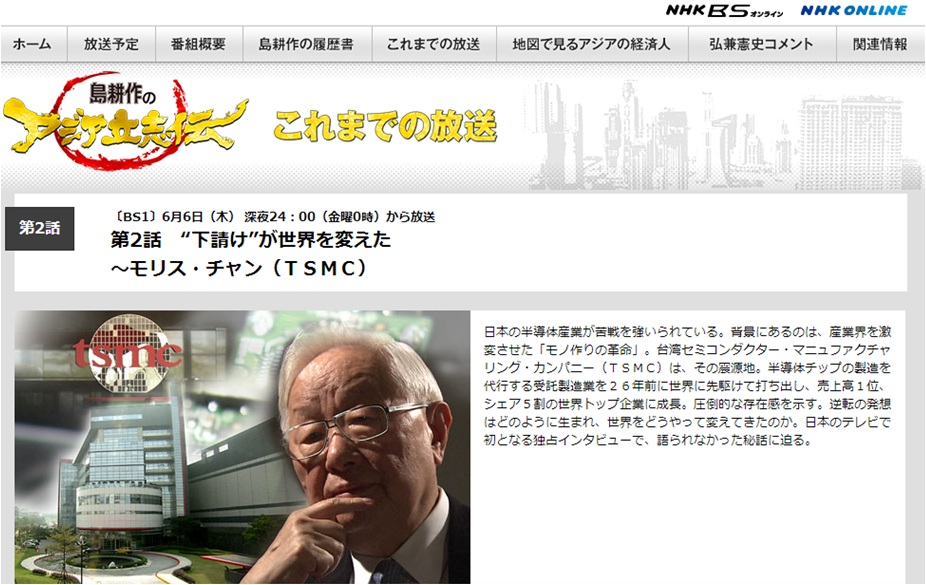
Japan’s NHK network is scheduled to broadcast an animated documentary on Taiwan Semiconductor Manufacturing Co at midnight Thursday, with TSMC’s chairman and CEO Morris Chang portrayed by the fictional character Shima Kosaku.

NHK’s new show — Shima Kosaku’s Asia Success Story — combines documentary footage and anime sequences, and focuses on famous Asian business leaders and their innovative strategies that make their businesses succeed and drive the Asian economy, according the program’s official website.

The TSMC episode, titled OEM that Changed the World — is the second in the series and will depict Chang and his company’s journey to the top of the semiconductor industry. Read more of this post

The Hot New M.B.A.: Supply-Chain Management; More Schools Are Ramping Up Their Programs, Adding Majors and Concentrations as Employer Demand Grows

Updated June 5, 2013, 7:46 p.m. ET

The Hot New M.B.A.: Supply-Chain Management

More Schools Are Ramping Up Their Programs, Adding Majors and Concentrations as Employer Demand Grows

By MELISSA KORN

Call it a problem of supply and demand.

With global operations becoming more complex, companies in manufacturing, retail and technology—and the consulting firms that service them—are scrambling to hire people with supply-chain expertise. But these experts are hard to come by.

Sensing growing demand, more than a half-dozen universities have recently introduced undergraduate majors, M.B.A. concentrations and even entire degree programs dedicated to procurement, inventory management and global supply-chain strategy. Read more of this post

Humanities Fall From Favor; Far Fewer Harvard Students Express Interest in Field With Weak Job Prospects

June 6, 2013, 12:15 a.m. ET

Humanities Fall From Favor

Far Fewer Harvard Students Express Interest in Field With Weak Job Prospects

By JENNIFER LEVITZ and DOUGLAS BELKIN

NA-BW682_HARVAR_NS_20130605182115

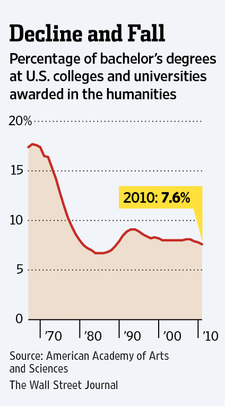
CAMBRIDGE, Mass.—The humanities division at Harvard University, for centuries a standard-bearer of American letters, is attracting fewer undergraduates amid concerns about the degree’s value in a rapidly changing job market.

university report being released Thursday suggests the division aggressively market itself to freshmen and sophomores, create a broader interdisciplinary framework to retain students and build an internship network to establish the value of the degree in the workforce. Read more of this post

Former England cricketer Paul Collingwood lost more than £300,000 of life savings in risky unregulated investments; Many unregulated schemes promise generous upfront tax breaks and the promise of double-digit returns

Former cricketer Paul Collingwood’s investment dreams end in ashes

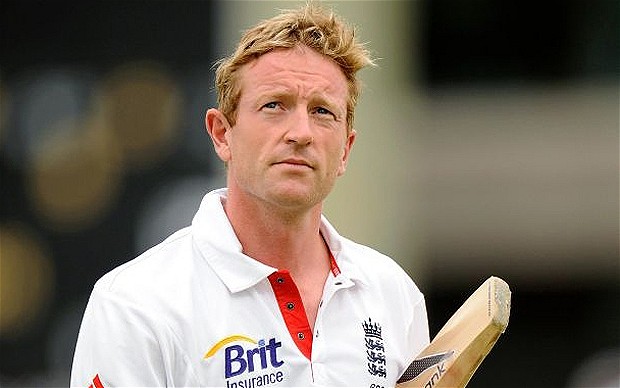
The former England cricketer Paul Collingwood and his wife are suing their financial adviser, claiming that he lost more than £300,000 of their life savings in risky unregulated investments.

paul-collingwood_2265375b

The victims of advisers who sell risky financial schemes include top sports stars Photo: REUTERS

By Emma Simon

7:00AM BST 08 Jun 2013

They have issued a High Court writ against their adviser, Roderick Langham, who worked for Cheshire-based Sigma Wealth Management, which advised a number of other sports stars and has since gone into liquidation.

Mr Collingwood said he had instructed the firm to invest his money for retirement, not gamble it on racy unregulated ventures. Read more of this post

Fiduciary Duty to Cheat? Stock Market Super-Star Jim Chanos Reveals the Perverse New Mindset of Financial Fraudsters

Fiduciary Duty to Cheat? Stock Market Super-Star Jim Chanos Reveals the Perverse New Mindset of Financial Fraudsters

April 1, 2013  |

Editor’s note: This article is the first in a new AlterNet series, “The Age of Fraud.

Hustlers. Cheaters. Crooks. American business has always had them, and sometimes they’ve been punished. But today, those who cheat and put the rest of us at risk are often getting off scot-free. The recent admission of Attorney General Eric Holder [3] that systemically dangerous megabanks may escape prosecution because of their size has opened a new chapter in fraud history. If you know your company won’t be prosecuted, a perverse logic says that you shouldcheat and make as much money for shareholders as you can.

Jim Chanos is one of America’s best-known short-sellers, famed for his early detection [4] of Enron’s fraudulent practices. In deciding which companies to short (short-sellers make their money when the price of a stock or security goes down), Chanos acts as a kind of financial detective, scrutinizing companies for signs of overvaluation and shady practices that fool outsiders into tlhinking that they are prospering when they may be on shaky financial footing. Chanos teaches a class at Yale on the history of financial fraud, instructing students in how to look for signs of cheating and criminal activity. I caught up with Chanos in his New York office to ask what’s driving the current era of rampant fraud, who is to blame, what can be done, and the ways in which fraud costs us financially and socially. Read more of this post

What Warren Buffett would change if he ever edited The Intelligent Investor by Benjamin Graham

The Intelligent Investor — By Warren Buffett

What Warren Buffett would change if he ever edited The Intelligent Investor by Benjamin Graham

CHETAN PARIKH

Chetan Parikh enjoys high recall among value investors in India. Rightly so, as he has contributed the most towards creating awareness about value investing through capitalideasonline. His book, India’s Money Monarchs, co-authored with Utpal Sheth and Navin Agarwal, was the first to chronicle the thought process of prominent Indian investors. Over the years, Parikh has not only built an impressive investing track record, he continues to spread the good word by teaching security analysis at Mumbai’s Jamnalal Bajaj Institute of Management Studies

Benjamin Graham laid the foundation for value investing, which Warren Buffett built on. But along the way, the architectural design underwent some significant changes Read more of this post

Indian promoters can learn a lot from Warren Buffett and Charlie Munger — and finance has very little to do with it

Business Lessons From Buffett

Indian promoters can learn a lot from Warren Buffett and Charlie Munger — and finance has very little to do with it

N MAHALAKSHMI

Barnett Helzberg was at New York’s Plaza Hotel, when he heard a woman holler, “Warren Buffett!” He spun around and yes, it really was. Helzberg did not waste the opportunity — he introduced himself and told Buffett he owned a company that satisfied the “acquisition criteria” laid out by him in the Berkshire Hathaway annual report (Buffett has been listing his acquisition criteria in the annual report for over three decades now). The billionaire investor told him to send across the information. Having sent the details of his company Helzberg Diamonds, he soon found himself in Buffett’s office at Omaha. Buffett looked at him and said, “Well, this will be the fastest deal in history.” When a perplexed Helzberg asked about due diligence, Buffett replied, “I can smell these things Read more of this post

Charles Brandes: “The Market Has Taught Me To Ignore The Market Most Of The Time”

“The Market Has Taught Me To Ignore The Market Most Of The Time”

While volatility can distort prices in the near term, the value of a business is eventually reflected in stock prices over the long term

OUTLOOK BUSINESS

Volatility, they say, is a friend of value investors. But the crisis of 2008 proved to be an exception to the rule. Take the case of Charles Brandes, the 70-year-old founder of Brandes Investment Partners, who saw assets under management wilt from an eye-popping $111 billion at the end of 2007 to around $21 billion in a span of five years. But the turn of events has not shaken the confidence of the dyed-in-the-wool value investor, who believes that so long as human nature doesn’t change, value investing will remain an effective long-term investment strategy. Incidentally, Brandes is among the privileged few to have legendary value investor, Benjamin Graham, as a mentor Read more of this post

“Investing Is About Figuring Out What Somebody Is Doing Right And Paying Less”; The founder of New York-based Gotham Asset Management does have a magic formula for investing

“Investing Is About Figuring Out What Somebody Is Doing Right And Paying Less”

The founder of New York-based Gotham Asset Management does have a magic formula for investing

Joel Greenblatt is no magician, but the founder of New York-based Gotham Asset Management does have a magic formula for investing. In 2005, Greenblatt, who also has been teaching at Columbia Business School for the past 17 years, published The Little Book that Beats the Market, which explains how investors can outperform market averages by following a simple process of investing in good companies at bargain prices. The ‘Magic Formula,’ as Greenblatt termed it, was about seeking out companies with high return on invested capital, and which could be purchased at a low price. The strategy produced back-tested returns of 30.8% per year from 1988 through 2004, more than double the S&P 500’s 12.4% return over the same period. What better proof than eating your own cooking, Greenblatt’s private investment partnership has logged a 40% annualised return since its inception in 1985. Read more of this post

Akio Yamada, who is the CEO of MIRAI Industry, makes the company ‘Paradise of employees’; Yamada’s main philosophy, “Employees are not machines.”

Case study: Akio Yamada, who is the CEO of MIRAI Industry, makes the company ‘Paradise of employees’

June, 2011

Mirai

< Akio Yamada, who is the CEO of MIRAI Industry, makes the company ‘Paradise of employees’ >

Eng. Jinhyung Park

What do you consider when you choose a company for getting a job? The company which gives you no overworks? The company which guarantees retirement age? The company which gives much of money? It is so hard to choose one. But, there’s a company which is fulfilling everything for employees. It is Mirai Industry Corporation. It has been chosen the greatest work place in the survey in Japan. Now, I will introduce this company for the reader who wants to manage a small company or studies business administration. Read more of this post

How Warren Buffett, Frank Ocean Deal With Soul-Sucking Haters: “Read more than you drink”; “Don’t ever forget the reason you started doing what you do”

HOW FRANK OCEAN, WARREN BUFFETT, AND OTHER BADASSES DEAL WITH SOUL-SUCKING HATERS

IF JERKS ARE BEING JERKY TO YOU, JUST “DON’T EVER FORGET THE REASON YOU STARTED DOING WHAT YOU DO.” THAT AND 5 OTHER SMART TIPS ON NOT LETTING THE STEEZ-CHALLENGED MESS WITH YOUR STEEZ.

BY: DRAKE BAER

As we in the career hustle know, the moment you start doing awesome work, you become become vulnerable to people stoked on shaming others. An example: look at the torrent of heinousness that surrounded Frank Ocean last year after he came out. So how to deal with haters? One option, as Neil Gaiman proclaimed and Ocean exhibited, is to make honeyed, soul-affecting music.

Frank Ocean, “Thinking About You”: A best practice for hate-resilience is to make strange, amazing things

But what about for the people who don’t sing soul? There is hope in the jealous working world, coming from Pioneers Press, the certifiably badass bookbinders from the prairies of Kansas. They recently blogged a few selections from their zine The Do-It-Yourself Guide to Fighting the Big Motherfuckin’ Sad, which is, according to author Adam Gnade, an antidepression handbook and a “guide to a freer, more lawless life.” As proponents of living well-lived lives, please allow us to curate a few of his more punching points below, cordoned off in helpful blockquotes.

1: “People will always shit on the things they’re scared of.”

So scare them. Innovation is heresy.

2: “Read more than you drink.”

Reading books is still one of the best ways to discover new things. Getting drunk probably isn’t–though a few beers may help you be more creative. Read more of this post

Off S&P 500, Heinz Could Recommit to Founder’s Vision that crafting unadulterated foods was a moral obligation

Off S&P 500, Heinz Could Recommit to Founder’s Vision

When U.S. stock trading begins tomorrow, H.J. Heinz Co. will no longer be listed on the Standard & Poor’s 500 Index. Another iconic U.S. company, General Motors Co., will take its place. Although Heinz has been a corporation since 1905, it was largely controlled by the founding family until 1987, when Tony O’Reilly became the first outsider to be named chairman. In February, Warren Buffett’s Berkshire Hathaway Inc. and Jorge Paulo Lemann’s 3G Capital Inc. said they would buy the company for $23 billion. Back in private hands, the company should carry forward the founder’s vision of both profit and service to society.

Beginning in 1880, new technologies introduced large-scale manufacturing and started to transform what Americans ate. This transition to foods made outside of the home sometimes resulted in adulteration of the type described in Upton Sinclair’s “The Jungle.” At the same time, the discovery of the toxic effects of various chemicals reported by Harvey Wiley’s “poison squad” studies heightened fears that there was something fundamentally wrong with the food supply. Heinz, however, developed as a large industrial food processor by building consumer trust based on the belief of its founder, Henry Heinz, that crafting unadulterated foods was a moral obligation. Read more of this post

Costco CEO Craig Jelinek Leads the Cheapest, Happiest Company in the World; I hope when I’m 90, and this company is around 30 years from now, I can go eat a hot dog at a Costco food court and hear someone say, ‘I remember you.’”

Costco CEO Craig Jelinek Leads the Cheapest, Happiest Company in the World

By Brad Stone on June 06, 2013

http://www.businessweek.com/articles/2013-06-06/costco-ceo-craig-jelinek-leads-the-cheapest-happiest-company-in-the-world

covertrail24_304feature_costco24__01__304

Costco CEO Craig Jelinek

How this week’s cover got madeJoe Carcello has a great job. The 59-year-old has an annual salary of $52,700, gets five weeks of vacation a year, and is looking forward to retiring on the sizable nest egg in his 401(k), which his employer augments with matching funds. After 26 years at his company, he’s not worried about layoffs. In 2009, as the recession deepened, his bosses handed out raises. “I’m just grateful to come here to work every day,” he says.

This wouldn’t be remarkable except that Carcello works in retail, one of the stingiest industries in America, with some of the most dissatisfied workers. On May 29, Wal-Mart Stores (WMT) employees in Miami, Boston, and the San Francisco Bay Area began a weeklong strike. (A Walmart spokesman told MSNBC the strike was a “publicity stunt.”) Workers at an Amazon.com (AMZN)fulfillment center in Leipzig, Germany, also recently held strikes to demand higher pay and better benefits. (An Amazon spokesman says its employees earn more than the average warehouse worker.) In its 30-year history, Carcello’s employer, Costco, has never had significant labor troubles. Costco Wholesale (COST), the second-largest retailer in the U.S. behind Walmart, is an anomaly in an age marked by turmoil and downsizing. Known for its $55-a-year membership fee and its massive, austere warehouses stocked floor to ceiling with indulgent portions of everything from tilapia to toilet paper, Costco has thrived over the last five years. While competitors lost customers to the Internet and weathered a wave of investor pessimism, Costco’s sales have grown 39 percent and its stock price has doubled since 2009. The hot streak continued through last year’s retirement of widely admired co-founder and Chief Executive Officer Jim Sinegal. The share price is up 30 percent under the leadership of its new, plain-spoken CEO, Craig Jelinek. Read more of this post

Rearden Commerce CEO Patrick Grady argues entrepreneurs see the world not as it is, but how it could be

Brainstorm Tech Spotlight: Patrick Grady, chairman & CEO of Rearden Commerce

June 6, 2013: 12:22 PM ET

Patrick Grady argues entrepreneurs see the world not as it is, but how it could be

FORTUNE — Fortune’s Brainstorm Tech Conference (July 22-24 in Aspen, Colo.) regularly brings together the best and brightest minds in tech innovation. Each week, Fortunewill turn the spotlight on a different conference attendee to offer his or her own personal insight into business, tech, and entrepreneurship. This week, we asked Rearden Commerce Chairman and CEO Patrick Grady to answer 10 questions about life outside of work, the company he admires most, and industry advice for young entrepreneurs. His responses follow. Read more of this post

As Check Point nears its 20th anniversary, co-founder, CEO and chairman Gil Shwed talks about ambition and fulfillment.

“I work for the interest and the challenge”

As Check Point nears its 20th anniversary, co-founder, chairman and CEO Gil Shwed reveals his management style, and how it has changed.

6 June 13 21:01, Hagai Golan

In a month’s time, Check Point Software Technologies Ltd. (Nasdaq: CHKP) will celebrate 20 years since it was founded. The network security giant, one of the most amazing companies to have grown up in Israel, is highly relevant to some of the burning issues of the day, and this is an opportunity to ask company founder, chairman and CEO Gil Shwed if he thought that Check Point would grow to such dimensions. “Yes and no,” he says, “I thought that the Internet would be something huge. A revolution. I didn’t realize to what extent.” Read more of this post

Roger Bootle, the founder of Capital Economics and columnist for The Daily Telegraph, has appointed advisers to prepare a sale of the business in a deal that could land him a windfall of up to £50m

Roger Bootle looks to sell Capital Economics

Roger Bootle, the founder of Capital Economics and columnist for The Daily Telegraph, has appointed advisers to prepare a sale of the business in a deal that could land him a windfall of up to £50m. Roger Bootle is thought to have been looking at selling up since turning 60 in June last year Photo: Rex Features

bootle_2583714b

By Philip Aldrick

6:00AM BST 07 Jun 2013

Mr Bootle, who owns 68pc of Capital Economics, has retained corporate finance firm Quayle Munro to work on a strategic review. The former HSBC chief economist, who started the independent consultancy in 1999, is thought to have been looking at selling up since turning 60 in June last year. Capital Economics has been growing rapidly, last year making a profit before tax of £4.9m. It had £3.6m of capital and £4.2m of net cash. Consultancies can attract multiples of more than 10 times earnings in a sale, which would value the business at around £70m. Mr Bootle has taken out £1.7m in pay and dividends in each of the past two years. A sale would also see big paydays for senior economists Jonathan Loynes, who holds 14pc of the stock, and Julian Jessop, who has a 7pc stake. Staff own the rest.

Innovation: DNA Fog security system that marks intruders with genetic material derived from plants. It’s hard to remove and links suspects to crime scenes

Innovation: DNA Fog by Applied DNA Sciences and SmokeCloak

By Caroline Winter on June 06, 2013

Form and function A fog-based security system that marks intruders with genetic material derived from plants. It’s hard to remove and links suspects to crime scenes.

Partners Stony Brook (N.Y.)-based Applied DNA Sciences developed the tracers, and Danish security company SmokeCloak builds the deployment devices.

“Police often have a very good idea who the criminals are, but they just cannot prove it.” — Applied DNA Sciences Chief Executive Officer James Hayward

tech_innovation2413__01__950

Experience has shown that as the BRIC companies expand internationally, many of the factors that contributed to early successes in the home markets are likely to prove irrelevant or even a hindrance

Proactive strategies for emerging market companies

By Professor Allen Morrison – May 2013

Emerging market economies, and especially the BRICs (Brazil, Russia, India and China), continue to experience impressive growth.  Yet despite the progress they have made, the economic growth they have enjoyed risks grinding to a halt unless they can effectively deal with a gaping problem: a lack of effective global leaders. Experience has shown that as the BRIC companies expand internationally, many of the factors that contributed to early successes in the home markets are likely to prove irrelevant or even a hindrance when the company tries to go global.  Read more of this post