Investing in Korea: Staying Rational Despite Samsung’s Halo Effect. Bamboo Innovator is featured in BeyondProxy.com, where value investing lives

Bamboo Innovator is featured in BeyondProxy.com, where value investing lives:

Investing in Korea: Staying Rational Despite Samsung’s Halo Effect, June 5, 2013 (Weblink: BeyondProxy.com)

Korea

When people take professions according to their personal inclinations, they perform work effortlessly, efficiently and joyously

Translating Ideas into Reality

by Ashu Khanna | Jun 6, 2013

When people take professions according to their personal inclinations, they perform work effortlessly, efficiently and joyously

“Often the difference between a successful person and a failure is not one who has better abilities and ideas but the courage to bet on one’s ideas, take a calculated risk and to act.” Andre Malraux

There is often a gap between intention and action. This incongruence arises due to our thoughts that creep in while taking action. Our interpretations, perceptions, beliefs, fears and attachments impact the quality of action. Our thoughts are so deeply embedded that we keep tumbling from one action to another, completely unaware of the intensity and significance of their influence on our life.   Read more of this post

Harvard’s Kaplan Says to Succeed Know What You Want

Harvard’s Kaplan Says to Succeed Know What You Want

By Zinta Lundborg  May 30, 2013

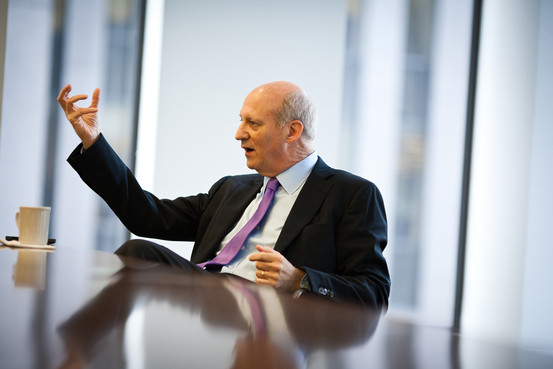
“You’ve got to take ownership of your own life,” says Robert Steven Kaplan. He’s written “What You’re Really Meant to Do: A Road Map for Reaching Your Unique Potential” to show people how to find satisfaction in their careers and their lives. It’s not a touchy-feely self-help tome, but a step-by-step guide to finding your true path written by a former investment banker: Kaplan moved to the Harvard Business School in 2005 from the Goldman Sachs Group (GS), where he was vice-chairman. We spoke at Bloomberg world headquarters in New York.

Lundborg: We’re living in tough times in terms of the job market, so perhaps people don’t have the luxury to do what they’re really meant to do?

Kaplan: All this is relative to your options. If you’ve got no option but to wash dishes, my advice is wash dishes. I still want you to think about your strengths and weaknesses. I want you to take a little time on the weekend or whatever to step back. Don’t let crisis management become a way of life. Read more of this post

The Rise of Superman: Decoding the Science of Ultimate Human Performance

The Rise of Superman: Decoding the Science of Ultimate Human Performance [Hardcover]

Steven Kotler (Author)

Book Description

Release date: March 4, 2014

In this groundbreaking book, New York Times–bestselling author Steven Kotler decodes the mystery of ultimate human performance. Drawing on over a decade of research and first-hand reporting with dozens of top action and adventure sports athletes like big wave legend Laird Hamilton, big mountain snowboarder Jeremy Jones, and skateboarding pioneer Danny Way, Kotler explores the frontier science of “flow,” an optimal state of consciousness in which we perform and feel our best.

Building a bridge between the extreme and the mainstream, The Rise of Superman explains how these athletes are using flow to do the impossible and how we can use this information to radically accelerate performance in our own lives.

At its core, this is a book about profound possibility; about what is actually possible for our species; about where—if anywhere—our limits lie. Read more of this post

Famed speculator and hedge fund manager Victor Niederhoffer after he lost everything in the 1997 Asian Crisis [video]

Victor Niederhoffer after he lost everything in the 1997 Asian Crisis

June 3, 2013 by Mick Weinstein

071015_r16657_p233

The following remarkable video was edited from a longer Japanese documentary. Famed speculator and hedge fund manager Victor Niederhoffer is interviewed in his emptied-out mansion after he lost everything (“a staggering amount”) in the 1997 Asian Financial Crisis. Don’t miss the George Soros cameo with a bikini-clad woman. As Joshua Wallis notes, the video is “a reminder of the perils of leverage and the consequences of unpredictability.” Niederhoffer managed to dust himself off after this and achieve something of his former glory with his Matador Fund, which did very well until Niederhoffer blew up again in 2007. For more on Niederhoffer, see John Cassidy’s excellent 2007 New Yorker profile.

THE BLOW-UP ARTIST

Can Victor Niederhoffer survive another market crisis?

by John CassidyOCTOBER 15, 2007

Niederhoffer’s approach is eclectic. His funds, a friend says, appeal “to people like him: self-made people who have a maverick streak.” Read more of this post

Smithfield: How Sausage Was Made; Joseph W. Luter III transformed his family’s firm into a global giant

Updated June 5, 2013, 8:14 p.m. ET

Smithfield: How Sausage Was Made

‘Seeds Were Planted’ 7 Years Ago, Luter Says, When He Suggested Joint Venture to Shuanghui Chair

By DAVID KESMODEL

MK-CD789_LUTER_G_20130605195541

Joseph W. Luter III transformed his family’s firm into a global giant

It was a brief meeting of the two most powerful people in pork. The encounter between Joseph W. Luter III, chairman of Smithfield Foods Inc.,SFD +0.33% the world’s largest pork processor, and Wan Long, chairman of Shuanghui International Holdings Ltd., known as “China’s No. 1 Butcher,” lasted only 90 minutes about seven years ago. Hosting Mr. Wan in his Manhattan apartment, Mr. Luter floated the idea of a joint venture, saying “we ought to do something together.” And that laid the foundation, Mr. Luter said in an interview this week, for a very different tie-up: last week’s $4.7 billion deal for Shuanghui to buy Smithfield in the biggest Chinese takeover of a U.S. company. “Seeds were planted,” the 73-year-old Mr. Luter said, “and sometimes it takes a while for seeds to germinate.” Read more of this post

Moneysupermarket.com founder Simon Nixon lands £200m windfall; Businessman bored by accountancy cashes in after strong demand for shares in price comparison site

Moneysupermarket.com founder Simon Nixon lands £200m windfall

Businessman bored by accountancy cashes in after strong demand for shares in price comparison site

Rupert Neate

The Guardian, Wednesday 5 June 2013 23.45 BST

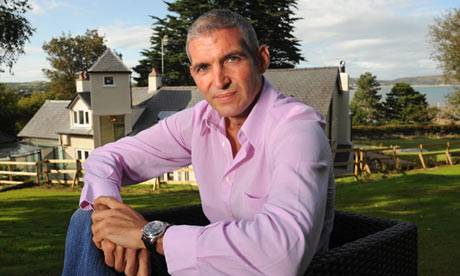
Simon Nixon

Simon Nixon, who founded the price comparison website Moneysupermarket.com. Photograph: Adrian Sherratt /Rex Features

Simon Nixon, the businessman who founded the price comparison siteMoneysupermarket.com after dropping out of studying accountancy at university because it was “boring”, has landed a £200m windfall.

Nixon – who had already banked a £100m fortune when the website joined the stock market in 2007 – has sold 100m shares, raising another £200m in cash.

Ferrari-loving Nixon, 45, will also collect about £20m from a dividend payout on his remaining 29% stake in the company. Nixon, who is understood to be relocating to Jersey for tax reasons, founded the website after quitting an accountancy course at Nottingham University because, according to an interview at the time of the flotation, “I hated it. It was boring.” Read more of this post

Marico’s Harsh Mariwala: Ours is the story of a small Indian FMCG player globalising

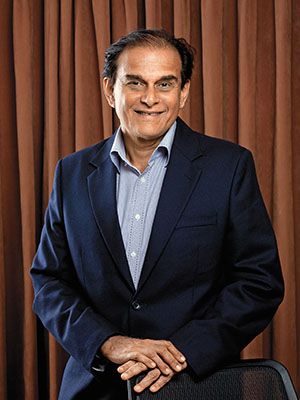
Harsh Mariwala: Ours is the story of a small Indian FMCG player globalising

by Harsh Mariwala | Jun 5, 2013

topimg_21809_harsh_mariwala_300x400

Harsh Mariwala realised if Marico had to get an international thrust, it needed a manager who wasn’t a part of the local business

We stepped out of india as marico needed to grow faster. We obviously needed to increase revenues, but a fast-growing company also attracts the best talent. One of the reasons we formed Marico was that we could closely associate the company with the FMCG industry. But we soon realised that as we were a small company, we couldn’t provide the kind of career-rotation opportunities that many large FMCG companies provided. And most importantly, we couldn’t rotate talent outside of India. Ours is the story of a small Indian FMCG player globalising. Over the years, analysts have often asked me why we are operating outside of India when the opportunity in India is huge.
My answer to that is simple: We are not growing our international business at the cost of our domestic business. Today, at approximately Rs 1,200 crore, our international business brings in a fourth of our revenues and we employ a total of 800 people overseas. When we first wanted to export, we couldn’t do so as export of coconut oil was banned. When the government started opening up the economy in 1991, we were able to persuade them to allow us to export. Read more of this post

China Blogger Questioning Home Prices Taken to Tea Party

China Blogger Questioning Home Prices Taken to Tea Party

Two men greeted him at the police station as he was escorted in from the January cold. Peng Chengxian didn’t ask who they were. Each wore a light-colored jacket and carried a dark handbag.

They must be “Guo Bao,” Peng says he thought. That’s the name of China’s secret police in charge of keeping order among more than 1.3 billion people for the ruling Communist Party.

“You’ve been invited here for a chat,” one of the men, who looked about a decade older than the other, told Peng. “No need to be nervous.”

“I know,” Peng, 32, replied. “It’s a ‘tea chat,’ isn’t it?” Read more of this post

The Way to Produce a Person; You would be more likely to cultivate a deep soul if you put yourself in the middle of the things that engaged you most seriously

June 3, 2013

The Way to Produce a Person

By DAVID BROOKS

Dylan Matthews had a fascinating piece about a young man named Jason Trigg in The Washington Post on Sunday. Trigg is a 25-year-old computer science graduate of the Massachusetts Institute of Technology who has hit upon what he thinks is the way he can do maximum good for the world. He goes to work each day at a high-frequency trading hedge fund. But, instead of spending his ample salary, he lives the life of a graduate student and gives a large chunk of his money away. Read more of this post

Amazing scenery of China’s Huangshan Mountain, UNESCO cultural and natural heritage

Amazing scenery of Huangshan Mountain

China.org.cn)  14:32, June 03, 2013

Huangshan Mountain, listed as a UNESCO cultural and natural heritage and World Geopark, boasts of spectacular landscapes thick with vegetation and lofty peaks. The 154-square-kilometer sight-seeing area possesses four unique scenes: peculiarly shaped granite rocks, waterfalls, pine trees and views of the clouds from above. The Flying over Rock, the Stone Monkey Gazing over the Sea of Clouds, the Brush pen-liked Rock and many other renowned scenic spots attract streams of visitors to the marvelous mountain every day. (China.org.cn)

F201306031451352499622354F201306031451336304180672F201306031451303144631598F201306031451272810615987F201306031451021773320622

How to attract long-term investors: An interview with M&G’s Aled Smith

How to attract long-term investors: An interview with M&G’s Aled Smith

The award-winning fund manager discusses what he looks for in a company when he’s making investment decisions.

June 2013 | byMarc Goedhart and Tim Koller

Executives overburdened by the demands of their companies’ short-term investors may yearn for a more supportive crowd that might be less skittish about volatility. Such investors would base their decisions on a deeper understanding of a company’s strategy, performance, and potential to create long-term value—and would not pressure a company for short-term gains at the expense of greater long-term growth.1 Attracting such investors can prove something of a challenge. Certainly, executives are often highly coached when they talk about their strategy and objectives, and have extensive information about potential investors and their style and approach to investing. Too often, though, those messaging cues come from sell-side analysts, who may have a shorter-term agenda. So says Aled Smith, who manages the Global Leaders Fund and the American Fund at M&G Investments, based in London.2 Smith recently joined Marc Goedhart and Tim Koller in McKinsey’s London office for this wide-ranging interview on what he looks for in potential investments for his portfolios. Read more of this post

Parents pray for students at Confucian temple before Gaokao, China’s SAT

Parents pray for students at Confucian temple before Gaokao

People’s Daily Online)  13:19, June 05, 2013

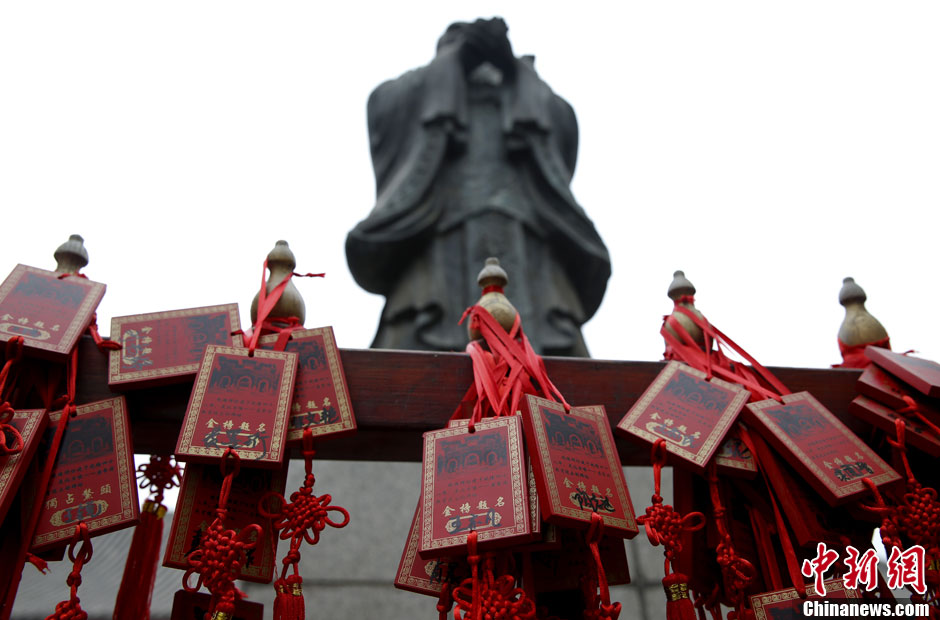
Every year before Gaokao, loads of students accompanied by their parents come and pray at Confucian temple.

F201306051317101237232119 (1)F201306051317103378120021

Chinese Officials stamps on man’s head and another reeked of alcohol while carrying out a campaign against street vendors and traders

Officials suspended for stamping on man’s head

2013-06-04 23:31:56 GMT2013-06-05 07:31:56(Beijing Time)  Shanghai Daily

Police in Yan’an City are investigating reports that an urban management official trampled on the head of a bicycle dealer and another reeked of alcohol while carrying out a campaign against illegal street vendors and traders. Officials at the scene and their supervisors, eight in total, have been suspended, according to the Yan’an urban management bureau. Last Friday, seven people got off a minivan which had “urban management law enforcement” painted on it, and carried away several bicycles lined up in front of a store in the city in northwestern Shaanxi Province. That led to a brawl during which the owner of the bicycle shop, a person surnamed Liu, was stamped on the head by an official, witnesses said. Video posted online showed a man in yellow, said to be Liu, and several uniformed men locked in a war of words as Liu held back the bicycles. The quarrel escalated into a free-for-all. Two officials kicked and beat Liu who fell to the ground. One official can be seen jumping on his head and shoulder. At the end of the clip Liu walks away, bleeding profusely. A police car can also be seen passing by in the video without stopping. The local district police refused to give any details as a probe was underway. The bicycle store owner was twice warned by law enforcement officials not to put the bicycles outside the store. Officials again found the bicycles parked outside last Friday, said Duan Yuting, deputy head of the local urban management supervising detachment. Officials seized the bicycles, said Duan. He had no comment over the “stamping” issue.

U158P5029T2D596342F26DT20130605073156U158P5029T2D596342F28DT20130605073156

Panera Bread chief Ron Shaich on staying recharged and why the company opened pay-what-you-can cafes

June 4, 2013, 8:02 p.m. ET

A New Test for Panera’s Pay-What-You-Can

By ANNIE GASPARRO

MK-CD738_Panera_G_20130604225543

Panera Bread Co. chief Ron Shaich on staying recharged and why the company opened pay-what-you-can cafes.

The fast-casual dining segment is getting crowded. While chains like Panera BreadCo. PNRA -0.64% and Chipotle Mexican Grill Inc. CMG -0.12% continue to log rapid expansion, even fast-food operators like Wendy’s are going upscale, adding items like flatbread sandwiches and remodeling their interiors.

Bakery-cafe chain Panera Bread, based in a St. Louis suburb, rang up a 28% increase in profit for fiscal 2012, outpacing the sector as a whole, but the company’s customer-traffic growth slowed in the first quarter. Read more of this post

Starbucks regularly launches products before they’re perfect. Why does such a risky approach to innovation work so well?

RISKY INNOVATION: WILL STARBUCK’S LEAP OF FAITH PAY OFF?

THE WORLD’S LARGEST COFFEEHOUSE CHAIN REGULARLY LAUNCHES PRODUCTS BEFORE THEY’RE PERFECT. WHY DOES SUCH A RISKY APPROACH TO INNOVATION WORK SO WELL?

BY: AUSTIN CARR

In late March, as Starbucks was preparing to introduce its first offer on Groupon, the daily-deal service, the coffee chain’s chief digital officer, Adam Brotman, realized he had no clue whether the gambit would pay off. The discount wasn’t for anything crazy like bungee jumps or skydiving lessons–it was for 50% off a $10 Starbucks Card eGift–but to Brotman, the deal was just as risky because of how the company would be offering it. His team had to integrate Starbucks’s eGift platform with Groupon’s system for the one-off promotion, and it was about to go live to the world. “They’d never done deals at the scale we were offering, and we had never put our [eGift] platform through that type of pressure test,” Brotman says. “But we didn’t have the luxury to say anything other than, ‘We think we got this right, so let’s see what happens.’ There are times when we just completely don’t know how things are going to work.” Read more of this post

Truly global vocabulary needs ‘untranslatable’ Chinese terms; Most people believe that the secret to promote Chinese culture is to have as many foreigners as possible studying the Chinese language. There is a better way.

Truly global vocabulary needs ‘untranslatable’ Chinese terms

Created: 2013-6-3 0:34:04

Author:Thorsten Pattberg

20130603_532077_01

MOST people believe that the secret to promote Chinese culture is to have as many foreigners as possible studying the Chinese language. There is a better way.
The difference between promoting and inhibiting one’s culture often lies in “translation.” All writers should be aware of the unwritten law of “cultural property rights”: WHEN to translate, WHAT translation does, and WHERE to avoid it.
The English language is often hailed as the “international language,” but it is not the global language. In fact, the global language will have to adopt tens of thousands of non-European concepts from China, India, and Japan. The list goes on.
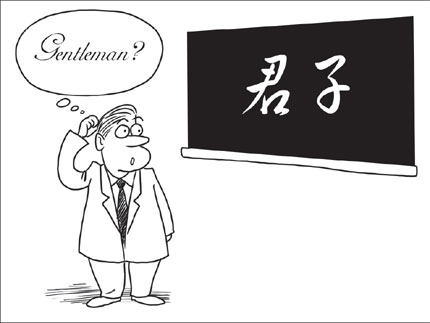
As I write this, great efforts are made by Chinese scholars to promote East Asian terms into the global lexicon – Chinese words like tianxia, shengren and junzi, and even the mythical long.  The reason is simple: Scientists so far may have indexed the animal and plant kingdoms, and the material world. But the taxonomization of culture has only just begun. Read more of this post

Directors’ duty is not just to investors: There is too much focus on noise in markets and not enough to operational performance

June 4, 2013 6:10 pm

Directors have a duty beyond just enriching shareholders

By John Kay

There is too much focus on noise in markets and not enough to operational performance

Do companies have a duty to their shareholders to minimise the amount of tax they pay? Even if this involves engaging in complex and artificial schemes that shift profits to jurisdictions in which little or no tax is payable?

Under the 2006 Companies Act, directors of British companies are required to promote the success of the business for the benefit of its members (the shareholders). In doing so, they must have regard to six specific factors: the long-term consequences of their decisions, the interests of employees, relationships with suppliers and customers, the impact of corporate activities on the community and the environment, the company’s reputation for high standards of business conduct and the need for fairness between different members of the company. Read more of this post

Maverick Internet tycoon Takafumi Horie, who was jailed for accounting fraud, back in business; Horie said he had got involved in around 30 start-ups since being released from prison three months ago

Japan dotcom jailbird back in business

Horie said he had got involved in around 30 start-ups since being released from prison three months ago. -AFP
Wed, Jun 05, 2013
AFP

JAPAN-CRIME-IT-COMPANY

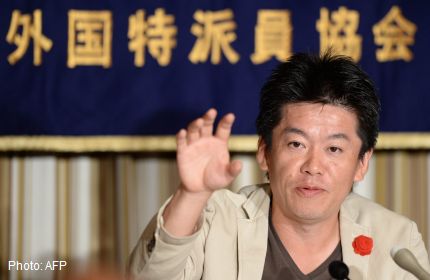
TOKYO – Maverick Internet tycoon Takafumi Horie, who was jailed for accounting fraud, said Wednesday Japan’s online landscape was prime territory for his aggressive style of business. Horie said he had got involved in around 30 start-ups since being released from prison three months ago, having served nearly two years for hiding losses on the balance sheets of his Internet service provider Livedoor.

Read more of this post

Taoist abbot Yuan Zhihong has a complicated attitude toward money: He knows his temple needs funds to make ends meet, but the commercialization of religious venues is affecting their sacred status

Taoist leaders focus on preserving values

Updated: 2013-06-05 02:02

By An Baijie (China Daily)

Taoist abbot Yuan Zhihong has a complicated attitude toward money: He knows his temple needs funds to make ends meet, but the commercialization of religious venues is affecting their sacred status.

“At some public memorial ceremonies, people have paid more than 1 million yuan ($163,000) to light the first incense stick,” he said. “The religion has become too secular in many places.” Read more of this post

To revive Infosys, Murthy must revamp sales, culture

To revive Infosys, Murthy must revamp sales, culture

9:06am EDT

By Harichandan Arakali

BANGALORE (Reuters) – Narayana Murthy’s success in turning around Indian IT services firm Infosys hinges on his ability to revive its sales efforts and shake up the conservative culture he helped create.

Eleven years after Murthy stepped down as chief executive at India’s second largest computer services exporter, Infosys unexpectedly brought back the 66-year-old as executive chairman to reverse falling market share and end two years of disappointing results. Read more of this post

Wang Huning, head of a secretive Communist Party office and a key architect of President Xi Jinping’s ‘China Dream’ campaign, is one of the most influential but least known figures in China today; Wang occupies a unique place in the party as the only person to have served as a top policy adviser and speechwriter to three successive presidents: Jiang Zemin, his successor Hu Jintao, and now Mr. Xi

June 4, 2013, 10:37 p.m. ET

The Wonk With the Ear of Chinese President Xi Jinping

By JEREMY PAGE

BEIJING—When Xi Jinping sat down with Russian and African leaders in March during his first overseas visit as China’s new leader, at his shoulder in every meeting was a bookish, bespectacled figure, listening intently and occasionally taking notes. Look for him to be there too in Rancho Mirage, Calif., on Friday when Mr. Xi and President Barack Obama meet for a summit.

P1-BL770_CWANG__G_20130604181034P1-BL769_CWANG_DV_20130604190256

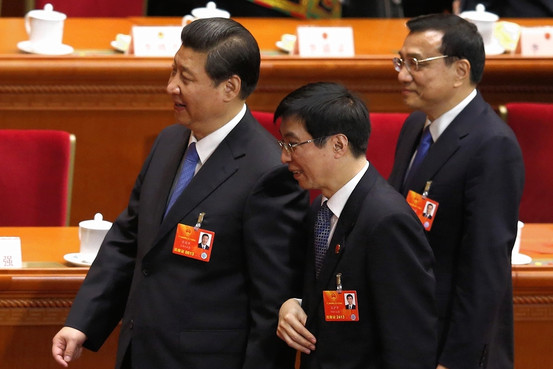
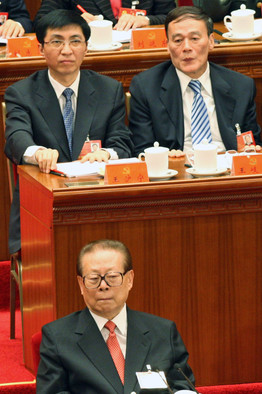
Wang Huning has advised three presidents. Mr. Wang, center, with President Xi Jinping left, in March. Mr. Wang sits behind former President Jiang Zemin in 2007

Even in China, few people would recognize Wang Huning, head of the Communist Party’s secretive Central Policy Research Office. And small wonder: The former university professor almost never talks in public, barely speaks to old acquaintances and makes a point of not associating with foreigners.

Yet party insiders and experts on Chinese politics consider him one of the most influential figures in China today, a key architect of its domestic and foreign policy over the past decade, and now of Mr. Xi’s signature “China Dream” campaign that evokes a militarily and economically strong nation reclaiming its place of prominence in the world.

Mr. Wang, who briefly studied in the U.S. and has headed the Research Office since 2002, occupies a unique place in the party as the only person to have served as a top policy adviser and speechwriter to three successive presidents: Jiang Zemin, his successor Hu Jintao, and now Mr. Xi. Read more of this post

Wide Moat Investing Summit 2013, July 9-10, 2013 (Presentation by Bamboo Innovator on Jul 10, 8.30am EST)

WideMoat

Bamboo Innovator Workshop for the Singapore Public: Detecting Frauds Ahead of the Investing Curve (Series #2 of 4)

Saturday, 3 August 2013 from 09:00 to 17:00 (SGT)
Singapore
Event Details

Frauds. Warren Buffett commented in the recent Berkshire Hathaway AGM 2013 that when he’s reading through financial statements, he’d find companies he was virtually certain are frauds. In response to a shareholder’s question on what did he find that made him so certain, both Buffett and Munger replied that “there isn’t a 40-point checklist” and that value investors need to understand the interaction between the underlying business model dynamics and the people running the enterprise when examining the numbers.

In Asia, with outbreaks of accounting frauds and corporate governance lapse erupting on a systematic basis at the firm level, how does a value investor go about generating sustainable outsized returns? To paraphrase Sherlock Holmes, to murder (to engage in earnings management) is easy, but to dispose the murdered body (to expropriate or tunnel out the cash and assets out of the company) is harder as it is detectable by the serious institutional investor with his or her keen observation of the various information signals and clues.

It would be premature to speak of “fundamental” analysis using possibly rigged accounting numbers due to propping and tunneling to fashion elaborate but “garbage-in-garbage-out” quant valuation models. Even “technical” analysis can be misleading given prices and volumes are often manipulated by the “insiders” (庄家) who establish the stock inventory (老鼠仓), luring investors in and then offloading in a pump-and-dump cycle. Such exploits by insiders is made easy as most stocks in Asia are still relatively small-cap and illiquid, given that the median market cap of the listed universe of 23,000 stocks in Asia is around $80 million and over 80% are under a billion dollar in market cap.

Thus, the use of “fundamental” or “technical” analysis, or its combination – without a Mungerian I-O accounting framework using the Bamboo Innovator way – can lead to a false sense of confidence that clever insiders exploit at your expense.

Course Highlights:

– Mr Kee Koon Boon, one of the few Asian fund managers being invited to speak at a number of top banking & finance conferences around the world alongside with renowned speakers such asPraveen Kadle, Chief Executive Officer of Tata Capital & Lauren Templeton, President of Lauren Templeton Capital Management

– Learn from an experienced & qualified instructor who has also taught in local Universities

Program Outline and Key Learning Points:

  • UNDERSTAND the importance of the Mungerian I-O (Incentive-Opportunity) accounting framework to adapt value investing principles in Asia.
  • LEARN the three accounting steps that “set-up” companies commonly use to expropriate assets and the ORECTA and other information signals that sophisticated institutional investors use in their cutting-edge empirical research tool-bag.
  • DEVELOP the ability to scan through thick annual reports and financial statements for the Seven Accounting Sins.
  • DEMYSTIFY the various techniques in “earnings management”, “revenue recognition management”, “real activity management” and “income smoothing” and differentiate between opportunistic bookkeeping mischief and discretionary signaling of private information of leading indicators of firm performance by management to investors.
  • ATTAIN the application tools used by sophisticated institutional investors in the accounting of words, that is, textual analysis of disclosures which are an important source of information with value relevance about the firm.
  • DISSECT actual cases of capex-related fraud in prominent Asian listed companies that are invested by reputable fund management institutions who are also caught flat-footed when things unravel.
  • RE-EXAMINE accounting fundamentals that universities impart without the relevant context of value investing, including the use and abuse of the accruals anomaly (AA) in investing strategies adopted by sophisticated institutional investors in various forms.
  • UNIFY at the end of the day all the previously disparate loose-hanging concepts, “descriptive” facts and “checklists” you have learnt from various sources into the practical Bamboo Innovator mental model when it comes to real investment decision-making.

Understand more about the Instructor’s investment approach with the following published articles:

About the Instructor:

Koon Boon is the founder and managing director of the Singapore-based Bamboo Innovator Institute to establish the thought leadership of resilient value creators around the world. KB has been rooted in the principles of value investing for over a decade as a fund manager and analyst in the Asian capital markets. He was a fund manager and head of research/analyst at a Singapore-based investment management organization dedicated to the craft of value investing in Asia. He had been with the firm since 2002 and was also part of the core investment committee in significantly outperforming the index in the 10-year-plus flagship Asian fund. He was previously the portfolio manager for Asia-Pacific equities at Korea’s largest mutual fund company. He received his Masters in Finance (magna cum laude) and double degree in Accountancy and Business Management (both summa cum laude) from the Singapore Management University (SMU). He had taught accounting at his alma mater in SMU and at SIM University. He had published research in the Special Issue of Istanbul Stock Exchange 25th Year Anniversary of the Boğaziçi Journal, Review of Social and Economic Studies, as well as wrote articles about value investing and corporate governance in the media. He had also presented in top banking and finance conferences in Sydney, Cape Town, HK, Beijing and in the recent Emerging Value Summit 2013. He had trained CEOs, entrepreneurs, CFOs, management executives in business strategy, macroeconomic and industry trends in Singapore, HK and China.

The Dictatorship of Data: Robert McNamara epitomizes the hyper-rational executive led astray by numbers

The Dictatorship of Data

Robert McNamara epitomizes the hyper-rational executive led astray by numbers.

By Kenneth Cukier and Viktor Mayer-Schönberger on May 31, 2013

Big data is poised to transform society, from how we diagnose illness to how we educate children, even making it possible for a car to drive itself. Information is emerging as a new economic input, a vital resource. Companies, governments, and even individuals will be measuring and optimizing everything possible.

But there is a dark side. Big data erodes privacy. And when it is used to make predictions about what we are likely to do but haven’t yet done, it threatens freedom as well. Yet big data also exacerbates a very old problem: relying on the numbers when they are far more fallible than we think. Nothing underscores the consequences of data analysis gone awry more than the story of Robert McNamara. Read more of this post

In the Pursuit of Longevity; Two new books offer insights on trying to bend mind and matter to stop or reverse the ravages of time

June 3, 2013

In the Pursuit of Longevity

By ABIGAIL ZUGER, M.D.

At some point between George Washington and Colonel Sanders, white hair and a cane turned from symbols of elegance to suggestions of decrepitude, and an industry was born. Not that the fountain of youth wasn’t always sought after. But to look young, think young, feel young — those are distinctly modern goals.

A giant how-to literature now attends them: As Lauren Kessler estimates in “Counterclockwise,” at the rate of a book a week it would take almost 160 years to read them all. That didn’t stop her from writing one more, of course. Still, she has a point. The field suffers from a dearth of intelligent consumer review.

Ms. Kessler, a no longer young but not quite old journalist who sneakily never does mention her chronological age, decided to test a host of popular techniques on herself. “I did everything,” she tells her readers, “so you don’t have to.” Read more of this post

Innovate or die: Blockbuster, Betamax and Kodak: three reasons why you should be scared of disruptive technologies

Innovate or die: Blockbuster, Betamax and Kodak: three reasons why you should be scared of disruptive technologies

June 4, 2013, Anneli Knight

There is a significant difference between invention and innovation, and for a business to survive in this fast-moving landscape it is vital to not only understand the difference, but to also put the principles into practice.

US innovator and founder of the Business Innovation Factory Saul Kaplan is author of The Business Model Innovation Factory: How to stay relevant when the world is changing. He is in Australia this week to speak at the Amplify Festival, a gathering of leading innovators from across the globe. Read more of this post

Device From Israeli Start-Up Gives the Visually Impaired a Way to Read

June 3, 2013

Device From Israeli Start-Up Gives the Visually Impaired a Way to Read

By JOHN MARKOFF

VISION-popup

Liat Negrin, an employee at OrCam, wears a device made by the company that consists of a camera and a small computer

JERUSALEM — Liat Negrin, an Israeli who has been visually impaired since childhood, walked into a grocery store here recently, picked up a can of vegetables and easily read its label using a simple and unobtrusive camera attached to her glasses.

Ms. Negrin, who has coloboma, a birth defect that perforates a structure of the eye and afflicts about 1 in 10,000 people, is an employee at OrCam, an Israeli start-up that has developed a camera-based system intended to give the visually impaired the ability to both “read” easily and move freely. Read more of this post

Conquering Global Markets: Secrets from the World’s Most Successful Multinationals

Conquering Global Markets: Secrets from the World’s Most Successful Multinationals [Hardcover]

Nancy A. Hubbard (Author)

images (13)

Release date: April 9, 2013 | ISBN-10: 0230293557 | ISBN-13: 978-0230293557

Conquering Global Markets offers assessments of the issues, statistics, cases, and best practices of mergers, acquisitions, joint ventures and alliances throughout the world. Using information gleaned interviews with CEOs, the book provides insights into making global M&As successful. Read more of this post

Be Like Water: The Philosophy and Origin of Bruce Lee’s Famous Metaphor for Resilience

Be Like Water: The Philosophy and Origin of Bruce Lee’s Famous Metaphor for Resilience

bruceleeartist1

Bruce Lee (right) with his only formal martial art instructor, Yip Man

“In order to control myself I must first accept myself by going with and not against my nature.”

With his singular blend of physical prowess and metaphysical wisdom, coupled with his tragic untimely death, legendary Chinese-American martial artist, philosopher, and filmmaker Bruce Lee (1940-1973) is one of those rare cultural icons whose ethos and appeal remain timeless, attracting generation after generation of devotees. Inspired by the core principles of Wing Chun, the ancient Chinese conceptual martial art, which he learned from his only formal martial arts teacher, Yip Man, between the ages of thirteen and eighteen. When he left Hong Kong in 1959, Lee adapted Wing Chun into his own version, Jun Fan Gung Fu – literal translation: Bruce Lee’s Kung Fu – and popularized it in America. In 1971, at the peak of his career, Lee starred in four episodes of the short-lived TV series Longstreet. In one of them, he delivered his most oft-cited metaphor for the philosophy of Gung Fu: But the famed snippet belies the full dimensionality of the metaphor and says nothing about how Lee arrived at it. Luckily, in Bruce Lee: Artist of Life (public library) – a compendium of his never-before-published private letters, notes, and poems, offering unprecedented insight into his philosophy on life and his convictions about martial arts, love, and parenthood – Lee traces the thinking that originated his famous metaphor, which came after a period of frustration with his inability to master “the art of detachment” that Yip Man was trying to impart on him. Lee writes: When my acute self-consciousness grew to what the psychologists refer to as the “double-bind” type, my instructor would again approach me and say, “Loong, preserve yourself by following the natural bends of things and don’t interfere. Remember never to assert yourself against nature; never be in frontal opposition to any problems, but control it by swinging with it. Don’t practice this week: Go home and think about it.”

And so he did, spending the following week at home:

After spending many hours meditating and practicing, I gave up and went sailing alone in a junk. On the sea I thought of all my past training and got mad at myself and punched the water! Right then – at that moment – a thought suddenly struck me; was not this water the very essence of gung fu? Hadn’t this water just now illustrated to me the principle of gung fu? I struck it but it did not suffer hurt. Again I struck it with all of my might – yet it was not wounded! I then tried to grasp a handful of it but this proved impossible. This water, the softest substance in the world, which could be contained in the smallest jar, only seemed weak. In reality, it could penetrate the hardest substance in the world. That was it! I wanted to be like the nature of water. Suddenly a bird flew by and cast its reflection on the water. Right then I was absorbing myself with the lesson of the water, another mystic sense of hidden meaning revealed itself to me; should not the thoughts and emotions I had when in front of an opponent pass like the reflection of the birds flying over the water? This was exactly what Professor Yip meant by being detached – not being without emotion or feeling, but being one in whom feeling was not sticky or blocked. Therefore in order to control myself I must first accept myself by going with and not against my nature.

Quoting from Lao Tzu’s famous teachings, Lee writes:

The natural phenomenon which the gung fu man sees as being the closest resemblance to wu wei [the principle of spontaneous action governed by the mind and not the senses] is water: Nothing is weaker than water, But when it attacks something hard Or resistant, then nothing withstands it, And nothing will alter its way. The above passages from the Tao Te Ching illustrate to us the nature of water: Water is so fine that it is impossible to grasp a handful of it; strike it, yet it does not suffer hurt; stab it, and it is not wounded; sever it, yet it is not divided. It has no shape of its own but molds itself to the receptacle that contains it. When heated to the state of steam it is invisible but has enough power to split the earth itself. When frozen it crystallizes into a mighty rock. First it is turbulent like Niagara Falls, and then calm like a still pond, fearful like a torrent, and refreshing like a spring on a hot summer’s day. So is the principle of wu wei: The rivers and seas are lords of a hundred valleys. This is because their strength is in lowliness; they are kings of them all. So it is that the perfect master wishing to lead them, he follows. Thus, though he is above them, he follows. Thus, though he is above them, men do not feel him to be an injury. And since he will not strive, none strive with him.