16 Wildly Successful People Who Majored In English: Steven Spielberg, Hank Paulson, Mitt Romney, Michael Eisner

16 Wildly Successful People Who Majored In English

Vivian GiangLynne Guey and Max Nisen | May 16, 2013, 5:13 PM | 57,027 | 9

Guess what, contrary to popular belief, you’re not entirely screwed out of having a successful career if you get an English degree.  English majors get a bad rap in today’s college debate, and it seems they always have.  It’s argued that their education doesn’t provide the necessary skills required in today’s economy. However, there are always exceptions to the rule, and many English majors go on to become highly successful people in business, government and technology. We’ve included 17 people who prove that success is determined by your drive, not background.

Singer Sting was an English major at Northern Counties College of Education.

He might be known for his musical career, but at one time, Sting was a school teacher until he decided to pursue his musical passions full-time. He has since received additional honorary music degrees from Northumbria University and Berklee College of Music.

Mitt Romney, CEO of Bain Capital, was an English major at Brigham Young University.

Mitt Romney acquired a multimillion-dollar fortune running private equity firm Bain Capital. His success in business was a popular selling point during his 2012 presidential campaign. But he didn’t get that background from an undergraduate degree. He actually graduated from Brigham Young University with a B.A. in English before going on to Harvard to get his MBA and J.D. Read more of this post

The Greatest Blunders Of Genius Scientists

The Greatest Blunders Of Genius Scientists

Clara MoskowitzLiveScience | May 16, 2013, 2:47 PM | 3,699 | 8

Even geniuses make mistakes, and sometimes those mistakes turn out to be genius in their own right, helping to illuminate some underlying mystery or impacting the way an entire field thinks. In celebration of happy accidents and enlightening errors, astrophysicist Mario Livio of the Space Telescope Science Institute in Baltimore, Md., tells the stories of five great scientific mistakes in his new book “Brilliant Blunders” (Simon & Schuster, May 14, 2013). These stories serve to show how even the smartest among us can err, and that in fact to achieve a big breakthrough, big risks are necessary, which sometimes also involve big failures. Below are Livio’s choices for the most brilliant scientific blunders. [Oops! 5 Retracted Science Studies]

Darwin’s notion of heredity

Charles Darwin achieved an amazing feat when he came up with his theory of natural selection in 1859. “Darwin was an incredible genius,” Livio told LiveScience. “His idea of evolution by natural selection is just mind-boggling — how he came up with something so all-encompassing as that. Plus Darwin really didn’t know any mathematics so his theory is entirely non mathematical.” This feat is even more incredible given the notion of heredity how traits are passed from parents to offspring) that Darwin and scientists of the time subscribed to would have made natural selection impossible. At the time, people thought the characteristics of the mother and the father simply get blended in the offspring just as a can of black paint and a can of white paint blend to create gray when combined. Darwin’s error was in not recognizing the conflict between this idea and his new theory. “If you introduce one black cat into a million white cats, the theory of blending heredity would just dilute the black color away completely. There’s no way you would ever end up with black cats,” Livio said. “Darwin didn’t understand this, he really didn’t catch this point.” It wasn’t until the concept of Mendelian inheritance was widely accepted and understood in the early 1900s that the puzzle pieces of natural selection fell into place. Gregor Mendel proposed correctly that when traits from two parents come together, rather than blending, one or the other is expressed. “As it turned out, Mendelian genetics worked precisely to solve this problem. In Mendelian genetics you mix more like you’re mixing two decks of cards, where each card retains its identity — not like paint,” Livio said. Read more of this post
Bill Gates Retakes World’s Richest Title From Carlos Slim

Bill Gates Retakes World’s Richest Title From Carlos Slim

Bill Gates is once again the world’s richest person.

The 57-year-old co-founder of Redmond, Washington-based Microsoft Corp. (MSFT) recaptured the title from Mexican investor Carlos Slim yesterday, according to the Bloomberg Billionaires Index, as the software maker hit a five-year high. It is the first time Gates has held the mantle since 2007. His fortune is valued at $72.7 billion, up 16 percent year-to-date.

Slim’s America Movil (AMXL) SAB, the largest mobile-phone operator in the Americas, has dropped 14 percent this year after Mexico’s Congress passed a bill that could quash the billionaire’s market dominance. That’s helped erase more than $3 billion from the 73-year-old tycoon’s net worth.

“When they’re talking about reform in a country that’s generally poor, and the guy shows up No. 1 on the list — not a good thing,” said Greg Lesko, managing director at New York-based Deltec Asset Management LLC, which oversees $750 million and has an “underweight” position in Slim’s flagship company. “He’s had a pretty good monopoly situation in Mexico, and the Mexican cellphone user has been paying more than he should. We applaud it for the country.” Read more of this post

Dan Brown’s Secret to Keeping Secrets; The best-selling author visits locations he never plans to write about, just to keep fans and readers guessing

May 16, 2013, 6:17 p.m. ET

Dan Brown’s Secret to Keeping Secrets

The best-selling author visits locations he never plans to write about, just to keep fans and readers guessing

By ALEXANDRA ALTER

When Dan Brown was researching his new novel, “Inferno,” a Dante-themed thriller set in Florence, he visited Michelangelo’s statue of David multiple times, and spent hours studying floor plans of Florence’s Uffizi Gallery, home to masterpieces by Leonardo da Vinci, Raphael and Botticelli. But the Uffizi and the David are mentioned only in passing in “Inferno,” and Mr. Brown never intended to use them to much effect. He visited the sites as a sort of cover, to throw people off and prevent plot points from leaking out. For Mr. Brown, who has made a name for himself writing novels about explosive revelations and codes, secrecy is paramount. So he uses a technique that he has mastered as a thriller writer: misdirection. “If I’m trying to keep things secret, it’s impossible to talk to these specialists without them saying, ‘Oh, my God, you wouldn’t believe who was here today and what he was asking,’ ” Mr. Brown says. “These trips usually take longer than they should, because out of 10 things I see, five of them have nothing to do with the book. I’m constantly trying to keep people guessing as to what I’m doing.” Read more of this post

Out of sync with the world: Depressed people suffer with ‘broken body clocks’

Out of sync with the world: Depressed people suffer with ‘broken body clocks’

  • There is a link between depression and changes in the body’s circadian rhythm, or body clock
  • There is a daily rhythm to the activity of many genes across many different areas of the brain
  • The pattern of gene activity is so distinctive that it can be used to estimate the hour of someone’s death
  • In people with depression clock is so disrupted that day pattern of gene activity can look like night pattern

By EMMA INNES

PUBLISHED: 11:39 GMT, 14 May 2013 | UPDATED: 11:48 GMT, 14 May 2013

Depressed people are out of sync with the rest of the world because their body clocks are broken, according to a new study.

The discovery of disrupted body clocks in the brains of people with depression is the first link to be found between the condition and changes in the circadian rhythm.

It is hoped that the finding will allow for the development of better treatments. Read more of this post

Richemont Chairman Rupert to Take Sabbatical After 25 Years; “I just want to be the master of my own time for a while,” he said, adding he will return. “It’s ironic that someone in the watch business isn’t in control of his time.”

Richemont Chairman Rupert to Take Sabbatical After 25 Years

Cie. Financiere Richemont SA (CFR) Chairman and controlling shareholder Johann Rupert will take a year off, leaving management of the world’s second-biggest luxury-goods company to a team of executives including Cartier’s former CEO. The stock rose as much as 7.6 percent to a record after the Geneva-based maker of Montblanc pens and Chloe fashion said it’s increasing its dividend 82 percent to 1 Swiss franc a share to mark its 25th anniversary. Rupert’s leave will put the company in the hands of Co-Chief Executive Officers Richard Lepeu and Bernard Fornas, who previously ran Cartier. The 62-year-old South African billionaire ended his third stint as CEO in March after having taken on the job in 2010 to replace his predecessor who resigned for health reasons. His sabbatical will start after the annual shareholders meeting in September.

“There are things I want to see and want to do,” Rupert said in a call with reporters, adding he may go to Antarctica and has 50 books he’d like to read. “I have the right to take a break after 25 years.” Read more of this post

LinkedIn founder Reid Hoffman: Why The Classic Career Question ‘What Should I Do With My Life?’ Is Totally Wrong

Why The Classic Career Question ‘What Should I Do With My Life?’ Is Totally Wrong

Alyson Shontell | May 16, 2013, 10:39 AM | 1,175 | 2

Whether you’re a new college graduate or you’ve spent years in the work force, one question seems to linger:

“What should I DO with my life?”

LinkedIn‘s founder, Reid Hoffman, says that’s the wrong question to ask. Instead, professionals should be asking, “How can I help?” and trying to understand what other people’s needs are. “[That] question focuses the attention on you, instead of the most important factor, everyone else.” Hoffman recently wrote in a PowerPoint presentation for college graduates. “The best career has you pursuing worthy aspirations, using your assets, while navigating the market realities.” To do that, Hoffman encourages people to find their competitive advantage, which matches the things they do well with what the market will currently pay for those skills. “Fulfill needs. Solve problems. And you can change the world.”

Amazing Career Advice For College Grads From LinkedIn’s Billionaire Founder

Nicholas Carlson | May 12, 2013, 9:07 AM | 4,978,097 | 68

Reid Hoffman says it took him 15 years after graduating from Stanford in 1990 to figure out what he was really doing with his life. Figure it out, he did! Hoffman is now the billionaire co-founder of LinkedIn, a $19 billion public company. During those 15 years, Hoffman first thought he wanted to become an academic. Then he abandoned that idea to start some companies. Mostly, they flopped. How’d he figure his path out? What lessons can today’s graduates learn from Hoffman’s journey? To answer those questions Hoffman and Ben Casnocha first co-authored a book called “The Start-up of You.” Then, expanding on ideas from that book, they created a slideshow presentation for college grads called “The 3 Secrets Of Highly Successful Graduates” and allowed us to republish it here.

23 Of The Best Pieces Of Advice Ever Given To Graduates

23 Of The Best Pieces Of Advice Ever Given To Graduates

Max Nisen and Lynne Guey | May 15, 2013, 1:26 PM | 145,428 | 13

A great commencement or class-day speech sticks with you forever. You remember it when you accept for your first job, and when you quit it. Too many, unfortunately, offer the same warmed-over clichés, like “dream big,” “work hard,” or “follow your passion.”  But there are some lessons that are truly worth remembering, or so well-said that they stick in the memory longer than just about anything else. We’ve collected some of the greatest speeches and pieces of advice, worth reading and listening to for any grad, or anyone looking for guidance. Links to the full speeches and transcripts are provided, when available.

SALMAN KHAN: Live your life like it’s your second chance.

From his 2012 commencement address at MIT: 

“… Imagine yourself in 50 years. You’re in your early 70s, near the end of your career. You’re sitting on your couch, having just watched the State of the Union holographic address by President Kardashian. “You begin to ponder your life. The career successes, how you’ve been able to provide for your family. You’ll think of all the great moments with your family and friends. But then you start to think about all of the things you wished you had done just a little differently, your regrets. I can guess at what they might be. “Sitting in 2062, you wish that you had spent more time with your children. That you had told your spouse how much you loved them more frequently. That you could have even one more chance to hug your parents and tell them how much you appreciate them before they passed. That you could have smiled more, laughed more, danced more and created more. That you better used the gifts you were given to empower others and make the world better. “Just as you’re thinking this, a genie appears from nowhere and says, “I have been eavesdropping on your regrets. They are valid ones. I can tell you are a good person so I am willing to give you a second chance if you really want one.” You say “Sure” and the genie snaps his fingers. “All of a sudden you find yourself right where you are sitting today. It is June 8, 2012, at Killian Court. You are in your shockingly fit and pain-free 20-something body and begin to realize that it has really happened. You really do have the chance to do it over again. To have the same career successes and deep relationships. But, now you can optimize. You can laugh more, dance more and love more. Your parents are here again so it is your chance to love them like you wished you had done the first time. You can be the source of positivity that you wished you had been the first time around. “So now I stand here, once again deeply honored to be here. Excited by what you, the MIT class of 2012 — both undergrads and graduate students — the young wizards of our time — a time like no other in human history — will do with your second chance.” Read more of this post

How To Get Others To See Your Potential

How To Get Others To See Your Potential

by Dorie Clark  |  11:00 AM May 16, 2013

Overcoming people’s past perceptions of you isn’t easy. When I launched my consulting business seven years ago, I was astonished to find — years later — that acquaintances and even friends hadn’t kept up with my career transition. They’d ask about my past work in politics or nonprofit advocacy, oblivious to the changes that had been consuming my life. It wasn’t their fault, however. These days, we all have thousands of Facebook friends or LinkedIn connections; it’s just not realistic to keep up with everyone’s latest developments. But the fact that they weren’t aware of my new business meant I was losing out on referrals and potential clients. I realized I had to ensure they took notice.

Of course, you can’t just prop someone’s eyelids open, A Clockwork Orange-style, and force them to read your white papers or watch your webinars. So how do you get other people to realize, and remember, what you’re doing now — and grasp what you’re truly capable of?

Create content. As a knowledge worker, it can be hard to demonstrate your expertise to anyone besides your boss. But the Internet — and the ability for anyone to start publishing content — has given us a profound opportunity. Just as a graphic designer has a portfolio she can display of her best logos and brochures, you should be creating intellectual property (blog posts, podcasts, videocasts — even a savvy and professional Twitter feed can count) that demonstrates your expertise. If you’ve changed careers, or are trying to move up the ladder at your company, others may still think of the “old you.” Creating solid content reminds people of your new skills and knowledge (it’s hard to ignore it if they see links to your blog posts every day in their social media feed) and enables people to judge you based on the quality of the material you produce, not your past history or credentials. Read more of this post

How listening to sad songs heals the blues

How listening to sad songs heals the blues

LONDON – Listening to sad songs is best way to get over a break up as it has same soothing effect as a sympathetic friend, researchers find

3 HOURS 16 MIN AGO

LONDON – Listening to sad songs is best way to get over a break up as it has same soothing effect as a sympathetic friend, researchers find. Sir Elton John once sang that listening to sad songs was the perfect way to recover from a relationship breakdown, the Daily Telegraph reported. But now psychologists appear to have uncovered evidence to support the pop star’s conclusions that they really do “say so much”. A new international study has found listening to sad music was the best way to recover from a relationship break-up as it had the same soothing effect as a sympathetic friend. Researchers concluded that when consumers experienced serious emotional distress they turned to a surrogate to replace a lost personal bond and lift their mood. Their findings appear to contradict popular opinion that upbeat music or humorous movies were a better way to beat distress. “Emotional experiences of aesthetic products are important to our happiness and well-being,” said co-author Dr Stephen Palmer, from the University of California at Berkeley. “Like a sympathetic friend, music, movies, paintings, or novels that are compatible with our current mood and feelings are more appreciated when we experience broken or failing relationships.” In the study, consumers were presented with various frustrating situations and asked to rate angry music, compared to joyful or relaxing music. Other volunteers were separately asked to recall experiences involving loss. The authors, also from the KAIST Business School in South Korea and the FGV School of Administration in Brazil, found some people were more likely to relate to their own state of mind. They found people experiencing relationship problems were more likely to prefer “sad music” or “tear-jerking dramas” that reflected their negative mood. Participants said they liked angry music more when they were frustrated by interpersonal violations such as being interrupted or when someone was late than by “impersonal” problems such as lack of internet connection or a natural disaster. Preference for sad music was significantly higher when they had experienced the break-up of a personal relationship, compared to an impersonal loss such as losing a competition. AGENCIES

How Bing Crosby and the Nazis Helped to Create Silicon Valley

May 13, 2013

How Bing Crosby and the Nazis Helped to Create Silicon Valley

Posted by Paul Ford

The nineteen-forties Bing Crosby hit “White Christmas” is a key part of the national emotional regression that occurs every Christmas. Between Christmases, Crosby is most often remembered as a sometimes-brutal father, thanks to a memoir by his son Gary. Less remarked upon is Crosby’s role as a popularizer of jazz, first with Paul Whiteman’s orchestra, and later as a collaborator with, disciple to, and champion of Louis Armstrong. Hardly remarked upon at all is that Crosby, by accident, is a grandfather to the computer hard drive and an angel investor in one of the firms that created Silicon Valley.

If today’s youth make up the first digital generation, Crosby’s was the first recorded-music generation. Born in 1903, Crosby grew up in Spokane, Washington, where he spent his latter adolescence haunting record stores and learning the drums, and his twenties on the road as a drummer and singer. He landed in Paul Whiteman’s legendary dance band, touring the country. Vaudeville was fading, as was the belting projection of singers like Al Jolson; jazz, talkies, and the radio were ascendant, with Crosby in the wave. Read more of this post

The Water On the Moon Probably Came From Earth

May 9, 2013

The Water On the Moon Probably Came From Earth

In September 2009, after decades of speculation, evidence of water on the surface of the Moon was discovered for the first time. Chandrayaan-1, a lunar probe launched by India’s space agency, had created a detailed map of the minerals that make up the Moon’s surface and analysts determined that, in several places, the characteristics of lunar rocks indicated that they bore as much 600 million metric tonnes of water.

In the years since, we’ve seen further evidence of water both on the surface and within the interior of the Moon, locked within the pore space of rocks and perhaps even frozen in ice sheets. All this has gotten space exploration enthusiasts pretty excited, as the presence of frozen water could someday make permanent human habitation of the Moon much more feasible.

For planetary scientists, though, it’s raised a knotty question: How did water arrive on the Moon in the first place? Read more of this post

Just How Useless Is the Asset-Management Industry?

Just How Useless Is the Asset-Management Industry?

by Justin Fox  |   8:00 AM May 16, 2013

Writing under a pseudonym in the Financial Analysts Journal in 1960, mutual fund executive Jack Bogle made “The Case for Mutual Fund Management.” Bogle took the track records of four leading mutual funds going back to 1930 and compared them to the performance of the Dow Jones Industrials. Not only had the four beaten the Dow, handily, but during the period from 1950 through 1956, for which the brokerage Arthur Wiesenberger & Co. (the Lipper/Morningstar of its day) had calculated mutual fund volatility, all but one of them had fluctuated less than the Dow.

“[M]utual funds in general have met the test of time, and performed in keeping with their stated policies and goals,” Bogle concluded.

As tests go, Bogle’s had its flaws. The fact that four funds (they’re not named in the article, but Bogle once told me they were Massachusetts Investors Trust, Investors Incorporated — now Putnam Investors — State Street, and Wellington) that had survived since 1930 had performed well didn’t say anything about the performance of the many funds that didn’t survive, or the new ones that popped up in the 1950s. But it’s quite possible he was right that the tiny mutual fund industry of the 1930s, 1940s, and early 1950s had served its investors admirably. Read more of this post

The Buffett Formula — How To Get Smarter

The Buffett Formula — How To Get Smarter

by SHANE PARRISH on MAY 15, 2013

“The best thing a human being can do is to help another human being know more.” — Charlie Munger

“Go to bed smarter than when you woke up.” — Charlie Munger

Most people go though life not really getting any smarter. Why? They simply won’t do the work required. It’s easy to come home, sit on the couch, watch TV and zone out until bed time rolls around. But that’s not really going to help you get smarter. Sure you can go into the office the next day and discuss the details of last night’s episode of Mad Men or Game of Thrones. Sure you know what happened on Survivor. But that’s not knowledge accumulation, it’s a mind-numbing sedative. You can acquire knowledge if you want it. In fact there is a simple formula, which if followed is almost certain to make you smarter over time. Simple but not easy. It involves a lot of hard work. We’ll call it the Buffett formula, named after Warren Buffett and his longtime business partner at Berkshire Hathaway, Charlie Munger. These two are an extraordinary combination of minds. They are also learning machines. Read more of this post

Why companies need inventors, not just their ideas

Why companies need inventors, not just their ideas

By Peter Gwynne May 13, 2013

Peter Gwynne is a former science editor of Newsweek and a freelance writer who covers science, technology and business.

According to an early and frequently quoted aerodynamic model, bumblebees cannot possibly fly. Of course, any entomologist or gardener knows that the fuzzy insects make it into the air with great success; the model simply had it wrong.

As with bees, so it is with business. Researchers have long held the conceit that innovative entrepreneurship is impossible. “They assert that ‘entrepreneurs can’t do anything new in the economy,’” says Daniel Spulber, a professor of management and strategy at the Kellogg School.

This is because established firms have several advantages when it comes to taking inventions to the market. “They have all kinds of assets that are complementary to innovation,” Spulber says, including established corporate structures, marketing channels, an existing customer base, and access to capital. To go it alone, on the other hand, the inventor must undertake the cumbersome effort of setting up a new firm and dealing with the uncertainty that any new invention faces in the market. Even Joseph Schumpeter, perhaps the greatest advocate of entrepreneurs, suggested in his classic book Capitalism, Socialism, and Democracy that only large companies have the resources and market power necessary for innovation. Read more of this post

What Is Organizational Culture? And Why Should We Care?

What Is Organizational Culture? And Why Should We Care?

by Michael Watkins  |   2:00 PM May 15, 2013

If you want to provoke a vigorous debate, start a conversation on organizational culture. While there is universal agreement that (1) it exists, and (2) that it plays a crucial role in shaping behavior in organizations, there is little consensus on what organizational culture actually is, never mind how it influences behavior and whether it is something leaders can change.

This is a problem, because without a reasonable definition (or definitions) of culture, we cannot hope to understand its connections to other key elements of the organization, such as structure and incentive systems. Nor can we develop good approaches to analyzing, preserving and transforming cultures. If we can define what organizational culture is, it gives us a handle on how to diagnose problems and even to design and develop better cultures.

Beginning May 1, 2013, I facilitated a discussion around this question on LinkedIn. The more than 300 responses included rich and varied perspectives and opinions on organizational culture, its meaning and importance. I include several distinctive views below, illustrated by direct quotes from the LinkedIn discussion thread — and then I offer my own synthesis of these views. (There often were multiple postings with similar themes, so these are simply early selections; unfortunately it was not possible to acknowledge everyone who made helpful contributions.) Read more of this post

Don’t Let Predictability Become the Enemy of Innovation

Don’t Let Predictability Become the Enemy of Innovation

by Michael Schrage  |   1:00 PM May 15, 2013

Unhappily shocked by Sputnik’s unexpected 1957 success, President Eisenhower quickly pushed the Pentagon to establish the Defense Advanced Research Projects Agency (DARPA). Its ostensible mission: “to prevent technological surprise to the U.S. military, and to create surprises of its own.”

Anticipating and enabling “technological surprise” has become even more challenging, DARPA director Arati Prabhakar recently told an MIT audience, because more people in more places have more access to more technology that ever before. Surprises can come from anywhere. In an era of greater global trade, knowledge transfer and transparency, Prabhakar unsurprisingly reports DARPA’s core value proposition demands disproportionately greater imagination and ingenuity. Predictability breeds complacency. Predictability is DARPA’s cultural, technical and organizational enemy. Read more of this post

Have we all been duped by the Myers-Briggs test? Despite its popularity, the personality test has been subject to sustained criticism by professional psychologists for over three decades

Have we all been duped by the Myers-Briggs test?

May 15, 2013: 11:13 AM ET

Despite its popularity, the personality test has been subject to sustained criticism by professional psychologists for over three decades.

By Roman Krznaric

FORTUNE — When Frank Parsons opened the world’s first career guidance center in Boston in 1908, he began by asking prospective clients 116 penetrating questions about their ambitions, strengths, and weaknesses (and how often they bathed). But then he did something more unusual: He measured their skulls.

Parsons was a committed believer in phrenology. If you had a large forehead, he might recommend you become a lawyer or engineer. But if your skull was more developed behind the ears, you were of the “animal type” and best suited to manual work. Read more of this post

The Leader’s Code: Mission, Character, Service and Getting the Job Done

May 15, 2013 4:25 pm

Management lessons from the frontline

Review by Morgen Witzel

The Leader’s Code: Mission, Character, Service and Getting the Job Done
By Donovan Campbell (Random House, $27)

That the experience of military leadership offers some useful lessons for leaders in other fields has long been understood. Sun Tzu’s The Art of War is still read by business leaders and sports coaches, and more recently Norman Dixon’s On the Psychology of Military Incompetence offers lessons from military failure.

The latest crossover book that draws from military experience is Donovan Campbell’s The Leader’s Code. As such efforts go, it is a pretty good one. Campbell, a former captain in the US Marine Corps who served in Iraq, writes fluently and persuasively, blendingabstract ideas and personal experience in a highly readable narrative. He begins by arguing that people no longer trust their leaders, whom they see as greedy and selfish. “The widespread destruction of trust has left a leadership vacuum that is slowly becoming filled with despair,” he says, pointing out that this is true of business and government alike. “We trust no single leader, or class of leaders, to fix what is broken.” Read more of this post

For Entrepreneurs, Failure Isn’t Always a Good Teacher

For Entrepreneurs, Failure Isn’t Always a Good Teacher

by Art Papas  |   8:00 AM May 15, 2013

Much has been said about the virtues of failure — it’s a learning opportunity, it happens to everyone, it’s character-building. Failure is becoming some romanticized rite of passage, invoking images of young entrepreneurs burning the midnight oil and yelling “Eureka!” I can say from experience that any entrepreneur who fails repeatedly before finding the golden ticket had better be ready to coat themselves in protective armor, because your stakeholders may not be as understanding of your failures.

I’ve often said that failure is a great teacher, but its lessons are too harsh. Entrepreneurs will fail all the time, yes, and there’s no alternative to failure. You can’t avoid it altogether. What you mustavoid, however, is letting it consume you and destroy your self-confidence. If you let yourself become afraid to innovate — to go for it — you haven’t just failed. You’ve become a failure.

Failure makes many of us less confident and less aggressive. We become gun shy. That’s not surprising. Unfortunately, the cold reality is that once you’ve failed as an entrepreneur, you need to have blind confidence and a healthy sense of aggression to prove to people that you actually cansucceed. You need to try again, and brace yourself to be criticized, lectured, doubted, and flat-out ignored by investors and sometimes even your own team. If at first you don’t succeed, you’re in for the fight of your life. Read more of this post

How to bridge a cultural ocean; Lessons on how to be brasher in business

Last updated: May 15, 2013 8:01 pm

How to bridge a cultural ocean

By Ian Sanders

On the 24th floor of a building on New York’s Avenue Of The Americas, a group of British entrepreneurs is attending a masterclass in how to do business in the US, listening to fellow Britons who have already set up in the city. The event has been organised by London-based media events company Chinwag as part of a trade mission in association with UK Trade and Investment, the government body that helps British businesses expand overseas. Amid the talk of tax arrangements and employment contracts, the entrepreneurs are learning about the cultural nuances in hiring, pitching and workplace culture. Read more of this post

Tiny Rowland’s maverick empire quietly vanishes; company has shrunk from a FTSE 100 component and symbol of buccaneering capitalism to a small Africa-focused infrastructure and agribusiness conglomerate

Last updated: May 15, 2013 7:12 pm

Tiny Rowland’s maverick empire quietly vanishes

By Kate Burgess and Anousha Sakoui

How the mighty are fallen. Lonrho, the global cars-to-crops empire built by maverick businessman Roland “Tiny” Rowland into one of the most prominent public companies of the last century, is about to vanish quietly from Britain’s stock markets. The company, which has shrunk from a FTSE 100 component and symbol of buccaneering capitalism to a small Africa-focused infrastructure and agribusiness conglomerate, has agreed to be taken private for £174.5m, about a tenth of its value in 1991. Two Swiss investors, Rainer-Marc Frey, a director of UBS and founder of hedge fund RMF, and Thomas Schmidheiny, the billionaire former chairman of Holcim, the cement maker, have offered Lonrho shareholders 10.25p a share in cash. The bid marks the end of a colourful chapter for the 100-year-old British company which was incorporated in London in 1909 as the London and Rhodesia Mining and Land Company and was to become synonymous with British capitalism in Africa.

Read more of this post

Nassim Taleb’s Six Rules For Succeeding In Life

Nassim Taleb’s Six Rules For Succeeding In Life

Matthew Boesler | May 15, 2013, 10:38 AM | 8,153 | 18

Black Swan and Antifragile author Nassim Taleb‘s six rules for success, just posted to his Facebook page:

Success in all endeavors is requires absence of specific qualities.

1) To succeed in crime requires absence of empathy,

2) To succeed in banking you need absense of shame at hiding risks,

3) To succeed in school requires absence of common sense,

4) To succeed in economics requires absence of understanding of probability, risk, or 2nd order effects and about anything,

5) To succeed in journalism requires inability to think about matters that have an infinitesimal small chance of being relevant next January,

…6) But to succeed in life requires a total inability to do anything that makes you uncomfortable when you look at yourself in the mirror.

As always, these are just heuristics. A brief explanation from earlier this month:

Nassim N. Taleb @nntaleb

Heuristics need to be convex, i.e. effect when wrong shoud be small, payoff from using it repeatedly should be broadly large.

3:09 AM – 3 May 2013

5 Habits Of The Most Creative People

5 HABITS OF THE MOST CREATIVE PEOPLE

HOW DO THE MOST CREATIVE PEOPLE WORK? BRYAN CRANSTON, KENDRICK LAMAR, MAX LEVCHIN, AND OTHER CREATIVELY SUPERCHARGED FOLKS SHARE THEIR METHODS.

BY: DRAKE BAER

What do a startup king, a social network innovator, a hip hop prince, perhaps the best actor on television, and two absolutely hilarious dudes have in common? They’re all among the Most Creative People–and we can learn quite a bit from the way they work.

Max Levchin: Always be asking questions

We talked to PayPal founder Max Levchin about how he keeps snagging startup ideas. Turns out it’s a lot about controlling chaos in ways we’ve discussed about why ideas come at random and why you need to document everything.

Levchin’s method is like this: He talks to tons of random creative people, asks them questions about their craft, takes extensive notes of their quandaries, and then compiles–and reviews–all of his research. What comes out of it? Companies–like his new mobile payment solution Affirm–and loads of paper. Dude has a crate of 200 legal pads sitting in his garage.

Kirthiga Reddy: Go flat

The director of online operations for Facebook India, Kirthiga Reddy has helped growthe social network’s user base from 8 to 71 million users over two years. What did it? A little California import: the flat culture of Silicon Valley, so different than the hierarchical norm in India.

“You’re not here to do just what you’re told,” she says. “You’re here to see gaps and to act upon them.” Read more of this post

Harvard-for-Free Meets Resistance as U.S. Professors See Threat

Harvard-for-Free Meets Resistance as U.S. Professors See Threat

Professors across the U.S. are criticizing a rush to offer free online college courses, challenging a movement designed to spread knowledge and reduce higher-education costs.

Amherst College faculty voted last month against joining an initiative led by Harvard University and Massachusetts Institute of Technology. The provost at American University issued a moratorium this month on such massive open online courses, or MOOCs. At San Jose State University, the philosophy department refused to use a free Web course from a Harvard professor.

As college costs soar, professors are concerned that MOOCs may primarily become a way for universities to reduce expenses. Even at Harvard, some faculty members said at a meeting last week that the movement could damage higher education by leading institutions to cut face-to-face instruction. Read more of this post

What You’re Really Meant to Do: A Road Map for Reaching Your Unique Potential

What You’re Really Meant to Do: A Road Map for Reaching Your Unique Potential [Hardcover]

Robert Steven Kaplan (Author)

9781422189900_p0_v1_s260x420

Publication Date: May 7, 2013

How do you create your own definition of success—and reach your unique potential?

Building a fulfilling life and career can be a daunting challenge. It takes courage and hard work. Too often, we charge down a path leading to “success” as defined by those around us—and ultimately, are left feeling dissatisfied.

Each of us is unique and brings distinctive skills and qualities to any situation. So why is it that most of us fail to spend sufficient time learning to understand ourselves and creating our own definition of success? The truth is, it can seem so natural and so much easier to just do what everyone else is doing—for now—leaving it for later to develop our best selves and figure out our own unique path. Is there a road map that will enable you to defy conventional wisdom, resist peer pressure, and carve out a path that fits your unique skills and passions?

Harvard Business School’s Robert Steven Kaplan, leadership expert and author of the highly successful book What to Ask the Person in the Mirror, regularly advises executives and students on how to tackle these questions. In this indispensable new book, Kaplan shares a specific and actionable approach to defining your own success and reaching your potential. Drawing on his years of experience, Kaplan proposes an integrated plan for identifying and achieving your goals. He outlines specific steps and exercises to help you understand yourself more deeply, take control of your career, and build your capabilities in a way that fits your passions and aspirations.

Are you doing what you’re really meant to do? If you’re ready to face this question, this book can help you change your life. Read more of this post

Designing the Corporate Center: How to Turn Strategy into Structure

Designing the Corporate Center: How to Turn Strategy into Structure

by Fabrice Roghé, Ulrich Pidun, Sebastian Stange, and Matthias Krühler

MAY 13, 2013

DesigningCorporateCenter_Ex1_lg_tcm80-134014DesigningCorporateCenter_Ex2_lg_tcm80-134017DesigningCorporateCenter_Ex3_lg_tcm80-134020

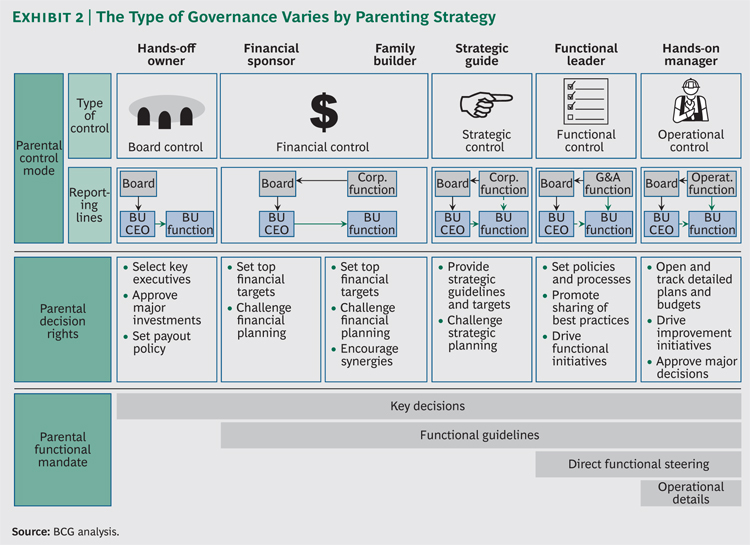
If there is one overriding imperative for CEOs, it is to add value to the portfolio of businesses so that the whole is worth more than the sum of its parts. Such value creation requires steering by the corporate center—whether across businesses, across regions, or across functions. But whatever form that steering takes, the corporate center must not only choose its optimal parenting strategy but also design an organization that translates that strategy’s value-creation logic into practice. Many CEOs, however, struggle to translate strategic logic into action, and as a result, many corporate centers still fall short of their full value-creation potential. The pressure to improve the center’s value creation is unrelenting and comes from all quarters. The capital market demands constant value creation and is quick to penalize corporate shares—and CEOs—if they fail to deliver. Analysts and shareholders pay close attention to valuation discounts. They are also quick to sound the alarm when overhead cost controls appear to be weakening. They compare the corporation against competitors that demonstrate excellence and ask why the corporation can’t keep up. Just as intense are the internal demands for constant value creation. Boards look for quick results from mergers and acquisitions (M&A) and press for corporate strategies that add value to the combined enterprise. Business units complain that the center insists that they engage in activities that impose costs and operating constraints without seeming to provide offsetting benefits. In the worst cases, these conflicts can paralyze the whole organization. In their own ways, the markets, boards, and business units are all asking the same urgent question: What is the corporate parent doing to add value to the business units? It is no longer sufficient to assemble a corporate portfolio of good businesses. Corporate stakeholders have shifted their focus from the specific competitive advantages of individual units—such as market share, technology, or brands—to the competitive advantage at the corporate level; that is, to the parenting advantage. Effective parenting strategies add value in many different ways. Some promote excellence in key business functions through clear guidelines; some share competencies among business units. Others improve decision quality, attract game-changing talent, or build a high-performance culture in each unit. Read more of this post

Anxious Wealth: Money and Morality Among China’s New Rich

Anxious Wealth: Money and Morality Among China’s New Rich [Paperback]

John Osburg (Author)

Anxious Wealth

Publication Date: April 3, 2013

Who exactly are China’s new rich? This pioneering investigation introduces readers to the private lives—and the nightlives—of the powerful entrepreneurs and managers redefining success and status in the city of Chengdu. Over the course of more than three years, anthropologist John Osburg accompanied, and in some instances assisted, wealthy Chinese businessmen as they courted clients, partners, and government officials.

Drawing on his immersive experiences, Osburg invites readers to join him as he journeys through the new, highly gendered entertainment sites for Chinese businessmen, including karaoke clubs, saunas, and massage parlors—places specifically designed to cater to the desires and enjoyment of elite men. Within these spaces, a masculinization of business is taking place. Osburg details the complex code of behavior that governs businessmen as they go about banqueting, drinking, gambling, bribing, exchanging gifts, and obtaining sexual services.

These intricate social networks play a key role in generating business, performing social status, and reconfiguring gender roles. But many entrepreneurs feel trapped by their obligations and moral compromises in this evolving environment. Ultimately, Osburg examines their deep ambivalence about China’s future and their own complicity in the major issues of post-Mao Chinese society—corruption, inequality, materialism, and loss of trust. Read more of this post

100 years on, Rockefeller Foundation still busy

100 years on, Rockefeller Foundation still busy

David Crary, The Associated Press, New York | World | Mon, May 13 2013, 8:48 AM

For the richest American family of their era, the goal was fittingly ambitious: “To promote the well-being of mankind throughout the world.”

With that mission, underwritten by the vast wealth of John D. Rockefeller Sr., the Rockefeller Foundation was chartered 100 years ago. For several decades, it was the dominant foundation in the United States, breaking precedent with its global outlook and helping pioneer a diligent, scientific approach to charity that became a model for the field.

“They were in a very small group of foundations that practiced idea-based philanthropy as opposed to just charity. They are willing to invest in ideas,” said Bradford Smith, who as president of the New York-based Foundation Center oversees research on philanthropy worldwide.

The Rockefeller Foundation is celebrating its centennial by touting an array of forward-looking projects, ranging from global disease surveillance to strengthening the resilience of vulnerable cities in the U.S. and Asia to future calamities. It is also looking back, at a 100-year history replete with triumphs and controversy. Read more of this post

Sir Luke Johnson: Whether it’s selling or shutting a business, leaving a job or ending a relationship, deciding when and if to let go makes all the difference

May 14, 2013 4:08 pm

Walking away is often the best option

By Luke Johnson

Deciding when and if to let go makes all the difference

Knowing when to quit separates winners from losers. Those who spend years pursuing lost causes can waste their lives. Others who leave gracefully and move on understand that the world is full of opportunities, and know that sheer stubbornness for its own sake is foolish. A couple of years ago I backed a play called Onassis in London’s West End. As ever, it was launched with great optimism. But the reviews were mediocre and the box office takings poor. Soon the choice came: should we put in more money to fund additional marketing, or accept that the show wasn’t good enough and close? I’m relieved to say that we shut, took the pain – and learnt a few lessons from the experience.

Whether it’s selling or shutting a business, leaving a job or ending a relationship, deciding when and if to let go makes all the difference. As they say, timing is everything. Occasionally massive persistence can pay off: Chester Carlson first patented his technique for a photocopier in 1938 but it wasn’t until 1949 that the Xerox Corporation first launched his product. But for every epic invention like that there are many thousands of doomed ideas that will never achieve lift-off. I regularly receive business plans for schemes that appear entirely uneconomic: in lots of cases the passionate founder has spent years hawking their dream around financiers getting nowhere, ignoring the evidence and allowing emotions to overwhelm their judgment. Read more of this post