AD OF THE DAY: This Cutesy Oreo Commercial Is Strangely Transfixing

AD OF THE DAY: This Cutesy Oreo Commercial Is Strangely Transfixing

Dominic Green | May 13, 2013, 8:30 PM | 563 | 

If you can stand electro-pop sensation Owl City’s auto-tuned singing, you just might love this new Oreo commercial. It features a song, the “Wonderfilled Anthem,” written by Owl City, and a cutesy animation of lovable, dancing characters. All together, the formula is oddly addicting, slightly reminiscent of last year’s Dumb Ways To Die video. An excerpt from the Martin Agency-created spot: “If I gave [Oreos] to great white sharks, would they share them with baby seals? / Would they call up a giant squid for a friendly meal?” Oreo has been all about viral marketing this year — its quick-thinking tweet during the Super Bowl power outage quickly earned the company deserved coverage.


The ‘Real Winners Of The World’ Don’t Have Work-Life Balance, They Have Work

The ‘Real Winners Of The World’ Don’t Have Work-Life Balance, They Have Work

Max Nisen | May 13, 2013, 10:00 PM | 6,284 | 20

For many, work-life balance is seen as the ultimate goal. For others, that mindset is hogwash that’s holding you back in your career. Taking time off for family or passions “can offer a nice life,” legendary GE CEO Jack Welch once told The Wall Street Journal. But he said that it lessens the chances for promotion or to reach the top of a career path. Welch is not the only one who believes this. Recently, Glencore Xstrata PC CEO Ivan Glasenberg argued that those executives who start to focus on family and hobbies will find themselves undercut and replaced by those who don’t. It’s easy to dismiss these attitudes as outdated, macho, and unreasonable. But it’s possible that people seeking work-life balance are just avoiding finding a way to work extremely hard, and be very happy about it.  Marty Nemko, a career coach, author, columnist, and radio host, argues that the most successful and contented people prefer a heavily work-centric life over work-life balance.

“The real winners of the world, the people that are the most productive, think that this notion of work-life balance is grossly overrated,” Nemko told Business Insider. “Most of the highly successful and not-burned out people I know work single-mindendly towards a goal they think is important, whether it’s developing a new piece of software, inventing something, or a cardiologist who’s seeing patients on nights and weekends instead of playing Monopoly with his kids on the weekend.””Don’t blame the hours,” Nemko says. “If somebody says they got burned out working 70 hours a week it’s because they weren’t competent enough to do the work..” These people, who are “out-of balance” in the usual sense of the word, find motivation and satisfaction in devoting themselves to something and making a difference. That comes with a caveat of course. Sleep is non-negotiable. “If you need your eight hours, you get it,” Nemko says. If you sleep eight hours a night, that still leaves you a hundred hours a week. “The pool of people that do not have work-life balance feel efficacious — are efficacious in the world — are making a difference, and are making more money,” Nemko says. He argues that many people who champion work-life balance aren’t overworked, but are using the term as a politically correct tool, as a smokescreen for the desire to not do work. So rather than focusing on work-life balance, focus on being in the moment, on giving everything at work instead of imagining relaxing at home on the weekend. And if you can’t bring yourself to work 70 hours now and then, or it feels like torture, you’re probably at the wrong job. Even startup founders, known for working incredible hours under a lot of stress, shouldn’t blame burnout on a lack of work-life balance. “Don’t blame the hours,” Nemko says. “If somebody says they got burned out working 70 hours a week it’s because they weren’t competent enough to do the work, they hired the wrong people, or the product they were working on wasn’t good enough, and they were trying to make it work when they really shouldn’t have.”

The search for work-life balance has become gospel in recent years. But depending on who you ask, sometimes it can become an excuse.


Island mentality: Joke map shows uncomfortable truths — about Taiwan

Island mentality: Joke map shows uncomfortable truths — about Taiwan

Staff Reporter  2013-05-14

20130514000024

A world map created as a joke by internet users in Taiwan is an accurate reflection of the prejudices of the country’s people, as highlighted by the local response to the fatal shooting of a fisherman by the Philippine coast guard on May 9, according to the chief editor of a multilingual Taiwanese magazine. The death of Hung Shih-cheng prompted a furious response across Taiwan, with hackers appearing to target government websites in the Philippines and fishermen burning the Philippine national flag. On Sunday, Taiwan’s president Ma Ying-jeou threatened to freeze the applications of Filipino laborers seeking work in Taiwan unless Manila addresses the incident to Taipei’s satisfaction within 72 hours. Chang Cheng, the editor-in-chief of 4-Way Voice, a monthly magazine catering to Vietnamese, Thai, Indonesian, Filipino and Cambodian readers, said Taiwan’s reaction has displayed a condescending attitude towards the Philippines. Taiwanese netizens and commentators are commonly saying that they are angry because “even” the Philippines is stepping all over Taiwan, Chang said, revealing a prevalent sense of superiority with regards to people from Southeast Asian countries. Read more of this post

Engaging with a company’s users: Ducati tapped the power of its fans; In five years revenues quadrupled to €407.8m, market share doubled and the company became more widely known

May 13, 2013 4:21 pm

Engaging with a company’s users

By Paolo Aversa

The story. Widely seen as the acme of Italian style, tradition and performance in motorcycle design and manufacturing, Ducati has nevertheless often struggled to transform fame and fans into sales. By 1996 the company was on the verge of bankruptcy and had undergone several buyouts when a new chief executive, Federico Minoli, took over.

The challenge. Ducati faced fierce competition from traditional brands such as Harley-Davidson, BMW and Triumph, and from Japanese companies Honda, Yamaha, Kawasaki and Suzuki. Ducati’s annual production in the late 1990s was about 20,000 bikes, which generated modest revenues compared with, say, the annual 5.4m Hondas sold at the time. In less than five years Mr Minoli effected a turnround. This was achieved partly by a strict reduction in production costs, but also through a strategy of extending the traditional consumer base of extreme riders to the larger group of more laid-back enthusiasts. Still, Mr Minoli felt Ducati had not made full use of the potential of its fans’ extensive community. But how could it reach such a widespread group of users with few resources to invest in the endeavour? Read more of this post

When Computer Games May Keep the Brain Nimble

Updated May 13, 2013, 7:12 p.m. ET

When Computer Games May Keep the Brain Nimble

By SUMATHI REDDY

PJ-BO258_YHEALT_DV_20130513172544

The computer game Double Decision helped boost players’ brain function, a study found. Doing crossword puzzles had no such benefit. A new study reveals that adults who played a video game helped their mental agility more than adults who did crossword puzzles. Your Health columnist Sumathi Reddy and University of Iowa public health professor Fred Wolinsky join Lunch Break with details. Photo: Double Decision.

The computer game’s concept is relatively simple. Find the matching motor vehicle and road sign amid a series of increasing distractions. Succeed and the challenge gets quicker and harder. Cognitive-training games like this one, Double Decision, are designed to improve brain functions and are at the center of a growing body of research looking at their effectiveness as scientists strive to find ways to ward off the cognitive declines that usually come with age. A government-funded study published this month found that playing Double Decision can slow and even reverse declines in brain function associated with aging, while playing crossword puzzles cannot. The study builds on an earlier large trial which found that older people who played various cognitive games had better health-related outcomes, driving records and performed better at everyday tasks such as preparing a meal. Read more of this post

Give a man a coalmine, make him rich, and what does he do? He goes and tells everybody he’s not your mate. The costs of corruption will weigh on NSW for years to come. A decade of deals can hardly be unwound now

Mateship, it is obvious, can come at a high price

May 11, 2013, Michael West

mucci-620x349

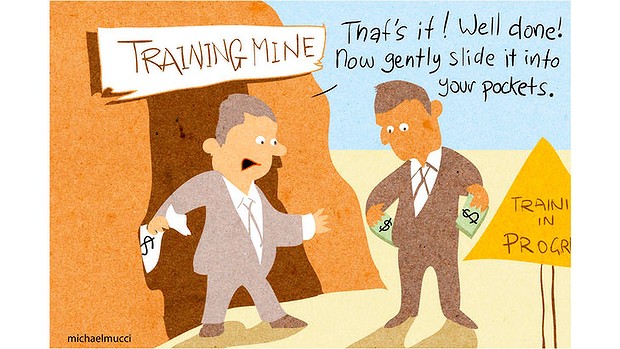
‘If he was me mate, he would have showed up.” Former union boss John Maitland tells the Independent Commission Against Corruption this week former New South Wales mining minister Ian Macdonald was not his mate because he didn’t show up at his farewell dinner. Crikey, that’s hurtful. Give a man a coalmine, make him rich, and what does he do? He goes and tells everybody he’s not your mate. It’s fair dinkum un-Australian! Granted, the union boss did concede in testimony before ICAC this week, that he and the minister may have had a ”close working friendship”. Yes, struck the deal over a magnum of pinot noir at Catalina Restaurant. Yes, there had been no tender – come on, it was only a ”training mine”. Yes, the training mine somehow become a real mine and found its way into a stockmarket company NuCoal. And yes, John’s $165,000 investment happened to turn into $14 million. After all that goodwill from Macca, one can only surmise that John attaches exceedingly rigorous performance hurdles to his mateships. In the same year that Macca approved the Hunter Valley licence for John, he also opened up tracts of land in the Bylong Valley. That’s the spot where, by sheer providence, Labor powerbroker Eddie Obeid had bought a property whose value was soon to rise fourfold. Eddie Obeid had stewardship of the mines portfolio in NSW from April 1999 to April 2003. Macca came later. A pall has been cast over any mining deal struck by the NSW government in the past 14 years, including those with mining leviathan Newcrest, which operates Cadia, the country’s largest gold mine, near Orange. Gold and Copper Resources – an explorer led by Brian Locke and backed by former Rio Tinto boss Leigh Clifford, founder of Barlow Jonker Jeremy Barlow, former Glencore and Xstrata chairman Willy Strothotte, and venture capitalist Mark Carnegie – is contesting the validity of Newcrest’s licences. They await judgment on the first of five court actions over the Cadia licences. It’s a mess, though there is the odd winner from ICAC: the Coalition, we in the media and, of course, Ian Macdonald’s dentist to name three (love that smile). But the costs of corruption will weigh on NSW for years to come. A decade of deals can hardly be unwound now.

The Ingenious Enterprise: Competing Amid Rising Complexity

The Ingenious Enterprise: Competing Amid Rising Complexity

by Martin Reeves and Jussi Lehtinen

MAY 07, 2013

472-Ingenious-Enterprise-Ex1_lg_tcm80-133375472-Ingenious-Enterprise-Ex2_lg_tcm80-133377

“Creating a great culture, finding the right people, managing them to do great things, and solving problems creatively and systematically are challenges faced by all organizations. What differentiates [organizations] is how they approach these challenges.”

Ray Dalio, Founder, President, and CIO, Bridgewater Associates

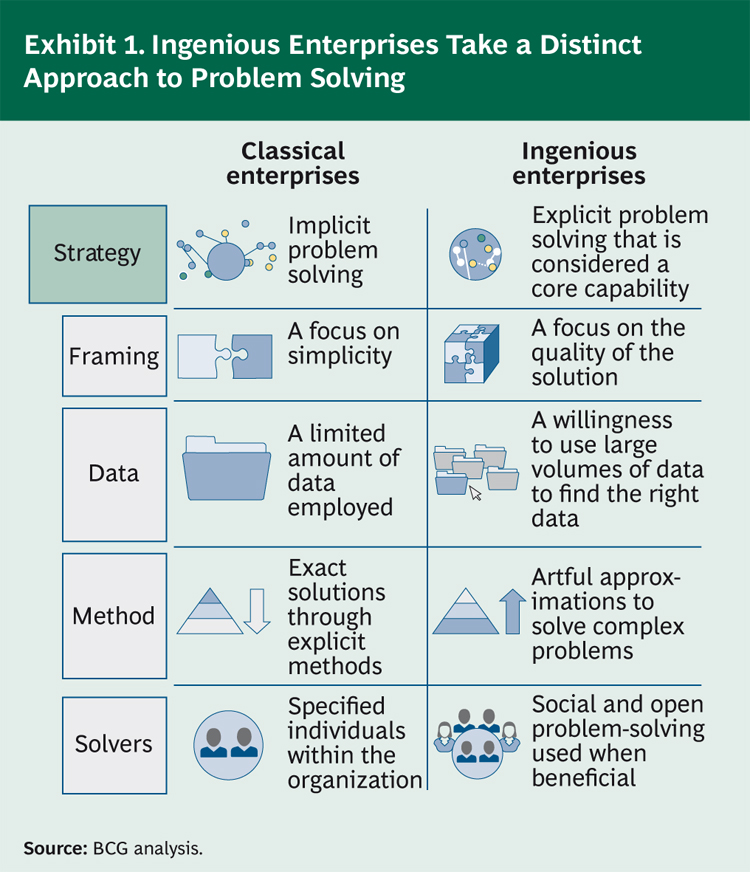
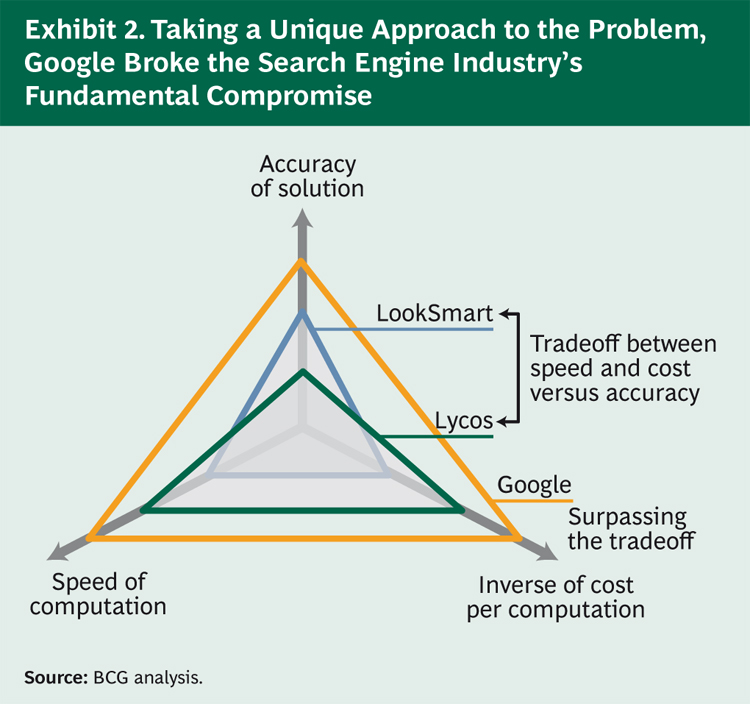
Business, at its heart, is about solving problems. Problem solving is performed both explicitly by analysts and computers and implicitly by your organization as a whole. And the way your organization is designed—the structure, processes, communication policies, incentives, training, and talent management you have in place—shapes the way your problems are approached and solved. Many organizations, however, lack explicit strategies for problem solving. This has come at little cost to these organizations historically, given that many of the problems they faced could be solved using straightforward, well-known methods. But today’s business environment, characterized by sharply rising complexity and hence increasingly complicated problems, is putting a rising premium on more sophisticated approaches to problem solving.

The rise in complexity—defined as the number of calculation steps required to reach a solution—is being driven by the rapid growth of three variables: data, interconnectedness, and the speed of change. Read more of this post

Graduate-turned-butcher shares experience with alma mater

Graduate-turned-butcher shares experience with alma mater

graduate-butcher_China-daily

Lu Buxuan (right) helps his brother Lu Buning in the family butcher’s shop.

Zhang Yue, China Daily/Asia News Network

Monday, May 13, 2013

CHINA – It was the first time in 24 years that Lu Buxuan was speaking at his alma mater, Peking University, and the scene was emotional. His career choice of selling pork for a living after graduation in 1989 – at a time when college education was accessible only to a few in the society – has brought him to public attention for the past decade. In April, Lu was invited to return to the university. This time as a speaker, providing advice to his juniors. “I am very excited to stand here,” Lu says. “I understand that only the elites of our society can stand here and give a speech to the students.” “I, on the other hand,” he choked, and his face turned red, “brought shame to my alma mater.” Lu graduated from Peking University in 1989, majoring in Chinese language and literature, and was assigned to a factory job in his hometown in Shaanxi province. “It was definitely not the job I liked. But most students were assigned jobs at that time.” Lu says his tough and stubborn personality made his career in the State-owned factory increasingly harder. “I didn’t talk much,” says 47-year-old Lu. “And because I was too quiet and did not cultivate good relationships with people around me, I was ostracized.” Lu quit his low-paying factory job in 1999 and was planning to start a small business of his own. Setting up a stall in a food market was one of the easiest options. Read more of this post

Richard Branson dresses as stewardess on charity flight

Branson dresses as stewardess on charity flight

20130512.160728_branson_2

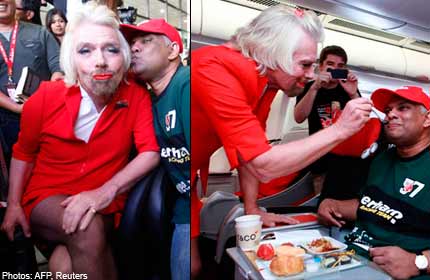
He spent the five-and-a-half hour flight pouring coffee or tea, serving meals, distributing goodies, entertaining as well as making in-flight announcements.

Virgin group founder Sir Richard Branson has finally made good on a bet he lost two years ago. The bet was made with AirAsia CEO Tony Fernandes on who had a better Formula 1 team at the 2010 Grand Prix in Abu Dhabi. The loser would have to dress as a female flight attendant on board the winner’s airline. Fernandes’ Lotus beat Branson’s Marussia Virgin by two spots in the final rankings. The flight took off from Perth, Australia, to Kuala Lumpur this morning (May 12). Tickets were priced at A$399 (S$494.61), with A$100 from each ticket sold donated to Australia’s Starlight Children’s Foundation. 10 per cent from all inflight sales will also be donated. “As an AirAsia X’s flight attendant, he has to comply with our grooming standards and that includes shaving his legs, donning high heels, putting on some makeup and slipping into the AirAsia’s famous red uniform,” Fernandes said. He added: “He will be committed to carry out the responsibilities of a flight attendant, including offering coffee, tea and other food and beverages to guests on the special 6-hour Perth to Kuala Lumpur flight.”

Japanese ‘latte’ artist creates 3D art on coffees

Japanese ‘latte’ artist creates 3D art on coffees

Forget your typical drawings of flowers and leaves on lattes, Japanese artist Kazuki Yamaoto brings latte art to a whole new level with 3D characters.

May 11, 2013

Forget your typical drawings of flowers and leaves on caffé lattes — art on coffee has gone 3D. According to an article on Kotaku, a Japanese “latte artist” named Kazuki Yamamoto, who is famous for drawing characters from games and anime with steam milk, has brought latte art to a whole new level — he does it in 3D now.

2014

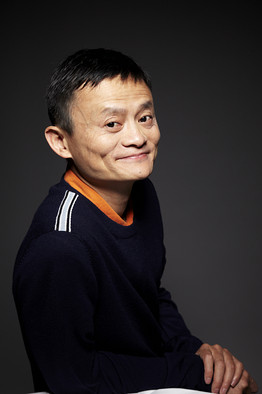
Jack Ma’s Last Speech as Alibaba CEO

Jack Ma’s Last Speech as Alibaba CEO

May 13, 2013

“Small businesses are where most of the Chinese dreams live”

After a couple of hours of music and extravaganza – including Ma himself singing – he gave his speech to the roaring stadium audience of over 20,000 employees, merchants, and guests. Below is our unofficial translation of Jack’s speech. I do hope it captured a large part of what he communicated:

Jack Ma: In the last ten years, there are many people who have paid a big price to live this dream. For our dream, we have walked ten years. I have been thinking, even if someone had removed 99 percent of Alibaba’s assets, we are still worthy. We have no regrets. We have our team, our partners, and friends. What is the thing that has made Alibaba what it is today? What is the thing that has made me what I am today? I have no reasons to succeed. Alibaba and Taobao have no reasons to succeed either. But today, we have walked so far and for so many years with so many aspirations for the future. I believe, it is trust that has made us walk this far.

When no one believes in the future, we chose to believe… we chose to trust.. that 10 years later, China will be better. We chose to believe that our colleagues will do better than myself. I believe, the younger generation of Chinese will do better than us. I’m very thankful that my colleagues have trusted me. It’s tough to be a CEO but being a CEO’s employee is even tougher. At times when trust was doubted, people actually bought things online, even when they haven’t even seen the items before. Over thousands of kilometers, through an unknown person, the goods fall safely into your hands. Today’s China has trust and belief. Everyday, there are 24 million transactions on Taobao signifying China’s trust. Read more of this post

Creators are so caught up in the pursuit of their work mission that they sacrificed all, especially the possibility of a rounded personal existence

How to be a Creator

by Eric Barker

1) Be curious and driven

For his book Creativity, noted professor Mihaly Csikszentmihalyi did interviews with 91 groundbreaking individuals across a number of disciplines, including 14 Nobel Prize winners. In 50 Psychology Classics Tom Butler-Bowdon summed up many of Csikszentmihalyi’s findings including this one: Successful creative people tend to have two things in abundance, curiosity and drive. They are absolutely fascinated by their subject, and while others may be more brilliant, their sheer desire for accomplishment is the decisive factor.

2) It’s not about formal education. It’s about hours at your craft.

Do you need a sky-high IQ? Do great geniuses all have PhD’s? Nope. Most had about a college-dropout level of education.

Via Talent Is Overrated: What Really Separates World-Class Performers from Everybody Else:

Dean Keith Simonton, a professor at the University of California at Davis, conducted a large-scale study of more than three hundred creative high achievers born between 1450 and 1850—Leonardo da Vinci, Galileo, Beethoven, Rembrandt, for example. He determined the amount of formal education each had received and measured each one’s level of eminence by the spaces devoted to them in an array of reference works. He found that the relation between education and eminence, when plotted on a graph, looked like an inverted U: The most eminent creators were those who had received a moderate amount of education, equal to about the middle of college. Less education than that—or more—corresponded to reduced eminence for creativity.

But they all work their ass off in their field of expertise. That’s how to be a genius. Those interested in the 10,000 hour theory of deliberate practice won’t be surprised. As detailed in Daily Rituals: How Artists Work, the vast majority of them are workaholics.

Via Daily Rituals: How Artists Work

“Sooner or later,” Pritchett writes, “the great men turn out to be all alike. They never stop working. They never lose a minute. It is very depressing.”

In fact, you really can’t work too much.

Via Talent Is Overrated: What Really Separates World-Class Performers from Everybody Else:

If we’re looking for evidence that too much knowledge of the domain or familiarity with its problems might be a hindrance in creative achievement, we have not found it in the research. Instead, all evidence seems to point in the opposite direction. The most eminent creators are consistently those who have immersed themselves utterly in their chosen field, have devoted their lives to it, amassed tremendous knowledge of it, and continually pushed themselves to the front of it.

3) Test Your Ideas

Howard Gardner studied geniuses like Picasso, Freud and Stravinsky and found a similar pattern of analyzing, testing and feedback used by all of them:

Via Creating Minds: An Anatomy of Creativity Seen Through the Lives of Freud, Einstein, Picasso, Stravinsky, Eliot, Graham, and Ghandi:

Creative individuals spend a considerable amount of time reflecting on what they are trying to accomplish, whether or not they are achieving success (and, if not, what they might do differently).

Does testing sound like something scientific and uncreative? Wrong. The more creative an artist is the more likely they are to use this method:

Via Little Bets: How Breakthrough Ideas Emerge from Small Discoveries

In a study of thirty-five artists, Getzels and Csikszentmihalyi found that the most creative in their sample were more open to experimentation and to reformulating their ideas for projects than their less creative counterparts.

4) You Must Sacrifice

10,000 hours is a hell of a lot of hours. It means many other things (some important) will need to be ignored. In fact, geniuses are notably less likely to be popular in high school. Why? The deliberate practice that will one day make them famous alienates them from their peers in adolesence.

Via Quiet: The Power of Introverts in a World That Can’t Stop Talking:

…the single-minded focus on what would turn out to be a lifelong passion, is typical for highly creative people. According to the psychologist Mihaly Csikszentmihalyi, who between 1990 and 1995 studied the lives of ninety-one exceptionally creative people in the arts, sciences, business, and government, many of his subjects were on the social margins during adolescence, partly because “intense curiosity or focused interest seems odd to their peers.” Teens who are too gregarious to spend time alone often fail to cultivate their talents “because practicing music or studying math requires a solitude they dread.”

At the extremes, the amount of practice and devotion required can pass into the realm of the pathological. If hours alone determine genius then it is inevitable that reaching the greatest heights will require, quite literally, obsession.

Via Creating Minds: An Anatomy of Creativity Seen Through the Lives of Freud, Einstein, Picasso, Stravinsky, Eliot, Graham, and Ghandi:

My study reveals that, in one way or another, each of the creators became embedded in some kind of a bargain, deal, or Faustian arrangement, executed as a means of ensuring the preservation of his or her unusual gifts. In general, the creators were so caught up in the pursuit of their work mission that they sacrificed all, especially the possibility of a rounded personal existence. The nature of this arrangement differs: In some cases (Freud, Eliot, Gandhi), it involves the decision to undertake an ascetic existence; in some cases, it involves a self-imposed isolation from other individuals (Einstein, Graham); in Picasso’s case, as a consequence of a bargain that was rejected, it involves an outrageous exploitation of other individuals; and in the case of Stravinsky, it involves a constant combative relationship with others, even at the cost of fairness. What pervades these unusual arrangements is the conviction that unless this bargain has been compulsively adhered to, the talent may be compromised or even irretrievably lost. And, indeed, at times when the bargain is relaxed, there may well be negative consequences for the individual’s creative output.

5) Work because of passion, not money

Passion produces better art than desire for financial gain — and that leads to more success in the long run.

Via Dan Pink’s Drive: The Surprising Truth About What Motivates Us:

“Those artists who pursued their painting and sculpture more for the pleasure of the activity itself than for extrinsic rewards have produced art that has been socially recognized as superior,” the study said. “It is those who are least motivated to pursue extrinsic rewards who eventually receive them.”

How Is an IPO Like a Marriage? The Billionaire Founder of China’s Alibaba Goes Public. “I’m like a bride on her wedding day. All she knows how to do is grin.”

May 10, 2013, 8:38 p.m. ET

Weekend Confidential: Jack Ma of Alibaba

How Is an IPO Like a Marriage? The Billionaire Founder of China’s Alibaba Goes Public.

By ALEXANDRA WOLFE

OB-XK963_wolfew_DV_20130510115032

‘I want to get back to normal,’ he insists. ‘I think if you asked Bill Gates, he wants to be back to himself.’

A week before he was set to step down as chief executive of Alibaba, one of the world’s largest e-commerce companies, Jack Ma was enjoying breakfast on an outdoor patio in Santa Monica, Calif. Worth an estimated $4.2 billion, the Chinese entrepreneur may grow even richer if the company he founded 14 years ago goes public. Philanthropy has brought him to California on this trip, but he has no intention of joining the famous billionaires’ pledge and donating at least half his money to charity. “This idea of giving your money out was not created by Gates and Buffett. It was created by the Communist Party in the 1950s!” he says with a laugh.

That wasn’t the only thing that had Mr. Ma, 48, chuckling. Since he announced his transition to executive chairman in January—he handed over the reins Friday—he has stoked speculation about a potential Alibaba IPO. With an estimated value of about $60 billion, the company could be one of the year’s hottest tech offerings if it makes the move. Read more of this post

How the Rich Play the Market, making the most of their advantages—and how they mess up

Updated May 10, 2013, 7:55 p.m. ET

How the Rich Play the Market

By JASON ZWEIG

BF-AE943_INVEST_G_20130510175323

F. Scott Fitzgerald wasn’t entirely right. The very rich are different from you and me—but not by much. A new study offers a comprehensive look at the portfolios and investment decisions of several hundred of the wealthiest families in the U.S. Every investor, rich or otherwise, can learn from how these people make the most of their advantages—and from how they mess up. These households, with an average net worth of roughly $90 million, invest intelligently, for the most part, spreading their bets widely, seldom trading and keeping their investing taxes to a minimum. But the superrich also commit rookie mistakes. Their approach to diversification might not always be ideal. They chase investment fads like dogs chasing parked cars. They freeze with fear just when bravery is most likely to be rewarded. Maybe the “smart money” isn’t so different from the middle-class “dumb money” that Wall Street likes to mock. Read more of this post

Carbon dioxide in atmosphere at highest level for 5 million years

Carbon dioxide in atmosphere at highest level for 5 million years

Atmosphere rising at fastest rate since records began

TOM BAWDEN 

FRIDAY 10 MAY 2013

The concentration of carbon dioxide in the atmosphere has breached the symbolically important level of 400 parts per million (ppm) for the first time in 5 million years after rising at its fastest rate since records began. Average daily CO2 levels jumped by 2.74 ppm in the first 17 weeks of 2013, compared to last year, the biggest increase since the benchmark monitoring stations high on the Hawaiian volcano of Mauna Loa began taking measurements in 1958. Read more of this post

Cooper Union recently announced that it would begin charging tuition, a decision made after decades of bad financial choices and recent treacherous markets

May 10, 2013

How Cooper Union’s Endowment Failed in Its Mission

By JAMES B. STEWART

Since Peter Cooper’s heirs gave the Cooper Union for the Advancement of Science and Art the land under the Chrysler Building in 1902, the school’s endowment has enabled it to offer students a high-quality, tuition-free education through two world wars, the Great Depression and multiple stock market crashes and financial crises. So why does Cooper Union now find itself forced to charge tuition of an estimated $20,000 a year, abandoning what many consider its most important legacy? This week, angry students were occupying the president’s office in protest. They might be even angrier to learn that some of their future tuition dollars could be going to support wealthy hedge fund managers who oversee some of the school’s $666.7 million endowment.

Cooper Union may be an extreme example, but it’s hardly the only college suffering from a combination of decades of bad decisions and recent treacherous markets. Its endowment was typical of the many endowments and pension funds that took the plunge into so-called alternative investments like hedge funds, which have lured investors with the promise of generous and steady returns in both good times and bad. And compared with many universities, Cooper Union did a good job managing its endowment through the recent financial crisis. As recently as 2009, the school maintains, it ranked first among all American universities for endowment performance. Read more of this post

A Brief History of LinkedIn

A Brief History of LinkedIn
by  on May 05, 2013

From a handful of guys in a living room to 225 million members around the world. Join us for a look back at where we’ve been over the last decade. Thanks to our amazing members for being a part of our journey.

Why Productive People Have Empty Schedules; Lessons on guarding your time by Warren Buffett, Peter Drucker, Charles Dickens, Reddit CEO Yishan Wong, and others. Nearly all creators spend nearly all their time on the work of creation

WHY PRODUCTIVE PEOPLE HAVE EMPTY SCHEDULES

WHAT’S THE ONE RESOURCE YOU CAN’T BORROW, INVEST, OR RECOVER? TIME. LESSONS ON GUARDING YOURS BY WARREN BUFFETT, PETER DRUCKER, CHARLES DICKENS, REDDIT CEO YISHAN WONG, AND OTHERS.

BY: DRAKE BAER

Back in 1991, Warren Buffett met Bill Gates, though as he tells Levo League, neither of them were excited to see one another. But it turned out they had a great time talking–and during the course of the conversation, Buffett pulled out the little black date book that he carries in his pocket. He flipped through it: the pages were practically empty. “You’ve gotta keep control of your time,” Buffett says, “and you can’t unless you say no. You can’t let people set your agenda in life.” Read more of this post

The Right Way for a CEO to Deliver Bad News

The Right Way for a CEO to Deliver Bad News

By Claire Suddath on May 09, 2013

How do you tell 400,000 people they’re terrible at their jobs? Do you hold a meeting? Send a mass e-mail? Tell only a few people and wait for your criticism to circulate, middle school-style? Or do you follow IBM (IBM) Chief Executive Officer Virginia “Ginni” Rometty’s example and record a video message, post it to your company’s internal blog, and then share it with the entire workforce?

After the disappointing earnings report on April 18, Rometty released a video to all 434,000 employees in which she admitted that IBM hadn’t “transformed rapidly enough.” She called out the sales staff for missing out on several big deals. “We were too slow,” she said. “The result? It didn’t get done.” The press got wind of her message, and Rometty’s now accused of the corporate equivalent of yelling at her children in public. The Wall Street Journal, which broke the story, called the outburst a “rare companywide reprimand.” IBM declined to comment on the video. Read more of this post

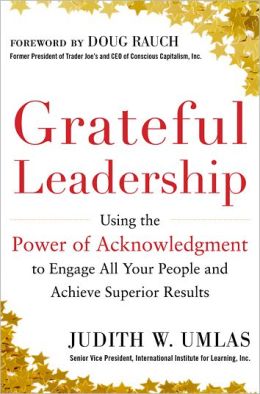
Grateful Leadership: Using the Power of Acknowledgment to Engage All Your People and Achieve Superior Results

Grateful Leadership: Using the Power of Acknowledgment to Engage All Your People and Achieve Superior Results[Hardcover]

Judith W. Umlas (Author)

9780071799522_p0_v1_s260x420

Publication Date: October 23, 2012

Go Grateful–have the courage to learn, the vision to lead, and the passion to grow.

When employees are engaged, they are passionate and feel a deeper connection to their work. Grateful Leadership is an essential approach for leaders who want to achieve the bottom line and foster a valuedriven workforce to build stronger professional relationships with customers, stakeholders, and employees.

Grateful Leadership shows how to create a more positive and meaningful connection between you and the people you lead. These skills are a catalyst for making immediate positive changes in your workplace that will enhance productivity, reputation, and overall performance.

Leadership training expert Judith W. Umlas provides the rationale, tools, and methodology to build a company culture based on the free expression of gratitude, and she reveals simple but remarkably effective ways for leaders to build a culture in which each individual employee possesses:

Courage to make important decisions

Willingness to take initiative

Trust in the organization and fellow employees

Motivation to strive for continuous improvement

Acknowledgment is a basic human need and a powerful motivator–people want to make a difference. In a culture of gratitude, employees stay; unappreciated employees leave.

Your company will benefit from the many Grateful Leadership stories from leaders such as Walter Robb, co-CEO of Whole Foods Market, that attest to the fact that when you appreciate, acknowledge, and affirm the essential contributions of employees, you unlock their potential to deliver superior results and enable your business to meet stakeholder expectations and outperform.

Grateful Leadership is a best-practices guidebook to employee engagement, staff retention, and increased productivity. Motivate and inspire your team, your organization, your customers, and, yes, yourself by following the book’s actionable next steps for implementing a culture based on acknowledgment, appreciation, and gratitude. Read more of this post

LinkedIn’s Reid Hoffman: Founding A Startup Is Like ‘Throwing Yourself Off A Cliff’; Elon Musk: “Being an entrepreneur is like eating glass and staring into the abyss of death.”

Reid Hoffman: Founding A Startup Is Like ‘Throwing Yourself Off A Cliff’

Julie Bort | May 9, 2013, 8:23 PM | 1,480 | 2

To hear successful entrepreneurs talk about it, founding a startup sounds like something no sane person should try. LinkedIn cofounder Reid Hoffman says that starting a company is like “throwing yourself off a cliff and assembling an airplane on the way down.” So he just told Bloomberg Television’s Emily Chang. This is a similar view to how his friend Elon Musk describes it. In 2010, Tesla and SpaceX founder Musk famously said, “Being an entrepreneur is like eating glass and staring into the abyss of death.”

Reid faced his almost-crash moment with LinkedIn shortly after it launched. He had hoped that people would simply see how useful it was and that the site would grow fast virally. But it didn’t. LinkedIn saw just “a trickle” of tech early adopters and not “an explosion,” he said. “So, I sat down with the team and said, if we don’t solve this, we’re dead.” He had only one idea to try: Allow people to upload their email address books to see if their friends had joined. If that failed, he would have, maybe, one more shot to get people interested in LinkedIn, but he didn’t know what else to try. Fortunately, the address book thing worked and growth spiked. This month, LinkedIn celebrated its 10-year anniversary. As of January, it had 200 million members in 200 countries.

The Life of Germany’s Own Walt Disney

05/09/2013 12:59 PM

Animated Success

The Life of Germany’s Own Walt Disney

By Oliver Klatt

et Fischerkoesen

Asthma forced Hans Fischerkoesen to spend most of his childhood in bed, but this period also ignited his imagination. In time, “Germany’s Walt Disney” would go on to become an animation legend. But his career almost became derailed by World War II — until Hitler stepped in. Read more of this post

How Rachel Riley built a childrenswear brand fit for David Beckham’s kids – now in its 20th year

How Rachel Riley built a childrenswear brand fit for David Beckham’s kids

With the expected arrival of a royal baby this summer, Rachel Riley’s childrenswear business – now in its 20th year – is well-placed to grow stronger, writes Emma Sinclair in her latest Biz Idol.

Rachel Riley’s shop customers have included David Beckham and Madonna.

P1040830_2556051bP1010639_1__2556902d

By Emma Sinclair

12:56PM BST 07 May 2013

May is a month of milestones for Rachel Riley, owner of the eponymously named children’s fashion brand. She’s just celebrated the fifteenth anniversary of the opening of her first shop on London’s Pont Street, and next week she celebrates her 50th birthday.

A smart child with a photographic memory, Rachel went to a girl’s comprehensive school in London.

She grew up “making stuff” for her dolls and teddies and was competent at knitting, embroidery and sewing. “I love using my hands,” she told me last week, when we caught up a few doors up from her second store, on Marylebone High Street.

She loved needlework and dress making but demonstrably intelligent, the school preferred that she focused on more academic subjects. She juggled academia and crafts, leaving school the first pupil ever to have secured a place at Cambridge University.

At the end of her first year a friend offered to lend her an apartment in Paris for the summer. Needing a job, she walked into a model agency who signed her on the spot. This was 1981 and she featured in over 20 television commercials and remembers how much she loved working with Sarah Moon, responsible for the infamous Cacharel and Anais Anais 80s adverts. Read more of this post

Why Pay More? When Radosław Sikorski, Poland’s foreign minister, went to Ukraine for talks last month, his Ukrainian counterparts reportedly laughed at him because he was wearing a Japanese quartz watch that cost only $165.

Peter Singer is Professor of Bioethics at Princeton University and Laureate Professor at the University of Melbourne. He is the author ofPractical EthicsOne World, and The Life You Can Save, which is also the name of an organization that he founded.

Why Pay More?

09 May 2013

PRINCETON – When Radosław Sikorski, Poland’s foreign minister, went to Ukraine for talks last month, his Ukrainian counterparts reportedly laughed at him because he was wearing a Japanese quartz watch that cost only $165. A Ukrainian newspaper reported on the preferences of Ukrainian ministers, several of whom have watches that cost more than $30,000. Even a Communist member of Ukraine’s parliament, the Rada, was shown wearing a watch that retails for more than $6,000.

The laughter should have gone in the opposite direction. Wouldn’t you laugh (maybe in private, to avoid being impolite) at someone who pays more than 200 times as much as you do, and ends up with an inferior product?

That is what the Ukrainians have done. They could have bought an accurate, lightweight, maintenance-free quartz watch that can run for five years, keeping virtually perfect time, without ever being moved or wound. Instead, they paid far more for clunkier watches that can lose minutes every month, and that will stop if you forget to wind them for a day or two (if they have an automatic mechanism, they will stop if you don’t move them). In addition, the quartz watches also have integrated alarm, stopwatch, and timer functions that the other watches either lack, or that serve only as a design-spoiling, hard-to-read effort to keep up with the competition. Read more of this post

Jack Ma of Chinese e-commerce giant Alibaba will officially step down today as CEO

Jack Ma to step down as Alibaba CEO today

2013-05-10 02:40:42 GMT2013-05-10 10:40:42(Beijing Time)  SINA English

Jack Ma of Chinese e-commerce giant Alibaba will officially step down today as CEO, according to Chinese media reports. He will be succeeded by his right-hand man Lu Zhaoxi. Alibaba was one of the earliest entrants into the Chinese online sector and has benefited hugely from its growth. A former English teacher, Ma set up Alibaba in 1999, convincing friends to fund him with $60,000 and picking a recognisable name with the aim of helping small firms find treasure by selling through the internet. Ma has inspired a generation of young Chinese with his open, no-nonsense and humorous personality. Both Taobao and Alibaba are owned by Alibaba Group, a private company based in the eastern city of Hangzhou. For many in China, life just wouldn’t be the same without Taobao, the country’s largest online shopping platform. In late April, Alibaba Group announced it will pay US$586 million for an 18 percent stake in Sina Corp’s Weibo microblog service.

U47P5029T2D589339F31DT20130510104042

Colleges Soak Poor Students to Funnel Aid to Rich

Colleges Soak Poor Students to Funnel Aid to Rich

By John Hechinger and Janet Lorin  May 8, 2013

U.S. colleges such as Boston University are using financial aid to lure rich students while shortchanging the poor, forcing those most in need to take on heavy debt, a report found.

Almost two-thirds of private institutions require students from families making $30,000 or less annually to pay more than $15,000 a year, according to the report released today by the Washington-based New America Foundation.

The research analyzing U.S. Education Department data for the 2010-2011 school year undercuts the claims of many wealthy colleges that financial-aid practices make their institutions affordable, said Stephen Burd, the report’s author. He singled out schools — including Boston University and George Washington University — that appear especially pricey for poor families.

“Colleges are always saying how committed they are to admitting low-income students — that they are all about equality,” Burd said in a phone interview. “This data shows there’s been a dramatic shift. The pursuit of prestige and revenue has led them to focus more on high-income students.” Read more of this post

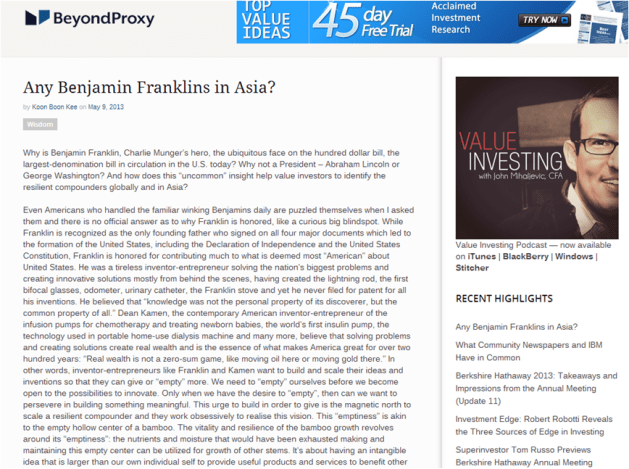
Any Benjamin Franklins in Asia? Bamboo Innovator is featured in BeyondProxy.com, where value investing lives

Bamboo Innovator is featured in BeyondProxy.com, where value investing lives:

Any Benjamin Franklins in Asia? May 9, 2013 (Weblink: BeyondProxy.com)

BenFranklinAsia

Charles Ellis on how much your money manager cost you and he worries about the challenges aging boomers face from low bond yields to uncertain stock returns, and dubious financial come-ons

How much does your money manager cost you?

By Penelope Wang @Money May 7, 2013: 6:01 PM ET

Charley Ellis, founder of Greenwich Associates, worries about the challenges aging boomers face from low bond yields to uncertain stock returns, and dubious financial come-ons.

Charley Ellis may not be a household name, but he commands the respect of many savvy investors.

He shook up Wall Street in 1975 with a landmark article in a financial trade journal that attacked the notion that professional money managers consistently beat the market. Nonprofessionals stand even less chance of outperforming the benchmarks, argued Ellis, so individuals need to rethink their approach to building wealth. That influential piece was the basis for Ellis’s classic investing book, Winning the Loser’s Game, the sixth edition of which is due in July. Founder of the financial consulting firm Greenwich Associates, Ellis has also served as a director of Vanguard. Today he still worries about investing costs, as well as the challenges that aging boomers face from low bond yields, uncertain stock returns, and dubious financial come-ons. Ellis, 75, spoke recently with MONEY editor-at-large Penelope Wang. Their conversation has been edited.

Read more of this post

Walter Robb: Whole Foods’ other CEO on organic growth

Walter Robb: Whole Foods’ other CEO on organic growth

By Geoff Colvin, senior editor-at-large @FortuneMagazine May 6, 2013: 9:31 AM ET

Company culture compels Whole Foods co-CEO Walter Robb to fly coach.

Selling groceries is a grinding, low-margin business — except forWhole Foods (WFMFortune 500). The world’s largest natural and organic grocer is a financial powerhouse with a market capitalization matching that of Kroger (KRFortune 500) which is eight times its size by revenue. Keeping the magic alive as Whole Foods (No. 232 on the Fortune 500) expands aggressively is partly the task of Walter Robb, 59, who shares the CEO job with founder John Mackey. Robb started a 1,000-square-foot natural and organic food market in 1977, not long after graduating from Stanford, then built a grocery business and sold it to Whole Foods in 1991. He talked recently with Geoff Colvin about making the chain more competitive on price, the power of its culture, flying Southwest Airlines in the middle seat, and much else. Edited excerpts: Read more of this post

Execs and investors from Pandora, IDEO, Andreessen Horowitz, SoundCloud, and Kleiner Perkins, among other masters of disruption, share the wisdom they’ve gathered on the way to the top

8 SUCCESSFUL ENTREPRENEURS GIVE THEIR YOUNGER SELVES LESSONS THEY WISH THEY’D KNOWN THEN

EXECS AND INVESTORS FROM PANDORA, IDEO, ANDREESSEN HOROWITZ, SOUNDCLOUD, AND KLEINER PERKINS, AMONG OTHER MASTERS OF DISRUPTION, SHARE THE WISDOM THEY’VE GATHERED ON THE WAY TO THE TOP.

BY: GRACE NASRI

Looking at the success trajectories of today’s disruptors–from Pandora cofounder Tim Westergren to Wikipedia’s Jimmy Wales–it’s easy to think that they had everything figured out from a young age. But many of today’s success stories learned lessons later in life that they wished they had known as they were beginning their careers. The eight investors and entrepreneurs below share the advice they wish they had gotten in their early twenties.

Tim Westergren: Avoid the risk of not trying and the regret of wishing you had.
Tim Westergren, the founder and Chief Strategy Officer at Pandora, said if he could offer his younger self one piece of advice, it would be to realize from an early age that it’s far more haunting to live with the regret of having not followed your instincts–even when those instincts required a diversion from the beaten path–than to have followed your gut and failed. Luckily for Westergren, he was one of the few who did follow his passions and that pursuit led him to found a company with a market cap of $2.5 billion.

“Be sure to ‘notice’ ideas when you have them. Stop. Take the time to consider them seriously. And if your gut tells you they’re compelling, be fearless in their pursuit,” Westergren said. “For most people, the idea of chasing a personal passion or being entrepreneurial is simply something they don’t think of themselves doing. We’re so programmed to walk well-trodden paths. But, we live life only once. So, rather than avoiding the risk of trying, avoid the risk of not trying. Nothing is more haunting than thinking, ‘I wish I had…’.” Read more of this post