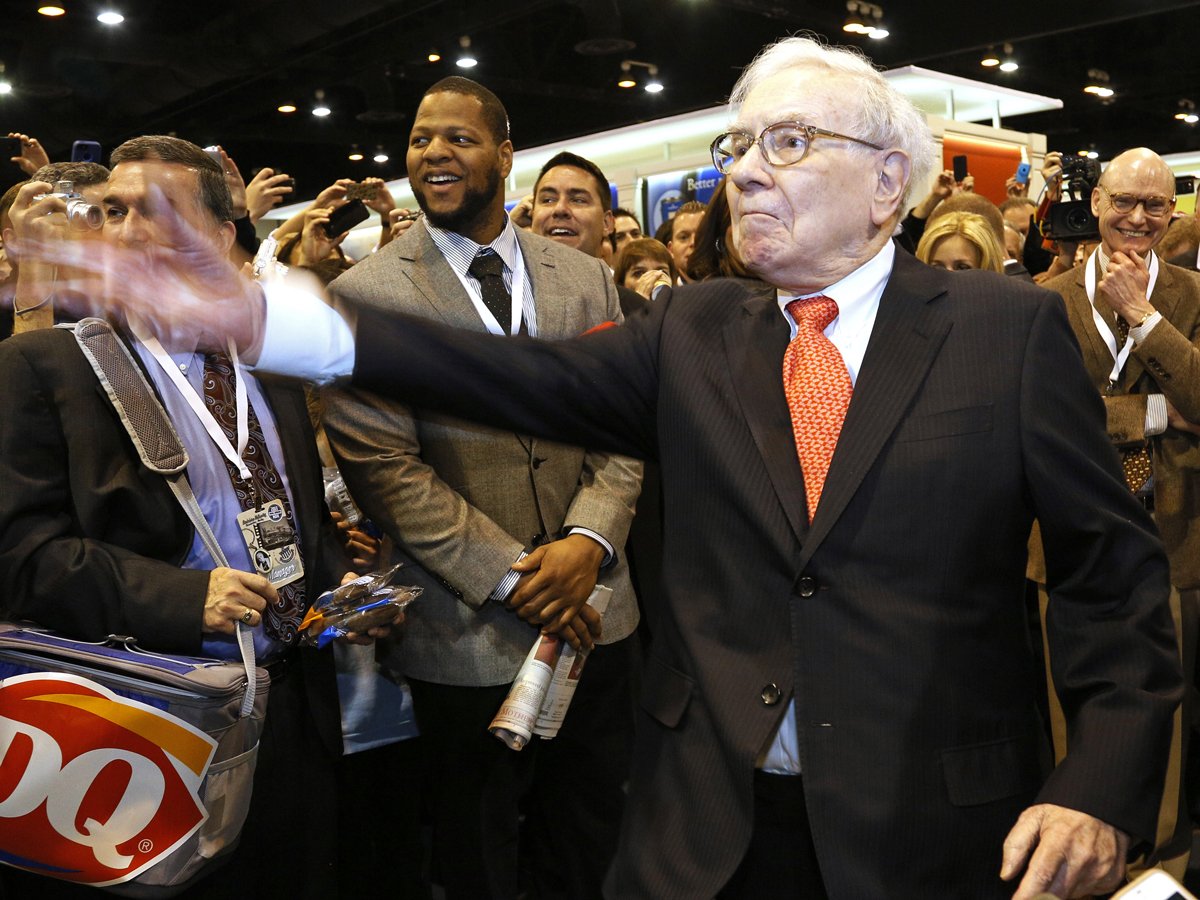
New book teaches children ABCs of Buffett’s Berkshire Hathaway

New book teaches children ABCs of Buffett’s Berkshire Hathaway

12:45pm EDT

By Jonathan Stempel

Handout photo of Chairman and CEO of Berkshire Hathaway Warren Buffett in an illustration on the cover of the book "My First Berkshire ABC"

OMAHA, Nebraska (Reuters) – Warren Buffett’s Berkshire Hathaway Inc invests in dozens of businesses, and a new book tries to explain it all to young readers, from A to Z. Two Omaha residents, author Nancy Rips and illustrator Tom Kerr, have teamed up on “My First Berkshire ABC” to teach children about one of the world’s best-known companies, and a little about the local billionaire behind it. More than 1,000 copies were sold at Berkshire’s annual meeting on Saturday, which draws thousands of people to Omaha, and where Buffett has a say on what gets sold. “You need something to bring home to your kids and grandkids to explain Berkshire,” Rips, who has also written three books about Jewish holidays, said in a joint interview with Kerr. Most pages show companies that Berkshire owns or invests in. G, for example, is for “Geico,” and features the car insurer’s talking gecko. And W is for “Wells Fargo”, and features the bank’s familiar stagecoach. The book’s theme changed at Buffett’s suggestion. “Our first effort was things like, ‘S is for sharing. Mr. Buffett believes in sharing. K is for being kind,'” Rips said. “I got an email back from Warren saying, it’s too laudatory, they will lampoon him in the news,” she continued. “And I wrote a whole new proposal: A is for Acme (Brick), B is for Borsheim’s (jewelry), C is for Clayton Homes, D is for Dairy Queen. I got an email back: ‘You’re in the show.'” Kerr has worked at many newspapers and drew McGruff, the Crime Dog for the National Crime Prevention Council. “Part of what Warren talks about is investing in things that you know,” he said. “Virtually everything in here is something that somebody can relate to and touch and understand.” Berkshire Vice Chairman Charlie Munger is shown under “Q,” stamping boxes of “quality” merchandise. Rips and Kerr have not heard from Buffett on whether he likes the book. Buffett’s assistant Carrie Sova had no comment on that question. Kerr depicted Buffett just four times, including on the cover holding his usual Cherry Coke. “This book is not all about Warren Buffett,” Kerr said. “I picked my spots. He’s so synonymous with Dairy Queen that I wanted him there, and obviously on the cover with Coca-Cola.” “Cherry Coke,” Rips interjected. “Yep,” Kerr said. “She had me change that.”

Chinese internet company Sohu CEO Charles Zhang says his generation has no value system or principles 张朝阳:我们这代人实际是没价值观也没原则

张朝阳:我们这代人实际是没价值观也没原则

2013-5-9 8:10:00  云科技    阅读:1206

导读:张朝近日对话云科技程苓峰,谈到搜狐的发展,也谈到他个人如何战胜精神的苦难,学会与自己相处。以下是对话全文: Read more of this post

Panera Bread’s founder Ron Shaich: Every Leader’s Job: Discover Tomorrow Today

Ron Shaich

Founder, Chairman, & Co-CEO at Panera Bread

Every Leader’s Job: Discover Tomorrow Today

Alan Kay, the renowned computer scientist, put it memorably some forty years ago: “the best way to predict the future is to invent it.” Aside from masterful technologists like Mr. Kay, few among us have the capacity to actually create the future. But I have no doubt that the foremost responsibility of any leader is to discover where the world is heading and prepare the organization for tomorrow’s arrival.

We all look to innovation as a prime source of differentiation and growth. Discovery stands at the core of every innovation effort. Whether it’s a breakthrough technology, an emerging business opportunity, or a better way to work, every successful innovation starts with a novel insight that profoundly changes the way we do what we do and ultimately yields substantial value for its creators.

Think of the entrepreneur’s most valuable asset. It certainly isn’t money. After all, capital is a renewable resource. What’s far more valuable is the entrepreneur’s ability to discover an untapped market, unsullied by cutthroat competition, where outsize profits await. Successful entrepreneurs aren’t capitalists. They’re opportunists. They see the white spaces in the market that others don’t and exploit those opportunities. Read more of this post

Sir Alex Ferguson: “They gave me the confidence and time to build a football club, rather than just a football team”. Alex Ferguson’s managerial lessons stretch far beyond football; Despite his success, Sir Alex never kidded himself that he knew everything; He knew his players’ pre-match toilet habits (and checked if they were going more than usual).

May 8, 2013 8:33 pm

Manchester United’s global brand reaches crossroads

By Roger Blitz, Leisure Industries Correspondent

Like Margaret Thatcher’s death, the announcement that Sir Alex Ferguson wasretiring after 26 years as Manchester United manager had the capacity to shock.

Supporters of both knew their respective departures had been coming, had even braced themselves for the moment, yet still could not quite believe it when it came.

Where they differed was that Lady Thatcher’s death did not move the markets, whereas the retirement of Sir Alex, a life-long supporter of the left, did. Shares inManchester United fell 4.1 per cent when New York opened for business.

It is a mark of Sir Alex’s longevity and success, with an accumulation of 13 Premier League titles and 2 Champions League trophies, that his departure should strike at the core of a club as financially strong and dominant on the pitch as Manchester United.

As Emmanuel Hembert of consultancy AT Kearney said: “It’s like Apple losing Steve Jobs. What’s next is the big question.” Read more of this post

What Eyeware Startup Warby Parker Sees That Others Don’t

What Eyeware Startup Warby Parker Sees That Others Don’t

Published: May 08, 2013 in Knowledge@Wharton

Shortly after Neil Blumenthal launched Warby Parker, the e-commerce eyeware startup known for its $95 retro-cool frames, customers emailed asking if they could “stop by” the company’s Philadelphia headquarters and check out the glasses for themselves. There was just one problem: Warby Parker — the brainchild of Blumenthal and three Wharton classmates, Andrew Hunt, Jeffrey Raider and David Gilboa — didn’t have a showroom. So they improvised.

“We said, ‘Sure, you can come to our… apartment,’ and we laid the glasses on the dining room table,” Blumenthal says.

When those would-be customers visited the makeshift shop back in 2010, “something special happened,” according to Blumenthal, 32. “They saw us sitting on the couch working our laptops, responding to orders, talking on the phone with customers. They saw the people behind the brand, which is so rare,” he says. “We realized we could learn from those customers — what they liked and what they wanted. Those people became some of our best advocates.”

Today, Warby Parker is a beloved and booming brand. The company’s hipster eyewear, coupled with its customer-centric strategy and socially conscious business model, has won over shoppers and impressed top-notch investors. In February, Warby Parker closed a round of financing worth $41.5 million, including funds from Millard Drexler, the chief executive of J. Crew, and American Express. The retail world is watching as the company embarks on its latest venture — an expansive store in New York City’s Soho neighborhood, across from the Apple store and next to Ralph Lauren. Read more of this post

Converge: Transforming Business at the Intersection of Marketing and Technology

Converge: Transforming Business at the Intersection of Marketing and Technology [Hardcover]

Bob W. Lord (Author), Ray Velez (Author)

9781118575529_p0_v3_s260x420

Publication Date: April 29, 2013

The leaders of Razorfish share their strategies for merging marketing and IT

To create rich, technologically enabled experiences, enterprises need close collaboration between marketing and IT. Converge explains how the merging of technology, media, and creativity is revolutionizing marketing and business strategy. The CEO and CTO of Razorfish, one of the world’s largest digital marketing agencies, give their unique perspective on how to thrive in this age of disruption. Converge shares their first-hand experience working closely with global brands—including AXE, Intel, Samsung, and Kellogg—to solve business problems at the collision point between media, technology, and marketing.

With in-depth looks at cloud computing, data- and API-enabled creativity, ubiquitous computing, and more, Converge presents a roadmap to success.

Explains how to organize for innovation within your own organization by applying the principles of agile development across your business

Details how to create a religion around convergence, explaining how to tell the story throughout the organization

Outlines how to adapt processes to keep up with and take advantage of rapid technological change

A book by practitioners for practitioners, Converge is about rethinking business organizations for a new age and empowering your people to thrive in a brand, new world. Read more of this post

Tales and fins from the heads of online ad agency Razorfish: Converge: Transforming Business at the Intersection of Marketing and Technology

May 8, 2013 5:38 pm

Tales and fins from the heads of Razorfish

Review by Emily Steel, US media and marketing correspondent

Converge: Transforming Business at the Intersection of Marketing and Technology
By Bob Lord and Ray Velez, Wiley, $29.95/£19.99

This story starts at a point in time that most observers predicted it would end. The year was 2002. The internet party was long over. Pets.com and other high-flying digital darlings were defunct. It was the dark days for the few survivors of the dotcom bubble, and Razorfish was barely hanging on.

The brash online ad agency that had come to symbolise the arrogance and frivolity of the era had slashed its staff from 1,800 employees to just 230. The company was sold for $8.2m – a minuscule fraction of its $4.2bn market value just two years bef­ore. One journalist asked the new owner if he was nuts for buying the shop.

Razorfish kept its grip, however, convincing one corporation then another that the internet was not a passing business fad. The once separate worlds of marketing, media and technology had started to collide rapidly, offering fundamentally new ways for businesses to operate and connect with consumers. Read more of this post

It’s Becoming Increasingly Difficult To Fake A Great Corporate Culture

It’s Becoming Increasingly Difficult To Fake A Great Corporate Culture

Dan SchawbelThe Fast Track | May 8, 2013, 5:18 PM | 2,399 | 1

Corporate culture is becoming increasingly important in the war for talent and retention at companies of all types around the world. Corporate culture is the personality of a company and it can’t be faked. Through social networks, review sites and word-of-mouth, a company’s culture is revealed. If employees are happy and fit in the culture, then the company gets a strong name and more people want to work there.

Some of the elements of culture include management techniques, shared values and mission, work ethic, daily work practices and language. Companies are not only competing for customers and revenue, they are competing on the basis of how they treat their employees and what they represent. If you have a strong culture, people will not only want to work for you, but they won’t want to work for anyone else so it’s well worth the investment of money and time.

Here are three companies that are doing it right: Read more of this post

Why corporate giants fail to change

Why corporate giants fail to change

May 8, 2013: 12:18 PM ET

The sources of corporate failure are often prosaic and avoidable. Nokia’s experience is a case in point.

By Julian Birkinshaw

(TheMIX) — Last week, I taught a case study on the decline of Nokia to my MBA students. I asked them, “Why did Nokia fall from industry leadership to also-ran status in the space of less than five years?” Their answers were predictable:

  • “They lost touch with their customers.” True, but almost tautological — and interesting to note that this is the same Nokia that in the early 2000s was lauded for its customer-centric marketing and design capabilities.
  • “They failed to develop the necessary technologies.” Not really true — Nokia (NOK) had a prototype touchscreen before the iPhone was launched, and its smartphones were technologically superior to anything Apple (AAPL), Samsung, or Google (GOOG) had to offer during the late 1990s.
  • “They didn’t recognize that the basis of competition was shifting from the hardware to the ecosystem.” Again, not really true — the “ecosystem” battle began in the early 2000s, with Nokia joining forces with Ericsson (ERIC), Motorola, and Psion to create Symbian as a platform technology that would keep Microsoft (MSFT) at bay.

Through this period, the people at Nokia were aware of the changes going on around them, and they were never short of leading-edge technology or clever marketers. Where they struggled was in converting awareness into action. The company lacked the capacity to change in a decisive and committed way.

The failure of big companies to adapt to changing circumstances is one of the fundamental puzzles in the world of business. Occasionally, a genuinely “disruptive” technology, such as digital imaging, comes along and wipes out an entire industry. But usually the sources of failure are more prosaic and avoidable — a failure to implement technologies that have already been developed, an arrogant disregard for changing customer demands, a complacent attitude towards new competitors. Read more of this post

Ottavio Missoni, Founder of Italian Fashion House, Dies at 92. Missoni founded the fashion company in the 1950s with his wife Rosita

Ottavio Missoni, Founder of Italian Fashion House, Dies at 92

Ottavio Missoni, founder of the Italian fashion company known for its zig-zag knitwear, has died. He was 92.

Missoni died “peacefully” in his home in Sumirago, a town near the northern city of Varese, the company said in an e-mailed statement today. It didn’t give additional details. Missoni was released May 1 from a hospital in Varese after being treated for a respiratory problem, Corriere della Sera reported the same day on its website.

Missoni founded the fashion company in the 1950s with his wife Rosita. With designs worn by celebrities including Madonna and Jennifer Lopez, the fashion house has expanded its store networks and diversified its business by designing hotels and tableware. A lower-priced line, M Missoni, was introduced in 1998 to broaden the brand’s customer base. Read more of this post

Cucinelli Becomes Billionaire Knitting $1,920 Cardigans

Cucinelli Becomes Billionaire Knitting $1,920 Cardigans

Brunello Cucinelli, the 59-year-old founder of the luxury fashion house that bears his name, has become a billionaire.

Knitwear brand Brunello Cucinelli SpA (BC) has more than doubled in value since its initial public offering in Milan last April, giving Cucinelli a net worth of at least $1 billion, according to the Bloomberg Billionaires Index. He has never appeared on an international wealth ranking.

“From the beginning we hoped for a positive and gentle listing,” Cucinelli said by phone from his Milan showroom through a translator. “Investors appreciate our quality, our positioning in the absolute luxury market and our Italian heritage.”

The Solomeo, Italy-based company, which sells $4,530 suede jackets and $1,920 cashmere cardigans, had sales of $360 million in 2012, up 15.6 percent in a year. It forecast “modest double-digit” revenue growth for 2013, Bloomberg News reported in February.

“It is chic sportswear where the quality of the finishing is very high,” Armando Branchini, founder of Milan-based luxury consultant Intercorporate, said in a telephone interview. “Cucinelli offers couture finishing, elegance and sophistication and yet you can wear it in a very casual way.”

Cucinelli’s 63 percent stake is valued at $947 million. He collected more than $90 million selling shares in the IPO. Read more of this post

Will Health-Care Law Beget Entrepreneurs? Thousands of would-be entrepreneurs want to start their own businesses, but are shackled to their current employer by the need for affordable health insurance

Updated May 8, 2013, 7:59 p.m. ET

Will Health-Care Law Beget Entrepreneurs?

By EMILY MALTBY and ANGUS LOTEN

Thousands of would-be entrepreneurs are itching to start their own businesses, but many are shackled to their current employer by health-care benefits they don’t think they could otherwise afford. Economists call this phenomenon “job lock,” or “entrepreneurship lock.”

But the pressure some Americans feel to cling to a corporate job chiefly for the health insurance could, conceivably, ease in coming years. Under provisions of the health-care law, new-business owners will be able to get coverage through public marketplaces, or “exchanges,” beginning in October, for policies that will take effect starting in January. Read more of this post

Turn Bad Stress Into Good

May 7, 2013, 8:12 p.m. ET

Turn Bad Stress Into Good

The Right Type of Pressure Can Boost Daily Performance; Taking More Control

By SUE SHELLENBARGER

Kate Matheny isn’t exactly someone who shies away from stress. Throughout her career, the Aurora, Colo., certified public accountant has pursued a progression of high-pressure management jobs. “I’m hard core,” says the 44-year-old wife and mother of two. “I wanted to be on top of the food chain [at work], and I wanted to be a great mom”—one who could attend lacrosse games, drive carpool and help with homework even after an hour-long commute and workdays that started, more often than not, with a 5 a.m. marathon-training run.

That is, until she hit the proverbial wall.

After months of losing sleep, dropping weight and “feeling pushed to the brink of losing my mind” by her juggling act, Ms. Matheny decided she had to address her stress—and turn it to her advantage. The new job she recently switched to still has its share of pressure, but with more support from her boss and more flexibility in her schedule, she says she feels great.

Contrary to popular belief, stress doesn’t have to be a soul-sucking, health-draining force. But few people know how to transform their stress into the positive kind that helps them reach their goals. Read more of this post

When the CEO Burns Out: Job Fatigue Catches Up to Some Executives Amid Mounting Expectations; No More Forced Smiles

May 7, 2013, 6:47 p.m. ET

When the CEO Burns Out

Job Fatigue Catches Up to Some Executives Amid Mounting Expectations; No More Forced Smiles

By LESLIE KWOH

A few years ago, James Green began to dread work. He dragged himself out of bed every morning and trudged through New York’s Penn Station, trying to muster a “game face” for his office at Giant Realm, an online advertising network. But Mr. Green wasn’t just any manager at the company; he was the CEO. And he was burned out on the job. Companies and managers are equipped to handle job fatigue among employees, but what happens when burnout—described as persistent fatigue, detachment or resentment triggered by excessive work and stress—strikes the top boss? More companies might soon find out. An uncertain economy, shareholder discontent and mounting expectations to deliver results have made the lives of chief executives more stressful, management experts say. And while few executives publicly acknowledge burnout, researchers studying the issue say it is more common than previously thought. In one study conducted by Harvard Medical School faculty, 96% of senior leaders reported feeling burned out to some degree, with one-third describing their burnout as extreme. Read more of this post

Nat Rothschild Rues ‘Terrible Mistake’ in Deal Gone Sour

Nat Rothschild Rues ‘Terrible Mistake’ in Deal Gone Sour

Nat Rothschild, dressed in a hooded sweater, jeans and hiking boots, perches on a cowhide sofa in his relatively modest chalet-style apartment in the Swiss ski resort of Klosters.

He recalls the fateful day in October 2010 when, as he scanned the globe for business opportunities, he first heard the word Bumi, Bloomberg Markets will report in its June issue.

Ian Hannam, a well-known JPMorgan Chase & Co. (JPM) investment banker, had e-mailed Rothschild suggesting he look at two coal companies, including PT Bumi Resources (BUMI), linked to the Bakrie family, a powerful Indonesian business dynasty.

“He said it was the best deal he had ever seen in his life,” Rothschild says. Read more of this post

Tips from Wall St hedge fund gurus fail to reward faithful

May 7, 2013 7:27 pm

Tips from Wall St hedge fund gurus fail to reward faithful

By Dan McCrum and Arash Massoudi in New York

Advice from the gurus of Wall Street may be rather less valuable than their fans would like to believe. Investors who bought on the basis of top tips from one of New York’s most celebrated hedge fund conferences last year spectacularly failed to beat the market. The Ira Sohn Investment conference held at New York’s Lincoln Center brings together the leading lights of the hedge fund community to share market insights as a way of raising money for cancer research. But a Financial Times analysis of last year’s tips shows decidedly mixed results. An investor who followed every top idea from the 12 speakers last year would have made 19 per cent, less than the 22 per cent gain available from a passive index fund tracking the US stock market. Many of the ideas have proved woefully miscued, including some from the most high-profile managers who will return to the stage on Wednesday: David Einhorn of Greenlight Capital and Bill Ackman of Pershing Square. Read more of this post

Here’s Taco Bell’s Brand New ‘Low End’ $1 Menu

Here’s Taco Bell’s Brand New ‘Low End’ Menu

Ashley Lutz | May 7, 2013, 6:02 PM | 2,569 | 6

Taco Bell announced last week that it was rolling out a new “low-end” menu at select stores across the country. Now we finally get to see what’s on the $1 menu, which is being tested in Sacramento and Kansas City. Pending results, the menu could roll out nationwide in the near future, company reps told us. The menu includes new items, such as a spicy potato taco, spicy beef mini quesadilla, shredded chicken mini quesadilla, and a beefy cheesy burrito. Check it out:

screen shot 2013-05-07 at 5.33.58 pm


Berkshire Hathaway 2013: Takeaways from the Annual Meeting using the Bamboo Innovator mental model (Go to BeyondProxy.com, where value investing lives)

Bamboo Innovator is featured in BeyondProxy.com, where value investing lives:

Berkshire Hathaway 2013: Takeaways and Impressions from the Annual Meeting, May 7, 2013 (Weblink: BeyondProxy.com) – Scroll down till the end of the article.

Berkshire_Bamboo

For Buffett, the Past Isn’t Always Prologue

MAY 6, 2013, 9:23 PM

For Buffett, the Past Isn’t Always Prologue

By ANDREW ROSS SORKIN

OMAHA — A little under an hour into the question-and-answer session at Berkshire Hathaway’s annual meeting here on Saturday, a name searing with history but now largely forgotten was mentioned: Henry E. Singleton. Mr. Singleton was, arguably, the Warren E. Buffett of the 1960s and ’70s, though hardly famous. His company, Teledyne, became a remarkably successful and huge conglomerate, with an assortment of related — and unrelated — businesses. Like Mr. Buffett, Mr. Singleton was a modest man with a rare sense of rationality. He didn’t pay his shareholders dividends; he was convinced he could allocate the money more profitably. And he was right more often than not. But after spending decades creating one of the world’s largest conglomerates, Mr. Singleton, who stepped down as chief executive in 1986 but remained as chairman, decided to break it into three companies in the early 1990s before he died at age 82 in 1999. He decided that Teledyne had become too big and unwieldy for a single manager to effectively oversee and expand. It’s a narrative that has been speculated about for years when it comes to Mr. Buffett’s Berkshire Hathaway, the fifth largest company in the world, judged by market value. Mr. Singleton’s name was invoked by Douglas A. Kass, an investor who is betting against Berkshire’s stock and was invited to the meeting to pepper Mr. Buffett with questions along with a panel of analysts and journalists, including this one. After explaining the story of Mr. Singleton, whom Mr. Buffett long admired, Mr. Kass then asked: “What is the advisability of restructuring Berkshire into separately traded companies organized along business lines?”

Mr. Buffett, who has described Berkshire as his “painting,” paused briefly. With a slight smirk that turned briefly into a scowl, he rejected the notion that the path Mr. Singleton chose was the right one for Berkshire. “Breaking them up into several companies I’m convinced would create a poorer result,” Mr. Buffett insisted, while praising Mr. Singleton as an investor. Charles Munger, Berkshire’s vice chairman, had this to say about Mr. Singleton: “I don’t think you should get into your head, just because he is a genius, he did it better than us.” (Mr. Munger knew Mr. Singleton personally.) But Mr. Munger quickly also acknowledged a truism of business: “You look at companies that got really big in the world, the record is not very good. We think we’ll do a little better than the giants in the past. Maybe we have a better system.” Read more of this post

Jeff Matthews on The Berkshire Hathaway Annual Meeting, 2013 Edition

Monday, May 06, 2013

“We Want to Win”: The Berkshire Hathaway Annual Meeting, 2013 Edition

Well props to ‘CD 105.9’ is all I can think, driving east on Dodge Street in a cold rain to the Berkshire Hathaway shareholder meeting early on a dark Saturday morning.  The reason for my good mood?  The Omaha “classic rock” station I’ve had my rental car radio set to the last three days is playing “Back in the USSR,” making this the first time I’ll have been to a Berkshire meeting with Paul McCartney’s Beatles-era send-up of communist Russia ringing in my ears.  “Let me hear your balalaikas ringing out/come and keep your Comrade warm/I’m back in the USSR/You don’t know how lucky you are, boy/Back in the USSR.”  What better way to get ready for Warren Buffett’s “Woodstock for Capitalists” than that?  Unfortunately, while CD 105.9 manages to mix more Beatles into its playlist than most “classic rock” formats do (they played “With a Little Help From My Friends” twice in two days)—something I’ve never quite understood, since The Beatles’ catalogue is about as “classic” as it gets—the good vibes never last long because the station also plays an inexplicably heavy rotation of Bob Seger. Enough about him. Pondering this strange play list as the final A chord on “USSR” fades out, I focus on my driving, because there’s still snow on the ground here in Omaha—unusual at this time of year, when the fields should be springing to life—and the roads are slick with rain, which is why they’ve already opened up the CenturyLink arena to Berkshire shareholders and Buffett groupies instead of forcing them to wait outside until the normal 7 a.m. doors-open time, according to a text message from a waiting acquaintance who’s already nabbed a seat inside and is saving one for me.

Disoriented in Downtown Omaha

But it’s not just the early morning darkness and wet roads causing me to pay more attention than usual. Omaha’s had a growth spurt since last year’s meeting, a fact I’d discovered last night trying to find the Hilton, which is right next door to the CenturyLink Center (where the meeting takes place), and both the hotel and the arena used to stand out like the Empire State Building (in its heyday) above an otherwise barren strip of vacant lots and highway exit ramps just a few blocks from downtown Omaha.  But most of those lots have given way to multi-story parking garages, hi-tech warehouses, bustling industrial buildings and a baseball stadium (Omaha hosts the college world series every summer), causing me to lose my bearings more than once last night and prompting me to pay attention this morning.  (It’s not just the business district that’s growing: the Old Market area—Omaha’s Soho, if you will—is changing, too. What used to be not much more than a square city block of jarring cobblestone streets and red bricked restaurants, bars and the occasional shop has spread into neighboring streets, with new restaurants everywhere and even a near-high-rise condo building going up along its fringe.)  I park on a side street in a metered spot a few blocks from the CenturyLink—the parking meters aren’t used on Saturdays (a little trick to save the $8 they now charge for event parking…I could swear it was $5 last year)—and head to the show while admiring the new buildings, which seem to be everywhere. It’s almost Miami-esque, at least in terms of quantity if not in bling.  After all, the Midwest doesn’t do bling.

Not Exactly ‘Hard Time Mississippi’

It does do volatile weather, of course, and the cold rain has eliminated the usual long lines of eager shareholders waiting for the doors to open, pushing everyone inside to find a seat and then get coffee before the movie starts.  I find my seat and settle down while absorbing the scene inside the arena, where 19,000 other people are finding their seats while Stevie Wonder’s gritty “Living For the City” plays on the sound system—painting quite a verbal contrast with the very rich, urbane crowd gathering here: “A boy is born/in hard time Mississippi/surrounded by four walls that ain’t so pretty/his parents give him love and affection/to keep him strong, moving in the right direction/Living just enough, just enough for the city…”  Paul Simon’s “The Boy In the Bubble” comes on next, its terrific beat marred by reference to “the bomb in the baby carriage,” which is a little to close to the recent events in Boston for comfort, so I head out to try to find Mario Gabelli, who usually works the floor for investment ideas from locals he has been grilling for decades, as only Mario can, and immediately bump into Doug Kass and his son Noah.  Doug is the short-seller Buffett has chosen to be on the panel of three analysts asking questions (in conjunction with another panel of three reporters asking questions, with shareholders making up the rest), and we hug despite him carrying a bulging briefcase and a clutch of papers.  Dougie is prepared, as well he should be, but that’s no surprise to me. We go way back to the early days of TheStreet.com, where the strictures of a for-profit enterprise eventually led me to start this not-for-profit blog, and I’ve always admired his willingness to say what he means and mean what he says without the need for crowd approval—a trait that will come in handy today. Read more of this post
Charles Ellis: What It Takes: Seven Secrets of Success from the World’s Greatest Professional Firms

What It Takes: Seven Secrets of Success from the World’s Greatest Professional Firms [Hardcover]

Charles D. Ellis (Author)

Book Description

Publication Date: February 11, 2013

Expert insights on what sets the great professional firms apart from all the rest

Having devoted a career that spans fifty years to consulting with and studying professional firms in the Americas, Asia, and Europe, author Charles Ellis learned firsthand how difficult it is for an organization to go beyond very good and attain, as well as sustain, excellence. Now, he shares his hard-won insights with you and reveals “what it takes” to be best-in-class in any industry. Enlightening and entertaining, What It Takes explores firms that are leaders in their particular field and the superior people who create and maintain them. Along the way, it identifies the secrets of their long-term success and reveals exactly how they can put your organization in a better position to excel when properly executed.

Read more of this post

The elite boast of little sleep, but it’s those at the bottom who really suffer

The elite boast of little sleep, but it’s those at the bottom who really suffer

Sleep proves how inequality touches even our most intimate lives – just ask those who toil for low pay with inadequate rest

Studies show that people at the bottom of society have among the least amount of sleep. 

Aditya Chakrabortty

The Guardian, Monday 6 May 2013 21.25 BST

For Bob Iger, boss of Disney, the day begins at 4.30am. “I exercise … I look at email. I surf the web. I watch a little TV, all at the same time. I call it my quiet time, but I’m already multi-tasking.” Attaboy, Bob! Mind you, no early bird gets near a worm if Brett Yormark, chief executive of the Brooklyn Nets basketball team, has his way. Brett’s up by 3.30am and in the office within an hour, from where he bombards flunkies with apparently “motivational emails”. Weekends are down time, so he only clocks in at 7am.

Some executives seize the day so firmly they might as well not bother with a kip at all. Take Dan Akerson, head of General Motors: he’s up before dawn to phone subordinates in Asia, but has confessed to Associated Press that even sleeptime is plagued by the question, “Why is the stock not doing better?” Still, his schedule means such dark nights of the soul are at least ultra-short. Read more of this post

What Triggers People to Reveal Too Much; Avoiding the Post-Conversation Cringe

May 6, 2013, 6:42 p.m. ET

Thank You for Not Sharing

What Triggers People to Reveal Too Much; Avoiding the Post-Conversation Cringe

By ELIZABETH BERNSTEIN

Ever shared too much information—and you weren’t even tipsy? Bonds columnist Elizabeth Bernstein joins Lunch Break with a look at why we over-share, and how to control the impulse. 

PJ-BO130_BONDS_G_20130506193703 Read more of this post

Ignore Anyone Who Tells You Insurance Is An Investment

Ignore Anyone Who Tells You Insurance Is An Investment

MichaelBankers Anonymous | May 6, 2013, 8:48 AM | 2,886 | 8

Insurance has one purpose, and one purpose only. Remembering that purpose will keep you from expensive insurance ‘solutions.’ The purpose of insurance is risk transfer. For the rest of your life, insurance salespeople will try to sell you the idea that you can both increase your wealth and protect against risk at the same time. Not True. Buying insurance transfers your personal risk to an insurance company – and should be used only that way. Insurance does not increase your wealth and attempts to convince you otherwise end in expensive financial monstrosities. Read more of this post

A Lesson From Buffett: Doubt Yourself

May 5, 2013

A Lesson From Buffett: Doubt Yourself

There was no big news at Berkshire Hathaway Inc.’s annual meeting this past weekend, but there was one great lesson for investors: Perhaps the most important thing you can do when everything seems to be going right in your portfolio is to listen to somebody who insists you are wrong. To spice up the annual ritual, Berkshire’s chairman, Warren Buffett, invited someone who has placed a bet against the stock—short-seller Doug Kass of hedge fund Seabreeze Partners Management—to join the panel of analysts posing questions to Mr. Buffett and vice chairman Charles Munger. Carp, if you will, that it didn’t take much bravery for Mr. Buffett to give air time to one skeptic among the more than 35,000 worshippers who would trample their grandmothers to kiss Mr. Buffett’s feet if he took his socks off. Complain, as many already have, that Mr. Kass’s questions weren’t all that tough. Then ask yourself: When is the last time the management of a major U.S. company sought out unrestricted criticism from someone betting against the stock? To get a sense of how unusual it was for Mr. Buffett to invite a bear to ask questions freely, consider a survey of more than 500 companies by the National Investor Relations Institute in 2011. The research found that 80% placed limits on who can ask questions during the quarterly ritual of the earnings conference call. Nearly 25% of the companies took questions only from “pre-approved lists” of callers. Only 11% permitted individual investors to ask questions; just 12% said the floor is open to everyone. What is more, 76% of companies prepared scripted answers to the questions they expected to get. According to the NIRI survey, the prepared comments by top executives that open the typical earnings conference call are prerecorded by about one out of 12 companies, but more than 80% of them don’t disclose that the remarks have been prerecorded. But before you start comparing U.S. corporate management to a closed system like, say, North Korea, ask yourself another question: When is the last time I tried as hard as possible to find someone to refute my own investing ideas? Mr. Buffett is “self-confident, but he’s not afraid of a challenge,” Mr. Kass told me last week. “I believe he enjoys challenges.” A deliberate, lifelong effort to find people to tell him why he might be wrong is one of the keys to Mr. Buffett’s success. It doesn’t come naturally to most investors. Mr. Buffett once noted about the scientist Charles Darwin that “whenever he ran into something that contradicted a conclusion he cherished, he was obliged to write the new finding down within 30 minutes. Otherwise his mind would work to reject the discordant information, much as the body rejects transplants. Man’s natural inclination is to cling to his beliefs, particularly if they are reinforced by recent experience.” Read more of this post

Warren Buffett and Bill Gates Looking Intense While Tossing Newspaper

Bill Gates Looks Super Intense While Throwing This Newspaper

Joe Weisenthal | May 4, 2013, 12:45 PM | 7,632 | 7

At the Berkshire Hathaway annual shareholder meeting, billionaire, Warren Buffett-buddy, and Berkshire board member Bill Gates participated in the annual, folksy tossing of the newspapers. From Reuters: Berkshire Hathaway CEO Warren Buffett (R) watches friend Microsoft Chairman Bill Gates throw a newspaper in a competition just before the Berkshire annual meeting in Omaha May 4, 2013. Buffett and the board of his conglomerate Berkshire Hathaway Inc are “solidly in agreement” on who should be the company’s next chief executive, he said at Berkshire’s annual shareholder meeting on Saturday. And here’s Warren, also looking incredibly focused post-toss.bill-gates-warren-buffett-newspaperwarren-buffett-28

Marketers Must Understand The Power Of Three

Marketers Must Understand The Power Of Three

Ira KalbMarshall School of Business, USC | May 5, 2013, 6:37 AM | 2,369 | 

Good marketing follows certain universal truths. To succeed in an increasingly skeptical and fragmented marketplace, therefore, it behooves marketers to learn and apply these universal truths to marketing their products. One of the most important “truths” is the “power of three.”

Third rock from the sun

Most of us learned in science class that the Earth is the third rock from the sun. Relating to another story we learned in school, Goldilocks and the Three Bears, life as we know it evolved on Earth because it is not too hot and not too cold. The climate is just right, or what scientists call the habitable zone of a solar system. While it may be difficult to prove that the power of three comes from this coincidence, there is no doubt that three derives its power from the evolution of the human brain.

People like choice but not too many choices

Our brains evolved in a way protect us from harm. As part of our protection system, we like to have choices. We know that if we don’t have a choice in a dangerous situation, we may not find a way out of it. On the other hand, our brains also know that if we have too many choices, we often get confused. If we are confused, we may make the wrong choice, which could cause us serious harm. This means that the brain likes to have choices, but not too many choices. That brings us back to Goldilocks. Three choices enable us to avoid the ones that are too hot and too cold, too big and too small, and select the one that is just right. To tap into this protection mechanism in the human brain, marketers should recognize this power of three that is built into almost everything. Read more of this post

The Cold Truth About Emotional Investing: New research shows that even the pros invest more from the heart than from logic

May 2, 2013, 3:58 p.m. ET

INTERVIEW

The Cold Truth About Emotional Investing

New research shows that even the pros invest more from the heart than from logic

By ANDREW BLACKMAN

When it comes to investing, emotion is commonly seen as a weakness that must be shunned. But new research from professors David Tuckett and Richard Taffler suggests that emotions play an inevitable part in all investing, by amateurs and pros alike.

In their recent book “Fund Management: An Emotional Finance Perspective,” the professors present the results of interviews with 52 experienced fund managers in the U.S., U.K., France and Asia. The picture that emerges is one of acute anxiety and emotional conflict.

The bottom line, they say: Individuals and pros perform better when they acknowledge that investing is inherently emotionally charged and when they understand how emotions affect their behavior.

We talked with Prof. Taffler, professor of finance and accounting at Warwick Business School in the U.K., and Prof. Tuckett, a fellow of the Institute of Psychoanalysis in London and visiting professor at University College London, about the role of emotions in investing. Here are edited excerpts of those conversations. Read more of this post

Warren Buffett and Charlie Munger’s Advice for a Good Life: “You gotta work where you’re turned on.”

Warren Buffett and Charlie Munger’s Advice for a Good Life

By Matt Koppenheffer | More Articles | Save For Later 
May 4, 2013 | Comments (0)

“Find what turns you on.” – Warren Buffett

Get your head out of the gutter. When Buffett spoke those words at Berkshire Hathaway‘s (NYSE: BRK-A  ) (NYSE: BRK-B  ) annual meeting, he was responding to a question about what advice he’d give to himself if he could go back 50 years and give himself some advice. And with that quip, Buffett was referring to finding something that “turns you on” to do for a living. Buffett’s right-hand man Charlie Munger didn’t disagree. He piled on: “You gotta work where you’re turned on.” Not that that comment did anything to squelch the innuendo.

It’s hard to argue the importance of that if you’re trying to live a satisfied life. But this isn’t just solid life guidance, it’s also a reminder of an critical aspect of Berkshire: Just how much Buffett and Munger love what they do. There’s a reason that Fortune‘s Carol Loomis titled her most recent book about Buffett “Tap Dancing to Work.” Is it warm and fuzzy? Sure it is, but it’s also a big reason why shareholder have, over the years, seen such incredible returns from Berkshire Hathaway. Buffett and Munger love what they do and that allows them to think in terms of the long term and what will drive long-term success. During the meeting, both executives opined on how big of an advantage it is that they don’t have outside forces — read quarterly earnings pressures — weighing on them. Since it’s not about a bigger bonus or more stock options, they’re free to make tough decisions — like not writing unprofitable insurance business — rather than always putting the pedal to the metal. As shareholders look ahead to whomever will succeed Buffett and Munger, this shouldn’t be overlooked. It’ll be great to get someone in there who’s tack-smart, cool-headed, and value-oriented at heart. But over the long term, the transition will work best if the current duo is able to find somebody that simply loves the job as much as they do (or, at least, close).

The Plateau Effect: Getting from Stuck to Success