Germans fascinated by Nazi era eight decades later

Germans fascinated by Nazi era eight decades later

7:48am EDT

By Gareth Jones

BERLIN (Reuters) – An exhibition chronicling the Nazi party’s rise to power draws tens of thousands of visitors. Millions of TV viewers tune in to watch a drama about the Third Reich. A satirical novel in which Hitler pops up in modern Berlin becomes an overnight bestseller.

German interest in the darkest chapter of their history seems stronger than it has ever been as the country marks several key anniversaries this year linked to the Nazi era.

On TV talk shows, in newspapers and online, people endlessly debate the Nazi era – from what their own grandparents did and saw, to how the regime’s legacy constrains German peacekeepers on overseas missions today, or why unemployed Greek and Spanish protesters lampoon Chancellor Angela Merkel as a new Hitler.

Next month, Germans will also be painfully reminded that the Nazis can still pose a threat today, when a young woman allegedly inspired by Hitler’s ideology goes on trial over a spate of racist murders committed since 2000. Read more of this post

Titans of innovation: What can business learn from Big Science?

Titans of innovation: What can business learn from Big Science?

Apr 27th 2013 |From the print edition

20130427_WBD000_0

AS A technical feat, ATLAS takes some beating. It is the world’s biggest microscope, used by physicists at CERN, a large laboratory near Geneva, to probe the fundamental building blocks of matter. Its barrel-shaped body, 45 metres long, 25 metres tall and weighing as much as the Eiffel tower, was assembled in a cavern 100 metres beneath the Swiss countryside from 10m parts, nearly twice as many as in a jumbo jet. It generates more data each day than Twitter does.

It is also a remarkable organisational achievement. The components were designed by hundreds of scientists and engineers from dozens of institutions. They were subsequently sourced from 400-odd suppliers on four continents, at a cost of $435m. At any one time the experiment involves more than 3,000 researchers from 175 institutes in 38 countries. Read more of this post

The debt to pleasure; A Nobel prizewinner argues for an overhaul of the theory of consumer choice

The debt to pleasure; A Nobel prizewinner argues for an overhaul of the theory of consumer choice

Apr 27th 2013 |From the print edition

“SOVEREIGN in tastes, steely-eyed and point-on in perception of risk, and relentless in maximisation of happiness.” This was Daniel McFadden’s memorable summation, in 2006, of the idea of Everyman held by economists. That this description is unlike any real person was Mr McFadden’s point. The Nobel prizewinning economist at the University of California, Berkeley, wryly termed homo economicus “a rare species”. In his latest paper* he outlines a “new science of pleasure”, in which he argues that economics should draw much more heavily on fields such as psychology, neuroscience and anthropology. He wants economists to accept that evidence from other disciplines does not just explain those bits of behaviour that do not fit the standard models. Rather, what economists consider anomalous is the norm. Homo economicus, not his fallible counterpart, is the oddity.

To take one example, the “people” in economic models have fixed preferences, which are taken as given. Yet a large body of research from cognitive psychology shows that preferences are in fact rather fluid. People value mundane things much more highly when they think of them as somehow “their own”: they insist on a much higher price for a coffee cup they think of as theirs, for instance, than for an identical one that isn’t. This “endowment effect” means that people hold on to shares well past the point where it makes sense to sell them. Cognitive scientists have also found that people dislike losing something much more than they like gaining the same amount. Such “loss aversion” can explain why people often pick insurance policies with lower deductible charges even when they are more expensive. At the moment of an accident a deductible feels like a loss, whereas all those premium payments are part of the status quo. Read more of this post

Chart of the Day: Enterprising Aussies; Of those who say they are interested in becoming entrepreneurs, % who actually try to start a new business

Enterprising Aussies

Apr 26th 2013, 13:46 by Economist.com

Starting up a business down under

A NEW report by PricewaterhouseCoopers (PWC), a professional-services firm, suggests that Australia could start a lot more businesses. It predicts that online and high-tech start-ups could account for 4% of GDP and 540,000 jobs by 2033, up from 0.1% of GDP and 9,500 jobs today. The report offers signposts as to how the country might shift from mining coal to mining data. Australia has about 1,500 tech start-ups, mostly in Sydney and Melbourne. Vast untapped opportunities await in health care, an industry that will surge as the nation ages. Australia’s regulatory environment for entrepreneurs is friendly, and the country is admirably open to skilled immigration. In an annual survey of global entrepreneurship, 54% of adult Australians said they were interested in starting their own business, compared with nearly 70% of Italians. But 19% of Australians actually began the process, the highest proportion of the 21 countries in the report, whereas only 3% of Italians did so. Nonetheless, PwC frets that “fear of failure” is more common in Australia than in America or Canada, and this could be holding it back.

20130427_gdc503 Read more of this post

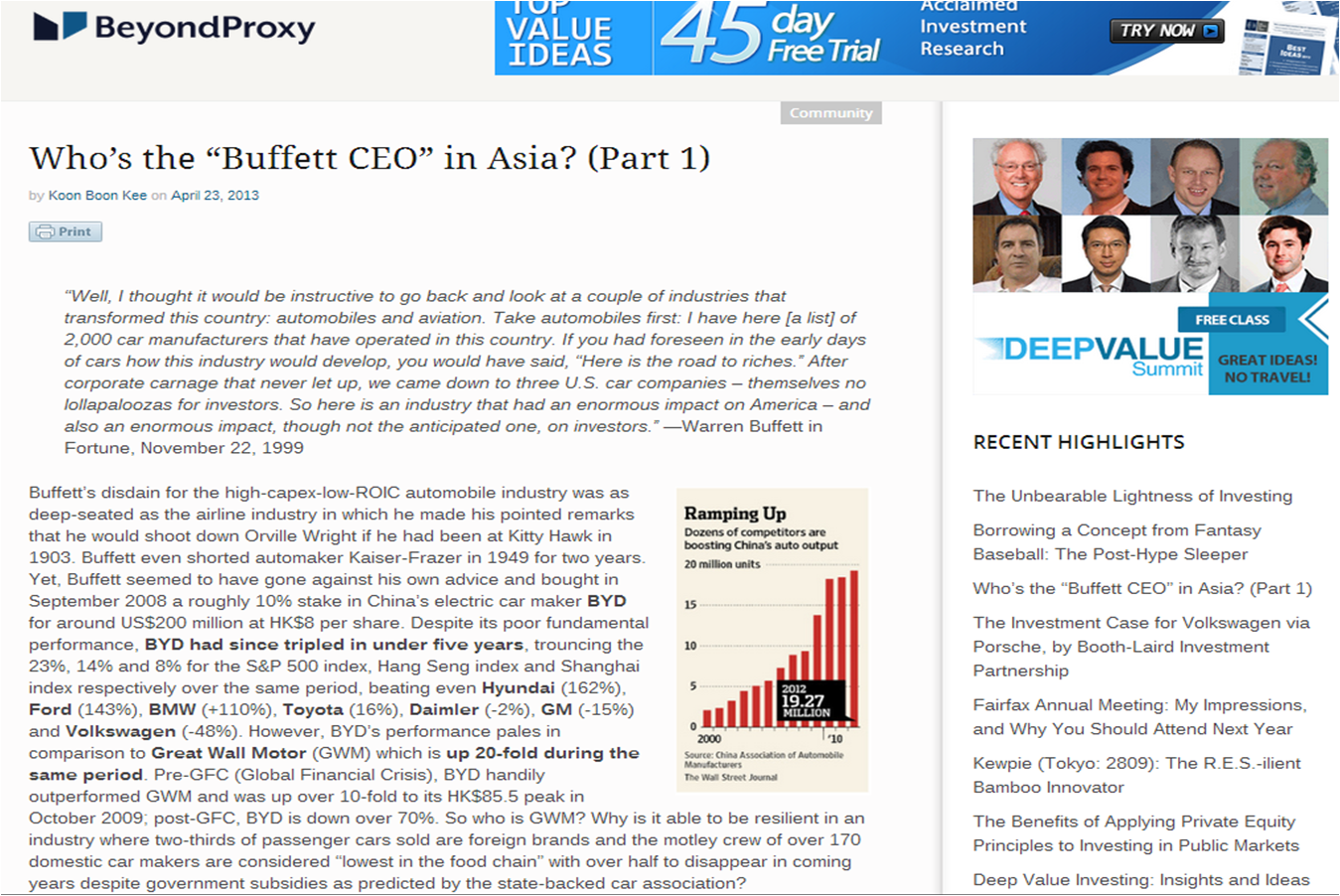
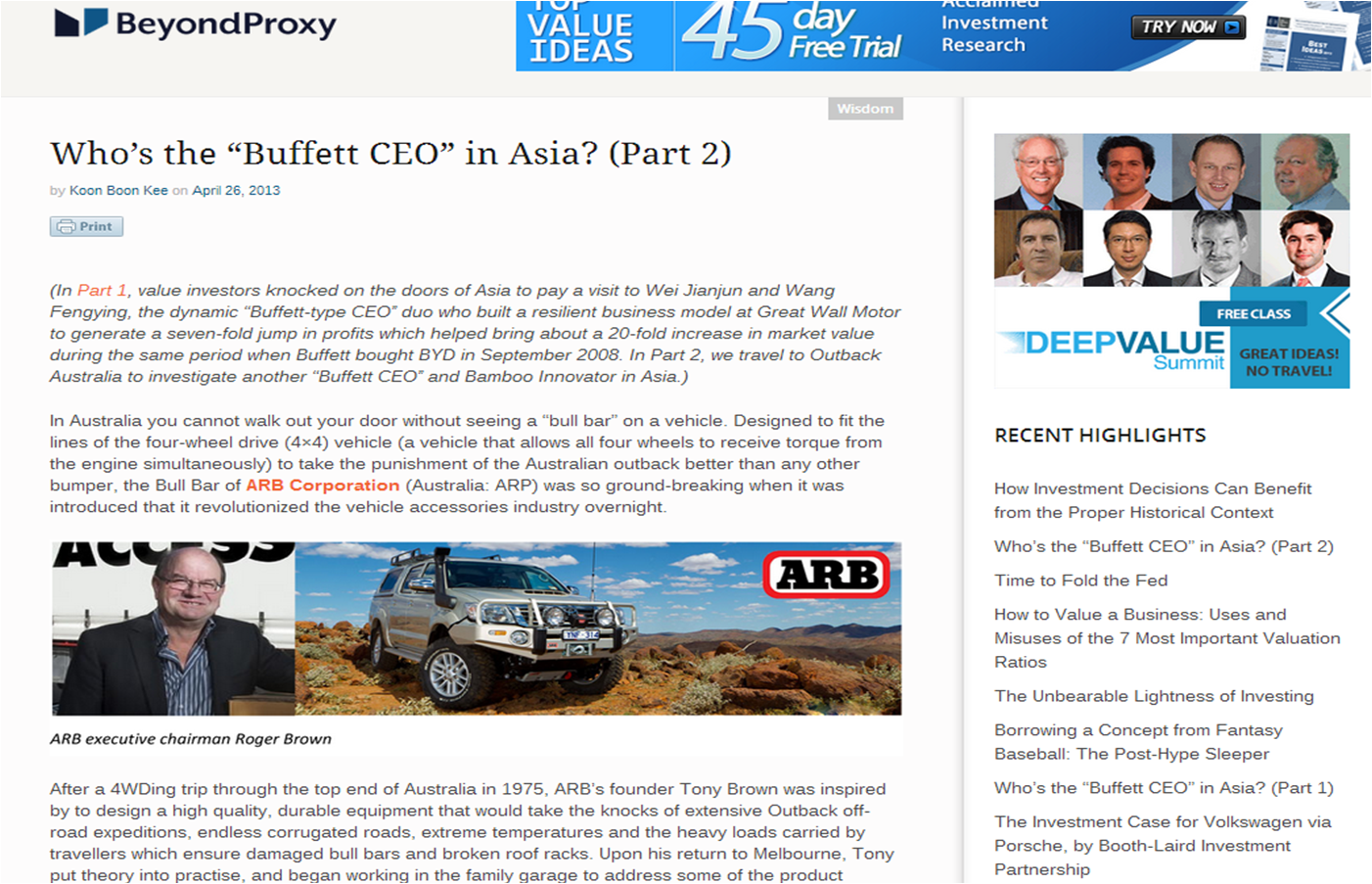
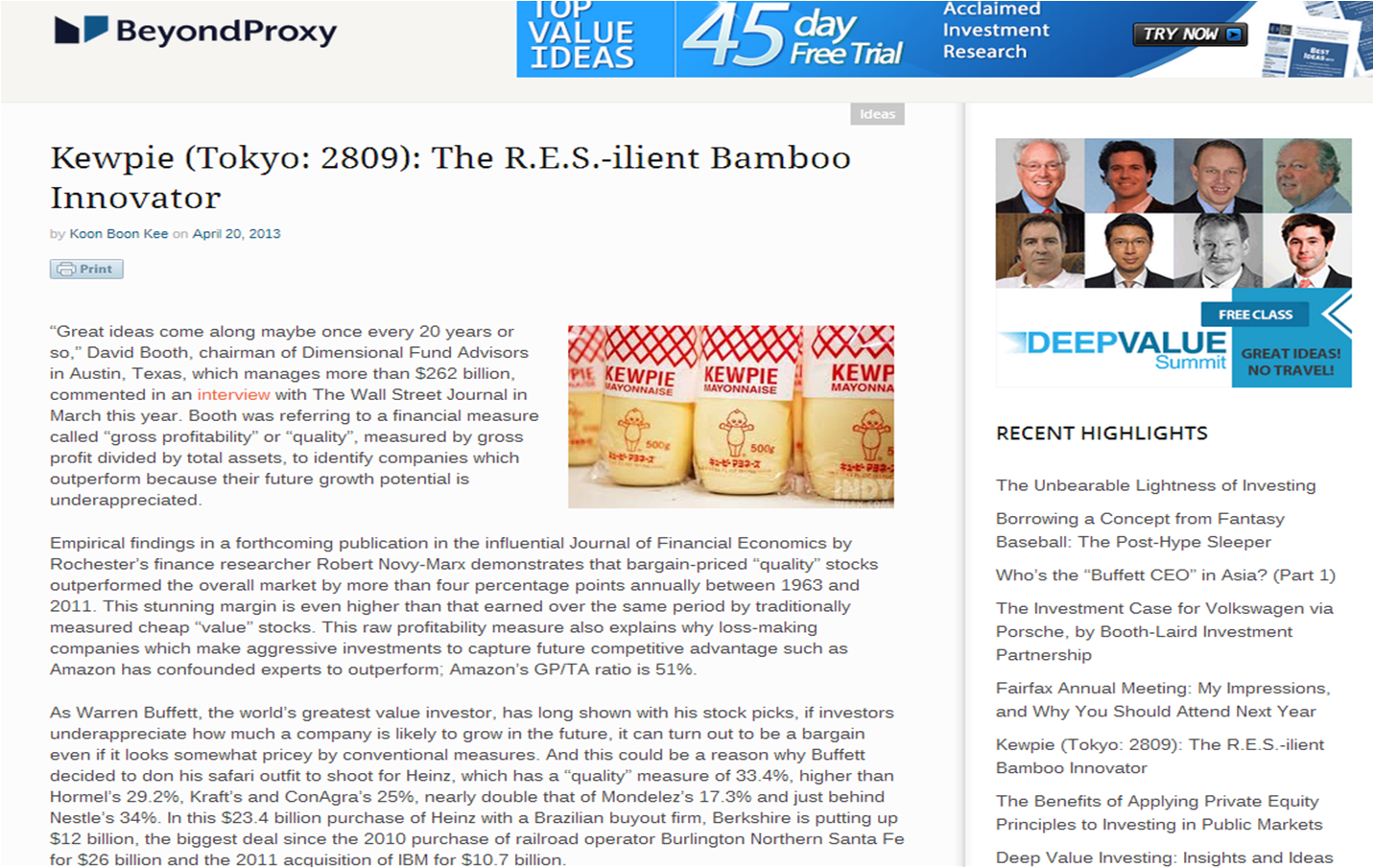
Knock, Knock, Who’s the “Buffett CEO” in Asia? Part 1 and 2 (Go to BeyondProxy.com, where value investing lives)

GWMARBKewpieJMATAsiaBamboo Innovator is featured in BeyondProxy.com, where value investing lives:

Who’s the Buffett CEO in Asia? Part 1 on China’s Great Wall Motor, April 23, 2016 (Weblink: BeyondProxy.com)

Who’s the Buffett CEO in Asia? Part 2 on Australia’s ARB Corporation, April 26, 2013 (Weblink: BeyondProxy.com)

Kewpie: Japan’s Heinz and R.E.S.-ilient Bamboo Innovator, April 20, 2013 (Weblink: BeyondProxy.com)

Value Investors in Asia: Making Sense of the Micro Vs. Macro Dilemma, April 16, 2013 (Weblink: BeyondProxy.com)

What Apple Can Learn From Warren Buffett

What Apple Can Learn From Warren Buffett

Give credit to Apple Inc. (AAPL) and its chief executive officer, Tim Cook, for getting serious about returning unneeded capital to shareholders. As for the details, some of them don’t seem well thought out.

The maker of iPhones and iPads this week said its board approved a sixfold increase in its stock-repurchase plan to $60 billion. Not long ago, even discussing the idea of large share buybacks was a nonstarter for Apple. Now that its stock has tanked, the company is acting like they are a must-do, no matter what else the future might bring. At about $408 a share, down 42 percent since its record high in September, Apple has a stock- market value of $383 billion.

“This is the largest single share repurchase authorization in history and is expected to be executed by the end of calendar 2015,” Apple said in an April 23 news release, the same day the company reported its first quarterly profit decline in a decade.

How could Apple be so confident it will spend the whole $60 billion by then? That’s hard to say. The company is under no obligation to complete the repurchase program, although it obviously wants the markets to believe it will. Apple’s statements this week suggested it would carry out the plan without regard to price, which should be the most important consideration of all. Read more of this post

Goldfish used to test the river quality in Sichuan quake zone died

Goldfish used to test the river quality in quake zone died

2013-04-26 01:08:21 GMT2013-04-26 09:08:21(Beijing Time)  SINA.com

About 100 goldfish raised in the pool of mountain springs in quake-hit Ya’an, Sichuan province were found dead on Tuesday night, raising fears of quality of drinking water in the region. Water samples have been sent to the Disease Control and Prevention Center of Sichuan province for further test. More than 4,000 residents in Tianquan county are without their natural water supplies, forcing them to live on bottled water and water carried by three fire trucks.

U47P5029T2D585682F31DT20130426090821

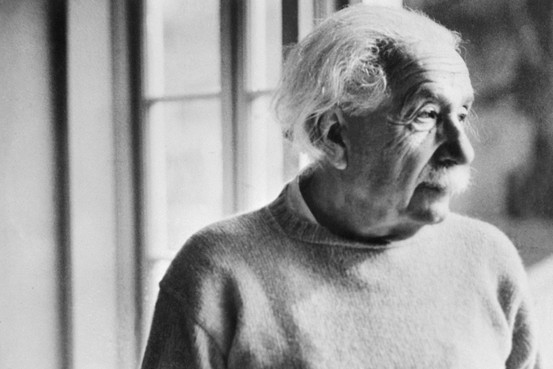
Gravity Theory of Einstein’s Proved Right—Again

Updated April 25, 2013, 7:28 p.m. ET

Theory of Einstein’s Proved Right—Again

By GAUTAM NAIK

OB-XF813_0425ei_G_20130425153714

Scientists have subjected Albert Einstein’s famous theory of gravity to its toughest real-world test so far—and it has prevailed.

The theory, which was published nearly a century ago, had already passed every test it was subjected to. But scientists have been trying to pin down precisely at what point Einstein’s theory breaks down, and where an alternative explanation would have to be devised.

Einstein’s framework for his theory of gravity, for example, is incompatible with quantum theory, which explains how nature works at an atomic and subatomic level. Read more of this post

Edir Macedo, Brazil’s Billionaire Bishop; Prosecutor says that Macedo’s promise of riches amounts to fraud; “The preachers make use of the faith, desperation, or ambition of [their followers] to sell the idea that God and Jesus Christ only look upon those who contribute financially to the church”

Edir Macedo, Brazil’s Billionaire Bishop

By Alex Cuadros on April 25, 2013

feature_edirmacedo18__01__630x420feature_edirmacedo18__04inline__popup

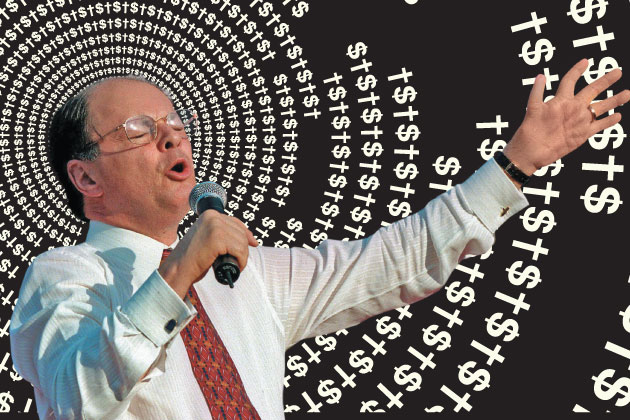
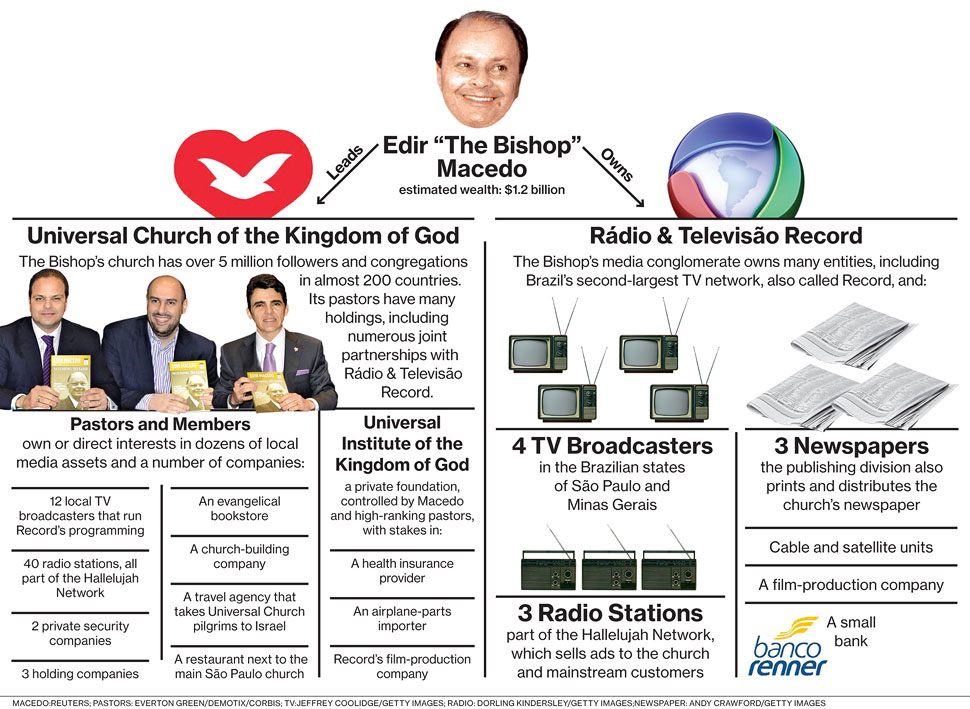
Edir Macedo is 5-foot-6, slight, and 68 years old. He has deformed fingers, a sparse crown of graying hair, and more than 5 million followers, whose donations over the last 36 years have made him a billionaire. In Brazil, where he was born and raised, he is a major national figure, the subject of dozens of criminal inquiries, and the owner of Rádio & Televisão Record, a media conglomerate that runs the country’s second-largest television network. He is known to most everyone by the title he created for himself: He is O Bispo—“The Bishop.” Macedo is the founder of the Universal Church of the Kingdom of God, a Pentecostal denomination specializing in prosperity theology, which links faith to financial success. He preaches twice a week, often in two different cities, and the sermons are fervently watched on church websites, his Facebook page, and the miniature TV sets that Brazilian taxi drivers like to keep on their dashboard. Now and then he holds outdoor events that draw crowds of half a million. In February he addressed 5,000 of his parishioners at one of his churches in Belo Horizonte, in southeastern Brazil. High overhead, a stained-glass cross lit by fluorescent bulbs took up most of the ceiling while a theater-size screen blew him up for the pews in the back. He paced back and forth on the stage, explaining the intersection of God and money. “Which is the largest country in the world, economically speaking? It’s America, the United States. Do you know why? Because way back—this is history, you can look it up on the Internet—the colonization was done by men who believed in the word of God. And they were tithers,” he said. “That’s why you see on the dollar bill: ‘In God we trust.’ ” Read more of this post

Buffett Tells Coke CEO Study Failure, Avoid Complacency; “You want a restlessness, a feeling that somebody’s always after you, but you’re going to stay ahead.”

Buffett Tells Coke CEO Study Failure, Avoid Complacency

Warren Buffett, who controls the largest stake in Coca-Cola Co. (KO), knows how to steal a show.

The billionaire investor showed up at the soda maker’s annual meeting today to help sell the company’s message to shareholders in an on-stage interview with Chief Executive Officer Muhtar Kent. The surprise appearance drew a standing ovation as Buffett advised Kent to stay ahead of competitors by reviewing what made other businesses falter.

“I like to study failure,” Buffett, 82, said at the meeting held in the Cobb Galleria Center in Atlanta. “We want to see what has caused businesses to go bad, and the biggest thing that kills them is complacency. You want a restlessness, a feeling that somebody’s always after you, but you’re going to stay ahead.”

Berkshire Hathaway Inc. (BRK/A), which Buffett has led for more than four decades, owns 400 million Coca-Cola shares after a share split last year, with a value of almost $17 billion. Berkshire, which owns See’s Candies and an equity stake in American Express Co. (AXP), favors companies that have loyal customers and can withstand competition, Buffett said. Read more of this post

Chinese officials’ deepening “watch phobia”; The disappearing Vacheron Constantin watch of Fan Jiyue, county Party secretary of Lushan

Latest case shows Chinese officials’ deepening “watch phobia”

2013-04-23 04:12:46 GMT2013-04-23 12:12:46(Beijing Time)  SINA English

By Jia Xiaoguang, Sina English

A distinct mark left by wearing watch on the wrist of a local official has solicited the attention of China’s watchful netizens recently, who linked their finding with the possibility of the official’s involvement in corruption. Photo shows Fan Jiyue, county Party secretary of Lushan hit by the recent deadly earthquake in southwestern Sichuan Province, had taken off his wrist watch before he started an inspection visit to the quake-stricken areas with Premier Li Keqiang. There is a ring of white stain on his left wrist, a clear evidence of wearing a watch, as the photo displays. Some netizens then found a file photo of Fan delivering a speech, which testifies to the existence of the “vanished” watch. It is a deluxe watch branded Vacheron Constantin, costing a staggering price up to 210 thousand yuan, some other person pointed out. Fan’s motivation of picking off the watch before showing up in the public is then accused of deliberately dodging the public supervision and covering up his extravagant life style, which, however, ended up with much wider self-exposure. His case, a latest instance of official’s rising fear of carelessly exposing their costly personal assets such as wristwatches, is preceded by the notorious “Brother Watch” Yang Dacai, former head of the work safety administration of NW China’s Shaanxi Province. Yang was found wearing luxury wristwatches and was later expelled from the Communist Party of China (CPC) over engagement in serious disciplinary violations in February.

U158P5029T2D584647F26DT20130423121246 U158P5029T2D584647F24DT20130423121246

Buddha statue wearing all-back hairstyle

Buddha statue wearing all-back hairstyle

2013-04-25 06:42:50 GMT2013-04-25 14:42:50(Beijing Time)  SINA English

By Jia Xiaoguang, Sina English

An online image of a colossal Buddha statue has caused a buzz among China’s Internet users recently, as the Buddha wears an outlandish all-back hairstyle that makes their eyes pop out. Still under construction, this sculpture is located in the Longhua Playground in Luoyang, C China’s Henan Province. While an official declaration has confirmed that the statue, though in the figure of a Buddha, is actually an artistic representation of the founder of the playground, it does little to suffocate the diffusing imagination of the netizens. “How come he wears an all-back hairstyle?” some one is clearly taken aback. “The Buddha must have used some hair-growing shampoo!” another cried out. “This is a sublime piece of art work. “ some other with the eyes of a connoisseur said. “His face reminds you of Sakyamuni, state leader, corrupt official and capitalist at the same time.”

U158P5029T2D585414F24DT20130425144250

Meet your new, high-tech $100 bill on Oct 8; The note features a series of amped-up security measures aimed at combating counterfeiters

Meet your new $100 bill

By Emily Jane Fox @CNNMoney April 24, 2013: 7:22 PM ET

tumblr_l18gscKsSY1qz7q8fo1_500

For only the fourth time in history, there will be a new $100 bill. After a three-year delay due to slower-than-expected production, Americans will finally have an improved, high-tech $100 bill for their wallets, the Federal Reserve said Wednesday. The bill is set to debut on Oct. 8. What’s so special about the new greenback? To start, the Fed says the the bill is a culmination of a decade-long research and design process. The note features a series of amped-up security measures aimed at combating counterfeiters, including a blue, 3-D security ribbon on the front of the bill that moves when the note is tilted back and forth and side to side. The inkwell and bell on the front of the bill and the number 100 on the right-hand corner also change from copper to green when the note is tilted. This is the fourth time the $100 bill has been redesigned, according to a Fed spokeswoman. It has been revamped three times in the last 20 years alone, as the Fed had to react more often to improved counterfeiting technology. The design was first unveiled in 2010 and was meant to go into circulation in Feb. 2011.

New York City Plans World’s Biggest Indoor Ice Facility in Bronx

New York City Plans World’s Biggest Indoor Ice Facility in Bronx

628x471

New York City plans to create the largest indoor ice facility in the world, with a former Deutsche Bank AG (DB) asset manager investing $275 million to turn a vacant Bronx armory into a 750,000-square-foot skating palace.

KNIC Partners LLC, founded by Kevin Parker, a former asset management head at Germany’s largest bank, will transform the Kingsbridge Armory into a center with nine regulation-size rinks expected to attract 2 million visitors a year, city officials said. The first five rinks are set to open in late 2018.

The landmark armory, built between 1912 and 1917, takes up a full city block and has been vacant since 1996. Officials said they expect the development will create 260 permanent jobs and 890 construction jobs in the Bronx, the poorest of the city’s five boroughs.

KNIC Partners will lease the facility for 99 years and direct 5 percent of annual gross revenue, or about $1 million per year, to the city, Tom Corsillo, a spokesman for KNIC Partners, said today in a telephone interview.

“The construction of the world’s largest indoor ice rink facility will create recreational opportunities for millions of visitors and local residents, and most importantly create hundreds of jobs for the local community,” Mayor Michael Bloomberg said in a statement. Read more of this post

Quant Finance Reading List

QUANTITATIVE FINANCE READING LIST

This is the big one! I’ve tried to list as many great quantitative finance books as I can. The lists cover general quant finance, careers guides, interview prep, quant trading, mathematics, numerical methods and programming in C++, Python, Excel, MatLab and R. If you have any suggestions for more books, please contact me at mike@quantstart.com and I’ll get them added.

This list was last updated on 8th April 2013.

General Quant Finance Reading

One area that routinely catches out prospective quants at interview is their lack of basic financial markets knowledge. It’s all well and good being the best mathematician and programmer on the globe, but if you can’t tell your stock from your bond, or your bank from your fund, you’ll find it a lot harder to pass those HR screenings.

These books also make much better bedtime reading than graduate texts on stochastic calculus…

The Big Short: Inside the Doomsday Machine – Michael Lewis

Liar’s Poker – Michael Lewis

When Genius Failed: The Rise and Fall of Long-Term Capital Management – Roger Lowenstein

More Money Than God: Hedge Funds and the Making of a New Elite (Council on Foreign Relations Books (Penguin Press)) – Sebastian Mallaby

How I Became a Quant: Insights from 25 of Wall Street’s Elite – Richard Lindsey, Barry Schachter

My Life as a Quant: Reflections on Physics and Finance – Emanuel Derman

Financial Engineering: The Evolution of a Profession (Robert W. Kolb Series) – Tanya Beder, Cara Marshall

The Quants: How a New Breed of Math Whizzes Conquered Wall Street and Nearly Destroyed It – Scott Patterson

Nerds on Wall Street: Math, Machines and Wired Markets – David Leinweber

Physicists on Wall Street and Other Essays on Science and Society – Jeremey Bernstein

The Complete Guide to Capital Markets for Quantitative Professionals (McGraw-Hill Library of Investment and Finance) – Alex Kuznetsov

Models.Behaving.Badly.: Why Confusing Illusion with Reality Can Lead to Disaster, on Wall Street and in Life – Emanuel Derman Read more of this post

Preparing Statement of Cash Flows from Taoist Perspectives

Preparing Statement of Cash Flows from Taoist Perspectives

Yu-Je Lee Takming University of Science and Technology

Jie He Qing Hai Province, Department of Finance

Mei Fen Wu National Taiwan University of Science and Technology

Ying Qing Li Guangzhou Hengyun Enterprises Holding, Ltd.

Ching Ho Chen Jinan University

April 7, 2013
Journal of Business & Management, Vol. 1, No. 2, April 2013

Abstract: 
The preparation of cash-flow statement under the indirect method involves adjustments of many items. This is a highly complex process prone to errors, due to a lack of philosophical guidance. This paper finds that the concept of natural equilibrium of Chinese Taoism “…is the way of heaven to take from what has in excess in order to make good what is deficient…” can lend intellectual support to the preparation of cash flows statement under the indirect method. This approach will greatly enhance the accuracy of cash flows statement under the indirect method. This paper uses examples to illustrate the process of adjustments in the preparation of cash- flow statement under the indirect method in the context of Taoist philosophy. The results show that the philosophical perspectives of Chinese Taoism can provide strong guidance on these adjustments by achieving both efficiency and efficacy. The assurance of this “win-win” is a testimony to the philosophical contents of Taoism in the context of modern times.

Buffett Challenger Kass Prepares For Meeting, Munger Test

Buffett Challenger Kass Prepares For Meeting, Munger Test

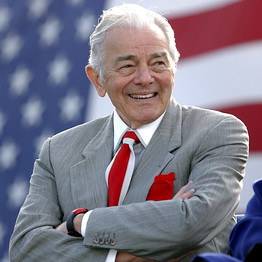
Douglas Kass, the investment manager selected by billionaire Warren Buffett to ask questions at Berkshire Hathaway Inc. (BRK/A)’s annual meeting next week, has hit the books in preparation for the challenge.

The fund manager said in an interview yesterday that he’s reading Alice Schroeder’s more-than-800-page biography of Buffett and other titles to get ready for the May 4 gathering in Omaha, Nebraska. It’s taken about 10 hours on average for each question, he said by phone.

“We can’t lose sight that this company, and Mr. Buffett as a person, has been combed over with questions,” said Kass. “It’s not like this is a breeze. I think he expects something of me, and I don’t want to disappoint him.”

Buffett, 82, has sought to refocus attention at the meeting on Berkshire by allowing journalists and analysts to alternate with the audience in asking questions of him and Vice Chairman Charles Munger. Kass, founder of Seabreeze Partners Management Inc., answered Buffett’s call to change the panel by adding an investment professional who’s betting on the stock’s decline.

“He wanted to spice up the annual meeting, and to make it more interesting from the context of the questions, as opposed to a bunch of softballs or non-Berkshire-related political questions, tax questions, policy questions,” Kass said. Read more of this post

20 Words We Owe to William Shakespeare

20 Words We Owe to William Shakespeare

Roma Panganiban

No high school English curriculum is complete without a mandatory dose of William Shakespeare, and no American teenager makes it to graduation without whining about how boring it is to learn about iambic pentameter. As contemporary speakers of the English language, however, they might be interested to learn how much the Bard of Avon had in common with the generations that popularized the acronyms LOL and OMG and reinvented the 1940s slang term “hipster.” Endlessly imaginative and not overly concerned with grammatical convention, Shakespeare’s scripts contain over 2200 never-before-seen words—a diverse collection of loan-words from foreign languages, compound words from existing English terms, nouns turned into verbs, and creatively applied prefixes—many of which have entered into everyday language. Here are 20 examples of words we can thank Shakespeare for.

1. ADDICTION: OTHELLO, ACT II, SCENE II

“It is Othello’s pleasure, our noble and valiant general, that, upon certain tidings now arrived, importing the mere perdition of the Turkish fleet, every man put himself into triumph; some to dance, some to make bonfires, each man to what sport and revels his addiction leads him.” – Herald

If not for that noble and valiant general and his playwright, our celebrity news coverage might be sorely lacking. Read more of this post

Need a work partner? Ditch the extrovert, go with a neurotic.

Need a work partner? Ditch the extrovert, go with a neurotic.

By Anne Fisher, contributor April 23, 2013: 11:10 AM ET

They shine in job interviews, but outgoing, confident people often don’t perform well in teams, says a new study. Surprisingly, neurotics do.

FORTUNE — Let’s say you’re considering two candidates for a job. They have similar credentials and experience, but their personalities are poles apart. One is quiet, seems anxious, and lets you do most of the talking in interviews, apparently out of fear of saying something wrong. The other is talkative, engaging, and bursting with confidence. Which one do you choose?

Most hiring managers would opt for the second, extroverted candidate. Yet, for a job requiring teamwork, the anxious one, who shows signs of the personality type called “neurotic,” might be the better choice in the long run.

“It’s counterintuitive,” notes Corinne Bendersky, who teaches management at the Anderson School at UCLA. She is co-author of a study called “The Downfall of Extroverts and the Rise of Neurotics: The Dynamic Process of Status Allocation in Task Groups,” set for publication in the next issue of The Academy of Management Journal.

“Our research shows that extroverts are held in high esteem by their teammates at first, but over time, their performance tends to be disappointing,” Bendersky says. “By contrast, neurotics exceed everyone’s expectations and end up being highly effective team members.” Read more of this post

The secret to success? Make laziness embarrassing. Successful people create accountability systems that boost important but not urgent items to the top of their priority lists — ideally in a way that makes failure really uncomfortable.

The secret to success? Make laziness embarrassing.

April 23, 2013: 11:45 AM ET

Successful people create accountability systems that boost important but not urgent items to the top of their priority lists — ideally in a way that makes failure really uncomfortable.

By Laura Vanderkam

FORTUNE — Like many writers, I’ve been kicking around an idea for a novel for years. I wrote a chunk of my tale — about a small-town high school basketball team, a championship, and a mystery — during a less busy time in my life years ago. I’d been jotting down ideas on how to finish it since 2011. But I couldn’t build momentum. I’d write a bit, then abandon the project for months.

I know why. I like to get paid for my work, and I like my work to be read. Writing a novel means investing serious time in something that may or may not ever result in publication, let alone revenue. Finishing it with no promise of external validation would require serious willpower. That’s a problem, since I already expend most of the willpower the universe grants me trying not to grab snacks hourly from the kitchen next to my home office. Consequently, with other people and projects competing for my attention, the novel always fell to the bottom of my list. Read more of this post

Foster a Culture of Gratitude

Foster a Culture of Gratitude

by Christine M. Riordan  |   1:00 PM April 23, 2013

In the movie Remember the Titans, Coach Herman Boone takes his high school football team to thebattleground of Gettysburg. Having inherited a fractured and divided squad, Coach Boone implores the players to “take a lesson from the dead. If we don’t come together, right now on this hallowed ground, we too will be destroyed, just like they were.” Coach Boone then establishes the primacy of an important team virtue: “I don’t care if you like each other right now, but you will respect each other.”

In every workplace and on every team, all people have the innate desire to feel appreciated and valued by others. Like Coach Boone, leaders of teams — and team members themselves — should work to foster a culture of value and appreciation. High performing teams have well-defined goals, systems of accountability, clear roles and responsibilities, and open communication. Just as importantly, teams that foster cohesion with a sense of appreciation and gratitude among the team members maximize performance on a number of dimensions. Jon R. Katzenbach and Douglas K. Smith, authors of the Wisdom of Teams, define a high-performing team in part by members’ strong personal commitment to the growth and success of each team member and of the team as a whole.

Research on gratitude and appreciation demonstrates that when employees feel valued, they have high job satisfaction, are willing to work longer hours, engage in productive relationships with co-workers and supervisors, are motivated to do their best, and work towards achieving the company’s goals. Google, which sits atop many best-places-to-work lists, fosters feelings of employee value through an open culture that promotes employee input, routinely rewards and recognizes performance, and encourages personal growth. In a recent interview, CEO Larry Page stated, “My job as a leader is to make sure everybody in the company has great opportunities, and that they feel they’re having a meaningful impact and are contributing to the good of society.” Read more of this post

Is This How You Really Talk? Your Voice Affects Others’ Perceptions; Silencing the Screech in the Next Cubicle

Updated April 23, 2013, 9:16 p.m. ET

Is This How You Really Talk?

Your Voice Affects Others’ Perceptions; Silencing the Screech in the Next Cubicle

By SUE SHELLENBARGER

It is hard to hear the sound of your own voice. But that sound may affect other people’s impressions of you even more than what you say. A strong, smooth voice can enhance your chances of rising to CEO. And a nasal whine, a raspy tone or strident volume can drive colleagues to distraction. “People may be tempted to say, ‘Would you shut up?’ But they dance around the issue because they don’t want to hurt somebody’s feelings,” says Phyllis Hartman, an Ingomar, Pa., human-resources consultant. New research shows the sound of a person’s voice strongly influences how he or she is seen. The sound of a speaker’s voice matters twice as much as the content of the message, according to a study last year of 120 executives’ speeches by Quantified Impressions, an Austin, Texas, communications analytics company. Researchers used computer software to analyze speakers’ voices, then collected feedback from a panel of 10 experts and 1,000 listeners. The speakers’ voice quality accounted for 23% of listeners’ evaluations; the content of the message accounted for 11%. Other factors were the speakers’ passion, knowledge and presence.

HowYouReallyTalk0423 Read more of this post

How IDEO brings design to corporate America

How IDEO brings design to corporate America

By Dinah Eng @FortuneMagazine April 11, 2013: 8:06 AM ET

130409154900-how29-a-620xa

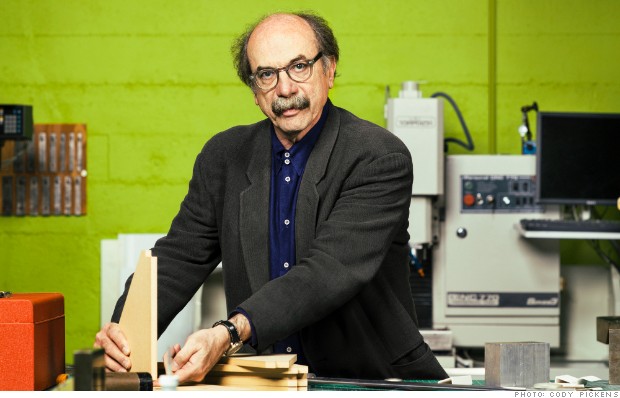
David Kelley in IDEO’s Palo Alto workshop

You may not know the design firm IDEO (pronounced EYE-dee-oh), but chances are you know its work. If you’ve used an Apple mouse (IDEO fashioned the company’s first, in 1980), swept with a Procter & Gamble (PGFortune 500) Swiffer (it collaborated on the hit), or even stood in line at an airport recently (the firm has worked with the Transportation Security Administration to make the process friendlier), you’ve felt the legacy of David Kelley. He founded IDEO in Palo Alto in 1978 and built it into a global operation with 600 employees and $130 million in revenue (he declines to divulge profits). IDEO brings a human-centered approach to products, services, and organizational concepts for the likes of Samsung, Eli Lilly (LLYFortune 500), and Bank of America (BACFortune 500). Kelley, 62, is also Stanford University’s resident design Yoda. The avowed “variety junkie” is proud that IDEO does everything from designing the ideal home for wounded soldiers to helping Elmo teach kids good behavior via a mobile app. His story:

I grew up in Barberton, Ohio, where my father was an engineer at Goodyear and my mother was a housewife. It was a typical Midwest upbringing, and I wasn’t really into college preparatory stuff. What was exciting to me was taking apart the car or the washing machine.

In 1973, I got a BS in electrical engineering from Carnegie Mellon University and went to work forBoeing (BAFortune 500) in Seattle, designing things for the interior of the 747. When I found out about the Stanford Product Design Program, I became interested in the human-centered side of technology, but didn’t think I’d get into the program. So I moved to Dayton and worked for National Cash Register (NCR,Fortune 500), designing new banking terminals, until I found out I was admitted.

Going to the Stanford program was a perfect fit. I love trying to understand what people want, what they value, and designing something for them. I graduated in 1977 with my MS in engineering and product design, and discovered that I really liked teaching. In 1978, I went to my mentor, professor Bob McKim, and said I wanted to keep teaching and I wanted to start my own company. He introduced me to Dean Hovey, who was studying at Stanford, and we started a company called Hovey-Kelley Design. A couple of professors who had their own companies in Silicon Valley gave us our first projects — designing a reading machine for blind people and a medical device called a differential [blood] cell counter.

Soon after Dean and I started our company, another Stanford colleague introduced us to Steve Jobs. We ended up doing a lot for Apple (AAPLFortune 500). They were technologically focused, and we focused on the human side. We’d ask [with the first Apple mouse], should you use the mouse with your fingertips or slide it like a bar of soap? Once we started doing Apple products, people wanted to know who we were.

Back then, we were paying about $300 a month for three offices. I remember flinching when I signed a 10-year lease because I still owed on student loans and I had a negative net worth. I had no interest in calculating revenue, and still don’t. We charged $25 an hour and had six employees. Half the time we worked, and half the time we didn’t. All I cared about was how much we were paid per hour, and if we had enough to keep everybody busy. Read more of this post

Alibaba’s billionaire founder Jack Ma: “The world is so cruel that only with much of your own efforts plus a bit of luck can you survive the black forest. Never expect anyone. Count on yourselves. ’

Jack Ma to Set up A College for Entrepreneurs in Two Years

By Chelsea Dong on April 23, 2013

Jack Ma, who is about to resign as CEO of Alibaba Group soon, revealed at an event on the past Sunday that he was planning to found a college for entrepreneurs in about two years in collaboration with some of his friends. He once said he would set up a business school with Feng Tang, a real estate tycoon. He also advised entrepreneurs not to count on big companies to save them. He said, ‘Never dream of saving your lives with help from big companies. The world is so cruel that only with much of your own efforts plus a bit of luck can you survive the black forest. Never expect anyone. Count on yourselves. ’ On May 10, Jack Ma will retire from his post as CEO and become the chairman. He seems to quite look forward that day. He said, he would do what he likes after that day and enjoy the simple relaxing life after resignation. Regarding the dreams other than the business school, he said, “I don’t want to leave much regret when I leave the world.”


Why People Stay Scared After Tragedies Like Boston Attack

Why People Stay Scared After Tragedies Like Boston Attack

The great psychologist William James was Gertrude Stein’s teacher and mentor. As legend tells it, James once posed a single question on a final examination: “What is risk?” Stein wrote, “This is,” walked out of the examination room, and went about her business. Supposedly James gave Stein an A.

After a tragedy such as the one last week in Boston, people have a heightened sense of risk. If a flood, an earthquake, a violent crime or a terrorist attack has occurred in the recent past, people tend to have a feeling of vulnerability, captured in the alarming idea that “you can’t be safe anywhere.” Often that feeling is far greater than reality warrants. This is so because of two facts about how human beings respond to risk.

The first is that we often assess probabilities not by looking at statistics, but by asking what events come readily to mind. If you are unable to think of a case in which a crime occurred in your neighborhood, or of a situation in which an accident resulted from talking on a mobile phone while driving, you might not much worry about crime or distracted driving. But if your neighbor was recently robbed, or if a friend was badly injured in a crash caused by distracted driving, you might think that the risk is pretty high.

Social scientists emphasize that people use the “availability heuristic,” which means that we assess risks by asking whether a bad (or good) event is cognitively “available.” It is hardly unreasonable to use the availability heuristic, yet we can be misled by it, and far more frightened than we need to be. Read more of this post

31 Business Lessons You Usually Learn The Hard Way

31 Business Lessons You Usually Learn The Hard Way

Dan WaldschmidtEdgy Conversations | Apr. 22, 2013, 3:49 PM | 4,331 | 1

Sometimes your best effort isn’t good enough to land you the deal.

You can’t learn if you aren’t willing to listen.

The only way to get other people to care about you is to care about them first.

You can’t find opportunities for success if you aren’t looking for them.

Just because social media is free doesn’t mean it gets you results.

You have to change the conversation before you can close the deal.

The difference between success and failure is just a decision to keep trying.

If you market like a “person” you have a better chance of getting people to buy.

Just because all your competitors are doing it doesn’t mean you should too.

You don’t have to build rapport to build trust.  Chit-chat is overrated.

Pretending like you never make mistakes doesn’t make it so.

Working smarter is a result of hard work; not a replacement for it.

Your big moment usually comes before you’re ready for it.

“Apologies” and “Thank You’s” are the best way to create a conversation on your terms.

You have to give a lot to get a lot.

Spend less time networking and handing out business cards. Be amazing.  People will find you.

Once you provide the answer people stop listening. Leave clues instead.

There is no easy way out for big problems; but there is always a way out.

Negativity isn’t reality.  Not for you.  Not for your critics.

You don’t need permission to start marketing to a prospect.

Being “professional” is key to getting prospects to want to do business with you.

Working smart will get you more applause.  Working hard will get more done in the long run.

Sometimes bad things happen to good people with great strategies.

Just because it hasn’t worked out already doesn’t mean that it won’t ever.

Anything that is easy to do isn’t going to lead to success.

Ironically, the quickest way to become an experts is to defy industry experts.

The number of people who believe in you doesn’t correlate to your chances of success.

Being the smartest person in the room doesn’t necessarily make you rich or wise.

You don’t have to be “up for the job” to finish the job.

If you haven’t failed a lot, you probably aren’t going to win a lot.

Experience is what you get just after you need it.

What I wish I knew before I started my business; We asked a successful illustrator, two entrepreneur mates and a young franchising go-getter what they’d do differently if they had their time again

What I wish I knew before I started my business

April 19, 2013, Larissa Ham

We asked a successful illustrator, two entrepreneur mates and a young franchising go-getter what they’d do differently if they had their time again.

Elise_Hurst_studio2010--1--copy---article-lead-620x349Elise Hurst

Hindsight is a wonderful thing – both in life and in business. If only you knew the mistakes you were likely to make before you wasted time and money making them. We asked a successful illustrator, two entrepreneur mates and a young franchising go-getter what they’d do differently if they had their time again.

1. Learn to plan for the next job

Illustrator, artist and children’s author Elise Hurst has illustrated more than 50 books, but when she started in 1996, work wasn’t exactly flooding in. “My first few jobs were accompanied by a constant mixture of elation and terror,” says Hurst. “I was so busy finding out if I could actually do what I’d promised, that I wasn’t even thinking of the next job. When the job finally finished, I was in a panic to suddenly find the next source of income. “I had no networks yet, no connections. I learned far too slowly that looking for work is a big part of the job.”

2. Be yourself

Many of us follow a certain career path because we love it and believe we can do something special, says Hurst. But while learning from others can be valuable, she warns against simply replicating your competitors. “There’s a good chance they’re doing it better,” Hurst says. “While you’re earning your crust, set aside time to develop your own ideas and your own style of doing things. That’s where your best chances lie and where the biggest satisfaction will come from.” Read more of this post

Pollution is radically changing childhood in China’s cities; “I hope in the future we’ll move to a foreign country. Otherwise we’ll choke to death.”

April 22, 2013

In China, Breathing Becomes a Childhood Risk

By EDWARD WONG

JP-POLLUTION-2-popup

Wu Xiaotian, in his Beijing apartment, has his sinuses cleared every night by a machine that pumps saltwater up his nose

BEIJING — The boy’s chronic cough and stuffy nose began last year at the age of 3. His symptoms worsened this winter, when smog across northern China surged to record levels. Now he needs his sinuses cleared every night with saltwater piped through a machine’s tubes.

The boy’s mother, Zhang Zixuan, said she almost never lets him go outside, and when she does she usually makes him wear a face mask. The difference between Britain, where she once studied, and China is “heaven and hell,” she said.

Levels of deadly pollutants up to 40 times the recommended exposure limit in Beijing and other cities have struck fear into parents and led them to take steps that are radically altering the nature of urban life for their children.

Parents are confining sons and daughters to their homes, even if it means keeping them away from friends. Schools are canceling outdoor activities and field trips. Parents with means are choosing schools based on air-filtration systems, and some international schools have built gigantic, futuristic-looking domes over sports fields to ensure healthy breathing.

“I hope in the future we’ll move to a foreign country,” Ms. Zhang, a lawyer, said as her ailing son, Wu Xiaotian, played on a mat in their apartment, near a new air purifier. “Otherwise we’ll choke to death.” Read more of this post

Cal Newport: The Secret To Success Is The “Craftsman’s Mindset”

Interview – Author Cal Newport on how you can become an expert and why you should *not* follow your passion

by eric barker
Newport

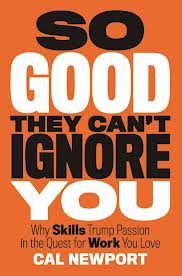
Cal Newport holds a PhD from MIT and is an assistant professor of Computer Science at Georgetown University. He runs the popular blog Study Hacks (which I highly recommend) and is the author of four books including, most recently, So Good They Can’t Ignore You: Why Skills Trump Passion in the Quest for Work You Love. Cal and I talked about the secrets to becoming an expert, how deliberate practice works and why following your passion can be a *bad* idea. My conversation with Cal was over 45 minutes, so for brevity’s sake I’m only going to post edited highlights here.

Don’t Follow Your Passion

Cal:

I set out to research a simple question:  How do people end up loving what they do? If you ask people, the most common answer you’ll get is, “They followed their passion.” So I went out and researched: “Is this true?” From what I found, “Follow your passion” is terrible advice. If your goal is to end up passionate about what you do, “Follow your passion” is terrible advice. So the first fundamental misunderstanding is this idea that we all have a pre-existing passion that’s relevant to a career, and if we could just discover it, then we would be fine. Research says actually most people don’t have one. The second problem is that it’s built on this misbelief that matching your work to something you have a very strong interest in is going to lead to a long-term satisfaction and engagement in your career. It sounds obvious that it should be true, but actually the research shows that’s not at all the reality of how people end up really enjoying and gaining great satisfaction and meaning out of their career. If you study people who end up loving what they do, here’s what you find and if you study the research on it, you find the same thing: Long-term career satisfaction requires traits like a real sense of autonomy, a real sense of impact on the world, a sense of mastery that you’re good at what you do, and a sense of connection in relation to other people. Now, the key point is those traits are not matched to a specific piece of work and they have nothing to do with matching your job to some sort of ingrained, pre-existing passion.

The Secret To Success Is The “Craftsman’s Mindset”

Cal:

My advice is to abandon the passion mindset which asks “What does this job offer me? Am I happy with this job? Is it giving me everything I want?” Shift from that mindset to Steve Martin’s mindset, which is “What am I offering the world? How valuable am I? Am I really not that valuable? If I’m not that valuable, then I shouldn’t expect things in my working life. How can I get better? Like a craftsman, you find satisfaction in the development of your skill and then you leverage that skill once you have it to take control of your working life and build something that’s more long-term and meaningful… When I talk about the habits of the craftsman mindset, it’s really the habits of deliberate practice. So someone who has the craftsman mindset is trying to systematically build up valuable skills because that’s going to be their leverage, their capital for taking control of their career and they share the same habits you would see with violin players or athletes or chess players.

The craftsmen out there are not the guys checking their social media feeds every five minutes. They’re not looking for the easy win or the flow-state. They’re the guys that are out there three hours, pushing the skill. “This is hard but I’m going to master this new piece of software. I’m going to master this new mathematical framework.” That’s the mindset, the habit of the craftsman.

How To Become An Expert At Something

Cal:

What you need is a clearly identified sort of skill you’re working on. You need some notion of feedback. So you have to have some notion of, “How good am I at this now, and am I any better now that I’ve done this versus not doing it?” So that’s sort of the coaching aspect of things. And then when actually working, you have to work deeply, which means you have to sort of work on the skill with a persistent, unbroken focus, and you have to try to push yourself a little bit beyond where you’re comfortable. So you should not really be able to easily get to the next step in what you’re doing. At the same time, you should, with enough strain, be able to make some progress.

What You’re Doing Wrong When Trying To Become An Expert

Cal:

I think when people want to get better at something the biggest mistake they make is seekingflow. It’s a very enjoyable state. It’s where you’re lost in what you’re doing, you’re applying your skills seamlessly and fluidly, and you feel like you have control.

But we know from research on how people actually gain expert levels of performance that the actual state in which you’re getting better is one of strain, and that’s different than flow. It’s a state where you actually feel like you’re being stretched. It’s uncomfortable. You’re doing things beyond your current abilities. It’s not fluid. You’re not necessarily lost. Your mind might be saying, “This is terrible. This is terrible. Check your e-mail. This is terrible. What if there is something on Facebook?

We avoid that for the most part, but we know that if you just keep doing what you know how to do already, you’ll hit a plateau almost immediately. So I think the avoidance of strain is the biggest mistake people make in trying to get better. Read more of this post

Busy is the new lazy

BUSY IS THE NEW LAZY

IF YOU’RE TELLING EVERYBODY THAT YOU’RE BUSY ALL THE TIME, IT’S TIME TO RETHINK YOUR IDEAS ABOUT PRODUCTIVITY.

BY: DRAKE BAER

“Going on about how busy you are isn’t conversation and doesn’t lead anywhere,” writes iDoneThis CCO Janet Choi on her company blog, “except making your conversation partner bored, or worse, peeved.” No one wants to be peeved. So why do we keep doing all this humblebragging about how busy we are? It’s a question Choi investigates thoughtfully: She observes that people who are “legitimately occupied” with work or family rarely play the “too busy” card (clearly, we don’t know the same people)–or, may even go out of their way to make a connection becausethey’ve been so swamped. To Choi, when we say “busy,” we’re really trying to say something else–although what exactly that might be depends on the harried soul that’s complaining. She supplies some translations:

I’m busy = I’m important.
Being busy gives people a sense they’re needed and significant, Choi says. It’s also a sign saying that you’re about to be on-ramped into somebody’s misguided ego trip.

I’m busy = I’m giving you an excuse.
Saying that you’re busy is a handy way to outsource your responsibility to your irresponsibility. Since you’re always distracted, you don’t have to do anything for anybody.

I’m busy = I’m afraid.
Look above at the “I’m important” part. Whether the speaker knows it or not, complaining of busyness is a subtle cry for help, one that reassures us that yes, we are in demand.

As Choi says, we’ve begun to regard busyness as a virtue. It’s maybe second to exhaustion when it comes to being cool at work. All this shows a major error in perspective, she says, one that takes us away from meaningful work:  It’s easy, even enticing, to neglect the importance of filling our time with meaning, thinking instead that we’ll be content with merely filling our time. We self-impose these measures of self-worth by looking at quantity instead of quality of activity. In this way, busyness functions as a kind of laziness. When we fill our schedules with appointments and hands with phones, we divest ourselves of downtime. When we’re endlessly doing, it’s hard to be mindful of what we’re doing.

How to eradicate busyness

Of course, it’s a interdependent issue. It’s hard to have downtime if your bosses subscribe to what Anne Marie Slaughter calls our time macho culture, “a relentless competition to work harder, stay later, pull more all-nighters, travel around the world and bill the extra hours that the international date line affords you.” But don’t let that excuse suffice. You can convince your bosses–if you know how to approach the conversation.