USA Today Founder Neuharth Dies at 89

April 19, 2013, 9:09 p.m. ET

AL NEUHARTH 1924-2013

USA Today Founder Neuharth Dies at 89

By STEPHEN MILLER

Al Neuharth was an irascible and ambitious newspaper baron who founded USA Today, at one time the largest-circulation daily paper in the country and still the largest in print.

OB-XD753_remneu_DV_20130419214116

Al Neuharth, shown in 2003, founded USA Today in 1982 with the idea of creating a national-circulation daily filled with bite-sized stories.

Mr. Neuharth, who died Friday in Cocoa Beach, Fla., at age 89, was the longtime chairman and chief executive of Gannett Co., a chain of local newspapers that he transformed into a diversified media conglomerate by his retirement in 1989. Mr. Neuharth founded USA Today in 1982 with the idea of creating a national-circulation daily filled with bite-sized stories. Though derided in some publishing circles at its founding, USA Today not only found a big audience but also became widely influential with its color photographs and infographics that included a vivid national weather map. A native of Eureka, S.D., Mr. Neuharth edited his high-school and college newspapers and held editing jobs at newspapers in Miami and Detroit before going to work for Gannett in 1963. He also was founder of the Newseum, the Washington, D.C., museum of the history of journalism.

Dirce Navarro de Camargo, Brazil’s Wealthiest Woman Who Controlled a Fortune of $13.8 Billion, Dies at 100

Dirce Navarro de Camargo, Brazil’s Wealthiest Woman, Dies

Dirce Navarro de Camargo, who became Brazil’s richest woman after inheriting the Camargo Correa SA industrial conglomerate, has died. She was 100.

Camargo died April 20, according to a spokesman, who asked not to be identified, citing company policy. He didn’t provide additional details. Her age was disclosed by an executive close to the family who asked not to be named because the matter is private. She controlled a fortune valued at $13.8 billion, making her the 62nd-richest person in the world, according to the Bloomberg Billionaires Index.

Founded in 1939 by her late husband, Sebastiao Camargo, the conglomerate has played a key role in developing Brazil’s infrastructure. It participated in the construction of Brazil’s capital, Brasilia, in the 1950s. Today, its interests include publicly traded cement maker Cimpor Cimentos de Portugal SGPS and Sao Paulo-based Alpargatas SA (ALPA4), which manufactures Havaianas flip-flops.

Camargo’s three daughters — Regina de Camargo Pires Oliveira Dias, Renata de Camargo Nascimento and Rosana Camargo de Arruda Botelho — are poised to inherit the family fortune. They hold an equal share of the Participacoes Morro Vermelho SA holding company, which controls Sao Paulo-based Camargo Correa, according to filings with Brazil’s securities regulator. Read more of this post

Entrepreneurs shine through in gloomy times; winners of the Queen’s Awards for Enterprise are a showcase for the country’s ability to create innovative products and services and sell them around the world.

April 22, 2013 12:43 am

Entrepreneurs shine through in gloomy times

By Brian Groom

Five years into the most prolonged economic downturn of modern times, British business could do with cheering itself up. A glance through this year’s winners of the Queen’s Awards for Enterprise should help.

From a maker of mass spectrometers to a nail bar chain, from a maker of milking equipment to a supplier of food supplements to improve fertility, the winners of the awards – first handed out in 1966 – are a showcase for the country’s ability to create innovative products and services and sell them around the world.

The 2013 list, published to mark the Queen’s birthday on April 21, contains 152 business awards, mixing FTSE companies with subsidiaries of foreign-owned groups and private businesses. Read more of this post

David Tran of the Sriracha sauce with $60 million in revenue: “I make sauce good enough for the rich man that the poor man can still afford.”

THE MAN BEHIND THE ROOSTER SAUCE

rooster-sauce-srirachascreen-shot-2013-04-21-at-8-07-30-am

David Tran, the 68-year old creator of Sriracha.

“Tran started Huy Fong in a tiny office in L.A.’s Chinatown, grinding jalapeño peppers by hand. It took him only a few days to come up with his recipe—a blend of jalapeños, vinegar, sugar, salt, and, of course, garlic—and it hasn’t changed much since. He figured he’d sell it to fellow Asian immigrants. “I had no idea Americans would ever even eat spicy food,” says Tran, and he determined from the start to keep the price low. It’s about $4 per 28-ounce bottle. As he likes to say, “I make sauce good enough for the rich man that the poor man can still afford.””

My Favorite Entrepreneur Story In A Long Time

MARK SUSTERposted yesterday

Editor’s Note: This is a guest post by Mark Suster (@msuster), a 2x entrepreneur, now VC at GRP Partners. Read more about Suster at his Startup Blog, BothSidesoftheTable.

If you don’t like it hot, use less,” he said. “We don’t make mayonnaise here.” 

This morning I was reading my social media and came across an article that Christine Tsai had posted on Facebook.

It was about the founder of Sriracha sauce, David Tran, displaced from Vietnam when the North’s communists took power.

As the son of an immigrant myself, I am a sucker for an immigrant story.

Moving to the U.S. with nothing but hard work and ambition. Having a strong sense of values. And wanting to build for the next generation.

It is of course why immigrants power so many successful businesses in the US and why we need to embrace them. They have nothing to lose. They bring new ideas, new cultures, new business practices. But they mostly want to be – AMERICAN. That’s all my dad ever wanted for us. Even while he clung to his native traditions and culture himself. Read more of this post

Wahaha’s Zong Qinghou and China’s richest businessman: work, tea and cigarettes

April 21, 2013 2:27 pm

Zong Qinghou: work, tea and cigarettes

By Simon Rabinovitch

Drinks king: Zong Qinghou’s products range from bottled water to milk

Despite being one of China’s most prominent businessmen, Zong Qinghou still uses the gritty metaphors that bear the mark of a youth spent tilling rural fields during the Cultural Revolution.

When discussing the succession plans at his multibillion-dollar Wahaha empire, he notes that Kelly Zong, his 31-year-old daughter, has already taken over some of the corporate responsibilities, before adding: “If she has any problems, I’ll go and wipe her butt.”

However, with or without the earthy Chinese phrase, talk of succession is much too premature for the 67-year-old beverage tycoon. Ranked as China’s wealthiest man, with an estimated fortune of $13bn according to the Hurun Rich List, Mr Zong has no desire to let go of the company he founded in the near future. Outside of work, he says with a raspy laugh, his only hobbies are drinking tea and smoking cigarettes. Read more of this post

The Inheritance Conversation. Ugh. Telling heirs how much they will inherit is one of the trickiest issues a parent faces.

Updated April 19, 2013, 3:56 p.m. ET

The Inheritance Conversation. Ugh.

Telling heirs how much they will inherit is one of the trickiest issues a parent faces.

By VERONICA DAGHER

WE-AA485_INHERI_G_20130419113459WE-AA479A_INHER_G_20130419145405 Read more of this post

Danes Rethink a Welfare State Ample to a Fault

April 20, 2013

Danes Rethink a Welfare State Ample to a Fault

By SUZANNE DALEY

sub-jp-denmark-articleLarge

Robert Nielsen, 45, said proudly last year that he had basically been on welfare since 2001.

COPENHAGEN — It began as a stunt intended to prove that hardship and poverty still existed in this small, wealthy country, but it backfired badly. Visit a single mother of two on welfare, a liberal member of Parliament goaded a skeptical political opponent, see for yourself how hard it is. It turned out, however, that life on welfare was not so hard. The 36-year-old single mother, given the pseudonym “Carina” in the news media, had more money to spend than many of the country’s full-time workers. All told, she was getting about $2,700 a month, and she had been on welfare since she was 16. In past years, Danes might have shrugged off the case, finding Carina more pitiable than anything else. But even before her story was in the headlines 16 months ago, they were deeply engaged in a debate about whether their beloved welfare state, perhaps Europe’s most generous, had become too rich, undermining the country’s work ethic. Carina helped tip the scales.

With little fuss or political protest — or notice abroad — Denmark has been at work overhauling entitlements, trying to prod Danes into working more or longer or both. While much of southern Europe has been racked by strikes and protests as its creditors force austerity measures, Denmark still has a coveted AAA bond rating. But Denmark’s long-term outlook is troubling. The population is aging, and in many regions of the country people without jobs now outnumber those with them. Some of that is a result of a depressed economy. But many experts say a more basic problem is the proportion of Danes who are not participating in the work force at all — be they dawdling university students, young pensioners or welfare recipients like Carina who lean on hefty government support. Read more of this post

Tomorrow always knows: How Xiao Jianhua, founder of the low-profile but powerful Beijing-HQ Tomorrow Holdings, came to control RMB1tn

Tomorrow always knows: How Xiao Jianhua came to control RMB1tn

Staff Reporter

2013-04-22

93_1365383799x92y-154717_copy1

Xiao Jianhua, founder of Tomorrow Holdings. (Internet photo)

Xiao Jianhua, founder of the low-profile but powerful Beijing-headquartered Tomorrow Holdings, controls nearly 1 trillion yuan (US$160 billion) of assets ranging from banks to securities houses. His success is founded on his company’s ability to handle rich networks and be sensitive to market information, the Shanghai-based First Financial Daily reports.

The daily said Xiao has been quick to follow every trend in China’s economic reforms, sensing the trend in every new regulation governing securities, banks, insurers and financial leasing companies.

According to New Fortune magazine, Tomorrow Holdings controls nine listing companies holding shares in 30 financial institutions, including 12 city commercial banks, six securities companies, four trust firms, four insurers, two mutual fund companies, one futures firm and one asset management company, with total assets nearing 1 trillion yuan. Yet Tomorrow itself has been almost invisible. Read more of this post

How These Public School Teachers Made $4.4 Million Selling Lesson Plans Online

How These Public School Teachers Made $4.4 Million Selling Lesson Plans Online

Megan Rose Dickey | Apr. 19, 2013, 9:13 PM | 30,041 | 33

972

Teaching is by no means a very financially rewarding profession. Even though teachers are doing one of the most important jobs in society, full-time public school teachers make a mere $56,069 per year on average. That’s where Teachers Pay Teachers comes in. The online marketplace for course materials and lesson plans has attracted 1.8 million teachers, whom have collectively sold more $30 million worth of materials online. The top 10 sellers on the platform have generated more than $5 million in sales, netting around $4.4 million in total. Deanna Jump, pictured above, currently earns more than $80,000 a month. Teachers Pay Teachers features course materials for grades ranging from preschool to the collegiate level. But Teachers Pay Teachers Head of Product John Yoo says they have seen the strongest interest in the K-12 sector. On the high school level, Yoo says Tracee Orman’s material on how to integrate “The Hunger Games” into the classroom has been widely popular. “She’s not only become seen as the expert in using the Hunger Games in the classroom,” Yoo says. “She’s done what I think all good teachers do, which is marry the things that kids are interested in and turn it into really good curriculum. You know, use what they’re interested in to draw them into the classroom.” Yoo notes that not all teachers have found the same success as the top 10 sellers. In order to be successful on the platform, Yoo says they encourage teachers to leverage social media to get their name out there. “Teachers by nature need to share with each other,” Yoo says. “That’s part of what it means to be on the job. […] Whether you’re experiences or new, you need to figure out how to teach things in ways that resonate with kids.” Business Insider got in touch with many of Teachers Pay Teachers’s most successful teachers to learn more about their experiences. Read more of this post

Doraemon trumps Hello Kitty for Olympic Games ambassador

Doraemon trumps Hello Kitty for Olympic Games ambassador

BY AMY CHAVEZ, APR 20, 2013

Doraemon-Olympics-Tokyo-420

Japan’s most lovable anime character, el gato cosmico (the cosmic cat) has been chosen to be Japan’s ambassador in Tokyo’s bid for the 2020 Olympic and Paralympic games. It’s the first time Japan has chosen an anime character for an Olympic ambassadorship. Congratulations Doraemon!

I know what you’re thinking: That’s a cat? He doesn’t look like a cat. His tongue is too smooth. He has no fur. And he’s blue! Well, he’s a cat of the future. A robotic feline of the 22nd century, to be exact. With the ability to travel back in time, which is why he is here now.

But just because Doraemon is a cat of the future doesn’t mean he doesn’t have experience in the past. He first appeared in Japan of 1969. In 2008 he was appointed by the Foreign Ministry to be their “anime ambassador.” No one really remembers exactly what Doraemon did while in office at that time, which at least means he did nothing scandalous. Read more of this post

What It Was Like To Be Psy’s Roommate When He Was Dropout At Boston University in 1996; “He missed classes all day long. Flunked everything.”

What It Was Like To Be Psy’s Roommate When He Was Dropout At Boston University in 1996

Jim Edwards | Apr. 19, 2013, 6:21 PM | 7,618 | 4

psy-3

No other singer has made a music video that has been seen more than 1 billion times, as South Korea’s Psy has. By that measure, he’s the biggest pop phenomenon on the planet. His new song, “Gentleman M/V” has been seen 166 million times after just one week on YouTube. On its own, that’s a huge achievement. But Psy wasn’t born a pop star. He originally planned to go into business. His father is Park Won-Ho, the chairman of DI Corporation (which makes semiconductors) and his mom is Kim Young-hee, a restaurateur in the Gangnam district of South Korea. In the late 1990s he went to Boston University to study business administration, but dropped out when his interest in music eclipsed his willingness to study, or even show up to class on time. He then briefly attended Berklee College of Music, but didn’t complete that course either. He spent his leftover tuition money on a computer, a keyboard, and a MIDI, and ultimately returned to Korea. We received an email from someone claiming to be Psy’s former roommate during his time in Boston. While we can’t verify everything our source tells us — these are memories from 1996 – 1998, after all — they certainly dovetail with what we know about the pre-fame life of Psy (real name Park Jae-Sang). At the time, his disinterest in studying was legendary among his friends, the roommate tells us:

… I will tell you the broad strokes.
I lived with him 97-98.
He was still fat. Lazy. Messy. Typical Korean-male studying abroad.
His family had money so he lived well.
He missed classes all day long. Flunked everything. When we ate and drank he would put on shows at the karaoke spots.
We used to grab his chubby cheeks and tell him to “wake up! You’re never going to make it in entertainment with a fat ugly face like yours!”
He would always respond with resolve. “I will make it! I’m going to be a star! Just you watch!”

That’s pretty much everything.

Psy, apparently, has had the last laugh.

The ONE Thing: The Surprisingly Simple Truth Behind Extraordinary Results

The ONE Thing: The Surprisingly Simple Truth Behind Extraordinary Results [Hardcover]

Gary Keller (Author), Jay Papasan (Author)

16256798

Publication Date: April 1, 2013

YOU WANT LESS.

You want fewer distractions and less on your plate. The daily barrage of e-mails, texts, tweets, messages, and meetings distract you and stress you out. The simultaneous demands of work and family are taking a toll. And what’s the cost? Second-rate work, missed deadlines, smaller paychecks, fewer promotions—and lots of stress.
AND YOU WANT MORE.
You want more productivity from your work. More income for a better lifestyle. You want more satisfaction from life, and more time for yourself, your family, and your friends.
NOW YOU CAN HAVE BOTH—LESS AND MORE.
In The ONE Thing, you’ll learn to
• cut through the clutter
• achieve better results in less time
• build momentum toward your goal
• dial down the stress
• overcome that overwhelmed feeling
• revive your energy
• stay on track
• master what matters to you
The ONE Thing delivers extraordinary results in every area of your life—work, personal, family, and spiritual.
WHAT’S YOUR ONE THING? Read more of this post

Forget the long to-do lists and choose one thing to be good at

Forget the long to-do lists and choose one thing to be good at

By Vickie Elmer April 19, 2013

Success doesn’t come from a four-hour workweek or a list of seven steps. People who are extraordinarily successful are known for just one thing, one passion, one amazing skill, says Gary Keller and co-author Jay Papasan in their new book called The One Thing. That is true for Warren Buffett choosing investments or Bill Gates and computers. This notion comes partly from Italian economist Vilfredo Pareto’s principle, which showed that 80% of wealth was held by 20% of the people. This works elsewhere as the 80/20 principle, where a small portion of effort leads to oversized results. “Things don’t matter equally. …The smaller I make my life, the bigger it gets,” says Keller, the co-founder and chairman of Keller Williams Real Estate. Great bosses understand that businesses will succeed when staff are encouraged to excel in one domain. ”I want my phones answered extraordinarily. I want my contracts read extraordinarily. I want software done extraordinarily,” Keller said about his own real estate business. Here are three lessons from The One Thing:

1.  Success is sequential, not simultaneous.  Many people want it all. Yet when Keller coached “a lot of very successful men and women” in the 1990s, he would see them create a list of assignments to tackle. By their next conversation, they hadn’t accomplished the most important ones. Finally, he started making them choose one thing they would concentrate on between sessions. That led to dramatically improved results. He would ask them the focusing question: “What’s the one thing I can do such that by doing it, everything else will be easier or unnecessary?” That question runs through the book, and can serve to focus on big picture goals as well as daily priorities.

2. Nail your “one thing” by lunch.  Schedule your time block—a minimum of two hours, three or more is better—for the first part of your day when your willpower is highest. “By noon or 1 o’clock at latest, you’ve had an awesome day,” he said. “You’ve done what mattered most. Now you deal with all the other stuff.” For executive meetings, know the one thing that drives your business’ success, and make that the first item on your agenda always.

3. Everyone blows it. Keller wanted his book to be grounded in research, so the first draft came in at 400 pages. His publisher said: “Why don’t you practice what you preach?” The authors ended up cutting it in half.

Jim Rogers’s daughter shows her Mandarin chops in Singapore

Jim Rogers’s daughter shows her Mandarin chops in Singapore

Xinhua and Staff Reporter, 2013-04-19

happyrogers-160141_copy1

Happy Rogers recites Tang poetry in Singapore. (Internet photo)

Happy Rogers, the nine-year-old daughter of American investor Jim Rogers, showed off her proficiency in Mandarin Chinese at an event in Singapore on Wednesday.

The student of Nanyang Primary School recited a poem by Li Qiao, a poet who lived during the Tang Dynasty (618-907).

Although it is common for young Chinese language learners to recite ancient poems, Happy’s near native fluency won a round of applause from her Singaporean audience. “I actually haven’t studied it. I just picked it up listening to native speakers,” the girl said in Chinese in response to a question from her father.

Her five-year-old sister Baby Bee also showed off her language skills by singing nursery rhymes in Chinese. Read more of this post

By God’s Nails! Careful How You Curse

April 19, 2013, 8:41 p.m. ET

By God’s Nails! Careful How You Curse

Swear words are defined by our taboos—yesterday’s aren’t today’s, and today’s won’t be tomorrow’s

By MELISSA MOHR

The English language has about a million words, give or take. Of these a very small number—10 or so, plus variants—are swear words, and they get a lot of play. They shock and offend us. They increase our heart rate and make our palms sweat. They can help us deal with emotional distress and even relieve physical pain. The words we use today to cuss someone out or to express our admiration are not the same ones people used in the past, however. Swear words are generated by cultural taboos, and these have changed over the years in some interesting ways. In the Middle Ages, cultural taboos were such that words we consider to be obscene today were perfectly acceptable, if direct. The c-word, for example, was found in medical texts, in literature, in the names of common plants and animals, in the names of streets and even in surnames.

Sard and swive were the medieval equivalents of the f-word—direct, non-euphemistic words for copulation. Far from being feared and censored, though, sard appears in a 950 translation from the Lindisfarne Gospels, in which Christ commands “Don’t sin, and don’t sard another man’s wife” (Matthew 5:27). Geoffrey Chaucer’s “Canterbury Tales,” from the late 14th century, is full of words like these. Among the more printable examples is the ending of the “Miller’s Tale,” which sums up the story with: “Thus swived was the carpenter’s wife…And Absolon hath kissed her nether eye, and Nicholas is scalded in the toute” (his behind, where the nether eye is located). Read more of this post

The precious letters of DNA; For today’s newly rich elite it is all too easy to buy art, but grabbing a one-of-a-kind piece of ‘real’ history carries cachet

April 19, 2013 5:37 pm

The precious letters of DNA

By Gillian Tett

For today’s newly rich elite it is all too easy to buy art, but grabbing a one-of-a-kind piece of ‘real’ history carries cachet

Imagine for a moment that you have just stumbled on the secret of life, aka the structure of DNA. Thrilled, you pen a letter to your 12-year-old son, outlining the discovery and concluding with the words “lots of love, Daddy.” Then, 60 years later, your children decide to sell that seven-page missive. What would it be worth? £10,000, £100,000, £1m or £10m?

It is not an academic question. Last week the letter that Francis Crick, a British scientist, really did write to his son in 1953, after he and his fellow scientist James Watson discovered the double helix structure of DNA, went to auction in New York. Before the sale, Christie’s had estimated that the letter – which starts, “Jim Watson and I have probably made a most important discovery” and describes DNA as something “beautiful … by which life comes from life” – would fetch around $800,000. Read more of this post

Eric Schmidt: The Dark Side of the Digital Revolution; Google’s Eric Schmidt and Jared Cohen, fresh from a visit to North Korea in January, on why the Internet is far from an unalloyed good to the citizens of dictatorships around the world

Updated April 19, 2013, 2:59 p.m. ET

The Dark Side of the Digital Revolution

Google’s Eric Schmidt and Jared Cohen, fresh from a visit to North Korea in January, on why the Internet is far from an unalloyed good to the citizens of dictatorships around the world.

By ERIC SCHMIDT and JARED COHEN

Google Chairman Eric Schmidt and Jared Cohen, director of Google Ideas, talk with WSJ’s John Bussey about what they hoped to accomplish from a visit to North Korea, and their observations about the country’s technological potential and its likelihood of embracing the Internet. Photo: Getty Images

How do you explain to people that they are a YouTube sensation, when they have never heard of YouTube or the Internet? That’s a question we faced during our January visit to North Korea, when we attempted to engage with the Pyongyang traffic police. You may have seen videos on the Web of the capital city’s “traffic cops,” whose ballerina-like street rituals, featured in government propaganda videos, have made them famous online. The men and women themselves, however—like most North Koreans—have never seen a Web page, used a desktop computer, or held a tablet or smartphone. They have never even heard of Google GOOG +4.43% (or Bing, for that matter). Read more of this post

Two Promising Places to Live, 1,200 Light-Years From Earth

April 18, 2013

Two Promising Places to Live, 1,200 Light-Years From Earth

By DENNIS OVERBYE

19planets-span-articleLarge

An artist’s impression of a sunrise on Kepler 62f. The two outer planets of the Kepler 62 system may lie in the habitable zone, where liquid water could exist on the surface.

Astronomers said Thursday that they had found the most Earth-like worlds yet known in the outer cosmos, a pair of planets that appear capable of supporting life and that orbit a star 1,200 light-years from here, in the northern constellation Lyra.

They are the two outermost of five worlds circling a yellowish star slightly smaller and dimmer than our Sun, heretofore anonymous and now destined to be known in the cosmic history books as Kepler 62, after NASA’s Kepler spacecraft, which discovered them. These planets are roughly half again as large as Earth and are presumably balls of rock, perhaps covered by oceans with humid, cloudy skies, although that is at best a highly educated guess.

Nobody will probably ever know if anything lives on these planets, and the odds are that humans will travel there only in their faster-than-light dreams, but the news has sent astronomers into heavenly raptures. William Borucki of NASA’s Ames Research Center, head of the Kepler project, described one of the new worlds as the best site for Life Out There yet found in Kepler’s four-years-and-counting search for other Earths. He treated his team to pizza and beer on his own dime to celebrate the find (this being the age of sequestration). “It’s a big deal,” he said. Read more of this post

Finding Your Place in the Competitive Jungle

Finding Your Place in the Competitive Jungle

by Vijay Govindarajan and Srikanth Srinivas  |  11:00 AM April 18, 2013

It’s a jungle out there.

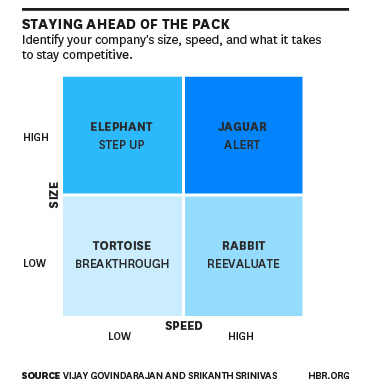
While this simple phrase has been used time and time again to discuss the many obstacles people and companies face, an animal metaphor does describe required innovation actions rather effectively. Imagine a 2×2 matrix with size on the y-axis and speed on the x-axis. Size can be represented as market share, revenue, or units sold, depending on the context. Speed is the speed of innovation of a company relative to the industry. When a company, product, or service is ahead of the competition, speed is high. When it is lagging behind the competition, speed is low.But why is relative speed so important? Consider a story where two hunters encounter a lion with no ammunition left in their guns. When one starts to run, the other claims the lion will eat him either way. The first replies, “Not as long as I can run faster than you!” Just like in the jungle, if you are not faster than the competition, you can get eaten up. The key question is, “What actions can be taken to get ahead of the pack?” — to become a jaguar or to stay a jaguar, as you see in the matrix below.

jungle-graphic2-thumb-580x611-3825 Read more of this post

World’s Oldest Person Jiroemon Kimura Turns 116 in Japan; Kimura’s motto in life is “to eat light and live long”

World’s Oldest Person Turns 116 in Japan
April 19, 2013

afp20130419113603420

The world’s oldest person turned 116 on Friday as local health chiefs in Japan launch a study to find out why he and many of those around him have lived so long.

Jiroemon Kimura, who was born in 1897, was expected to celebrate his astonishing milestone with friends and family, and receive a visit from the mayor of his home city of Kyotango in the west of the country.

Kimura is one of 95 people who will be 100 years old or more in the city’s 60,000-strong population.

The centenarian does not smoke and has made it a practice to eat only until he is 80 percent full, a local official told AFP.

He drinks only a “modest” amount of alcohol, a local report said.

Kimura’s motto in life is “to eat light and live long,” said the official. Read more of this post

Double Entry: How the Merchants of Venice Created Modern Finance

Double Entry: How the Merchants of Venice Created Modern Finance [Paperback]

Jane Gleeson-White (Author)

9780393088960_p0_v1_s260x420

Publication Date: October 7, 2013

“Lively history. . . . Show[s] double entry’s role in the creation of the accounting profession, and even of capitalism itself.”—The New Yorker

Filled with colorful characters and history, Double Entry takes us from the ancient origins of accounting in Mesopotamia to the frontiers of modern finance. At the heart of the story is double-entry bookkeeping: the first system that allowed merchants to actually measure the worth of their businesses. Luca Pacioli—monk, mathematician, alchemist, and friend of Leonardo da Vinci—incorporated Arabic mathematics to formulate a system that could work across all trades and nations. As Jane Gleeson-White reveals, double-entry accounting was nothing short of revolutionary: it fueled the Renaissance, enabled capitalism to flourish, and created the global economy. John Maynard Keynes would use it to calculate GDP, the measure of a nation’s wealth. Yet double-entry accounting has had its failures. With the costs of sudden corporate collapses such as Enron and Lehman Brothers, and its disregard of environmental and human costs, the time may have come to re-create it for the future. Read more of this post

How a Potter Took Accounting Into the Industrial Age

How a Potter Took Accounting Into the Industrial Age

ipLedfefsESY

In the mid 1700s, Josiah Wedgwood built the world’s first industrialized pottery factory. Source: Getty Images

This week, the International Integrated Reporting Council introduced a draft of a new framework for corporate accounting that would require companies to go beyond reporting just financial capital and also encompass environmental, social and governance risks.

The structure — known as “integrated reporting” — is a response to the realization brought on by the 2008 financial crisis and increasing environmental stresses that we need a new accounting paradigm for the 21st century. The limits of current national-accounting practices were acknowledged in 2012 when the United Nations adopted a new international standard to give “natural capital” equal status to gross domestic product as a gage of a nation’s economy.

These aren’t the first such paradigm shifts in the history of accounting. At the end of the 18th century, the double-entry account-keeping practices developed by Italian merchants in the Middle Ages were updated for the new industrial era.

The first signs that double entry could be adapted to the new age of factories, wage labor and large-scale capital investment appeared in the north of England, in the works of the renowned potter Josiah Wedgwood. Read more of this post

Innovator: Ruggero Scorcioni’s App Uses Brain Waves to Block Calls

Innovator: Ruggero Scorcioni’s App Uses Brain Waves to Block Calls

By Caroline Winter on April 18, 2013

tech_innovator17__01__630x420

Neuroscientist and former software engineer Ruggero Scorcioni found himself consistently distracted by the phone while he was trying to work. “If I’m busy coding or thinking about research and have phone calls coming in, it’s hard to get back into the same mental state,” says Scorcioni, 42. “Maybe you had a great idea, but then it’s gone.” In January, on a whim, he entered an AT&T app-development hackathon, and came up with a solution.

His idea was sparked by a gift to participants: a cat-ear headset built by Neuro-wear with sensors that track the wearer’s brain waves and perk up fluffy motorized ears during periods of high brain activity. Scorcioni, who’d just finished a fellowship at the Neurosciences Institute in La Jolla, Calif., decided to hack the headset to create an app that blocks incoming calls when the receiver is concentrating. With 26 hours to complete the hackathon, he worked until the last minute, pausing only for two hours of sleep and a shower. That labor produced a working prototype of Good Times, which analyzes real-time brain wave data from the headset, then sends commands to AT&T’s telephone network to either permit or block incoming calls. Blocked callers are redirected to an automated message asking them to try again later. Scorcioni describes the app as “a mentally activated ‘Do Not Disturb’ sign.” Read more of this post

Loews Creates ‘Investment Hunter’ Comic Book to Tout Its Stock

Loews Creates ‘Investment Hunter’ Comic Book to Tout Its Stock

By Noah Buhayar on April 18, 2013

mf_valuehunter17__01__630x420

Some companies have a simple story for investors. Ford makes cars. Apple designs and sells iPhones and other devices.Loews (L), a holding company that insures businesses, operates hotels, and produces energy, has a more complex tale to tell. Last summer, Chief Executive Officer Jim Tisch was talking with designers from Addison, the firm that produces Loews’s annual reports, about ways to spread the word about the company when he made an offbeat suggestion: What about a comic? “He was thinking of a way to present the information in an engaging way, as opposed to a 60-page PowerPoint,” says Mary Skafidas, vice president for investor and media relations at Loews, who was at the meeting.

After months of work with illustrators and Addison, Loews released The Adventures of Lotta Value, Investment Hunter! on its website on April 11. The 13-page graphic novel opens in the office of private detective Lotta, a female Sam Spade. Her client, Rich Stockman, a middle-aged man in a trench coat, needs help deciding whether to put money in Loews. He tells her the key to the company’s success is “tucked away in vaults at each subsidiary.” Read more of this post

Why More Extreme Foods Are Creeping Onto Menus; America’s $161 billion fast-food industry has embraced rich, fatty, gooey extreme foods to grab diners’ attention. Reactions have ranged from, “Oh my God, why?” to “Oh my God, why not?”

Why More Extreme Foods Are Creeping Onto Menus

By Susan Berfield and Venessa Wong on April 18, 2013

comp_fastfoodchart17_950_pop

For Americans who haven’t been to a state fair recently or who are unacquainted with Paula Deen’s style of Southern comfort food, this may come as a surprise: Some people make sandwiches with doughnuts. Now a doughnut sandwich is available for a lucky (or brave) few at none other than Dunkin’ Donuts (DNKN). The chain is testing a Glazed Donut Breakfast Sandwich—there’s a pepper fried egg and cherrywood-smoked bacon inside—in about a dozen stores in the Boston area.

“We’ve seen our customers buy doughnuts in the summertime to bring to the family cookout and put burgers on them,” says Dunkin’ executive chef Stan Frankenthaler, who runs the chain’s test kitchen. “We make sandwiches for ourselves on doughnuts.” Trying out the salty-sweet treat with customers seemed natural. Reactions to the doughnut sandwich, Frankenthaler says, have ranged from, “Oh my God, why?” to “Oh my God, why not?” Read more of this post

Berkshire’s Munger Pledges Record $110 Million to U. Michigan; “Charlie Munger believes that educating one’s self, in the right setting, is very powerful.”

Berkshire’s Munger Pledges Record $110 Million to U. Michigan

Charles Munger, vice chairman at Warren Buffett’s Berkshire Hathaway Inc. (BRK/A), pledged $110 million of securities to the University of Michigan to fund fellowships and a graduate-student residence.

The gift is the largest single donation in the school’s 196-year history, the Ann Arbor-based university said yesterday in a statement on its website. The proposed building will have room for more than 600 occupants and contain apartments with as many as seven bedrooms and private bathrooms that share cooking, dining and living areas.

Munger, 89, studied mathematics at the university in the 1940s and has previously contributed $20 million for renovations at a housing complex. The latest pledge includes $10 million for fellowships. Recipients would live in the residence and be chosen from among the university’s 19 schools and colleges to spur interaction among students from multiple disciplines.

“This project envisions an approach that makes graduate study less isolated,” university President Mary Sue Coleman said in the statement. “Charlie Munger is passionate about improving graduate student housing, and believes that educating one’s self, in the right setting, is very powerful.” Read more of this post

Conglomerate Murugappa is sometimes dubbed southern India’s Tata Group,CampdenFB talks to its fourth-gen chairman about his plans for the family business

VALUE CREATION

ARTICLE | 18 APRIL, 2013 02:07 PM | BY RASHMI KUMAR

Conglomerate Murugappa is sometimes dubbed southern India’s Tata Group,CampdenFB talks to its fourth-gen chairman about his plans for the family business.

outdoorV

Walking along Parry’s Corner (pictured, right) in the southern Indian city of Chennai can be an arduous task with its milling crowds, the many street shops selling everything from fake watches to clothes, and the constant whirr of traffic. The wholesale trading district doesn’t come across as the ideal setting for the headquarters of a multi-billion-euro conglomerate, but that is where family-controlled Murugappa Group is based. Read more of this post

Xiaomi Founder Lei Jun on the Pressures and Perils of Doing a Startup; Perhaps everyone underestimates the psychological pressure. 雷军自述:小米神话背后一些不神话的东西

Xiaomi Founder Lei Jun on the Pressures and Perils of Doing a Startup

April 18, 2013 by C. Custer

China’s Xiaomi is now widely recognized as one of the country’s best startups; it’s what happens when you take a good idea combined with experienced team and adequate funding and then insert all that into the perfect market environment. The company took in nearly $1 billion in sales revenue in the first half of 2012, and things are still going well today. But as Xiaomi founder Lei Jun writes in a recent column on his Xiaomi adventure, even for an experienced founder and investor, things don’t always look that rosy when you’re just starting out:

Actually, the decision to do Xiaomi was definitely not an easy one, there were a lot of things I was worried about. For example, I was going to do mobile phones and I had never worked in mobile before. Who would believe I was capable of making a mobile phone? Who would be willing to work with me on a mobile phone? What investors would be willing to give money to me to make a mobile phone? These are the questions I was anxious about. Perhaps everyone underestimates the psychological pressure.

Read more of this post

People celebrate Myanmar New Year’s Day; Hnit Thit Ku Mingalar Pa – Happy New Year!

People celebrate Myanmar new year’s day

Xinhua | 2013-4-18

2975a73d-964a-484d-ba96-132e1907e938

Novices pay homage on the first day of Myanmar new calendar year at the world-famous Shwedagon Pagoda in Yangon, Myanmar, April 17, 2013. On Myanmar new year’s day, people in the country used to perform meritorious deeds and Buddhists, who account for the majority of the people, usually go to the pagodas, monasteries and meditation centers where they practice meditation. (Xinhua/U Aung)

b002bc7f-20c3-4976-b690-a6615854546d

People gather on the first day of Myanmar new calendar year at the world-famous Shwedagon Pagoda in Yangon, Myanmar, April 17, 2013. On Myanmar new year’s day, people in the country used to perform meritorious deeds and Buddhists, who account for the majority of the people, usually go to the pagodas, monasteries and meditation centers where they practice meditation. (Xinhua/U Aung)

6c5dfa49-7c5e-4402-88cf-cdc4b6c5edac.Shwedagon Pagoda

15 Career Insights From Benjamin Franklin; “The noblest question in the world is ‘What good may I do in it?'”; “If you’re going through hell, keep going.”

15 Career Insights From Benjamin Franklin

Vivian GiangMax Nisen and Gus Lubin | Apr. 17, 2013, 6:21 PM | 44,321 | 5
benfranklin-1

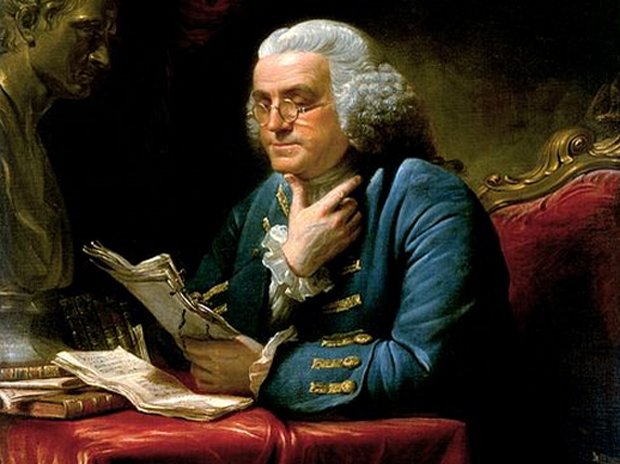
As one of the Founding Fathers, Benjamin Franklin played a crucial role in forming America.

But throughout his life, he played several other imperative roles — politician, inventor, scientist, musician, entrepreneur and author. He also gave tons of great advice (which he admitted that he only tried to follow) in his serialized “Poor Richard’s Almanack” and elsewhere.

On the 223rd anniversary of his death (April 17, 1790), we compiled some of his best advice on productivity, the workplace, and careers.

“Plough deep while sluggards sleep and you shall have corn to sell and to keep.”

Franklin claimed to get up every morning at 4:00 a.m. Many of the world’s most successful CEOs also get up early, including GE‘s Jeff Immeltwho’s up at 5:30, or GM‘s Dan Akerson, who rarely makes it past 4:30 or 5 a.m. before he gets up and starts calling Asia. Some tips for turning into an early riser include skipping late day caffeine, stopping the use of technology before bed, and outlawing the snooze button.

“Employ thy time well, if thou meanest to gain leisure.”

If you want to be done with your work, you must first finish it. This means that you should be as productive as possible during your work hours, and always place work ethics above your leisure time. As a young man, Franklin “seemed to work all the time, and the citizens of Philadelphia began to notice the diligent young businessman.”

“If you were a servant, would you not be ashamed that a good master should catch you idle? Then if you are your own master, be ashamed to catch yourself idle.”

An easy way to motivate yourself is to imagine that you were working for a favorite boss or mentor, and whether you’d be disappointing them.  It’s hard to argue that Franklin spent much time idle. In addition to his accomplishments as a statesman, he was a prolific inventor, notably creating bifocals and the lightning rod.

“At the working man’s house, hunger looks in but dares not enter.”

Born into a humble family, Franklin ran away at a young age to start a new life and worked hard to become one of the most powerful people in the country.

“Diligence is the mother of good luck.”

In other words, you make your own luck. Franklin certainly worked hard. Though he was ambivalent about religion himself, Franklin was a believer in the Puritan work ethic.

“He that pursues two hares at once, does not catch one and lets the other go.”

Although Franklin pursued an insane variety of careers, he tried to focus on one thing at a time.

Many serial multitaskers would do well to remember that multitasking can make you dumb.

“Tell me and I forget, teach me and I may remember, involve me and I learn.”

Franklin’s ambivalence toward formal instruction may be why he dropped out of school at a young age. Instead he learned things the old fashioned way, by working for his blacksmith father and apprenticing at the printing shop of his brother James. Franklin left his apprenticeship too, however, and by the age of 17 was living on his own in Philadelphia and learning by trial and error.

“Work while it is called today, for you know not how much you may be hindered tomorrow.”

This is the reason procrastination is so dangerous. A crisis, meeting, or personal problem can easily eat up huge hunks of a day. When you’re free to work, work hard, and get the most important things done.  Franklin’s schedule, printed in his autobiography, makes it clear he lived this maxim. Not only did he work long hours, he rose early to plan his day, and reflected on his successes or failures at its end.

“Not to oversee workmen is to leave them your purse open.”

Research has found that accepting small thefts in an organization ends up leading to larger fraud. Creating an honest and ethical workplace takes constant work.

“A slip of the foot you may soon recover, but a slip of the tongue you may never get over.”

In other words, be very, very careful when talking trash about people. Gossiping at the office is almost never a good idea. If there are issues, then it’s far better to address them openly. Another Franklin aphorism went even further: “Speak ill of no man, but speak all the good you know of everybody.”

“To be humble to superiors is duty, to equals courtesy, to inferiors nobleness.”

While being too humble is a mistake, as Facebook COO Sheryl Sandberg has observedhumility is a valuable quality. First of all, it’s a good way to get people to like you. Second, a humble attitude is necessary if you want to learn from people around you — whether your boss or your intern.

“Nothing brings more pain than too much pleasure; nothing more bondage than too much liberty.”

An abundance of choice sounds nice in theory, but can actually lead to paralysis, indecision, and stress. The best path is balanced.

“It is the first responsibility of every citizen to question authority.”

Franklin helped define the philosophy that defined America at the beginning, both justifying the revolution and preparing a system that was conducive to reform. This is good advice for your career too. As an employee, it is also your duty to come up with your own ideas to give feedback to your bosses about when processes can be improved.

“The noblest question in the world is ‘What good may I do in it?'”

Frankin’s Puritan upbringing made sure he always had a stalwart commitment to values like egalitarianism, hard work, honesty, and charity. Wharton professor Adam Grant’s research focuses on the idea that people aren’t just motivated by money, but by the positive impact they have on others. One study he did found that call center workers brought in 171% more revenue after oen of the students they were raising money for came in and told them how a scholarship had changed his life.

“If you’re going through hell, keep going.”

In other words, keep going until things get better. Don’t give up.