Resilient Growth In Crisis? Bamboo Innovators CSL and Keppel Show How

Resilient Growth In Crisis? Bamboo Innovators CSL and Keppel Show How

By KEE Koon Boon

8 April 2013

“Sometimes to be reborn, you must first die,” Dr. Victor Fung, group chairman of the multi-billion Li & Fung group of companies, cites pensively this old Chinese proverb in order to ask an open-ended question, “In a world that’s speeding up, how will companies change enough without crisis?”

We cannot avoid, or even choose, a crisis in order to engender the change that is required to overcome stall points in growth and to stay relevant in today’s marketplace where disruptive industry trends and black-swan crises have become a permanent fixture. When the inevitable traumatic upheavals and unorthodox challenges do come, innovators craft their business models to stay resilient like the bamboo, which bend, not break, even in the most terrifying storm that would snap the might resisting oak tree.

Australia’s CSL and Singapore’s Keppel are two such companies who have experienced near-deaths in daring greatly to scale and globalize their once domestic SME operations right under the noses of powerful incumbent global giant rivals – and they were renewed and reborned to be resilient Bamboo Innovators.

In its remarkable transformation from a sleepy government outfit providing snakebite antivenin since its privatization and listing in 1994 with a market value of A$500 million to a A$29 billion global biotech champion, CSL had experienced a near-death crisis in 2002. Similarly, Keppel, the global leader in offshore oil rig design and building, had hit a crisis in 1973, 1983 and 1990. Both were able to bounce back higher to scale greater heights. Why? Both companies have dedicated leaders cultivating a culture rooted in trust, cooperation and empowerment to contend with and heal creative dissent to handle large-scale complex projects repeatedly with excellence.

Brian McNamee was plucked from relative obscurity at the age of 33 to head CSL at the recommendation of then Industry Minister John Button. Similarly, the late Hon Sui Sen, founding Chairman of Singapore’s Economic Development Board (EDB), picked Chua Chor Teck to be Keppel’s first managing director in May 1972 and to take over and “Singaporeanize” Keppel from the hands of British managers of the Swan Hunter Group, then one of the best known shipbuilding companies in the world that has now disappeared.

During the era when America was dubbed the OPEC (Organization of Plasma Exporting Companies) of the global plasma industry, CSL broke the dominance of America’s grip by buying Swiss plasma fractionation pioneer ZLB for A$1 billion in 2000 and Germany’s Aventis Behring for US$925 million in 2004. Today, domestic earnings account for 10 percent of the group earnings at CSL with the bulk provided by its global businesses. Similarly, Keppel got its design and technology in oil rig from acquiring rig builder Far East Livingstone Shipbuilding (FELS), which Keppel took majority control in 1973 during the oil crisis. Subsequently, the late Sim Kee Boon, Chairman of Keppel Corp from 1984 to 1999, continued to lead the globalization push of Keppel, subsequently continued by the capable leaders Mr. Lim Chee Oon, Mr. Choo Chiau Beng, Mr. Tong Chong Heong, Mr. Loh Wing Siew and so on. Mr. Sim outlined the basic strategy of avoiding “green-field” or start-from-scratch projects and to invest in yards that are already there. For instance, Keppel acquired Allison-McDermid in America, AHI in Middle East, PEM Setal in Brazil, and Verolme Botlek in Europe. Mr. Sim’s dream was to see Keppel become like a Nestle with a very significant global presence.

The big-picture “plan” to globalize is seen obvious but managing the unseen risks and creating adaptive advantages along the way are more important. For the first two years, ZLB lived up to its promise, resulting in solid earnings growth for CSL, and its market value more than doubled. But the wheels came off in 2002 when the industry went into oversupply and a combination of sharply falling product prices and disadvantageous currency mismatch nearly crippled CSL. Back in 1983, Keppel’s cash purchase of Straits Steamship saddled it with a debt of S$845 million. Furthermore, the shipbuilding industry during that period was pronounced a sunset industry by the pundits as the industry went into oversupply with more than 80 shipyards capable of building rigs. Keppel survived the crisis and was the only surviving rig-builder in the world in 1986 then. Subsequently, another crisis hit shortly after Keppel’s acquisition of Texas-based jackup yard Allison-McDermid in 1990 when an American firm brought a US$565 million litigation case against Keppel for alleged breach of contract and damages involving the building of jackup offshore drilling rigs. CSL turned risk into opportunity by acquiring Aventis Behring to consolidate its position as the industry recovers. Keppel eventually won the suit. Keppel saw the need for control and bought out its partner, renaming the entity AmFELS which became a wholly-owned subsidiary of Keppel. It grew to become one of the best-equipped offshore yards in the Gulf of Mexico.

Growth through acquisitions has proven to be the graveyard for many companies in general. Warren Buffett, the world’s greatest investor, likened growing via acquisitions to kissing unresponsive corporate toads who croaked and the tempting but value-destroying toy that executives must have because their peers have one too. Post-acquisition efforts in integrating the companies into the parent company to compete as a coherent whole prove crucial to successfully scale to greater heights and not blow up. Both CSL and Keppel are able to do so because of the foundation laid down in the culture carefully nurtured by Mr. McNamee and Mr. Chua.

“We respected them greatly for their skills and their capabilities, so we weren’t cultural imperialists. We greatly respect our Swiss and German colleagues and so there was no notion that they were being taken over and that they were going to work to our method,” McNamee articulated how their culture of trust and respect provided both parties a common ground to work together towards a global vision for the group. The culture of empowerment at CSL is embedded into its business model to foster open innovation and extensive collaboration with its acquired companies and a network of high-quality academics, scientists and physicians across the world. CSL minimises a silo formation by giving people personal responsibility and by running R&D using a matrix structure. This intangible culture has delivered powerful tangible results, including how CSL beat competitors to be the first to market with an effective vaccine against the global swine flu epidemic and in developing the anti-cervical cancer drug Gardasil. The dedication of McNamee is also touching. He was diagnosed to have cancer and kidney problems when he was planning to buy ZLB. Swiss giant Novartis also offered more money and fanned the patriotism flame that ZLB should remain in Swiss hands. Due to the persistence of McNamee who flew to Switzerland against medical advice to personally negotiate the deal, CSL acquired ZLB despite paying 20 percent less than its rival bidder.

In his touching eulogy for Mr. Chua, “the much-loved leader among his men” who passed away from cancer in 1986 when he was 47, Keppel’s influential long-time US representative Mr. John Bajor commented, “Yes there’s complete dedication expected but the return in caring for each employee is the spirit he so carefully nurtured and left behind. It has become the Keppel way.” Mr. Sim also paid tributes to Mr. Chua who “tried exceedingly hard to inculcate in the organisation the ‘Keppel culture’ of loyalty, thrift and hard work.” Mr. Chua’s dedication and his “genuine interest in helping junior officers overcome difficulties in order to advance their career” has laid the foundation to the “Can Do” spirit of excellence at all levels in Keppel for many years to come.

The story at Bamboo Innovators CSL and Keppel highlighted the intangible culture of kindness, caring and empowerment is akin to the invisible intricate underground root structure that makes the ground around a bamboo grove very stable – and make possible the adaptability of the bamboo to bend, not break, with storms and crisis, and to remain relevant and evergreen no matter how the world around us speeds up and changes.

In History Departments, It’s Up With Capitalism; The new work marries hardheaded economic analysis with the insights of social and cultural history, integrating the bosses’-eye view with that of the office drones — and consumers — who power the system

April 6, 2013

In History Departments, It’s Up With Capitalism

By JENNIFER SCHUESSLER

A specter is haunting university history departments: the specter of capitalism. After decades of “history from below,” focusing on women, minorities and other marginalized people seizing their destiny, a new generation of scholars is increasingly turning to what, strangely, risked becoming the most marginalized group of all: the bosses, bankers and brokers who run the economy. Even before the financial crisis, courses in “the history of capitalism” — as the new discipline bills itself — began proliferating on campuses, along with dissertations on once deeply unsexy topics like insurance, banking and regulation. The events of 2008 and their long aftermath have given urgency to the scholarly realization that it really is the economy, stupid.

The financial meltdown also created a serious market opportunity. Columbia University Press recently introduced a new “Studies in the History of U.S. Capitalism” book series (“This is not your father’s business history,” the proposal promised), and other top university presses have been snapping up dissertations on 19th-century insurance and early-20th-century stock speculation, with trade publishers and op-ed editors following close behind. The dominant question in American politics today, scholars say, is the relationship between democracy and the capitalist economy. “And to understand capitalism,” said Jonathan Levy, an assistant professor of history at Princeton University and the author of “Freaks of Fortune: The Emerging World of Capitalism and Risk in America,” “you’ve got to understand capitalists.” That doesn’t mean just looking in the executive suite and ledger books, scholars are quick to emphasize. The new work marries hardheaded economic analysis with the insights of social and cultural history, integrating the bosses’-eye view with that of the office drones — and consumers — who power the system. “I like to call it ‘history from below, all the way to the top,’ ” said Louis Hyman, an assistant professor of labor relations, law and history at Cornell and the author of “Debtor Nation: The History of America in Red Ink.”

Read more of this post

Big, Hot, Cheap, and Right: What America Can Learn from the Strange Genius of Texas

April 6, 2013

How Texas Became Texas and Why It Matters

By BRYAN BURROUGH

41ZcuFIesgL

AS a Texas-raised journalist, I can tell you two things with confidence about my native state. One, its economy has been humming nicely for years. Two, this appears to greatly offend a certain breed of Northern writer, several of whom have descended on the state in an attempt to rebut stories of a “Texas miracle.” Their reports, Erica Grieder writes, have contributed to “a widespread impression that Texas is corrupt, callous, racist, theocratic, stupid, belligerent, and most of all, dangerous.”

This is nothing new, as most any Texan will tell you. But Ms. Grieder, a onetime correspondent for The Economist who now works at Texas Monthly, and a Texan herself, has written a smart little book that counters much of this silliness, and explains why the Texas economy is thriving. It’s called “Big, Hot, Cheap and Right: What America Can Learn from the Strange Genius of Texas” (PublicAffairs, $26.99). The sad truth, alas, is that it’s probably a lot easier to understand the successes of Texas than it would be to duplicate them.

What might be copied, Ms. Grieder indicates, is the so-called Texas model — that is, a weak state government with few taxes and fewer regulations and services. It would be far harder to replicate the state’s civic DNA, which features traits that can be traced to its decade, beginning in 1836, as a stand-alone nation (independent, suspicious of Washington), the late-1800s cowboy era (self-reliant, fraternal) and the 20th-century introduction of oil and entrepreneurialism (pro-business, skeptical of government). Those values, Ms. Grieder says, created a populace ideal for economic growth: “pragmatic, fiscally conservative, socially moderate and slightly disengaged.” Read more of this post

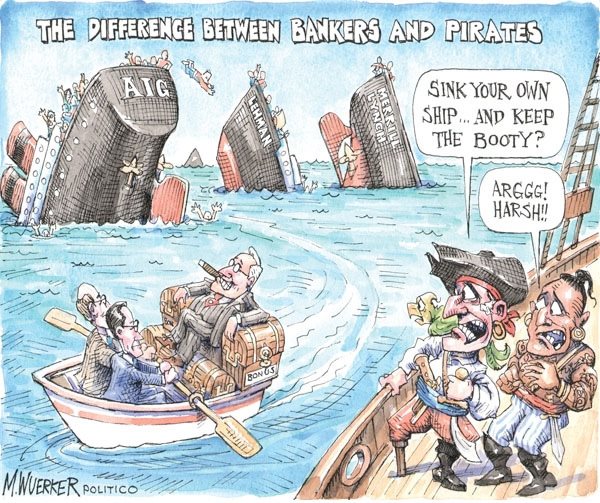
Cartoon of the Day: The Difference Between Bankers and Pirates

pirates-vs-bankers

It’s harder than ever to run a truly actively managed fund. Here’s how four firms execute unique – and successful – strategies. “We want to know that there’s intellectual thought, that there’s a process for buying companies, as well as for selling them”

SATURDAY, APRIL 6, 2013

Earning Their Keep

By SARAH MAX | MORE ARTICLES BY AUTHOR

It’s harder than ever to run a truly actively managed fund. Here’s how four firms execute unique — and successful — strategies.

It’s not easy being an active fund manager these days. Market information that was once available to a privileged few now flows freely and quickly. Index funds and exchange-traded funds, meanwhile, make it possible to implement simple or sophisticated strategies cheaply and effectively.

And then there’s performance.

Last year, 66% of domestic equity managers underperformed relative to the Standard & Poor’s 1500 index, according to the S&P Dow Jones Indices SPIVA Scorecard. That’s a considerable improvement over 2011, when 84% of active managers lagged the benchmark, but it’s hardly vindication for stock-picking. Even managers dealing in the supposedly inefficient international markets have struggled to get an edge. Last year, just 56% of international funds and 54% of emerging-market funds managed to deliver that elusive, market-beating “alpha” they’re paid for. There have been consequences: Over the past five years, nearly 27% of actively managed domestic equity funds and 23% of international equity funds have merged or liquidated.

So what’s an active manager to do? Some end up as “closet indexers,” who charge too much for hugging the index. In 2011, only 11% of assets invested in actively managed large-company funds were in portfolios that deviated from their benchmark by more than 80%, according to Martijn Cremers, a Notre Dame professor who helped pioneer “active share,” a measure of how truly active an active manager is. However, “skilled managers are out there,” says Charlie Ruffel, managing partner at Kudu Advisors, a strategic advisory firm for asset managers. “The challenge is in identifying them.”

The standout managers tend to have standout firms behind them, equipping them with the research teams, technology, financial backing, and supportive culture needed to go above and beyond. Some favor more concentrated approaches, investing in a small number of their very best ideas. Others take pains to investigate or even involve themselves with the management of the companies they invest in. Some take creative approaches to data-crunching, creating new perspectives on the market, while others simply thrive in a culture of constantly questioning and defending their stock-picking and portfolio moves. “Up until five years ago, managers didn’t need to try so hard to stand out,” adds Ruffel. “We’re in a different place.” Experts, such as financial advisors and consultants who help institutions choose funds, are constantly evaluating managers, looking for a process that brings consistent outperformance. They’re also looking for lights and mirrors — actions that appear to be in the name of research but don’t add value. Too much activity, they say, can be a warning sign. For instance, a manager who spends a disproportionate amount of time or travel on a position that represents less than 5% of the portfolio “might be cause for concern,” says Jonathan Bergman, a managing director at TAG Associates in New York. In general, however, Bergman and his peers are reassured when they hear that management has gone to great lengths to gain extra insight into a holding. “We want to know that there’s intellectual thought, that there’s a process for buying companies, as well as for selling them,” he says. Read more of this post

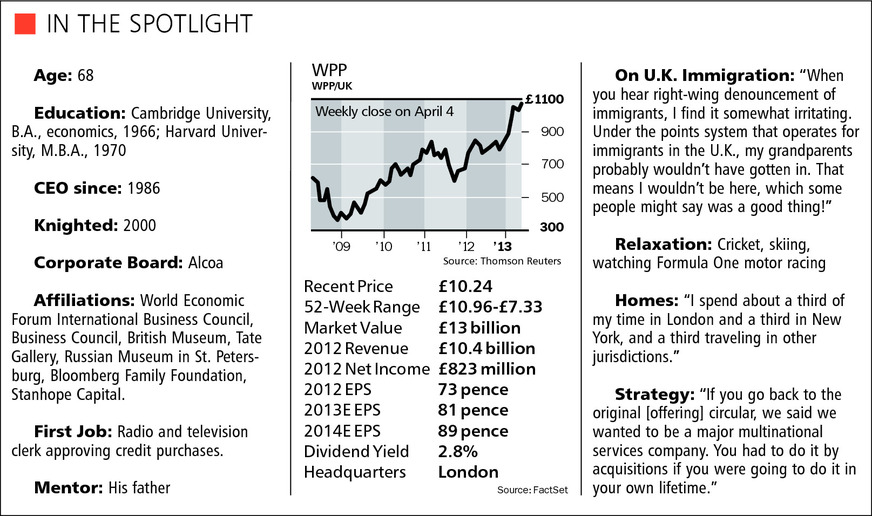
WPP CEO Martin Sorrell has built an advertising and marketing-services colossus by snapping up famous agencies on both sides of the Atlantic. A fighter to the end

SATURDAY, APRIL 6, 2013

No Ordinary Ad Man

By JONATHAN BUCK  | MORE ARTICLES BY AUTHOR

WPP CEO Martin Sorrell has built an advertising and marketing-services colossus by snapping up famous agencies on both sides of the Atlantic. A fighter to the end.

BA-BB574_ceo_p1_DV_20130406000449ON-BA554_SPOTLI_G_20130406010611

The advertising industry has long been known for colorful, larger-than-life characters. But few—past, present, or fictional (think Mad Men‘s Don Draper)—can compete with Martin Sorrell.

The head of London-based WPP, Sorrell is charming and feisty, puckish and ruthless, and seems to make money and enemies with equal dispatch. The legendary ad man David Ogilvy dismissed him as an “odious little jerk” when Sorrell sought to buy the U.S. advertising firm Ogilvy & Mather in 1989. But Sorrell, as usual, got the last laugh, winning both the company and an apology from Ogilvy, who went on to serve as WPP’s nonexecutive chairman for the next three years.

Sorrell, 68, has been called a bean counter, but then, his globe-spanning advertising and marketing-services conglomerate amounts to a huge hill of beans. Launched in 1985 with the friendly takeover of a British shopping-cart maker known as Wire & Plastic Products, WPP (ticker: WPP.U.K.) today employs 165,000 people in 110 countries, and operates under dozens of separate brands. It reported worldwide billings of more than $70 billion in 2012, and counts Google (GOOG) and News Corp. (NWSA), the owner of Barron’s, as its biggest customers. Read more of this post

Up close and personal with Subway’s co-founder Fred DeLuca

Saturday April 6, 2013

Up close and personal with Fred DeLuca

By Liz Lee
lizlee@thestar.com.my

Star Publication (M) Bhd

WHEN he started, he had only five sandwiches on the menu, all foot-long and served cold.

Today, he heads the world’s largest food chains, beating McDonald’s in 2011 and not showing signs of giving up that position.

Subway co-founder and president, Fred DeLuca’s story is the epitome of the proverb “slow and steady wins the race”.

Even though Subway is growing at a rapid-fire pace especially in Asia, DeLuca says the main focus is to look at building the business one store at a time.

“The foundation for success is to understand what customers want, and that is good food, service and cleanliness,” he adds.

At the Asian level, Subway’s business is also undergoing strong expansion with an ambitious target of 10,000 stores by 2020. These stores would generate US$3bil (RM9.26bil) sales.

Subway’s Asia business is now worth over US$500mil (RM1.54bil), with 1,600 stores operating in the region. It enjoys a 29% year-on-year revenue growth. Read more of this post

Great Scientist ≠ Good at Math; E.O. Wilson shares a secret: Discoveries emerge from ideas, not number-crunching

April 5, 2013, 10:07 p.m. ET

Great Scientist ≠ Good at Math

E.O. Wilson shares a secret: Discoveries emerge from ideas, not number-crunching

By E.O. WILSON

For many young people who aspire to be scientists, the great bugbear is mathematics. Without advanced math, how can you do serious work in the sciences? Well, I have a professional secret to share: Many of the most successful scientists in the world today are mathematically no more than semiliterate.

During my decades of teaching biology at Harvard, I watched sadly as bright undergraduates turned away from the possibility of a scientific career, fearing that, without strong math skills, they would fail. This mistaken assumption has deprived science of an immeasurable amount of sorely needed talent. It has created a hemorrhage of brain power we need to stanch. Read more of this post

How the South Sea Bubble Created U.K.’s Modern Monarchy; The crisis devastated thousands of investors, including Sir Isaac Newton, and permanently changed the structure of the constitutional monarchy, allowing a prime minister to become head of the government as the monarch gradually assumed the more ceremonial role of head of state

How the South Sea Bubble Created U.K.’s Modern Monarchy

The bubble of 1720 precipitated England’s first stock-market crash. In August of that year, shares in the South Sea Company reached a peak of 1,000 pounds and dropped to 150 pounds by the end of September.

The crisis devastated thousands of investors, including Sir Isaac Newton, who reputedly said after losing 20,000 pounds, “I can calculate the movement of heavenly bodies but not the madness of men.” The crash also permanently changed the structure of the constitutional monarchy, allowing a prime minister to become head of the government as the monarch gradually assumed the more ceremonial role of head of state. Read more of this post

Five routes to more innovative problem solving; Tricky problems must be shaped before they can be solved. To start that process, and stimulate novel thinking, leaders should look through multiple lenses.

Five routes to more innovative problem solving

Tricky problems must be shaped before they can be solved. To start that process, and stimulate novel thinking, leaders should look through multiple lenses.

April 2013 • Olivier Leclerc and Mihnea Moldoveanu

Source: Strategy Practice

Rob McEwen had a problem. The chairman and chief executive officer of Canadian mining group Goldcorp knew that its Red Lake site could be a money-spinner—a mine nearby was thriving—but no one could figure out where to find high-grade ore. The terrain was inaccessible, operating costs were high, and the unionized staff had already gone on strike. In short, McEwen was lumbered with a gold mine that wasn’t a gold mine.

Then inspiration struck. Attending a conference about recent developments in IT, McEwen was smitten with the open-source revolution. Bucking fierce internal resistance, he created the Goldcorp Challenge: the company put Red Lake’s closely guarded topographic data online and offered $575,000 in prize money to anyone who could identify rich drill sites. To the astonishment of players in the mining sector, upward of 1,400 technical experts based in 50-plus countries took up the problem. The result? Two Australian teams, working together, found locations that have made Red Lake one of the world’s richest gold mines. “From a remote site, the winners were able to analyze a database and generate targets without ever visiting the property,” McEwen said. “It’s clear that this is part of the future.”1

McEwen intuitively understood the value of taking a number of different approaches simultaneously to solving difficult problems. A decade later, we find that this mind-set is ever more critical: business leaders are operating in an era when forces such as technological change and the historic rebalancing of global economic activity from developed to emerging markets have made the problems increasingly complex, the tempo faster, the markets more volatile, and the stakes higher. The number of variables at play can be enormous, and free-flowing information encourages competition, placing an ever-greater premium on developing innovative, unique solutions.

This article presents an approach for doing just that. How? By using what we call flexible objects for generating novel solutions, or flexons, which provide a way of shaping difficult problems to reveal innovative solutions that would otherwise remain hidden. This approach can be useful in a wide range of situations and at any level of analysis, from individuals to groups to organizations to industries. To be sure, this is not a silver bullet for solving any problem whatever. But it is a fresh mechanism for representing ambiguous, complex problems in a structured way to generate better and more innovative solutions.

The flexons approach

Finding innovative solutions is hard. Precedent and experience push us toward familiar ways of seeing things, which can be inadequate for the truly tough challenges that confront senior leaders. After all, if a problem can be solved before it escalates to the C-suite, it typically is. Yet we know that teams of smart people from different backgrounds are more likely to come up with fresh ideas more quickly than individuals or like-minded groups do.2 When a diverse range of experts—game theorists to economists to psychologists—interact, their approach to problems is different from those that individuals use. The solution space becomes broader, increasing the chance that a more innovative answer will be found.

Obviously, people do not always have think tanks of PhDs trained in various approaches at their disposal. Fortunately, generating diverse solutions to a problem does not require a diverse group of problem solvers. This is where flexons come into play. While traditional problem-solving frameworks address particular problems under particular conditions—creating a compensation system, for instance, or undertaking a value-chain analysis for a vertically integrated business—they have limited applicability. They are, if you like, specialized lenses. Flexons offer languages for shaping problems, and these languages can be adapted to a much broader array of challenges. In essence, flexons substitute for the wisdom and experience of a group of diverse, highly educated experts.

To accommodate the world of business problems, we have identified five flexons, or problem-solving languages. Derived from the social and natural sciences, they help users understand the behavior of individuals, teams, groups, firms, markets, institutions, and whole societies. We arrived at these five through a lengthy process of synthesizing both formal literatures and the private knowledge systems of experts, and trial and error on real problems informed our efforts. We don’t suggest that these five flexons are exhaustive—only that we have found them sufficient, in concert, to tackle very difficult problems. While serious mental work is required to tailor the flexons to a given situation, and each retains blind spots arising from its assumptions, multiple flexons can be applied to the same problem to generate richer insights and more innovative solutions.

Networks flexon

Imagine a map of all of the people you know, ranked by their influence over you. It would show close friends and vague acquaintances, colleagues at work and college roommates, people who could affect your career dramatically and people who have no bearing on it. All of them would be connected by relationships of trust, friendship, influence, and the probabilities that they will meet. Such a map is a network that can represent anything from groups of people to interacting product parts to traffic patterns within a city—and therefore can shape a whole range of business problems.

For example, certain physicians are opinion leaders who can influence colleagues about which drugs to prescribe. To reveal relationships among physicians and help identify those best able to influence drug usage, a pharmaceutical company launching a product could create a network map of doctors who have coauthored scientific articles. By targeting clusters of physicians who share the same ideas and (one presumes) have tight interactions, the company may improve its return on investments compared with what traditional mass-marketing approaches would achieve. The network flexon helps decompose a situation into a series of linked problems of prediction (how will ties evolve?) and optimization (how can we maximize the relational advantage of a given agent?) by presenting relationships among entities. These problems are not simple, to be sure.3But they are well-defined and structured—a fundamental requirement of problem solving. Read more of this post

Exclusive: Some wealth advisers take a fee for client fund assets

Exclusive: Some wealth advisers take a fee for client fund assets

12:54pm EDT

By Jed Horowitz

(Reuters) – At least three wealth management firms that market themselves as objective financial advisers are getting payments for investing their clients’ money in certain mutual funds, a practice that even some of these firms say could create conflicts of interest.

The firms, known as registered investment advisers, are typically paid by clients with fees tied to the growth or contraction of client assets, and not to specific products. But Fidelity Investments and Charles Schwab Corp are paying these financial advisers as much as 0.25 percent of the assets that their clients put into no-transaction-fee mutual funds.

Such funds are popular with ordinary investors because they don’t have to pay commissions to buy or sell them, although some advisers say they have higher expenses than funds with commissions. Brokers such as Fidelity and Schwab make hundreds of millions of dollars in fees selling funds that they and others manage. Read more of this post

In Sign of Warming, 1,600 Years of Ice in Andes Melted in 25 Years

April 4, 2013

In Sign of Warming, 1,600 Years of Ice in Andes Melted in 25 Years

By JUSTIN GILLIS

Glacial ice in the Peruvian Andes that took at least 1,600 years to form has melted in just 25 years, scientists reported Thursday, the latest indication that the recent spike in global temperatures has thrown the natural world out of balance. The evidence comes from a remarkable find at the margins of the Quelccaya ice cap in Peru, the world’s largest tropical ice sheet. Rapid melting there in the modern era is uncovering plants that were locked in a deep freeze when the glacier advanced many thousands of years ago. Dating of those plants, using a radioactive form of carbon in the plant tissues that decays at a known rate, has given scientists an unusually precise method of determining the history of the ice sheet’s margins. Read more of this post

How P&G Presents Data to Decision-Makers: Over 50,000 P&G employees now have access to a “Decision Cockpit”

How P&G Presents Data to Decision-Makers

by Tom Davenport  |   3:00 PM April 4, 2013

Those of us who believe that managers make better decisions when key data are presented visually tend to get very excited about all the innovation going on in the graphical display of information. (For a sampling of some new and cool tools, see the popular Hans Rosling TED talk.) However, if you work in a large organization and want it to make better use of data visualization, I’d argue thatcommonality is more important than creativity. If you can establish a common visual language for data, you can radically upgrade the use of the data to drive decision-making and action. The best case I can cite for this argument is Procter & Gamble, which has institutionalized data visualization as a primary tool of management. Working with visual analytics software vendor Tibco Spotfire, P&G has put visual displays of key information on desktops — over 50,000 P&G employees now have access to a “Decision Cockpit” (shown below).

MyCockpit-thumb-580x433-3673 Read more of this post

The chemist in the kitchen: Rachel Edwards-Stuart cooked up a career from applying lab techniques to modern cuisine

April 4, 2013 5:16 pm

The chemist in the kitchen

By Emma Jacobs

images (5)

In her elements: Rachel Edwards-Stuart uses her academic studies to create culinary transformations

Nervy, nerdy Rachel Edwards-Stuart fizzes about the kitchen in her north London higgledy-piggledy flat, pulling out bits of equipment. A water bath, a blow torch, pipettes. Ah, here is the smoking gun. “The tube is over there,” she yanks a foot-long piece of rubber from a shelf. “My cleaning lady hides things in weird places.” She pauses. “I don’t know where you’d normally put a tube from a smoking gun.”

The 30-year-old food scientist is such an enthusiast for the overlapping spheres of science and gastronomy that she interrupts one train of thought with another and another.

Her primary job is to teach the science of cooking and ways of creating gastronomic experiments to chefs – professionals in restaurants as well as amateurs who aspire to make such gourmet confections at home. But she also advises chefs and the food industry. She shares the evangelising passion of a mad professor desperate to communicate their ideas while baffled by their audience’s ignorance. Read more of this post

The Story Of A Failed Startup And A Founder Driven To Suicide

The Story Of A Failed Startup And A Founder Driven To Suicide

Alyson Shontell | Apr. 4, 2013, 8:43 PM | 86,356 | 37

jody-sherman

A few months ago, on Sunday, January 27, an entrepreneur named Jody Sherman had plans to see a movie with a friend.

But that afternoon, the friend received a call from Jody’s wife, Kerri.

Jody had gone missing. Three hours later, Kerri notified the Las Vegas Police Department, fearing something might have happened to her husband.

At 11:12 PM, the police found Sherman’s body.

He was in his car on Witch Mountain Road, near Mount Charleston, Nevada, about 25 miles from Las Vegas. Sherman had been shot in the head.

The Clark County coroner’s office determined that Sherman had killed himself. It was five days before his 48th birthday.

News of Sherman’s suicide ripped through Twitter and the technology blogs. His death left thousands aching and confused. He left no note. His last Facebook message was written by his wife:

“This is Jody’s final post, and it isn’t coming from Jody. He’s gone. This is not a bit of his wonderful twisted humor. This is sad and real and forever. He didn’t say goodbye to anyone because he knew he couldn’t. So I’m saying it for him. If you are reading this it’s because you are connected to Jody in some way. He loved you, respected you, admired you, valued your presence in his life, or felt some combination of any or all of these things. And he would want each and every one of you to know and understand exactly that. Please post anything you have to say to or about Jody here.”

Just a few days after Sherman’s suicide, his company, Ecomom, had a board meeting in which his co-founder and the board found the startup in a startling state.

A couple of weeks later, Ecomom closed its doors. The prosaic reason: The company’s liabilities were greater than its assets.

Put more simply, Ecomom was broke. The 28-person startup — which had just raised $5 million six months earlier and more than $12 million total — ran out of cash. And no one left at the company seemed to know where it had gone. Read more of this post

The Practical University: The promise of online education lies in taking care of the technical knowledge so that universities can focus on transmitting practical knowledge

April 4, 2013

The Practical University

By DAVID BROOKS

The best part of the rise of online education is that it forces us to ask: What is a university for?

Are universities mostly sorting devices to separate smart and hard-working high school students from their less-able fellows so that employers can more easily identify them? Are universities factories for the dissemination of job skills? Are universities mostly boot camps for adulthood, where young people learn how to drink moderately, fornicate meaningfully and hand things in on time?

My own stab at an answer would be that universities are places where young people acquire two sorts of knowledge, what the philosopher Michael Oakeshott called technical knowledge and practical knowledge. Technical knowledge is the sort of knowledge you need to understand a task — the statistical knowledge you need to understand what market researchers do, the biological knowledge you need to grasp the basics of what nurses do.

Technical knowledge is like the recipes in a cookbook. It is formulas telling you roughly what is to be done. It is reducible to rules and directions. It’s the sort of knowledge that can be captured in lectures and bullet points and memorized by rote. Read more of this post

Chinese Education: The Truth Behind the Boasts; Parents in China’s big cities sometimes pay donations and steep fees to middlemen to get their children into the best schools

Chinese Education: The Truth Behind the Boasts

By Dexter Roberts on April 04, 2013

In an international survey released just over two years ago, high school students from Shanghai scored at the top in math, science, and reading. Some Americans saw this as a Sputnik moment—a wake-up call for the rest of the world to better educate its young or risk falling behind the Chinese. In March, China’s leadership announced that education spending totaled 7.79 trillion yuan ($1.26 trillion) over the last five years, reaching a target of 4 percent of gross domestic product. “The quality and level of education in China was comprehensively raised,” said outgoing Premier Wen Jiabao on March 5.

The reality is China’s students receive educations of greatly varying quality. Their parents often pay a lot for it, depending on where they live and how ambitious their choice of school—even though China is committed to a system “implemented uniformly by the State,” with “no tuition or miscellaneous fee,” according to the 1986 Compulsory Education Law. Yet some rural families struggle to pay school costs as high as one-half their meager incomes, while up to 130 students crowd country classrooms, according to Yang Dongping, an education expert at the Beijing Institute of Technology and the dean of the 21st Century Education Research Institute. Yang adds that urban parents pay introduction fees of as much as $10,000 to middlemen to win entry into the better schools. Read more of this post

Advice from a leading industrialist: Be diligent, Be honest, Be frugal; “Corruption comes from greed and is encouraged because people respect the rich even if their dirty money comes from corruption and bribery. According to Buddhist teaching, we should have hiri and ottappa, or shame and fear of doing evil. If we show respect to corrupt people, it will further encourage the wrong attitude towards corruption.”

Advice from a leading industrialist: Be diligent, Be honest, Be frugal

Published: 4 Apr 2013 at 00.00

488266

The visitor to the headquarters of Kulthorn Kirby Plc (KKC) can’t help but notice the big sign hanging in the main lobby, which declares “Be Diligent _ Be Honest _ Be Frugal”.

“It’s also my personal motto,” says Suraporn Simakulthorn, the executive chairman of KKC, the major SET-listed maker of air-conditioner compressor motors and refrigeration product equipment.

“I started my career with the Telephone Organisation of Thailand back in 1963, then moved to work at Ericsson in 1967 for 13 years,” he explains. “Learning from my own personal experience, I believe we must be diligent and have a conviction to get the job done.

“Honesty is second to none when you work with others. In our 32-year history at Kulthorn Kirby, we’ve gone through a number of cooperative ventures with partners including Western and Asian counterparts. Honesty is the key element in business achievement.

“Last but not least is being frugal, which is similar to something we are well aware of, the ‘self-sufficient economy’. Since I used to be a corporate employee myself, I am truly aware of the importance of saving. We have to behave in a way that we spend only what is necessary and keep some savings at all times.” Read more of this post

Isaac Newton’s Nightmare During the South Sea Stock Bubble (Dec 1718 – Dec 1721)

Isaac Newton’s Nightmare — Charted By Marc Faber

Sam Ro | Apr. 2, 2013, 4:43 PM | 6,414 | 3

The parabolic move in Bitcoin prices has us thinking about some of the most notorious asset bubbles in history. We were thumbing through some of Jeremy Grantham‘s old research and saw this great chart from Marc Faber. “I can calculate the movement of stars, but not the madness of men,” Newton apparently said after he lost his fortune.

screen shot 2013-04-02 at 4.29.11 pm

Henninger: Capitalism’s Corruptions; Corruption suppresses growth because citizens in time recognize that honest work produces a lower return than spending one’s energies gaming the system

April 3, 2013, 6:47 p.m. ET

Henninger: Capitalism’s Corruptions

On capitalism, Pope Francis, Barack Obama and François Hollande aren’t singing from the same hymnal.

By DANIEL HENNINGER

ED-AQ615_wl0404_DV_20130403175653

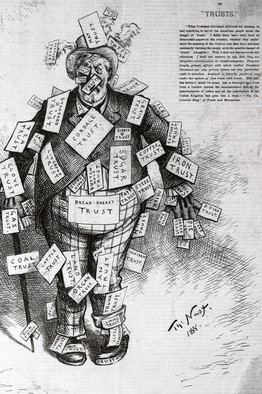
Public relations for capitalists hasn’t been so hard since Thomas Nast was caricaturing them in 19th-century America. The back wash of the 2008 financial crisis has put capitalist baiting back in vogue. The president of the United States got himself elected to a second term with a four-year assault on “the wealthiest” and the “well off.” French President Nicolas Sarkozy attacked the “free-wheeling Anglo-Saxon model” of capitalism, so the French dumped him to elect an aggressive anti-capitalist. Read more of this post

Creating ‘bamboo innovators’ in S’pore now on AsiaOne

Now on AsiaOne: http://www.asiaone.com/News/Latest%2BNews/Singapore/Story/A1Story20130402-413040.html

Creating ‘bamboo innovators’ in S’pore
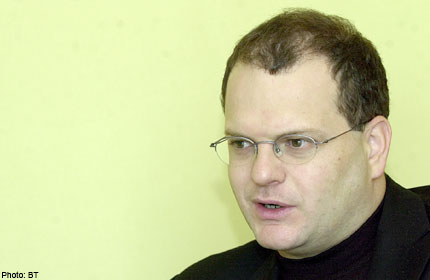
20130402.152437_bt_gilv7

Uncertain conditions can breed innovative businesses, where risk-taking educators nurture flexible students. -ST
Kee Koon Boon

Wed, Apr 03, 2013
The Straits Times

Gil Shwed, CEO & Founder of Check Point Sofware.

SINGAPORE – “Can my kid watch how you milk cows?”

“Can my kid see how you print the newspaper?”

These were questions asked by Israeli inventor and entrepreneur Gil Shwed’s mother when she took him on educational “adventure trips” when he was young, exposing him to a dairy farm, a printing house, and his father’s office in 1972, where at age five he saw a computer for the first time.

He soon signed up for computer classes at age nine, a summer coding job at 12, and took computer science classes at the Hebrew University while still in high school.

Unlike his career-minded peers, Mr Shwed persisted with an idea first cooked up during his military conscription: building a type of computer security software that links up computer networks in a way that would allow some users access to confidential materials while denying access to others. He embarked upon the project with two friends after army conscription and without the security of “proper” jobs.

By 1994, the trio’s Firewall product won the best software award at a computer show, vindicating a venture capital firm’s faith in Mr Shwed’s vision. Check Point Software Technologies listed on Nasdaq in 1996. Its market value today has jumped 12-fold to US$10 billion (S$12.4 billion).

Binding the trio together was a pioneering ethos where “education” with a “bitzu’ism” quality was at its heart. A bitzu’ist is a Hebrew word that loosely translates to “pragmatist” with a resilient quality, like bamboo that bends but does not break in the wildest storms when even oak trees snap. The bitzu’ist is the “builder, the irrigator, the pilot, the gun-runner, the settler all rolled into one”.

Mr Shwed thinks of his home country Israel as a “start-up nation”. “We managed to create a country from zero. We’ve had an entrepreneurial spirit for over 100 years. One thing that really helps us here is that we don’t have a local market.”

Surrounded by hostile neighbours and with few natural resources, Israel has the highest density of start-ups in the world, with one for every 1,800 Israelis. With a population of 7.7 million with 70 different nationalities, Israelis think globally when creating products and innovative firms.

Developing human capital is the key to growing the Israeli economy. Its education system is not about chasing after instrumental achievements such as “grades” or a “checklist-based holistic curriculum vitae” or “high graduation salary”.

The education system in Israel is made market-relevant when plugged into an unique ecosystem that constantly searches for and supports innovative ideas and new products to help build “bamboo innovator” companies such as Check Point.

In “Singapore version 1.0’s” growth since independence, the education system is meritocratic, highly competitive and “standardised”, lifting the technical competence and social mobility of Singaporeans to fit multinational companies (MNCs) with their export-oriented strategies.

This is augmented by higher valued-added services from logistics, shipping and maritime support to legal, finance and accounting, generating high wages to beat inflationary pressures. “Education 1.0” is about meeting the needs of capable MNCs which connect Singapore’s small, open economy to the real marketplace.

Yet the highly skilled workforce is not able to translate its “intangibles” in know-how into building and even owning “bamboo innovators”. The “earnings” accrued from this know-how remain with the MNCs.

In investing lingo, a high-salaried MNC worker has a price earnings (PE) ratio of one while a MNC can have a PE value of 20 times. A productive “bamboo” worker is one who, when a wind blows away his MNC title and position, can still remain a resilient innovator to create value because he has that intangible quality that is indestructible.

MNCs are concerned about the Singapore workforce lacking the initiative and innovativeness desired by knowledge-based industries, thus creating a barrier to a breakthrough in wages and productivity. It is the hollow “emptiness” in its centre – the intangibles – that gives bamboo great strength and flexibility in a raging storm.

The Singapore workforce’s accumulation of wealth and tangible assets for their own sake has evolved into a sense of entitlement, a dangerous liability that erodes character, moral values and social cohesion.

Reform attempts through character education and creative thinking alone are not only difficult but also decidedly off-track. As economist David Landes puts it, nothing dilutes drive and ambition more than a sense of entitlement. This kind of distortion makes an economy inherently uncompetitive.

Instead of the diminishing marginal returns from repeating “Education 1.0”, where school results are instrumental, these complex uncertain times require an education system that enables students to grope and reach directly into the global marketplace, to be sensitive and alert to existing anomalies and paradigms, and to how things ought to function and behave.

Educators must connect and sensitise students to the chaotic global marketplace. It is this sensitivity and alertness that leads to creating “bamboo innovators”.

Reflecting former deputy prime minister Goh Keng Swee’s view about the spirit of education as both “a search for truth” and “the way to a better life”, Singapore’s “Education 2.0” system should centre on how and why resilient firms continue to create value in uncertain and difficult times.

The system should also educate students who dare to become “bamboo innovators” like Mr Shwed, and who will build enduring creations.

As former Israeli president Shimon Peres said, “the most careful thing is to dare”.

China’s $10 Million Artist Pursues Spartan Life in NYC; “Every morning I wake up between 7 a.m. and 8 a.m., have a cup of coffee, read the news and head to the studio,” says artist Zhang Xiaogang, “where I stay until 10 p.m. to 11 p.m.”

China’s $10 Million Artist Pursues Spartan Life in NYC

Zhang Xiaogang, Forever Lasting Love

“Every morning I wake up between 7 a.m. and 8 a.m., have a cup of coffee, read the news and head to the studio,” says artist Zhang Xiaogang, “where I stay until 10 p.m. to 11 p.m.”

It’s a Spartan routine for China’s priciest living artist, who achieved that status when his triptych titled “Forever Lasting Love” sold for $10.2 million at a Hong Kong auction in 2011. His latest works, a mix of paintings and sculptures, are now on view at the Pace Gallery in New York’s Chelsea area where the opening last week attracted several hundred guests.

Read more of this post

Pimco’s Bill Gross Says Buffett to Soros Careers Fueled by Expansion: “What if there is a future that demands that an investor – a seemingly great investor – change course, or at least learn new tricks? Ah, now, that would be a test of greatness: the ability to adapt to a new epoch. Investors should be judged on their ability to adapt to different epochs, not cycles.”

Gross Says Buffett to Soros Careers Fueled by Expansion

Bill Gross, manager of the world’s largest mutual fund, said the most renowned investors from Warren Buffett to George Soros may owe their reputations to a favorable era for money management as expanding credit fueled gains in asset prices across markets.

The real test of greatness for investors is not how they navigated market cycles during that time, but whether they can adapt to historical changes occurring over half a century or longer, Gross, 68, wrote in an investment outlook published today entitled “A Man in the Mirror,” named after a song by Michael Jackson.

“All of us, even the old guys like Buffett, Soros, Fuss, yeah – me too, have cut our teeth during perhaps a most advantageous period of time, the most attractive epoch, that an investor could experience,” Gross wrote. “Perhaps it was the epoch that made the man as opposed to the man that made the epoch.”

Gross, one of the co-founders in 1971 of Newport Beach, California-based Pacific Investment Management Co., is examining his legacy as the bond shop he built over four decades is seeking to adapt to an environment that looks very different from the bull market that fueled Pimco’s growth to one of the largest money managers in the world. The prospect of elevated market volatility, an aging population and climate change could make investing far more challenging in the coming decades, Gross said. Read more of this post

Pimco’s Bill Gross Asks “What Makes A Great Investor?”: “All of us, even the old guys like Buffett, Soros, Fuss, yeah – me too, have cut our teeth during perhaps a most advantageous period of time, the most attractive epoch, that an investor could experience”

Bill Gross Channels Michael Jackson In Latest Monthly Letter, Asks “What Makes A Great Investor?”

04/03/2013 07:31 -0400

From Bill Gross of PIMCO

I’m starting with the man in the mirror 

I’m asking him to change his ways
And no message could have been any clearer
If you wanna make the world a better place
Take a look at yourself, and then make a…
Chaaaaaaaange …..

 Michael Jackson

A Man in the Mirror

Am I a great investor? No, not yet. To paraphrase Ernest Hemingway’s “Jake” in The Sun Also Rises, “wouldn’t it be pretty to think so?” But the thinking so and the reality are often miles apart. When looking in the mirror, the average human sees a six-plus or a seven reflection on a scale of one to ten. The big nose or weak chin is masked by brighter eyes or near picture perfect teeth. And when the public is consulted, the vocal compliments as opposed to the near silent/ whispered critiques are taken as a supermajority vote for good looks. So it is with investing, or any career that is exposed to the public eye. The brickbats come via the blogs and ambitious competitors, but the roses dominate one’s mental and even physical scrapbook. In addition to hope, it is how we survive day-to-day. We look at the man or woman in the mirror and see an image that is as distorted from reality as the one in a circus fun zone. Read more of this post

The Innovators: The Men Who Built America

http://en.wikipedia.org/wiki/The_Men_Who_Built_America

The Men Who Built America (also known as The Innovators: The Men Who Built America in some international markets) is a History eight-hour, four-part miniseries docudramabroadcast in Fall (autumn) 2012, and on the History Channel UK in Spring 2013. The series focuses on Cornelius VanderbiltJohn D. RockefellerAndrew CarnegieJ. P. Morgan and Henry Ford and how their industrial innovations and business empires revolutionized and, as alluded to in the title, “built” America. The series is directed by Patrick Reams and Ruán Magan and is narrated by Campbell Scott. It averaged 2.6 million total viewers, 1.2 million Adults 25-54 and 1 million Adults 18-49 across 4 nights.

418831_563132657043923_1061238913_n (1)

Tactics to Spark Creativity; To have a good idea, “you have to be able to float through your environment with your antennae up, like a butterfly, and just let things ping your antennae.”

April 2, 2013, 7:20 p.m. ET

Tactics to Spark Creativity

Even People Who Lack Ideas Can Set the Scene for Inspiration; Just Walk Away

By SUE SHELLENBARGER

Why is it that some people rack their brains for new ideas, only to come up empty—while others seem to shake them almost effortlessly out of their sleeves? Whether creativity is an innate gift or a cognitive process that anyone can jump-start is a question so intriguing that researchers keep studying it from different angles and discovering new and surprising techniques. Several recent studies suggest that the best route to an “aha moment” involves stepping away from the grindstone—whether it’s taking a daydream break, belting back a drink or two or simply gazing at something green. Of course, personality can make a difference. People who rate high in openness to new experiences in personality tests also may be more distractible and curious, according to a 2010 study in Creativity Research Journal. Among 158 college students, those who were less inhibited and more receptive to lots of stimuli also were able to generate more ideas than others, says the study by British researchers.

But personality isn’t the only path to inspiration, researchers say. Walking away from a problem to do simple, routine tasks, and letting the mind wander in the process, can spark creative new connections or approaches to solving dilemmas, says a 2012 study in Psychological Science. That helps explain why “a lot of great ideas occur at transition times,” when people are waking up or falling asleep, bathing, showering or jogging, says Jennifer Wiley, a psychology professor at University of Illinois at Chicago and lead author of a 2012 research summary in Current Directions in Psychological Science. Read more of this post

Mattel’s former Chairman & CEO (2000-2011) Robert Eckert: The Two Most Important Words

The Two Most Important Words

by Robert A. Eckert

When I arrived at Mattel, the company was losing almost a million dollars a day, the bonus pool was empty, and equity awards were underwater. I believed that those challenges were surmountable. On my first day, at a “town hall” gathering in the cafeteria, I said, “I know how this works. We will turn things around, and because I’m the new, outsider CEO, I’ll get a lot of the credit. But I know who’s really going to deserve the thanks—all of you. I appreciate what you’re about to accomplish.”

I had just arrived from Kraft Foods, where I spent the first 23 years of my career. By the time I was chosen to lead the world’s largest toy company, I had experienced every layer of organizational life, starting as an entry-level grunt. And although I worked hard, I also had a lot of help. My parents and teachers influenced me in powerful and positive ways. My 15 different bosses at Kraft all supported, guided, and taught me. (Well, all but one—who, by the way, lasted only a year at the company.) I found myself saying thank you a lot. Yet I’m also a learner by nature, as I expect most readers of this column are. So I learned to say thank you even more, because the effect was obvious.

Most people come to work every day aiming to do a good job (even if my one bad boss didn’t believe that). And most people—and, as a result, most organizations—actually do pretty well. What should they get in return? Cosmetics entrepreneur Mary Kay Ash put it this way: “There are two things people want more than sex and money: recognition and praise.”

Now, I’m not Pollyannaish. My colleagues can vouch for my toughness. But what’s wrong with recognizing a job well done? Why not say thank you more often—and mean it? Read more of this post

Video: Haptic-feedback shoes guide blind walkers

Video: Haptic-feedback shoes guide blind walkers

Posted by: Kate Torgovnick

April 1, 2013 at 5:51 pm EDT

The footage in this video — which shows a man, a woman and a teenager walking down paths, around curves, up stairs and across streets — may not at first viewing seem remarkable. But the people in this video are blind — and walking without a cane or guide dog. Instead, they are being guided by their shoes. These shoes, which TED Senior Fellow Anthony Vipin Das introduced us to at TED2013, use haptic feedback and GPS technology to guide the blind. Each pair contains electronic circuitry, sensors and small actuators that give the wearer feedback on their movement as they walk, vibrating to tell them when to turn or lift their feet. (See Katherine Kuchenbecker’s great TED-Ed lesson to the field of haptic technology, which debuted on TED.com just last week.) They use a voice-programmed app that reads local GPS maps and plan routes. They have sensors that note obstacles and tell the wearer to stop. The shoes can also read gestures from the walker — for example, two taps means “take me home.” These shoes are called Le Chal, which means “take me there” in Hindi. And as Vipin Das shared in this Q&A with the TED Blog, they are being tested in their first clinical study at LV Prasad Eye Institute in Hyderabad, India. Expected to be available this year, the shoes can be pre-ordered at Ducere Technology’s website. “It’s very encouraging to see the kind of response we’ve had from wearers,” Vipin Das tells the TED Blog. “They were so moved because it was probably the very first time that they had the sense of independence to move confidently — that the shoe was talking to them, telling them where to go and what to do.”

An industrious Spanish bed maker has come up with a novel take on money-hoarding: a mattress with a built-in safe.

March 27, 2013, 11:52 AM

The Mattress Safe: Cushion Your Pain In Spain

By Matthew Walter

An industrious Spanish bed maker has come up with a novel take on money-hoarding: a mattress with a built-in safe.

Read more of this post

10 things financial advisers won’t say

April 1, 2013, 7:38 p.m. EDT

10 things financial advisers won’t say

Pros will tell you where to put your money, but often at a steep price

By Ian Salisbury

MW-BA868_sm10th_20130328165556_MG
1. “We’re your biggest advocate, except when we’re not.” Read more of this post