The World According to Lee Kuan Yew; “Americans prosper not because of universal ideology but because of geopolitical good fortune, resource energy, generous flows of capital, and technological flow from Europe.”

Book Review: Singapore Slam – The World According to Lee Kuan Yew

Lee Kuan Yew: The Grand Master\’s Insights on China, the United States, and the World
Interviews and selections by Graham Allison, Robert D. Blackwill, with Ali Wyne.
Foreword by  Henry A. Kissinger
Feb 2013, Belfer Center Studies in International Security

Mar 4, 2013
By Anchalee Kongrut

If you follow Southeast Asian politics, you listen when Lee Kuan Yew speaks. This is not only because the first minister of Singapore usually hits his mark and makes valuble points along the way, but Lee Kuan Yew is also not afraid to go all the way – he debunks rumors, mocks ideology and vehemently argues against what he disagrees with. He pursues his arguments to the end. You know you’re not getting the watered-down version.

Thus, readers of Lee Kuan Yew’s latest book can expect more than in-depth analysis from one of the world’s most renown strategic thinkers. “The Sage of Singapore” shares his candid, brutal opinions on radical Islamism, democracy and India’s unfulfilled greatness.

Lee Kuan Yew: The Grand Master’s Insights on China, the United States, and the World is an anthology of interviews and speeches Lee has given over the last four decades. A team of editors from The Belfer Center for Science and International Affairs at Harvard’s Kennedy School creatively combed and categorized his opinions into eight themes, mostly concerning the geopolitics of the Asia-Pacific rivalry between China and the U.S, and the future of India Islamic extremism and democracy.

The world according to Lee Kuan Yew is an exciting place, full of promises enabled by scientific and technological progress. However, it is also a world full of chaos and potential anarchy caused by the clash between ideology and pragmatism.   Read more of this post

BBC selling Lonely Planet to Kentucky cigarette billionaire Brad Kelley

BBC selling Lonely Planet to Kentucky cigarette billionaire Brad Kelley

BY RAFAT ALI, SKIFT

MAR 04, 2013 8:39 AM

EXCLUSIVELonely Planet, the storied travel guidebooks publisher owned by BBC, is about to be sold, we have learned. And the buyer is a doozy: reclusive Kentucky billionaire Brad Kelley, who spent the 1990s selling discount cigarette brands like USA Gold, Bull Durham, and Malibu, then sold the company for almost $1 billion in 2001, and parlayed that money into becoming the one of the largest land owners and conservationists in United States.

The deal is in final stages of negotiation, and barring any big red flags that come up the last second it should be announced next week.

The deal terms, according to our sources: Kelley will buy a majority controlling stake in Lonely Planet, and BBC Worldwide, the commercial arm of BBC which bought LP, will retain a small-but-sizable stake to help maintain editorial control through current management, as well as save on inter-country taxes.

The sale price is apparently higher than what BBC currently values LP at — that is why it is selling the majority stake, of course, no one else will pay that much — but still way below what BBC originally paid for it, which was a total of $210 million spread over roughly four years starting in 2007. In July 2012, BBC Worldwide did a second write down and valued it at $135 million. The value may be even lower now based on flagging book sales numbers. With a majority stake, the price Kelley is paying will likely be close to $100 million, but the exact number will likely to be revealed in BBC’s annual review statements that usually come out after March. Read more of this post

A 75-year-old Japanese man died after 25 hospitals refused to admit him to their emergency rooms 36 times over two hours, citing lack of beds or doctors to treat him

Japan man dies after hospitals reject him 36 times

Posted on 5 March 2013 – 03:53pm

Last updated on 5 March 2013 – 04:19pm

TOKYO (March 5, 2013): A 75-year-old Japanese man died after 25 hospitals refused to admit him to their emergency rooms 36 times over two hours, citing lack of beds or doctors to treat him, an official said Tuesday.

The man, who lived alone in a city north of Tokyo, called an ambulance after suffering breathing problems at his home in January.

Paramedics rushed to his house but were told in turn by all 25 hospitals in the area that they could not accept the man because they did not have enough doctors or any free beds, a local city official said, adding some institutions were contacted more than once.

The ambulance eventually made a 20 minute drive to a hospital in neighbouring Ibaraki prefecture, but the man was pronounced dead shortly after arrival. The cause of death has not been made public.

One of the paramedics told Jiji Press they had never experienced “a patient being rejected so many times”. Read more of this post

Emerging Value Summit 2013 (April 9-10). R.E.S.-ilient Compounders in (the Next) Crisis: Buffett + Bosch + Baiyao = Bamboo Innovators

Dear Friends and All,

Value investors focused on emerging markets will gather at the “Emerging Value Summit 2013” (http://www.valueconferences.com/reg/emerging13/) on April 9-10 to share their insights and ideas. Some of the speakers include Tata Capital CEO Mr Praveen Kadle, FCA Corp Founder & CEO Mr Robert Scharar, Ms Lauren Templeton etc. The Emerging Value Summit 2013 is organized by The Manual of Ideas, the definite source of value investing ideas (http://www.manualofideas.com/).

I am honored to be invited by Oliver from The Manual of Ideas to be one of the speakers to share with you the topic:

R.E.S.-ilient Compounders in (the Next) Crisis: Buffett + Bosch + Baiyao = Bamboo Innovators”. Thank you Oliver.

Further updates will be uploaded on the Emerging Value Summit 2013 website from next week.

Thank you for your kind feedback and encouragement all along. Hope you will enjoy this latest upcoming presentation about Bamboo Innovators, a research series to establish thought leadership on resilient and innovative value creators in Asia and around the world.

Kind regards,

Koon Boon (KB)

Why innovation is sequester-proof

Why innovation is sequester-proof

By Vivek Wadhwa, Tuesday, March 5, 1:39 AM

This may come as surprise to people in Washington (or perhaps not), but the sequester is hardly a topic of discussion in Silicon Valley. Indeed, it’s not even a trending topic on Twitter. That is how unimportant short-term government decisions are to innovation. While lawmakers battle over taxes and fiscal cliffs, entrepreneurs are busy solving humanity’s problems so that we can go from debating how we distribute scarce resources to discussing how we equitably share the bounty we are creating.

In his bestselling book, “Abundance”, my colleague, XPRIZE Chairman and CEO and Singularity University founder Peter Diamandis, tells the story of how aluminum went from a rare metal to something we casually wrap our food in. When the king of Siam hosted Napoleon III in the 1840s, writes Diamandis, the people working for Napoleon were served with silver utensils. Those working for the king received gold. The king himself got aluminum-the rarest metal at the time. Aluminum was so valuable because it was extremely difficult to extract from bauxite-though it is one of the most abundant elements on Earth. Then came electrolysis technology, which used electricity to liberate aluminum from bauxite, driving down aluminum’s value.

It isn’t just aluminum that has become abundant — so have electrical power, refrigeration, television, telephones, cars, and air conditioning. Two hundred years ago, kings and queens didn’t have these luxuries. Today, many people who are classified as poor in the U.S. do. This prosperity has not reached most of the developing world yet. But the proliferation of mobile phones shows what is possible. Within ten years, their numbers have gone from zero to nearly 1 billion in both India and China. Even some of the poorest villagers own them. Read more of this post

How do you align your talent and motives?

Tuesday March 5, 2013

How do you align your talent and motives?

Talking HR with Elisa Dass

“THERE was an idea to bring together a group of remarkable people, so when we needed them, they could fight the battles that we never could.” Nick Fury, superspy and recruiter of the Avengers.

With that in mind, Fury formed a strong team of superheroes with Captain America, Thor, Iron Man, the Hulk, Black Widow and Hawkeye. Although they were remarkable, Fury had different challenges with each of them. Like the Avengers, we often find that an organisation’s identified high potentials come with their own challenges. For today’s article, we will focus on the alignment of talent (T) and motives (M) of an individual and how we can approach it. Let’s define T and M before we unleash the superheroes.

Werner Barkhuizen, the managing director of Saville Consulting South Africa, defines M as what you want need or enjoy doing; and T as the behaviours you are effective in.

We often say we’d do well in what we enjoy. Is it always true? In our workplace, do we always find pleasure in what we do well in? Is there an alignment between our M and T? With these questions in mind, how does it impact an organisation’s development and succession planning of its talent pool? Read more of this post

Learning for life, the Finnish way; No tuition, only one major exam (with six hours given per paper) and classes that mix kids of all abilities. We discover how they do it, in our two-part special report

Learning for life, the Finnish way

No tuition, only one major exam (with six hours given per paper) and classes that mix kids of all abilities. We discover how they do it, in our two-part special report.

Mention private tuition, and one gets a bemused look from Finnish educators, pupils and parents. This is unheard of in their country, they say. When school ends, so do the lessons.

6 HOURS 44 MIN AGO

Mention private tuition, and one gets a bemused look from Finnish educators, pupils and parents. This is unheard of in their country, they say. When school ends, so do the lessons. Once bell rings at 2pm across schools in Finland, children run to the park to indulge in snowball fights or pastimes like ice hockey and music. The only group missing out on the fun, when TODAY visited last month shortly before the matriculation exam (the only national assessment in Finland), were the 18-year-olds, who duly trooped home to revise. Mr Juha Korhonen, who has three children, did not know of any tuition programmes in Finland. “Even if there were, I wouldn’t send my kids … Children need free time and rest after school and homework,” he said. Homework for Finnish students consists of a few Math problems or perhaps essay assignments. For the minority who have trouble keeping up, teachers provide remedial lessons after school. As Professor Jouni Valijarvi, an expert in international tests such as the Programme for International Student Assessment (PISA), notes: “In Finland, school is the only place where students study.” This has been the tradition, said the Director of Finnish Institute for Educational Research: “Children mark a very clear difference between school time and their free time.” Even the after-school sports or arts activities that students engage in — and which are managed by private or community organisations — are clearly treated as hobbies, and not the mandated co-curricular activities of Singapore schools. Hanna Korhonen, 13, trains in figure skating because “I enjoy it very much and I hope to be a professional skater someday”. Read more of this post

Up all night: The science of sleeplessness

UP ALL NIGHT

The science of sleeplessness.

by Elizabeth KolbertMARCH 11, 2013

Some people can’t go to sleep until late; others can’t sleep in. Both suffer “social jet lag.” Illustration by Nishant Choksi.

Nathaniel Kleitman, known as the “father of modern sleep research,” was born in 1895 in Bessarabia—now Moldova—and spent much of his youth on the run. First, pogroms drove him to Palestine; then the First World War chased him to the United States. At the age of twenty, he landed in New York penniless; by twenty-eight, he’d worked his way through City College and earned a Ph.D. from the University of Chicago. Soon after, he joined the faculty there. An early sponsor of Kleitman’s sleep research was the Wander Company, which manufactured Ovaltine and hoped to promote it as a remedy for insomnia.

Until Kleitman came along, sleep was, as one commentator has put it, “a huge blind spot in the science of physiology.” No one bothered to study it because it was defined by what it wasn’t—sleep was a state of not being awake and, at the same time, of not being comatose or dead. (It’s unclear what exactly attracted Kleitman to this academically marginal topic, but it has been suggested that it fitted with his own marginalized background.) Read more of this post

Spielberg to make mini-series about Napoleon

Spielberg to make mini-series about Napoleon
Posted: 05 March 2013 0900 hrs

LOS ANGELES: Hollywood legend Steven Spielberg is to make a television mini-series about Napoleon, based on a screenplay by Stanley Kubrick, he told a French broadcaster.

The 66-year-old “Schindler’s List” and “E.T.” filmmaker is working on the basis of a five-decade old script by Kubrick, who directed classics including “A Clockwork Orange” and “2001: A Space Odyssey”.

“I’ve been developing Stanley Kubrick’s screenplay for a mini series, not for a motion picture, about the life of Napoleon,” Spielberg told broadcaster Canal Plus, without saying if he would direct or just produce the project.

“Kubrick wrote the script in 1961, a long time ago,” he said, noting that he and Kubrick were both involved in the development of “A.I. Artificial Intelligence”, which came out in 2001.

Kubrick, famed for his obsessive perfectionism, abandoned the Napoleon biopic project in the 1970s because of budget and production challenges, according to the Hollywood Reporter. Read more of this post

Interview – UCLA Film School professor Howard Suber explains how you can be a better storyteller

Interview – UCLA Film School professor Howard Suber explains how you can be a better storyteller

by eric barker

Howard Suber is one of my mentors. He founded the graduate program I was in at UCLA and has taught literally thousands of students about the power of film and narrative structure.

From his bio at UCLA:

During his 40 years on the UCLA faculty, Howard Suber helped establish and also chaired the UCLA Film Archive, the Critical Studies and Ph.D. Programs, and the UCLA Producers Program. He is a former Associate Dean, recipient of UCLA’s Distinguished Teaching Award, and has been a consultant and expert witness to all the major film studios on copyright and creative control issues. He continues to teach Film Structure and Strategic Thinking.

He is the author of The Power of Film and Letters to Young Filmmakers: Creativity and Getting Your Films Made.

I spoke to him about how to be a better storyteller and how we can use narrative to improve our lives.

The full interview was over two hours long, so for brevity’s sake I’m only going to post heavily edited highlights here.

What Do All Great Stories Have In Common?

Howard:

The word “but.” Which is to say inexperienced or poor storytellers structure their material with the words “and” or “then.” So “They did this, and then they did that, and then they did this, and then they did that,” which produces an episodic structure that doesn’t build on anything, and there’s no relationship between what came before and what came after. Read more of this post

Hangzhou eatery chain Grandma’s thrives on making customers wait at its chain of 60 outlets across China; One customer claimed online he had queued for three days before finally securing a seat in his local Grandma’s

Hangzhou eatery chain Grandma’s thrives on making customers wait

  • Staff Reporter
  • 2013-03-04

Grandma’s, a chain of eateries founded in Hangzhou in 1998 as a single noodle house, now has 60 outlets across China often crammed with diners or those waiting in long queues for a table.

One customer claimed online he had queued for three days before finally securing a seat in his local Grandma’s, reported the Beijing magazine, China Entrepreneur.

However, for most the wait is well worth it as the restaurant chain’s fare is usually priced at about a third of what it costs for similar food at other restaurants, the magazine said.

Whether in Hangzhou, Shanghai or Beijing, the average bill per customer at a Grandma’s restaurant comes to about 60 yuan (US$9.50), compared with around 80 yuan (US$12.70) at similar restaurants.

Although eateries across the country have been hurt by increasing costs and sliding profits since 2010, Grandma’s has remained strong. It opened a dozen new outlets in 2012 alone, and is expected to open more in 2013.

Founder Wu Guoping told the China Entrepreneur the key to his success lay in his unending drive to look for ways to improve the management of his business. Read more of this post

We Are What We Quote

MARCH 2, 2013, 12:59 PM

We Are What We Quote

By GEOFFREY O’BRIEN

Quotes are the mental furniture of my life. From certain angles my inner landscape resembles a gallery hung with half-recalled citations, the rags and tag-ends of a lifetime of reading and listening. They can be anything at all, the exquisitely chiseled perceptions of poets and philosophers or the blurts of unscheduled truth-telling by public figures caught in the spotlight (the former Jersey City mayor Frank Hague’s “I am the law” or Richard Nixon’s “I’m not a crook”); the punch lines of 1930s comedians or the curtain lines of Jacobean dramatists; or words of wisdom or anguish or ridiculous humor, or simply, for instance, M.F.K. Fisher’s recollection of “the potato chips I ate slowly one November afternoon in 1936, in the bar of the Lausanne Palace.” They are the dangling threads that memory can latch onto when everything else goes blank.

What is the use of quotations? They have of, course, their practical applications for after-dinner speakers or for editorialists looking to buttress their arguments. They also make marvelous filler for otherwise uninspired conversations. But the gathering of such fragments responds to a much deeper compulsion. It resonates with the timeless desire to seize on the minimal remnant — the tiniest identifiable gesture — out of which the world could, in a pinch, be reconstructed. Libraries may go under, cultures may go under, but single memorizable bits of rhyme and discourse persist over centuries. Shattered wholes reach us in small disconnected pieces, like the lines of the poet Sappho preserved in ancient treatises. To collect those pieces, to extrapolate lost worlds from them, to create a larger map of the human universe by laying many such pieces side by side: this can become a fever, and one that has afflicted writers of all eras.

Anyone, of course, might develop a passion for quotes, but for a writer it’s a particularly intimate connection. A good quotation can serve as a model for one’s own work, a perpetual challenge with the neatness and self-sufficiency of its structure laid bare in the mind. How does it work? How might a quotation be done differently, with the materials and urgencies of a different moment? Perhaps writers should begin, in fact, by inwardly uttering again what has already been uttered, to get the feel of it and to savor its full power.

Quotes are the actual fabric with which the mind weaves: internalizing them, but also turning them inside out, quarreling with them, adding to them, wandering through their architecture as if a single sentence were an expansible labyrinthine space. Read more of this post

Spoiled brats spring from pampering parents

Spoiled brats spring from pampering parents

Created: 2013-3-4

Author:Ni Tao

20130304_525102_01

FOR renowned army singer Li Shuangjiang, the music is over, the curtain brought down by his ne’er-do-well son Li Tianyi. The junior Li has been placed under detention in Beijing for allegedly taking part in the gang-rape of an underage girl in a hotel room, together with four friends. It’s not the first time Li fils has dishonored his father, now 74 and arguably one of China’s best altos.  In 2011, the younger Li was given a one-year term in a juvenile rehabilitation facility for violently beating a man with whom he nearly had a car crash. He was released in September. After only six months, the bad boy struck again, this time bringing greater shame to his father and raising deeper questions about his parenting. The younger Li’s aggression can only be bred by his parents’ indulgence, many assert. This assertion appears plausible.  After the gang-rape case went public, Meng Ge, the boy’s mother and also a singer, appealed to the public to show some tolerance for his son, who is still a minor aged 17. Read more of this post

All the words Warren Buffett had never used until this year

http://data.qz.com/2013/warren-buffetts-2012-letter-to-shareholders/

All the words Warren Buffett had never used until this year

By David Yanofsky — March 3, 2013

Warren Buffett’s annual letter to Berkshire Hathaway shareholders for 2012 is more than 13,000 words long, but some words stand out more than others. There are 188 words in this year’s missive— including ”fret,” “software,” and “recession-resistant”—that Buffett had never used in his previous 35 letters, which describe his thoughts about Berkshire’s performance and the global business climate.

buffettimage

Are High-Priced Managers Worth It? Some stock pickers get paid a lot more than others. Here’s how to decide if they are right for you

March 1, 2013, 10:47 a.m. ET

FUNDAMENTALS OF INVESTING

Are High-Priced Managers Worth It?

Some stock pickers get paid a lot more than others. Here’s how to decide if they are right for you.

By CORRIE DRIEBUSCH

IF-AB069_COSTch_G_20130228141804

Investors know they have to pay higher fees for actively managed mutual funds than for index funds.

But those portfolio-management fees vary greatly from fund to fund, and investors often wonder if they will get enough bang from a costlier fund to justify the bigger buck.

Consider, for instance, the 100 largest actively run U.S.-stock mutual funds. The average portfolio-management fee—which is typically the largest component of a fund’s overall expense ratio—is 0.58% of assets a year, according to Morningstar Inc. MORN +0.28% But five of the funds charge an even 1%: Yacktman FocusedFairholmeSequoiaBaron Growth andJPMorgan U.S. Large Cap Core Plus .

Is a higher-paid manager worth it? Financial advisers and fund analysts consider things such as a fund’s track record, management style and total costs when making the decision. Read more of this post

In teachers they trust: Every Finnish school is a good school, because every teacher is highly-trained and qualified. In a two-part special report, we look at the secrets of Finland’s education model.

In teachers they trust

Every Finnish school is a good school, because every teacher is highly-trained and qualified. In a two-part special report, we look at the secrets of Finland’s education model.

Asked how he assesses his teachers, Mr Matti Koivusalo shrugs matter-of-factly that he has “no means” to do so. “There is no evaluation whatsoever for teachers. Everything is based on trust,” says the Principal of Haaga Comprehensive School in Helsinki.

Asked how he assesses his teachers, Mr Matti Koivusalo shrugs matter-of-factly that he has “no means” to do so. “There is no evaluation whatsoever for teachers. Everything is based on trust,” says the Principal of Haaga Comprehensive School in Helsinki.

Indeed, the “open” school culture means any feedback quickly reaches his ears, says Mr Koivusalo, who looks after 50 teachers and 600 pupils in grades one through nine (the equivalent of Primary 1 to Secondary 3 in Singapore).

It is easy to see how: Along the school’s hallway, pupils look up from their mobile phones and greet him as he walks past; some engage him in friendly banter. At the school cafeteria where free lunches are served daily — an established practice at all Finnish schools — teachers join him for lunch and chat about how their day has gone.

Said Mr Koivusalo: “If something bad happens, I’ll hear about it in five minutes … The atmosphere is such that (students and teachers) can come and talk about it freely without being afraid.”

Even so, sackings are rare in Finnish schools, say educators. Mr Vesa Valkila, one of the principals at Turku University teacher training school, tried to explain: “Finnish teachers have a lot of freedom and are trusted … that really motivates a lot of them to do their best.” Read more of this post

Frogs Leap from Indonesian Swamps to Tabletops in France; “God will protect us and be fair to us, and make sure there are always frogs”

Frogs Leap from Indonesian Swamps to Tabletops in France
March 03, 2013

Bogor, West Java. The Indonesian frog vendor closes her eyes, asks Allah for his blessing, and with one swift strike of a cleaver, beheads the trembling creature.

Though diners in white table-clothed French brasseries may not know it, their frogs legs most likely come from the murky swamps of tropical Indonesia, caught by hunters in the dead of the night to be slaughtered and sold at local markets.

As mechanically as a factory worker, Sri Mulyani rips off the frog’s skin, pulls out its innards with her bare hands and flings the amphibian onto a mountain of others that have suffered the same fate.

“If I feel disgusted and sick of frogs, I just think about the money,” the smiling 41-year-old told AFP at an early-morning market in Bogor, on the outskirts of the capital Jakarta.

Mulyani and her frog-hunter husband, Suwanto, 48, make up to Rp 500,000 ($52) a day – well above the local minimum wage of around $200 a month – chasing and selling frogs to restaurants or middlemen for export. Read more of this post

The No-Limits Job; for 20-somethings in creative fields, the work — often unpaid — never seems to end. Nor do the days

March 1, 2013

The No-Limits Job

By TEDDY WAYNE

Every generation has its own anthem of making the journey from youthful naïveté to adult reality, whether it’s Neil Young’s “Old Man,” Nirvana’s “Smells Like Teen Spirit” or most recently, perhaps, the Taylor Swift song “22.”

“Tonight’s the night when we forget about the deadlines,” it goes. “It feels like one of those nights, we won’t be sleeping.”

If only it were as easy for Ms. Swift’s less affluent contemporaries to blow off their deadlines as it is for the singer-songwriter (now a slightly more seasoned 23). Sleepless nights are more likely because they are on the clock, not at the club.

“If I’m not at the office, I’m always on my BlackBerry,” said Casey McIntyre, 28, a book publicist in New York. “I never feel like I’m totally checked out of work.”

Ms. McIntyre is just one 20-something — a population historically exploitable as cheap labor — learning that long hours and low pay go hand in hand in the creative class. The recession has been no friend to entry-level positions, where hundreds of applicants vie for unpaid internships at which they are expected to be on call with iPhone in hand, tweeting for and representing their company at all hours.

“We need to hire a 22-22-22,” one new-media manager was overheard saying recently, meaning a 22-year-old willing to work 22-hour days for $22,000 a year. Read more of this post

Cave Explorer Hunts Antibiotics 1,600 Feet Down: Health

Cave Explorer Hunts Antibiotics 1,600 Feet Down: Health

By Meg Tirrell  Feb 27, 2013

In a remote cave 1,600 feet below New Mexico’s Carlsbad Caverns National Park, Hazel Barton, a microbiologist working with Cubist Pharmaceuticals Inc. (CBST), has found a drug-resistant bacteria that may one day help extend the life of Cubist’s best-selling antibiotic, Cubicin.

“We know what the resistance is going to look like,” said Barton, an associate professor at the University of Akron in Ohio. “There’s no resistance now, but in something like 20 years when there is, we’re going to know how to inhibit it.”

Barton’s discovery in Lechuguilla Cave, where humans have rarely set foot since its opening in 1986, is part of a global hunt for never-before-used antibiotics to combat the spread of drug-resistant superbugs. Last month, the World Economic Forum declared drug-resistant bacteria one of the greatest risks to human health in its 2013 Global Risks report. With the pace of new antibiotic development slowing to a crawl, the report warned that the world may face “a scenario in which all antibiotics are rendered ineffective for treating even common infections.”

As bacteria develop resistance to available medicines, modern methods of antibiotic development in labs have failed to keep pace with an emerging crop of superbugs. Many drugmakers have dropped out of the market because of regulatory hurdles and poor return on investment.

That failure carries a steep price. Antibiotic-resistant infections are estimated to add $21 billion to $34 billion in costs to the U.S. health-care system each year, according to the World Economic Forum’s report. Antibiotic-resistant bacteria cause the majority of the 99,000 deaths annually in North America from infections acquired in hospitals, the report said. Read more of this post

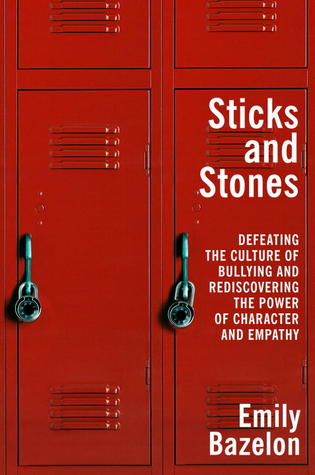
Sticks and Stones: Defeating the Culture of Bullying and Rediscovering the Power of Character and Empathy

Sticks and Stones: Defeating the Culture of Bullying and Rediscovering the Power of Character and Empathy[Hardcover]

Emily Bazelon (Author)

13642996

Book Description

Release date: February 19, 2013

Being a teenager has never been easy, but in recent years, with the rise of the Internet and social media, it has become exponentially more challenging. Bullying, once thought of as the province of queen bees and goons, has taken on new, complex, and insidious forms, as parents and educators know all too well. No writer is better poised to explore this territory than Emily Bazelon, who has established herself as a leading voice on the social and legal aspects of teenage drama. In Sticks and Stones, she brings readers on a deeply researched, clear-eyed journey into the ever-shifting landscape of teenage meanness and its sometimes devastating consequences. The result is an indispensable book that takes us from school cafeterias to courtrooms to the offices of Facebook, the website where so much teenage life, good and bad, now unfolds. Along the way, Bazelon defines what bullying is and, just as important, what it is not. She explores when intervention is essential and when kids should be given the freedom to fend for themselves. She also dispels persistent myths: that girls bully more than boys, that online and in-person bullying are entirely distinct, that bullying is a common cause of suicide, and that harsh criminal penalties are an effective deterrent. Above all, she believes that to deal with the problem, we must first understand it. Blending keen journalistic and narrative skills, Bazelon explores different facets of bullying through the stories of three young people who found themselves caught in the thick of it. Thirteen-year-old Monique endured months of harassment and exclusion before her mother finally pulled her out of school. Jacob was threatened and physically attacked over his sexuality in eighth grade—and then sued to protect himself and change the culture of his school. Flannery was one of six teens who faced criminal charges after a fellow student’s suicide was blamed on bullying and made international headlines. With grace and authority, Bazelon chronicles how these kids’ predicaments escalated, to no one’s benefit, into community-wide wars. Cutting through the noise, misinformation, and sensationalism, she takes us into schools that have succeeded in reducing bullying and examines their successful strategies. The result is a groundbreaking book that will help parents, educators, and teens themselves better understand what kids are going through today and what can be done to help them through it. Read more of this post

Boy, 6, writes book to save friend’s life

Boy, 6, writes book to save friend’s life

bookchocv

Saturday, Mar 02, 2013
The New Paper

They are the best of friends in primary school.

So when his chum needed help, Dylan Siegel jumped in.

At six, Dylan has produced a 16-page book called Chocolate Bar, a handwritten and illustrated story.

More than two months after putting his book on the market, he has managed to raise more than US$30,000 (S$37,150) from events, sales and donations made through Facebook and online.

The book uses the term chocolate bar as a synonym for awesome.

He came up with his book because his good friend Jonah Pournazarian, seven, suffers from a rare liver disorder with no known cure, the Daily Mail reported. Jonah often eats through a tube, sometimes corn starch or chicken soup with vegetables. Read more of this post

Buffett: Performance streak may end this year; “To date, we’ve never had a five-year period of underperformance, having managed 43 times to surpass the S&P over such a stretch”: Long-time Berkshire investors said they detected almost a sense of frustration in this year’s letter

Buffett: Performance streak may end this year

12:30am EST

By Ben Berkowitz

(Reuters) – Berkshire Hathaway may end a long streak of outperforming the S&P 500 this year, Chief Executive Warren Buffett warned shareholders on Friday, even as he said he was still eagerly hunting for acquisitions to grow the ice-cream-to-insurance conglomerate.

In his annual letter to investors, Buffett opened up with a caution that this year, for the first time, the growth in Berkshire’s book value per share may underperform the growth in the S&P 500 when measured over a five-year period.

“To date, we’ve never had a five-year period of underperformance, having managed 43 times to surpass the S&P over such a stretch,” he wrote. “But the S&P has now had gains in each of the last four years, outpacing us over that period. If the market continues to advance in 2013, our streak of five-year wins will end.”

Buffett said he expects the growth in Berkshire’s intrinsic business value will over time exceed the S&P’s returns by small margins. But at the same time, he said the firm would continue to underperform in a strong market like this year.

Long-time Berkshire investors said they detected almost a sense of frustration in this year’s letter. Read more of this post

It’s a Dog’s Life for Singapore’s Pampered Pets; “A lot of people wouldn’t bat an eyelid on spending several thousand dollars on a dog. The litmus test is whether the dog stays with them for the rest of its life or not,”

It’s a Dog’s Life for Singapore’s Pampered Pets
March 01, 2013

The guests lean over the side of the boat to catch the morning breeze as their catamaran eases off from a jetty in Singapore. A typical cruise, except for the fact that the passengers are dogs. “Actually, this is their third cruise,” said Andy Pe, 43, the doting owner of two Black Labrador Retrievers, a Yellow Labrador, a Golden Retriever and two mongrels. “They enjoy the sea breeze and water so much.” From boat cruises and spas to their own obituary section in the leading newspaper, pets are pampered in a big way in Singapore, a city-state with one of Asia’s highest standards of living. Read more of this post

The Tyranny of the Queen Bee: Women who reached positions of power were supposed to be mentors to those who followed, writes Peggy Drexler—but something is amiss in the professional sisterhood

March 1, 2013, 3:17 p.m. ET

The Tyranny of the Queen Bee

Women who reached positions of power were supposed to be mentors to those who followed—but something is amiss in the professional sisterhood.

By PEGGY DREXLER Read more of this post

You can influence your return on luck

Saturday March 2, 2013

You can influence your return on luck

By ROSHAN THIRAN

Luck and success: Datuk Seri Idris Jala during a conversation said he had six key points to leadership success and his final point was about having good luck.

THESE past few weeks, with the Chinese New Year celebrations in full swing, many friends wished me “luck” many times. Everyone was hoping for a great year with lots of luck. Most believe that luck happens by chance. Luck, we believe is something you cannot plan for or obtain by design. Luck is fated, or is written in the stars. Or is it?

I remember a conversation I had with Datuk Seri Idris Jala many years ago when he explained the secret to his success as a leader. He had six key points to leadership success and his final point was about having good luck. He did not term it “luck” but called it “divine intervention.” He believed that you could control about 40% of things you were working on. The remaining 60% were things beyond your control where you had little influence. However, Idris believed that if you were a good human being, operating with ethics and spending time in solitude and reflection, you could “influence” the divine to be on your side and bring yourself good “luck.” Read more of this post

Family Fortunes: How to Build Family Wealth and Hold on to It for 100 Years; Why family money should NOT be invested in “safe, conservative” investments; Why you can’t trust wealth “professionals” and why you should never entrust your money to money managers; why most celebrity CEOs are a threat to the businesses they run; Why giving your children as much education as possible is NOT a good idea

Family Fortunes: How to Build Family Wealth and Hold on to It for 100 Years (Agora Series) [Hardcover]

Bill Bonner (Author), Will Bonner (Contributor) Read more of this post

Robert Hagstrom: What Is the Difference between Investing and Speculation?

Investing is the relentless process of translating and refining tacit knowledge into a distinctive and unique investment framework or mental model that is scalable beyond one single person and adaptable in different relevant contextual situation, particularly in dealing with what we do not know. Investors write with a framework as the north star to guide and navigate the marketplace jungle where dangerous animals, poisonous creatures and alluring sirens lurk at the corner. Speculators never bother to write. Investors care deeply about ideas and research. Speculators care solely about “making money”. Writing, research, ideas, knowledge – these are frivolous/useless pursuits with no immediate or short-term profits to Speculators. Investors have an instinctive longing to weave outside our own skin some reflection of our mind. Investors uphold the notion of responsibility, which emphasizes the active nature of the agent/knower, as well as the element of choice involved in the activity of the agent/knower, who can be assessed to be responsible or irresponsible as having fulfilled his obligations to fellow enquirers as part of membership in a community. Getting closer to the truth as a result of one’s virtues is more valuable for Investors than getting it on the cheap for Speculators.

KB

What Is the Difference between Investing and Speculation?

Robert Hagstrom, CFA

27 February 2013

Editor’s note: Today, we are doing something different. Robert approached us with a question that we found interesting, so we decided to pose it to some professional investors. In addition to our regular coverage, we are pleased to feature his framing of an interesting debate. We will be publishing select responses to the question over the next few days. If you are compelled, we invite you to comment below, tweet us @cfainvestored, or reach out to us via email.

What is the difference between investing and speculation? At first, you think the answer is simple because the distinction is obvious — that is, until you actually put pen to paper and try to answer the question.

Go ahead; take a few seconds and think about it. Write down “investing.” Now write the definition. Do the same for “speculation.” If you are like me, frustration quickly builds because the answers do not come quickly or easily, and they should. After all, these terms have been a part of the financial lexicon since Joseph de la Vega wroteConfusion of Confusions in 1688, the oldest book ever written on the stock exchange business. In his famous dialogues, de la Vega observed three classes of men. The princes of business, called “financial lords,” were the wealthy investors. The merchants, the occasional speculators, were the second class. The last class was called the “persistent speculators” or the “gamblers.” Read more of this post

Breakfast with AQR’s Billionaire Hedge Fund Manager Cliff Asness; AQR could not be the success it is if David Kabiller did not have skills that complement the acute personality and thinking of Asness. Turning ideas into a money-making reality requires a partnership

Breakfast with AQR’s Cliff Asness

Posted By AMANDA WHITE On 01/03/2013 @ 1:37 pm In IN CONVERSATION

Having a breakfast meeting with Cliff Asness is a wake-up call. He will let you know if you’re late – something he holds in very little regard. He admits he has to constantly remind himself that just because he’s 20 minutes early to everything that others are not automatically then 20 minutes late. Asness is open, he’s entertaining, even funny. And he also possesses the rare combination, at least in this industry, of intellectual genius and social libertarianism. It’s very engaging and you quickly get the feeling that you’re only scratching the surface of his intellect as he changes from political activist to quantitative mathematician to social philosopher.

Social justice is also good business

Having two sets of twins is an almost perfect justice for a man who revels in the competitive game of statistics – he’s clearly an overachiever. But while he boasts about the competitive achievements particular to quantitative investment managers, his intellectual reach doesn’t stop there. His social and political interests include gay marriage and tax.

“I believe in all forms of small government, not just economic. Read more of this post

David Brooks: The Learning Virtues; A book on education cultures finds that the Chinese tend to define learning morally while Westerns define it cognitively

February 28, 2013

The Learning Virtues

By DAVID BROOKS

Jin Li grew up in China during the Cultural Revolution. When the madness was over, the Chinese awoke to discover that far from overleaping the West, they were “economically destitute and culturally barren.” This inspired an arduous catch-up campaign. Students were recruited to learn what the West had to offer. Li was one of the students. In university, she abandoned Confucian values, which were then blamed for Chinese backwardness, and embraced German culture. In her book, “Cultural Foundations of Learning: East and West,” she writes that Chinese students at that time were aflame — excited by the sudden openness and the desire to catch up. Li wound up marrying an American, moved to the States and became a teacher. She was stunned. American high school students had great facilities but didn’t seem much interested in learning. They giggled in class and goofed around.

This contrast between the Chinese superstudent and the American slacker could be described with the usual tired stereotypes. The Chinese are robots who unimaginatively memorize facts to score well on tests. The Americans are spoiled brats who love TV but don’t know how to work. But Li wasn’t satisfied with those clichés. She has spent her career, first at Harvard and now at Brown, trying to understand how Asians and Westerners think about learning. The simplest way to summarize her findings is that Westerners tend to define learning cognitively while Asians tend to define it morally. Westerners tend to see learning as something people do in order to understand and master the external world. Asians tend to see learning as an arduous process they undertake in order to cultivate virtues inside the self. Read more of this post

Jonah Berger On The Power Of Scarcity; Contagious: Why Things Catch On

Jonah Berger On The Power Of Scarcity

BY JONAH BERGER

MARCH 1, 2013

In Fast Company’s April issue, we’ll profile Jonah Berger, the 32-year-old Wharton professor who has become one of the world’s foremost experts on what goes viral and why. It’s easy to find examples of products or ideas that have spread and become popular, but as he writes, “It’s much harder to actually get something to catch on. Even with all the money poured into marketing and advertising, few products become popular.” His new book Contagious: Why Things Catch On, being published next week by Simon & Schuster, tries to answer the question, Why do some products, ideas, and behaviors succeed when others fail? In this exclusive excerpt, which will be serialized in five parts, he explores the concept of social currency, one of the six elements Berger says helps unravel the mysteries of virality.

In 2005, Ben Fischman became CEO of the discount shopping website SmartBargains.com. The business model was straightforward: companies wanting to offload clearance items or extra merchandise would sell them cheap to SmartBargains, and SmartBargains would pass the deals on to the consumer. There was a broad variety of merchandise, and prices were often up to 75% lower than retail. But by 2007 the website was floundering. Margins had always been low, but excitement about the brand had dissipated, and momentum was slowing. A year later Fischman started a new website called Rue La La. It carried high-end designer goods but focused on “flash sales” in which the deals were available for only a limited time–24 hours or a couple of days at most. And the site followed the same model as sample sales in the fashion industry. Access was by invitation only. Sales took off, and the site did extremely well. So well, in fact, that in 2009 Ben sold both websites for $350 million.

Rue La La’s success is particularly noteworthy, given one tiny detail. It sold the exact same products as SmartBargains. How come Rue La La was so much more successful? Because it made people feel like insiders.

Read more of this post