China Escalating Attack on Google: The Chinese authorities have blocked global versions of the company’s search engines, and Gmail, Calendar and Translate have been affected

China Escalating Attack on Google

By DAN LEVINJUNE 2, 2014

BEIJING — The authorities in China have made Google’s services largely inaccessible in recent days, a move most likely related to the government’s broad efforts to stifle discussion of the 25th anniversary of the crackdown on pro-democracy demonstrators in Tiananmen Square on June 3 and 4, 1989.

In addition to Google’s search engines being blocked, the company’s products, including Gmail, Calendar and Translate, have been affected. Read more of this post


There is a growing dissatisfaction among employees of South Korean brokerage houses, which have been hit by an unprecedented wave of restructuring, with respect to the conditions of proposed voluntary retirement packages

Voluntary retirement allowances offered by brokerage houses half of banks

2014.05.30 14:32:38

There is a growing dissatisfaction among employees of South Korean brokerage houses, which have been hit by an unprecedented wave of restructuring, with respect to the conditions of proposed voluntary retirement packages.
While a simple comparison is inappropriate given the varying sizes and wage levels of the country’s brokerage houses, a significant gap with the bank industry appears clear.  Read more of this post

1 in 4 Korea-listed firms reports loss in Q1

1 in 4 listed firms reports loss in Q1

Yoon Jae-un, Gang Bong-jin, Kim Yoon-jin

2014.06.02 18:32:04

One in four companies whose shares change hands in the KOSPI market reported a loss in the first quarter (Q1).
Their earnings did not show marked growth momentum, as views are mixed over the future of the global economic recovery and the stronger won has crimped export competitiveness. But their sales and bottom line improved modestly against a year ago.
26.89 percent, or 135 of 502 listed companies on the KOSPI, which submitted consolidated financial statements (fiscal year ends in December), posted net losses in Q1, said the Korea Exchange (KRX) and Korea Listed Companies Association Monday.
17.73 percent or 89 firms remained in the red, while 9.16 percent or 46 companies swung to loss. The listed firms’ combined operating profit shrank 1.48 percent, or 386.3 billion won, from 26.1 trillion won a year ago to 25.7 trillion won in Q1 this year. But their sales edged up 1.19 percent and net profit 4.57 percent during the same period. “The listed companies’ non-listed units are presumed to have performed poorly, and it is not quite right to say their profit rose by a noticeable margin,” said an official at the KRX.  Read more of this post

Korea’s 386 generation is powerful but conflicted; 386 refers to people who were in their 30s in the 90s decade (accounting for the numeral 3), who went to college in the 1980s (the 8), and who were born in the 1960s (the 6)

Korea’s 386 generation is powerful but conflicted

June 03,2014

Mrs. Kim, a 50-year-old housewife in Seoul, has never considered herself a conservative. She entered college in 1985, but she never actively participated in the pro-democracy movement against dictator Chun Doo Hwan’s regime. However, she certainly shared the zeitgeist of those days. Read more of this post

Xi Jinping’s World Cup diplomacy; So why is Xi so obsessed with football? The reason is because football is a part of his strategy to overcome the United States

Xi Jinping’s World Cup diplomacy

June 03,2014

image001-2

Table tennis is China’s national sport. The chance of a Chinese player, male or female, winning the World Table Tennis Championships is more than 90 percent. The Chinese say their Ping-Pong players are the best in the universe; they are proud that no other country is a match for China. We don’t need to discuss so-called Ping-Pong diplomacy to know that the sport is China’s pride.  Read more of this post

Is Soros trying to spark a Japan rally? Reshuffling Japan’s pensions suggests Abe is still grabbing the low-hanging fruit, not making the hard decisions

Is Soros trying to spark a Japan rally?

Reshuffling Japan’s pensions suggests Abe is still grabbing the low-hanging fruit, not making the hard decisions.

June 03,2014

Takahiro Mitani finds himself between George Soros and a hard place.
Mitani is Japan’s $1.26 trillion man. The Government Pension Investment Fund that he runs tops Mexico’s annual output and dwarfs the Middle Eastern sovereign-wealth funds that investors are always cooing about. Prime Minister Shinzo Abe wants the notoriously conservative fund to crank up returns by putting more money in stocks – with an unlikely assist from billionaire Soros.
In January, the world’s most famous short seller chatted with Abe at Davos, urging him to nudge the pension colossus into the 21st century. News of that tete-a-tete is helping Abe to push changes in the fund’s management structure and to encourage it to diversify. At the moment, about 60 percent of the fund’s holdings are wasting away in the lowest-yielding domestic debt – Japan’s – anywhere. Getting the fund to move large chunks of that money into stocks could provide a timely boost to Abe’s reflation efforts. Read more of this post

Choi Dung-kyu, the CEO of Daebo Group: “I started picking up trash out of gratitude for my customers,” Kim said. “But now it has become a pleasant task”

CEO goes the extra mile

Head of Daebo Group serious about health and company’s success

연 매출 1조원 넘는 회장님, 고속도 휴게소 변기 닦는 까닭

image001-1

May 31,2014

Choi Dung-kyu, the CEO of Daebo Group, controls traffic at the Hwaseong Rest Area parking lot, located along the West Coast Highway. He takes on that role during holidays and vacation seasons, when most rest areas are jam-packed. By Kwon Hyuk-jae

On a crisp morning two weeks ago at Hwaseong Rest Area, located along the West Coast Highway, Choi Dung-kyu, 66, was cleaning toilet bowls with his bare hands.
Scrubbing the holes where the water flushes out, he stressed that the most important part of cleaning them was to leave them smooth and slippery.  Read more of this post

Gwanfia casts pall on new Korean agencies; “If former government officials get in the new agencies, the purpose of creating them will be tarnished. The government needs to nominate real experts if it wants to prove its earnestness.”

Gwanfia casts pall on new agencies

June 03,2014

image001

A handful of new government agencies that will oversee the financial sector are expected to be created in the second half of the year, but lawmakers and the general public can’t stop frowning, believing that the new entities will only give jobs to former public employees.  Read more of this post

Forum warns of economic risks; Multinationals doing ‘carry trades’ will have to be very cautious

Forum warns of economic risks

Multinationals doing ‘carry trades’ will have to be very cautious

June 03,2014

As the global economy gradually improves and economies look for exit strategies from their stimulation regimens, economists are warning about risks on the horizon.
Some are warning of an expansion of carry trades by multinational companies, particularly in emerging markets, while others warn of new crises for highly leveraged Asian companies as monetary policy starts to tighten. Read more of this post

Student loans to weigh on Korean economy; Growth rate doubles that of household debt; “In 2012, Korean parents shouldered 79.9 percent of their children’stuition. In 2008, they shouldered 94.7 percent”

Updated : 2014-06-02 19:12

Student loans to weigh on economy

Growth rate doubles that of household debt: BOK
By Yoon Ja-young

Media reports in the United States state that student loans arehampering the economic recovery. A report by LG Economic ResearchInstitute said that student loans will also become a major problem inKorea.
The Bank of Korea estimated the country’s education-related loans at28.4 trillion won last year, up 12.3 percent from the previous year. It isdouble the growth rate of the total household debt, which increased bysix percent.  Read more of this post

How Narendra Modi was able to clear the hurdle of suspicions over his role in Gujarat’s anti-Muslim riots is a fascinating case study

Updated: Tuesday June 3, 2014 MYT 7:00:09 AM

Lessons from India

BY KARIM RASLAN

How Narendra Modi was able to clear the hurdle of suspicions over his role in Gujarat’s anti-Muslim riots is a fascinating case study.

INDIA is on the cusp of immense change. The election of Narendra Modi – an unthinkable outcome as recently as a year ago – will alter Asian, if not global, politics.

The 63-year-old is now at the helm of a 1.2 billion-strong nation. How he manages them will have an enormous impact. Read more of this post

Making a painless transition in IFRS convergence in Singapore

PUBLISHED JUNE 03, 2014

Making a painless transition in IFRS convergence

MAK KEAT MENG

ON May 29, 2014, the Singapore Accounting Standards Council (ASC) announced that Singapore-incorporated companies listed on the Singapore Exchange (SGX) will apply a new financial reporting framework identical to the International Financial Reporting Standards (IFRS) in 2018. Read more of this post

Review rules on takeovers and privatisations in Singapore

PUBLISHED JUNE 03, 2014

LETTER TO THE EDITOR

Review rules on takeovers and privatisations

MICHAEL Dee has written two very good analyses on the recent takeover offer for CapitaMalls Asia (CMA) by Capitaland (CL): “CMA shareholders should stand their ground against ‘fair offer'” in BT of April 22 and “Offer for CMA is still undervalued” in BT of May 29. All his points are very pertinent and can be equally applied to other recent takeover attempts, including that of LCD Global Investments (LCD) by RDL Investments (RDL). Read more of this post

Murthy’s return sparks year of change at Infosys; At least 10 executives have quit since founder retook helm

June 2, 2014 9:59 am

Murthy’s return sparks year of change at Infosys

By Avantika Chilkoti in Mumbai

Imagine a ship where the crew jump overboard just as the captain returns to the bridge. At least 10 senior executives have quit Infosys since Narayana Murthy, co-founder and outsourcing pioneer, returned to the Indian software group a year ago to shore up the troubled business.

BG Srinivas, Infosys president, last week became the most recent member of the top brass to resign, adding to the instability that has complicated Mr Murthy’s task. Mr Srinivas did not give a reason for his departure, and has subsequently accepted a job at Hong Kong telecoms group PCCW. Read more of this post

Colourful world of interdealers faces deep structural changes

June 2, 2014 11:31 pm

Colourful world of interdealers faces deep structural changes

By Philip Stafford

The fast-growing asset management business that Terry Smith, the chief executive of Tullett Prebon will focus on when he departs the UK interdealer broker, stands in stark contrast to the industry he will leave behind.

Mr Smith, who is expected to leave the broker by the end of the year, is keen to grow Fundsmith, an asset management business he set up four years ago. Read more of this post

China becomes largest buyer of industrial robots

Last updated: June 1, 2014 10:22 pm

China becomes largest buyer of industrial robots

By Tanya Powley in London

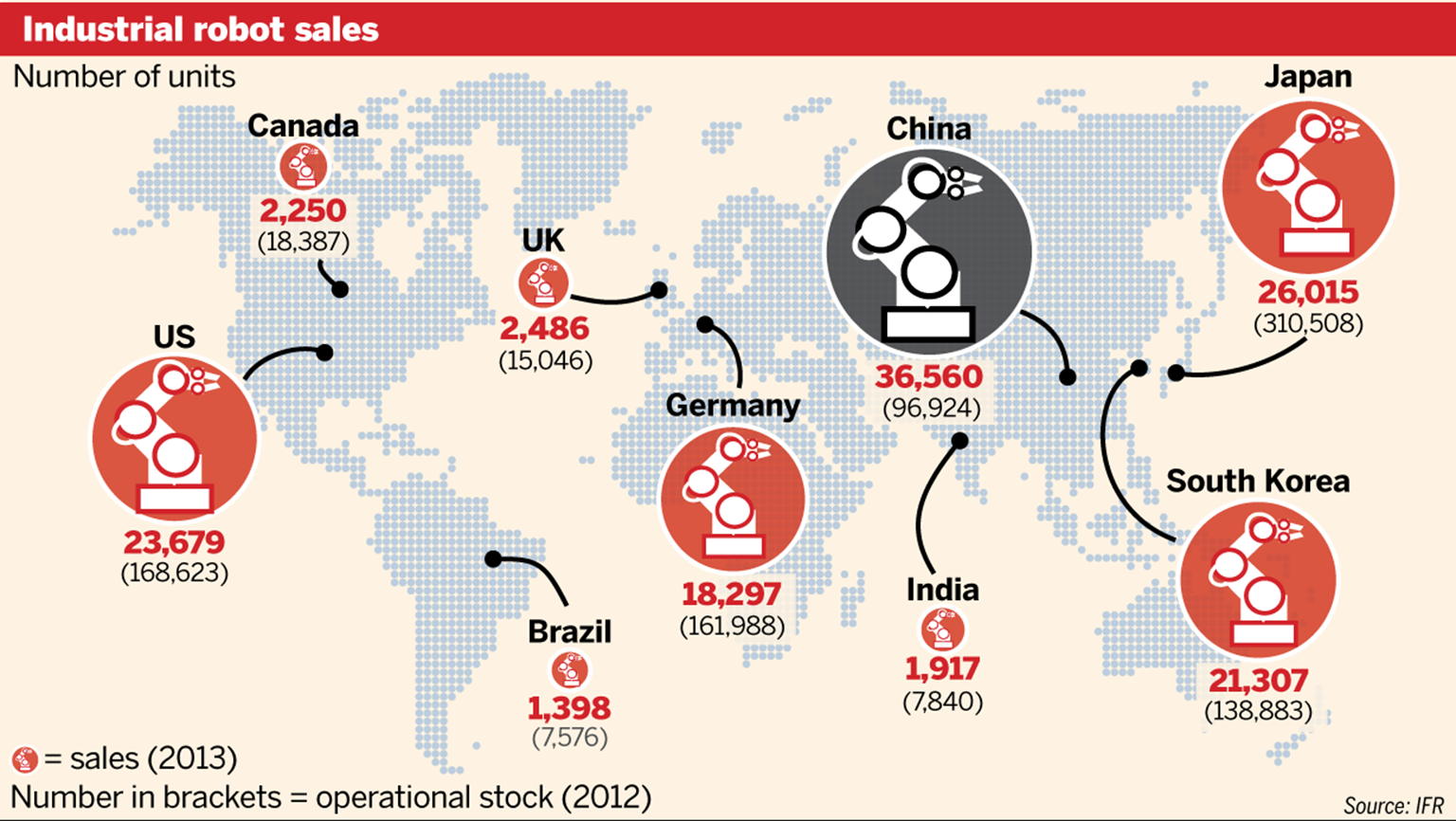
China, once the manual labour “workshop of the world”, has become the largest buyer of industrial robots, as rising wage costs and growing competition from emerging economies have forced manufacturers to turn to technology.

image001-1

The country bought one in five robots sold globally in 2013, overtaking tech-savvy Japan for the first time, in its attempt to drive productivity gains. Read more of this post

World’s smallest stock markets battle growing pains

June 2, 2014 4:38 pm

World’s smallest stock markets battle growing pains

By Elaine Moore

image001

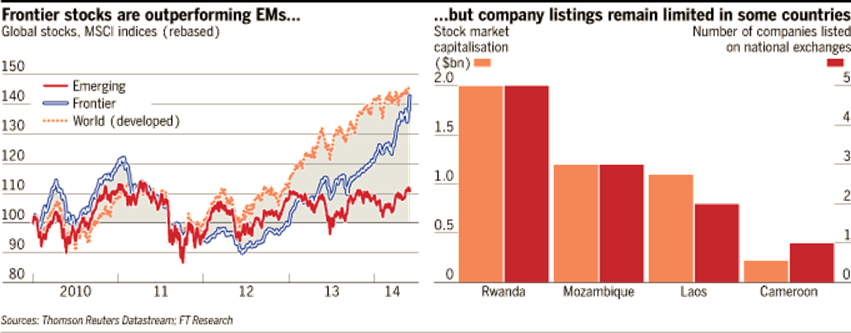
Every day, the flip-flop wearing moped drivers who make up the majority of Cambodia’s street traffic can look up at the tallest tower in Phnom Penh and check the performance of their country’s stock market.

It does not take long. Three years after the exchange opened the electronic billboard outside still shows the price, value and trading volume of a single listed company: the Phnom Penh Water Supply Authority. Read more of this post

“Most funds tend to revolve around one portfolio’s manager’s views of the world. You just can’t run hundreds of billions of dollars, or in our case trillions, that way. You can’t be a fiduciary that way.”

June 2, 2014 10:33 pm

UBS investment chief poised to quit company

By James Shotter in Zürich

Alexander Friedman is to step down as UBS’s global chief investment officer after three and a half years to pursue “a new opportunity outside the firm”.

The Swiss bank said that Mr Friedman, a former chief financial officer of the Bill & Melinda Gates Foundation, would be succeeded by Mark Haefele, head of the bank’s global investment office. Read more of this post

Chinese exporters have a long record of using fake trade receipts to bring US dollars onshore, swap them into local currency and benefit from the higher interest rates and appreciation. That distorts China’s economic data

June 2, 2014 7:50 am

Renminbi bulls seize on hopes for economy

By Josh Noble in Hong Kong

image002-1 image001-8

Remember when currency policy, rather than maritime disputes, used to top the agenda for US-China relations?

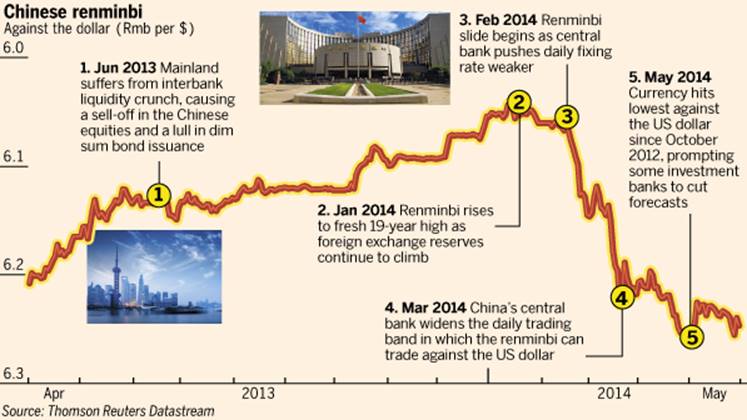
Washington long complained that Beijing kept its currency artificially weak, helping it win manufacturing business and amass roughly $4tn in foreign exchange reserves.

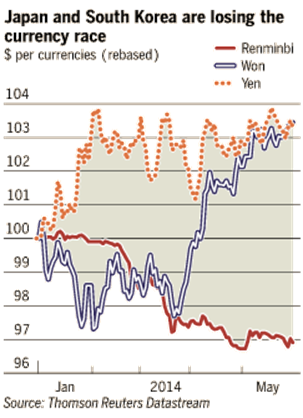
For a while, appreciation proved an effective antidote – a stronger renminbi meant a quieter US Treasury. Between the summer of 2010 and January this year, the renminbi had risen almost 12 per cent against the dollar, to reach its highest level in almost two decades. Read more of this post

Bitcoin could be used to hide assets in divorces, warn lawyers

June 2, 2014 2:15 pm

Bitcoin could be used to hide assets in divorces, warn lawyers

By Jane Croft

Bitcoin, the electronic currency, could be used by divorcing spouses to hide assets from estranged partners, lawyers have said, as court battles shift their focus to the disclosure of assets.

Divorce settlements in England are seen as particularly generous to ex-wives, because judges recognise the equal contributions made by the breadwinner and the homemaker in a marriage, and divide the assets equally.

Moreover, courts are increasingly having to deal with legal battles brought by one side claiming the other has not made full disclosure of assets and has concealed wealth. Read more of this post

Under fire Australian miners look to repair their image

Last updated: June 1, 2014 8:41 am

Under fire Australian miners look to repair their image

By Jamie Smyth in Bulga, Australia

Tony Brown typically spends his days ferrying tourists to and from the Great Barrier Reef. But last month, the charter boat operator flew to Europe where he helped persuade Deutsche Bank and HSBC not to fund the expansion of a coal port that green groups claim could destroy the Unesco World Heritage-listed site.

“The dredging required to build the port is a risk to the reef and the A$6bn tourist industry that depends on it,” says Mr Brown, who has vowed to continue the fight to block what would become the world’s largest coal port at Abbot Point in Queensland.

The decision by the banks is the latest victory in a global campaign being waged against the funding of fossil fuel projects and companies by green groups, which allege they are causing catastrophic global warming. Read more of this post

Japan charms European investors despite growth fears; “Japan remains an under-analysed and under-appreciated market, with a lot more improvement going on in governance, capital efficiency and shareholder returns than most casual investo r

June 1, 2014 6:18 am

Japan charms European investors despite growth fears

By Madison Marriage

Enthusiasm for Japan-focused funds in Europe has not abated, despite fears that Prime Minister Shinzo Abe’s economic reforms have begun to run out of steam.

European investors placed €3.1bn in Japan-focused funds in the first three months of the year, according to figures from Cerulli Associates, the research firm.

This followed a bumper year for Japan fund managers in 2013, during which European investors allocated €13.6bn to the asset class – a sharp reversal on the €2.1bn of outflows suffered in 2012. Read more of this post

One day, two revolutions and uncertain destinies; June 4 1989 brought deeply contrasting events to Poland and China, writes Timothy Garton Ash

June 2, 2014 6:39 pm

One day, two revolutions and uncertain destinies

By Timothy Garton Ash

June 4 1989 brought deeply contrasting events to Poland and China, writes Timothy Garton Ash

Twenty-five years ago the world changed course. On June 4 1989 semi-free elections in Poland kick-started the end of communism across the whole Soviet bloc – and the Tiananmen Square massacre launched China on an entirely different trajectory. The consequences are still being played out, from Ukraine to the South China Sea.

I will never forget coming back to a newspaper office in Warsaw that afternoon, with elated Polish friends, and noticing on a television screen the first grainy footage of the bodies of Chinese protesters being carried on makeshift stretchers down the streets of Beijing. Read more of this post

Indian power: Narendra Modi must centralise it

Indian power: Narendra Modi must centralise it

Nick Butler | Jun 01 13:27 | 10 | Share

Imagine being elected prime minister of a country with one and a quarter billion people, about 300m of whom live in absolute poverty. That is the challenge facingNarendra Modi in India. The hardest question must be to know where to start.

When it comes to energy Mr Modi’s first acts have been encouraging. He has set a high but achievable target for the installation of solar, on and off the grid, building on his experience in the state of Gujarat. He has also forced together three key ministries – covering power, coal and renewables – under a new minister, Piyush Goyal. He should probably have gone further and added petroleum and natural gas as well. Structural change in the complex bureaucracy of the Indian government matters a lot. Read more of this post

Crooked UK professionals face five-year jail terms; Lawyers and accountants who work for organised criminals will face five-year jail terms under a crackdown on white-collar professionals who profit from crime while turning a blind eye

June 3, 2014 12:01 am

Crooked UK professionals face five-year jail terms

By Helen Warrell, Jane Croft and Sam Fleming

Lawyers and accountants who work for organised criminals will face five-year jail terms under a crackdown on white-collar professionals who profit from crime while turning a blind eye.

Measures, to be introduced in Wednesday’s Queen’s Speech will include a new offence of “participation in an organised crime group” for those who write contracts, rent warehouse space or deliver packages on behalf of gangster networks. This follows an example set by countries such as Ireland, Canada and New Zealand, which already have a “dual conspiracy” system to prosecute professional associates even if they are not directly involved in crimes. Read more of this post

Returns of pre-packaged fund – also known as model portfolios – hit by huge fees

June 2, 2014 7:42 pm

Packaged fund returns hit by huge fees

By Emma Dunkley

The investment returns on “pre-packaged” portfolios sold by wealth managers could vary by as much as £46,000 over a decade on a £500,000 pension due to the wide range of fees charged, a report reveals.

Research by investment platform Skandia based on data from The Lang Cat, an independent consultancy, shows the total cost of investing in these pre-packaged funds – also known as model portfolios – can have a substantial impact, knocking thousands of pounds off returns.

Model portfolios invest in a number of funds to target a level of returns and a degree of risk. Wealth managers may offer a number of such portfolios, often assigning them a risk rating to suit different types of investor. Read more of this post

China faces crucial choice over future growth; Growth can be robust or consumption-led but not both

June 2, 2014 6:08 am

China faces crucial choice over future growth

By Manoj Pradhan

Growth can be robust or consumption-led but not both

China has always divided investor opinion. The biggest debate now is about the future path China’s growth will take. Bulls say the transition to sustainable growth will be smooth; bears argue it will be volatile. Yet both agree consumption will rise to offset weaker investment. The result? Economic growth of 6 per cent, give or take, led by consumption.

This may turn out to be wishful thinking. Growth in China can either be robust, or consumption-led, but not both. If China chooses consumption-led growth, it could also be choosing much lower growth than the 6 per cent or so most have in mind.

There are three reasons for this. First, high investment growth in the past few years has added capital and supported labour income and hence consumption. Lower investment growth would weaken that support. Read more of this post

Do not be fooled by fund rankings; Memory of risks fades as crisis drops out of performance tables

Last updated: June 2, 2014 11:18 am

Do not be fooled by fund rankings

By Stephen Foley

Memory of risks fades as crisis drops out of performance tables

To the extent that good can come from calamity, the silver lining of the credit crunch is that it has begat an era of more cautious lending, tougher capital rules and wider regulation, plus more risk-aware investment processes. The crisis was so searing that its lessons will be carried by a whole generation of finance professionals.

It is not the fading of human memories that should worry us most. It is a fading of statistical memory.

As we have checked off the string of “fifth anniversaries” of credit crisis milestones, the period is being erased from some of the most important metrics used by investors to plan their portfolios – with the result that the risks in those portfolios may be unwittingly drifting upwards. Read more of this post

Australia: End of the boom; A cooling Chinese economy has hurt the mining sector, prompting protests over the tough new budget

June 2, 2014 6:19 pm

Australia: End of the boom

By Jamie Smyth

A cooling Chinese economy has hurt the mining sector, prompting protests over the tough new budget

The small coal mining town of Singleton was so over-run by contractors seeking jobs during Australia’s decade-long mining boom that some had to join waiting lists for apartments. Unemployment was virtually non-existent and businesses thrived as an army of workers arrived to work in the dozen mines that ring the town.

“It was so vibrant here it was impossible to keep good staff. Most went to highly paid jobs in the mines,” says Danny Gresham, director of the Singleton Tyre and Battery Centre, a local industry supplier. Read more of this post

Economic Wind Doesn’t Fill Companies’ Sales; This is a break from the usual pattern, where public-company sales increase at a much faster pace than overall sales during economic expansions and fall much more during recessions.

Economic Wind Doesn’t Fill Companies’ Sales

JUSTIN LAHART

Updated June 2, 2014 3:48 p.m. ET

image001-6

Even with a tepid economy, it is surprising just how difficult it has been for U.S. companies to get sales going.

With nearly all the results in, it looks like revenue at companies in the S&P 500 rose 3.6% in the first quarter from a year earlier, according to S&P Dow Jones Indices. That is only marginally higher than the 3.4% gain in economywide sales, as measured by final sales of goods and services produced in the U.S.

This is a break from the usual pattern, where public-company sales increase at a much faster pace than overall sales during economic expansions and fall much more during recessions. Nor is the weakness of corporate sales a recent phenomenon. They have increased just 3.4% over the past two years, while economywide sales have risen 6.9%. Read more of this post