New Zealand Winemakers Seek Protection for Local Labels
Updated September 16, 2013, 5:40 a.m. ET

New Zealand Winemakers Seek Protection for Local Labels

LUCY CRAYMER

AI-CD561_NZWINE_G_20130916033907

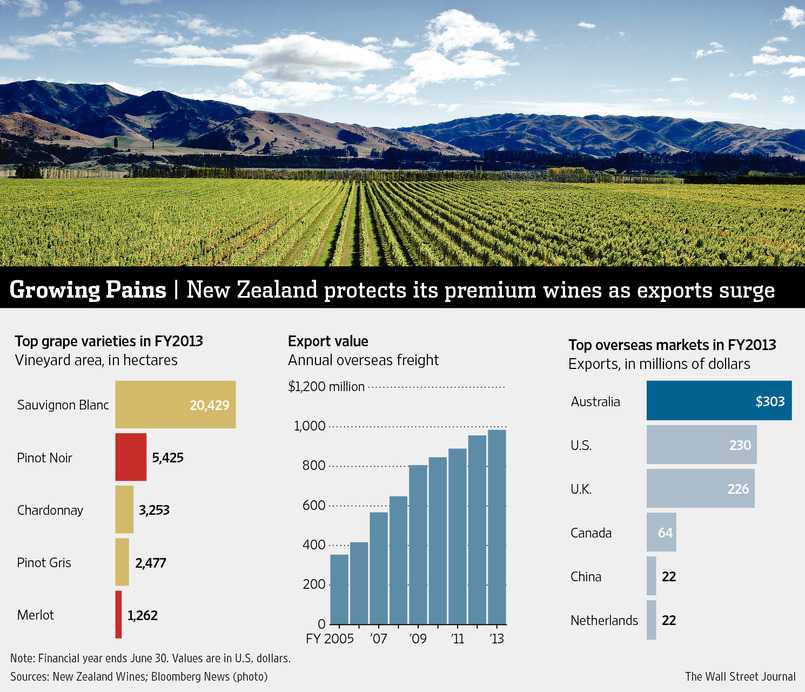
MARLBOROUGH, New Zealand—When the first winemakers harvested grapes here in the 1970s, they joined an army of New World vintners taking on established producers such as France and Spain. Now, New Zealand’s winemakers are resorting to an Old World tactic to fend off a challenge from newer rivals—regional trademarks. As wine consumption booms in countries such as China and Russia, entrepreneurs are setting up vineyards there, raising fears among New Zealand growers about knockoff wines posing as premium labels exported from regions like Marlborough and Central Otago. New Zealand winemakers are lobbying for the same legal protection for their brands that French producers won for Champagne two decades ago. Read more of this post
A renewed attack on social media by the Chinese leadership isn’t just an offensive against bloggers and activists. It’s also an assault by the Communist Party on its own shortcomings

September 16, 2013, 12:44 PM

The Other Side of China’s Social Media Crackdown

By Russell Leigh Moses

A recently renewed attack on social media by the Chinese leadership isn’t just an offensive against bloggers and activists who dominate the daily online discourse in China. It’s also an assault by the Communist Party on its own shortcomings. The sweeping political strategy towards social media that’s been taking shape here began before President and Party chief Xi Jinping left for this year’s G20 summit in Russia, and it picked up speed and suspects while he was away.  That’s a clear sign that there’s consensus in the Party leadership about how to handle dissent. The first part of the attack strategy involved the coordinated clampdown on leading microbloggers and social celebrities whose followings often sideline messages from state authorities. Read more of this post

Japanese tofu prices are going up 20% because of Abenomics

Japanese tofu prices are going up 20% because of Abenomics

By Adam Pasick @adampasick 4 hours ago

Japan’s tofu manufacturers are planning to jack up prices by 20% this autumn—the first markup in 15 years—as a response to the rising price of American soybean imports, caused in part by a stronger Japanese yen. Prime Minister Shinzo Abe has pushed a series of reforms designed to rid the economy of deflation, but the policies have had harsh consequences for industries that must import dollar-denominated commodities like oil, natural gas, and soybeans. Japan is the biggest per capita consumer of soy foods—not just in tofu but in soy sauce, miso, edamame, and the smelly fermented delicacy known as natto—with the average adult consuming 24.3 kilograms per year. The country is reliant on imports for about three-quarters of its supply, according to the US Department of Agriculture; that percentage rose even higher after the Fukushima nuclear disaster, which rendered 22% of domestic supply unusable (pdf, pg 2) because of radiation fears. Yasuo Hachijin, head of an industry group in the Kinki region and president of Kyoto-based Global Protein Foods Inc., said the price of raw materials has climbed 20% over the last five years. He told the English-language Japan Times, that “the hike will not be enough to fill the gap and that the industry will have consider another one.” The Japanese tofu industry’s woes have been exacerbated by drought conditions in the American Midwest, which resulted in six weeks of rising soy prices through Sept. 16—the longest run of rising prices since 2009. Prices eased slightly this week due to reports of much-needed rain—a relief to US farmers, if not necessarily to their clients in Japan’s tofu factories. Read more of this post

China eyes private funds to tackle bad-debt buildup, avoid bailout

China eyes private funds to tackle bad-debt buildup, avoid bailout

5:23pm EDT

By Gabriel Wildau

SHANGHAI/BEIJING (Reuters) – Faced with a chorus of warnings that China risks choking on bad debts, Beijing is pushing banks to raise private capital in an effort to head off the need for a second government bailout in as many decades. The hangover from a credit binge that powered China’s swift recovery from the global financial crisis, combined with the economy’s slowdown, has prompted expectations of a repeat of the early 2000s, when Beijing shored up its major banks with hundreds of billions of dollars. Right now, however, authorities appear focused on pushing banks to bolster their balance sheets by aggressively enforcing new international bank capital requirements, known as Basel III. Read more of this post

China banks urged to note risks when making new products, adding that it would tighten controls on banks’ leverage level

China banks urged to note risks when making new products

1:32am EDT

BEIJING (Reuters) – China’s banking watchdog has told banks to be cautious in financial product innovation to head off possible risks in the sector, adding that it would tighten controls on banks’ leverage level. “A lesson from the global financial crisis tells us the overlapping of different businesses may intensify hidden risks,” Shang Fulin, the chairman of the China Banking Regulatory Commission, said in a statement on the commission’s website.


Germans Export Grandma to Poland as Costs, Care Converge

Germans Export Grandma to Poland as Costs, Care Converge

Sonja Miskulin has forgotten her beloved cat, Pooki. She can’t remember whether she has grandchildren and has no memory of her nine-hour journey one recent Sunday to forever leave behind her home in Germany. Suffering from dementia, the wheelchair-bound former translator celebrated her 94th birthday in a Polish nursing home last month. Her daughter sent her there in a bid for a better life and more affordable care. Read more of this post

Dark side of the mooncakes: China’s war of graft hits high-end pastries

Dark side of the mooncakes: China’s war of graft hits high-end pastries

6:07pm EDT

By Megha Rajagopalan

BEIJING (Reuters) – Gold-encrusted mooncakes stuffed with shark’s fin are out of favour ahead of this week’s mid-autumn festival in China after a crackdown on corruption killed off demand for such lavish pastries – long used as a way to bribe officials. With more calories than a Big Mac, mooncakes are given as gifts to family, friends and employees during China’s Mid-Autumn Festival, which falls on September 19 this year. In recent years lavish varieties have popped up with jewellery-box style packaging, allowing cash, liquor or other goodies to be hidden in with the pastries. Read more of this post

Corruption and the world’s biggest building: 50-year-old billionaire behind the biggest building in China and the world has vanished; “There are more investigations, and more arrests, to come”

Corruption and the world’s biggest building

The New Century Global Centre is the biggest building in the world; 16 Wembley stadiums could fit underneath its vast roof.

By Malcolm Moore, Chengdu

5:35PM BST 13 Sep 2013

But the behemoth in the central city of Chengdu which formally opened at the end of last month, has become for many China’slargest and most embarrassing monument to the allegations of corruption that have wormed through the Communist Party. The 50-year-old billionaire behind the project, Deng Hong, once one of China’s richest men, has vanished and is thought to be in police custody. “We don’t know where he is,” a spokesman for his company, Entertainment and Travel Group (ETG) said. In his wake, more than 50 government officials have been detained by a series of overlapping investigations that reach to the highest level of the party, according to a former editor of a state newspaper. “There are more investigations, and more arrests, to come,” the editor added. Read more of this post

China replaces US as the people of ‘more, more, more’; more than 60% of citizens admitted to worshipping money, with more than 95% of citizens believing that Chinese people worship money too much

China replaces US as the people of ‘more, more, more’

Staff Reporter

2013-09-16

As China continues to develop into one of the world’s biggest and most important economies, the dreams of its people have also evolved. According to Chinese investment web portal Eastmoney.com, modern Chinese citizens have nine big wishes, and almost all of them are all about money. The most common wish among Chinese citizens nowadays is to make big money and become super wealthy. A joint poll conducted by Reuters and Ipsos in February revealed that China ranked no. 1 out of 23 countries surveyed when it comes to agreeing with the statement that “money is the best sign of a person’s success.” Around 69% of Chinese people polled agreed with the statement compared to just 33% of American participants. A survey conducted by China’s nationalistic Global Times tabloid also found that more than 60% of citizens admitted to worshipping money, with more than 95% of citizens believing that Chinese people worship money too much. Read more of this post

China Reins in Popular Online Voices With New Microblog Controls

China Reins in Popular Online Voices With New Microblog Controls

Chinese microblogger Dong Rubin mused to his 45,000 followers last month that he might face arrest amid a government crackdown on Internet rumors. On Sept. 10, he was detained for misreporting the worth of his business. Dong joined a group of people who had gone online to criticize government-sanctioned projects or voice political opinions and wound up in detention on unrelated allegations. This year, Dong opposed plans for an oil refinery in the southern city of Kunming where he lives, a project that spurred street protests. Read more of this post

Flurry of Chinese plans to build aviation hubs raises concern

Flurry of Chinese plans to build aviation hubs raises concern

5:32pm EDT

BEIJING (Reuters) – More than 50 cities in China have answered Beijing’s call for cleaner economic growth with plans for aviation hubs, airports clustered with industrial zones. The problem is that they may not all be needed. The cities hope the projects will attract investment in areas like logistics, high-technology and finance – the sort of businesses Beijing is encouraging to move the economy away from the smoke-stack industry that has driven rapid growth for years. But critics argue the projects will exacerbate a problem China is trying to stamp out – debt-fuelled construction that local authorities have used for years to boost their local economies. Read more of this post

Floating Casinos From Hong Kong Stealing Macau Gamblers

Floating Casinos From Hong Kong Stealing Macau Gamblers

When Li Yu wanted to take a gambling trip, she looked into Macau but found the hotels too expensive. So she booked a room on an overnight casino boat that sailed about an hour from Hong Kong into international waters before opening up its baccarat tables. “I don’t care about the food or other amenities, my sole purpose is to gamble,” said Li, a housewife from nearby Guangzhou who played into the early hours of the morning with about 70 others in the ship’s cramped casino. “It’s way cheaper than going to Macau.” Read more of this post

Bubble trouble hits Hong Kong jade sales

Bubble trouble hits Hong Kong jade sales

Celine Ge 9 hours ago

Prized as a magical imperial stone, jade is a status symbol of the super rich in Asia, but rocketing prices in the top-end of the market have left traders in Hong Kong struggling to find buyers. With the cost of high-quality raw jade and jade products surging repeatedly in the past eight years, prices tags are now becoming prohibitive and experts predict the bubble must soon burst as buyers are stepping back. Driven up by the appetite of wealthy Chinese, the rising cost of jade is also being fuelled by fears of a shortage in supply from Myanmar, the key source. Read more of this post

Why Australia is Miele’s biggest market outside Germany

Caitlin Fitzsimmons Online editor

Why Australia is Miele’s biggest market outside Germany and the retail sector has reason to be cheerful

Published 16 September 2013 11:32, Updated 16 September 2013 11:34

The joint head of German appliances brand Miele has a message for the Australian retail sector: times are pretty good, actually. Given that Australia is Miele’s second biggest market outside Germany, he should know. Dr Markus Miele and Dr Reinhard Zinkann, the great-grandson of the company founders, recently spent a week in Australia to launch the new range of Miele cooking appliances and met with retail partners including Harvey Norman and Winning Appliances. Read more of this post

This time, Japan keen to learn from Fed’s policy exit

This time, Japan keen to learn from Fed’s policy exit

5:14pm EDT

By Leika Kihara

TOKYO (Reuters) – As markets tune into how the Federal Reserve is going to rein in its massive stimulus program, so is the Bank of Japan. The BOJ, the pioneer of so-called quantitative easing, is still years away from tapering off its own extraordinary stimulus program so it has the luxury of watching the U.S. central bank go first. But the more that the BOJ is able to push inflation towards its policy target of 2 percent – compared with less than 1 percent now and following years of deflation – the more attention financial markets will pay to how Japan’s exit debate is shaping up. For now, all eyes are on the Fed. Read more of this post

Singapore Banks on Asean Lure as Job Crunch Raises Angst

Singapore Banks on Asean Lure as Job Crunch Raises Angst

Singapore is counting on Southeast Asia’s economic boom to lure investment as the island’s clampdown on foreign labor raises wage costs and makes it difficult for companies to fill positions. A plan by Southeast Asian nations for a common market through the removal of tariffs and trade barriers for goods and services by 2015 will boost the bloc’s appeal as a production base, Economic Development Board Chairman Leo Yip said in a Bloomberg Television interview with Haslinda Amin. Singapore is poised to benefit as companies expanding in the region set up headquarters and research facilities here even as they build factories elsewhere, he said. Read more of this post

When market movers are the index makers; Investors have outsourced much power to the index providers

September 15, 2013 2:53 pm

When market movers are the index makers

By John Authers

Investors have outsourced much power to the index providers

Who has the power to move markets? Often some unlikely candidates. As everyone learnt during the global financial crisis, rating agencies had been given too much power. This was the side-effect of regulations that placed limits on the bonds that banks or fund managers could hold, based on their ratings. The result was to outsource due diligence to the agencies. This put far more weight on the opinion of one or two analysts than they were ever designed to bear. Read more of this post

Gross’s Trade Sours as Bonds Lose Faith in Fed Guidance

Gross’s Trade Sours as Bonds Lose Faith in Fed Guidance

Bond investors are losing confidence in the Federal Reserve’s pledge to keep benchmark interest rates at about zero into 2015 as the U.S. economy accelerates. Concern the Fed will increase its target rate for overnight loans between banks next year is showing up in wider price swings for shorter-term securities. Volatility in five-year Treasuries (USGG2YR) rose above 10-year notes for the first time since 2011 and yields on two-year notes more than doubled in the past four months. As recently as last week, Bill Gross, who manages the world’s biggest bond fund at Pacific Investment Management Co., was recommending debt with short maturities. Read more of this post

Fed Leadership Doubt Erodes Low-Rate Message as QE Taper Looms

Fed Leadership Doubt Erodes Low-Rate Message as QE Taper Looms

Federal Reserve officials will gather in their Washington board room this week to decide on policies that will unfold over the next two to three years without knowing who will lead the institution during that time. Yesterday’s announcement that Lawrence Summers has withdrawn his name from Obama’s list of candidates to succeed Fed Chairman Ben S. Bernanke threatens to weaken the central bank’s policy message by leaving the succession unsettled just as it considers scaling back record accommodation. Policy makers will decide at their Sept. 17-18 meeting whether the economy is strong enough to begin tapering $85 billion in monthly bond purchases. As they do so, they will use so-called forward guidance to convince investors they can keep interest rates low for as long as it takes to bring down unemployment so long as prices remain in check. Read more of this post

Rates too low: Why housing trouble in Australiaa could be just months away

Rates too low: Why housing trouble could be just months away

Published 12 September 2013 10:04, Updated 12 September 2013 12:19

Christopher Joye

13f80a42-1ac1-11e3-92df-169c5e9f7f94_12p4eco

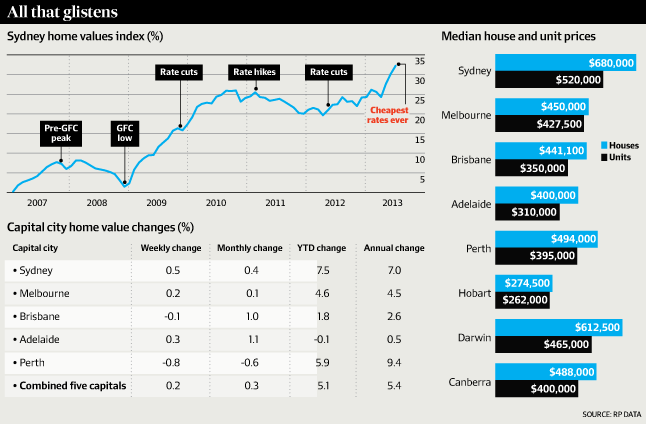
I am worried about Australia’s housing market. Very worried. Not so much about the fundamentals, which are solid. Or current performance, which is robust without raising alarm. I am concerned about what lies around the corner – and here, I am talking months, not years. I presented at a hedge fund conference during the week with notorious housing pessimist Gerard Minack. There was a fascinating role reversal. Asked about Australia’s housing prospects, Minack said he now buys into the view that house prices will track incomes. Minack was up front in admitting that he forecast striking price falls during the global financial crisis – he certainly bandied around figures in the 20 per cent range. He explained that he was wrong because it was “garbage in and garbage out”. The enormous rise in the jobless rate he anticipated never materialised. Read more of this post

Mortgage crisis looming, Bank of Israel warns; Too many borrowers are committing themselves to excessive monthly payments that could lead to widespread defaults

Mortgage crisis looming, Bank of Israel warns

Too many borrowers are committing themselves to excessive monthly payments that could lead to widespread defaults, a study has found.

By Eran Azran and Arik Mirovsky | Sep. 16, 2013 | 8:50 AM |  1

Israel’s mortgage market is at risk of collapse in the event of a major economic downturn, a study released on Sunday by the Bank of Israel warned. The average monthly mortgage repayment as a percentage of household income has risen sharply to 31%, up from 23% three years earlier – a rate that is exceptionally high by international standards. If housing prices continue to rise at their current levels, that figure could climb to 34%, the central bank warned. The percentage of total mortgage repayments made by Israelis exceeding 40% of household income – a threshold the Bank of Israel said it regards as high risk – has reached a record high of 17%. Four years ago, the figure was just 12%, the central bank said. Read more of this post

Changes to Norway’s gigantic sovereign-wealth fund will be felt around the world

Changes to Norway’s gigantic sovereign-wealth fund will be felt around the world

Sep 14th 2013 |From the print edition

20130914_WBD000

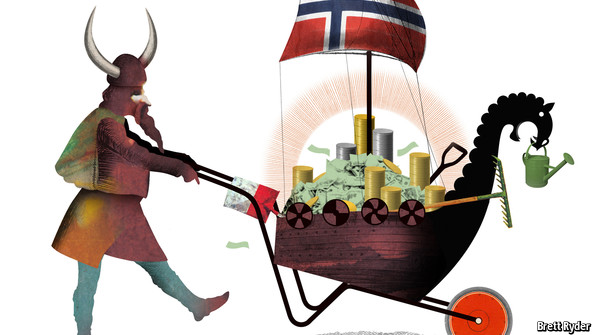
NORWEGIANS are different from you and me: they have more money. Norway’s general election on September 9th sounded many of the familia themes of elections everywhere. Erna Solberg, a Conservative, beat Jens Stoltenberg, the Labour prime minister, partly by offering a new face and lower taxes. But as Ms Solberg begins to run the country she will be confronted by a very different problem from most of her fellow world leaders: not how to make ends meet but how to manage abundance. Read more of this post

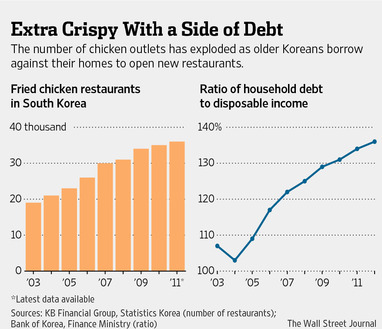
Restaurant Boom Bodes Ill for Korea Economy; fried chicken joints started by families who used their homes as collateral for loans is part of a broader swelling of the nation’s household debt to levels approaching those in the U.S. before the housing bust

September 13, 2013, 6:45 p.m. ET

Restaurant Boom Bodes Ill for Korea Economy

ALEX FRANGOS and KWANWOO JUN

WO-AP410_SKCHIX_NS_20130913192106

SEOUL—Korean fried chicken—crunchy, tasty and usually served with pitchers of cold beer—has become a culinary phenomenon far beyond the country’s shores. But at home, it is a source of worry for the struggling economy. In neighborhood after neighborhood, South Korean cities are crowded with greasy fried chicken joints started by families who used their homes as collateral for loans. Chicken-fueled credit is part of a broader swelling of the nation’s household debt to levels approaching those in the U.S. before the housing bust. “If anyone would start doing this business, I would stop him by all means,” says Kang Hyo-seon, who at 51 years old speeds around Seoul on a motorcycle delivering boxes of fried chicken. Read more of this post

Shanghai Free-Trade Dreams Set to Be Dashed; Investors Speculate Wildly on Vague Announcement; Reality Likely to Disappoint

September 13, 2013, 7:59 a.m. ET

Shanghai Free-Trade Dreams Set to Be Dashed

Investors Speculate Wildly on Vague Announcement; Reality Likely to Disappoint

AARON BACK

Little is known about the new free-trade zone that is being planned in Shanghai. But that hasn’t stopped Chinese investors from speculating wildly on who might benefit. Since a vague announcement on Aug. 23 that China’s top governing body had approved the 29-square kilometer zone in Shanghai, shares in Shanghai International Port Co. have risen by more than 130%. Tianjin Port Holding Co. 600717.SH -1.66% is up 30% over the same period on speculation that other coastal cities will get similar areas. Shanghai Pudong Development Bank 600000.SH -2.78% has risen 30% since last Thursday on expectations that financial controls will be loosened in the zone. The reality is likely to disappoint. China already has export-processing zones, where materials and parts can be imported tariff-free and assembled into exports. It’s unclear what more the government will do to expedite trade. Read more of this post

In China, the Dangers of Due Diligence; Background checks, audits and other investigations are just part of doing business in most countries, but in China those jobs can pose big risks

September 13, 2013

In China, the Dangers of Due Diligence

By JANE PERLEZ

SHANGHAI — When Peter Humphrey and his wife, Yu Yingzheng, appeared on Chinese national television recently, handcuffed and wearing orange prison vests, it was the first time in more than a month that family and friends had seen the British-American couple, well-known figures in the foreign business world here. But any sense of relief was tempered by what they saw next: Mr. Humphrey, his face electronically blurred, his head bowed, confessed to a crime and apologized to the Chinese government. Read more of this post

China in Central Asia: Rising China, sinking Russia; In a vast region, China’s economic clout is more than a match for Russia’s

China in Central Asia: Rising China, sinking Russia; In a vast region, China’s economic clout is more than a match for Russia’s

Sep 14th 2013 |From the print edition

20130914_ASD001_1

LESS than a decade ago little doubt hung over where the newly independent states of Central Asia had to pump their huge supplies of oil and gas: Russia, their former imperial overlord, dominated their energy infrastructure and markets. Yet today, when a new field comes on stream, the pipelines head east, to China. As if to underline the point, this week China’s president, Xi Jinping, swept through Central Asia, gobbling up energy deals and promising billions in investment. His tour left no doubts as to the region’s new economic superpower. Read more of this post

Henmania: Chicken is set to rule the roost in the global meat market

Henmania: Chicken is set to rule the roost in the global meat market

Sep 14th 2013 |From the print edition

ROASTED, fried or served with noodles, chicken is on its way to becoming the world’s favourite meat. Diners currently chomp through more pork—some 114m tonnes a year compared with 106m tonnes for poultry. But chicken consumption is growing faster—by 2.5% a year compared with 1.5% for pig meat—and is on track to overtake pork before 2020. And much more chicken is traded across borders: some 13.3m tonnes a year compared with 8.6m tonnes of beef and 7.2m tonnes of pork, according to the UN’s Food and Agriculture Organisation. Chicken is on a roll. Read more of this post

Household debt: Singapore’s ‘Achilles heel’?

Household debt: Singapore’s ‘Achilles heel’?

SINGAPORE, TOURISM, EMERGING ASIA, CURRENCIES, INDIA, BUSINESS NEWS

CNBC.com | Thursday, 12 Sep 2013 | 2:25 AM ET

Singapore stepped up efforts to contain a rapid increase in household debt by tightening rules around unsecured credit late Wednesday – a move viewed by economists as a preemptive strike ahead of a rise in borrowing costs in the country. “The central bank is being pre-emptive. Taken together with the previous measures announced, including the Total Debt Servicing Ratio (TDSR) framework for property loans, they will likely be effective,” Michael Wan, economist at Credit Suisse told CNBC on Thursday, referring to a measure which caps monthly mortgage payments to 60 percent of a borrower’s monthly income. Read more of this post

Singapore is missing new software boat

Singapore is missing new software boat

Saturday, Sep 14, 2013

Bas Vodde

The Straits Times

Western countries are losing in “old” industries like consumer electronics, but they aren’t too bothered by this. That’s because they are still front runners in new software-centric industries – despite years of outsourcing. Singapore is missing this boat. Netscape founder and HP board member Marc Andreessen recently wrote an important article – Why Software Is Eating The World – about how software is disrupting traditional businesses. The role of software is changing from one of business support to being a core business. Companies need to re-learn their new core business, otherwise software companies will learn their old core business and disrupt them. Read more of this post

The SEC is pressing energy companies in the U.S. to disclose how much of their reserves—a key gauge of future profit—consists of oil rather than less valuable liquids like propane

September 13, 2013, 6:41 p.m. ET

Oil Firms Queried on Reserves

SEC Is Pressing Companies for More Disclosure

DANIEL GILBERT

The Securities and Exchange Commission is pressing energy companies in the U.S. to disclose how much of their reserves—a key gauge of future profit—consists of oil rather than less valuable liquids like propane. After prodding from regulators, companies including BHP Billiton Ltd. BHP.AU -1.04%and ConocoPhillips COP +0.60% have recently joined Exxon Mobil Corp.XOM +0.48% and Anadarko Petroleum Corp. APC -0.87% in agreeing to break out how much of the fuel they can pump at a profit is crude rather than liquids derived from natural gas. Read more of this post