Japan Salaries Extend Longest Fall Since ’10 in Threat to Abe

Japan Salaries Extend Longest Fall Since ’10 in Threat to Abe

Japan salaries extended the longest slide since 2010 in July, raising the stakes for Prime Minister Shinzo Abe’s decision on whether to increase a sales tax. Regular wages excluding overtime and bonuses dropped 0.4 percent from a year earlier, marking a 14th straight month of decline, according to data released today by the Ministry of Health, Labour and Welfare. Bonus payments rose 2.1 percent, helping to lift total cash earnings 0.4 percent. Read more of this post

RBA Running Out of Room to Cut Rates, Australia’s Robb Says

RBA Running Out of Room to Cut Rates, Australia’s Robb Says

Australia’s central bank is running out of room to implement emergency stimulus measures should they be needed with interest rates now at historical lows, Shadow Finance Minister Andrew Robb said. The central bank doesn’t have “a lot of room left if there was some other unforeseen event in the world economy to make a difference,” Robb, whose Liberal-National coalition is on track to win government at the Sept. 7 election, said in an interview with Bloomberg Television today. “The Reserve Bank has been relied upon, or pressured, to do the heavy lifting in the economy for the last few years.” Read more of this post

SNB Shield Reaps Reward of Growth Defying Euro Area

SNB Shield Reaps Reward of Growth Defying Euro Area

Switzerland’s economy defied the recession that afflicted its neighbors to notch up a year of uninterrupted growth, underlining the importance of the country’s currency ceiling as it marks its second anniversary. Swiss gross domestic product rose 0.5 percent in the second quarter from three months through March, when it expanded by 0.6 percent, the Secretariat for Economic Affairs in Bern said in a statement today. That is more than a median estimate of 0.3 percent in a Bloomberg survey of 18 economists. Read more of this post

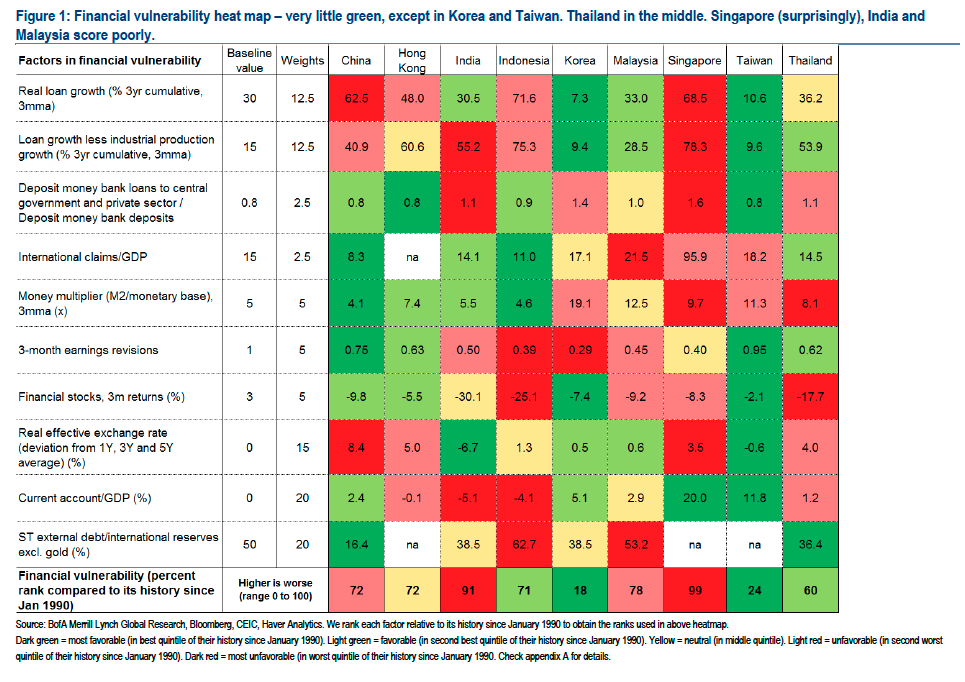
Asia financial vulnerability heat map

Screen-shot-2013-09-02-at-2.57.55-PM

“If bubbles in residential properties burst, people can still sell them if the sticker price is low enough, because people always need a place to live. But once the commercial property market crashes, nobody is willing to rent a shop that loses money every day”

An urban inferiority complex

Updated: 2013-09-02 07:35

By Wang Chao ( China Daily)

Industry insider points to a problem that is bubbling under the surface Read more of this post

Deng Xiaoping’s Lessons for Today’s China

Deng Xiaoping’s Lessons for Today’s China

What would Deng Xiaoping make of Charles Xue?

It’s a surprisingly edifying question. In the past few weeks, Chinese authorities have been eager to show their allegiance to the rule of law. They have gone after Western pharmaceutical companies for bribery, milk-powder suppliers for price-fixing and a well-known British investigator for illegally obtaining information about Chinese citizens. The most riveting spectacle — the often salacious testimony in the trial of Bo Xilai, a former Politburo member — had hardly ended when reports emerged that the next target might be Bo’s mentor, Zhou Yongkang, who would be the highest-ranking party member brought down for corruption since the Cultural Revolution. Read more of this post

Chinese Banks Contribute 70% of Profits in Services, Raising Concerns over Structural Imbalances

Chinese Banks Contribute 70Pct of Profits in Services, Raising Concerns over Structural Imbalances

09-02 13:46 Caijing

Banks’ profits have grown rapidly from 58 percent in 2009 and 68 percent in 2013, as a share of total profits in services.

Extra-high profitability in Chinese banks, most of which are state-owned or state-backed, has raised concerns about structural imbalances in services, a sector that has been attached much importance in steering a growth model away from exports to consumption. Chinese banks have generated nearly 70 percent of profits in total among the top 500 companies in services, although the number of banks only accounts one tenth of total, a report issued by the China Enterprise Confederation (CEC) over the weekend showed. Read more of this post

China Wuhan Debt-to-GDP Ratio at 185.64%

China Wuhan Debt-to-GDP Ratio at 185.64Pct

09-02 15:24 Caijing

The lcoal government’s debt-to-GDP ratio was 1.5 times higher than the U.S. red line on government debt levels. Debt-to-GDP ratio in Wuhan, the capital city of South China’s Hubei province, could stand out at 185.64 percent, among the highest in Chinese cities, local media said. The city is one of a lengthy list of Chinese cities which are under the inspection of the National Audit Office for their debt piles, starting from early August amid fears of a government debt crisis. Local government of Wuhan has amassed a huge amount of debt in recent years due to aggressive urban construction, with statistics showing ending June 2012, the city had 203.7 billion yuan in debt outstanding. Read more of this post

China’s retail industry increasingly resembles an army of mice running on wheels. More and more money is being invested, but at the end of the day, companies find themselves running neck and neck with the rest of the competition

How fast companies dodge price wars

Updated: 2013-09-02 07:36

( China Daily) Read more of this post

China’s consumers aren’t living up to sales pitch; Spike in bad loans worries retailers in China

China’s consumers aren’t living up to sales pitch

Decelerating investment in housing, infrastructure and manufacturing, is dragging on incomes.

August 28, 2013 @ 10:41 am

By John Foley

The author is a Reuters Breakingviews columnist. The opinions expressed are his own.

Consumer brands in China are finding their rewards aren’t quite as advertised. Growth in purchases of a wide range of goods has slowed sharply over the past year, and companies ranging from Samsonite to Apple are reporting disappointing Chinese sales figures. Consumers in the world’s second-largest economy will have their day, but the idea they alone can sustain growth looks threadbare. Read more of this post

It’s China vs. China in GMO Food Fight

September 3, 2013, 7:30 AM

It’s China vs. China in GMO Food Fight

Top of Form

China’s fierce public debate on genetically modified food, long a political hot potato in a country obsessed with how to feed its 1.3 billion citizens, has become the subject of a spat between big guns from two of its most powerful governing institutions. Two weeks ago, a major-general in the People’s Liberation Army took to a popular newspaper to publish (in Chinese) a series of pointed rhetorical questions about Beijing’s policy allowing more trade in genetically modified grains, suggesting that genetically modified organisms, or GMO, are a strategy by which a Western conspiracy to supplant China’s food security is taking shape. GMOs are organisms that have had their genetic blueprint artificially re-engineered; for example, crops altered to become bug-resistant. Read more of this post

China’s top restaurants reeling over new austerity

China’s top restaurants reeling over new austerity

By DIDI TANG, Associated Press | September 3, 2013 | Updated: September 3, 2013 3:18am

BEIJING (AP) — The shark’s fin, bird’s nest and abalone are gone from the offerings at Beijing’s Xiang E Qingrestaurant — a favorite of Communist Party cadres just months ago. Diners are now left with less exotic fare such as shredded beef, pickled turnip and fried peanuts. China’s high-end restaurants have gone into crisis under leader Xi Jinping‘s campaign to crack down on the kinds of party extravagances that have angered ordinary Chinese, such as dining on the public dime. To stem big losses and avoid the now-tarnished image of VIP banquet halls, these restaurants have been busy reinventing themselves. Read more of this post

With Labs Pumping Out Legal Highs, China Is the New Front in the Global Drug War

With Labs Pumping Out Legal Highs, China Is the New Front in the Global Drug War

By Charlie CampbellSept. 02, 201310 Comments

The drugs arrived in an “unnamed, unmarked package,” recalls Timothy LaMere. The rest of what happened that night is more of a blur. After sharing the 2C-E — a synthetic imitation of the rave drug ecstasy — with friends at a house party in Blaine, Minn., things started to go very wrong. Those who took the drug became dangerously unwell — sweating, shaking, rolling around on the floor and experiencing seizures and severe pain. LaMere was among 10 people hospitalized, while one friend, 19-year-old Trevor Robinson, father of a 5-month-old baby, died after “punching walls, breaking items, staring and having dilated pupils and yelling,” according to the criminal complaint. LaMere is currently serving a 10-year sentence for third-degree unintentional murder in a state correctional facility. “I feel horrible. I feel horrible for Trevor’s family — I was close to his mum before — and I feel horrible for anyone who knew him,” he tells TIME. Read more of this post

Wison Engineering Services Says Billionaire Founder Hua Bangsong Assists With China Corruption Probe on its business relationship with PetroChina

Wison Says Founder Hua Bangsong Assists With China Probe

Wison Engineering Services Co. said its controlling shareholder Hua Bangsong is helping China’s authorities with their investigations, amid a corruption probe into its one-time largest client PetroChina Co. Wison has been informed that Hua “is now assisting the relevant authorities in the PRC in their investigations,” the company said today in a Hong Kong stock exchange filing. Wison fell 16 percent yesterday before its shares were halted. The company said it noted recent press reports on its business relationship with PetroChina Co., the country’s biggest oil and gas producer whose former chairman Jiang Jiemin and four other senior executives are being investigated by the government. Wison provides consulting, engineering and construction services to chemical factories and oil refineries. Read more of this post

What’s next for ChiNext? Black sheep is comeback kid

What’s next for ChiNext? Black sheep is comeback kid

By Ye Zhen | August 12, 2013, Monday |  PRINT EDITION

CHINEXT, the once troubled board for start-up companies in the southern city of Shenzhen, has been logging strong performance this year, underscoring expectations that the commitment by China’s new leadership to rebalance the economy will benefit small and private businesses. The ChiNext Index, which tracks a Nasdaq-style exchange for growth enterprises, has leapt a stunning 63 percent so far this year, while the CSI 300 index, the benchmark for blue chips in Shanghai and Shenzhen, has slumped 10 percent. ChiNext closed at 1,172.52 points on Friday. Read more of this post

Unfinished Business – China Mobile’s Corruption Woes Roll On

Unfinished Business – China Mobile’s Corruption Woes Roll On – Economic Observer Online

By Liao Jiehua (廖杰华) , Chen Yong (陈勇) and Wu Qiaofa (吴侨发)
Issue 634 ,Aug 26, 2013  
Executives continue to fall to corruption charges at the world’s largest mobile phone operator. On Aug 19, Xu Long (徐龙), chairman of China Mobile’s Guangdong branch (Guangdong Mobile), was placed under investigation for “serious disciplinary violations.” Economic Observer learned that as far back as 2010, the Zhejiang Provincial Commission of Discipline Inspection had begun investigating Xu; and auditing authorities have also looked into him on five separate occasions. But nothing concrete was ever discovered.
However, everything began to unravel when two other high China Mobile officials, Li Xinze (李欣泽) and Sun Lian (孙炼), were interrogated in April and July respectively. These men have reportedly led authorities to many new clues implicating Xu Long. Read more of this post

China’s oil boss `must have embezzled huge amount’

Oil boss `must have embezzled huge amount’ 
Grace Cao
Tuesday, September 03, 2013
The director of the State-owned Assets Supervision and Administration Commission, Jiang Jiemin, who is under investigation, “must have embezzled a huge amount of money,” official mainland media reported. Jiang, a former boss of PetroChina Group, is being investigated by the Communist Party’s Central Commission for Discipline Inspection. The commission yesterday launched a new website to facilitate reporting about corruption and its chief, Wang Qishan, visited the operations. Jiang is facing a probe for serious disciplinary violations. Read more of this post

China sacks head of state asset regulator Jiang Jiemin amid graft probe

China sacks head of state asset regulator Jiang Jiemin amid graft probe

Tuesday, 03 September, 2013, 11:30am

Reuters in Beijing

Top Chinese economic official Jiang Jiemin has been sacked as head of the body overseeing state-owned companies for “suspected serious disciplinary violations”, the official Xinhua news agency reported on Tuesday. The phrase is normally used as code for corruption in China, and the move comes as the country’s leaders step up a campaign against graft. Xinhua cited the powerful Organisation Department of the ruling Communist party. Read more of this post

Why The Lingerie Industry Can’t Compete With Victoria’s Secret; Victoria’s Secret didn’t start dominating lingerie until it stopped being cheap and began focusing on the customer experience

Why The Lingerie Industry Can’t Compete With Victoria’s Secret

ASHLEY LUTZ SEP. 2, 2013, 4:37 PM 5,371 6

Victoria’s Secret is facing a deluge of competition from lingerie start-ups that seek to challenge the brand. Brands like AdoreMe, Intimint, and True & Co. are trying to seduce Victoria’s Secret customers with lower prices and more tailored selections.  AdoreMe offers direct-to-consumer lingerie at about half of Victoria’s Secret prices. Intimint asks customers to take a quiz and sends them new lingerie selections every month, based on their preferences. True & Co. sends women five bras a month, giving them the option of keeping what they like and sending back what they don’t. While these brands are consumer-friendly and creative, their business models ignore exactly what makes Victoria’s Secret so successful. In the ’90s, Victoria’s Secret used to focus on value. But the brand floundered because there was nothing to set it apart from other price-friendly brands like Hanes and Maidenform. Victoria’s Secret didn’t start dominating lingerie until it stopped being cheap and began focusing on the customer experience.  Read more of this post

‘Deeping’ food attracts consumers for its exceptionally deeper and richer taste and it is healthier at the same time

2013-09-02 18:28

‘Deeping’ food attracts consumers

By Rachel Lee

K2013090200130-200

This photo shows the Davidoff Cafe Rich Aroma Instant Stick Cafe made by Davidoff Cafe, a premium European coffee maker. The coffee stick, which was first launched in 2008, has become popular again among savvy consumers for its exceptionally deeper and richer taste.

It’s different from dipping food. Consumers’ love and interest in food concepts like well being and healing has now gone further: they want deeping food. It is a type of food that is regarded healthy and has a deeper, richer taste at the same time. “Consumers have long been seeking healthy, healing food and now the taste element has been added to their interest,” said a Davidoff Cafe spokesman. Read more of this post

Korean government looking to overhaul corporate pay system; Domestic companies’ wage systems are so complicated that even employees do not precisely understand how their salaries are calculated

Gov’t looking to overhaul corporate pay system

Seo Dong-cheol, Jang Jae-woong

2013.09.02 18:29:46

A survey of 1,000 South Korean companies with 100 or more staff on their payrolls showed that basic wages constituted an average of 57.3 percent of workers’ annual salary, said the Ministry of Employment and Labor Monday. Recently, Korea has seen a series of lawsuits regarding ordinary wages, with a Supreme Court trial on a case concerning ordinary wages scheduled to be held at 2:00 pm on September 5. The trial will be presided over by the chief justice, and at least two-thirds of the 13 Supreme Court justices will be seated. The thorny issue of ordinary wages is attributed to companies’ complicated wage systems that consist of various types of allowances and bonuses. Domestic companies’ wage systems are so complicated that even employees do not precisely understand how their salaries are calculated. Consequently, workers’ performance and capacity are not proportionately tied to their salaries, and corporations are saddled with diverse types of allowances. Gaining ground is the argument that the more belatedly the basic wage and ordinary wage systems will be revamped, the more difficult it will become to tackle the issues regarding the retirement age and resolving youth unemployment to improve job creation and the quality of employment. A government official said “a fundamental shift in wage systems will ease the financial burden on corporations, increase productivity and employment and improve labor-management relations.” The Ministry of Employment and Labor set up a new division and a research task force committed to establishing a more reasonable wage system with the goal of resolving the ordinary wage issue and settling the retirement age at 60 by 2016

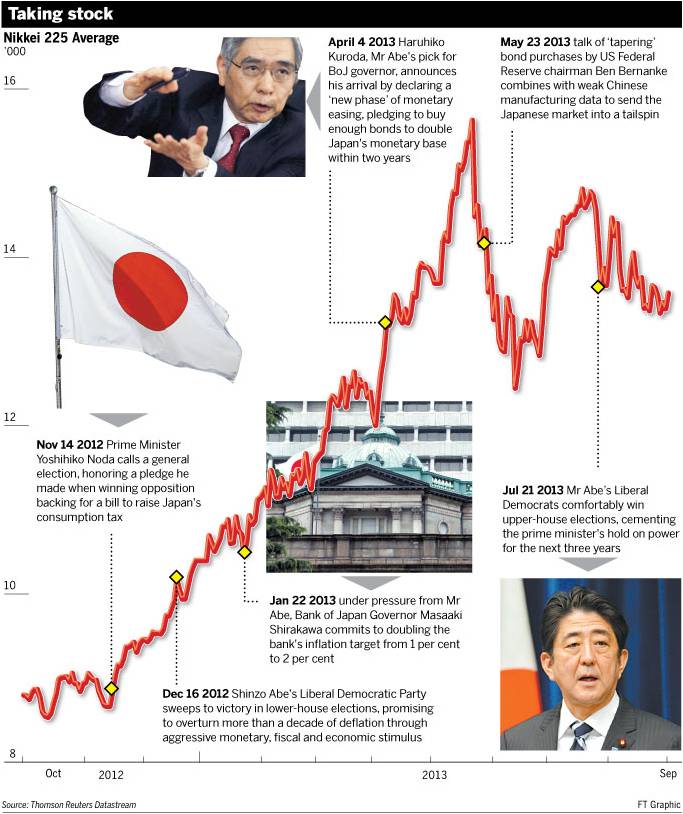
Japan put on hold as investors await Abe’s next move

September 2, 2013 1:09 pm

Japan put on hold as investors await Abe’s next move

By Ben McLannahan in Tokyo

Japan

For a sense of how much the Japanese government frets about stock prices, take a look at the programme for Mizuho Securities’ autumn conference, beginning in Tokyo next Monday, for which about 320 foreign and 1,200 domestic investors – a record high – have signed up. The keynote speaker – on “Abenomics: the autumn siege” – is none other than Akira Amari, minister of state for economic and fiscal policy, and the right-hand man of Prime Minister Shinzo Abe. It is the first time in the conference’s six-year history that a member of the cabinet has agreed to speak. Read more of this post

Craftsman Automation: Cheap and Efficient Engineering; This diversified light engineering company has grown by adopting new ideas without worrying about following the herd

Craftsman Automation: Cheap and Efficient Engineering

by Ashish K Mishra | Sep 3, 2013

This diversified light engineering company has grown by adopting new ideas without worrying about following the herd

topimg_22389_s_ravi_600x400 Craftsman-FINAL.indd

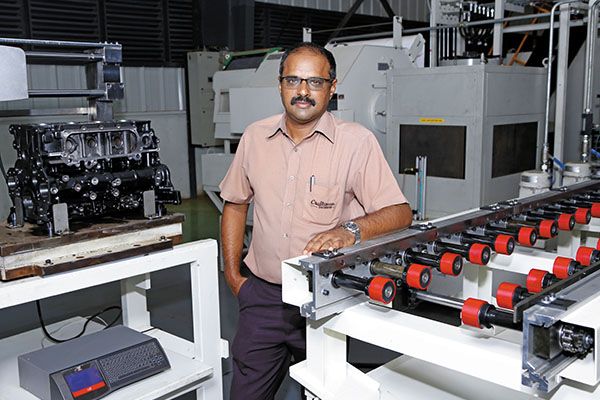
“So, how’s business?” Ask any businessman this question and, often, you know what response to expect. “Good, very good, excellent, thank you.” But S Ravi, chairman and managing director of Craftsman Automation, said, “Not good.” He explained why: “The commercial vehicles market is looking tough and we don’t know how long it will continue like this. But tractors have done well for us. And we are in a much better position than we were at the time of the Lehman crisis.” That’s Ravi for you: Positive and realistic at the same time. His company is no different.  Read more of this post

Genesis Colors: Success Beyond Satya Paul; its scale of 30 stores is unique for the upscale end of the Indian apparel sector which is dotted with designers, many of whom are celebrities but often fail to create a successful business

Genesis Colors: Success Beyond Satya Paul

by Prince Mathews Thomas | Sep 2, 2013

Though the company is far from a one-brand wonder, Satya Paul continues to be its calling card

topimg_22375_sanjay_kapoor_300x400 Sanjay Kapoor_Final.indd

One of India’s largest fashion retailers in the premium and luxury segment is, ironically, not a familiar name to the average shopper. Ask about Genesis Colors and you are likely to draw a blank. But mention Satya Paul and you are on familiar terrain. Designer brand trumps company brand: That is the Genesis business model. Here’s how it works. Although founded in 2001, the Genesis story began in 2002 with the launch of a revamped Satya Paul. Named after the designer who created it in 1985, the brand had established itself in the Indian fashion firmament before it came under Genesis’s fold. But it was only after 2002 that Satya Paul scaled up to become, arguably, the country’s leading homegrown fashion brand in the high-end segment. And Genesis’s biggest success. It has 30 exclusive stores in India, the largest network for any domestic premium brand, and accounts for 30 percent of Genesis’s Rs 310 crore revenue (for 2012-13). The scale is unique for the upscale end of the Indian apparel sector which is dotted with designers, many of whom are celebrities but often fail to create a successful business. This segment constitutes about 25 percent of India’s premium/luxury market, worth $5 billion, says Ankur Bisen, head of retail and consumer products, Technopak, a management consulting firm.  Read more of this post
Indian Land Deform; Amid an economic crisis, Delhi makes it harder to invest

Updated September 2, 2013, 8:28 p.m. ET

Indian Land Deform

Amid an economic crisis, Delhi makes it harder to invest.

Someone should tell New Delhi that when sensible leaders talk about not letting a crisis go to waste, they mean seizing the opportunity to enact pro-growth reforms. Instead, as capital flees and growth slips again, Indian politicians last week passed a land acquisition bill that will hurt farmers, hinder investment and increase corruption. India’s current system of land laws, largely unchanged since 1894, is certainly in desperate need of a revamp. Woefully incomplete government land registries make it hard for anyone to establish a clear title to property, especially in rural areas. Attempts to buy land directly from owners can take years as the notoriously inefficient courts grapple with the resulting litigation. Read more of this post

The Malaysian Government has yet to decide which projects would be postponed to address the narrowing of the country’s current account surplus on the balance of payments and high fiscal debt

Updated: Tuesday September 3, 2013 MYT 9:19:16 AM

Government will review projects

BY LEONG HUNG YEE 
HUNGYEE@THESTAR.COM.MY

MRT lines 1,2 and 3 unaffected and will proceed as planned

PUTRAJAYA: The Government has yet to decide which projects would be postponed, but maintained that the Mass Rapid Transit (MRT) project would proceed as planned, according to Prime Minister Datuk Seri Najib Tun Razak. He said the Government, in addressing the narrowing of the country’s current account surplus on the balance of payments, would consider carefully the public sector projects to be undertaken. Read more of this post

Why Canada’s financial news is often a thinly disguised weather report

Why Canada’s financial news is often a thinly disguised weather report

Philip Cross, Special to Financial Post | 13/08/30 | Last Updated:13/09/02 4:03 PM ET
Welcome to September, Canada’s busiest month.

The quickened pace might come as a shock to you, in your life, because you just left August where the living is easy. OTTAWA — The U.S. economy has been picking up and overburdened Canadian consumers are still spending, as are fiscally strapped governments. But that’s hardly a scenario for robust growth in this country — not without the long-promised increase in business investment and expanded exports. Read more of this post

Shareholders, Small-Town America Enemy No. 1?

Shareholders, Small-Town America Enemy No. 1?

Did greedy investors really destroy small-town America?

That’s about the only conclusion one can draw from a Washington Post article last week recounting how Endicott, New York, where International Business Machines Corp. was founded and based for many years, was gutted as the company responded to shareholders who insisted on better investment returns. It used to be a given that the interests of corporations and communities such as Endicott were closely aligned. But no more. Across the United States, as companies continue posting record profits, workers face high unemployment and stagnant wages. Read more of this post

Misconceptions About Fed’s Bond Buying

Misconceptions About Fed’s Bond Buying

To combat the recession that began in 2007, the Federal Reserve and some other central banks have been buying large amounts of long-term bonds. The novelty of this quantitative easing makes the policy especially prone to popular misconceptions.

Misconception No. 1: QE bond purchases are comparable to stimulus spending on roads and tax cuts, which adds to the national debt.

— QE actions to lower long-term interest rates require much bigger changes in the Fed’s balance sheet than conventional policy aimed at short-term interest rates. The “Q” in QE is the quantity of assets purchased — and the dollar amounts are necessarily very large. But QE is a swap of one asset (bank reserves) for another (bonds); this has no direct effect on the national debt. Indeed, QE indirectly shrinks the national debt by reducing interest payments and by strengthening economic activity, which raises tax revenue. Read more of this post

Is your bond fund quietly investing in shares?

Is your bond fund quietly investing in shares?

Some fund managers have the option to invest outside their main area of expertise. Should you be worried, asks Kyle Caldwell.

Some funds managers have been straying outside their normal markets.  Photo: JLImages / Alamy

By Kyle Caldwell

7:00AM BST 02 Sep 2013

Professional fund managers are usually endlessly upbeat whether the market is rising steadily or plunging headlong. But now – after several years of healthy stock market gains, during which world economies have not recovered as swiftly – a growing number of fund managers are admitting they can no longer see value in the markets they specialise in. In other words, prices are too high. This has led some to stray outside their normal remits – with the result that the make-up of the fund is no longer the same as when many investors first put money with the manager. Read more of this post