The debt dragon: Credit habit proves hard for China to kick

Last updated: August 26, 2013 7:54 pm

The debt dragon: Credit habit proves hard for China to kick

By Simon Rabinovitch in Guiyang
ChinaDebt

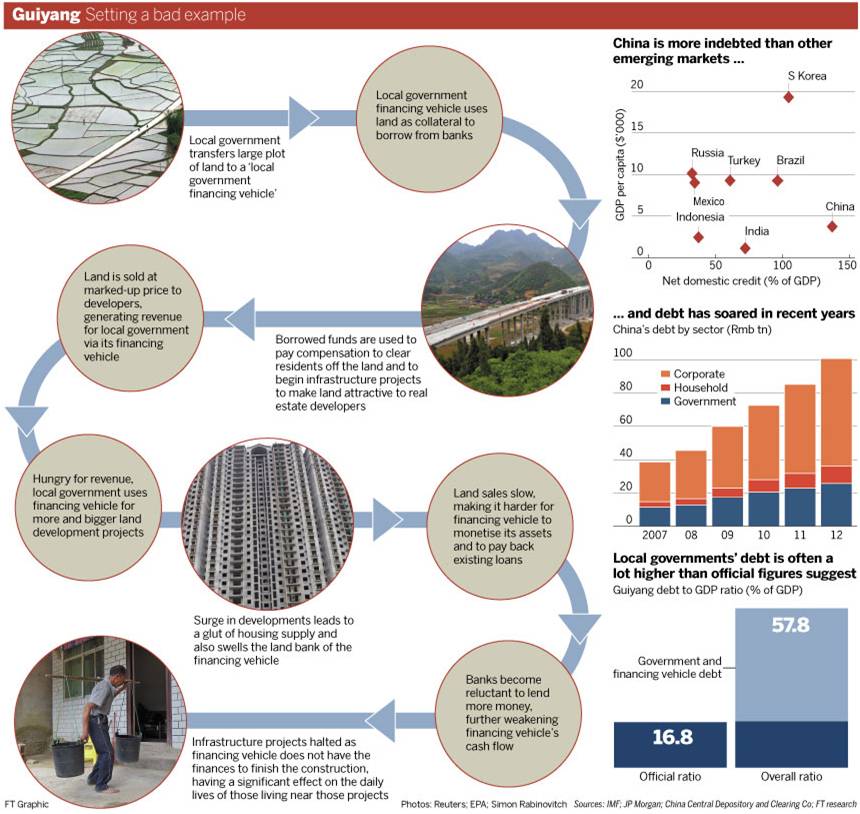
The Chinese government says its debt problem is under control, but the people of Pianpo village have cause to disagree. Over the past year they have seen their water cut off, rubbish pile up in the streets and their wages go unpaid as debt has mounted. An elevated motorway soars over the villagers’ concrete homes, meant to connect them to central Guiyang, one of China’s fastest-growing cities. Instead, the slip road to Pianpo ends in a patch of gravel. The state-owned company building the road took on too much debt and could not pay its construction workers. Water pipes were dismantled when the roadworks began but were never repaired when cash ran short. A couple of times a day, Chen Xiuxiang, 75, trudges up a hill to fetch his weight in water – 120 pounds – from a working tap, carrying two buckets on a wooden pole across his shoulders. Most of his neighbours do the same. “They keep promising they’ll fix things but they never do,” says Mr Chen. Read more of this post

Debt Drags on China’s Growth; Interest Costs Leave Companies With Less Cash to Invest; China Construction Bank encountered a surge in overdue loans during the first half of the year and could face a “hidden crisis”

August 26, 2013, 1:24 p.m. ET

Debt Drags on China’s Growth

Interest Costs Leave Companies With Less Cash to Invest; the Case of Shougang Group

TOM ORLIK

AM-AZ992_CINTER_G_20130826120304

As worries over China’s debt problem mount, the burden of paying off those loans could be the trigger that tips runaway credit into slower economic growth and financial stress. Few areas illustrate the problems better than the old industrial sector, where state-owned steel plants and cement kilns continue to borrow and expand even as overcapacity grows. With debts high and profits low, some companies, such as state-owned steel giant Shougang Group, are using new loans to repay old ones, according to Dagong Global Credit Rating Co. Shougang Group declined to comment. Read more of this post

Huge debts send China’s steel industry to verge of bankruptcy

Huge debts send China’s steel industry to verge of bankruptcy

Staff Reporter

2013-08-27

Eighty six of China’s major medium-and-large steel enterprises incurred more than 3 trillion yuan (US$486.4 billion) in total liabilities as of June, or a debt ratio of 69.74%, signaling that the industry is on the verge of bankruptcy, reports Beijing’s Economic Observer, citing figures from the China Iron and Steel Association (CISA). Meanwhile, the industry’s profits for the first six months of the year totaled only 2.2 billion yuan (US$356.7 million), with 35 steel enterprises, or about 40% of the total, reporting losses. However, their assets-liabilities ratio, accounts receivable turnover ratio and accounts payable turnover ratio registered a rise. Read more of this post

Don’t Blame the Fed for Asia’s Problems

Don’t Blame the Fed for Asia’s Problems

It’s time to set our clocks back in Asia. (ADXY) Not to 1997, as many are recommending, but to 1994.

Memories of the former year remain raw. Currencies had gone into free fall and current-account deficits exploded. Central bankers and International Monetary Fund officials scurried to contain the chaos. It’s true that another 1997-like crisis is highly unlikely. Today, exchange rates are more flexible, foreign-currency debt is lower, banks are healthier, countries are sitting on trillions of dollars of reserves, and economies are far more transparent. The differences between 1997 and today trump the similarities. Read more of this post

Capital Flight Drains Reserves as Rupee, Rupiah Fall: Currencies

Capital Flight Drains Reserves as Rupee, Rupiah Fall: Currencies

By Candice Zachariahs and Lilian Karunungan – Aug 25, 2013

Asian nations are depleting foreign reserves as they seek to bolster their currencies while investors pull billions of dollars from the region. Of the 10 Asian central banks with the largest reserves, six have cut their holdings this year, led by a record 18 percent reduction byIndonesia, data compiled by Bloomberg show. Their reserves are rising at the slowest pace in data going back to 2000. Holdings in Asiaprobably contracted once price moves are taken into account, Citigroup Inc. estimates. Read more of this post

Why Chinese Have Shiny Nails After Visiting the Showroom

Why Chinese Have Shiny Nails After Visiting the Showroom

On his first visit to the Peugeot SA (UG) dealership in Wuhan, China, Xu Zhongli spent hours asking questions and fiddling with cars. Over the next month, he returned for another four marathon sessions and also made several visits to a Citroen showroom. Neither dealer showed any signs of impatience with him, Xu says. “I needed time to look at the models and consider the color,” said Xu, 41, a production supervisor, who finally settled on a 105,000 yuan ($17,000) silver Peugeot 308, his first car. “I had to negotiate the price, too.” Read more of this post

The days of China’s banks raking in easy fat profits have gone, for now, as the slowing economy and market-based financial reform squeeze profits and extend bad loans

Market reform eats into bank profits

2013-08-26

BEIJING, Aug. 26 (Xinhua) — The days of China’s banks raking in easy fat profits have gone, for now, as the slowing economy and market-based financial reform squeeze profits and extend bad loans, semi-annual reports have shown. By Monday, seven commercial lenders had published their semi-annual reports, and all of them report slower profits and higher non-performing loan ratios, although the facts are better than expected. Read more of this post

Kangbashi/Inner Mongolia home market on brink of collapse as home prices in the area have tumbled from 20,000 yuan (US$3,200) to 3,000 yuan (US$500) a square meter

Kangbashi home market on brink of collapse

Staff Reporter

2013-08-27

The housing market in Kangbashi New Area, a district in Ordos in Inner Mongolia, is on the brink of collapse as home prices in the area have tumbled from 20,000 yuan (US$3,200) to 3,000 yuan (US$500) a square meter, the state-run China Youth Daily reports. China’s real estate bubble seems to have spread to medium and small cities mainly due to excess supply as a result of massive outflows of local residents and low income levels in less developed cities, say analysts who are bearish on the property market. Read more of this post

China’s Lofty Goals for Shale Gas Development Just Pipe Dreams, Experts Say

08.26.2013 19:02

China’s Lofty Goals for Shale Gas Development Just Pipe Dreams, Experts Say

Lack of innovation, technology and capital likely mean that the ambitious targets set for the next few years are not attainable

By staff reporter Pu Jun and intern reporter Huang Kaiqian

(Beijing) – China wants to reap the benefits of a shale gas revolution similar to the one in the United States, but there are many obstacles to this happening, experts say. In the first half of 2013, 56 shale gas wells were in the exploratory phase in the country, but only 24 were producing gas. Only six wells – all dug by either China Petrochemical Corp. (Sinopec Group) or China National Petroleum Corp. (CNPC) – had daily output capacity of 10,000 cubic meters or more. And all the shale gas blocks sold in the most recent round of auctioning were in the early phases of prospecting, meaning they had not produced a drop. Read more of this post

China’s Economic Rebalancing Act Faces Uphill Political Battle; Chinese Leaders’ Reform Proposals Cut Against Interests of Local Governments

August 26, 2013, 2:30 p.m. ET

China’s Economic Rebalancing Act Faces Uphill Political Battle

Chinese Leaders’ Reform Proposals Cut Against Interests of Local Governments

BEIJING—A mid-July move by China to increase the power of the market in the banking sector was a significant step in a plan to overhaul the country’s economic model. It may also have been the last easy win for China’s new leaders, whose reform program will likely run into stiff opposition from within the ruling Communist Party. President Xi Jinping and Premier Li Keqiang have advocated a more limited role for the state, and with economists convinced that Beijing’s investment-heavy growth model has run its course, the government has signaled its aim to rebalance the economy toward domestic demand. Read more of this post

China’s aluminum producers staggering as factories lack orders

Aluminum producers staggering as factories lackorders

Updated: 2013-08-27 06:50

By Du Juan ( China Daily)

00221917e13e1386360105 Read more of this post

Billabong Posts A$860 Million Loss as Brand Deemed Worthless

Billabong Posts A$860 Million Loss as Brand Deemed Worthless

Billabong International Ltd. (BBG), the Australian surfwear company whose shares fell by more than half over the past year, posted a loss more than three times its market value and said its core brand was worthless. The loss was A$860 million ($776 million) in the year ended June, compared with a loss of A$276 million in the previous 12 months, the Gold Coast, Australia-based company said in a statement today. Billabong was expected to lose A$547 million, according to the average of four analyst estimates compiled by Bloomberg. Read more of this post

India’s reserves squeezed as investors shun rupee assets

August 27, 2013 7:18 am

India’s reserves squeezed as investors shun rupee assets

By Victor Mallet in New Delhi and Avantika Chilkoti in Mumbai

India’s foreign exchange reserves have dropped by nearly $14bn since the end of March and are set to dwindle further as international investors shun the rupee and other emerging market assets in favour of the US dollar, according to economists and market analysts. India entered the latest emerging market sell-off, which was prompted by fears that the US Federal Reserve would soon “taper” its quantitative easing, in relatively good shape in terms of financial safety. Read more of this post

The ironies of India’s economic crisis; Leaders blame their woes on the receding tide of easy money

August 25, 2013 4:15 pm

The ironies of India’s economic crisis

By Ruchir Sharma

Leaders blame their woes on the receding tide of easy money, writes Ruchir Sharma

Anot so funny thing happened while the world was watching for an emerging markets crisis to erupt in China. The crisis erupted in India instead. Contagion typically attacks weak links first, often exposing vulnerabilities hidden in plain sight. The fall of the rupee exposes India as having the emerging world’s worst fiscal deficit and largest current account deficit in absolute terms. What went wrong? For much of the past decade, India was celebrated as one of the emerging nations destined to rise indefinitely. Even after the global crisis of 2008, like China and others, it kept growth alive by spending heavily, helped by the easy money flowing out of the US. Behind the scenes, though, the picture was deteriorating, with crony capitalism, government subsidies and inflation rising rapidly. Read more of this post

India Dealmaking Could Slump on Central Bank Rule to stem the flight of capital from the country.

August 26, 2013, 1:22 PM ET

India Dealmaking Could Slump on Central Bank Rule

Vipal Monga

Senior Editor

Indian companies have been snapping up foreign targets of late, but that activity could slow because of new regulations being imposed on overseas deals by the Reserve Bank of India. According to a report by the Press Trust of India, India’s central bank will be reviewing a pending $2.4 billion dealbetween Indian’s Apollo Tyres andCooper Tire & Rubber Co. as part of new controls meant to stem the flight of capital from the country. Read more of this post

Is the tycoon era in HK coming to an end?

Is the tycoon era in HK coming to an end?

Tuesday, August 27, 2013 – 08:45

The Sunday Times

Hong Kong – When residents of Banyan Garden in Kowloon moved into their new homes built by tycoon Li Ka Shing’s Cheung Kong Holdings 10 years ago, they realised their connection with Asia’s richest man did not stop there. The estate management company they had to use was a Li Ka Shing business. Their phone and broadband services were provided by a Li Ka Shing telecoms operator. Read more of this post

A Painful ‘Recoupling’ for Markets; Korea decouples from emerging markets?

2013-08-26 17:39

Korea decouples from emerging markets

By Kim Rahn
Korea has been moving differently from other emerging Asian nations that have seen economic turmoil in recent weeks. While economic data of countries like India and Indonesia have turned negatively following outflow of foreign capital amid fears of the U.S.’ stimulus cut, those of Korea have shown only little fluctuation. For the past month, Indonesia’s sovereign credit default swap (CDS) premium, a barometer of risk-hedging costs for a country on sovereign or corporate debts, rose from 194.44 basis points (bp) to 286.43 bp. A basis point is 0.01 percentage point. However, Korea rose only 2.66 bp from 82.50 bp to 85.16 bp. Read more of this post

Half of South Korea’s households leased homes through “jeonse” or monthly rental system, and the average jeonse deposit surpassed 100 million won ($89,554) for the first time

Average ‘jeonse’ deposit exceeds $90,000 for first time

2013.08.27 11:26:01

Half of South Korea’s households leased homes through “jeonse” or monthly rental system, and the average jeonse deposit surpassed 100 million won ($89,554) for the first time. Jeonse is a lease system in which a tenant pays a large lump-sum deposit for typically a two-year rental period. Four out of 10 jeonse tenants deposited 100 million won or more to lease homes, with half of jeonse tenants finding it difficult to afford an over five percent increase in deposit. To address the problem, the financial regulator is pondering curbing big jeonse loans and instead increasing jeonse or monthly rental loans for the underprivileged. The numbers are a result of a survey of 5,000 heads of households aged between 20 and 59 conducted and released by the Korea Housing-Finance Corporation Tuesday. Of the polled, 49.6 percent lived in their own housing last year, down one percentage point from 50.6 percent of 2011. This is a steep decline from 63.6 percent of 2007. In contrast, households living in homes rented on a jeonse basis accounted for 25.4 percent of respondents, and those on a monthly payment basis 13.2 percent. Semi-jeonse, a lease system in which jeonse deposit is lowered in exchange for monthly payment, was rare as lately as 2011. But 4.4 percent of respondents were renting housing on a semi-jeonse basis last year, indicating a shift away from jeonse to monthly payment lease. The median jeonse deposit came to 101.8 million won last year, above the 100 million won mark, and surged more than 10 million won from 90.4 million won of 2011. The average jeonse deposit stood at 75.2 million won in 2010.

Startups gain appeal as Japan Inc. names fade

Startups gain appeal as Japan Inc. names fade

BY YURI KAGEYAMA

AP

AUG 27, 2013

In a shabby back-alley office in Shibuya, a Tokyo district known for youth culture and tech ventures, defectors from corporate Japan are hard at work for a little-known company they fervently believe will be the country’s next big manufacturing success. Like a startup anywhere in the world, its bare-bones setup crackles with an optimistic energy and urgent sense of purpose. What’s different, for Japan, is that this startup’s talent is drawn from the ranks of famous companies such as Mitsubishi, Michelin and Nissan. Read more of this post

Japan’s debt-funding costs to hit $257 billion next year

Japan’s debt-funding costs to hit $257 billion next year: document

2:48am EDT

By Takaya Yamaguchi

TOKYO (Reuters) – Japan expects to spend a record $257 billion to service its debt during the next fiscal year, a document obtained by Reuters showed, underscoring the huge burden created by the government’s borrowings. The amount to be allocated for debt-servicing for the year that will begin on April 1 is nearly as large as the gross domestic product of Singapore, which the World Bank put at $275 billion at the end of 2012. Read more of this post

Too many entitled entrepreneurs in the Malaysian eco-system

Updated: Thursday August 22, 2013 MYT 8:36:45 AM

Bad-apple problems

GABBERISH BY GABEY GOH

Too many entitled entrepreneurs in the Malaysian eco-system.

I HAVE been hearing quite a bit over the last few weeks how the start-up community in Malaysia is just not up to par. From complaints about entrepreneurs being overly secretive and unwilling to share insights to the dominance of the “give me” mentality, frankly, the picture being painted is not pretty at all. “Rotten apples in the community pull other start-ups back. There is no support system, everybody wants help but nobody contributes,” said an obviously frustrated start-up personality who only wished to be known as Bob. Read more of this post

Zero Worship: Credit-Card Firms Compete With No-Interest Transfers; Hunt for Customers Pushes Banks to Revive Terms That Were the Rage in the 1990s

Updated August 26, 2013, 6:35 p.m. ET

Zero Worship: Credit-Card Firms Compete With No-Interest Transfers

Hunt for Customers Pushes Banks to Revive Terms That Were the Rage in the 1990s

ROBIN SIDEL

MI-BY114_ZEROfr_G_20130826162223MI-BY103_ZERO_G_20130826173604

The goal of the 0% teasers is to reel in new customers with the lure of not paying interest on current balances, and then get them to rack up interest-bearing charges on new purchases.  

U.S. credit-card companies, hungry for new customers as many Americans continue to shun debt, are pumping up a popular promotion that can be risky for both lenders and consumers. Financial companies that issue plastic are flooding mailboxes and email accounts with offers that allow new customers to transfer their existing credit-card balances from other institutions without paying interest for as long as two years. The teasers, known as 0% balance transfers, have been used periodically since the late 1990s. The current offers, however, cover unusually lengthy periods and, in some cases, are being extended to a wider swath of potential customers than in the past, say industry executives and consultants. Those with spotty credit histories, however, still aren’t eligible for the promotions. Read more of this post

U.S. Treasury to Hit Debt Limit in Mid-October

August 26, 2013, 3:48 p.m. ET

U.S. Treasury to Hit Debt Limit in Mid-October

Latest Timeline Could Step Up Pressure on Congress

DAMIAN PALETTA

WASHINGTON—The U.S. Treasury Department will hit its borrowing limit in mid-October and likely will no longer be able to pay all its bills soon after that time, people familiar with the matter said Monday. The timeline could step up pressure on Congress to decide whether to raise the debt ceiling in the coming weeks. Lawmakers remain split over whether to raise it or insist that increase be combined with a large deficit-reduction package. Read more of this post

U.S. equity funds have biggest outflow since June 2008 – BofA

U.S. equity funds have biggest outflow since June 2008 – BofA

Fri, Aug 23 2013

NEW YORK, Aug 23 (Reuters) – Investors worldwide withdrew $14.3 billion from U.S. equity funds in the latest week, marking the biggest weekly outflow from the funds since June 2008, data from a Bank of America Merrill Lynch Global Research report showed Friday. Nearly all of the outflows from U.S. equity funds in the week ended Aug. 21 were from exchange-traded funds, the report said, also citing data from fund-tracker EPFR Global. Read more of this post

Junk Debt Exceeds $2 Trillion in Central Bank Repression

Junk Debt Exceeds $2 Trillion in Central Bank Repression

It took three decades for the amount of speculative-grade debt to reach $1 trillion. It took about seven years to reach $2 trillion as investors sought relief from the financial repression brought on by near-zero interest rates. The market for dollar-denominated junk-rated debt has expanded more than eightfold since the end of 1997 from $243 billion, according to Morgan Stanley. That compares with a quadrupling of the investment-grade market to $4.2 trillion as tracked by the Bank of America Merrill Lynch U.S. Corporate Index. Read more of this post

Economic Moat Crossing Ahead: Railroads Advance to Wide

Economic Moat Crossing Ahead: Railroads Advance to Wide

By Keith Schoonmaker, CFA | 08-26-13 | 06:00 AM | Email Article

We have upgraded the six North American Class I railroad economic moat ratings to wide from narrow because of our increased confidence that the rails will continue to improve operating ratios, and consequently, returns on invested capital. In the past, we considered the railroads’ excess returns too paltry to warrant assurance of long-run sustainable economic profit, but the railroads have demonstrated strong resilience through trials of recession-weakened freight and the decline in coal volume over the past several years. Based on this performance, we now are confident that rails will leverage their competitive advantages of low cost and efficient scale to generate positive economic profits for the benefit of share owners with near certainty 10 years from now, and more likely than not 20 years from now; by our methodology, this defines a wide economic moat. Read more of this post

“Cheap” emerging markets: Bargain basement or falling knife?

Cheap emerging markets: Bargain basement or falling knife?

Fri, Aug 23 2013

By Sujata Rao

LONDON (Reuters) – Emerging markets are looking very cheap and the beaten-down prices could be a solid base for future returns, but funds should be prepared for more short-term losses if they take the plunge. Stocks, bonds and currencies across the developing world are suffering a rout on a scale not seen for years. Asset price valuations look dirt cheap – versus emerging markets’ own history and also possibly against their future prospects. Read more of this post

America’s Low-Tech Profit Pump Is Wearing Out

August 26, 2013, 11:56 a.m. ET

America’s Low-Tech Profit Pump Is Wearing Out

JUSTIN LAHART

MI-BY101A_CAPEX_G_20130826192705

American companies have spent the past decade investing too little in technology, and they’ve done that for a simple reason: They could get away with it. Now the bill is about to come due. The payoff a company expects when it invests in a piece of tech equipment is that somewhere down the line it won’t have to shell out as much of its sales on paying its workers. If the firm worries that labor costs might shoot higher, it will be minded to invest heavily in labor-saving technology. If, on the other hand, it thinks labor costs will be contained, it will have less of a penchant for tech. Read more of this post

Yinchuan, capital of Ningxia Hui autonomous region, might soon be known as the sparkling wine capital of China.

Yinchuan, destined to be China’s wine capital

Updated: 2013-08-26 06:56

By Zhong Nan and Li Fangfang ( China Daily) Read more of this post

Plunge in coal prices disrupts private lending chain in China’s Shaanxi’s Shenmu

Plunge in coal prices disrupts private lending chain in Shenmu

Staff Reporter

2013-08-25

Due to a plunge in coal prices last year, Shenmu county in northwestern China’s Shaanxi province — a bastion of the coal industry which was the main source behind the county’s GDP of 100 billion yuan (US$16.3 billion) — has been plagued by a private-debt crisis as many debtors have fled from the municipality. The crisis has disrupted the private funding chain in the county, seriously threatening the operation of many private enterprises and the continuation of ongoing projects. Read more of this post