How the cookie crumbled for Tesco in China
August 26, 2013 Leave a comment
How the cookie crumbled for Tesco
Updated: 2013-08-26 06:56
By Mike Bastin ( China Daily) Read more of this post
R.E.S.-ilience in Value Creation 《竹经:经商经世离不得立根创新》
August 26, 2013 Leave a comment
How the cookie crumbled for Tesco
Updated: 2013-08-26 06:56
By Mike Bastin ( China Daily) Read more of this post
August 26, 2013 Leave a comment
Electric carmaker Tesla hits roadblock in China over trademark
Reuters | Friday, 23 Aug 2013 | 9:44 AM ET
Popular electric carmaker Tesla Motors’ plans to enter the world’s biggest auto market have stalled after a businessperson in China claimed trademark rights to the name, people close to the California-based company have told Reuters. The maker of the best-selling U.S. electric car—the premium Model S sedan with a price tag of $70,000—had originally hoped to launch a flagship showroom in Beijing at the start of the year, according to three sources, but has had to put that idea on hold partly because of the trademark issue. Read more of this post
August 26, 2013 Leave a comment
Cut the cord, before China’s municipal gov’ts strangle themselves
Gregory Chow
2013-08-26
Many questions have arisen on the huge accumulation of debt by China’s municipal governments, including: What is its specific amount? What are its reasons? Is it a serious problem? How to solve it? The total debt of China’s municipal governments is estimated at 14 trillion yuan (US$2.3 trillion), 30% of its national income of 48 trillion yuan (US$7.8 trillion), compared with the share of 14.4% of the central government’s debt. As a result, the Chinese government’s total debt amounts to 44% of the national income, far below the 100% of the US government’s debt, which is not a serious problem in the eyes of most American people, especially Democrats. Read more of this post
August 26, 2013 Leave a comment
China Suspended PMI Details Over Accuracy Concerns, Bureau Says
By Bloomberg News – Aug 26, 2013
China suspended the release of industry-specific data from a purchasing managers’ index for manufacturing because of accuracy concerns, the National Bureau of Statistics said.
“We can’t ensure all industry-specific data can reach accuracy requirements,” Sheng Laiyun, a statistics agency official, said at a briefing in Beijing today. “Samples in some industries are very small, and accidental changes may affect overall data quality — we were concerned that some of the numbers may affect related investors and users.” Read more of this post
August 26, 2013 Leave a comment
Charlene Chu Interview with Goldman on China’s Credit Bubble
Charlene Chu is a Senior Director in the Financial Institutions Group at Fitch Ratings, based in Beijing. She oversees the credit ratings of Chinese banks and other financial institutions. Before joining Fitch, Ms. Chu was a Senior Analyst in the emerging markets group at the Federal Reserve Bank of New York. Below she shares her concerns about China’s rapid credit growth. Charlene Chu who was called a hero by SocGen analyst, Albert Edwards, was recently interviewed by Allison Nathan of Goldman Sachs. Below is a transcript of the interview with Charlene Chu. The views stated herein are those of the interviewee and do not necessarily reflect those of Goldman Sachs.
Allison Nathan: How large has the recent credit expansion in China been and how worrisome is it? Read more of this post
August 26, 2013 Leave a comment
Beijing reviews grain acquisition amid rising corruption
Staff Reporter
2013-08-26
A group of China’s government agencies and scholars, led by the National Development and Reform Commission, are reviewing policy reforms dealing with grain acquisition, the Beijing-based Economic Information Daily reports. Discussions have yet to reach a consensus, although the direction will most likely move toward market-oriented policy, protecting the interest of farmers and reducing intervention in the market, said Li Guoxiang, a researcher at the Rural Development Institute of the China Academy of Social Sciences. Government acquisition concerns the minimum purchase price of wheat grain and rice, and the temporary storage of corn, soybeans and rapeseed. When market prices are lower, the government buys grain in order to protect the interests of farmers and boost confidence in growing grains. In recent years, acquisition prices have continued to rise, exposing a number of shortcomings. Read more of this post
August 26, 2013 Leave a comment
August 25, 2013, 8:35 p.m. ET
China Rethinks Deals for Resources
BEIJING—A dusty $8 billion Australian mine that has yet to export a chunk of ore is emblematic of why China is rethinking its huge, multiyear effort to buy up resources abroad. The mine, the Sino Iron project more than 900 miles north of Perth, in Western Australia, was launched in 2006 with an estimated $2.5 billion in development costs. The mine was to supply China with iron ore, a crucial steelmaking ingredient, and help China break into a global mining market dominated by BHP Billiton, BHP.AU -0.18%Rio Tinto RIO.AU +0.15% and Vale VALE3.BR -0.39% SA. Instead, Chinese owner Citic Pacific Ltd. 0267.HK +0.67% has grappled with everything from high labor costs and naturally occurring asbestos in the rock to a massive ore-grinding mill that years after its installation still doesn’t work. Read more of this post
August 26, 2013 Leave a comment
S. Korea lags behind India, Indonesia in FX reserve adequacy ratio
2013.08.26
Based on economic data, South Korea’s foreign exchange reserve adequacy ratio is lower than India and Indonesia, which are rattled by signs of a financial crisis. According to data from the Bank of Korea, Ministry of Strategy and Finance and International Monetary Fund (IMF), Korea held $329.7 billion in foreign exchange reserve as of late July this year, equivalent to 130 percent of the base level set forth by the International Monetary Fund (IMF). Taking into account short-term external debt, the outstanding balance of investment in securities and others by foreigners, M2 money supply and exports, the IMF sets out a base level of foreign exchange reserves by country and suggests a country hold 100 to 150 percent of such level. Korea has maintained about 130 percent of such level for the recent years. Indonesia posted a reserve adequacy ratio of 165 percent and India that of 180 percent in late 2011, according to the IMF’s estimates for Asian emerging countries. Many of the countries’ ratios exceeded that of Korea, as the ratio of the Philippines came to 344 percent and that of Thailand 317 percent. Malaysia’s ratio stood at 137 percent as of late 2012. Korea runs a current account surplus and boasts a fiscal discipline, yet the country suffers a frequent inflow and outflow of foreign investment funds, as well as risk arising from North Korea. As a result, Korea cannot afford to be secure about foreign currency reserves even as it meets the IMF’s guideline. This has bolstered the voice that Korea needs to increase foreign currency reserves in case major economies wind down quantitative easing.
August 26, 2013 Leave a comment
In India, Even Cricket Is No Longer Cricket
Since its inauguration in 2008, the Indian Premier League, India’s biggest sporting and television spectacle, has often been on the front rather than the sports page of Indian newspapers. “Rich, fast and powerful,” this abbreviated version of the British sport of cricket became “for many an image of the new India,” as James Astill writes in “The Great Tamasha: Cricket, Corruption, and the Turbulent Rise of Modern India.” Intoxicating the country’s emerging middle class, it “also drew in a powerful horde of investors and chancers — film stars, politicians and billionaire tycoons.” Read more of this post
August 26, 2013 Leave a comment
How India’s Growth Ended In Tears
DEAN NELSON, THE DAILY TELEGRAPH AUG. 25, 2013, 3:39 PM 3,224
It’s enough to make a poor man cry and a wealthy investor sprint for the exit. From the back of a van in Delhi’s chaotic Karol Bagh market, opposition politicians are selling discounted onions to disgruntled voters ahead of next year’s general election. The humble red onion, heart of the vegetable curry most Indians depend on, has more than trebled in price in the last few weeks and opposition leaders hope the increase will take a large bite into the Congress-led government’s remaining support. Read more of this post
August 26, 2013 Leave a comment
Food Worth $6.8b Rots in India Each Year: Minister
By Agence France-Presse on 8:47 pm August 23, 2013.
New Delhi. Food grains, fruits and vegetables worth $6.8 billion go to waste every year in India because of inadequate storage facilities, a minister said on Friday. Agriculture minister Sharad Pawar said the country’s storage requirement was 61.3 million tons against the current capacity of around 29 million tons, citing a report commissioned last year. “The present gap is around 32 million tons,” he said in the upper house of the parliament, according to the Press Trust of India news agency. The total wastage of cereals, fruits and vegetables would add up to 440 billion rupees ($6.8 billion) a year, the minister said. Read more of this post
August 26, 2013 Leave a comment
China graft crackdown hits Hong Kong’s “Dried Seafood Street”
POSTED: 25 Aug 2013 12:43 PM
In a narrow Hong Kong street filled with the tang of dried sea creatures, shopkeepers are blaming China’s recent corruption crackdown for falling sales of expensive banquet foods such as shark fin and abalone. HONG KONG: In a narrow Hong Kong street filled with the tang of dried sea creatures, shopkeepers are blaming China’s recent corruption crackdown for falling sales of expensive banquet foods such as shark fin and abalone. Such items have fallen off the menu since China’s new leadership came to power demanding austerity from Communist Party and military officials as a means of reigning in graft and dampening public anger over corruption. Read more of this post
August 26, 2013 Leave a comment
9 out of top 10 conglomerates’ market capitalization tumble down
2013.08.25
South Korea’s 10 biggest family-owned conglomerates saw their stock market capitalization plummet this year, with the sole exception of SK Group. The combined market capitalization of the conglomerates’ 90 listed subsidiaries came to 630.9 trillion won ($567 billion) as of Friday, the latest trading day, said the Korea Exchange (KRX) and local financial data provider FnGuide Sunday. This is 9.4 percent, or 65.6 trillion won, down from 696.5 trillion won early this year. During the same period, the benchmark KOSPI retreated 7.9 percent. Of the top 10 conglomerates, Samsung Group suffered the largest market capitalization loss worth 46 trillion won, or 14.1 percent, followed by LG Group (6.6 trillion won), GS Group (2.9 trillion won), and Lotte Group (2.8 trillion won). Samsung Electronics’ share prices tumbled down, accounting for the biggest of proportion of Samsung Group’s market value loss. The market capitalization of Samsung Electronics declined 17.8 percent, or 41.4 trillion won, from 232.1 trillion won early this year to 190.8 trillion won as of now. LG Group’s market value fell, driven by LG Chem’s loss of 4.3 trillion won and that of LG Household & Health Care worth 2.3 trillion won. GS Group was mainly hurt by GS E&C, as the construction subsidiary has won contracts with lower profitability and remained in red ink for a prolonged period, and as a result its market capitalization tumbled down 47.2 percent, or 1.4 trillion won. SK Group was the single conglomerate whose market value increased. Most of the group’s subsidiaries fared poorly in the stock market, yet the market value of SK Telecom jumped 38.2 percent, or 4.6 trillion won, from that of early this year, contributing to a modest increase in market capitalization at a group-wide level.
August 26, 2013 Leave a comment
2013-08-25 18:50
Outdoor brands target ‘glampers’
By Rachel Lee
The country’s market for outdoor sporting goods has become ever more diversified and competitive as it has grown over the last few years. As more people enjoy “naports” and “glamping,” fashion and lifestyle companies are striving to attract those outdoor and leisure enthusiasts by launching new products that are made with unusual materials. The naports, a combination of night and sports, refers to a group of people who play sports at night after work due to their tight schedules. Glamping, in which glamor meets camping, straddles two worlds: the rough outdoors and the keep-your-hands-clean comfort of home. “People who go glamping like me use canvas tents and a real bed instead of a bedroll,” said Kim Jung-hyun, a 32-year-old office worker. Kim goes glamping with his friends twice a month. “I think the glamping group cares more about the quality of the vacation while getting the most from the outdoor experience.” Read more of this post
August 26, 2013 Leave a comment
August 26, 2013, 8:00 AM
The Strike That Rattled Singapore: A WSJ Investigation
Top of Form
By Chun Han Wong

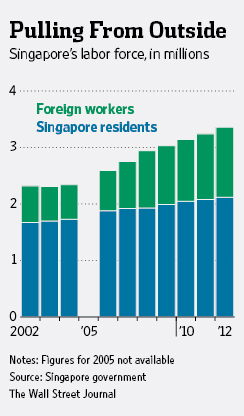
This story of a strike by Chinese bus drivers in Singapore offers a close-up look at a major issue facing the Southeast Asian city-state today: The growing number of migrant workers who underpin Singapore’s economy and the social tensions that their presence can generate. What happened over two days in late November 2012 rattled the foundations of Singapore’s economic success – its business-friendly governance and industrial harmony – and prompted a robust response from the government. The strike, a rarity in Singapore, resonated across Asia, where other countries are grappling with a growing dependence on foreign labor, too. And it provided a window into ordinary lives seldom-seen: the migrants who fan out from China in search of a fatter paycheck abroad. How to balance the need for new workers from overseas with the preservation of established ways, presents a major dilemma that policymakers and citizens will wrestle with for years to come. Read more of this post
August 26, 2013 Leave a comment
‘Iskandar intra-city rail line plan scrapped’
Published: 2013/08/26
KUALA LUMPUR: The RM1.23 billion intra-city rail line for Iskandar Malaysia in Johor, as proposed by a private party, will be scrapped, said people with first hand knowledge on the matter.
This is because the government wants to focus on the high-speed rail system linking Kuala Lumpur and Singapore, which will likely have a stop in Iskandar Malaysia, and the Rapid Transit System from Johor Baru to Woodlands, Singapore. “It does not make sense to have too many railway lines in Johor. It will be congested. We also have the Gemas-Johor Baru double-tracking project coming up,” a source told Business Times. Metropolitan Commuter Network (MCN), a 60:40 joint venture between Malaysia Steel Works (KL) Bhd (Masteel) and KUB Malaysia Bhd, had proposed to build the intra-city rail project. The joint venture first mooted the idea in 2009. Read more of this post
August 26, 2013 Leave a comment
What is shadow banking?
Stijn Claessens, Lev Ratnovski, 23 August 2013
There is much confusion about what shadow banking is and why it might create systemic risks. This column presents shadow banking as ‘all financial activities, except traditional banking, which require a private or public backstop to operate’. The idea that shadow banking is something that needs a backstop changes how we think about regulation. Although it won’t be easy, regulation is possible.
There is much confusion about what shadow banking is. Some equate it with securitisation, others with non-traditional bank activities, and yet others with non-bank lending. Regardless, most think of shadow banking as activities that can create systemic risk. This column proposes to describe shadow banking as ‘all financial activities, except traditional banking, which require a private or public backstop to operate’. Backstops can come in the form of franchise value of a bank or insurance company, or a government guarantee. The need for a backstop is a crucial feature of shadow banking, which distinguishes it from the “usual” intermediated capital market activities, such as custodians, hedge funds, leasing companies, etc. It has been very hard to ‘define’ shadow banking. The Financial Stability Board (2012) describes shadow banking as “credit intermediation involving entities and activities (fully or partially) outside the regular banking system”. This is a useful benchmark, but has two weaknesses: Read more of this post
August 26, 2013 Leave a comment
Trades from 1990s come back to haunt Wall Street
7:04am EDT
By Lauren Tara LaCapra and Dan Wilchins
(Reuters) – In the 1990s, U.S. banks came up with a clever idea: using life insurance to bet that their employees would eventually die. Now those wagers are coming back to haunt Wall Street banks for reasons that have little to do with their employees’ longevity. For more than a decade, the lenders purchased life insurance policies, known as “bank-owned life insurance,” on employees in bulk. These policies were unusual: banks chose how the premium would be invested; and were on the hook for investment losses or gains over time, unlike typical policies where the insurer invests the premium. Read more of this post
August 26, 2013 Leave a comment
August 25, 2013, 4:19 p.m. ET
Stagnant Wages Are Crimping Economic Growth
Employers Seem Wary to Raise Pay
Americans are spending enough to keep the economy rolling, but don’t expect them to splurge unless their paychecks start to grow. Four years into the economic recovery, U.S. workers’ pay still isn’t even keeping up with inflation. The average hourly pay for a nongovernment, non-supervisory worker, adjusted for price increases, declined to $8.77 last month from $8.85 at the end of the recession in June 2009, Labor Department data show. Stagnant wages erode the spending power of consumers. That means it is harder for them to make purchases ranging from refrigerators to restaurant meals that account for most of the nation’s economic growth. Read more of this post
August 26, 2013 Leave a comment
Multiples Expanding Fastest Since Dot-Com Bubble as Rally Ages
Price gains of stocks in the Standard & Poor’s 500 Index (SPX) are outpacing profits by the fastest rate in 14 years as the bull market extends beyond the average length of rallies since Harry S. Truman was president.
The benchmark gauge for U.S. equities has risen 14 percent relative to income over the past 12 months to 16 times earnings, according to data compiled by Bloomberg. Valuations last climbed this fast in the final year of the 1990s technology bubble, just before the index began a 49 percent tumble. The rally that started in March 2009 has now outlasted the average gain since 1946, the data show. Read more of this post
August 26, 2013 Leave a comment
Updated: Monday August 26, 2013 MYT 6:46:56 AM
Long leash for shadow banks
LONDON: World leaders are expected to take a softly-softly approach to regulating the so-called shadow banking sector when they meet in Russia next month to avoid damaging the flow of finance to the global economy. While governments have cracked down on risk-taking by traditional banks in the wake of the financial crisis, the shadow banking sector, an assortment of financial intermediaries that handle US$60 trillion of transactions a year – roughly the same size as the world economy – remains a source of systemic risk for taxpayers. Read more of this post
August 26, 2013 Leave a comment
Fed Officials Rebuff Coordination Calls as Stimulus Taper Looms
Federal Reserve officials rebuffed international calls to take the threat of fallout in emerging markets into account when tapering U.S. monetary stimulus.
The risk that the Fed’s trimming of bond buying will hurt economies from India to Turkey by sparking an exodus of cash and higher borrowing costs was a dominant theme at the annual meeting of central bankers and economists in Jackson Hole, Wyoming, that ended Aug. 24. An index of emerging-market stocks last week fell 2.7 percent, the steepest in two months, compared with a 0.5 percent gain in the Standard & Poor’s 500 Index. Read more of this post
August 26, 2013 Leave a comment
Bond Yields Show Selloff Beating ’09 Peaking Until Rate Rise
As the U.S. bond market suffers its worst rout since 2009, the gauge that historically signals more pain for fixed-income investors is instead suggesting yields (USGG10YR) are near their peak.
The gap between two- and 10-year Treasury yields widened to 2.55 percentage points this month, double the median of 1.23 points since 1990 and approaching the record 2.93 points in February 2010, data compiled by Bloomberg show. The yield curve is steepening at the fastest pace since 2009 as the Federal Reserve signals its intent to keep the target interest rate for overnight loans between banks at about zero into 2015 while reducing the bond-buying economic stimulus that drove 10-year yields to the highest level in more than two years. Read more of this post
August 26, 2013 Leave a comment
Best Banks ‘Barely’ Covering Capital Cost in Risk-Weight Study
Scandinavia’s biggest banks, which rank highest in a Bain & Co. a study comparing returns on risk-weighted assets, are still hardly making enough money to cover the cost of holding capital.
Nordic banks had an average return on risk-weighted assets of 1.9 percent in 2012, the highest ratio in western Europe, according to Bain’s calculations. For European banks, the average was 0.5 percent last year and zero in 2008, the report showed. Swedbank AB (SWEDA) and Svenska Handelsbanken AB (SHBA), both based in Stockholm, had the highest returns among western Europe’s biggest banks, at 4 percent and 3.6 percent, respectively. Read more of this post
August 25, 2013 Leave a comment
Taiwan’s Perng wins 10th top central banker honor
CNA 2013-08-24
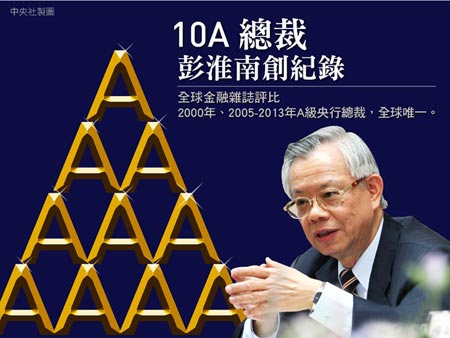
Taiwan’s central bank governor Perng Fai-nan was named as the one of the world’s top central bankers for the 10th time by Global Finance. (Photo/CNA)
Taiwan’s central bank governor Perng Fai-nan was named as the one of the world’s top central bankers for the 10th time by Global Finance on Friday in its annual report on central bankers’ performance worldwide. Perng was awarded an A for the ninth straight year from 2005-2013 in the magazine’s central bank report cards, which grades central bankers on an A to F scale. He received his first A in 2000, two years after he became governor of the Central Bank of the Republic of China (Taiwan). He is the first central bank chief to receive an A for the 10th time. Perng expressed his gratitude for the recognition and attributed his achievement to the people of Taiwan and all those who work at the central bank. Read more of this post
August 25, 2013 Leave a comment
The adidas method: A German firm’s unusual approach to designing its products
Aug 24th 2013 | HERZOGENAURACH |From the print edition
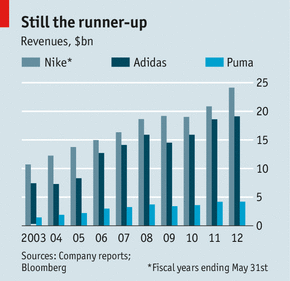
TEN years ago sportswear-makers were cramming ever more features and futuristic designs into their products. They were convinced that the consumer bought, say, training shoes based on their technical specifications. But in 2004 James Carnes, today adidas’s creative director for sportswear, and a Danish consultant named Mikkel Rasmussen met at a conference in Oslo at which Mr Rasmussen challenged this notion. A mobile phone, he said, may have 72 functions, but that is 50 more than most people wanted, or used. Mr Carnes was intrigued, and so began an almost decade-long engagement for ReD, the small consultancy Mr Rasmussen co-founded in Copenhagen. In that decade adidas’s sales and share price have grown steadily, alongside those of Nike, an American firm that is the global leader in sportswear (see chart). It remains far ahead of Puma, its crosstown rival. The two German firms, based in Herzogenaurach in Bavaria, were founded by brothers, Adi Dassler (hence adidas’s name) and the older Rudolf (Puma), who fell out. Read more of this post
August 25, 2013 Leave a comment
Multinationals in China: Guardian warriors and golden eggs; The state’s crackdowns on big firms are not all about bashing foreigners
Aug 24th 2013 | SHANGHAI |From the print edition
FOREIGN companies love to complain about doing business in China. The rules of the game are rigged against them, they grouse, the locals are corrupt and the government is always turning the thumbscrews on them. Amid such moans it is worth remembering that, for all the barriers that foreign multinationals face in China, it has welcomed them with open arms compared with the protectionism imposed by Japan and South Korea at comparable stages in their economic development. Nevertheless, the recent spate of high-profile crackdowns on international firms, and people associated with them, has prompted worries about a generalised anti-foreigner backlash. Read more of this post
August 24, 2013 Leave a comment
Last updated: August 23, 2013 8:40 pm
Too soon to buy unloved emerging markets
By Robin Wigglesworth
To be utterly unloved is an unusual state of affairs for emerging markets.
Since the economic cataclysms of the 1990s, investors in developing countries have reaped a financial bonanza. But a combination of deteriorating economic fundamentals and the US Federal Reserve’s plans to “taper” its monetary stimulus has convulsed emerging markets since the start of May. Emerging market equity fund managers are more familiar with the unpopularity of their asset class than their bond colleagues. While the latter have suffered only a few dismal months, the former have been in the doldrums for a few years. But with sentiment so overwhelmingly bearish towards equities in particular, is this a golden contrarian buying opportunity? Read more of this post
August 24, 2013 Leave a comment
August 23, 2013, 5:28 a.m. ET
Emerging Stocks’ Emerging Problems
India Shows How the Emerging-Market Selloff May Have Only Begun
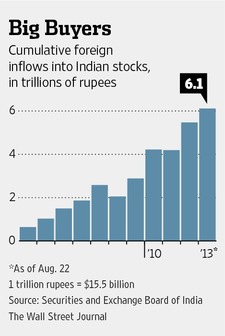
Emerging-market stocks have taken a thumping lately, and it could get a whole lot worse if foreign investors hasten their retreat. The MSCI Emerging Markets index is down 12.6% for the year, but it appears a lot of the selloff has been driven by local players. Foreigners have been slow to get out of emerging-market stocks. In fact, for most of the year they have been putting more money to work, according to EPFR, including inflows into stock funds much of the past two months. Read more of this post
August 24, 2013 Leave a comment
Hot Potato: Momentum As An Investment Strategy
August 2013 | Ryan Larson
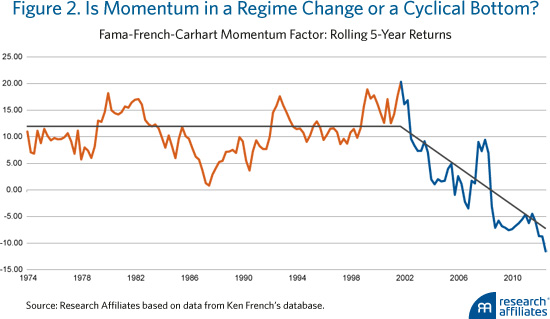
Momentum investing has important features in common with other factor-based Smart Beta strategies. For example, it has straightforward index or portfolio construction rules that are easily explained and implemented. And, although momentum investing is emphatically not a contrarian strategy, neither is it necessarily inconsistent with the Smart Beta thesis that prices are noisy and mean-reverting. In this interpretation, momentum investing is a lively game of hot potato—buying rapidly appreciating stocks, holding them for a relatively short period, and selling them before their price trends reverse direction. And in favorable conditions it works very well. Read more of this post

咬定青山不放松,立根原在破岩中。 千磨万击还坚劲,任尔东西南北风。

