Does investing in gold have a future?

Last updated: August 23, 2013 7:33 pm

Does investing in gold have a future?

By Jonathan Eley

Few asset classes polarise opinion quite like gold. For some, it is the ultimate store of value that has withstood every crisis for millennia and will still be standing when the world’s financial system finally collapses under the weight of its own debt. For others, it is the “barbarous relic” that John Maynard Keynes so disdained, a non-productive, non-yielding asset beloved of crackpots and conspiracy theorists. Read more of this post

Why IKEA Doesn’t Care If Its Delivery Service Is A Nightmare; “Amazon can disrupt anything that doesn’t have to be assembled or curated”

Why IKEA Doesn’t Care If Its Delivery Service Is A Nightmare

JESSICA WINTER, SLATE AUG. 23, 2013, 10:54 AM 1,659 3

It all started because I wanted the Nelson Swag Leg Desk. Not a new, licensed reproduction—I wanted the scuffed-up, 1960-vintage Nelson Swag Leg Desk I found on eBay. It seemed to me mostly irrelevant that I could not afford the Nelson Swag Leg Desk. But my husband suggested a budgetary adjustment: Instead of pairing the Nelson Swag Leg Desk with pricey custom-built bookshelves as planned, we could economize with a jumbo set of Ikea’s Billy bookcases, which fit the appointed space almost to the centimeter. At first, I resisted this financially expedient arranged marriage of a modern-design icon to a prosaic dorm-room staple that I associated with beer pong and Gustav Klimt’s The Kiss. Eventually, though, I started talking myself into the compromise. I tried to think of it as a chic high-low flourish, like Anna Wintour pairing couture with jeans on her first Vogue cover, or Mike D plonking a Target pouf smack in the middle of his otherwise ultra-customized Brooklyn townhouse. Or something.

Read more of this post

No excuse for Glencore Xstrata writedown; Argument claiming ‘accounting construct’ fails to convince

Last updated: August 23, 2013 1:52 pm

No excuse for Glencore Xstrata writedown

By Paul Murphy

Argument claiming ‘accounting construct’ fails to convince

When large companies announce big asset impairment charges after a controversial takeover, as Glencore Xstrata did this week, two things happen. First, the financial press bang the multibillion-dollar figure into a headline or two; then, almost immediately, ranks of investment banking analysts step up to explain, in condescending tones, that this is just an accounting exercise and really doesn’t matter since no cash was involved. If the acquisition under debate involved the predator paying solely or largely in shares, as Glencore did in acquiring Xstrata, then those ignorant newspaper headlines are treated with complete disdain. Read more of this post

In the past year, Chinese films have galloped ahead like a dark horse, beating Hollywood imports

Fast forward with film

Updated: 2013-08-23 23:54

By Raymond Zhou ( China Daily)

In the past year, Chinese films have galloped ahead like a dark horse, beating Hollywood imports.

It is hardly surprising that most of these domestic hits are comedies. Comedy is mostly local.When Hollywood sent scouts to recover the secret formula, many of them reported that theseChinese movies were not particularly funny. Of course not. When you translate every line intoEnglish, you have lost much of the fun, leaving only a few sight gags. You have to sit with a full-house local audience to gauge the effect of these movies. Read more of this post

Illegal rooftop temple prompts unholy ire in Chinese city

Illegal rooftop temple prompts unholy ire in Chinese city

A privately-built illegal temple-like structure is seen on the top of a 20-storey residential block in the southern Chinese city of Shenzhen

Thu, Aug 22 2013

By Alexandra Hoegberg

(Reuters) – An elaborate temple-like structure perched on an apartment block in southeastern China is an illegal hazard that should be torn down, residents say. But they may not be as lucky as opponents of a lavish rooftop villa in Beijing. The temple in Shenzhen is believed to have been on the roof for about seven years but the complaints have hit the spotlight only after a doctor in Beijing was given 15 days to demolish his 800-square-metre (8,600-square-foot) house and garden built illegally atop a 26-storey apartment block. Read more of this post

Chinese Airlines Lure Pilots With Double the Pay of U.S. Captains; Carriers Boost Salaries to Hire Seasoned Crews, Causing Shortage Across Asia

August 23, 2013, 6:54 p.m. ET

Chinese Airlines Lure Pilots With Double the Pay of U.S. Captains

Carriers Boost Salaries to Hire Seasoned Crews, Causing Shortage Across Asia

JEFFREY NG

HONG KONG—China is snapping up the world’s supply of senior pilots, contributing to a global shortage and creating headwinds for Asia’s fast-expanding airlines. China is among the world’s fastest-growing air-travel markets, with domestic passenger traffic second only to the U.S., with the market expanding 14.7% in June compared with a year earlier, according to the International Air Transport Association. The rising middle class in China means millions more people are taking to the skies. Beijing plans soon to allow even more growth in its tightly controlled sector by encouraging the development of budget airlines, which are already booming across Asia. Read more of this post

Picky Fund Flows May Shield Northeast Asia Currencies From Fed Storm

Picky Fund Flows May Shield Northeast Asia Currencies From Fed Storm

By Jonathan Vit on 10:36 am August 23, 2013.
Singapore. Faced with tumbling markets as the US Federal Reserve becomes more likely to ease its stimulus measures, investors dedicated to emerging Asian markets are betting that the South Korean won and Taiwan dollar will fare better than their Southeast Asian counterparts. Dedicated Asian investors have to invest in the region so they are putting their money into Taiwan and Korea. Read more of this post

“Asean countries were almost the darlings of Asia for some time because people were saying they had higher growth prospects”

nvestors on High Alert After Rupiah Dive

By Yudith Ho, Liau Y-Sing & Yumi Teso on 11:08 am August 24, 2013.
The Thai baht and Malaysian ringgit are under closer scrutiny from investors concerned that worsening economic data will put them in a similar predicament to the Indonesian rupiah, which plunged 11 percent this year. The baht dropped 2.1 percent this week and the ringgit declined 0.8 percent as money was pulled from emerging-market assets on speculation the US Federal Reserve will soon start tapering stimulus. The rupiah slid 4.2 percent during the week, the most since November 2008, after the country reported a record current-account deficit on Aug. 16. Read more of this post

Thailand’s joining Japan and Korea as one of the “old men” of Asia

Thailand’s joining Japan and Korea as one of the “old men” of Asia

By Gwynn Guilford @sinoceros August 23, 2013

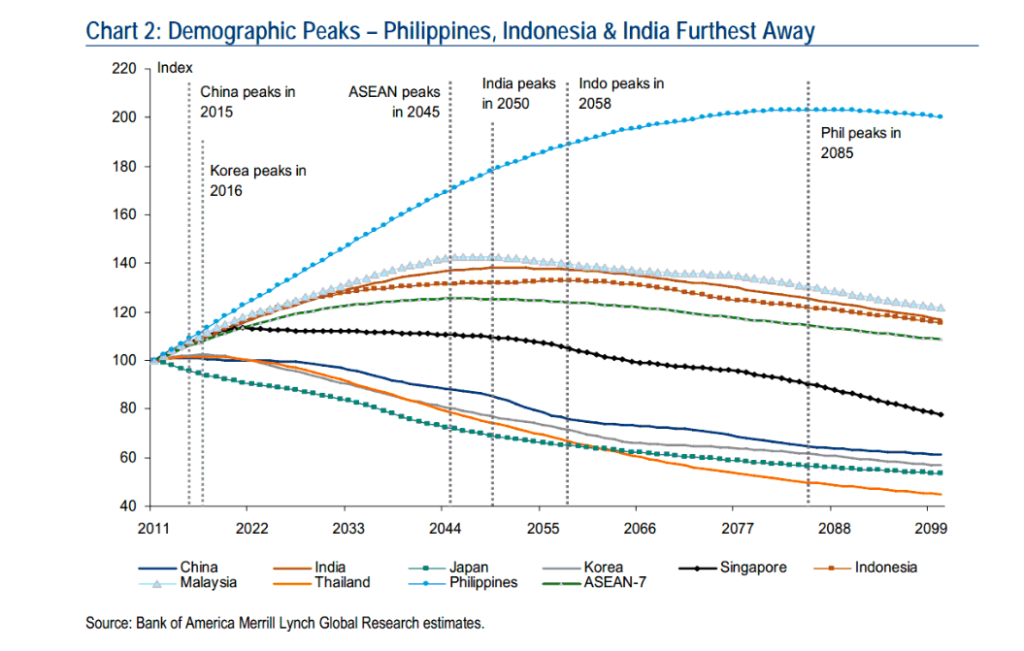
The latest news on Thailand’s economy has been grim. Not only did the country enter a recession (paywall) in the second quarter of this year, but it increasingly faces the twin specters of rising household debt and capital outflows. And now there’s news that makes the outlook even grayer—literally. As a new Bank of America/Merrill Lynch report puts it, Thailand is “emerging as the old man” of Southeast Asia. Due to a low fertility rate, its population is aging faster than previously assumed. The dangerous implication for its economy is that Thailand’s working-age population will peak in 2017, rather than 2020, according to recent recalculations by the United Nations. So the labor force will start shrinking sooner than planned, falling 1.2% between now and 2023, according to BofA/ML projections. More on why that’s bad in a moment, but first, here’s the chart. As you can see, by about 2060, Thailand’s working-age (the orange line) population shrinkage will have become the biggest in Asia:

screen-shot-2013-08-23-at-9-23-41-am

(Data indicate working-age population, not total population.) Read more of this post

Foreign workers in Singapore rush to cash in weak rupee, rupiah

Foreign workers in Singapore rush to cash in weak rupee, rupiah

Amelia Tan, The Straits Times/ANN, Singapore | Business | Fri, August 23 2013, 1:48 PM

India and Indonesia nationals working in Singapore are scrambling to change money as their currencies languish at multi-year lows. Others are rushing to send funds home after the rupee and rupiah declined sharply over the past week. Remittance shops and money changers in areas such as Serangoon Road said that they had been serving up to double the usual number of customers from both countries since Monday. Read more of this post

Currency sell-off: Tragedy in three acts; Emerging market darlings have lost their lustre as investors ponder life without US quantitative easing

August 23, 2013 5:52 pm

Currency sell-off: Tragedy in three acts

By Victor Mallet

Emerging market darlings have lost their lustre as investors ponder life without US quantitative easing

Droopy rupee: India’s currency plumbed record lows this week as investors withdrew money from emerging markets

India, 1991. Thailand and east Asia, 1997. Russia, 1998. Lehman Brothers, 2008. The eurozone from 2009. And now, perhaps, India and the emerging markets all over again. Each financial crisis manifests itself in new places and different forms. Back in 2010, José Sócrates, who was struggling as Portugal’s prime minister to avert a humiliating international bailout, ruefully explained how he had just learned to use his mobile telephone for instant updates on European sovereign bond yields. It did him no good. Six months later he was gone and Portugal was asking for help from the International Monetary Fund. This year it is the turn of Indian ministers and central bankers to stare glumly at the screens of their BlackBerrys and iPhones, although their preoccupation is the rate of the rupee against the dollar. Read more of this post

Malaysia’s second-largest bank CIMB May Miss Break-Even Target on 2012 Purchase of RBS Investment Banking Units

CIMB May Miss Break-Even Target on RBS Banking Units Buy

CIMB Group Holdings Bhd. (CIMB), Malaysia’s second-largest bank by assets, may not break even as planned by the end of this year on its 2012 purchase of most of Royal Bank of Scotland Group Plc (RBS)’s Asia-Pacific investment banking assets. As stocks and currencies slide, “I don’t know” if the businesses will cover costs associated with the acquisition, Chief Executive Officer Nazir Razak said in an interview with Bloomberg TV’s Haslinda Amin yesterday. Read more of this post

Spanish football offside as excesses cast shadow on new season; Spain’s economic crisis hits debt-fuelled clubs hard

August 23, 2013 2:14 pm

Spanish football offside as excesses cast shadow on new season

By Tobias Buck in Madrid

When FC Barcelona travel to Málaga on Sunday for their second match of the Spanish football season, fans are likely to witness a profoundly uneven contest.

Barcelona are the reigning champions ofSpain and hailed as one of the best sides to have ever played the game. The team includes Lionel Messi, the four-time European footballer of the year, as well as Neymar, a Brazilian forward who joined Barca for an eye-popping €57m this summer. Read more of this post

Since Citi Bike launched in late May, the number of complaints about America’s largest bike-share system have decreased sharply—even as ridership increased

Updated August 23, 2013, 10:17 p.m. ET

Bike-Share Complaints Drop, for Now

Calls to City’s 311 Line Fall Sharply Even as Ridership Shoots Up

DEREK KRAVITZ

NY-CN602A_NYCIT_NS_20130823170903

When Citi Bike launched during the last five days of May, users called 311 an average of 17 times a day to complain about malfunctioning stations, app glitches and other kinks, according to city data. But since then, the number of complaints about the nation’s largest bike-share system have decreased sharply—even as ridership increased, according to city data. Read more of this post

Richard Vedder: The Real Reason College Costs So Much; The expert on the economics of higher education explains how subsidies fuel rising prices and why there’s a ‘bubble’ in student loans and college enrollment

August 23, 2013, 7:08 p.m. ET

Richard Vedder: The Real Reason College Costs So Much

The expert on the economics of higher education explains how subsidies fuel rising prices and why there’s a ‘bubble’ in student loans and college enrollment.

ALLYSIA FINLEY

Another school year beckons, which means it’s time for President Obama to go on another college retreat. “He loves college tours,” says Ohio University’s Richard Vedder, who directs the Center for College Affordability and Productivity. “Colleges are an escape from reality. Believe me, I’ve lived in one for half a century. It’s like living in Disneyland. They’re these little isolated enclaves of nonreality.” Read more of this post

Lofty Profit Margins and Shrinking Share of GDP Going to Worker Compensation Hint at Pain to Come for Stocks

Updated August 23, 2013, 5:24 p.m. ET

Lofty Profit Margins Hint at Pain to Come for Stocks

With Margins Near Record Levels, It Looks Like There’s Only One Direction for Shares to Go

MARK HULBERT

BF-AF624_HULBER_G_20130823160303

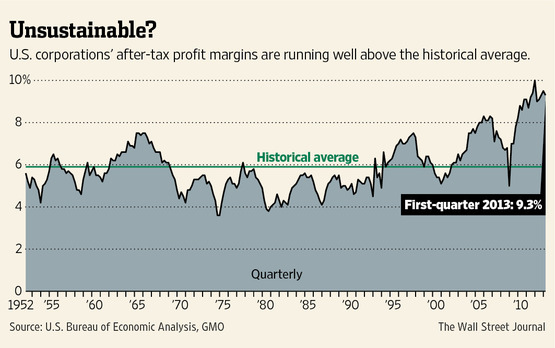
Profit margins at near-record levels—watch out below! If you are wondering what might prove to be the stock market’s Achilles’ heel, look no further than its dependency on near-record corporate profit margins. Any sizable decline would almost certainly translate into big losses for the stock market. Given the current high levels, such a retreat seems likely. Investors therefore may want to begin building up a healthy cash position to take advantage of lower prices in coming years. Read more of this post

Discount stores thrived during the recession, but that may be approaching an end for all the wrong reasons. It highlights the nation’s uneven economic recovery; many Americans still aren’t benefiting from riding the wave of higher stock and home prices

The end of the dollar store recovery

By Nin-Hai Tseng, Writer August 23, 2013: 10:18 AM ET

Discount stores thrived during the recession, but that may be approaching an end for all the wrong reasons.

FORTUNE – Dollar stores were one of the few bright spots in U.S. retail during the Great Recession as cash-strapped consumers looked to do more with less. And while many are still going to these discounters for bargains, they’re also buying less. On Thursday, Dollar Tree (DLTR) reported that its second-quarter profit rose 4.6% from a year earlier — its stock jumped after the discount retailer raised its forecast for the rest of the year, but profits reflected a relatively modest increase for a company that saw double-digit earnings growth for the past five years. Read more of this post

Indonesia unveils emergency fiscal package to revive confidence

August 23, 2013 12:19 pm

Indonesia unveils emergency fiscal package to revive confidence

JAKARTA, August 23 – Indonesia’s government unveiled an emergency fiscal package on Friday to promote foreign investment, reduce imports and prop up itstumbling rupiah currency, as it struggles to revive confidence in southeast Asia’s largest economy. The intervention follows a punishing week for emerging markets, with currencies from Brazil to India shaken by fears of higher global borrowing costs and a reduction in cheap cash from the US. Read more of this post

Value Partners’ Cheah Cheng Hye: A global financial crisis bigger than the one in 2008 is conceivable in five to 10 years.

Updated: Friday August 23, 2013 MYT 7:04:00 AM

A bigger global crisis possible

BY DAVID TAN
DAVIDTAN@THESTAR.COM.MY

bizd_pc_2308_p6

GEORGE TOWN: A global financial crisis bigger than the one in 2008 is conceivable in five to 10 years. Value Partners Group chairman and co-investment officer Cheah Cheng Hye said the crisis, which would not be V-shaped in nature, would bring about capital flights, volatile markets, rising inflation and social unrest. “The global financial crisis would have to do with the very serious deficits that cannot be financed. Developed and developing countries have over the years accumulated such deficits by making promises that cannot be realised in order to get re-elected. “These deficits would sow the seeds of future social and political unrest,” he said at a public lecture entitled From Journalist to Fund Manager, which was officiated by Penang Chief Minister Lim Guan Eng. Also present was Penang Institute chief executive officer Zairil Khir Johari. On Malaysia, Cheah said Value Partners was not bullish about the country. “Malaysia’s Government and household debts are higher than those in Indonesia, China and Thailand. Half of the country’s government bonds are held by foreigners, who would be the first to run in a crisis. “The Malaysian workforce is now less productive than the workforce in Thailand and the Philippines. Malaysia is also importing more oil than selling it,” he said. Read more of this post

Why China’s wine exchange is crashing: 110-proof grain alcohol all tastes much the same

Why China’s wine exchange is crashing: 110-proof grain alcohol all tastes much the same

By Gwynn Guilford @sinoceros 12 hours ago

Imagine a stock that jumps 25.5% on its first day of trading, coming to rest at $159 a share. Three months later, though, shares tank, plummeting to $54. Now, 17 months after going public, it’s worth $58.70. Nope, it’s not Groupon. It’s “Crystal Shede 2012 Collector’s Edition,” a 110-proof rice wine (or baijiu, as it’s known) made by a Sichuan distiller called Tuopai Shede, and it brought in 77 million yuan ($12.4 million) from its public offering on the Shanghai International Wine Exchange (SIWE). Read more of this post

China Feels Emerging-Market Headwinds

Aug 23, 2013

China Feels Emerging-Market Headwinds

By Richard Silk

The wind-down of an extraordinary period of monetary stimulus in the U.S. could cast a shadow over China’s fragile growth, raising fears of renewed stress in financial markets and a hit to the budding recovery in exports. The flow of funds out of Asia—anticipating higher U.S. interest rates—has not yet hammered China as badly as some of its neighbors. That’s largely because China imposes broad controls on capital, limiting foreign investments in stocks, bonds and property as well as the money Chinese investors can send overseas. Read more of this post

Chinese Consumers Step Back, Pinching Firms; Canon, Nike and Apple Feel Squeeze in Economic Slowdown

August 22, 2013, 5:48 p.m. ET

Chinese Consumers Step Back, Pinching Firms

Canon, Nike and Apple Feel Squeeze in Economic Slowdown

RICHARD SILK

BEIJING—Companies as diverse as retailers and gadget makers are reporting weakened results from China, as the economic slowdown there blunts Beijing’s drive to make the nation’s consumers a bigger driver of growth. Last month, Canon Inc. 7751.TO +1.07% cut the Japanese company’s year-end profit forecast to ¥380 billion ($3.89 billion), off 16% from forecasts three months earlier, citing in part the slowdown in China. Nike Inc. NKE -0.72% reported falling China sales in its latest results, while British supermarket chain Tesco TSCO.LN +1.42%PLC is in talks with a local company, China Resources Enterprise Ltd.,0291.HK -1.51% about folding its 131 underperforming Chinese stores into a joint venture. Read more of this post

Fitch’s Charlene Chu Is the ‘Rock Star’ of Chinese Debt Analysis; At worst, Ms Chu predicts, a crisis is brewing. At best, China is at risk of a long, debt-laden economic slowdown.

August 22, 2013, 11:17 p.m. ET

Charlene Chu Is the ‘Rock Star’ of Chinese Debt Analysis

The Fitch Staffer Has Emerged as One of the Most Sought-after Experts on Chinese Finance

ALEX FRANGOS

MI-BY047_CHARLE_G_20130822180604

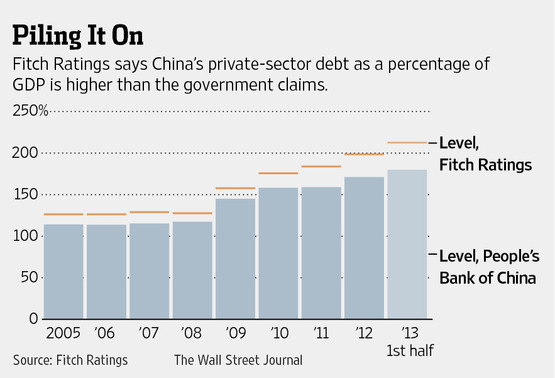
When top officials at the U.S. Federal Reserve want to understand the Chinese financial system, they meet Charlene Chu. Goldman Sachs, GS -0.74% which isn’t short of China experts, interviewed her and sent the transcript to its clients. And one of the world’s most influential investment firms calls her a rock star. From her cubicle in a Beijing office tower, Ms. Chu, who works for bond-rating firm Fitch Ratings, has emerged as one of the most sought-after experts on China’s increasingly risky financial system. Read more of this post

Radioactive groundwater under Fukushima nears sea

RADIOACTIVE GROUNDWATER UNDER FUKUSHIMA NEARS SEA

By MARI YAMAGUCHI

— Aug. 23 7:02 AM EDT

TOKYO (AP) — Deep beneath Fukushima’s crippled nuclear power station a massive underground reservoir of contaminated water that began spilling from the plant’s reactors after the 2011 earthquake and tsunami has been creeping slowly toward the sea. Now, 2 1/2 years later, experts fear it is about to reach the Pacific and greatly worsen what is fast becoming a new crisis at Fukushima: the inability to contain vast quantities of radioactive water. Read more of this post

Fed Burned Once Over Taper Now Twice Shy on QE3

Fed Burned Once Over Taper Now Twice Shy on QE3

U.S. central bankers have $3 trillion of losses reminding them they had better get their communications right should they decide to taper their bond purchases.

That’s how much global equity markets declined in the five days after Federal Reserve Chairman Ben S. Bernanke’s June 19 remarks that he may reduce his $85 billion in monthly securities buying this year and halt it altogether by mid-2014. His comments pushed the yield on the benchmark 10-year Treasury to a 22-month high. Read more of this post

India to Import Onions for First Time Since 2011 as Prices Surge; Onion prices in Delhi surged to 60 rupees (93 cents) a kilogram (2.2 pounds) from 16 rupees three months ago; “The government isn’t caring enough about us.”

India to Import Onions for First Time Since 2011 as Prices Surge

India is preparing to import onions for the first time in two years as a surge in prices threatens to trigger a backlash against Prime Minister Manmohan Singh before next year’s elections.

Prices of the vegetable have almost quadrupled in three months in New Delhi as the government struggles to tackle the highest inflation among the biggest emerging markets. State-run trading company PEC Ltd. this week sought overseas suppliers to deliver as much as 300,000 tons of onions, while National Agricultural Cooperative Marketing Federation of India Ltd. said the country may buy from China, Iran, Egypt and Pakistan. Read more of this post

Indian Billionaire Costs Climb as $18 Billion of Debt Due

Billionaire Costs Climb as $18 Billion of Debt Due: India Credit

Default risk for Indian companies has risen to a one-year high as a plunging rupee increases the cost of repaying $18 billion of debt due by March.

Companies led by billionaires Mukesh Ambani and Anil Agarwal are among borrowers with $10.6 billion of bonds and loans maturing by Dec. 31 and $7.4 billion in the following three months, data compiled by Bloomberg show. The average cost of insuring notes of seven Indian issuers against non-payment has risen 90 basis points in 2013 to 360 basis points as of Aug. 21, the highest since September, according to data provider CMA. A similar measure for Asia fell 23 basis points to 135. Read more of this post

Zombie borrowers haunt China’s shadow banks

Zombie borrowers haunt China’s shadow banks

12:24am EDT

By Gabriel Wildau

SHANGHAI (Reuters) – Call it the new China Syndrome: Although Asia’s biggest economy is slowing down markedly, credit continues to surge. Dead-end projects and dying industries are sucking up an ever-larger portion of new credit, while more productive borrowers are starved for funds. Nowhere is this more evident than in China’s shadow banking sector, the non-bank financiers that have pumped credit into the economy at a spectacular rate. Trust companies – firms that sell investment products to Chinese savers and use the proceeds to make loans or buy other types of assets – have posted the fastest growth. Read more of this post

New study reveals corruption pattern in China

New study reveals corruption pattern

Updated: 2013-08-22 07:41

By Tang Yue, Zhang Yuchen and Wu Wencong ( China Daily)

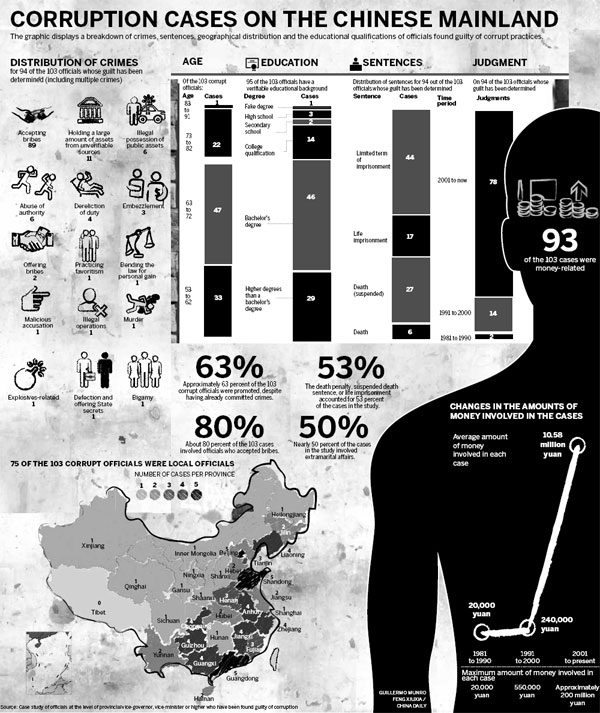
Many fallen officials had occupied high-level posts, report Tang Yue, Zhang Yuchen and Wu Wencong.

02587d4d8601137f9e2a2b Read more of this post

or Banks, the Chinese ‘Princeling’ Stock Has Fallen; Drought in IPO Market Curbs Need for Elite Connections

August 22, 2013, 11:46 a.m. ET

For Banks, the Chinese ‘Princeling’ Stock Has Fallen

Drought in IPO Market Curbs Need for Elite Connections

WEI GU

AM-AZ946_WEICOL_G_20130822113605

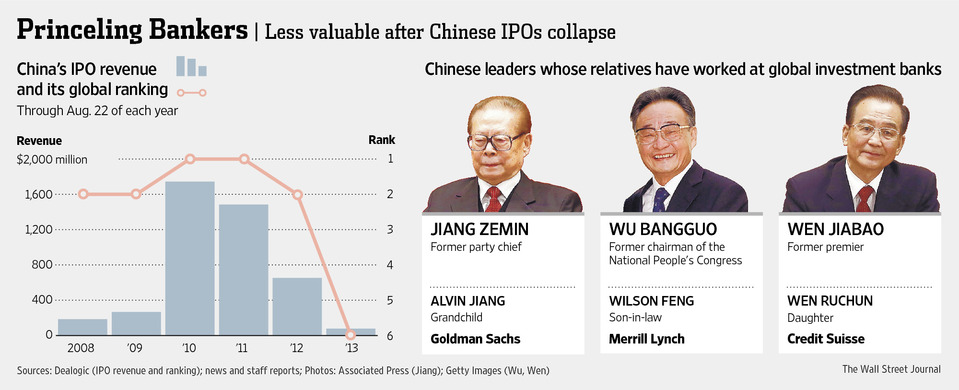
The great irony of the U.S. government’s investigation into the hiring of Chinese princelings by J.P. Morgan Chase JPM +1.12% & Co. is that right now, the children of China’s elite aren’t that valuable to the big investment banks. China’s state-owned companies, where the princelings could help the most, are far less important to the banks than they were when there was a steady parade of multibillion-dollar initial public offerings. Recently, China has suffered an IPO drought. Read more of this post