Korea’s leading brokerage houses are reeling from the unprecedented earning shocks many suffered between April and June in the wake of the prolonged market slump

2013-08-18 16:48

Soaring loss hits Hyundai Securities

By Yi Whan-woo
A number of the nation’s leading brokerage houses are reeling from the unprecedented earning shocks many suffered between April and June in the wake of the prolonged market slump. Among them, Hyundai Securities suffered the worst performance, with its operating loss expanding to 25.6 billion won ($23 million) in the first quarter from the previous year’s 11.4 billion won loss. Brokerages close their books in March. Daeshin Securities also had its operating loss more than double to 14.3 billion won during the same period. The worsening performance was due mainly to a toxic mixture of sluggish trading caused by the prolonged market slump and the rise in yields on bonds following U.S. Federal Reserve Chairman Ben Bernanke’s remark on ending the economic stimulus policy. Bernanke said in June that the U.S. economy offers hints of the possibility of beginning to slow the pace of its bond-buying stimulus. KDB Daewoo Securities, the No. 1 market player, posted an operating profit of 3.76 billion won ($3.36 million) in the April-June period, down 86.8 percent from the previous year and worse than the 56 percent forecasted by FnGuide, a financial news provider. Samsung Securities posted an operating profit of 15.4 billion won, a 63 percent year-on-year decrease. Mirae Assets Securities said its operating profit fall by more than six-fold during the same period, down 19.8 billion won in 2011 to 3 billion won this year. In contrast, there are a couple of firms that have managed to weather the market slump. Korea Investment & Securities posted an operating profit of 24.7 billion won in the first quarter, up 10 percent from a year before. Shinhan Investment, the securities arm of Shinhan Financial Group, and Hana Daetoo Securities, also saw their operating profits jump by 298 percent and 606 percent, respectively, to 19.7 billion won and 4 billion won, during the cited period.

Older S. Koreans flock to smartphones

Older S. Koreans flock to smartphones

Weon Yo-hwan/ Sohn Yoo-ri

South Korea’s ‘Silver Mobilian’ is making headway in maneuvering smart devices. ‘Silver Mobilian’ is the newly-coined term that combines ‘silver’ with ‘mobilian’ referring to those changing their way of living with mobile devices. It means financially well-off older generation who utilizes mobile devices and social networking service (SNS) in active manners. Smart devices including smartphones and tablet PCs are no longer excusive tools for young generation. The rate of wireless internet usage among those in their 50s grew a startling 35.2 percent compared to a year ago, according to the Korea Internet & Security Agency (KISA)’s report released earlier this year. The growth among those in their 50 was steeper than among those in their 20s (5.3 percent) or 30s (19.6 percent).  Read more of this post

The Kaesong Trap: Restarting the industrial zone may restrict Seoul’s ability to respond to the North’s provocations

August 18, 2013, 1:03 p.m. ET

The Kaesong Trap

Restarting the industrial zone may restrict Seoul’s ability to respond to the North’s provocations.

BRUCE KLINGNER

South and North Korean negotiators reached a preliminary agreement last week to reopen the jointly run industrial zone in Kaesong. But their success against considerable odds raises several questions.

Most fundamentally, why does Seoul want to return to Kaesong in the first place? The benefits lop-sidedly accrue to Pyongyang, providing a steady source of hard currency to the beleaguered regime. On the southern side, there is no economic incentive, corporate advocacy or political interest in expanding the complex. Even before the most recent round of North Korean threats, Kaesong was on life-support. Read more of this post

Thai Growth Slows as Scope for Monetary Stimulus Seen Limited

Thai Growth Slows as Scope for Monetary Stimulus Seen Limited

Thai economic growth slowed for a second quarter as exports cooled and local demand weakened, with rising household debt restricting the scope for monetary easing.

Gross domestic product increased 2.8 percent in the three months through June from a year earlier, after expanding a revised 5.4 percent in the previous quarter, the National Economic and Social Development Board said in Bangkok today. The median of 16 estimates in a Bloomberg survey was 3.3 percent.

Southeast Asian nations from Singapore to Indonesia have seen exports falter as growth slows in China, and Europe and Japan struggle to sustain economic recoveries. The Bank of Thailand will hold the policy interest rate at 2.5 percent at its Aug. 21 meeting, a Bloomberg survey showed, after Assistant Governor Paiboon Kittisrikangwan said last month that household debt at 80 percent of GDP limits the scope for further easing. Read more of this post

Pemandu CEO: Innovation is not dead in Malaysia; Lim Kon Liang makes better hospital beds much more cheaply than the established manufacturers and they are sold to more than 40 countries world wide

Updated: Monday August 19, 2013 MYT 9:05:12 AM

Innovation is not dead in Malaysia

TRANSFORMATION UNPLUGGED BY IDRIS JALA

While innovation happens, we need it to happen much more often

WE can all certainly appreciate that one of the most difficult of things to teach – and to learn – is without doubt innovation, the ability to do things differently from how it was done before to bring about beneficial change for a person, organisation or country.

It’s almost a state of mind, an attitude which encourages the creative process in solving problems by looking at things from different angles and taking unconventional but effective measures in a holistic manner to bring about desired change. Read more of this post

U.S. Stocks Beat BRICs by Most Ever Amid Emerging Market Flight

U.S. Stocks Beat BRICs by Most Ever Amid Emerging Market Flight

Investors are favoring U.S. stocks over emerging markets by the most ever as fund flows and volatility measures show institutions are increasingly seeking the relative safety of American equities.

Almost $95 billion was poured into exchange-traded funds of American shares this year, while developing-nation ETFs saw withdrawals of $8.4 billion, according to data compiled by Bloomberg. The Standard & Poor’s 500 Index (SPX) trades at 16 times profit, 70 percent more than the MSCI Emerging Markets Index. A measure of historical price swings indicates the U.S. market is the calmest in more than six years compared with shares from China, Brazil, India and Russia. Read more of this post

Twilight of Bernanke Years Shows No Sign of Buyer’s Rem

Twilight of Bernanke Years Shows No Sign of Buyer’s Rem

U.S. markets are backing up Ben S. Bernanke’s assertion that he has the best inflation record of any Federal Reserve chairman since World War II.

Since Bernanke took office in February 2006, inflation as measured by the personal-consumption-expenditures price index has averaged 1.9 percent. Criticism from Republicans, including House Speaker John Boehner of Ohio, that the Fed’s stimulus would spark a rapid acceleration in prices is unfounded, bond yields show. Traders anticipate prices will rise at a 2.17 percent rate in the next decade, near the Fed’s 2 percent goal. Read more of this post

The glut of capital that desperately requires guidance; Capital demands solutions that the world currently lacks

August 18, 2013 4:32 pm

The glut of capital that desperately requires guidance

By John Authers

Capital demands solutions that the world currently lacks

What happens when there is too much capital? It may be a good problem to have, but it demands solutions that the world currently lacks.

Measure capital as the sum of all financial assets and, according to the management consultants Bain & Company, global capital tripled between 1990 and 2010 – driven by financial wizardry, and increasing leverage. As financial services groups introduced new products, and populations looked for new ways to save, the supply of financial assets outstripped growth in the underlying economy. Read more of this post

Tapering plan drives investors into riskier debt

August 18, 2013 6:21 pm

Tapering plan drives investors into riskier debt

By Stephen Foley and Vivianne Rodrigues in New York

The Federal Reserve’s plan to end quantitative easing, in part to prevent financial bubbles, is in fact driving investors into riskier corners of the debt markets.

While the safest bonds have sold off hardest since Ben Bernanke, Fed chairman, set a timetable for tapering its monetary stimulus, the best-performing fixed-income assets have been the lowest-rated junk bonds. Read more of this post

More than 100 mutual funds have 80% of their assets in ETFs, which are cheaper and more efficient to trade. So why are the mutual funds that invest in them more expensive?

SATURDAY, AUGUST 17, 2013

Mutual Funds Use ETFs as a Shortcut

By STEVE GARMHAUSEN | MORE ARTICLES BY AUTHOR

ETFs have become increasingly popular with all sorts of investors—including mutual fund managers. More than 100 mutual funds have 80% of their assets in ETFs, which are cheaper and more efficient to trade. So why are the mutual funds that invest in them more expensive?

File under: If you can’t beat ’em, join ’em. The popularity of the $1.5 trillion exchange-traded-fund industry is indisputable. But what’s surprising is how popular ETFs have become with mutual-fund managers. In fact, the past five years have seen the launch of about 100 funds that hold at least 80% of their assets in ETFs, according to Morningstar. And it’s becoming more and more common for managers of conventional mutual funds to use ETFs here and there for “tactical” purposes. Read more of this post

Inverse ETFs in the Hot Seat

SATURDAY, AUGUST 17, 2013

Inverse ETFs in the Hot Seat

By BRENDAN CONWAY | MORE ARTICLES BY AUTHOR

Leveraged ETFs have a bad rap—as they should. But while they could be disastrous for your portfolio, they probably won’t damage the health of the market. Probably.

For individual investors, leveraged exchange-traded funds present a number of dangers, most prominently the chance to lose a lot of money very quickly. But are they dangerous to the health of the market, as well? These niche ETFs are built specifically for traders: They aren’t meant to be held, even overnight. If you own, say, a Direxion triple inverse Chinese-stock fund for more than a day, your investment moves in unpredictable directions, since the strategies used to create the leverage are reset every single day. So, if you hold one of these leveraged or inverse ETFs—and there are now some 250 of them—your return over time will bear little relation to the underlying index. It’s for this reason the Financial Industry Regulatory Authority has come down on the industry, and fined four big-name brokerages last year, for wrongly selling these ETFs to buy-and-hold clients. Read more of this post

Govts face extra debt costs as stimulus dries up

Updated: Monday August 19, 2013 MYT 6:51:22 AM

Govts face extra debt costs as stimulus dries up

PARIS: Governments face a rise in their borrowing costs due to the winding down of monetary stimulus programmes and as investors bet on central banks hiking interest rates sooner than promised. Moody’s Analytics warned last week that “US rates could rise as the Fed moves to slow its purchases of long-term debt, which in turn could push up the yields on European government bonds.” Read more of this post

Chinatown buses: Driving them out of business; For some 15 years “Chinatown bus” lines have shuttled thrifty folk between east-coast cities for a fraction of the price of name-brand carriers

Chinatown buses: Driving them out of business

Regulators nobble cheap travel

Aug 17th 2013 | WASHINGTON, DC |From the print edition

FRUGAL travellers in America’s north-east have heard the stories. There was the bus that rolled over from going too fast. There was the one that, somehow, lost its rear wheels. A few others burst into flames. Yet potential passengers still gather near the Chinese gate in Washington, DC to catch a cheap ride to New York. A one-way ticket costs around $20, against a whopping $150 on the train. It is far from luxurious, but you can watch films on your iPad or flirt with the other young travellers.

For some 15 years “Chinatown bus” lines have shuttled thrifty folk between east-coast cities for a fraction of the price of name-brand carriers. Chinese immigrants were first to hop aboard, followed by college students and other cash-strapped Americans. Read more of this post

Brazil tries to fill the potholes in its path to growth; Potholed roads among the worst in the world

August 18, 2013 12:25 pm

Brazil tries to fill the potholes in its path to growth

By Joe Leahy in São Paulo

Fernando Atisto has one of the most dangerous jobs in Brazil. He delivers fresh produce to São Paulo’s central market. “The roads getting here are terrible and, aside from that, dangerous. There are a lot of potholes even on the privately run ones,” said the truck driver, who has just delivered a haul of apples to the Ceagesp market from São Joaquim in Santa Catarina state, more than 800km away. When people in South America’s biggest city shop at the supermarket, they rarely spare a thought for the sacrifice required to ensure there is food on the shelves. In a country with some of the world’s poorest infrastructure and most congested cities, every apple or piece of meat that reaches a supermarket must undergo a journey that is as perilous for truck drivers as it is tedious. Read more of this post

Audit the auditors; Rule changes will make the profession serve investors better

August 18, 2013 4:52 pm

Audit the auditors

Rule changes will make the profession serve investors better

There has been plenty of blame to go around for the financial crisis and the scandals it exposed. Until recently, some of it stuck to auditors who had signed off on company accounts that were quickly exposed as wishful thinking or worse. But efforts to improve the value of audits to investors have produced mixed results in the face of resistance from the profession. Read more of this post

Federal authorities have opened a bribery investigation into whether JPMorgan Chase hired the children of powerful Chinese officials to help the bank win lucrative business

AUGUST 17, 2013, 8:01 PM

Hiring in China By JPMorgan Under Scrutiny

By JESSICA SILVER-GREENBERG, BEN PROTESS and DAVID BARBOZA

Federal authorities have opened a bribery investigation into whether JPMorgan Chase hired the children of powerful Chinese officials to help the bank win lucrative business in the booming nation, according to a confidential United States government document.

In one instance, the bank hired the son of a former Chinese banking regulator who is now the chairman of the China Everbright Group, a state-controlled financial conglomerate, according to the document, which was reviewed by The New York Times, as well as public records. After the chairman’s son came on board, JPMorgan secured multiple coveted assignments from the Chinese conglomerate, including advising a subsidiary of the company on a stock offering, records show. Read more of this post

Michael Pettis On China’s Urbanization Fallacy

Michael Pettis On China’s Urbanization Fallacy

08/17/2013 13:53 -0400

Authored by Michael Pettis, originally posted at China Financial Markets blog,

The latest default bull argument supporting higher levels of growth in China than I believe possible is the urbanization argument. Beijing is planning another major urbanization push, and according to this argument China can resolve the problem of wasted investment by investing in the urbanization process, that is it can engage in a massive investment program related to the need to build infrastructure for all the newly urbanized. Here is the Financial Times on China’s urbanization policy:

Li Keqiang, the country’s recently appointed premier, has vowed to put urbanisation at the core of his economic and social agenda. Government departments are drawing up a set of policies, expected to be announced this year, that are intended to guide more than 100m rural citizens into cities over the next decade. The prospect of a concerted push for urbanisation is viewed with excitement by everyone from mining companies to property developers and local officials to stock brokers. As China’s growth slows, they hope the urbanisation campaign will give the country a boost. They are counting on it to unleash a fresh wave of investment, create a vast body of consumers and ultimately propel China past the US as the world’s biggest economy. Read more of this post

Japan’s culture warriors enlist an emblem of the imperial past; Controversy over a new film highlights the change in Japanese attitudes since the 1990s

August 16, 2013 7:34 pm

Japan’s culture warriors enlist an emblem of the imperial past

By David Pilling

Controversy over a new film highlights the change in Japanese attitudes since the 1990s

download (11)

In the entrance hall of Tokyo’s Yushukan war museum, a temple to Japanese revisionism, the first thing you notice is the dark green livery of the legendary Mitsubishi A6M Zero fighter aircraft, in its day the world’s most advanced carrier-based fighter. More manoeuvrable than the British Spitfire and with an astonishingly long range, it greatly aidedJapan’s war effort before the Allies developed the technology and tactics to beat it. Deployed in the 1941 attack on Pearl Harbor, three years later, when Japan’s defeat had become inevitable, the Zero was being sent out on desperate kamikaze missions. Read more of this post

Materialism is destroying China’s interest in reading books

Materialism is destroying China’s interest in reading books

By Helen Gao, The Atlantic 2 hours ago

BEIJING—In a chapter from his essay collection China in Ten Words, Yu Hua, an acclaimed Chinese writer, recounts the following anecdote from his childhood: In the wake of the Cultural Revolution, Western classic novels, previously denounced as “poisonous weed,” started to reappear in the remote village where he lived. Because of the shortage in supply, however, villagers had to purchase these books with ration tickets issued by the local bookstore. On the day the tickets were distributed, Yu arrived at the bookstore at dawn. A line was already snaking out from the entrance, formed by hundreds of villagers who had waited all night long. At 8 a.m., the bookstore owner announced that only 50 ration tickets were available. Yu remembered feeling as if “someone had poured a bucket of icy water over his head in the dead of winter.” The 51st person in line, staring at people ahead of him leaving with brand new copies of Anna Karenina and David Copperfield, looked so crushed that the number “51″ soon became a village slang for bad luck. Read more of this post

Everbright Securities “Fat Finger” Trading Error Roils Shanghai Stock Market

Everbright Securities Trading Error Roils Shanghai Stock Market

Everbright Securities Co. (601788), the state-controlled Chinese brokerage that’s part of a group including financial firms and hotels, is probing a trading error that roiled the country’s stock market yesterday. The China Securities Regulatory Commission is investigating a surge in the Shanghai Composite Index (SHCOMP) caused by large share purchases by Everbright, the regulator said in a statement yesterday. All other operations are normal, China’s fifth-largest brokerage by market value said in a statement to the bourse. Read more of this post

Chinese Retailers Are Paying People To Make Their Stores Look More Popular

Chinese Retailers Are Paying People To Make Their Stores Look More Popular

ANDREA FENN, JING DAILY AUG. 16, 2013, 4:10 PM 1,063 1

Social recommendation in China is a much older invention than the “Share” button of social networks. But its significance might be also about to change.

While strolling down High Street, whenever deafened by barkers and blinded by neon signs, Chinese passers-by have infallibly resorted to a most social way of guiding their shopping behavior: picking the store with the longest queue outside. Read more of this post

China’s new economic zone fails to draw HK property tycoons

China’s new economic zone fails to draw HK property tycoons

5:07am EDT

By Yimou Lee and Michelle Chen

HONG KONG (Reuters) – A much-hyped land auction in a developing free-trade zone in southern China failed to attract any of Hong Kong’s powerful property developers, signaling growing investor caution towards the ambitious $45 billion project. More than 50 journalists vastly outnumbered the two mainland bidders present on Friday, with developer China Resources Land Ltd (1109.HK: Quote, Profile, Research,Stock Buzz) beating Shimao Property Holdings Ltd (0813.HK: Quote, Profile, Research, Stock Buzz) with a bid of 10.9 billion yuan ($1.8 billion) for the commercial site in the southern boom town of Shenzhen where the zone is located. Read more of this post

China’s Leader Embraces Mao as He Tightens Grip on Country

August 16, 2013, 10:31 p.m. ET

China’s Leader Embraces Mao as He Tightens Grip on Country

JEREMY PAGE

WUHAN, China—On a visit here in July, Chinese President Xi Jinping went to a lakeside villa where Mao Zedong spent summers in the 1950s enjoying such luxuries as a swimming pool and air conditioning. Opening a new exhibition there that makes no mention of the millions who died under Mao’s leadership, Mr. Xi declared that the villa should be a center for educating youth about patriotism and revolution. A week earlier, he went to a village from which Mao attacked Beijing in 1949. There, Mr. Xi vowed that “our red nation will never change color.” It isn’t just Mr. Xi’s rhetoric that has taken on a Maoist tinge in recent months. He has borrowed from Mao’s tactical playbook, launching a “rectification” campaign to purify the Communist Party, while tightening limits on discussion of ideas such as democracy, rule of law and enforcement of the constitution. Read more of this post

China’s elderly care market opens wider for investors

China’s elderly care market opens wider for investors

Saturday, Aug 17, 2013

Yang Yao

China Daily/Asia News Network

Foreign and private investors are being encouraged to invest in the elderly care market, a move top policymakers say can help boost domestic demand and create jobs. The government will simplify procedures and slash administrative charges to allow non-governmental groups to run homes for the elderly, according to a statement issued after an executive meeting of the State Council, presided over by Premier Li Keqiang, on Friday. “We encourage social investors to establish professional elderly care institutions and support overseas investors to invest in senior care,” the statement said. “Market access will be widened.” Read more of this post

China’s “Childish” Bond Market Crosses Tipping Point

China’s “Childish” Bond Market Crosses Tipping Point

Tyler Durden on 08/16/2013 17:59 -0400

MacroViewChartofWeek08142013

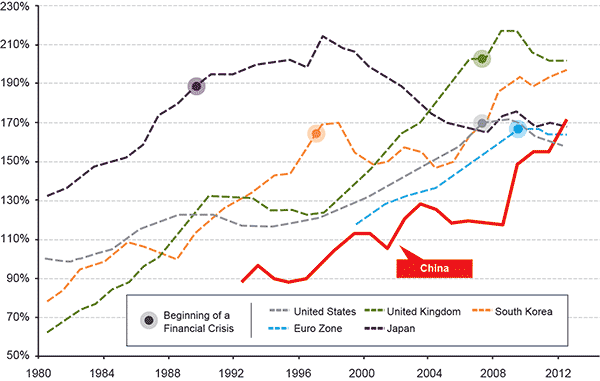
That China faces a number of serious economic (and potentially social) problems is no surprise and as Guggenheim’s Scott Minerd notes, trying to predict when persistent structural problems will lead to a shock for markets is extremely difficult (as we noted here). However, from a symbioticcollapse in the previously ‘virtuous’ bond-market-to-banking-system relationship, to the drying up of easy credit for all but the largest (and least over-capacity) firms, it appears that China’s private sector leverage has crossed the tipping point that signalled crises in the US, UK, Japan and South Korea. Although the recent data (believe it or not) show signs of a stabilization in the Chinese economy, the elevated debt burden should continue to cast doubt over its growth sustainability and the “childish” and non-transparent nature of China’s bond market offers little or no hope for a free market solution. Read more of this post

A police investigation into allegations of fraud by Shanghai’s largest insurance dealer has stirred the insurance market and created jitters over the possible loss of customers’ insurance contracts

08.16.2013 16:26

Probe Launched over Insurance Dealer for Sales Fraud

Shanghai Fanxin Insurance Agency Co. found by insurance regulator to have sold unauthorized fixed-income agreements

By staff reporter Wang Shenlu

1376642129204847

(Beijing) — A police investigation into allegations of fraud by Shanghai’s largest insurance dealer has stirred the insurance market and created jitters over the possible loss of customers’ insurance contracts. The Shanghai branch of the China Insurance Regulatory Commission said on August 15 that insurance sales agent Shanghai Fanxin Insurance Agency Co. was found selling unauthorized fixed-income financial agreements. Shanghai police have launched a formal investigation into the company’s alleged misconduct, said the regulator. Rumors have circulated in the market since August 14 that Chen Yi, general manager of Fanxin has fled to Canada with 500 million yuan. Caixin learned from a source close to the company that Chen is no longer the legal representative of the company and has left the country as the company is facing financial turmoil. Read more of this post

Indian Markets Battered by Signs of End to Easy Money; Stocks Fall 4%, Rupee at New Low, as Investors Question Economic Prospects

Updated August 16, 2013, 7:19 p.m. ET

Indian Markets Battered by Signs of End to Easy Money

Stocks Fall 4%, Rupee at New Low, as Investors Question Economic Prospects

SHEFALI ANAND in Mumbai and PRABHA NATARAJAN in New York

BF-AF602_ISTOX_G_20130816183604

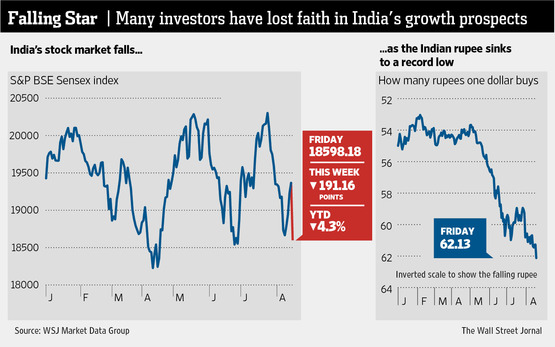
Indian shares fell sharply Friday as investors questioned whether the now-fragile economy of the world’s second most-populous country could withstand an end to global easy-money policies. The Bombay Stock Exchange’s S&P BSE Sensex index lost nearly 4%, its largest one-day drop in almost two years, while the Indian currency, the rupee, hit an all-time low against the U.S. dollar. Traders said an immediate trigger for the selloff was Thursday’s better-than-expected U.S. employment report—which was seen as raising the odds the U.S. Federal Reserve would more quickly tighten the monetary taps. Read more of this post

Reviving the Spirit of Independence Day in Indonesia

Reviving the Spirit of Independence Day

By Zakky Ramadhany on 11:55 am August 17, 2013.
The roads and alleyways of Cempaka Putih Barat, a North Jakarta neighborhood, are mainly deserted with most of its residents still spending Idul Fitri with their families in their hometowns. But by noon on Saturday — Independence Day — those who chose to stay will begin to flood the streets, carrying bamboo poles painted red and white. “The most important thing is to find solid bamboo suitable to be used as the flagpole, then paint the wood to make it look more beautiful. This is done to celebrate Independence Day,” said Nursaleh, a resident of the area, who is in charge of organizing the neighborhood’s Independence Day celebration every year. Read more of this post

Indonesia imitates India’s costly growth obsession

Indonesia imitates India’s costly growth obsession

Fri, Aug 16 2013

By Andy Mukherjee

SINGAPORE (Reuters Breakingviews) – Indonesia is failing to learn from India’s economic misery. That makes it a candidate for a disorderly decline in the currency, runaway inflation and financial instability. The country’s central bank, which has tightened monetary policy by just 75 basis points this year, left the benchmark interest rate unchanged at 6.5 percent in its August 15 meeting. It also asked banks to rein in credit if they don’t have adequate deposits. While the warning is welcome, it’s not a substitute for raising the price of money. Read more of this post

Layoffs Taboo, Japan Workers Are Sent to the Boredom Room; Facing a sluggish economy and increasing competition, Japan’s prime minister and major companies want to reduce longstanding restrictions on dismissing full-time workers

August 16, 2013

Layoffs Taboo, Japan Workers Are Sent to the Boredom Room

By HIROKO TABUCHI

TAGAJO, Japan — Shusaku Tani is employed at the Sony plant here, but he doesn’t really work. For more than two years, he has come to a small room, taken a seat and then passed the time reading newspapers, browsing the Web and poring over engineering textbooks from his college days. He files a report on his activities at the end of each day. Sony, Mr. Tani’s employer of 32 years, consigned him to this room because they can’t get rid of him. Sony had eliminated his position at the Sony Sendai Technology Center, which in better times produced magnetic tapes for videos and cassettes. But Mr. Tani, 51, refused to take an early retirement offer from Sony in late 2010 — his prerogative under Japanese labor law. So there he sits in what is called the “chasing-out room.” He spends his days there, with about 40 other holdouts. “I won’t leave,” Mr. Tani said. “Companies aren’t supposed to act this way. It’s inhumane.” Read more of this post