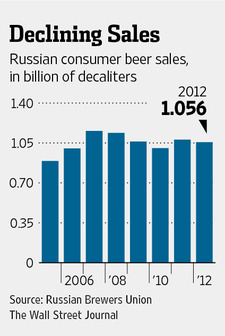
“Beer is for children, Vodka is for real men.” The world’s top brewers once bet big on Russia’s famous love of drinking, investing hundreds of millions of dollars there. But now the Kremlin’s campaign against alcoholism has sapped the life out of the party.

August 16, 2013, 8:28 p.m. ET

Russian Beer Fest Goes Flat for Brewers

Kremlin’s crackdown on alcoholism saps life out of the party

LUKAS I. ALPERT

BF-AF597_RUSBEE_NS_20130816180925

MOSCOW—The world’s top brewers once bet big on Russia’s famous love of drinking, pouring hundreds of millions of dollars into new plants and distribution networks as they sought to tap a growing taste for beer in a land where vodka long ruled. For years the investment paid off. But now the Kremlin’s campaign against alcoholism has sapped the life out of the party as a flood of new regulations and taxes aimed at turning around dismal life expectancy rates for men has made the beer market go flat, brewers say. Read more of this post

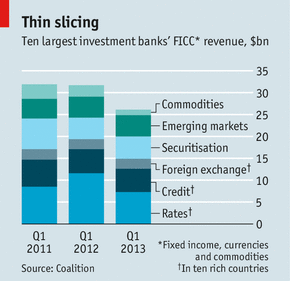
Metal bashing: Insinuations of market manipulation accelerate another upheaval in finance

Metal bashing: Insinuations of market manipulation accelerate another upheaval in finance

Aug 17th 2013 | NEW YORK |From the print edition

20130817_FNC235

THE deepening relationship between America’s judicial system and its biggest banks has reached the world of metals. The Commodities Futures Trading Commission (CFTC) has reportedly issued subpoenas to Goldman Sachs, JPMorgan Chase and others as it investigates complaints that banks and other owners of metals warehouses have been hoarding metals and driving up prices. Private class-action suits filed in federal courts spanning New York, Michigan, Louisiana and Florida have made similar price-fixing allegations, which the banks vigorously deny. Read more of this post

Chief executive officers and chief financial officers in Singapore may soon be legally liable for their certifications that their companies’ financial statements are true and fair

Bosses may face legal liability for financial statements

Saturday, Aug 17, 2013

Michelle Quah

The Business Times

SINGAPORE – Chief executive officers and chief financial officers in Singapore may soon be legally liable for their certifications that their companies’ financial statements are true and fair. This possibility was touched upon by Minister of State for Finance and Transport Josephine Teo at the Public Accountants Conference on Wednesday. Mrs Teo, speaking to an 800-strong crowd of mostly practising accountants, said the profession’s regulator, the Accounting and Corporate Regulatory Authority (Acra), is exploring various approaches taken by other jurisdictions to further strengthen the quality of financial reporting – an issue of some concern here. Read more of this post

The west desperately needs more madcap schemes like the Hyperloop; Animal spirits built the the railways, highways and the Panama Canal

August 16, 2013 6:42 pm

The west desperately needs more madcap schemes like the Hyperloop

By Stian Westlake

Animal spirits built the the railways, highways and the Panama Canal, writes Stian Westlake

20130817_STP001_0

Silicon Valley product launches are a dime a dozen. But Monday’s announcement was something rather special. Elon Musk, founder of PayPal, Tesla and SpaceX, had promised the world he would publish thedesign for the Hyperloop, a revolutionary new form of transport – and it is hard not to love it. It’s fast. It’s solar-powered. And it’s a bargain: according to Mr Musk, it would cost 10 times less to build than the high-speed railways now beloved of the American and British governments. No wonder the world’s geeks and dreamers have been poring over the space-age sketches. Read more of this post

The FBI Manipulated Some Penny Stocks

15 Aug 2013 at 5:31 PM

The FBI Manipulated Some Penny Stocks

By Matt Levine

The SEC announced securities fraud charges against a fairly random assortment of South Florida crooks today and the message I took away from the assorted complaints is that it’d be a lot of fun to work in the South Florida office of the FBI. Basically the job seems to consist of setting up fake hedge funds and then using them to con people into giving you money, which is pretty much my dream job, and also the dream job of a lot of South Florida crooks I guess. Only in the FBI version the people you’re conning are themselves con men, and the money is illegal bribes, and then you arrest them, so it’s okay. Read more of this post

Price-to-Earnings Ratios Aren’t Always What They Seem; P/E Calculations Based on Differing Views of Earnings Paint Competing Pictures of the Market

BY MARK HULBERT

Price-to-Earnings Ratios Aren’t Always What They Seem

P/E Calculations Based on Differing Views of Earnings Paint Competing Pictures of the Market

MARK HULBERT

BF-AF571_HULBER_G_20130816143313

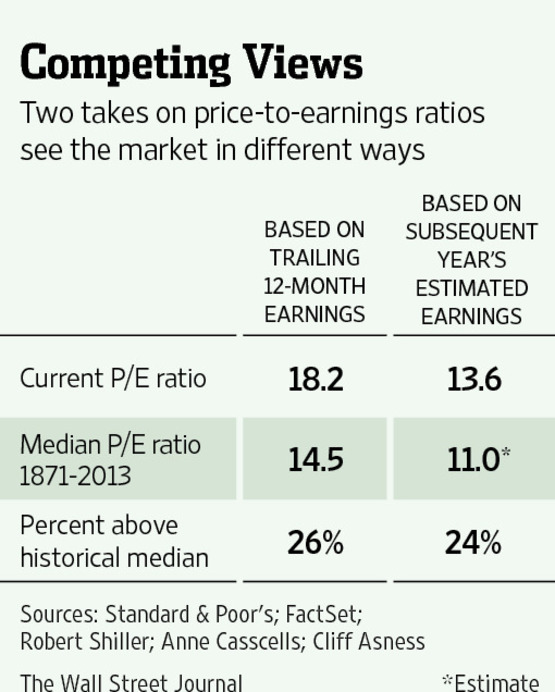
“The stock market is overvalued.” “The stock market is undervalued.”

Which one of these statements is true?

Both are, thanks to quirks of the most popular way of measuring a stock’s valuation: the price/earnings ratio.

While no one disagrees about what the “P” is when calculating the ratio, there is no consensus on how to define earnings-per-share. One of the biggest points of dispute: whether to use analysts’ earnings estimates for the coming year or reported company earnings from the previous 12 months. Comparing ratios calculated in these two ways is little better than comparing apples to oranges, according to Cliff Asness, managing partner at AQR Capital Management, an investment firm with $84 billion of assets under management. In an email, he went so far as to say that those who compare P/Es in this way are engaging in a “sleight of hand,” though he allowed that many may “not be aware of the mistake they are making.” Read more of this post

This Stunning Anecdote Shows Just How New The Concept Of A Bond Market Sell-Off Is To Everyone

This Stunning Anecdote Shows Just How New The Concept Of A Bond Market Sell-Off Is To Everyone

MATTHEW BOESLER AUG. 16, 2013, 12:40 PM 3,255 4

10-year-ust-yield

Business Insider/Matthew Boesler, data from Bloomberg

For the vast majority of the current crop of Wall Street traders, a bull market in bonds is really all there’s ever been. One has to go back more than 30 years – to the late 1970s and early 1980s – to find the last bear market in bonds. Yet things have changed in 2013. The consensus on Wall Street now expects the Federal Reserve to announce a tapering of the pace of monthly bond purchases it makes under its quantitative easing program at the September FOMC meeting. The mere thought of such a decision in the minds of traders and investors was enough to spark a violent sell-off in the Treasury market this summer – the yield on the 10-year note is up 118 basis points since May 2 alone at current levels near 2.8%. Now, the long bull market in bonds is widely perceived to have come to an end. “A remarkably low 3% of investors expect long-term bond yields to be lower in 12 months,” said BofA Merrill Lynch chief investment strategist Michael Hartnett of the bank’s August Global Fund Manager Survey. As Treasuries have declined in value this year, many bond investors have seen something they aren’t used to seeing: negative returns in their monthly statements. In fact, according to ConvergEx Group chief market strategist Nick Colas, there may be a lot of people out there who didn’t even know that was possible. “I have had more than one high-net-worth broker tell me that his clients think the ‘Risk Free Rate’ means that you never see a mark down in the value of your Treasury portfolio,” says Colas. “They are only now discovering their error, and the realization is unwelcome.” The “risk-free rate” is a theoretical concept used in ubiquitous financial calculations like the capital asset pricing model to value securities. The “risk-free rate” in these models usually refers to the yield on U.S. Treasuries, where the rate of return (yield) is viewed as “riskless” because Treasuries don’t contain default risk. So, apparently there are investors out there who heard the term “risk-free rate” and assumed that an investment in Treasuries would never lose money. “Fixed income isn’t a one-way bet,” says Colas. “That fact spills over into everything from corporate capital allocation to equity market valuations. And it will take longer than to Labor Day to accommodate this new fact.”

Bonds Upended as AAA Yields Exceed AAs on Tapering

Bonds Upended as AAA Yields Exceed AAs on Tapering

Corporate bonds with AAA ratings are yielding more than debt graded a tier lower, a divergence that’s happened only twice in the past decade as investors sour on securities with the most to lose when interest rates rise.

The average yield of 2.86 percent for $34.2 billion of the highest-rated bonds in a Bank of America Merrill Lynch index on Aug. 13 was 0.27 percentage point more than the average for AA bonds. The last time that happened was in early 2009, when derivative traders roiled by the worst financial crisis since the Great Depression were treating then-AAA borrower General Electric Co. like junk. Read more of this post

Buffett targets cars, oil and satellite TV

August 16, 2013 12:00 am

Buffett targets cars, oil and satellite TV

By Dan McCrum in New York

Warren Buffett put money to work in cars, oil and satellite television in the second quarter as the chief executive of Berkshire Hathaway and his deputies invested the most money in stocks since 2011, according to regulatory filings. Berkshire increased its holdings in General Motors, the carmaker recovering from bankruptcy and a government bailout, and made two new investments: in Dish Network, the broadcaster controlled by Charles Ergen, and Suncor Energy, a Canadian oil company. The billionaire investor, for decades a proponent of the long-term attractions of stocks, made the investments in a period when the US stock market surpassed its previous high set in 2007. The rising market helped push the value of Berkshire’s stock portfolio to $97bn on Thursday, accounting for more than a third of the conglomerate’s $287bn market capitalisation. Read more of this post

Rising credit yet falling NPL ratio; Flood of problem loans to stretch China’s bad banks

August 15, 2013 4:29 pm

Flood of problem loans to stretch China’s bad banks

By Paul J Davies in Hong Kong

NPL

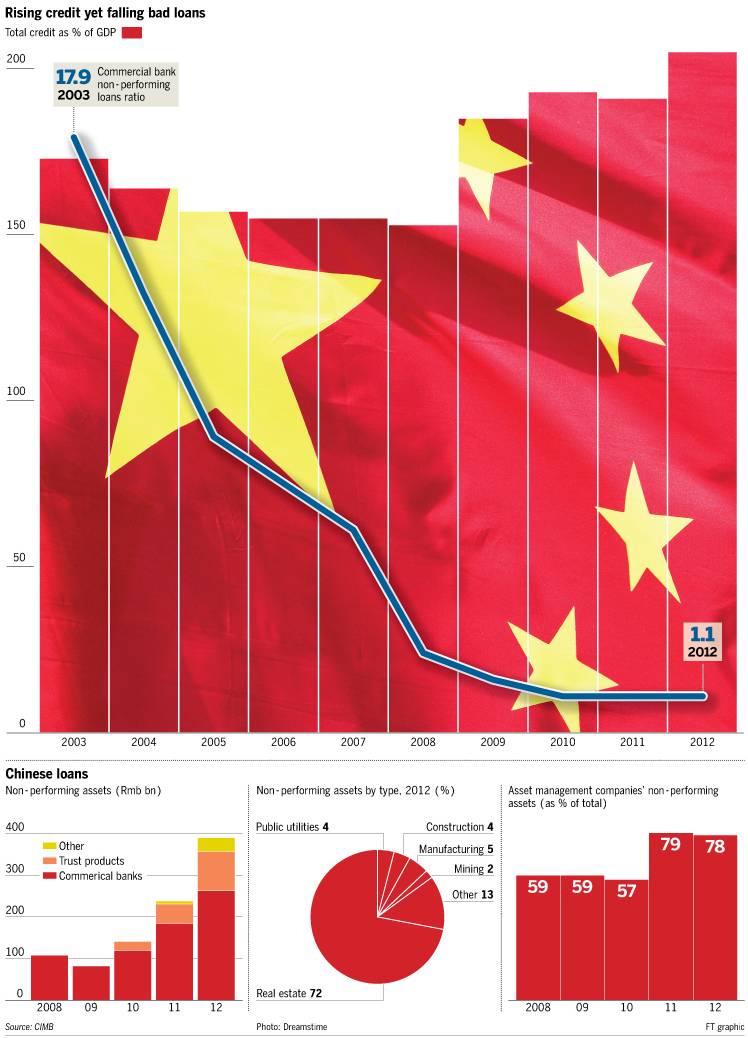
When Goldman Sachs economists wanted to bring their global clients up to speed on the risks in China’s credit boom, they spoke to Charlene Chu, the Fitch Ratings analyst known for her bearish views. Ms Chu has studied China’s shadow finance sector to come up with one of the highest estimates of the country’s debt pile at more than 200 per cent of gross domestic product. She also warns that the banking sector is far more exposed to many of the shadow loans than most people realise. The latest official figures show non-performing loans (NPLs) at Chinese banks grew by Rmb13bn ($2bn) in the second quarter to Rmb540bn, increasing for a seventh straight quarter. Read more of this post

Easy Credit Dries Up, Choking Growth in China

August 15, 2013

Easy Credit Dries Up, Choking Growth in China

By KEITH BRADSHER

Chinaeconjp-popup-v2

In Shenmu, China, stores have closed, construction projects have been halted and protests have erupted because an economic slowdown has led to increasingly widespread defaults on loans. 

SHENMU, China — As the Chinese economy boomed, few cities soared faster or higher than Shenmu, a community of nearly 500,000 in northwestern China. Top luxury clothing stores in this city’s downtown were recording as much as $500,000 a day in sales. Tables at the best restaurants had to be reserved weeks in advance. The new Fortune Garden Club for the city’s business elite made headlines by paying $1 million for a king-size mahogany bed, to be used by members and their companions. But a painful credit crisis is now spreading across Shenmu and cities nearby, as thousands of businesses have closed, fleets of BMWs and Audis have been repossessed and street protests have erupted. Read more of this post

Critics point to China’s bond market as an underrecognized risk as the country struggles to control surging lending amid a weakening economy

August 15, 2013, 1:12 p.m. ET

Critics Decry Risks Posed by Link Between China’s Banks and Bonds

The Market ‘Is Like a Child Compared to That in Other Countries’

SHEN HONG

MI-BX909_CBONDS_G_20130815201211

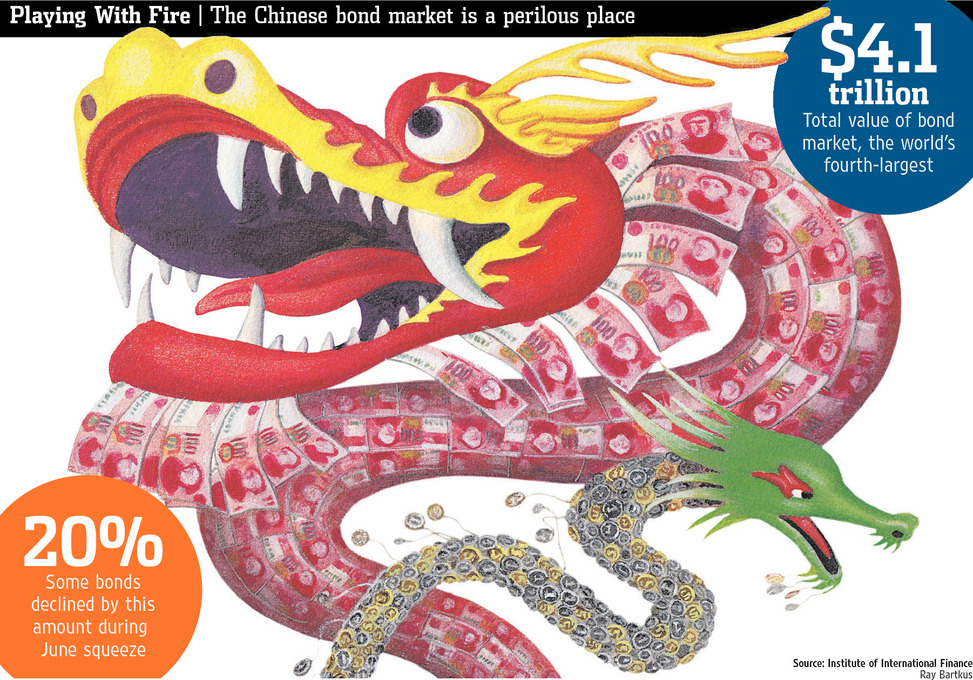
SHANGHAI—Worried about a boom in lending by the country’s fast-growing “shadow banks,” China created a cash crunch in June to squeeze their source of funding. One unintended consequence, though, was a selloff in the country’s $4 trillion bond market. The selloff—triggered by banks selling bonds to raise cash—bolstered critics of China’s financial system, who point to its bond market as an underrecognized risk to the country as it struggles to control surging lending amid a weakening economy. China’s bond market has quintupled in size to 25.5 trillion yuan ($4.1 trillion) since 2004, driven most recently by the Chinese government’s stimulus plan to combat the impact of the global financial crisis. Read more of this post

China Mobile Exercises Sway in 4G Standards

August 15, 2013, 2:08 p.m. ET

China Mobile Exercises Sway in 4G Standards

PAUL MOZUR

MK-CF596_CMOBIL_G_20130815180610

BEIJING—When the year began, most of the world’s biggest telecommunications companies were lining up behind a single technical standard for the next generation of high-speed smartphones and other mobile gadgets. Then in March, China Mobile Ltd.0941.HK -1.01% made an unexpectedly aggressive move.

The state-owned wireless company, which has more than 740 million customers, committed to buying $7 billion of equipment this year for a mobile network based on another standard. China Mobile’s support instantly gave that standard critical mass, setting off an international race to supply the new gear. Read more of this post

Foreseeing Trouble in Exporting Natural Gas

August 15, 2013

Foreseeing Trouble in Exporting Natural Gas

By CLIFFORD KRAUSS and NELSON D. SCHWARTZ

MIDLAND, Mich. — As Dow Chemical’s chief executive, Andrew N. Liveris has made himself into something of an outcast among his fellow business leaders.

The reason? He is spearheading a public campaign against increased exports of natural gas, which he sees as a threat to a manufacturing renaissance in the United States, not to mention his own company’s bottom line. But many others say such exports would provide far more benefits to the country than drawbacks, all part of a transformation that promises to increase the nation’s weight in the global economy. Read more of this post

In an effort to be deemed authentic, luggage maker Tumi’s new campaign will feature less-well-known figures whose accomplishments seem more attainable.

August 15, 2013

Tumi Ads Use Less Famous Faces to Underline Its Accessibility

By STUART ELLIOTT

DECADES ago, a man named Garry Davis provocatively renounced his American citizenship and declared himself a citizen of the world. Now, Tumi, which sells luxury suitcases, bags and other products for travelers, is proclaiming the arrival of the “global citizen.”

In a worldwide campaign scheduled to begin on Sunday, Tumi is saying, in effect, that it will let competitors that include Louis Vuitton go to market with famous faces like Angelina Jolie, Keith Richards, Madonna and even Mikhail S. Gorbachev. According to Tumi and its creative agency, Yard, potential buyers of Tumi’s wares are more likely to respond to less-well-known figures who, though not megastars, are still men and women of distinction and achievement. Read more of this post

Department stores have been losing customers to other retailers for decades. But some are thriving

Department stores have been losing customers to other retailers for decades. But some are thriving

Aug 17th 2013 | NEW YORK |From the print edition

20130817_WBC213

IN THE shopping calendar, the back-to-school period ranks behind only Christmas in importance to American retailers. It is a time for outfitting tots with superhero rucksacks and fashion-conscious teens with “metallic” oxford shoes. But events off the sales floor have distracted merchants from the tinkling of tills. In July Hudson’s Bay, a Canadian department-store chain, said it would buy Saks, an upmarket American one, for $2.4 billion. Then on August 13th Bill Ackman, an activist investor, quit the board of J.C. Penney, a less luxurious retailer, after a failed attempt to hasten the departure of its interim boss, Mike Ullman (see article). Read more of this post

Campbell Soup Sued Over Heart Association Endorsements; The association labels more than 30 of Campbell’s Healthy Request soups as “heart-healthy” even though a can has at least six times as much sodium as the organization recommends

Campbell Soup Sued Over Heart Association Endorsements

Campbell Soup Co. (CPB) and the American Heart Association were sued by a consumer who claimed the AHA fraudulently certifies the company’s products as healthy.

The association labels more than 30 of Campbell’s Healthy Request soups as “heart-healthy” even though a can has at least six times as much sodium as the organization recommends, according to a complaint filed yesterday by Kerry O’Shea in federal court in Camden, New Jersey. Those soups display the AHA’s “Heart-Check Mark” logo, which the organization licenses, according to the complaint. Read more of this post

Norway sees Liu Xiaobo’s Nobel Prize hurt salmon exports to China; Norway’s market share of salmon exports to China has plummeted from 92 per cent in 2010 to just 29 per cent in the first half of this year

August 15, 2013 4:46 pm

Norway sees Liu Xiaobo’s Nobel Prize hurt salmon exports to China

By Richard Milne, Nordic Correspondent

Call it the price of a Nobel Peace Prize. Norway’s market share of salmon exports to China has plummeted from 92 per cent in 2010 to just 29 per cent in the first half of this year. Both the Faroe Islands and the UK have overtaken it in sales despite it enjoying a near monopoly for the previous decade. The cause is obvious, say industry and political experts: the decision of a Norwegian committee in October 2010 to award the Nobel Peace Prize to Liu Xiaobo, a jailed Chinese dissident. “It is no secret that declining sales in China are connected to the Nobel Peace Prize. This is a difficult political situation between Norway and China, and not something that can be solved by the industry,” Alf-Helge Aarskog, chief executive of Marine Harvest, one of the country’s biggest salmon farmers, told a Norwegian newspaper. Read more of this post

China to tone down new year TV galas in anti-graft push

China to tone down new year TV galas in anti-graft push

Friday, August 16, 2013 – 14:28

Reuters

BEIJING – China will tone down and simplify the glitzy, kitsch and widely watched television galas beamed across the country over the traditional Lunar New Year festival, state media said on Friday, as part of government efforts to fight graft. The “CCTV Spring Festival Gala”, a more than four-hour showcase of comedy skits, music and dance, has become a lounge room fixture for hundreds of millions of Chinese since first broadcast in 1982, spawning copy-cat shows on regional stations over the holiday. This year, Canadian singer Celine Dion – wildly popular in China – was given top billing on CCTV’s gala where she sang “My Heart Will Go On” and a Chinese song, and every year a whole host of famous Chinese faces put in appearances. But next year’s event is going to be a more basic affair, the official Xinhua news agency reported, following newly installed President Xi Jinping’s campaign to cast aside extravagance in the name of fighting corruption and winning back public trust. “Stage lighting and decoration will use the most economical technologies, luxurious decors will be spurned, and simplicity will be striven for,” Xinhua said of the main CCTV gala for next year. Beijing Television will also cut spending on lighting, decorations and payments to stars on its show, focusing instead on “the experience of the feelings of local people”, the news agency added. Shanghai Television will give more space to new and upcoming artists, while Zhejiang Television will no longer allow any A-list celebrities to appear, Xinhua said. “All of these measures are to control … the indiscriminate extravagances of television galas,” a spokesman for China’s television regulator was quoted as saying. The new rules echo similar demands made of officials to simplify their lives by Xi since he took over as Communist Party chief last November. He has made cutting back on extravagance and waste a key theme of his administration, seeking to assuage anger over corruption and restore faith in the party.
Twenty-one years after the start of compulsory superannuation, the Superannuation system is going strong with more than $1.6 trillion in retirement savings, with returns hitting pre-GFC levels

Super fires up with equities

August 14, 2013

John Collett

The superannuation system has come of age. It is now 21 years since the introduction of compulsory super and there is more than $1.6 trillion in retirement savings. Our superannuation system is the envy of much of the developed world, especially those countries with rapidly ageing populations. While compulsory super started at just 3 per cent of salary in 1992, it is now 9.25 per cent and will gradually rise over the next several years to 12 per cent.

Read more of this post

Thai corporates waking up to key role of R&D

Thai corporates waking up to key role of R&D

Achara Deboonme
The Nation August 16, 2013 1:00 am

SCG president Kan Trakulhoon presents Prime Minister Yingluck Shinawatra a piece of motar, on which texture will prevail when sprayed on with water. In this piece is Yingluck’s face. The magic mortar is one of new innovative products.

DuPont foresees rapid progress in research and development in Thailand, with growing awareness among Thai companies that innovation will be the key for their survival in the new world order. At its innovation centre in Bangkok, which celebrates its second anniversary today, (Aug 16), 1,500 visitors from 300 companies have been seen, expressing their ideas and seeking consultation on how to commercialise them. “The innovation centre in Bangkok is among the top three most active centres, among 11 around the world,” Douglas Muzyka, chief science and technology officer of the global company, said on the sidelines of Siam Cement Group’s “Thailand Innovation Forum” yesterday. Read more of this post

Rich World’s Biggest Jobs Growth Approaches End in Singapore

Rich World’s Biggest Jobs Growth Approaches End in Singapore

Tony Cousens spent more than S$100,000 ($79,000) to find waiters and housekeepers for the Ramada and Days Hotels in Singapore. Months after the two establishments opened, he is still about 100 people short.

Cousens’s plight underscores the new reality for an economy that probably delivered the biggest employment surge among 33 advanced economies in the decade to 2014, according to data compiled by Bloomberg. Singapore’s annual jobs growth may halve in the coming years from a 2007 peak as the island widens a clampdown on foreign workers, Bank of America Corp. estimates. Read more of this post

Did Indonesia’s Ministry of Trade really ban e-commerce companies from getting foreign investment?

Is foreign investment a no-go for e-commerce companies in Indonesia?

By DailySocial 16, Aug 2013

Did Indonesia’s Ministry of Trade really ban e-commerce companies from getting foreign investment?

The Ministry of Trade apparently has issued a new directive which extends the negative investment list from offline businesses to online business, according to Remco Lupker, president of Ambient Digital Indonesia, on his blog post tonight. This, he says, effectively cuts off foreign investment for anything to do with direct sales to consumer. Lupker also outlined the effects it may have on the local e-commerce companies and how they can manage to comply with this new policy. Read more of this post

India Seeks to Overhaul a Corporate World Rife With Fraud

AUGUST 15, 2013, 3:35 PM

India Seeks to Overhaul a Corporate World Rife With Fraud

By JEN SWANSON

MUMBAI, India — In the wake of global scandals involving kickbacks and accounting fraud, one unlikely country, India, is aiming to set a tone in overhauling its corporate oversight laws. This month, the nation’s upper house of Parliament passed the Companies Bill, 2012, sweeping legislation meant to overhaul auditing, impose stiffer penalties for fraud and create more government oversight of businesses. The lower house had passed the bill last year. Once India’s president, Pranab Mukherjee, signs it into law, it will replace India’s 57-year-old corporate legislation that critics say had failed to keep up with changes in business practices. Read more of this post

India Loan Woes Go From Bad to Worse; India’s Slowing Economy Exacerbates Banks’ Nonperforming Loans; India’s capital crisis: Reform, not controls, is the only way to revitalise the economy

Updated August 15, 2013, 6:05 a.m. ET

India Loan Woes Go From Bad to Worse

India’s Slowing Economy Exacerbates Banks’ Nonperforming Loans

ABHEEK BHATTACHARYA

Indian banks’ loan books are already a problem. But they’re going to weaken further. At State Bank of India, 500112.BY +0.27% the country’s largest lender by assets, nonperforming loans jumped to 5.7% of the total at June 30 from 5% a year ago. AtPunjab National Bank, 532461.BY -0.26% bad loans jumped to 4.8% from 3.4% a year earlier. Standard & Poor’s says the ratio of NPLs sector-wide will increase from 3.4% in March this year to 3.9% by March 2014 and 4.4% a year later. India’s slowing economy is the main problem. Overall growth slumped to a 10-year low of 5% in the fiscal year ended March 2013. The situation is likely to worsen. The Reserve Bank of India forecasts only a slight recovery in the economy in the near term, with growth rising to 5.5% in the current fiscal year. Borrowers will remain under pressure when it comes to servicing debt.Credit Suisse CSGN.VX -1.17% says most NPLs so far are at small- and midsize businesses but larger companies will feel the strain too as relatively low economic growth persists. Worse, a pending rule change could force banks to record more bad loans. Read more of this post

High land prices in India mean no cheap hotels

August 15, 2013 5:47 pm

High land prices in India mean no cheap hotels

By Henny Sender

Sites available in China to those who promise to create jobs

Nothing happens quickly in India. It has now been six years and counting since Lemon Tree, a local chain of mid-market hotels with money from private equity group Warburg Pincus, started to build a hostelry in Mumbai. Acquiring land, whether from the government or from private hands, is both expensive and time-consuming. There is no central land registry or simple mechanism to do title searches. The construction process is hampered by lengthy approvals, changing regulations, archaic zoning and weak infrastructure. Lemon Tree now has about 3,000 rooms in India. Meanwhile, Seven Days Inn, a hotel chain in China that Warburg Pincus invested in around the same time, six years ago, has about 40,000 rooms. It is not just hotels in India that are hostage to this frustrating process. Hospitals, retailers, logistics companies and manufacturers all face the same infuriating dynamic. Read more of this post

South Korea’s cash-strapped companies are seeking to sell their headquarters one after another to secure cash amid the prolonged recession

Cash-strapped companies sell headquarters

기사입력 2013.08.15

South Korea’s cash-strapped companies are seeking to sell their headquarters one after another to secure cash amid the prolonged recession. The companies increasingly sell head offices and lease them back for a long term, a deal called sale-and-leaseback, which ensures investors to gain profit from property lease. Builders and financial companies are especially rushing to sell their headquarters. Daewoo Engineering & Construction (E&C) sold its head office at 390 billion won ($349.0 million) and GS E&C at 170 billion won, with Doosan E&C following suit. Mirae Asset Securities is working on selling its head office in Gangnam, Seoul, and Hyundai Capital plans to make an offshore investment with cash it earned from the sales of headquarters in Yeouido in April. In the securities sector, Tongyang Securities and Daishin Securities sold their respective headquarters. Press and media companies have joined the sales as well. YTN has recently decided to sell its head office in Namdaemun, Seoul, at a price between 200 billion won and 250 billion won. MBC, meanwhile, has been looking for a potential buyer for its headquarters building in Yeouido since last year. The head offices put on the market are being acquired by big investors such as pension funds, who have been struggling to look for suitable investment vehicles as the key rate has remained low. Property developers, real estate investment trusts (REIT), and private equity funds started a process to acquire the buildings, followed by pension funds, mutual aid societies and life insurance companies.

Nagasaki Bomb Maker Offers Lessons for Japan’s Fukushima Cleanup

Nagasaki Bomb Maker Offers Lessons for Japan’s Fukushima Cleanup

Hanford Engineer Works produced the 20 pounds of plutonium for the bomb dropped on Nagasaki. It’s among the most toxic nuclear waste sites and the place Japan is turning to for help dealing with melted reactors in Fukushima.

Tokyo Electric Power Co. (9501) has sent engineers on visits to the Hanford site in Washington state this year to learn from decades of work treating millions of gallons of radioactive waste. Hanford also has a method to seal off reactors known as concrete cocooning that could reduce the 11 trillion yen ($112 billion) estimated cost for cleaning up Fukushima. Read more of this post

When Shareholder Activism Goes Too Far

August 15, 2013

When Shareholder Activism Goes Too Far

Posted by James Surowiecki

With the hedge-fund manager Bill Ackman having resigned from J. C. Penney’s board of directors on Tuesday, we can now declare the end of his extraordinarily unsuccessful attempt to reinvent Penney. It was months in the making: Penney’s board fired Ackman’s handpicked C.E.O., the former Apple retail head Ron Johnson, back in April. But Ackman, who still owns more than seventeen per cent of the company, had stayed on the board after Johnson’s departure, and still seemed to harbor hopes of remaking the company. The debacle at Penney is now prompting people to look more skeptically at Ackman, who manages Pershing Square Capital, and that’s fitting. But it should also make us skeptical, in general, of one of the more dubious trends in today’s market: money managers who also fancy themselves corporate visionaries. Read more of this post

The quest for a Ryanair of rail freight; The EU wants more goods to be moved by train. Progress is slow

The quest for a Ryanair of rail freight; The EU wants more goods to be moved by train. Progress is slow

Aug 17th 2013 | PRAGUE |From the print edition

IN AVIATION the arrival of privately owned low-cost airlines has shaken up the market and sent the traditional flag carriers into retreat. But in Europe’s railway business there is still little competition in passenger services. Even in freight, where there ought to be more scope for rivalry, the market is still dominated by state-owned incumbents. The European Commission’s “Transport 2050” plan, adopted two years ago, promises to get half of all the continent’s medium-distance goods transport off the roads and on to rail (or water) by 2050. But although some progress has been made in designating cross-border rail “corridors”, the plan will not get far unless there is more choice and competition.

Newer, private rail-freight firms complain that their attempts to get into the market are frustrated by the incumbents. Laszlo Horvath, president of CER Hungary, complains that the state-owned giants, which usually own the tracks as well as running trains, turn nasty whenever young private firms like his try to expand. Read more of this post