Drug Research in China Falls Under a Cloud

July 22, 2013

Drug Research in China Falls Under a Cloud

By KATIE THOMAS

Executives at the British drug maker GlaxoSmithKline were warned nearly two years ago about critical problems with the way the company conducted research at its drug development center in China, exposing it to potential financial risk and regulatory action, an internal audit found.

The confidential document from November 2011, obtained by The New York Times, suggests that Glaxo’s problems may go beyond the sales practices that are currently at the center of a bribery and corruption scandal in China. They may extend to its Shanghai research and development center, which develops neurology drugs for Glaxo. Read more of this post

Emotions High Over ParknShop Sale Talk; Superman Li Ka-Shing may have been influenced by the city’s pivot away from its traditionally laissez-faire stance

July 23, 2013, 11:27 AM

Emotions High Over ParknShop Sale Talk

Top of Form

As a deeply unequal city, Hong Kong both reveres and fiercely resents its local boy-made-good Li Ka-shing, who from his early days running a plastic flower business has since built up an empire worth some $120 billion. Nowhere was this more evident this week than in reactions to the fact that the tycoon may be planning to sell ParknShop, his Hong Kong-based grocery chain.

News that Asia’s richest man is planning the sale prompted mixed reviews in his hometown on Monday, attracting full-page spreads in local newspapers. While some celebrated the move, others expressed apprehension. “The rich are scared, and once again using their feet to vote,” wrote one user on Sina Weibo, China’s popular Twitter-like microblogging service. “The hatred of the rich and their businesses has been spreading…of course it will disrupt the appetite for investment,” ran an editorial in the Hong Kong Commercial Daily. Read more of this post

Large Loans Are Highlight of Mediocre Asian Deal Environment

Jul 22, 2013

Large Loans Are Highlight of Mediocre Asian Deal Environment

By Cynthia Koons, Reuters

One thing stands out in Asia’s uninspiring deal landscape this year: big loans. Acquisition financing in Asia, excluding Japan, has hit its highest year-to-date level since 2007, up 46% from the same period last year, according to Dealogic. That is despite acquisitions rising only 3% this year after a slowdown in recent months. Now as investors pull cash out of Asia in the belief that the U.S. Federal Reserve will soon start winding down its monetary stimulus, some people are saying this wave of debt-fueled deals could soon end. “I don’t think I would stand and wave my hand at this point in time and say, ‘This is the new normal,’ ” said Keith Pogson, a partner in Ernst & Young’s Asian-Pacific financial-services office. Read more of this post

‘Land of Smiles’? Not for tourists exposed to Phuket’s dark side

‘Land of Smiles’? Not for tourists exposed to Phuket’s dark side

AFP, July 22, 2013 – 4:41PM

From jet ski scams to robbery, assault and even police extortion, for the millions of tourists who flock to Thailand each year the kingdom does not always live up to its reputation as the “Land of Smiles”. Now following a flurry of complaints, governments are urging the country to do more to protect the safety of the record numbers of foreigners visiting Thailand. Its sun-drenched beaches, tranquil temples and libidinous nightlife have long been a magnet for tourists from around the world, but for some it is far from paradise. Drink spiking in bars can be a problem and sometimes people wake up to find they have been robbed. Read more of this post

Singapore’s Loss of Top MBA Program Threatens Education Ambition; “There is no doubt that Hong Kong provides a more dynamic vibrancy in Asia than Singapore does”

Singapore’s Loss of Top MBA Program Threatens Education Ambition

Singapore’s efforts to become an Asian center for higher education was dealt a blow this month when the school with the top-ranked MBA program said it will relocate to Hong Kong.

The University of Chicago, whose executive MBA program was ranked No. 1 by Bloomberg Businessweek last year, said July 10 it’s relocating to be closer to China. That came after New York University’s Tisch School of Arts and the University of Nevada, Las Vegas said there are plans to close their Singapore campuses in the next two years. Read more of this post

Alibaba Billionaire Jack Ma’s Comment Fallout Shows Fine Line on Politics

Billionaire Ma’s Comment Fallout Shows Fine Line on Politics

The fallout from comments attributed to Jack Ma about the 1989 Tiananmen Square crackdown highlights the balance business leaders need to strike in China between pleasing politicians and showing independence.

After the South China Morning Post newspaper quoted Ma as saying China’s rulers made the “most correct decision” in their handling of the deadly June 4, 1989, protests, activists started an online petition calling for an apology. The billionaire’s company, Alibaba Group Holding Ltd., disputed the accuracy of the report, which the newspaper said it stands by. Read more of this post

Hong Kong Says Loans to Mortgage Companies May Undermine Curbs

Hong Kong Says Loans to Mortgage Companies May Undermine Curbs

Hong Kong banks’ support for mortgage lending by finance companies may reduce the effectiveness of home-lending controls, the city’s banking watchdog said.

“If banks provide loans to finance companies to support their mortgage business and these finance companies do not follow the Hong Kong Monetary Authority’s guidelines on property mortgage lending, this may undermine the effectiveness of the prudential measures,” the regulator said in an e-mailed statement yesterday. The HKMA “does not encourage banks to provide loans to these finance companies,” it said. Read more of this post

MillerCoors Sees Metal-Warehouse Delay Costing Buyers $3 Billion

MillerCoors Sees Metal-Warehouse Delay Costing Buyers $3 Billion

Global aluminum costs were inflated by $3 billion in the past year through unfair rules that allow Goldman Sachs (GS) Group Inc. and other warehouse owners to slow deliveries, said a risk executive at brewer MillerCoors LLC.

The practices of warehouse owners authorized to hold aluminum by the London Metal Exchange created artificial limits on available supply, leaving prices “inflated relative to the massive oversupply and record production,” Tim Weiner, a global risk manager at Chicago-based MillerCoors, said in written testimony before his appearance today at a U.S. Senate subcommittee hearing in Washington. Read more of this post

Mandela’s Wealth-Sharing Dream Fades in South Africa

Mandela’s Wealth-Sharing Dream Fades in South Africa

Prudence Moime looks up from stirring a pot of corn meal in front of her two-room shanty in northeastern South Africa and gazes across the surrounding rocky hillside. Just beyond her view lie some of the world’s best platinum deposits.

She says she waits in vain for some of the money promised to her village by African Rainbow Minerals Ltd. (ARI), part-owned by Patrice Motsepe, the richest black South African and a beneficiary of the country’s policy to spread the wealth to blacks after the end of apartheid. Read more of this post

Corporate fraud specialists say using travel agencies, and marketing or consulting firms, to launder money, embezzle or create slush funds to bribe officials is common in China, even at MNCs

July 21, 2013

Files Suggest a Graft Case in China May Expand

By DAVID BARBOZA

SHANGHAI — A few weeks ago, when Chinese investigators raided a small travel agency in this fast-growing city, they came upon something startling.

The agency appeared to be using fake contracts and travel invoices to help executives at the British pharmaceutical giant GlaxoSmithKline bribe doctors, hospitals, foundations and government officials, Chinese authorities said. Read more of this post

Alcoa chairman and chief executive Klaus Kleinfeld complained that China’s aluminium smelter sector is “living on a different universe”; record production despite 41% of all Chinese smelters may be financially “under water”.

Aluminium; parallel universe or the same one? Andy Home

10:11am EDT

By Andy Home

LONDON (Reuters) – China’s production of aluminium cranked up several gears last month to an annualized 22.42 million tonnes. It was the second-highest run-rate ever, eclipsed only by what may have been a holiday-distorted output figure in February.

The world’s largest producer churned out 10.54 million tonnes of the light metal in the first half of this year, according to figures from China’s Nonferrous Metals Industry Association published by the International Aluminium Institute (IAI). Read more of this post

Hotlines spring up for China VIPs to buy luxury goods amid anti-graft drive

Hotlines spring up for China VIPs to buy luxury goods amid anti-graft drive

Monday, 22 July, 2013, 12:00am

George Chen george.chen@scmp.com

Amid Xi Jinping’s anti-graft drive and the popularity of weibo, those who have something to hide prefer to do their shopping by telephone

President Xi Jinping’s anti-graft campaign may have created a new business on the mainland: serving “important people” in an extremely low-profile, or even secret, way.

I was back in Shanghai for a quick trip recently and dropped by several big shopping centres on Nanjing Road, one of the mainland’s busiest streets. Ironically, these shopping centres – and, in particular, the big luxury brand shops inside – didn’t look busy at all. They were almost empty. Read more of this post

A Reformist Chinese Leader? Stop Fooling Yourself

A Reformist Chinese Leader? Stop Fooling Yourself

By Jeffrey WasserstromJuly 22, 201313 Comments

Pedestrians walk past a billboard displaying, from left, Chinese Communist Party leaders Mao Zedong, Deng Xiaoping, Jiang Zemin and Hu Jintao at an event celebrating the 90th anniversary of the Chinese Communist Party in Beijing

For those of us who have tracked Chinese political trends since the late 1970s when Deng Xiaoping came to power, reading the news about China these days can prove strangely disorienting. One week, we’ll be struck by a slew of stories, on everything from fast trains to record growth rates, which underscore how different China is than it was when Deng first launched his reforms. The next week, though, we’ll be struck just as powerfully by a sense of eerie familiarity. Headline after headline — about the intractability of corruption, the death of a watermelon vendor or a petitioner’s desperate attempt to draw attention to this plight by detonating an explosive device at a Beijing airport — seem just like those we came across a few years or even a couple of decades ago. Read more of this post

Systemic risk over China’s mid-tier banks

Updated: Tuesday July 23, 2013 MYT 8:01:46 AM

Systemic risk over China’s mid-tier banks

BY KARIM RASLAN

Analysts have been warning on the risks of China’s “shadow banking” system – a sector estimated to have as much as RM4.15tril in assets.

RAMADAN is always a good time for reflection. This year, I’ve been researching a new TV documentary series, Ceritalah Indonesia, that I’m hoping to shoot by September. I want to tell the story of how Indonesia, having endured the Asian Financial Crisis in 1997/1998, ousted President Suharto and then launched into the tumultuous “Reformasi Era” before finding some degree of stability under President Susilo Bambang Yudhoyono. As a result, I’ve been going over recent history – including the roots of the crisis itself. Now even though I’m not an economist, it’s been a very interesting journey, especially reading about the various bank failures that sparked off and then deepened the crisis. Back then, banks seemed to be falling like dominoes: Thailand’s Finance One collapsed spectacularly. This was followed only a few months later by Bank Indonesia’s surprise decision to close sixteen banks. As the momentum gathered in intensity, one of Japan’s most important brokerage houses – Sanyo Securities was also shuttered. Read more of this post

Hasbro Games Show Signs of Life in iPad World; Hasbro has remade classic products, such as turning “Twister” into “Twister Dance” and incorporating pop music into the game, to lure a younger set accustomed to digital elements in their play

Hasbro Games Show Signs of Life in iPad World

Hasbro Inc. (HAS), the world’s second-largest toymaker, is showing signs that its games business just may thrive in an iPad world.

Sales of games such as “Monopoly” and “Magic: The Gathering” rose 19 percent to $255.4 million in the second quarter, Pawtucket, Rhode Island-based Hasbro said today in a statement. That was the unit’s third straight sales gain and reverses a 7.6 percent drop in the same period a year earlier.

Hasbro has remade classic products, such as turning “Twister” into “Twister Dance” and incorporating pop music into the game, to lure a younger set accustomed to digital elements in their play. After years of playing catch-up to Zynga Inc. (ZNGA) and others in the market for games played on Apple Inc.’s best-selling tablet, Hasbro two weeks ago acquired a stake in Backflip Studios, maker of titles such as “DragonVale” and “Paper Toss.” Read more of this post

Wall Street Commodity Trading in Jeopardy Amid Fed Review

Wall Street Commodity Trading in Jeopardy Amid Fed Review

JPMorgan Chase & Co. (JPM), Morgan Stanley (MS) and Goldman Sachs Group Inc. (GS) are among lenders whose commodity-trading is in jeopardy as the Federal Reserve reconsiders letting banks ship oil and store metal.

The central bank, ahead of a Senate subcommittee hearing on the issue tomorrow, says it’s reviewing a decade-old ruling to let deposit-taking banks trade physical commodities. A reversal would be the Fed’s biggest exclusion of banks from a market since Congress lifted the Depression-era law against them joining with securities firms in 1999. Read more of this post

BRIC Bust Seen in Emerging Market Discontent With Growth

BRIC Bust Seen in Emerging Market Discontent With Growth

Stretched budgets and sluggish growth are putting emerging-market governments on a collision course with rising pressures from recently empowered middle classes for more spending and better services.

From Jakarta to Brasilia, policy makers face the end to an era of abundant global liquidity that helped fuel the fastest expansion in three decades. In the eight weeks through July 17, investors pulled $40.3 billion from emerging-market bond and equity funds amid signs the Federal Reserve may begin reducing stimulus later this year. In 2012, $111 billion poured into these asset classes, according to EPFR Global in Cambridge, Massachusetts, which tracks money flows. Read more of this post

SEC Warns: Prepare For Repo Defaults

SEC Warns: Prepare For Repo Defaults

Tyler Durden on 07/22/2013 21:28 -0400

As we warned here most recently, the shadow-banking system remains the most crisis-catalyzing part of the markets currently as collateral shortages (and capital inadequacy) continue to grow as concerns. In recent weeks, between The Fed, Basel III, and the FDIC, regulators have signalled the possible intent to change risk, netting, and capital rules that could have dramatic implications on the repo markets and now, it seems, the SEC has begun to recognize just how big a concern that could be. As Reuters reports, the SEC urged funds and advisers last week to review master repurchase agreement documentation to see if there are any procedures to handle defaults, and if necessary, prepare draft templates in advance. A retrenchment in repo markets is unwelcome news for the liquidity of the underlying securities. Most repos, around 80%-90%, are against government-related collateral and it is the repo market which makes government securities relatively more liquid by allowing fast and efficient financing and short covering. It is not accidental that trading volumes in bond markets are so closely related to the outstanding amount of repos. Read more of this post

The Sinodependency index: Is exposure to China still a good thing?

The Sinodependency index

Declaration of Chindependence

For an American multinational, is exposure to China still a good thing?

Jul 20th 2013 | SYDNEY |From the print edition

20130720_FNC092

BEFORE the global financial crisis, emerging economies like China aspired to “decouple” themselves from the rich world, hoping that local demand and regional trade would sustain them even if Western markets faltered. After the crisis, rich economies aspired to couple themselves with China, one of the few sources of growth in a moribund world. Carmakers in Germany, iron-ore miners in Australia and milk-powder makers in New Zealand all benefited enormously from exports to the Middle Kingdom. Every company needed a China story to tell. But as China slows and America gradually recovers, those stories are becoming less compelling. Some of them are turning into cautionary tales. Exposure to China does not always endear a firm to investors, as GlaxoSmithKline, a British pharmaceutical giant embroiled in a corruption scandal in the country, is now discovering. As a rough gauge of multinational exposure to China, The Economist in 2010 introduced the Sinodependency index, a stockmarket index that weights American multinationals according to their China revenues. The latest version of the index includes all of the members of the S&P 500 index that provide a usable geographical breakdown of their revenues. The weight of each of these 133 firms in the index reflects their market capitalisation multiplied by China’s share of their revenues. A company worth $100 billion that derives 10% of its revenues from China has the same weight as one worth $20 billion deriving half of its revenues from China. Where firms report their revenues for Asia-Pacific but not for China, the index assumes that China’s share of regional revenues matches its share of regional GDP. The biggest members of the index are Apple, with an 11% weight in 2013, followed by Qualcomm (8.3%) and Intel (7%). Most of the firms in the index are more dependent on China now than they were. China accounted for 11.2% of their revenues on average in 2012, compared with 9.8% in 2009. Read more of this post

Investors Struggle With Cash Conundrum: Respected investment pros are scouring the world for cheap stocks and bonds, and coming up empty. They are left holding cash, preferring to dilute returns rather than risk buying near the top

Jul 21, 2013

Investors Struggle With Cash Conundrum

By E.S. Browning

Charles de Vaulx has an investment idea: cash.

That may seem an odd choice, since cash earns less than inflation, making it a money-losing proposition. But Mr. de Vaulx, who oversees $17.8 billion as chief investment officer at International Value Advisers in New York, has been boosting his cash position. He is having trouble finding stocks he considers cheap and won’t buy overvalued stocks. He considers bonds even more overvalued than stocks, leaving him perched on a lumpy cash pillow. Other value-oriented investors have made similar choices, led by Berkshire Hathaway Inc. BRKB +0.29% chief executive Warren Buffett. Mr. Buffett is sitting on $49 billion, his biggest cash hoard ever, according to Berkshire’s latest quarterly report. It is an odd spectacle. Teams of respected investment pros are scouring the world for stocks and bonds they can buy on the cheap, and coming up empty. They are left holding some cash, telling their investors and shareholders they prefer to dilute their returns now rather than risk losing a lot by buying near the top. Read more of this post

Hong Kong Brokers Drive Cabs as Competition Forces Locals Out

Hong Kong Brokers Drive Cabs as Competition Forces Locals Out

Hong Kong, Asia’s second-biggest stock market, may see 25 percent of its local brokerages close as trading and fees plunge, and competition from banks intensifies, a securities association said.

The number of local broking firms may decline to 300 from about 400 in the next five years, Mofiz Chan, a spokesman of the Hong Kong Securities & Futures Professionals Association, said in a telephone interview. Read more of this post

Foreign Capital Outflows Hit China in June; Net Outflow Was First Since November, Contributing to Credit Crunch

Updated July 22, 2013, 7:27 a.m. ET

Foreign Capital Outflows Hit China in June

Net Outflow Was First Since November, Contributing to Credit Crunch

BEIJING—Foreign capital flowed out of China in June as economic growth slowed and a rise in the Chinese currency stalled, contributing to a credit crunch that briefly strained the nation’s banking system. The credit crunch has eased considerably since last month as the central bank injected liquidity in the interbank market, where banks lend funds to each other, but the squeeze raised doubts about the strength of China’s banking and financial system. The net outflow of foreign capital in June was the first since November. The People’s Bank of China and financial institutions sold a net 41.2 billion yuan ($6.71 billion) worth of foreign currency in June compared with net purchases of 66.86 billion yuan in May, according to Wall Street Journal calculations based on central bank data released Monday. Read more of this post

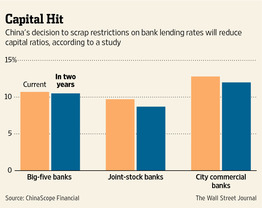
Beijing Lending Shift May Force Banks to Raise Capital; China’s banks will need up to $100 billion in new funding over the next two years following Beijing’s move to shake up lending

July 21, 2013, 12:06 p.m. ET

Beijing Lending Shift May Force Banks to Raise Capital

Removal of Floor on Loan Rates Is Seen Hitting Smaller Lenders Hardest

LINGLING WEI

MI-BX327_CLEND_D_20130721171804

BEIJING—China’s banks will need up to $100 billion in new funding over the next two years following Beijing’s move to shake up lending, according to an analysis by a research firm, and that could spur banks to tap investors for capital even amid growing worries over the strength of their balance sheets. China’s central bank on Saturday removed a government floor on the interest rates banks can charge their clients for credit, allowing financial institutions to price loans at whatever level they want. Authorities hope the action will foster competition among banks and result in easier access to loans for businesses and individual borrowers, especially small and private manufacturers long shunned by big state-owned lenders.  Read more of this post

China’s rate reform adds to concerns for bank investors as eventual industry overhaul will deprive the banks of virtually risk-free profits

China’s rate reform adds to concerns for bank investors

12:16am EDT

By Pete Sweeney and Gabriel Wildau

SHANGHAI (Reuters) – Beijing’s move to scrap the floor on lending rates is not yet a game-changer for Chinese banks, but it may have just started the countdown to an eventual industry overhaul which will deprive the banks of virtually risk-free profits.

China bank stocks mostly fell on Monday, the first trading session following the rate reform announced late on Friday. An index of banks listed in Shanghai was down 1.7 percent in late morning trading, compared with a decline of 0.4 percent for the broader Shanghai Composite Index .SSEC.SS. Read more of this post

Senior provincial officials seek financial help from China’s finance ministry, even from provinces considered economically sound such as Guangdong

Senior provincial officials seek help from China’s finance ministry

Staff Reporter

2013-07-18

Several senior provincial-level officials have personally sought financial support from China’s Ministry of Finance, with officials from provinces considered economically sound such as Guangdong, also voicing similar demands, reports Shanghai’s National Business Daily. Amid an economic slowdown, provincial officials have made visits to the Ministry of Finance with the aim of receiving central government benefits to bolster their regions. The list includes Guo Gengmao, secretary of the CPC Henan Provincial Committee, Xie Fuzhan, the governor of Henan, Zhou Benshen, secretary of the CPC Hebei Provincial Committee, and the governor of Guangdong Zhu Xiaodan. Read more of this post

The path of bankruptcy which crippled the once booming industrial city of Detroit is now being followed by certain cities in China

Detroit clones cropping up around China

Staff Reporter

2013-07-21

The path of bankruptcy which crippled the once booming industrial city of Detroit is now being followed by certain cities in China. These cities, such as Ordos and Wenzhou, develop rapidly without considering market demand and become “ghost towns,” according to the China Securities Journal.

The difference between Detroit and ghost towns in China, said Yang Shaofong, chairman of Chinese property developer Conworld, is that the latter will never go bankrupt because Beijing will always bail them out through policy support. Many of the ghost towns are actually already bankrupt. Read more of this post

How to Make an Audit Report Useful

Updated July 22, 2013, 12:00 a.m. ET

How to Make an Audit Report Useful

Auditors’ letters are boring and uninformative. In the future they may still be boring, but at least they’ll say something.

Face it: It is going to be pretty hard to ever make audit reports scintillating reading. But they definitely could be made a lot more informative. Audit reports are those tedious letters in which a company’s outside auditor attests that its financial statements are accurate. In fact, they’re so tedious, and offer so little information, that most investors can be forgiven for skipping them. But now many want to revamp the reports so they provide more information about the auditor’s findings—from potential risks that could affect the financial statements to areas of the audit that the auditor thinks are particularly important. The graphic at left (click to enlarge) is a mock-up prepared by The Wall Street Journal of what a revamped audit report might look like, drawing on ideas suggested by regulatory agencies and accounting groups around the world. There is no uniform agreement on what changes to make, and no revamp will incorporate all these ideas. U.S. audit regulators haven’t even issued a formal proposal yet indicating which ideas they will pursue. Though a revamped report would still be jargon-filled—and probably longer because of the suggested additions—investors might get more out of it. In other words, at least the tedium might be worth it.

LE-AA271_AUDITt_G_20130718123613

When you’re rattled by collateral, do the Fed taper talk; it seems increasingly that Taper talk was forced upon the Fed for market operational reasons rather than anything to do with economic conditions being ripe for a pullback in easing

When you’re rattled by collateral, do the Fed taper talk

Izabella Kaminska

| Jul 19 10:02 | 11 comments | Share

Tim Duy, professor of practice at the department of economics at the University of Oregon, is confusing Brad DeLong, professor of economics at Berkeley, with his observation that the Fed seems to be striving to change the mix but not the level of outright accommodation. This, at least, seems to be the motivation for taper talk. We’re less confused, and quite like what Duy is saying. Note the following (our emphasis):

Bernanke is talking as if the goal is to change the mix of monetary policy but not the level of accommodation, essentially trading some reduced accommodation from ending asset purchases for additional accommodation by extending the forward guidance on interest rates. But why? If the level of accommodation is the same, does the mix matter? That’s an interesting question – does the Fed have research saying the mix matters, and why? I can see two reasons. One is that somehow asset purchases have a more negative distortionary impact. Another is that there exists an internal bias in the FOMC against expanding the balance sheet. Arguably, some elements of both where on display in Bernanke’s testimony today: Read more of this post

At-home beauty device market grows

2013-07-21

At-home beauty device market grows

By Rachel Lee

hair_200

Laser 4X, a hair removal device made by Tria Beauty, is designed for at-home use

The country’s at-home beauty device market has been expanding gradually over, creating a new approach to beauty and skin care. Using high-tech, easy-to-use home beauty devices, consumers can now perform procedures like facial rejuvenation, cellulite and fat reduction, acne treatment and hair removal at home. Some popular at-home devices are Nu Skin’s ageLOC Galvanic Body Trio, a spa device that contours, smoothens and firms the body, and Unix Electronics’s Style Cube,  a hairstyling device. Read more of this post

Korea: Republic of Workaholics

2013-07-21

Korea: Republic of Workaholics

Long working hours make workers unhappy

By  Kim Bo-eun
130721_a01_korea2

Korea is notorious for being a country of workaholics, having one of the world’s highest numbers of annual working hours per employee. While the government and leading conglomerates have been cutting back on working hours and lengthening breaks, small- and medium-sized companies still face the miserable reality of all work and no play. Korea still has one of the lowest numbers of legally guaranteed vacation days. Even then, employees rarely use up all of their vacation days due to the workaholic culture, and when they do go on their short vacations, they are prone to be stress-ridden. Read more of this post