Commodity Traders Face New Squeeze as Storage Congestion Spreads

Commodity Traders Face New Squeeze as Storage Congestion Spreads

Commodity traders are facing another supply squeeze as stockpiles concentrate in fewer cocoa depots, mirroring congestion at metals warehouses that means some buyers are paying record premiums for deliveries.

Warehouses in Antwerp, Belgium, held 61 percent of cocoa certified for delivery by the NYSE Liffe exchange on June 24, compared with 36 percent a year earlier, bourse data show. That mirrors the trend in metal stockpiles, with 73 percent of aluminum and 90 percent of copper tracked by the London Metal Exchange now held in three locations. Read more of this post
The panic that rippled through Asia’s markets in May and June might just be a prelude to a more serious capital flight when the U.S. Federal Reserve starts winding down its stimulus measures for real

Asian stress points unveiled as Fed tapering looms

5:07pm EDT

By Nachum Kaplan and Umesh Desai

Singapore (Reuters) – The panic that rippled through Asia’s markets in May and June might just be a prelude to a more serious capital flight when the U.S. Federal Reserve starts winding down its stimulus measures for real.

How quickly the U.S. Federal Reserve reduces its $85 billion a month of bond purchases, which keep interest rates low, will determine how quickly money is pulled out of Asia. Read more of this post

New-breed bosses rev up Indonesia’s state enterprises

New-breed bosses rev up Indonesia’s state enterprises

Wednesday, Jul 10, 2013

John McBeth

The Straits Times

SINGAPORE – Don’t say it too loudly because it might upset the bureaucrats, but over the past five years, go-ahead private sector executives have been changing the corporate culture and turning around the fortunes of a clutch of Indonesia’s state-owned enterprises.

Pertamina oil company president-director Karen Agustiawan, 54; Garuda Airlines chief executive officer Emirsyah Satar, 53; and Kereta Api national railway boss Ignasius Jonan, 49, have all made an impact on organisations previously known for their leaking budgets and tardy public service. Read more of this post

Trouble Looms for Japan’s Once-Mighty DPJ; Beleaguered Party Projected to Lose Last Grasp on Power in Upper House Race

Updated July 10, 2013, 1:26 p.m. ET

Trouble Looms for Japan’s Once-Mighty DPJ

Beleaguered Party Projected to Lose Last Grasp on Power in Upper House Race

TOKO SEKIGUCHI

TOKYO—Four years after its historic overthrow of the entrenched one-party rule of the Liberal Democratic Party, the Democratic Party of Japan is set to lose its last grasp on power with polls predicting a catastrophic loss for the beleaguered party in the coming upper house race.

The DPJ, led by Banri Kaieda is projected to lose half its 44 seats up for election in the July 21 race, according to surveys by Japan’s major dailies. The DPJ, which for now is the largest single voting bloc in the upper chamber, will be giving up its presence as the dominant opposition force, as the governing LDP-New Komeito coalition’s bicameral control of parliament all but eliminates the DPJ’s tactical recourse against the enactment of government-proposed bills. Read more of this post

Dividend Stock Investors Should Really Consider How CEOs Are Paid

MORGAN STANLEY: Dividend Stock Investors Should Really Consider How CEOs Are Paid

SAM RO JUL. 11, 2013, 7:39 AM 844 1

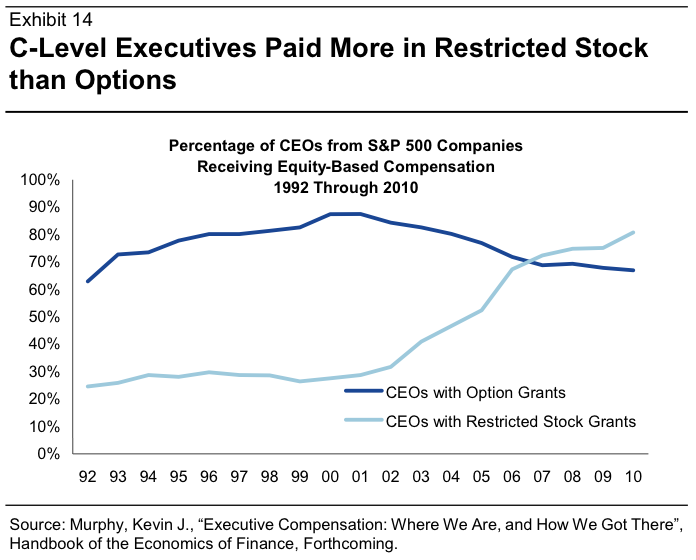
Adam Parker, Morgan Stanley’s Chief U.S. Equity Strategist, is on Bloomberg Surveillance with Tom Keene this morning. While discussing dividend paying stocks, Parker noted that we should consider executive compensation structures. Parker addressed this in a recent report to clients: Management teams are paying themselves more in restricted stock units (RSUs) than in options. In recent years, more CEOs of S&P 500 companies have received compensation in the form of restricted stock than as options (Exhibit 14). It is important that fundamental analysts understand how the senior management teams of the companies they are analyzing are variably compensated, as those with restricted stock and not options are much more likely to increase dividends. The principle? People rarely intentionally damage their own net worth. The shift toward equity-based compensation was designed to align executives’ interests with shareholders. However, we have to wonder if corporate decision-makers will pass up better uses of cash to enrich themselves in the form of dividends. Regardless, this decision to pay out an increasing dividend is crucial to investors. Since 1930, dividends have accounted for 42 percent of stock market investment returns.

screen shot 2013-03-18 at 8.41.33 pm

Chateau d’Yquem ’90 Extends Decline to Lowest Level Since 2009

Chateau d’Yquem ’90 Extends Decline to Lowest Level Since 2009

A case of 1990 Chateau d’Yquem, Bordeaux’s top-ranked Sauternes dessert wine, sold for 2,700 pounds ($4,050) on the Liv-ex market yesterday, extending a 15-month drop and taking it to its lowest level since October 2009.

The wine sold for 20 percent less than the 3,380 pounds at which it traded in March last year, having peaked at 3,400 pounds in September 2011, according to data on London-based Liv-ex’s Cellar Watch website. Read more of this post

Fittings maker Grohe attracts bid interest from rivals; Grohe, which has a 8% global market share, posted sales of 1.4bn euros, EBITDA 273m euros

Fittings maker Grohe attracts bid interest from rivals – sources

1:10pm EDT

FRANKFURT (Reuters) – German bathroom fixtures maker Grohe GROH.UL has attracted bidding interest from several rivals, which have been asked to submit tentative offers by the end of next week, three people familiar with the process told Reuters.

Grohe’s owners, investor TPG Capital TPG.UL and the private equity arm of Credit Suisse (CSGN.VX: Quote,Profile, Research, Stock Buzz), are running a so-called dual track process that may alternatively result in a stock market listing of Europe’s biggest bathroom equipment maker in the autumn. Read more of this post

Brazil Signals World’s Biggest Key Rate Increase Far From Over; Brazil Raises Rate to 8.5% as Inflation Undermines Growth

Brazil Signals World’s Biggest Key Rate Increase Far From Over

Brazil’s central bank raised the benchmark interest rate a third consecutive time and said it was giving continuity to the world’s biggest tightening cycle, signaling increases may be extended through year-end as policy makers battle inflation.

The bank’s board, led by President Alexandre Tombini, yesterday raised the benchmark Selic (BZSTSETA) rate by 50 basis points to 8.50 percent, as forecast by all 51 analysts surveyed by Bloomberg. The move led Itau Unibanco to reiterate its call for a rate increase in each of the three meetings left this year. Read more of this post

Indonesia Raises Rate More Than Forecast to 6.5% on Inflation

Indonesia Raises Rate More Than Forecast to 6.5% on Inflation

Bank Indonesia raised its key interest rate more than forecast to bolster a weakening currency and ease inflation pressures after the government increased fuel prices last month.

The central bank boosted the reference rate by 50 basis points to 6.5 percent, Governor Agus Martowardojo said in Jakarta today. The outcome was predicted by three of 19 economists surveyed by Bloomberg News, with the majority expecting a 25 basis-point increase. It also boosted the deposit facility rate to 4.75 percent from 4.25 percent. Read more of this post

Emerging Markets Are Stuck on Fed’s Elevator Ride

Emerging Markets Are Stuck on Fed’s Elevator Ride

Back in the 1960s, a French finance minister called the U.S.’s ability to borrow in its own currency — thanks to the dollar’s pre-eminence and reserve-currency status — an “exorbitant privilege.” It’s an advantage that the rest of the world has to pay for, one way or another. This has lately given many emerging-market governments cause for complaint. If they had the will, one or two of them could do something about it. Maybe it’s time they did.

The issue has been highlighted in recent weeks as the Federal Reserve (FDTR) unsettled global markets by signaling its intent to start tightening monetary policy — at least, that’s what investors thought it said. There was a sell-off in global fixed-income markets, and many emerging economies saw the value of their bonds, equities and currencies drop. Read more of this post

REITs Deepening Bond Losses as Leverage Forces Sales

REITs Deepening Bond Losses as Leverage Forces Sales

Annaly Capital Management Inc. (NLY)’s Wellington Denahan, head of the largest mortgage real-estate investment trust, told investors less than three months ago that reports REITs could threaten U.S. financial stability were as misleading as the media frenzy over shark attacks in 2001.

Since the May 2 comments, shares of the companies, which use borrowed money to make $400 billion in credit market bets, have dropped about 19 percent and the value of their assets has plunged after the Federal Reserve triggered a flight from bond funds by signaling plans to slow its debt-buying program.

REITs may have needed to sell about $30 billion of government-backed mortgage securities in just one week last month to maintain the amount of borrowing relative to their net worth, according to JPMorgan Chase & Co. Those types of sales deepened losses in the mortgage-bond market, which had the worst quarter since 1994, accelerated the exit from fixed-income funds and fueled a jump in home-loan rates to a two-year high. Read more of this post

World Cup Billionaire Mata Pires Stirs Brazil Protests Over Stadiums

World Cup Billionaire Stirs Brazil Protests Over Stadiums

Cesar Mata Pires represents everything protesters in Brazil detest.

When demonstrators across the country swarmed new World Cup soccer stadiums last month amid a haze of tear gas and rubber bullets, one placard punctuated their anger over the government’s decision to finance the arenas at the expense of taxpayers, which enriched a handful of well-connected tycoons while neglecting public services.

The sign, which said “The $ for Education Went to OAS,” took aim at the construction company owned by Mata Pires, which has emerged as one of the biggest winners in the building boom leading up to the World Cup and the 2016 Olympics. It also has made its 63-year-old chief executive a billionaire. Read more of this post

Worst Dim Sum Baosteel Shows Smokestack Troubles

Worst Dim Sum Baosteel Shows Smokestack Troubles

Baosteel Group Corp. was the worst-performing high-grade corporate Dim Sum bond in the past month as Premier Li Keqiang sacrifices economic growth during a shakeup of smokestack industries.

The yield on March 2017 debt of Baosteel, China’s third-largest steelmaker, rose 102 basis points and touched a record 4.87 percent on July 5, data compiled by Bloomberg show. That was the most among non-financial issuers on HSBC Holdings Plc’s investment-grade Dim Sum index, as average yields on the yuan debt sold offshore climbed 79 basis points to 4.01 percent. U.S. industrial companies pay 2.43 percent for three- to five-year debt, according to Bank of America Merrill Lynch indexes. Read more of this post

China Seen Widening Car-Purchase Limit to Fight Pollution; “More cities will introduce purchase restrictions. This is just the beginning of a long-term trend.”

China Seen Widening Car-Purchase Limit to Fight Pollution

China, the biggest emitter of greenhouse gases, plans to widen the number of cities curbing auto purchases to fight pollution and congestion, threatening vehicle sales, the government-backed car association said. Eight cities — Chengdu, Chongqing, Hangzhou, Qingdao, Shenzhen, Shijiazhuang, Tianjin and Wuhan — will probably introduce measures limiting auto purchases, Shi Jianhua, deputy secretary general of the China Association of Automobile Manufacturers, said in a briefing in Beijing today, without being more specific about the timing. Such limitations could cut vehicle deliveries by 400,000 units, or 2 percent of nationwide sales, and undermine economic growth, Shi said. If introduced, the measures may triple the number of Chinese cities — Beijing and Shanghai have vehicle quotas — imposing curbs on automobiles as public anger grows over worsening congestion and air pollution.

Read more of this post

Investing for a rapidly changing world

July 5, 2013 6:51 pm

Investing for a rapidly changing world

By Norma Cohen, Demography Correspondent

The news on the population front often could not appear more grim – longer working lives, less spending and more saving, higher taxes, and a greater likelihood of chronic or degenerative diseases, such as Alzheimer’s. But there is a silver lining. There is a way to profit from the current unprecedented pace of population change and several large fund management groups are turning their collective hands to doing just that. Read more of this post

Seoul braces for a slowdown; S Korea is trying to find best balance between intervention and market forces at times of stress

July 9, 2013 5:46 pm

Inside Business: Seoul braces for a slowdown

By Henny Sender

S Korea is trying to find best balance between intervention and market forces at times of stress

Asia is bracing for harder times once again. “The oxygen is getting thinner,” noted Frederic Neumann, HSBC’s Asian regional economist, as he slashed growth projections for the region in a report this week. One early straw in the wind was the decision by South Korea’s new government of Park Geun-hye some weeks ago to quietly cancel the planned privatisation of Korea Development Bank, one of Seoul’s principal policy arms. The decision is understandable. As a relatively open economy that lacks the continental dimensions of its neighbour, South Korea is among the countries that are potentially most exposed to the harder economic times. About a quarter of its exports go to China. So when economic growth in its neighbour slows, South Korea also slows. Read more of this post

China Leaves Sour Taste at Yum Brands; Dependency on the Country Has Come Home to Roost After Poultry Scandal There

July 9, 2013, 6:53 p.m. ET

China Leaves Sour Taste at Yum Brands

Dependency on the Country Has Come Home to Roost After Poultry Scandal There

SPENCER JAKAB

MI-BX068_YUMTAP_NS_20130709183304

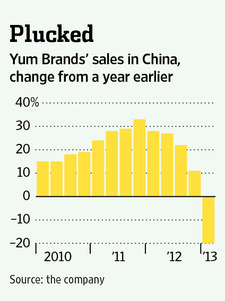
While not quite putting all its eggs in one basket, fast-food chain Yum Brands Inc.YUM +0.70% has leaned heavily on the popularity of fried chicken in China. That dependency has come home to roost in recent months as a poultry scandal in late 2012 and then an avian-flu outbreak this spring drove customers away. Although KFCs in China account for just over a 10th of Yum’s restaurant count globally, it owns all of them and they are the bulk of a Chinese business that contributed 42% of Yum’s “segment profit” in 2012. Restaurants elsewhere are largely franchised and have less earnings impact. Read more of this post

Why China will not buy the world; The Chinese economy is marked by its dependence on others

July 9, 2013 7:26 pm

Why China will not buy the world

By Martin Wolf

The Chinese economy is marked by its dependence on others

China frightens the west. Rarely, however, do westerners look at how the world looks to China. Yes, it has made enormous economic strides. But it still sees a world economy dominated by developed economies. Among the few westerners able to look at the world from the Chinese point of view is Peter Nolan, professor of Chinese development at Cambridge university. In a thought-provoking book published last year, he addressed one of the big fears about China – that it is buying the world. His answer is no: we are inside China but China is not inside us. To understand what Prof Nolan means by this, one must understand his view of what has happened during three decades of technology-driven global economic integration. The world economy has been transformed, he argues, by the emergence, through mergers, acquisition and foreign direct investment, of a limited number of dominant businesses, almost entirely rooted in advanced countries. Read more of this post

China’s credit crunch buffets Berlin; 15 per cent to 20 per cent of German Dax companies’ earnings are China related

July 9, 2013 6:58 pm

China’s credit crunch buffets Berlin

By Ralph Atkins

Germany was the rock of stability during the eurozone crisis but it is being seriously buffeted by the economic slowdown in China. German shares have dropped much more than the European average since June 19. That was when the US Federal Reserve confirmed it wanted to scale back its asset purchases – but also when China’s credit crunch sprang to global attention, heightening worries about how Beijing was applying the economic brakes. There was more bad news yesterday when the International Monetary Fund revised down forecastsfor Chinese growth this year and next. Deutsche Bank estimates the fall in German shipments to China in the first three months of this year compared with the same period in 2012 was already equivalent to 0.5 per cent of German gross domestic product. Read more of this post

Emerging Markets Hit by IMF Forecast; Lower Growth Prospects Further Rattle Developing Nations

Updated July 9, 2013, 9:00 p.m. ET

Emerging Markets Hit by IMF Forecast

Lower Growth Prospects Further Rattle Developing Nations

ERIN MCCARTHY, CHARLES FORELLE and IAN TALLEY

MI-BX090_Emergi_G_20130709190307

Investor fears that the end of easy money is at hand are ricocheting around the globe, slamming financial markets and squeezing economic growth prospects from Brazil to Turkey. In the latest fallout, the International Monetary Fund on Tuesday trimmed its global-growth forecast, reducing its projections for emerging markets such as China and Russia. The report highlights the difficulties facing nations that recently were flooded with investor cash amid a global search for yield, but now face outflows as interest rates rise in the U.S. The IMF’s move underscores the ripple effects as markets brace for the withdrawal of central-bank stimulus policies. Scores of riskier markets have been whipsawed since Federal Reserve Chairman Ben Bernanke signaled this spring that the central bank’s monthly bond purchases, currently $85 billion, eventually will be curtailed. Many investors expect the sharp moves to continue as participants grapple with Fed policy and economic uncertainty. Read more of this post

The political nightmare of a slowing China

The political nightmare of a slowing China

The recent financial turmoil in China, with interbank loan rates spiking to double digits within days, provides further confirmation that the world’s second-largest economy is headed for a hard landing.

4 HOURS 40 MIN AGO

The recent financial turmoil in China, with interbank loan rates spiking to double digits within days, provides further confirmation that the world’s second-largest economy is headed for a hard landing. Fuelled by massive credit growth, the economy has taken on a level of financial leverage that is the highest among emerging markets. This will not end well. Indeed, a recent study by Nomura Securities finds that China’s financial-risk profile today uncannily resembles those of Thailand, Japan, Spain and the United States on the eve of their financial crises. Read more of this post

More Taiwanese firms in China heading home

More Taiwanese firms in China heading home

A growing wave of Taiwanese companies that rode the tide of cheap manufacturing in China are returning home. But they play it safe by relocating partially as costs rise in China. -ST
Lee Seok Hwai
Wed, Jul 10, 2013
The Straits Times

TAIPEI – A growing wave of Taiwanese companies that rode the tide of cheap manufacturing in China over the last three decades are returning home as costs on the mainland creep up. But they are hedging their bets by keeping most of their existing operations in China and relocating only partially or investing in new facilities – focused on research and development (R&D) or more sophisticated manufacturing – back in Taiwan, where wages have remained stagnant for the past decade because of an underperforming economy. Read more of this post

Japan’s Bullet Trains Face Challenge From Low-Fare Airlines

Japan’s Bullet Trains Face Challenge From Low-Fare Airlines

The battle between three new budget airlines in Japan is benefiting businessmen as well as tourists, as operators of the bullet trains that have dominated long-distance travel since 1964 cut prices to defend market share.

West Japan Railway Co. (9021) and Kyushu Railway Co. started reducing advance ticket prices this month by as much as 34 percent to 14,000 yen ($140) between the central city of Osaka and the southern city of Kagoshima over the next three months. Read more of this post

Bible holds lessons for future of energy; The Genesis message about preparing for harsh times should be applied to fuel production

July 9, 2013 7:11 pm

Bible holds lessons for future of energy

The Genesis message about preparing for harsh times should be applied to fuel production

The writers of Genesis understood the commodity cycle very well. When the pharaoh dreamt of seven fat cows being eaten by seven lean ones, it was a warning to prepare in the good times for harsher days to come. It is a Biblical lesson that energy policy makers would do well to relearn.

In the global oil market, we are in the fat years. Not only is the US enjoying a fully fledged oil boom, but production is set to grow in Canada and Kazakhstan, Iraq and Brazil. It is tempting to think that we are entering an “age of abundance”, in which concerns about oil security are behind us. Read more of this post

‘Abenomics’ Brings an IPO Flood

Jul 9, 2013

‘Abenomics’ Brings an IPO Flood

By Kana Inagaki

AM-AZ347_AMONEY_NS_20130709041208

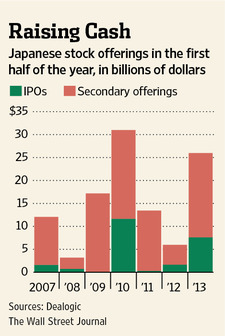
As equity fundraising slows in other Asian markets, Japanese companies such as Suntory Beverage & Food Ltd. 2587.TO +2.37% are raising billions of dollars by issuing shares, pushing capital raising in Japan during the first half of 2013 to a three-year high. Olympus Corp. 7733.TO +2.36% said Monday that it would seek to raise as much as $1.2 billion through a new share offering. Last week, advertising company Dentsu Inc. 4324.TO -0.31%and home builder Daiwa House Industry Co. 1925.TO +0.22% said they would look to raise $1.2 billion and $1.4 billion, respectively. And Suntory Beverage & Food Ltd. listed in Tokyo last week after raising $3.9 billion in Asia’s biggest initial public offering this year. Read more of this post

Japanese Fans Mourn Demise of 25-Year-Old ‘Potato Snack’; The weak yen may be a boon for exporters like Toyota but it was the last straw for Potato Snack

July 9, 2013, 10:32 p.m. ET

Japanese Fans Mourn Demise of ‘Potato Snack’

Crisp Once Came in Salami, Pudding, Octopus Flavors; Memorials, Hoarding

ELEANOR WARNOCK

2.JPG

A hostess at a pachinko parlor in Koshu, Japan, posed with Potato Snack. Players can select sweets and snacks as prizes for playing pachinko, or Japanese pinball.

The weak yen may be a boon for exporters like Toyota Motor Corp., 7203.TO 0.00%but it was the last straw for Potato Snack. The 25-year-old Japanese cracker, sold four in a 30-cent bag, had already been pummeled by years of stagnant demand. With the prospect of a weakening currency pushing higher costs of imported ingredients, maker Izumi Seika Co. pulled the plug on the unit that makes Potato Snack last month, to the dismay of die-hard fans. Heartbroken consumers have poured out their grief over the Internet, sending more than 100,000 tweets and uploading a score of video eulogies to YouTube. Devotees have staged farewell parties for the snack, which had a texture like deep-fried wonton and came in flavors from fried chicken to salami.

Read more of this post

Malaysian Stocks First From Worst on Lowest Volatility

Malaysian Stocks First From Worst on Lowest Volatility

At a time when slowing economic growth and political protests from Brazil to Turkey are spurring capital flight from emerging markets, Malaysia has turned into a refuge for equity investors.

The FTSE Bursa Malaysia KLCI Index was the biggest loser in Asia just four months ago as the closest elections in 55 years threatened the ruling coalition’s plans to spend $444 billion on infrastructure. Now the $478 billion stock market is the region’s best performer, after Prime Minister Najib Razak’s May 5 poll victory sparked a 4.2 percent rally in the KLCI index. Read more of this post

Mega-Bridge Tests Yudhoyono With Legacy in Focus; “He wants to leave these tangible, physical legacies, and the bridge is clearly one of them. The real worry is that this bridge would become a white eelephant. It would not just be costly, but it would actually blow up Indonesia’s well deserved achievement of macroeconomic stability.”

Mega-Bridge Tests Yudhoyono With Legacy in Focus: Southeast Asia

For Aat Djunaidi, a 12-hour wait to catch a ferry linking Indonesia’s most-populous islands isn’t so bad. On some trips the 41-year-old waits for two days before his truck can cross the Sunda Strait from Java into Sumatra. “If they build a bridge, it would take just 20 minutes to cross,” Djunaidi, who makes the journey three times a week to transport Suzuki motorcycles, said while waiting at the back of a four-kilometer (2.4-mile) queue. “I’d be happy if I get to use the bridge in my lifetime.” Indonesia will soon decide whether to proceed with what would be the world’s largest suspension bridge, according to Luky Eko Wuryanto, a deputy minister overseeing infrastructure projects. First conceived half a century ago, the planned 29-kilometer link that would cost an estimated $15 billion has spawned a debate over the best way to reduce logistics costs in a country with more than 17,000 islands and 250 million people. Read more of this post

Even Levy’s $7,000-a-Day Matched by Other Arts Titans

Even Levy’s $7,000-a-Day Matched by Other Arts Titans

Reynold Levy made about $7,000 each weekday as president of Lincoln Center for the Performing Arts.

Glenn Lowry, director of the Museum of Modern Art, earned about the same, $1.8 million in 2011.

The senior Carnegie Hall stagehand’s reward for moving a piano: that’s anyone’s guess, but his annual pay was $465,000.

As the pillars of New York culture attempted to rebound from the financial crisis in 2011, so did compensation at the top. Read more of this post

Commodity Traders’ Buildup on Easy Money Seen as Risk in Report; 10 largest trading houses with $1 trillion in revenue could potentially become “too physical to fail.”

Commodity Traders’ Buildup on Easy Money Seen as Risk in Report

Trading houses active in multiple commodity markets have built up physical holdings through easy access to financing, creating a possible systemic risk, according to a report by the Centre for European Policy Studies. Disclosure of physical holdings and a minimum amount of information that must be provided to regulators could reduce the risks for governments that might have to bail out trading houses, Brussels-based CEPS wrote in a statement with the European Capital Markets Institute. The 10 largest trading houses had about $1 trillion in revenue in 2011, according to CEPS and ECMI, and trading houses could potentially become “too physical to fail.” Read more of this post