Chinese banking: a Wild West in the Far East? China’s banks are now the biggest in the world but fears are growing they are very unstable

Chinese banking: a Wild West in the Far East?

China’s banks are now the biggest in the world but fears are growing they are very unstable, writes Harry Wilson.

By Harry Wilson

8:00PM BST 06 Jul 2013

As Government ministers ponder whether to split Royal Bank of Scotland into a “good bank” and a “bad bank”, it is worth remembering that China did something similar with not one big lender, but four at the turn of the millennium. In October 1999, a month before Fred Goodwin began his ill-fated reign as chief executive of RBS, the Chinese government created four massive “asset management companies” that would eventually take on toxic loans valued at $480bn (£320bn). Thirteen years on, these bad banks still exist, operating out of office blocks dotted around Beijing and Hong Kong, and continue to hold non-performing loans worth Rmb1.7 trillion (£180bn), according to credit rating agency Moody’s. Largely unknown to the outside world, they are a reminder that China’s banking system remains as prone to boom and bust as any Western economy and perhaps more so. As the rescue showed, the “Big Four” banks were, and are, not just “too big to fail”, but the beating heart of the entire Chinese economic system, controlling nearly half the country’s $19 trillion of financial assets. Read more of this post
Emerging Markets: A Career-Killing Sequel?

SATURDAY, JULY 6, 2013

A Career-Killing Sequel?

By BEN LEVISOHN | MORE ARTICLES BY AUTHOR

Emerging markets stocks were on a tear—until they stopped. This year has been the Hudson Hawk to what had been akin to the Die Hard franchise. The good news is that stocks are looking cheap; the bad is that they could still get cheaper.

After the blockbuster success of the Die Hard franchise, moviegoers thought they knew what they were getting from a new Bruce Willis flick: action, adventure and a wisecracking hero. In 1991, however, they got Hudson Hawk, a movie about a show-tune singing cat burglar robbing the Vatican. The film bombed. Investors in the emerging markets can relate. For years, they’ve bought into the narrative that the developing world’s faster economic growth, improving credit quality, and increased stability would lead to supersized returns. And for a while, they did. Emerging markets stocks rose 12% annually for the ten years ended Dec. 31, 2012. Read more of this post

One Born Every Minute; As exchange-traded funds pour into the market, more of them are of dubious value. Consider the Bitcoin ETF

| SATURDAY, JULY 6, 2013

One Born Every Minute

By RANDALL W. FORSYTH | MORE ARTICLES BY AUTHOR

As exchange-traded funds pour into the market, more of them are of dubious value. Consider the Bitcoin ETF. “There’s an app for that” is the mantra behind the boom in smartphones, turning them from things used just to make calls and send texts, to devices that put mobile computing in the palm of your hand or your pocket (well, almost, as screens steadily expand in size). Financial markets have seen a parallel phenomenon: “There’s an ETF for that,” for all manner of things. And, as with smartphone apps, a few exchange-traded funds dominate the market, alongside thousands of dubious offerings. Read more of this post

Proposed EU financial transaction tax will hit FX users hard

EU financial transaction tax will hit FX users hard: report

7:03pm EDT

By Sebastian Sadr-Salek

LONDON (Reuters) – A proposed EU financial transaction tax (FTT) could discourage use of the foreign exchange (FX) market by typically raising costs of doing business by up to 700 percent, a report said on Monday. The report by the Global Financial Markets Association (GFMA) said that due to the double-sided nature of the proposed tax, transaction costs for pension funds would increase by around 1,500 percent. And they could reach as high as 4,700 percent for some FX products such as those that involve short-dated swaps with a very low transaction cost. Read more of this post

Crowded ETF Exit Proving Costly as Bonds Trail

Crowded ETF Exit Proving Costly as Bonds Trail: Credit Markets

Investors who sought exchange-traded funds as a faster way to trade corporate bonds are finding that they can be as expensive to trade as the underlying debt.

As trading in the three-biggest credit ETFs surged to unprecedented levels last month amid the market’s biggest losses since 2008, the funds’ shares dropped as much as 1.1 percentage points more than the net value of the less-traded securities they hold. The two largest high-yield bond ETFs have lost about 6 percent since reaching a five-year high May 8. That’s about 2 percentage points more than the loss for the Bank of America Merrill Lynch U.S. High Yield Index. Read more of this post

Losing $317 Billion Makes Treasuries Safer for Mizuho to HSBC

Losing $317 Billion Makes Treasuries Safer for Mizuho to HSBC

The biggest investors in Asia and Europe are keeping their money in Treasuries even after the steepest two-month loss for the securities erased $317 billion of market value.

Mizuho Asset Management Co., which oversees $32 billion, added Treasuries due in 10 years or longer to its holdings in the past month. HSBC Private Bank, with $480 billion in assets, bought U.S. notes when 10-year yields rose to 2.5 percent. Deutsche Asset & Wealth Management, which manages about $1.3 trillion, is holding debt maturing in less than four years, betting American interest rates will remain subdued. Read more of this post

For Europe’s Debt Collectors, More Work Isn’t Paying Off

July 7, 2013, 6:52 p.m. ET

For Europe’s Debt Collectors, More Work Isn’t Paying Off

MANUELA MESCO

MK-CE530A_BADDE_D_20130707181813

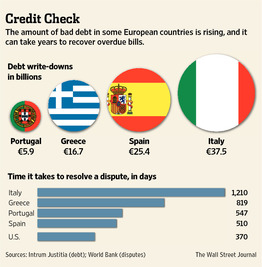
MILAN—In Europe, bad debts are soaring, the economy is contracting and business owners are flocking to debt-collection agencies to chase down deadbeat clients. Yet the boom in bad debt is bringing surprisingly little joy to the Continent’s repo men. Clogged courts, tough debt-collection rules and tapped-out debtors are making their jobs harder—and less profitable. Consider Marco Alborghetti, a Rome-based debt collector. He recently resolved a case involving a €10,000 ($12,825) debt owed to a client, the owner of a leasing company. It took 10 years to pursue the debtor through Italian courts. While the client recovered the entire amount, Mr. Alborghetti says the hassle, as well as the cost of hiring lawyers to pursue the case, hardly made the job worth it. “It’s just uneconomical for everyone involved,” he said. Read more of this post

Record numbers of exchange traded funds have closed so far this year, underscoring the difficulty many of the investment vehicles face in gaining traction among investors, despite the industry’s overall boom in popularity in recent years

July 7, 2013 2:11 pm

ETFs close in record numbers despite industry boom

By Arash Massoudi and Tracy Alloway in New York

Record numbers of exchange traded funds have closed so far this year, underscoring the difficulty many of the investment vehicles face in gaining traction among investors, despite the industry’s overall boom in popularity in recent years. About 117 ETFs have shuttered in the first half of this year, according to data collected by independent research firm ETFGI, easily outpacing closures in the same period in previous years. Out of 4,849 exchange traded products on the market, more than 60 per cent have less than $100m in assets, suggesting that more closures could take place in the coming months. Read more of this post

Billionaires and their supercars add to Singapore inequality concerns

July 7, 2013 3:10 pm

Billionaires and their supercars add to Singapore inequality concerns

By Jeremy Grant in Singapore

At a showroom in Singapore, a small crowd of McLaren enthusiasts were gathering for the unveiling of the latest “supercar” made by the British carmaker, a petrol-electric hybrid with a top speed of 350km an hour. Never mind that the vehicle only comes in left-hand drive, so can not legally be driven on Singapore’s crowded right-hand drive roads. Anyone interested in buying would be looking at the P1 as an investment, even if they could get their hands on one – for a cool S$1.5m ($1.2m). McLaren has only made 375 of the cars and has yet to allocate what few are left unsold to the Singapore market. None of this has put off Chor King Ang, senior executive at Kwang Sia, a Singapore-based fashion retailer that sells luxury labels such as Hugo Boss and DSquared2 in stores across southeast Asia. “I’ve long been a fan of their Formula One racing team,” he said, adding that he is already an owner of an earlier McLaren model. In the past year, the trappings of wealth have been increasingly visible in Singapore as the number of sports cars roaring down its streets has increased. Last month saw the first sale in the island-nation of a Koenigsegg “hypercar” for $5.3m. Read more of this post

Rising rates to spur litany of capital losses

July 7, 2013 5:54 pm

Rising rates to spur litany of capital losses

By Tracy Alloway and Tom Braithwaite in New York

US banks have watched billions of dollars of paper profits on their securities portfolios wiped out by rising market interest rates, erasing huge gains made during the prolonged run of increasing bond prices since the financial crisis and ensuring that erosions of capital will be a feature of the coming bank earnings season.

Data released by the Federal Reserve on Friday showed unrealised gains in these portfolios had plummeted from more than $40bn at the beginning of the year to about $6bn, with the most precipitous falls over the past few weeks amid mounting market concern about the “tapering” of the central bank’s bond-buying programme. Read more of this post

Mexico’s freight business has transformed into a principal artery for the top export industries of Latin America’s second-largest economy

Trains, planes and automobiles: Mexico rail freight comes of age

Fri, Jul 5 2013

By Gabriel Stargardter

MEXICO CITY (Reuters) – Slowly, like the trains that crawl past towering avenues of containers here at the country’s largest rail hub, Mexico’s freight business has transformed into a principal artery for the top export industries of Latin America’s second-largest economy. A rail network that once shunted Mexico’s mustachioed revolutionaries to battles across the country was gasping for air by the late 1990s as grinding inefficiency and rising costs forced the government into privatization. Read more of this post

Quebec rail disaster shines critical light on oil-by-rail boom

Quebec rail disaster shines critical light on oil-by-rail boom

6:59pm EDT

By Scott Haggett, Dave Sherwood and Cezary Podkul

20130707.121437_reuters_trainderail

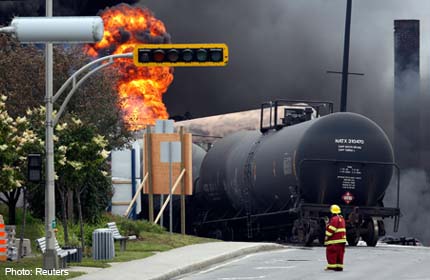
(Reuters) – The deadly train derailment in Quebec this weekend is set to bring intense scrutiny to the dramatic growth in North America of shipping crude oil by rail, a century-old practice unexpectedly revived by the surge in shale oil production. At least five people were killed, and another 40 are missing, after a train carrying 73 tank cars of North Dakota crude rolled driverless down a hill into the heart of Lac-Megantic, Quebec, where it derailed and exploded, leveling the town center. It was the latest and most deadly in a series of high-profile accidents involving crude oil shipments on North America’s rail network. Oil by rail – at least until now – has widely been expected to continue growing as shale oil output races ahead far faster than new pipelines can be built. Read more of this post

Rice Stocks Reach 12-Year High as Food Costs Drop

Rice Stocks Reach 12-Year High as Food Costs Drop: Commodities

Rice stockpiles are expanding to the highest level in 12 years as production increases to a record, adding to a worldwide surge in agricultural output that is poised to diminish the $1.1 trillion global food-import bill.

Reserves will gain for a seventh year, rising 2.7 percent to 108.6 million metric tons in 2013-2014, the U.S. Department of Agriculture estimates. Output will climb 1.9 percent to 479.2 million tons, exceeding demand by 2.8 million tons. Prices for 5-percent broken Thai white rice, an Asian benchmark, will drop 13 percent to $455 a ton by December, according to the median of eight trader and analyst estimates compiled by Bloomberg. Read more of this post

Jim Rogers Correctly Predicted Gold Would Fall To $1200, And Now He Thinks It Could Go As Low As $900

Jim Rogers Correctly Predicted Gold Would Fall To $1200, And Now He Thinks It Could Go As Low As $900

MAMTA BADKAR JUL. 6, 2013, 6:44 AM 8,375 33

The price of gold peaked at just over $1,900 per ounce in the fall of 2011. And it was right around that time that commodities guru Jim Rogers began warning investors that the yellow metal could hit a low of $1,200 before the sell-off was over. He was right. Gold prices entered a bear market (down 20% from its high) in April. And on June 27, they touched $1,200. In a phone interview this week, Rogers explained to us how he arrived at the $1,200 figure. He also offers his outlook for gold as it continues its complicated bottoming process. Read more of this post

Fund management: The rise of smart beta

Fund management: The rise of smart beta

Terrible name, interesting trend

Jul 6th 2013 |From the print edition

INVESTORS face a quandary. Cash offers a return of virtually zero in many developed countries; government-bond yields may have risen in recent weeks but they are still unattractive. Equities have suffered two big bear markets since 2000 and are wobbling again. It is hardly surprising that pension funds, insurers and endowments are searching for new sources of return. Step forward “smart beta”, the latest bit of jargon from the fund-management industry. “Alpha” is the skill required to choose individual assets that will outperform the market; “beta” is the return achieved from exposure to the overall market, for example via an index fund. “Smart beta” is an approach that tries to enhance the return from tracking an asset class by deviating from the traditional “cap-weighted” approach, in which investors simply buy shares or bonds in proportion to their market value. The sector is still small: there is just $142 billion in smart-beta funds, compared with more than $2 trillion stashed in hedge funds. But the concept is catching on. According to State Street Global Advisors, smart-beta funds received inflows of $15 billion in the first quarter of 2013, up by 45% on the same period a year earlier. Read more of this post

Fedspeak: Complex Monetary Policy Spawns Flights of Metaphors; Central Bankers Wax Poetic, Invoking Punch Bowls, Bulls and Scarlett Johansson

Updated July 5, 2013, 6:45 a.m. ET

Fedspeak: Complex Monetary Policy Spawns Flights of Metaphors

Central Bankers Wax Poetic, Invoking Punch Bowls, Bulls and Scarlett Johansson

VICTORIA MCGRANE

At a news conference in mid-June, Federal Reserve Chairman Ben Bernanke struggled to explain what the Fed is trying to do, attempting this metaphor: “We’re going to be shifting the mix of our tools as we try to land the ship in a smooth way onto the aircraft carrier.” He then turned to automobiles, a favorite of central bankers. Trying to distinguish between reducing the Fed’s monthly bond-buying and raising short-term interest rates, he said the former is “akin to letting up a bit on the gas pedal as the car picks up speed” while the latter is “beginning to apply the brakes.” There is a long tradition of explaining complex monetary policy with metaphors. Back in 1955, in a speech littered with analogies to driving, bomb shelters and school exams, then Fed Chairman William McChesney Martin made popular the line that the duty of the Fed was to take away the punch bowl just as the party gets good. Read more of this post

Three years ago, Andreas Vgenopoulos, a Greek lawyer-turned-tycoon, was riding high. His investment fund had just snapped up Olympic Air. Today, however, he has become a symbol of Greece’s travails

July 5, 2013, 7:22 p.m. ET

Tycoon’s Rise and Fall: A Modern Greek Drama

By DEBORAH BALL and ALKMAN GRANITSAS

BF-AF312_TYCOON_G_20130705161147

Andreas Vgenopoulos in 2009 as he discussed plans to save Olympic Air. The carrier has suffered along with the rest of Greece’s economy.

ATHENS—Three years ago, Andreas Vgenopoulos, a Greek lawyer-turned-tycoon, was riding high. His investment fund, which had €15 billion ($19.4 billion) to spend following one of the biggest private-equity fundraisings ever, had just snapped up Olympic Air. Mr. Vgenopoulos was hailed as a national hero for saving Greece’s long-suffering flag carrier—an event he celebrated with a grand soiree in an Athens airport hangar with Cirque du Soleil acrobats performing for the assembled guests. Read more of this post

A cruel, cruel summer for U.S. credit funds

A cruel, cruel summer for U.S. credit funds

7:36pm EDT

By Katya Wachtel and Sam Forgione

NEW YORK (Reuters) – It’s shaping up to be a brutal summer for bond investors as the bloodbath in the U.S. credit market shows no signs of letting up, even as nearly $80 billion has already been wiped from funds. The past six weeks have been humbling for well-known fund managers including Bill Gross of PIMCO, Jeffrey Gundlach of DoubleLine Capital and Ray Dalio of Bridgewater Associates – all victims of a violent sell-off in U.S. Treasuries, mortgage-backed securities or inflation-protected bonds.

On Friday, the yield on the benchmark 10-year Treasury note touched 2.73 percent, gaining more than a full percentage point since early May, as better-than-expected U.S. jobs data fanned speculation that the Federal Reserve could begin to scale back its $85 billion-a-month bond-buying stimulus this fall. Read more of this post

Plight of the sea turtles: Students coming back home helped build modern China. So why are they now faring so poorly in the labour market?

Plight of the sea turtles: Students coming back home helped build modern China. So why are they now faring so poorly in the labour market?

Jul 6th 2013 | SHANGHAI |From the print edition

20130706_CND001_1

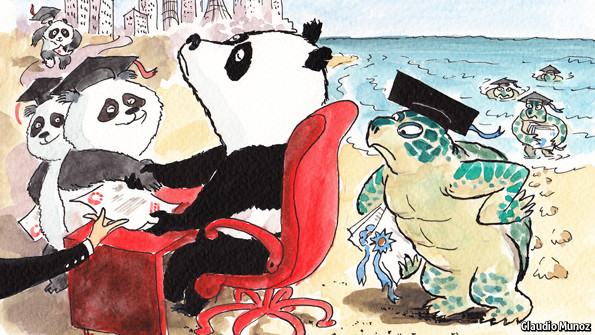
“I LEFT in 1980 with only three dollars in my pocket,” recalls Li Sanqi. He was one of the first allowed to study overseas after the dark days of the Cultural Revolution. Like most in that elite group, he excelled, rising to a coveted position at the University of Texas, while launching several technology firms. Now he is a senior executive at Huawei, a Chinese telecoms giant, enticed back by the chance to help build a world-class multinational.

Mr Li seems the perfect example of a sea turtle, or hai gui (in Mandarin, the phrase “return across the sea” sounds similar to that animal’s name), long applauded in China for bringing back advanced skills. In the past such folk reliably reaped handsome premiums in the local job market, but no longer. Sea turtles are not universally praised, the wage differential is shrinking and some are even unable to find jobs. Wags say they should now be called hai dai, or seaweed. This is a startling turn, given their past contributions. Read more of this post

China’s watchdogs show they have teeth in probing infant milk, drugs and Tetra Pak

July 5, 2013 5:55 pm

China’s watchdogs show they have teeth

By Kathrin Hille and Leslie Hook in Beijing and Patti Waldmeir in Shanghai

Tetra Pak became the latest multinational to be targeted by Chinese regulators on Friday, with the launch of an antitrust investigation against the European food packaging group.The announcement followed a probe into the pricing practices of 60 drugmakers by the National Development and Reform Commission, China’s main economic planning agency, and another pricing investigation against baby formula makers. The unveiling of three probes involving foreign companies within the space of one week has led to concerns that multinationals are being targeted by the Chinese authorities – and that their high hopes of the vast Chinese market could be disappointed. Read more of this post

Steel: An inferno of unprofitability; The world’s overcapacity in steelmaking is getting worse, and profits are evaporating

Steel: An inferno of unprofitability; The world’s overcapacity in steelmaking is getting worse, and profits are evaporating

Jul 6th 2013 |From the print edition

20130706_WBC024

THE importance of steel is in no doubt. It is the material from which much of the modern world is made, from skyscrapers to washing machines. Governments everywhere regard a strong steelmaking business as a sign of economic virility, and thus hover anxiously over their domestic producers. A French minister recently threatened to nationalise ArcelorMittal’s Florange plant if it pursued plans to cut jobs and close two blast furnaces. Despite a weak world economy, global production of steel rose by 1.2% last year to a record 1.55 billion tonnes. Read more of this post

Many wonder about Yingluck’s ‘ice-cream gang’ and its power, a so-called gang of four who allegedly influenced Thailand’s prime minister’s decisions.

Many wonder about Yingluck’s ‘ice-cream gang’ and its power

He alleged that former PM Thaksin Shinawatra was unable to control Samak because of this gang. -The Nation/ANN
Sat, Jul 06, 2013
The Nation/Asia News Network

BANGKOK – Labour Minister Chalerm Yoobamrung dropped a bombshell on Thursday when he declared that Prime Minister Yingluck Shinawatra’s “ice-cream gang” would end up dragging her down a ravine. This declaration gave rise to one simple question: Who is in this ice-cream gang and what influence do they have on her decisions? This is not the first time that Chalerm has spoken about an influential gang. During the tenure of the late ex-PM Samak Sundarvej, he talked about a so-called gang of four who allegedly influenced the prime minister’s decisions. The members of this gang were Newin Chidchob, former leader of the Northeast faction in the then-ruling People Power Party; then-deputy PM and finance minister Surapong Suebwonglee; then-deputy PM Sahas Banthitkul; and then-PM’s secretary-general Thirapol Noplampha. He alleged that former PM Thaksin Shinawatra was unable to control Samak because of this gang. During Abhisit Vejjajiva’s tenure, a so-called ice-cream gang 1 was allegedly present. Its members reportedly included then-PM’s Office minister Satit Wongnongtoey; former Democrat spokesman Thepthai Senpong; Democrat MP Sirichok Sopha; then-PM’s secretary-general Korbsak Sabhavasu; then-deputy PM’s secretary-general Issara Sunthornvut; and then-finance minister Korn Chatikavanij. Read more of this post

Singapore property market: In 2006, 15 groups of people would view a condominium unit for rent. Now it’s 15 landlords looking for that one elusive tenant. And those who are less stubborn will even slash prices to secure a tenant

Property market: Dark clouds ahead?

Thursday, Jul 04, 2013

Linette Heng

The New Paper

SINGAPORE – Stick a hand out anywhere in Singapore and you’re likely to touch a millionaire. A paper millionaire, at least. The Republic has the highest concentration of millionaires in the world. Try 17 per cent of all households here, according to a 2012 report by The Boston Consulting Group. But so much of it is tied down to property. Spoils from property account for 58 per cent of their overall wealth, according to a 2013 Barclays report. Things have been good after the global financial crisis in 2008 with money pouring in. But market watchers say things are set to change with forecasts of higher interest rates and more units coming into the market. More than 30,000 units, including HDB flats, will be completed by the end of the year. And those relying on rents to pay off their investment properties may have no idea the water is slowly coming to a boil. Real estate agents The New Paper contacted have seen the signs. In 2006, property agent Harold Teo would regularly have about 15 groups of people viewing a condominium unit for rent. Now the game has changed. He said: “Now it’s 15 landlords looking for that one elusive tenant. And those who are less stubborn will even slash prices to secure a tenant.” They are even willing to reduce rent by up to $500, said Mr Teo, for an apartment originally demanding $4,000 a month. What has changed? Mr Teo calls it the perfect storm – fewer foreigners, less money and more units. Read more of this post

Making money from private equity in China has become as challenging as “trying to catch a fish in a tree“*.

Private Equity in China 2013: the Opportunity & The Crisis — China First Capital Research Report

2013-07-04 15:36:29

Peter Fuhrman, Chairman and CEO China First Capital

Making money from private equity in China has become as challenging as “trying to catch a fish in a tree“*. The IPO exit channel is basically shut. Fundraising has never been harder. One hundred billion dollars in capital is locked up inside unexited deals. LPs are getting very anxious. Private companies are suffocating from a lack of new equity financing. PE firms are splintering as partners depart the many struggling firms. Read more of this post

Could poor planning turn China’s city centers into slums?

Could poor planning turn China’s city centers into slums?

Thursday, July 4, 2013

Series: Unstable foundations (Part 3)

China has built glittering metropolises in the span of roughly three decades of reform and opening. But in an equal span of time, shiny urban centers risk losing their shining façades or even descending into slums thanks to poor construction quality and unclear property rights.

One study released in January points to exactly that scenario. Authored by an international team of scholars, the report shows that ambiguity in the country’s land laws is pushing investment out of the center of the city and toward the outskirts.  Read more of this post

Investors have fled bonds of all kinds since mid-June—and even one of the fixed-income market’s safest corners – short-term investment-grade bond funds – hasn’t been immune.

July 5, 2013, 6:09 p.m. ET

‘Safer’ Short-Term Bond Funds See Outflows

DAISY MAXEY

Investors have fled bonds of all kinds since mid-June—and even one of the fixed-income market’s safest corners hasn’t been immune. According to preliminary data from mutual-fund tracker Lipper, in the week ended June 26 investors pulled a net $126 million out of the short-term investment-grade bond funds that have reported so far. That brings those funds’ assets to $77 billion. Unless that number changes, the week would be the first time the category saw more money leave than come in since November 2011. Until the end of May, short-term investment-grade bond funds were the bond market’s defensive darlings. This year through May, according to Lipper, investors poured $12.7 billion into the funds, which buy bonds with a relatively low risk of default that mature within one to three years. Because they mature soon, short-term bonds are less vulnerable to interest-rate increases, which drive down bond prices. For that reason, many investors had moved assets from intermediate- and long-duration funds to short-duration funds. But when Federal Reserve officials signaled in mid-June that the central bank might taper its bond buying later this year, investors pulled billions of dollars out of bond funds—and even short-term bond funds were hit. Read more of this post

Banks’ Capital Estimates Seen Overstated; Regulators’ Report Is Liable to Support Push Toward Tighter Rules for Lenders

July 5, 2013, 12:50 p.m. ET

Banks’ Capital Estimates Seen Overstated

Regulators’ Report Is Liable to Support Push Toward Tighter Rules for Lenders

GEOFFREY T. SMITH

The discretion banks use in judging the riskiness of their long-term assets can overstate their capital ratios by up to 20%, global regulators said in a final report on the subject Friday. The long-awaited report, by the Basel Committee on Banking Supervision, appeared to confirm what many outside the banking industry had long suspected: that banks have a structural bias to understate the risk embedded in the vast majority of their investments, so as to make them look better-capitalized and protected against possible shocks than they actually are. Read more of this post

Real Returns: Are Private-Equity Gains Built to Last?

July 5, 2013, 6:05 p.m. ET

Real Returns: Are Private-Equity Gains Built to Last?

MARK HULBERT

A new study shows that one of the chief benefits of private-equity firms is largely an illusion. The study comes as Dell DELL -2.10% shareholders prepare for a July 18 vote on whether to accept a bid from founder Michael Dell and private-equity firm Silver Lake Partners to take the company private at $13.65 a share.

To be sure, many private-equity buyout funds have in the past produced superior returns. But their fees are steep—typically 2% of assets plus 20% of any profits. And many of their advantages are either ephemeral or can be replicated at a much lower cost. Read more of this post

China: Private Banks Possible in Sweeping Reform

China: Private Banks Possible in Sweeping Reform

Friday, 05 Jul 2013 07:32 AM

China on Friday promised sweeping changes to its state-run banking industry — including allowing the creation of private lenders — to support its credit-starved entrepreneurs and curb what regulators worry are growing financial risks.

Analysts including the World Bank say an overhaul of a Chinese banking system that lends little to private businesses is urgently needed to keep economic growth strong. Communist leaders who took power last year have promised to support entrepreneurs who generate China’s new jobs and wealth, but have yet to make significant changes. Read more of this post

Mortgage REITs Slide Most Since 2011 on Fed Tapering Concern

Mortgage REITs Slide Most Since 2011 on Fed Tapering Concern

Real estate investment trusts that buy mortgage debt slumped after a better-than-forecast employment report stoked speculation the Federal Reserve will begin to reduce the size of its asset purchases.

A Bloomberg index of shares in the REITs tumbled 3.9 percent as of 4:40 p.m. in New York, the largest drop since October 2011. Annaly Capital Management Inc. (NLY), the largest of the companies, and American Capital Agency Corp. (AGNC), the second biggest, each plunged more than 5 percent. Read more of this post