Trades Rival University Degrees for Canada Labor Market

Trades Rival University Degrees for Canada Labor Market

Ellie MacRae is taking summer classes to accelerate a four-year degree in early childhood studies, even as she worries her efforts won’t pay off like her boyfriend’s electrical training.

“Undergraduate degrees don’t get you a job,” said MacRae, 21, who is in her second year at Toronto’s Ryerson University. Her boyfriend “will have an easier time finding a job than me – – there’s just a lot more opportunities in the trades.” Read more of this post

Which State Drinks The Most (And Least) Beer?

Which State Drinks The Most (And Least) Beer?

Tyler Durden on 07/04/2013 19:55 -0400

On a day when the underlying reason for celebration in the US is often washed away by a few gallons of alcohol, we thought it timely to see just which states are the biggest soaks. It is likely no surprise that Utah is the driest state but the top 4 states seem head and shoulders above the rest with North Dakota topping the list at 45.8 gallons of beer per capita per year (or an average of just over 1 pint per day – which seems very reasonable?). Only 4 states have seen consumption per capita rise in the last 5 years – Vermont (+8.34%), North Dakota (+7.5%), Maine (+3.45%) and New Hampshire (+0.34%) – while Nevada (-16.42%), Washington (-15.24%), and Florida (-15.01%) are sobering up the fastest…

20130704_drink

China signals will cut off credit to rebalance economy

China signals will cut off credit to rebalance economy

7:21am EDT

By Koh Gui Qing and Langi Chiang

BEIJING (Reuters) – China said on Friday it would cut off credit to force consolidation in industries plagued by overcapacity as it seeks to end the economy’s dependence on extravagant investment funded by cheap debt. In a statement from the State Council, or cabinet, Beijing laid out broad plans to ensure banks support the kind of economic rebalancing China’s new leadership wants as it looks to focus more on high-end manufacturing. Read more of this post

China Vice Finance Minister Urges ‘High Alert’ on Local Debt

China Vice Finance Minister Urges ‘High Alert’ on Local Debt

A Chinese vice finance minister warned the nation must be on “high alert” to the dangers of rising debt in companies set up by local governments to fund investment projects.

“Prominent risks are not only in the shadow-banking area but also in local government financing vehicles, and we do need to be on high alert,” Zhu Guangyao said at a briefing in Beijing today. At the same time, companies are mainly investing in infrastructure projects with relatively good operations and repayment abilities, he said. Read more of this post

PBOC to Extend Cash Crunch as Zhou Discovers Flaws

PBOC to Extend Cash Crunch as Zhou Discovers Flaws

China’s finance companies predict central bank Governor Zhou Xiaochuan will extend a cash crunch, albeit without June’s dramatic swings, as he calls for the market to “discover and correct” excessive lending.

The seven-day repurchase rate, which measures interbank funding availability, may average 4 percent in the third quarter, compared with 3.62 percent in the past year, according to the median estimate in a Bloomberg survey of eight analysts. The rate surged to a record 10.8 percent on June 20, and averaged 4.49 percent last quarter, the highest since the National Interbank Funding Center started compiling the data in 2003. The similar rate in India fell 73 basis points. Read more of this post

China Probes Tetra Pak for Abuse of Market Control; China Probes 60 Drugmakers in Effort to Curb Drug Prices

China Probes Tetra Pak for Abuse of Market Control, Xinhua Says

China is probing Switzerland-based food-packaging company Tetra Pak Group for possible abuse of market dominance, the official Xinhua News Agency reported today, citing the State Administration for Industry & Commerce.

The market watchdog has organized more than 20 of its regional agencies to investigate the allegations, Xinhua said without giving further details. Three telephone calls to the watchdog’s press office in Beijing weren’t answered. Calls to Tetra Pak’s Shanghai office were also not answered. Read more of this post

Christmas Candy Stockpiled in July as Aussie Slump Looms

Christmas Candy Stockpiled in July as Aussie Slump Looms

Andy Adams has already bought his Christmas candy. With the Australian dollar down 12 percent in its longest losing streak since the 2008 financial crisis, he’s stocking his food store early in anticipation of a further fall.

“We basically doubled the size of our last order. We had to,” said Adams, whose British Sweets and Treats store in the Sydney suburb of Bondi caters to U.K., Irish and American expats craving Maynards Wine Gums, Barry’s Tea, and Baby Ruth bars. “We know the dollar’s going to creep down, so we’re trying to grab it now at a reasonable price.” Read more of this post

Ferrari-Beating Great Wall Motor Shows Wei Jianjun Forging Next Hyundai

Ferrari-Beating Great Wall Shows Wei Forging Next Hyundai

Wang Jiangwei recalls spending last summer sweating through a month of military drills conducted by Chinese People’s Liberation Army instructors. Wang isn’t a soldier; he’s a researcher at Great Wall Motor Co. His Baoding, China-based employer is so profitable, it generates a fatter margin than any listed carmaker in the world. Behind the success is Chairman Wei Jianjun, who has built China’s biggest SUV maker with a leadership style that stands out for its emphasis on discipline and frugality. “The military training is pretty serious and tough,” said Wang. “Not only new hires but people who get promoted, even those becoming department heads, need to redo training.” Great Wall represents a rare breed of Chinese automakers independent of foreign partners and government, sparing it from having to split profits and endure extra bureaucracy. With the stock surging 60-fold (2333) in Hong Kong since its 2008 low, Wei has become Asia’s wealthiest car executive, with an estimated fortune of $6.5 billion as he strives to create China’s first global automotive brand. “Wei is a real professional, a real entrepreneur,” said Bill Russo, formerly vice president of Chrysler Northeast Asia and now president of automotive consultant Synergistics Ltd. in Beijing. “If there’s one or two automakers able to survive all the competition with foreign rivals in the next decades or so, Great Wall will definitely be one of them.” Read more of this post

Performance of China’s Hong Kong Shares Has Been a Long-Term Letdown

July 4, 2013, 5:34 p.m. ET

Performance of China’s Hong Kong Shares Has Been a Long-Term Letdown

DANIEL INMAN

MI-BW991_CHISTO_NS_20130704175705

When Tsingtao Brewery Co. 600600.SH +0.48% went public in Hong Kong in July 1993, runaway investor demand for the beer maker’s new shares lifted them 29% on their first trading day. Since then, nearly 600 other big Chinese companies have raised a total of about $250 billion through initial public offerings in Hong Kong, according to Dealogic. IPOs by banks, real-estate developers and other firms opened the door for foreign investors eager to bet on China’s booming economy—and vaulted Hong Kong into a big-time rival to New York and London in the global battle for new stock listings. But the performance of so-called H-shares, as Hong Kong listings of companies incorporated in China are known, has been a letdown. The Hang Seng China Enterprises Index is up 43% since its birth in 1994. Economic growth in China has averaged 10% over the past two decades. In comparison, Japan’s Nikkei Stock Average lost 30% in a prolonged period of economic stagnation, and the U.K.’s FTSE 100 index gained 101%. Read more of this post

Three Thai tycoons are warning of a nascent economic bubble, blaming policies that have encouraged consumers to take on debt while the government borrows hugely to spur the economy

Tycoons of disaster urge caution; State policies creating a bubble, they warn

Published: 4 Jul 2013 at 23.52

518161

From left, Sawasdi Horrungruang, Boonchai Bencharongkul and Prachai Leophairatana. The three business tycoons discussed how they survived the 1997 crisis. (Photo by Pawat Laopaisarntaksin)

Three businessmen who lost most of their empires during the tom yum kung crisis are warning of a nascent economic bubble, blaming policies that have encouraged consumers to take on debt while the government borrows hugely to spur the economy. Boonchai Bencharongkul, a founder of No.2 mobile operator Total Access Communication (DTAC), voiced concern about a potential new crisis forming. “I think the current situation is worrisome. As one of those who had such an experience, I can smell it now. People are rushing and competing to buy condos while more and more people are driving Ferraris. These are the same things we saw before the 1997 crisis occurred,” Mr Boonchai told a forum hosted by Thansettakij newspaper Thursday. He said populist policies such as the first-time car buyer tax rebate have prodded people to borrow from banks as part of the government’s attempt to boost gross domestic product (GDP). “Don’t focus so much on GDP. In the end, people really care about how much money they have left in their pockets,” he said. Read more of this post

China Rongsheng, the nation’s biggest shipyard outside state control, is seeking support from the government and its largest shareholder amid a plunge in orders and prices

China Rongsheng’s Call for Government Support Drives Down Shares

China Rongsheng Heavy Industries Group Holdings Ltd. (1101), the nation’s biggest shipyard outside state control, is seeking support from the government and its largest shareholder amid a plunge in orders and prices. The shares fell.

The shipbuilder had a net loss in the first half, it said in a filing on preliminary earnings to Hong Kong’s stock exchange today. Rongsheng, which reported its first annual loss since 2008 last year, dropped 9.4 percent to 96 Hong Kong cents as of 9:31 in Hong Kong trading. Read more of this post

One-Third of China Shipyards Face Closure as Orders Slump

One-Third of China Shipyards Face Closure as Orders Slump

By Jasmine Wang – Jul 4, 2013

China, the world’s biggest shipbuilding nation, may see a third of its yards shut down in about five years as they struggle to win orders amid a global vessel glut, an industry group said. The yards in peril of closure have failed to get any orders “for a very long period of time,” Wang Jinlian, secretary general of the China Association of National Shipbuilding Industry, said in an interview yesterday. They may end operations in three to five years if the “gloomy market persists.” The nation has more than 1,600 shipyards.

Read more of this post

China Suspends PMI Details in New Hurdle for Scrutiny of Economy

China Suspends PMI Details in New Hurdle for Scrutiny of Economy

China suspended the release of industry-specific data from a monthly survey of manufacturing purchasing managers, with an official saying there’s limited time to analyze the large volume of responses.

“We now have 3,000 samples in the survey, and from a technical point of view, time is very limited — there are many industries, you know,” Cai Jin, vice president of the China Federation of Logistics & Purchasing, which compiles the data with the National Bureau of Statistics, told reporters yesterday in Beijing. Read more of this post

Few Roads Leading to China Tell Tale of Mongolia Fears

Few Roads Leading to China Tell Tale of Mongolia Fears

Mongolia has a China complex.

Some 800 years after Genghis Khan forged its tribes into the world’s largest empire, Mongolians are awakening to lucrative — and unsettling — realities.

Lying beneath Mongolia’s storied lands are an estimated $1.3 trillion in mineral resources that could redraw global commodity maps, denting Australia’s coal, Brazil’s iron ore and Chile’s copper exports. A nation whose cultural icon remains the nomadic herder could become the next Kuwait and Qatar, examples of lightly populated countries grown luxuriously rich on the world’s thirst for commodities. Read more of this post

In China, a replica of Manhattan, the financial district of Yujiapu in the port city of Tianjin, loses its luster

In China, a replica of Manhattan loses its luster

by Rob Schmitz

Marketplace for Wednesday, July 3, 2013

P1080669P1080666

The financial district of Yujiapu in the port city of Tianjin aims to be a rival to Manhattan within ten years. The government has spent billions building replicas of Rockefeller Center, Lincoln Center, and are building China’s largest high-speed rail station here. Economists question the district’s future. A construction worker rests underneath a bulldozer amidst the rubble of Yujiapu, one of the largest construction sites in the world, where the city of Tianjin is building dozens of skyscrapers in an effort to create one of the world’s largeste financial centers.

The buildings rising from a saltwater marsh in the port city of Tianjin looks an awful lot like New York City. But don’t be fooled, says Lin Lixue, a dapper young spokesman for a local developer. This Manhattan replica aims to be abigger Apple.

“Our goal is to create the world’s largest financial center, right here, within ten years,” says Lin. “We’re building skyscrapers, we’ve got China’s largest high-speed railway station coming soon, we’re building a tunnel under the sea, and we’ll soon build several subway lines.” Read more of this post

Beijing steps up centralisation of power to control provincial leaders

Beijing steps up centralisation of power to control provincial leaders

Friday, 05 July, 2013, 12:00am

Ivan Zhai and Echo Hui

More governors now have central government backgrounds and analysts say the trend of centralisation will continue for at least a decade

Beijing has sent more officials from ministries and state-owned enterprises to provinces during the latest leadership reshuffle, amid fears it may lose control of local governments, observers said. They say the trend of centralising power is likely to continue for at least a decade. More than 800 senior officials were elected to local governments, people’s congresses and people’s political consultative conferences during the reshuffle, which was wound up last week, Xinhua said. For the first time in nearly three decades, half of the 22 governors – most of whom were elected during the 18th party congress leadership reshuffle last year – had central government backgrounds, according to research by the Post. Five years ago, only two governors were directly installed by Beijing. Read more of this post

Central Bank Raises the Red Flag over P2P Lending Risks; “Some are selling wealth management products and guaranteeing loans under the banner of P2P business but they have gone beyond the scope of P2P lending.”

07.04.2013 16:29

Central Bank Raises the Red Flag over P2P Lending Risks

PBOC surveys find host of problems with companies offering peer-to-peer loans, and some worry the transactions amount to illegal fund raising

By staff reporters Li Xiaoxiao and Yang Lu

(Beijing) – A recent report by the central bank about peer-to-peer (P2P) lending websites in China has shed light on some severe problems in the business for which there is, as yet, little regulation. The original idea for P2P lending websites was that they were only a platform to match people with spare cash and those who need to borrow money. A typical transaction could see someone with cash to spare lend 5,000 yuan to a young couple wanting to decorate their new home. The attraction for lenders is that expected rates of return are mostly above 10 percent and some exceed 20 percent. In contrast, the annual interest rate on a one-year term deposit at banks is 3.25 percent. The industry started to take off in 2009, and now it is worth nearly 60 billion yuan. Read more of this post

China drug audit gives pharmaceutical groups the chills

July 4, 2013 8:20 pm

China drug audit gives pharmaceutical groups the chills

By Andrew Jack in London

After the gold rush of the past decade, the latest move this week by the Chinese authorities to probe the medicines sector has sent a chill wind through the multinational pharmaceutical groups expanding in the country. The National Development and Reform Commission in Beijing has signalled that it is examining pricing by 60 companies, including the domestic affiliates of half a dozen international groups such as Astellasof Japan, Merck of the US and GlaxoSmithKline in the UK.

Read more of this post

Qatar: what next for the world’s most aggressive deal hunter? Nation must grapple with the end of sky-high returns

July 4, 2013 8:55 pm

Qatar: what next for the world’s most aggressive deal hunter?

By Camilla Hall, Simeon Kerr, Roula Khalaf, Lionel Barber, Patrick Jenkins and Ed Hammond

As the global economy recovers, the nation must grapple with the end of sky-high returns

On a visit last year to Qatar Holding’s headquarters, a Gulf banker stepped inside a boardroom, intrigued by what he glimpsed as he walked past. His attention fixed on a set of whiteboards, each scrawled with the names of an array of global companies. This, he suspected, was a shopping list. Some of the companies, including Valentino, the Italian fashion label, had already been bought by other Qatari investors. So had a stake in Germany’s Siemens, which was also on the boards. Printemps, a French department store, would be snapped up months later. “It was as if there was no company that doesn’t interest them,” the banker says. Read more of this post

Metals pricing under threat from warehousing rule change; reduced dominance of warehousing companies in physical metals markets could lead to significant price drops for some metals

July 4, 2013 5:47 pm

Metals pricing under threat from warehousing rule change

By Jack Farchy

Warehousing sounds dull. But investors should pay attention: it may be about to reshape the global metals markets. The buzz among metals traders this week was not about Chinese growth or US monetary policy, but a proposed change in warehousing rules by the London Metal Exchange. The move, coming just six months after the LME was acquired by Hong Kong Exchanges & Clearing for £1.4bn, aims to reduce long queues to remove metal from some warehouses in the LME’s global network. Should the LME push ahead with its proposal, traders and analysts say, the impact on the global metals markets could be dramatic, reducing the dominance of warehousing companies in physical metals markets and possibly leading to significant price drops for some metals. Read more of this post

Hoping to bring banking services to millions of people in small towns and villages, India is turning to industrial companies to set up banks, a strategy that has had bad consequences in other countries

July 4, 2013, 7:22 p.m. ET

India’s Risky Step to Boost Banks

NUPUR ACHARYA And SHEFALI ANAND

MI-BW974A_IBANK_NS_20130704163017

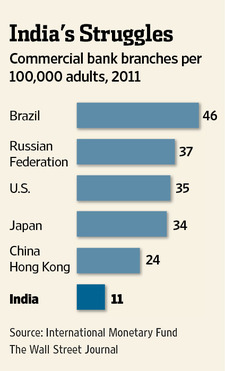
MUMBAI—Hoping to bring banking services to millions of people in small towns and villages, India is turning to industrial companies to set up banks, a strategy that has had bad consequences in other countries. Regulators are taking this risk because only one in two Indians have bank accounts in India, and one in seven have access to bank credit, according to CrisilLtd., 500092.BY +0.14% a research unit of Standard & Poor’s. State-run banks, which dominate India’s banking system, are struggling to expand due to shortage of capital. Meanwhile, foreign banks have been stymied, because all of them together are allowed to open only 12 branches a year. Read more of this post

Brazilians Foil a Bus Fare Hike, but Commuting’s Still Costly

Brazilians Foil a Bus Fare Hike, but Commuting’s Still Costly

By Joshua Goodman on July 03, 2013

BW28_econ_brazilbuschart_202inline

The street protests that rocked São Paulo and Rio de Janeiro achieved their initial modest goal: In mid-June authorities revoked a 9¢ increase in bus fares that had gone into effect in both cities. Yet even without the fare hike, Brazilians devote a bigger share of their paychecks to mass transit than most of their urban counterparts around the world. Read more of this post

What Abe Can Learn From Japan Inc.’s Mavericks

What Abe Can Learn From Japan Inc.’s Mavericks

There’s no shortage of pundits eager to tell Shinzo Abe how to shake up Japan’s economy. Instead of looking to academics for advice, though, the prime minister should get into the trenches with some of the nation’s more unconventional corporate heads.

Abe talks, for example, about wanting to make Japanese companies worldlier. For pointers, he should study what Tadashi Yanai has already accomplished at Fast Retailing Co., home of the Uniqlo brand. Yanai has become Japan’s richest man — and the only Japanese on Time magazine’s latest 100 most-influential list — largely because of his success at expanding abroad. Read more of this post

Chavez’s 70% Gold Bet Unravels as Reserves Plunge

Chavez’s 70% Gold Bet Unravels as Reserves Plunge: Andes Credit

The bet on gold that former Venezuelan President Hugo Chavez made in the final years of his life is collapsing at the wrong time for his country.

Chavez, who argued that Venezuela should move away from the “dictatorship of the dollar,” stockpiled more than 70 percent of Venezuela’s foreign reserves in gold by 2012, the highest percentage among all emerging-market countries and more than 50 times that held by neighbors Colombia and Brazil, according to the World Gold Council. Read more of this post

Forget Handouts—India Is Starving for Growth; New Delhi’s decision to increase handouts of subsidized food doesn’t bode well for India’s economy

July 4, 2013, 7:28 a.m. ET

Forget Handouts—India Is Starving for Growth

New Delhi’s decision to increase handouts of subsidized food doesn’t bode well for India’s economy.

ABHEEK BHATTACHARYA

New Delhi’s decision to increase handouts of subsidized food doesn’t bode well for India’s economy. The bigger problem, though, is that India is starving for growth. The National Food Security Bill, passed by the government Wednesday, guarantees cheap grain to 800 million Indians. But there’s no such thing as a free lunch. The new program will cost at least $4 billion a year, according to the government, on top of the roughly $18 billion a year India already spends on food subsidies. Critics say the move is a politically motivated handout meant to garner popular support ahead of next year’s general election, and does nothing to fix India’s woeful food supply infrastructure. Read more of this post

Burned Bond Buyers Re-Evaluate Africa

July 4, 2013, 4:20 p.m. ET

Burned Bond Buyers Re-Evaluate Africa

SERENA RUFFONI And PATRICK MCGROARTY

MI-BW975_AFBOND_G_20130704163106

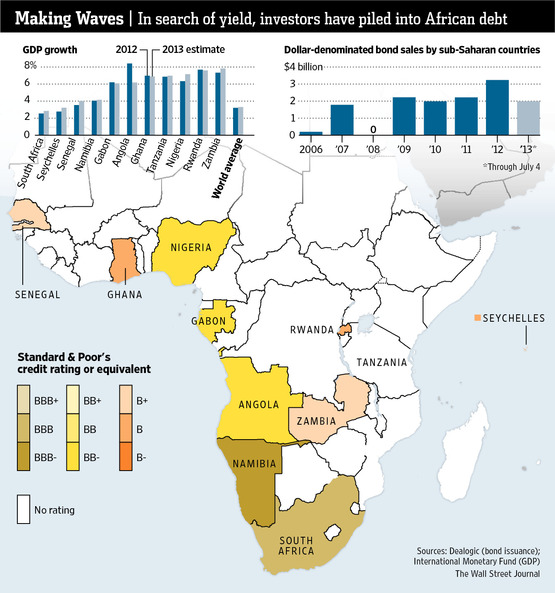
Just weeks ago, Africa was a hot destination for yield-hungry bond investors. It was a bet that burned many money managers. Prices of government bonds around the world have declined, pushing yields higher, as investors come to terms with the possibility the Federal Reserve could scale back its economic stimulus within months. A flurry of bonds issued by nations in sub-Saharan Africa since September have taken some of the biggest hits, an unpleasant wake-up call for investors who dove into these “frontier” markets in search of fat yields. The selloff has spurred investors to take a closer look at these countries’ finances and re-evaluate the risks that come with investing in Africa. As exuberance turns to trepidation, doubts have surfaced about whether countries with plans to tap international markets this year will proceed. Flagging investor interest has already raised borrowing costs for Nigeria, which sold $1 billion worth of bonds to global money managers Tuesday. Read more of this post

Crocs Wants You to Forget About Its Clogs; Crocs is targeting foreign markets. Half of the 90 stores it will open in 2013 will be in Asia

Crocs Wants You to Forget About Its Clogs

By Matt Townsend on July 03, 2013

http://www.businessweek.com/articles/2013-07-03/crocs-wants-you-to-forget-about-its-clogs

Search online for “hate crocs” and you’ll quickly see why Crocs (CROX) is eager to downplay the clunky clogs it unleashed on an unsuspecting world 11 years ago. Bloggers have denounced the rubbery footwear as ugly and an escalator tripping hazard. On YouTube, a woman cuts a yellow pair into pieces and then feeds them to a blender.

The clogs still generate 47 percent of the company’s sales; lots of people like them, especially medical professionals and kids. Yet to hit Chief Executive Officer John McCarvel’s target of doubling sales in five years, the company has to woo consumers with its other footwear. That’s why Crocs-the-company is telling the world all about its foam-bottomed wedges, sneakers, and leopard-print ballet flats—and putting Crocs-the-clogs in the back of stores the way grocers do with milk. “If someone wants them,” McCarvel says, “make them walk through all the new stuff first.” Read more of this post

The Eurobond’s 50th birthday has lessons for governments about how not to regulate finance

The Eurobond’s 50th birthday has lessons for governments about how not to regulate finance

Jul 6th 2013 |From the print edition

20130706_LDD002_0

FIFTY years ago this week Autostrade, an Italian motorway operator, issued a $15m bond. The first Eurobond was less a piece of clever financial engineering than an elaborate tax dodge. The idea dreamed up by London bankers was to capture some of the dollars that were sloshing around Europe (hence the name Eurodollars) because of America’s Regulation Q, which limited the interest rates paid on deposit accounts. Autostrade was chosen as the first issuer because it had the right to pay interest (in the form of coupons) without deducting Italian tax. The bond was issued in Schiphol airport in Amsterdam to avoid British stamp duty. The coupons were payable in Luxembourg to avoid British income tax. Read more of this post

Mumbai’s hungry high rollers; The fight to fill the stomachs of Mumbai’s rich

Mumbai’s hungry high rollers; The fight to fill the stomachs of Mumbai’s rich

Jul 6th 2013 | MUMBAI |From the print edition

20130706_ASD001_0

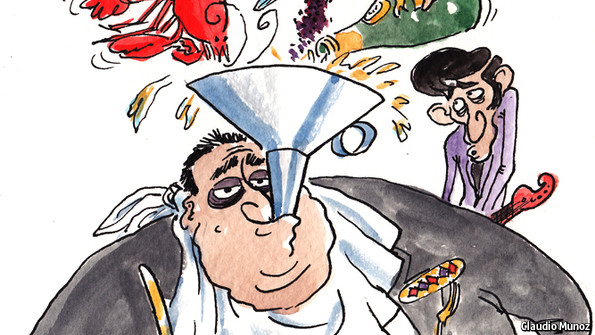
IF YOUR thing is an infinite supply of langoustine and Veuve Clicquot served, to a piercing guitar solo, by a waiter who probably lives in a slum, then head to Mumbai. India’s financial capital has developed a mania for Sunday brunch. The magic formula is a gluttonous amount of food and drink for $40-80 a head, and a background of classic rock. Luxury hotels and restaurants each have their own style and their own clientele. In the Marriott Hotel in Juhu, a filmi suburb where actors live, bandannas and boob-jobs are on display. At the new Shangri-La, bankers boast about how much face-time they get with Mukesh Ambani, an upholstered tycoon, while loading up on tuna nigiri-zushi. The age of the brunch reflects rising numbers of wealthy folk. “People used to entertain at home, but things have become less conservative—money does wonders,” says a catering manager at the Taj Mahal Palace Hotel, standing by a cheese the size of a car wheel. It also reflects a dearth of things for the well-to-do to do. Mumbai has little green space, few shops and dire transport. The rich would not be seen dead on the foreshore promenades where anglers cast for mullet on the weekends when the council does not release sewage into the sea, or on the beaches where whizzing cricket balls, rubbish and tens of thousands of paddlers vie for space. Read more of this post

P&G Invokes Bollywood in India Toothpaste Battle

P&G Invokes Bollywood in India Toothpaste Battle

Procter & Gamble Co. (PG) is betting on one of Bollywood’s most popular actors to help it break the dominance of Colgate Palmolive Co. (CL) and Hindustan Unilever Ltd., which together control 73 percent of India’s toothpaste market.

The world’s biggest maker of consumer products, which started selling its Oral-B Pro-health toothpaste in mainly urban centers in India in June, is using Hindi-movie actor Madhuri Dixit-Nene to endorse the brand. By enlisting mother-of-two Dixit-Nene, 46, P&G is targeting all age groups, said Harish Bijoor, who advises companies on brands. Read more of this post