China, Australia and a hard landing

China, Australia and a hard landing

Neil Hume | Jul 04 03:53 | Comment | Share

Australias-exposure-to-China-Barclays-e1372900110391

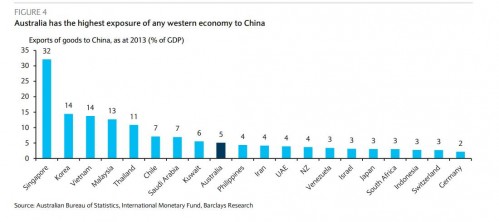
Kevin Rudd 2.0 has been quick to highlight the dangers posed by slowing Chinese growth since he was returned as Australia’s prime minister. For example: When I look at the challenges of rest of this year, and certainly for the upcoming three-year term, the huge outstanding economic challenge for us is the end of the China resources boom. This will have a dramatic effect on our terms of trade, a dramatic effect on living standards in the country, a dramatic effect also potentially on unemployment unless we have an effective counter-strategy. And… There are a lot of bad things happening out there. The global economy is still experiencing the slowest of recoveries. The China resources boom is over. China itself, domestically shows signs of recovery and when China represents such a large slice of our own economy, our jobs and our own opportunities for raising our living standards. But just how dangerous is a Chinese slowdown? Read more of this post

Rise in mortgage rates cuts into home buyer demand

Rise in mortgage rates cuts into home buyer demand

Wed, Jul 3 2013

NEW YORK (Reuters) – Expectations the Federal Reserve will slow its economic stimulus program by the end of the year pushed mortgage rates higher last week, sapping demand from potential home buyers, data from an industry group showed on Wednesday.

Rates measured by the Mortgage Bankers Association jumped to the highest level since July 2011, which also cut into refinance activity. The share of refinance applications fell to the lowest level in more than two years. Read more of this post

Abalone price plummets in China

Abalone price plummets in China

Staff Reporter

2013-07-04

The Chinese government’s anti-corruption and frugality policy has had a significant effect on prices of luxury food products but the price of abalone and sea cucumbers have plummeted by 50%, reports the People’s Daily, the flagship newspaper of the Communist Party of China. “The food doesn’t sell well in big hotels but it is widely available, so how can it command a high price?” said a man who bought 20 abalones, a type of edible sea snails, at only 60 yuan (US$10) in a traditional market in Shanghai. In addition to abalones and sea cucumbers, other luxury items including Chinese liquor and tea leaves have seen their prices drop between 40-60% since May. An expert in aquaculture industry said that there may be two reasons to explain the drop of abalone prices, one being the government-led frugality campaign announced in December aimed at curbing consumption that uses public funds, among other purposes. While the excessive number of people raising abalones and other luxury seafood can also be seen as a cause for the oversupply this year.


Hong Kong Rents Push Out Mom and Pop Stores

July 3, 2013

Hong Kong Rents Push Out Mom and Pop Stores

By BETTINA WASSENER and MARY HUI

HONG KONG — Nam Kee Noodles is a typical Hong Kong restaurant: functional, popular and busy. A dozen plastic-topped tables offer room for about 40 patrons. Customers line up outside at lunchtime, waiting to consume spicy noodle soup, dumplings and iced soy milk amid the clatter of plastic bowls and chopsticks. In April, however, the little restaurant, in the heart of Causeway Bay, one of Hong Kong’s busiest shopping districts, nearly had to shut down after the landlord tripled the already-expensive rent. “We were paying around 200,000 dollars a month,” said Au Kei-hong, the shop’s manager, referring to an amount in Hong Kong dollars equivalent to about $25,800. “But the landlord then increased it to 600,000. It was too expensive. We cannot afford that.” Read more of this post

Investors are bailing out of China’s markets as fears grow over the slowing economy and Beijing discourages ideas that it might try to juice it back up

July 3, 2013, 11:52 a.m. ET

Investors Pull Back From China Assets

DANIEL INMAN

AM-AZ271_CSTOX_NS_20130703125703

Investors are bailing out of China’s markets as fears grow over the slowing economy and Beijing discourages ideas that it might try to juice it back up. Global fund managers have yanked money out of Chinese stocks for sixteen of the last 18 weeks, including a net $834 million during a five-day period ending June 5. That was the largest outflow since January 2008, when the financial crisis was getting underway, according to data provider EPFR. The gloomy mood is also spilling over into the currency market. Investors are raising their bets the yuan will fall, clashing with efforts by the central bank to keep it strong. Read more of this post

It used to be that American companies were busy expanding in Asia. These days, it is the other way around

Jul 3, 2013

Asian Acquirers Change Focus

By Cynthia Koons

It used to be that American companies were busy expanding in Asia. These days, it is the other way around.

In the space of a few weeks, Chinese meat producer Shuanghui International Holdings Ltd. struck a $4.7 billion agreement to buy Smithfield Foods Inc. and Apollo Tyres Ltd. made a $2.5 billion offer to purchase Cooper Tire & Rubber Co. Those deals, one at the end of May and the other in mid-June, are the biggest Chinese and Indian acquisitions of U.S. companies on record. Bankers say the moves show that Asian buyers not only increasingly believe they can manage foreign companies, they are also confident about the underlying U.S. economy. Read more of this post

Major Chinese shipbuilder Rongsheng Bows to Demand Slump and has laid off about 40% of its workforce in recent months

July 3, 2013, 12:12 p.m. ET

Chinese Shipbuilder Bows to Demand Slump

COLUM MURPHY And DINNY MCMAHON

AM-AZ273_RONGSH_G_20130703101505

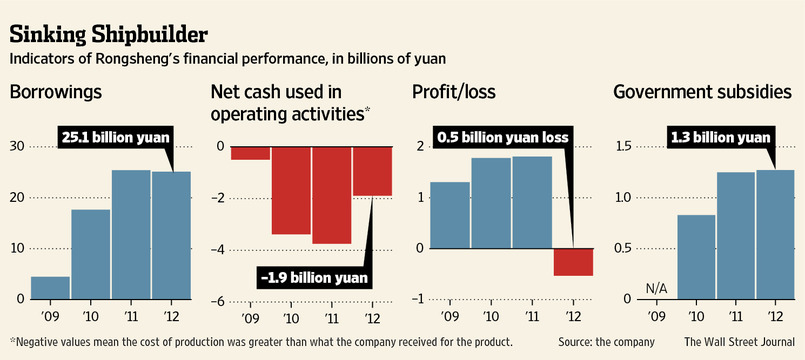
BEIJING—A major Chinese shipbuilder has laid off about 40% of its workforce in recent months, in a sign that China Inc. CHA 0.00% is under increasing strain from the slowdown in the world’s No. 2 economy.

Lei Dong, secretary to the president ofChina Rongsheng Heavy Industries Group Holdings Ltd., 1101.HK -10.17%said the company has let go of about 8,000 people, of whom more than half were subcontracted workers and the remainder full-time Rongsheng employees. He said there are currently about 12,000 employees at the shipbuilder, which is based in Rugao, Jiangsu province, north of Shanghai. Read more of this post

The Ambivalent Would-Be Hegemon: China is far too angry, lonely, mercantilist and domestically insecure to be considered a true global power

July 3, 2013, 12:55 p.m. ET

The Ambivalent Would-Be Hegemon

China is far too angry, lonely, mercantilist and domestically insecure to be considered a true global power.

DAVID ZWEIG

To what extent has China gone global in its diplomacy, support for global governance, trade and investment, soft power and military reach? David Shambaugh, a professor of political science at George Washington University and one of America’s leading China watchers, attempts to answer this question by drawing on a multitude of interviews with key players in China and around the world, as well as an extensive research effort. The result is a first-rate book that the nonacademic world will savor.

Mr. Shambaugh opens with a valuable synopsis of China’s internal debate about its global identity. Chinese academics remain uncertain about their state’s “international personae,” resulting in a conflicted identity. This scholarly elite is composed largely of a “left wing” with a strong nativist streak and a realist bent—meaning they believe security comes from across-the-board self-strengthening. Read more of this post

Indonesian Outflows Spur Pressure for Further Policy Tightening; “There was a time window in which the government could ride on the positive momentum and push through more concrete measures, but it’s now gone,”

Indonesian Outflows Spur Pressure for Further Policy Tightening

Indonesia’s policy makers delivered the country’s first benchmark interest-rate increase since 2011 and first fuel-price boost in five years in June. Capital outflows since then have spurred pressure for further moves.

The rupiah remains among the worst performers in Asia in the past year, falling about 0.8 percent after Indonesia on June 13 became the region’s first major economy to raise rates this year. Global funds sold 2.5 trillion rupiah ($250 million) of local-currency government bond holdings in the week after the June 22 fuel adjustment, aimed at containing a current-account deficit that has hurt the currency. Read more of this post

High-flying luxury: battle for Asia’s jet-set is hotting up

High-flying luxury: battle for Asia’s jet-set is hotting up

5:23pm EDT

By Anshuman Daga

SINGAPORE (Reuters) – With limousine pick-ups and on-board chefs, Asia’s premium airlines are investing hundreds of millions of dollars on luxury services in a bet on a rebound in business from the wealthy, even as low-cost carriers fly high with the booming middle class.

Although business and first-class traffic has fallen significantly in the last few years as companies cut costs, carriers such as Singapore Airlines Ltd (SIA), Cathay Pacific Airways Ltd and Qantas Airways Ltd are estimated to still earn about 35 to 40 percent of passenger revenue from the high-margin segment. Read more of this post

China’s Visit-the-Parents Law Also Affects City Buildings

China’s Visit-the-Parents Law Also Affects City Buildings

China will accelerate development of standards for functions and designs that accommodate the elderly in buildings and public facilities to comply with the same new law under which people can be forced to visit their parents.

China’s revised and broadened Law for the Protection of the Rights and Interests of the Elderly includes a chapter aimed at ensuring comfortable living environments, the official Xinhua News Agency reported yesterday. Read more of this post

China Said to Suspend Release of Steel Industry PMI Data

China Said to Suspend Release of Steel Industry PMI Data

China suspended the release of a set of data on the country’s steel industry after the National Bureau of Statistics decided to change how the figures are compiled, a person involved in producing the numbers said.

The June Purchasing Managers’ Index for the steel industry won’t be released, said the person, who asked not to be identified as he wasn’t authorized to speak publicly about the matter. It isn’t yet clear what changes will be made and in what time frame, or if the data for July would be released next month, the person said. Read more of this post

The Hunt for the Never-Been-Done ETF

July 2, 2013, 10:10 p.m. ET

The Hunt for the Never-Been-Done ETF

JOE LIGHT and JASON ZWEIG

MI-BW916_ETFNAM_G_20130702180904

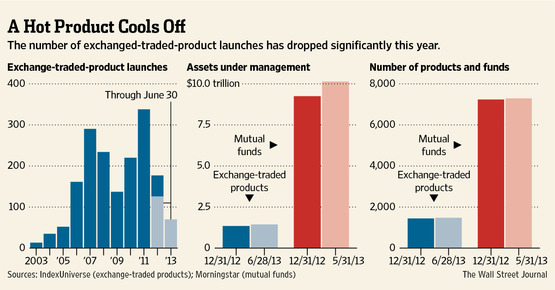
Maybe the Wall Street financial-product machine really can run out of new ideas. Just 70 exchange-traded funds and other exchange-traded products were launched from Jan. 1 to June 30, according to IndexUniverse LLC, a research firm in San Francisco. The total is down 44% from 126 in the same period a year earlier. The slide is a sign the market for ETFs—which hold a bundle of investments and boomed in the past decade as a cheaper, tax-efficient alternative to traditional mutual funds—has gotten so saturated fund companies are struggling to come up with niches that aren’t served by existing ETFs. Just this year, companies have launched ETFs that track Nigerian stocks, that use “forensic accounting” to avoid stocks with financial red flags, and that give leveraged exposure to the Brazilian market. Read more of this post

Dividend Stocks Enter New Era of Caution

Updated July 2, 2013, 6:04 p.m. ET

Dividend Stocks Enter New Era of Caution

MATT JARZEMSKY

MI-BW964A_MKTLE_G_20130702182118

Jitters about Federal Reserve policy have made investors more cautious about stock sales by companies that pay high dividends, but the window is still open for new offerings. Investors may no longer be rushing to buy just about anything with a high yield at just about any price, as they seemed to be doing at times during the first five months of the year. Yet interest rates are expected to remain exceptionally low even if the Fed begins to scale back its stimulus efforts. That, many analysts and investors say, will continue to fuel a search for yield through dividend stocks, and provide an appetite for new offerings. At the same time, the kind of improved growth outlook that would lead the Fed to taper its easy-money policies could encourage stock sales by companies more sensitive to economic growth. Investors look to shares of these companies because they offer potential for price appreciation. Read more of this post

This is a big deal. Hot money is now fleeing China “abruptly”

This is a big deal. Hot money is now fleeing China “abruptly”

By Matt Phillips @MatthewPhillips July 2, 2013

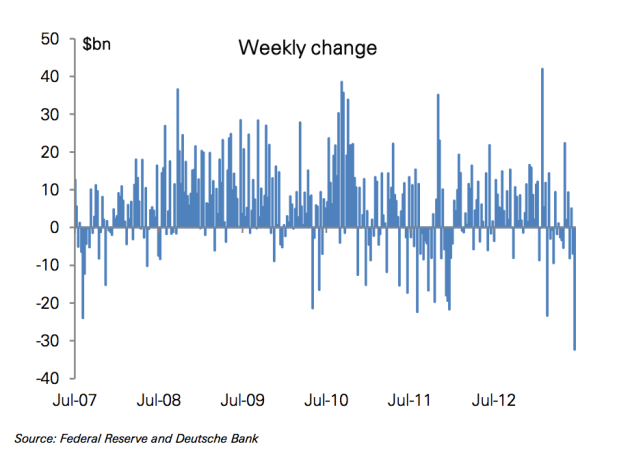
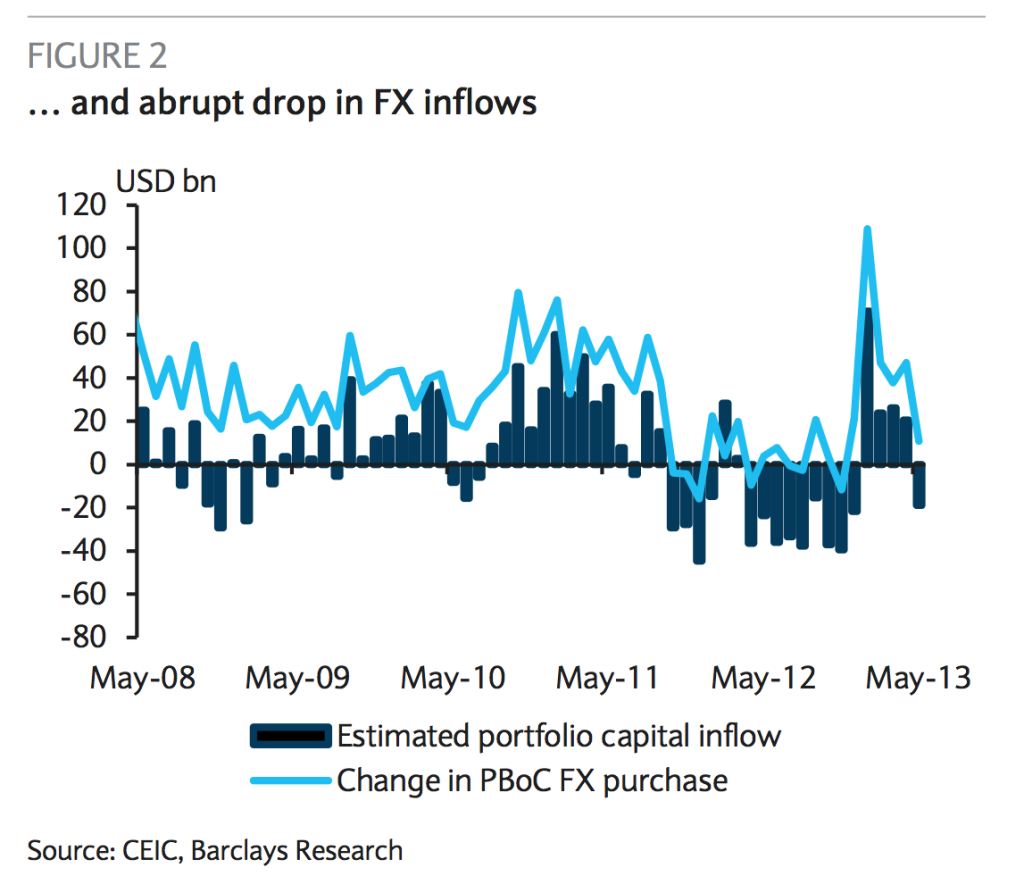
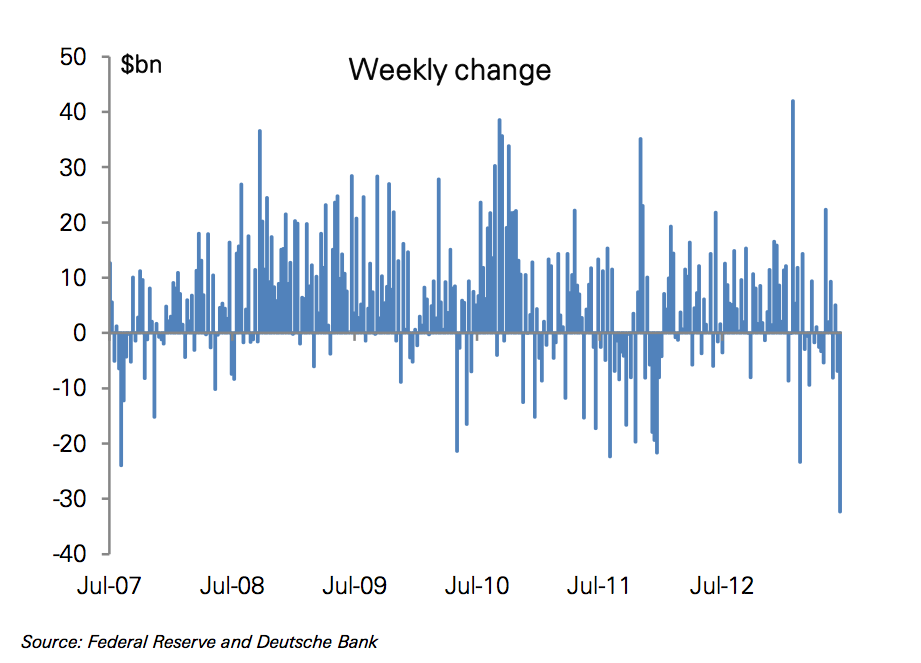
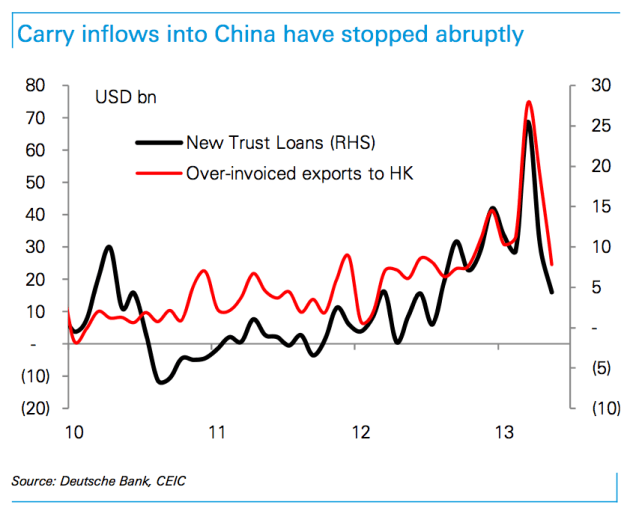
An important reason why countries like China have capital controls is to keep tidal flows of incoming foreign cash from creating destabilizing asset bubbles. But foreign capital has wormed its way into the mainland anyway. One creative method that got attention recently was phantom sales of “exports” to places like Hong Kong. Investors have salivated over opportunities—even if they are somewhat shadowy—to tap into Chinese growth. But the saliva glands seem to be drying up. Deutsche Bank FX analysts point out that flows of capital have started to change course in recent weeks, and they use so-called “over-invoiced” exports to Hong Kong as a proxy. Analyst at Barclays have also noticed the “abrupt” turn in financial flows into China. In the chart below, they’re looking at estimates of portfolio investment as well as central-bank purchases of foreign currencies. (The way China keeps capital flows in check is by forcing the private sector to convert foreign currencies in to Chinese yuan at the fixed government rate. So you can look at how much foreign currency the People’s Bank of China buys as a proxy for the amount of foreign currency that’s weaseled its way into the country.) We’re in the opening phase of this reversal. And whatever the causes of it might be—fears about the solidity of China’s financial system, slowing growth, the unwinding of the Fed’s easy-money policy—it could have wide-ranging implications. Domestically, the departure of foreign cash from China may have played a role in the recent credit crunch that sent a shiver through China’s banks. Government media minders have told the local press to tone down its coverage of financial worries (paywall), but that will only undermine confidence further. Internationally, if a decline of investment slows China’s economy, large trade partners such as Taiwan and Australia would feel it. Oh, and one other thing. Do you know where China happens to stow all that foreign cash it buy out of the markets? US government bonds. China is the largest foreign buyers of Uncle Sam’s IOUs, which helps finance the US’s persistently large current-account deficit. And coincidentally, last week saw the largest outflow on record from the Federal Reserve’s so-called “custody holdings” of Treasurys. Those are the Treasurys that the Fed holds in accounts for official entities, such as foreign central banks that use US government debt to store foreign exchange reserves. Here’s a look at a Deutsche Bank chart, which suggests that what happens in China will most definitely reverberate outward. Food for thought.
​screen-shot-2013-07-02-at-11-34-29-am screen-shot-2013-07-02-at-11-39-12-am screen-shot-2013-07-02-at-12-02-27-pm

China’s Leading Baby Formula Maker Cut Prices on Sweeping Probes

China’s Leading Baby Formula Maker Cut Prices on Sweeping Probes

07-03 11:09 Caijing

The investigation, however, targets more than the six, said a person familiar with the case, adding that dozens of brands could be involved.

Beingmate, a leading Chinese baby formula brand is trimming its products prices on the heel of a sweeping anti-trust investigation targeting both foreign and home brands, in what is believed to be the second shake-up in China’s milk industry following the food scandal in 2008. Read more of this post

Taiwan’s housing bubble is bigger than anyone admits

Taiwan’s housing bubble is bigger than anyone admits

Editorial 2013-07-03

Declining real income and surging housing prices in Taiwan continues to worsen, along with the stagnation in the country’s economy, even though the government has reiterated that it has taken stock and is trying to deal with the situation. Government data show that real income during first four months of this year dropped to a level comparable to 15 years ago, while the average unit price of new housing purchases in Taiwan’s six major metropolitan areas hit a record high of NT$245,000 (US$8,155) per ping (3.3 square meters) during the first quarter. Read more of this post

Gross Caught in TIPS Trap Gundlach Sidestepped in Tumble

Gross Caught in TIPS Trap Gundlach Sidestepped in Tumble

On April 19, three weeks before he called the end of the 30-year bull market in bonds, Bill Gross said he was buying inflation-linked Treasuries, a bet that money printing by the world’s central banks would push up consumer prices.

While Treasuries subsequently fell as he had predicted, so did inflation expectations, amplifying rather than limiting losses for Gross’s Pimco Total Return Fund (PTRAX), which had 12 percent of its $289 billion in Treasury Inflation-Protected Securities at the end of the first quarter. The world’s largest mutual fund fell 4.7 percent in May and June, prompting $9.9 billion in withdrawals last month, the most on record. Read more of this post

Bernanke Denies India to Mexico Rate Cuts as Currencies Sink

Bernanke Denies India to Mexico Rate Cuts as Currencies Sink

Traders who anticipated lower interest rates in developing nations are reversing course as prospects for reduced Federal Reserve economic stimulus sparks the worst rout in emerging-market currencies since 2001.

Just a month ago, central bankers in Mexico, India and South Korea were expected to pare borrowing costs at least once, according to interest-rate swaps data compiled by HSBC Holdings Plc. Now, the measures show no chance of cuts. Poland’s central bank said today that it has ended an easing cycle after lowering the benchmark rate to a record low 2.5 percent. Traders anticipate one more reduction in Hungary, instead of the two they expected a month ago. Read more of this post

Indian rupee record plunge is curbing demolition of obsolete merchant vessels, exacerbating a fleet surplus; “Indian scrap yards buy old tonnage from owners in dollars, but sell the scrap metal to steel mills in rupees”

India-Rupee Slump Seen by Broker ACM as Brake on Ship Demolition

A plunge in the Indian rupee to near a record is curbing demolition of obsolete merchant vessels, exacerbating a fleet surplus in the maritime industry, according to London-based shipbroker ACM Shipping Group Plc. “Indian scrap yards buy old tonnage from owners in dollars, but sell the scrap metal to steel mills in rupees,” ACM senior analyst Marc Pauchet said in a report sent by e-mail today. “Mills are finding it increasingly difficult to meet the prices demanded by recyclers.” The currency of the world’s largest vessel-scrapping nation fell 1 percent to 60.24 per dollar as of 3:12 p.m. in Mumbai today, according to prices compiled by Bloomberg. That’s 0.8 percent away from its record low of 60.765 per dollar on June 26. The shortfall in India’s current account, the broadest measure of trade, widened to a record 4.8 percent of gross domestic product in the year ended March 31, official data show. Ship owners are contending with a fleet surplus across the maritime industry that Clarkson Plc (CKN), largest shipbroker, estimated in March was the largest since the early-1980s. The Baltic Dry Index, an overall measure of commodity freight costs, averaged 847 points this year, its worst start on record, according to the Baltic Exchange in London.

To contact the reporter on this story: Alaric Nightingale in London at anightingal1@bloomberg.net

CJ Group has gone into emergency mode after Chairman Lee Jay-hyun was arrested Monday on charges of creating secret funds and evading taxes

2013-07-02 17:24

CJ put on emergency footing

By Kim Tae-jon

CJ Group has gone into emergency mode after Chairman Lee Jay-hyun was arrested Monday on charges of creating secret funds and evading taxes.  Read more of this post

Cash crunch has shown that financial policy in China is not reliable

July 2, 2013 3:17 pm

Pity the banks after Beijing’s blunt move

By Simon Rabinovitch in Shanghai

Cash crunch has shown that financial policy in China is not reliable

It is unfashionable these days to take the side of banks, especially institutions that are mollycoddled by the state. China’s government-owned banking behemoths are among the most unlikely candidates for compassion. But they deserve more than a little sympathy after the cash crunch of the past three weeks. Read more of this post

S. Korea’s household debts still face fragile structures

S. Korea’s household debts still face fragile structures

English.news.cn   2013-07-03

SEOUL, July 3 (Xinhua) — Growth of household debts in South Korea continued to slow amid efforts to contain further rise, but its debt structure remained fragile due to heavy dependence on high-rate loans, excessive debts compared with debt-servicing capabilities and growing multiple borrowers, data from related authorities showed Wednesday. The country’s household debts reduced 2.2 trillion won from three months earlier to 961.6 trillion won (843 billion U.S. dollars) as of end-March, the first decline in four years, according to reports submitted to lawmakers by the Ministry of Strategy and Finance, Bank of Korea (BOK), the Financial Services Commission (FSC) and the Financial Supervisory Service (FSS). Read more of this post

The Revolving Door of Chinese Politics: A look at how ambitious executives at China’s major state-owned enterprises hope to be transferred to government posts

The Revolving Door of Chinese Politics – Economic Observer Online

By Shen Nianzu (沈念祖)
Issue 626, July 1, 2013
This is an extended abstract of an article that appeared in this week’s edition of The Economic Observer, for more highlights from the EO print edition, click here.
It’s already been 100 days since a new generation of officials have taken up their posts in the country’s State Council. Many of the newly appointed politicians formerly served at executives at some of China’s major state-owned enterprises (SOE).
For example Guo Shengkun (郭声琨), who was recently appointed as Minister of Public Security and also as one of China’s five State Councilors, once served at the CEO and Chairman of Aluminum Corporation of China (Chinalco or 中国铝业公司). Read more of this post

Zong Qinghou built Hangzhou Wahaha Group into a beverage giant, and now he has his sights set on conquering the retail sector

07.03.2013 13:53

Time for a Transformation

Zong Qinghou built Hangzhou Wahaha Group into a beverage giant, and now he has his sights set on conquering the retail sector

By staff reporters Shen Hu, Zhou Qun and intern reporter Wu Yijing

(Hangzhou) — With nearly 70 billion yuan in personal assets, Zong Qinghou, founder and chairman of Hangzhou Wahaha Group Co., is China’s richest man and a talented salesman. Starting his business career by selling cold drinks and ice cream on a bicycle at age 42, Zong created Wahaha in 1989 and made the company the country’s largest beverage producer. Zong is well known for his toughness in business negotiations. In a dispute between Wahaha and its French partner, Groupe Danone, over branding issues several years ago, he mobilized resources in political, social, business and judicial arenas to win the argument. And yet he always says: “My wealth is accumulated by selling bottles of water.” Read more of this post

Listed Chinese firms invest in wealth management products

Listed Chinese firms invest in wealth management products

Staff Reporter

2013-07-03

Amid the credit crunch, many Chinese banks have rolled out wealth management products with high yields, which have attracted numerous investors, including listed firms with idle funds in hand.

According to Industrial Securities, in the third week of June the yield rate of one-month renminbi-denominated wealth management products issued by major banks has risen further to 5.06% per annum, while the rate of four and nine-month products issued by banks limited by shares hit 5.67% and 6.2%, respectively. Read more of this post

Seoul’s start-up generation; A group of ambitious young software entrepreneurs is striking out in South Korea

July 2, 2013 4:50 pm

Seoul’s start-up generation

By Simon Mundy

Led by example: technology entrepreneur Jimmy Kim co-founded Sparklabs, an incubator to provide would-be founders with advice and funding

Jay Mok’s family were shocked: 29 years old, recently married, a graduate from a top Seoul university with a good job at a global consulting firm, his career was a source of pride. Then he quit to pour his savings into developing a smartphone application.

“The older generation don’t understand as much about IT or the mobile business,” he says. “They think if I fail, the whole family will fail.” Read more of this post

Risks of a hard landing for China; Beijing might need to do what its leaders neither want nor expect

July 2, 2013 7:12 pm

Risks of a hard landing for China

By Martin Wolf

Beijing might need to do what its leaders neither want nor expect

The new Chinese leadership is trying to manage one of the most difficult of economic manoeuvres: slowing down a flying economy. Recently, difficulties have become more apparent, with the attempt of the authorities to bring “shadow banking” under control. Yet this is part of a bigger picture: the risk that a slowing economy might even crash. Indeed, the expressed desire of China’s new government to rely on market mechanisms raises the risks. Read more of this post

For Pension Funds, Higher Fees Don’t Mean Higher Returns, Study Finds

July 2, 2013, 11:01 a.m. ET

For Pension Funds, Higher Fees Don’t Mean Higher Returns, Study Finds

Report on State Pension Funds Adds Fuel to Debate on Active Investment Managers

MICHAEL CORKERY

Public-employee pension plans paying the highest investment fees aren’t generating the highest returns, according to a new study by a pair of Maryland think tanks. In fact, just the opposite may be true, says the Maryland Public Policy Institute and Maryland Tax Education Foundation. On average, 10 states paying the most money-management fees had lower investment returns between June 30, 2007 and June 30, 2012 than 10 states paying the fewest fees.

Read more of this post

A Dizzying Condo Market: Toronto’s effort to create a livable city through densely populated neighborhoods is a roaring success, but to what end?

July 2, 2013

A Dizzying Condo Market

By IAN AUSTEN

TORONTO — Sandwiched between two rail lines in this city’s core, great factories once produced the finest Canada could offer the world: Magic baking powder, Brunswick bowling alley flooring and Massey Ferguson farm equipment.

Those factories and many others here have been long abandoned or demolished, but the area is bustling. It is now called Liberty Village and it is packed with high-rise condominiums, largely built over the last five years, with many more still under construction. Read more of this post