Taiwan Cuts Capital Gains Tax on Share Sales, Removes Threshold

Taiwan Cuts Capital Gains Tax on Share Sales, Removes Threshold

Taiwan lawmakers voted to roll back provisions of a capital gains tax on stock sales of more than NT$1 billion ($33.3 million) and removed an index price threshold that depressed shares.

Tax on capital gains from transactions of more than NT$1 billion was reduced to 0.1 percent from the 2.25 percent under the original law. Lawmakers also removed a 8,500-point close threshold for the Taiex index before the tax could go into effect. Legislative Yuan President Wang Jin-pyng announced the passage of revisions in a special legislative session today. Read more of this post

Foreign Funds Erase Inflow Into Indonesia Stocks This Year; Philippine Stocks Enter Bear Market as Foreign Outflows Surge

Foreign Funds Erase Inflow Into Indonesia Stocks This Year

Foreign fund flows into Indonesian equities turned negative for the first time this year after investors pulled money from the stock market for a 22nd day.

Foreigners sold a net $68 million worth of Indonesian stocks yesterday, according to data compiled by Bloomberg, taking total outflows this year to $20 million. The Jakarta (JCI) Composite Index fell for a fifth day, dropping 0.2 percent to 4,418.872, its lowest close since Jan. 28. Read more of this post

Brazil’s World Cup Scorn Deepens Rout as Budget in Danger

Brazil’s World Cup Scorn Deepens Rout as Budget in Danger

The record rout in Brazilian bonds is deepening on speculation President Dilma Rousseff’s vow to boost spending to placate protesters will swell the budget deficit at a time when a stagnating economy saps tax revenue.

Brazil’s real-denominated bonds due 2023 have plunged this month, causing yields to jump to a 15-month high of 11.63 percent on June 21 even as the Treasury offered to buy back the notes in five unscheduled auctions this month. In the same span, the cost to protect its sovereign dollar debt against losses for five years soared to a 20-month high and exceeded that of lower-rated Turkey for the first time in seven years. Read more of this post

Abe Recovery Pits Graduate Jobs Against Senior Savings

Abe Recovery Pits Graduate Jobs Against Senior Savings

In the heart of Tokyo on a March afternoon, Akitsugu Yamamoto, clean-cut and clad in a dark business suit, is looking for a job at an employment agency whose name translates as New Grad Hello Work.

In a couple of days, Yamamoto, 27, will be leaving Waseda University, one of Japan’s top educational institutions, with a graduate degree in public management — and no job offers, Bloomberg Markets will report in its August issue. Read more of this post

Taiwan’s Prodigal Companies Come Home as China Labor Costs Rise

Taiwan’s Prodigal Companies Come Home as China Labor Costs Rise

For eight years, the former Taroko Textile Corp. factory in Hsinchu County, Taiwan, has been empty, a victim of the migration of manufacturing to the mainland. Now, as China’s supply of cheap labor wanes, work is returning.

ITEQ Corp. (6213), which makes materials electronics companies need to build circuit boards, is installing equipment as part of a NT$2 billion ($66 million) refurbishment to begin production by the end of 2014, said Eric Liu, head of investor relations. It will be the company’s first new factory in Taiwan since 1998. ITEQ began moving work to Guangdong in southern China in 2002. Read more of this post

Lexus Made in Japan Risks China Irrelevance

Lexus Made in Japan Risks China Irrelevance

When shopping last year for his first car, Will Zhang considered a Lexus CT200h and a BMW 320i. Though he preferred the Lexus, he went with the BMW because at 340,000 yuan ($55,400) it was 18 percent cheaper.

“The Lexus has superior quality, performance and fuel economy,” said the 32-year-old manager at a Shanghai property developer. “But I chose the BMW for the price.” Read more of this post

Banks Could Face U.S. Home-Equity ‘Payment Shock,’ Moody’s Says

Banks Could Face U.S. Home-Equity ‘Payment Shock,’ Moody’s Says

Home-equity lenders could see delinquencies rise in the next two years as borrowers face a “payment shock,” Moody’s Investors Service said.

The majority of home-equity loans were issued during the housing bubble before the 2008 financial crisis when underwriting standards were “dismal,” Moody’s said today in a report. Those loans will reach the 10-year mark between 2015 and 2017, when borrowers who are paying only interest must start repaying principal, and some won’t be able to keep up, Moody’s said. Read more of this post

Hedge funds hope losing shorts on U.S. natural gas will pay off

Hedge funds hope losing shorts on U.S. natural gas will pay off

5:54pm EDT

By Barani Krishnan and Joe Silha

NEW YORK (Reuters) – This year’s early rally in U.S. natural gas prices dealt heavy losses to hedge funds that stubbornly maintained short positions in the face of brutally cold weather, and the price slide of the past two months has not yet erased losses that prompted some investors to flee the funds, industry sources say.

Sasco Energy, Skylar Capital and Copperwood Energy, funds founded by some of the most prominent names in gas trading, posted losses after misreading winter weather patterns in the first quarter that caused a spike in prices of gas used for heating, said the sources speaking on condition of anonymity. Read more of this post

GTT, the world’s No. 1 maker of cryogenic hull linings for LNG tankers, valued at up to $2.4 billion; GTT and Norwegian competitor Moss Maritime have a virtual duopoly on the lucrative niche market despite Korean shipbuilders – which have a near monopoly on LNG tankers – have tried for years to develop their own cryogenic technology

French LNG cryogenics specialist GTT for sale

1:03pm EDT

By Geert De Clercq

PARIS (Reuters) – Total (TOTF.PA: Quote, Profile, Research, Stock Buzz) and private equity firm Hellman & Friedman plan to sell their 30 percent stakes in GTT, the world’s No. 1 maker of cryogenic hull linings for LNG tankers, in an IPO that could value GTT at up to $2.4 billion, sources close to the companies said.

Gaztransport & Technigaz (GTT), also 40 percent owned by GDF Suez (GSZ.PA), has 70 percent of the market for the high-tech alloy membranes that line the hulls of the world’s liquefied natural gas (LNG) carriers. Read more of this post

Banks slow to revive Singapore trading desks after rate-fixing cull

Banks slow to revive Singapore trading desks after rate-fixing cull

5:33pm EDT

By Rachel Armstrong

SINGAPORE (Reuters) – Cost pressures and tougher regulation mean banks in Singapore are struggling to replace the 100 traders who left the market during a rate-fixing probe.

The world’s fourth largest foreign exchange center is still reeling from the crackdown, which has left volumes flowing through banks’ once vibrant interest rate and emerging market currency trading desks a long way below pre-scandal levels. Read more of this post

Puerto Rico – a vacation oasis overrun with high debt

Analysis: Puerto Rico – a vacation oasis overrun with high debt

2:55pm EDT

By Tiziana Barghini and Michael Connor

(Reuters) – Puerto Rico’s turquoise Caribbean waters lap white sandy beaches under year-round sun, making the island a safe place to relax.

But beyond its shoreline, U.S. investors see a threatening view, a tropical version of a near-bankrupt industrial city – Detroit, whose stressed finances are run by a state-appointed manager. Read more of this post

China’s tight liquidity to continue until mid-July: experts

China’s tight liquidity to continue until mid-July: experts

Staff Reporter

2013-06-25

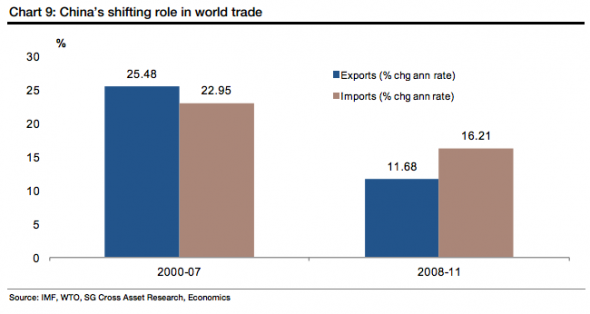
The Shanghai Interbank Offered Rate, or Shibor, had a drastic downward correction on the last trading session last week after a sudden surge on June 20, but the persistent tight liquidity conditions in China’s financial sector showed no signs of reversing, with the overnight rate still standing at a comparatively high level of above 8%, reports the Shanghai-based National Business Daily. The current situation regarding a shortage of funds is expected to continue throughout the rest of June, and may extend to mid-July, the paper said, citing banking executives. The overnight rate surged between June 7 to June 20 amid tightening liquidity, boosted by the delivery of fiscal deposits, income tax payments, and a drop in incremental foreign exchange deposits. The Shibor hit new highs on June 20, with the overnight rate surging 578.4 basis points to 13.444%, a record high, and the seven-day Shibor rising 292 basis points to 11.004%. On June 21, the overnight Shibor fell 495.2 basis points to 8.492%, and seven-day Shibor dropped 246.1 basis points to 8.543%. But 14-day and one-month Shibor continued to rise, adding 97.2 and 29.9 basis points, respectively, to 8.566% and 9.698%, the paper said. Zhang Chenhui, director of Financial Institute of Development Research Center under the State Council, said that liquidity should remain tight for about one more month, unless the People’s Bank of China, the nation’s central bank, moves to ease liquidity. International rating agency Fitch Group said last Friday that the Shibor rates are facing upward pressure for the rest of the month as more than 1.5 trillion yuan (US$244 billion) of yuan-designated wealth management products will expire during the period. UBS Securities also expects the fund shortage to last until mid-July, citing five main factors: the country’s five major banks paying fiscal bonuses of 240 billion yuan (US$39 billion), a net redemption of wealth management products or related financing pressure, the comparatively high leverage payments by financial institutions, the delivery of banking reserves of around 800 billion yuan (US$130 billion) in early July, and the delivery of fiscal deposits worth around 450 billion yuan (US$73 billion) in mid-July as well.

The head of a top South Korean food and entertainment conglomerate, CJ Group, presented himself to prosecutors to face questioning over alleged tax evasion and embezzlement

June 25, 2013, 4:55 PM

Chaebol Leader Answers Summons: A Familiar Scene

By Jaeyeon Woo

OB-XY776_cj_G_20130625033021

South Korea’s CJ Group chairman Lee Jae-hyun appears at the Seoul Central District Prosecutors’ Office in southern Seoul on Tuesday. The head of a top South Korean food and entertainment conglomerate, CJ Group, presented himself to prosecutors to face questioning over alleged tax evasion and embezzlement.

The tense-looking head of the large conglomerate slowly made his way to answer a prosecutors’ summons through a throng of reporters.

“I am sorry for causing concern to the public,” he said. “I will sincerely respond to the investigation.”

It’s an all-too-familiar scene in South Korea. Tuesday’s tableau could have involved any of a dozen business leaders, but in this case, it was 53-year-old CJ Group Chairman Lee Jae-hyun. He didn’t have anything else to say to the media, and his legal representative couldn’t be reached by The Wall Street Journal. Read more of this post

The World Bank should stop ranking countries on how business-friendly they are, according to an independent review that said an annual listing creates perverse incentives for governments

World Bank Is Told to Dump Rankings From ‘Doing Business’

The World Bank should stop ranking countries on how business-friendly they are, according to an independent review that said an annual listing creates perverse incentives for governments.

The bank’s annual “Doing Business” publication should continue under a new title and with a new methodology, Trevor Manuel, a former South African finance minister who led the audit, told reporters in London today. Read more of this post

The $70 billion All Weather Fund managed by hedge fund titan Ray Dalio’s Bridgewater and widely held by many pension funds to survive stormy markets is emerging as a big loser in the recent selloff in global markets

Exclusive: A big Bridgewater fund is under the weather

5:21pm EDT

By Katya Wachtel and Jennifer Ablan

NEW YORK (Reuters) – A $70 billion portfolio managed by hedge fund titan Ray Dalio’s Bridgewater Associates and widely held by many pension funds to survive stormy markets is emerging as a big loser in the recent selloff in global markets.

The Bridgewater All Weather Fund is down roughly 6 percent through this month and down 8 percent for the year, said two people familiar with the fund’s performance.

The All Weather Fund is one of two big portfolios managed by Bridgewater and uses a so-called “risk parity” strategy that is supposed to make money for investors if bonds or stocks sell off, though not simultaneously. Read more of this post

The Boglification of alternatives; “Institutions are finally realizing the cost of hedge funds, including fees, lack of liquidity, lack of transparency, and lack of regulation, are starting to outweigh the benefits”

The Boglification of alternatives

Advisers, institutions view fees as the main reason to avoid alts, Morningstar/Barron’s survey finds

By Jason Kephart   |  June 24, 2013 – 1:55 pm EST

When it comes to alternatives, investors are finding out what John Bogle knew many years ago: You get what you don’t pay for.

A majority of financial advisers and institutions now view fees as the main reason to avoid alternatives, up from 38% and 39% respectively in 2009, according to Morningstar Inc. and Barron’s 2012 alternative investment survey. Read more of this post

A big PBOC bluff? Alot of the FX purchase were the result of borrowed dollars coming into the Chinese system, rather than pure trade dollars, and that much of the RMB liquidity created against those dollars headed straight into the weapons of mass ponzi market instead of Chinese Treasury bills

A big PBOC bluff?

Izabella Kaminska

Screen-Shot-2013-06-21-at-14.55.57-590x314 Screen-Shot-2013-06-24-at-10.36.01-590x275

The PBOC’s “this is not the liquidity crisis you’re looking for” statement at the weekend may have drawn attention, but it didn’t really manage to reassure equity markets. The Shanghai Composite closed over 5 per cent lower on the day. The issue at hand may be linked to this: That would be the Chinese RMB weakening against the US dollar, in the context of a generally strengthening dollar index:

This is worth bearing in mind in light of the ‘other‘ hypothesis explaining some part of the trouble in China at the moment. This is based on the idea that the mother of all carry-trades may be being pushed to its limits by rising US bond yields, FX volatility and Fed taper speculation (if not the Chinese’ own attempt to stamp out over-invoicing practices). Read more of this post

China’s ‘Shadow Banks’ Fan Debt-Bubble Fears

June 24, 2013, 10:36 p.m. ET

China’s ‘Shadow Banks’ Fan Debt-Bubble Fears

By LINGLING WEI and BOB DAVIS

P1-BM049A_CDEBT_NS_20130624171503P1-BM050_CDEBT__G_20130624173005P1-BM048_CDEBT__G_20130624163129

A statue of Citic Trust founder Rong Yiren, known as China’s ‘Red Capitalist,’ is in the headquarters lobby.

BEIJING—In a 52-story office tower overlooking the leafy streets of this city’s embassy district, some 400 deal makers at Citic Trust Co. arrange financing for property developers, steel mills and other businesses starved for cash and shunned by China’s traditional banks. Read more of this post

Li’s Cash Squeeze Risks 1st China GDP-Goal Miss Since ’98

Li’s Cash Squeeze Risks 1st China GDP-Goal Miss Since ’98

China’s biggest squeeze on credit in at least a decade is increasing the chance that Li Keqiang will be the first premier to miss an annual growth target since the Asian financial crisis in 1998.

Goldman Sachs Group Inc. and China International Capital Corp. yesterday joined banks from Barclays Plc to HSBC Holdings Plc in paring their growth projections this year to 7.4 percent, below the government’s 7.5 percent goal. The cuts followed a tightening in central bank liquidity that yesterday left the overnight repurchase rate more than double the year’s average. Read more of this post

China Loses Control of Its Frankenstein Economy

China Loses Control of Its Frankenstein Economy

The world has grown used to the idea that China’s leaders are masterful stewards of their gargantuan economy. They steered brilliantly around the iceberg of the 2008 financial crisis, maintaining growth of near-double-digit rates. So when People’s Bank of China chief Zhou Xiaochuan began clamping down on excessive liquidity last week, some observers viewed him as a Chinese Paul Volcker. Now that the worst was over, Zhou seemed to indicate, it was time for China to rein in lending and prevent a credit bubble from swelling.

Then reality intervened. After the overnight repurchase rate zoomed to a record 13.91 percent, Zhou had to back off, hastily injecting fresh funds to stem the turmoil. The chaos traumatized money markets. Some were dismayed by signs that Zhou would end the era of easy money in China. Others feared that he couldn’t. Read more of this post

The co-founder of Specialty Medical Supplies has been held since Friday in his factory on the outskirts of Beijing, as about 80 employees are refusing to let him go until they get severance packages

Updated June 24, 2013, 8:44 p.m. ET

Chinese Workers Hold Executive Captive in Office

By LAURIE BURKITT

MK-CE246_CCAPTI_G_20130624160425

Entreprenuer Chip Starnes says he has been held since Friday.

BEIJING—The co-founder of Florida-based Specialty Medical Supplies has been held since Friday in the executive quarters of his factory on the outskirts of Beijing, he said. About 80 of his 110 employees are blocking doors and locking gates, refusing to let the 42-year-old entrepreneur go until they get severance packages, according to Chip Starnes, the co-founder.

“What they don’t understand is that they aren’t losing their jobs,” he said. He said his workers have misunderstood his intentions to move part of his manufacturing operations to India and instead believed he was closing up the entire shop. Read more of this post

Carrefour considering sale of China, Taiwan businesses; Carrefour has been exiting non-strategic markets to raise cash and to cut its debt

Carrefour considering sale of China, Taiwan businesses: report

3:45pm EDT

(Reuters) – Carrefour SA (CARPD.PA: Quote, Profile,Research, Stock Buzz), the world’s second largest retailer, is exploring a sale of its businesses in China and Taiwan, including a possible initial public offering in Hong Kong or a combination of some of those assets with another company, The Wall Street Journal reported on Monday, citing people familiar with the matter. An IPO route could represent around $1 billion in funds, the Journal said, citing a source, adding that Carrefour’s plans were still at a preliminary stage. (r.reuters.com/mug29t) Carrefour has not hired bankers yet, The Wall Street Journal said, citing sources. Carrefour declined to comment on the report. The French group, which is Europe’s largest retailer, has been struggling for years in Europe, partly due to a reliance on hypermarkets, which have been losing out as time-pressed shoppers buy more goods locally and online and prefer to buy general merchandise from specialists. Carrefour has been exiting non-strategic markets to raise cash and to cut its debt. However, investors are concerned that the company is retreating from too many high-growth markets.

Big business is taking advantage of recession-hit Spain’s hunger for cash, striking advertising deals for landmarks that have seen a Columbus statue dressed in a Barcelona soccer shirt and a metro station named after a telco

Advertising spreads onto landmarks in crisis-hit Spain

1:44pm EDT

By Clare Kane

MADRID (Reuters) – Big business is taking advantage of recession-hit Spain’s hunger for cash, striking advertising deals for landmarks that have seen a Christopher Columbus statue dressed in a Barcelona soccer shirt and a metro station named after a telecoms company.

With local councils and transport authorities across Europe feeling the squeeze as governments battle to cut deficits, these deals could be a taste of things to come.

“Advertising seeking controversy isn’t anything new … what’s different here is the inventive ways local authorities are coming up with to make money,” said Manuel Martin, communication theory professor at Spain’s University of Navarra. Read more of this post

Singapore, Malaysia face economic hit from prolonged smog

Singapore, Malaysia face economic hit from prolonged smog

Monday, Jun 24, 2013

Reuters

SINGAPORE – Singapore and Malaysia could face a bigger economic impact than from their worst air pollution crisis 16 years ago if slash-and-burn fires in Indonesia continue to rage in the coming weeks, turning off tourists and raising business costs.

Restaurants, tourist attractions and some other businesses are already feeling the pain as haze envelopes the Southeast Asian neighbours, from Singapore’s upscale shopping districts to Malaysia’s popular beach resorts. Read more of this post

So many exploration and production special-purpose acquisition companies (SPACs) is troubling; What you want to see less of are the so-called deal-maker types

Tuesday June 25, 2013

So many exploration and production special-purpose acquisition companies is troubling

Raison D’etre – By Risen Jayaseelan

THAT there are so many exploration and production (E&P) special-purpose acquisition companies, or SPACs, is troubling me. Aren’t there other businesses that can fit into a SPAC model? One would almost think that only E&P concepts are allowed to float as SPACs.

Read more of this post

Yingluck Risks Farmer Ire to Curb Fiscal Burden: Southeast Asia

Yingluck Risks Farmer Ire to Curb Fiscal Burden: Southeast Asia

Thai Prime Minister Yingluck Shinawatra risks a backlash from farmers who helped put her in power after cutting guaranteed rice prices following criticism that the program put the country’s finances at risk.

The Cabinet on June 19 approved a 20 percent reduction in rice-purchase prices to help stem losses from the program that the government estimates at about 137 billion baht ($4.4 billion) last year. Moody’s Investors Service said on June 3 the subsidies hamper Thailand’s goal of achieving a balanced budget by 2017 and are negative for the nation’s sovereign ratings. Read more of this post

India plc goes shopping

June 24, 2013 5:17 pm

India plc goes shopping

By Avantika Chilkoti

The largest ever Indian acquisition of a US company was announced this month.Apollo Tyres is to acquire Cooper Tire and Rubber, the world’s 11th largest tyre producer by revenues, for $2.5bn. Shares in Apollo tanked following the news, with investors sceptical about how the two businesses will be integrated.

Such negative reactions are not uncommon. Indian companies have completed a series of high-profile overseas acquisitions over the past decade and the initial response has often been bearish. But the doubters have often been proved wrong. Read more of this post

Exit From the Bond Market Is Turning Into a Stampede

June 24, 2013

Exit From the Bond Market Is Turning Into a Stampede

By NATHANIEL POPPER and PETER EAVIS

Wall Street never thought it would be this bad.

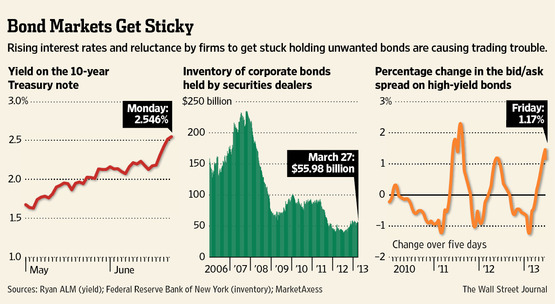
Over the last two months, and particularly over the last two weeks, investors have been exiting their bond investments with unexpected ferocity, moves that continued through Monday.

A bond sell-off has been anticipated for years, given the long run of popularity that corporate and government bonds have enjoyed. But most strategists expected that investors would slowly transfer out of bonds, allowing interest rates to slowly drift up. Read more of this post

Falling Debt Prices Roil Market; Fielding Calls From a Pushy Bond Dealer as Buyers Vanish

Updated June 24, 2013, 9:05 p.m. ET

Falling Debt Prices Roil Market

Fielding Calls From a Pushy Bond Dealer as Buyers Vanish

By KATY BURNE, AL YOON and KELLY NOLAN

MI-BW750_BONDS_G_20130624184505

The rout in the credit markets has gotten so messy some investors are having trouble finding people willing to buy what they are selling.

From municipal bonds to corporate debt to mortgage-backed securities, prices fell sharply again Monday, extending big declines that began last week. Read more of this post

CITI: We’re ‘Shocked’ By The Surge In Negative Earnings Preannouncements

CITI: We’re ‘Shocked’ By The Surge In Negative Earnings Preannouncements

SAM RO JUN. 24, 2013, 7:10 PM 2,172

screen shot 2013-06-24 at 6.38.06 pm

The S&P 500 closed at 1,573 today, which is down over 6% from its recent all-time highs. Many have attributed much of the pullback to the hawkish tone that the Federal Reserve has recently adopted. However, stock market fundamentals have been deteriorating lately too.  Specifically, earnings expectations have come down sharply. And earnings are arguably the most important driver of stocks. In his latest note to clients, Citi’s Tobias Levkovich says he is “shocked” by how negative these trends have been. The Street had become a bit too happy of late and then got upended by the Fed and the likely tapering of QE amidst some prior hopes of a delay in ending such accommodative policy, almost without spending any time looking at earnings estimates or trends less than a month before second quarter results are released. Such a thought process seems ill-founded since earnings matter the most for equities, in our opinion, and there is relatively robust statistical evidence to back up that contention. In this respect, we have been a tad shocked by the surge in negative-to-positive preannouncement trends that make 2009’s surge appear less worrisome in retrospect (see Figure 1). Upward earnings guidance has dipped as well (see Figure 2) and there has been little consternation or discussion about it. Read more of this post