Debt on China’s Local Gov’ Financing Platforms Forces Regulator into Balancing Act

06.03.2013 17:33

Debt on Local Gov’ Financing Platforms Forces Regulator into Balancing Act

CBRC forced to choose between stability of banking system and providing officials with the funding they need

By staff reporters Tian Lin and Huo Kan

(Beijing) – Local government financing platforms’ debts now total 9.3 trillion yuan, exceeding last year’s local government revenues by half, a China Banking Regulatory Commission (CBRC) official recently said at an internal meeting.

By the end of 2015, nearly 3.5 trillion yuan of those debts will come due, exerting heavy pressure on local governments’ fiscal conditions, he said. Read more of this post
Why wealthy Chinese buy their insurance in Hong Kong; people were using offshore insurance to launder money. “The dividends paid by insurance companies is all clean money”

Why wealthy Chinese buy their insurance in Hong Kong

Jun 3, 2013 12:42pm by Lydia Guo

Wealthy Chinese mainlanders famously love to go shopping in Hong Kong, hungry for items such as milk powder, gold and luxury shoes and handbags. But they also like to buy less high profile items, including insurance policies.

During the first quarter of this year, mainland visitors spent HK$2.8bn ($361m) on premiums for personal policies such as life insurance and annuities, or 12.5 per cent of the total for such premiums, according to Hong Kong’s Office of the Commissioner of Insurance. That is a 55 per cent increase over the amount they spent a year earlier.

Why would mainlanders put insurance policies on their shopping lists? One reason is their desire to transfer capital overseas. Others are diversifying their asset allocation, avoiding a proposed estate tax and the fact that usually premiums are lower but returns higher in Hong Kong compared with mainland China. And, of course, Hong Kong’s health service is generally better. Read more of this post

Beijing Caps Home Prices to Control Demand: Mortgages

Beijing Caps Home Prices to Control Demand: Mortgages

Beijing, which already has China’s strictest real estate curbs, is being forced to take additional steps to contain surging home prices as demands for record-high down payments fail to deter buyers.

The city has enforced citywide price caps since March by withholding presale permits for any new project asking selling prices authorities deem too high, according to developer Sunac China Holdings Ltd. (1918) and realtor Centaline Group. Local officials will need further tightening as they struggle to meet this year’s target of keeping prices unchanged from last year, said Bacic & 5i5j Group, the city’s second-biggest property broker. Read more of this post

Volvo Becomes China Latecomer as Geely’s Li Miscalculates Home Advantage

Volvo Becomes China Latecomer as Li Miscalculates Home Advantage

Three years after buying Volvo Cars, Chinese tycoon Li Shufu may get to compete with Volkswagen AG (VOW)’s Audi and Bayerische Motoren Werke AG on a more level playing field in his own country.

Volvo Cars, a unit of Li’s Zhejiang Geely Holding Group Co., will begin production this month at its first factory in China, allowing it to avoid the nation’s 25 percent import tariff. The company had so far brought in its cars from overseas or produced them in limited quantities at a Ford Motor Co. plant in Chongqing, China.

The three years it took to open the factory shows how Li, 49, miscalculated the edge he would have in his home country as the Chinese government subjected the Swedish brand to the same regulatory approval procedures as all foreign automakers. Still, the plant paves the way for Volvo to double sales to 800,000 by the end of the decade as China heads toward becoming the world’s largest market for premium vehicles. Read more of this post

Elite in China Molded in Part by Tiananmen

June 3, 2013

Elite in China Molded in Part by Tiananmen

By ANDREW JACOBS and CHRIS BUCKLEY

BEIJING — For four days, more than 400 of China’s brightest political minds gathered in smoke-clouded halls at a Beijing hotel, vigorously debating the nation’s future.

It was April 1989, and after a decade of economic transformation, China faced a clamor for political liberalization. Days later, protests erupted in Tiananmen Square, and the lives of those at the meeting took radically different turns. Several are now national leaders, including Li Keqiang, China’s prime minister. Others ended up in prison or exile, accused of supporting the demonstrations that shook the Communist Party and ended with soldiers sweeping through the city on June 4, shooting dead hundreds of unarmed protesters and bystanders. Read more of this post

Swedish Students Go To College For Free And Still Wind Up With Five-Figure Debt

Swedish Students Go To College For Free And Still Wind Up With Five-Figure Debt

Matt Phillips, Quartz | Jun. 3, 2013, 3:35 PM | 1,779 | 2

average-swedish-student-debt-average-us-student-debt_chart-1

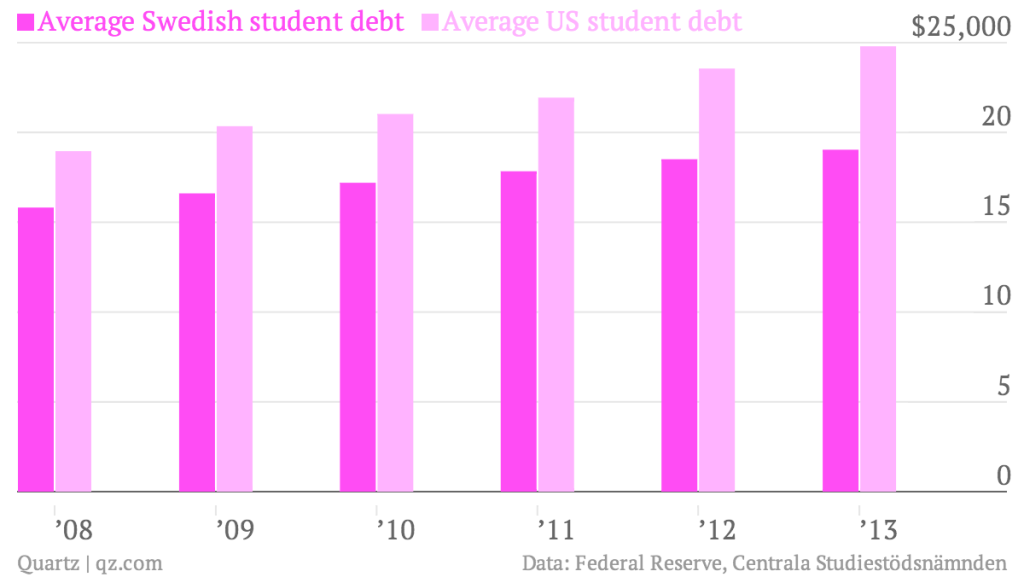
Swedish colleges and universities are free. Yep. Totally free. But students there still end up with a lot of debt. The average at the beginning of 2013 was roughly 124,000 Swedish krona ($19,000). Sure, the average US student was carrying about 30% more, at $24,800. But remember: Free. College in Sweden is free. That’s not even all that common in Europe anymore. While the costs of education are far lower than in the US, over the past two decades sometimes-hefty fees have become a fact of life for many European students. Britain got them in 1998. Some German states instituted them after a federal ban on student fees was overturned in the courts. In fact, since 1995 more than half of the 25 OECD countries with available data on higher education have overhauled their college tuition policies at public institions, with many adding or raising fees. And yet, students in Germany and the UK have far lower debts than in Sweden. And 85% of Swedish students graduate with debt, versus only 50% in the US. Read more of this post

Solar Thieves Evade German Police Hunted With Liquid DNA: Energy

Solar Thieves Evade German Police Hunted With Liquid DNA: Energy

At least 14 times this year, thieves raided solar parks in Germany’s Brandenburg state, carrying off tons of photovoltaic panels in a crime that’s forcing investors in the world’s biggest solar market to tighten security.

“Even thief-proof screws didn’t stop them,” Christian Linder, of plant developer Athos Solar GmbH, said by telephone on June 3 after 130 panels on the outskirts of Berlin were detached from their foundations and carted off. “We have security staff patrolling the park now.”

Solar theft in the eastern state between Berlin and Poland has increased from 16 cases in all of 2008, the region’s police department said. In the south, authorities in Bavaria released recommendations to help protect its 9.6 gigawatts of installed capacity. That’s enough to power about 2.3 million homes in a nation that invested about $15 billion in solar gear in 2012. Read more of this post

UK high streets to lose 5,000 shops in next five years

June 4, 2013 12:04 am

UK high streets to lose 5,000 shops in next five years

By Hannah Kuchler

British high streets are forecast to lose another 5,000 shops in the next five years, as stores – caught between cautious consumers and competition from online and out-of-town rivals – lower the shutters for the last time.

Town centre shopping streets have lost 5 per cent of their outlets in the last two years, according to new research from the Local Data Company and the Saïd Business School. If this trend continues at the same rate, they project that high streets will shed another 13 per cent of stores by 2018. Read more of this post

Bond volatility threatens banks’ Value at Risk models

June 3, 2013 5:32 pm

Bond volatility threatens banks’ Value at Risk models

By Tracy Alloway in New York

Recent volatility in some of the world’s biggest bond markets could upend the complicated mathematical models that underpin large banks’ trading businesses, risk managers have warned.

“Value at Risk,” or VaR models, have been a key part of banks’ risk management toolboxes for the past two decades, despite being heavily criticised for failing to predict the large losses incurred during the recent financial crisis. Read more of this post

EM assets lose favour on fears of slowing Fed QE

June 3, 2013 4:10 pm

EM assets lose favour on fears of slowing Fed QE

By Robin Wigglesworth and Alice Ross

Nowhere did recent hints that the US Federal Reserve could cut back its bond-buying in the near future reverberate as loudly as in emerging markets.

Although the bond and stock markets of developing countries have rallied over the past decade on the back of fundamental fiscal and economic improvements, gains have recently been supercharged by the aggressive ‘quantitative easing’ of western central banks – primarily the Fed. Read more of this post

Call to press fund managers over fees paid by pension trustees

June 3, 2013 11:34 pm

Call to press fund managers over fees paid by pension trustees

By Norma Cohen, Demography Correspondent

Fees collected by fund managers add up to a rising proportion of the returns they generate for pension trustees, with a vast divergence between what different investment groups charge for similar services, according to a report.

The fees paid by pension trustees have stayed flat while their returns have been subdued compared with past decades, adding to concern about the relative cost of fund managers’ services, says Lane Clark & Peacock, the actuarial consultants. Read more of this post

Emerging Market Currency Dominoes to Fall as SocGen Sees Rout

Emerging Market Dominoes to Fall as SocGen Sees Rout

The worst month in a year for emerging-market currencies will prove to be more than a momentary bout of weakness to strategists at firms from UBS AG to Societe Generale SA who see the Federal Reserve weaning investors off its extraordinary stimulus.

South Africa’s rand led declines among the 24 developing-nation currencies tracked by Bloomberg last month, tumbling 11.3 percent. JPMorgan Chase & Co.’s Emerging Markets Currency Index (FXJPEMCI) fell 3.3 percent, the most since it slipped 7 percent in May 2012. Only China’s yuan gained, rising 0.51 percent.

“For these emerging-market currencies, this is the beginning of a trend that perhaps is going to be longer and deeper in terms of a correction,” Tom Levinson, a currency strategist in London at ING Groep NV, the largest Dutch financial-services firm, said in a May 31 phone interview. Read more of this post

More Institutions Dispense with Hedge Funds As an Asset Class

More Institutions Dispense with Hedge Funds As an Asset Class

03 JUN 2013 – IMOGEN ROSE-SMITH

At its February meeting the board and the six-person investment committee of the Employees Retirement System of  Texas made a big decision. They voted to integrate hedge funds across the system’s $24.9 billion portfolio — using them within certain asset classes, like equities and fixed income — instead of simply lumping these investments into a separate allocation.

The Austin, Texas–based retirement fund joins a growing number of U.S. pension funds that are taking a more open approach to hedge fund investing, among them the Teacher Retirement System of Texas and the Virginia Retirement System. The practice is already quite common among foundations and endowments, including such respected university endowments as those of the University of Virginia and the University of   Texas at Austin. At University of   Texas Investment Management Co., CIO Bruce Zimmerman views asset allocation as a matrix, with the market along one axis and investment funds and their liquidity profiles along the other. For example, U.S. equities could include a long-short equity hedge fund, a long-only manager, an activist equity manager and private equity. Read more of this post

Will Xi Jinping’s ‘Chinese dream’ include the rule of law?

Will Xi Jinping’s ‘Chinese dream’ include the rule of law?

By Fred Hiatt, Monday, June 3, 8:19 AM

As he accepted the Communist Party’s designation to be China’s president and supreme military leader in March, Xi Jinping vowed “to achieve the Chinese dream of great rejuvenation of the Chinese nation.”

Xi’s speech to the National People’s Congress won plaudits from the press. “His crisp yet rich voice and frank yet resolute gaze revealed a power to invigorate the people,” the China People’s Daily reported.

But the speech left analysts guessing about what sort of rejuvenation — also translated as “revival” or “renaissance” — the new leader has in mind. Presumably President Obama will be looking for clues when he meets with Xi later this week in California. Read more of this post

Coutts Asia CIO bearish on Singapore property. Investors appear to be “in denial” about the risks over residential property in Hong Kong and Singapore

Coutts Asia CIO bearish on Singapore property

SINGAPORE — Investors appear to be “in denial” about the risks over residential property in Hong Kong and Singapore and that a slowdown in purchases will mean lower prices, private bank Coutts’ chief investment officer for Asia and the Middle East said today (June 3).

BY 2 HOURS 11 MIN AGO

SINGAPORE — Investors appear to be “in denial” about the risks over residential property in Hong Kong and Singapore and that a slowdown in purchases will mean lower prices, private bank Coutts’ chief investment officer for Asia and the Middle East said today (June 3).

“You get that fuzzy period when everyone tells you everything is fine until the point when the bank tells you (that) you must sell or you face a cash-flow problem,” Mr Gary Dugan told the Reuters Wealth Management Summit in Singapore. Read more of this post

Companies in Wenzhou, China’s entrepreneurial hub and epicenter of the underground banking sector, struggle to survive

Companies in Wenzhou struggle to survive

Staff Reporter

2013-06-02

Wenzhou City Sentai Environmental Protection Equipment has qualified for bankruptcy protection amid a growing wave of struggling companies in Wenzhou in eastern China’s Zhejiang province — the country’s entrepreneurial hub and epicenter of the underground banking sector — reports Guangzhou’s Southern Weekly.

The Wenzhou municipal party committee approved the application and under its restructuring and bankruptcy protection program, loss-making companies can continue to run their businesses without being targeted by debt collectors. It also means that the court cannot order the sale of the company’s assets, aiming to help struggling companies obtain financial aid and pay their dues through a legal process. Read more of this post

Singapore wealth manager David Chong, the colourful founder and chairman of Portcullis TrustNet, under fire amid crackdown on offshore tax evasion

A Singapore wealth manager under fire amid crackdown

Monday, Jun 03, 2013

images (12)

SINGAPORE – The email landed at a tough time for David Chong, the colourful founder and chairman of Portcullis TrustNet, one of Asia’s biggest wealth advisory companies.

By threatening to publish offshore companies and trusts held by his clients, it hit a raw nerve at a company whose customers rely on its discretion. But it also came as the wealth management industry faces a wave of global scrutiny from regulators trying to weed out tax dodgers.

The email from a group of investigative journalists said it wanted to expose how the rich compound the world’s economic problems by using offshore tax loopholes to minimise tax payments. Read more of this post

Tax haven allegations dog rich and famous Koreans

2013-06-02 19:10

Tax haven allegations dog rich and famous

Authorities join to crack down on offshore tax evasion
By Kim Tae-jong

Lists disclosed by a local online news outlet have stirred huge controversy, as they accused businessmen and their family members, mostly well-known to the public, of setting up paper companies or accounts in offshore tax havens in an apparent move to create slush funds or avoid paying due taxes.
Newstapa, the Korea Center for Investigative Journalism (KCIJ), came up with the lists after it analyzed data jointly with the International Consortium of Investigative Journalists (ICIJ) and has made a series of announcements. Read more of this post

Risk-Averse Culture Infects U.S. Workers, Entrepreneurs

Updated June 2, 2013, 10:04 p.m. ET

Risk-Averse Culture Infects U.S. Workers, Entrepreneurs

By BEN CASSELMAN

P1-BL745_Risk_G_20130602181808

Americans have long taken pride on their willingness to bet it all on a dream. But that risk-taking spirit appears to be fading.

Three long-running trends suggest the U.S. economy has turned soft on risk: Companies add jobs more slowly, even in good times. Investors put less money into new ventures. And, more broadly, Americans start fewer businesses and are less inclined to change jobs or move for new opportunities.

The changes reflect broader, more permanent shifts, including an aging population and the new dominance of large corporations in many industries. They also may help explain the increasingly sluggish economic recoveries after the past three recessions, experts said. Read more of this post

Dividend Stocks Fall Victim to Fed; Utilities, REITs, Other Sectors That Benefited From Aggressive Bond-Buying Program Take a Hit

Updated June 2, 2013, 4:55 p.m. ET

Dividend Stocks Fall Victim to Fed

Utilities, REITs, Other Sectors That Benefited From Aggressive Bond-Buying Program Take a Hit

By JONATHAN CHENG

MI-BW292_Abreas_G_20130602221204

Stock investors are getting a taste of what could be in store with a sustained rise in bond yields.

A month of sharply climbing U.S. Treasury yields culminated last week in an abrupt selloff among stocks that had been posting big gains thanks to demand from income-hungry investors.

Hardest hit were utilities, telecommunications stocks and real-estate investment trusts, all of which had benefited from the Federal Reserve keeping government-bond yields at rock-bottom levels. The Fed’s extraordinary stimulus policies, which have pumped billions of dollars into the financial markets, had caused investors to seek out income in riskier fare, such as stocks that pay high dividends. Read more of this post

Muddy Waters to Jupiter Seek Profit as China Risk Rises

Muddy Waters to Jupiter Seek Profit as Risk Rises: China Credit

China’s bond risk rose the most in a year in May and investors from Muddy Waters LLC’s Carson Block to Jupiter Asset Management Ltd. are seeking to profit from an economic slowdown as policy makers rein in debt. The cost of insuring sovereign bonds against non-payment rose 15 basis points in May to an eight-month high of 86, as economists queried discrepancies in the nation’s data releases. Credit-default swaps on State Bank of India (SBIN), a proxy for the nation, fell 6 basis points last month, according to CMA, which compiles data in the privately negotiated market. Concern that loans will sour have escalated as falling commodity prices point to flagging growth and inflated export data suggest the economy isn’t as strong as official figures indicate. Varying estimates over the scale of borrowing by local governments and the shadow banking system used to bypass loan curbs compound the risk, according to Jupiter Asset.

“The problem is the lack of transparency,” said Ariel Bezalel, who helps oversee about $44 billion as a portfolio manager at the fund manager in London. “No one really seems to know or have a good handle on the shadow banking system in terms of how large, how severe the non-performing loans situation is.” Read more of this post

Foreign luxury brands desert Shanghai’s Bund as glamor fades

Foreign luxury brands desert Shanghai’s Bund as glamor fades

Staff Reporter

2013-06-03

20130603000047

The Bund in Shanghai. China’s economy has reached a critical point where the country must find a new direction to maintain progress. (File photo/Xinhua)

The flagship store of Italian designer Giorgio Armani in Shanghai closed earlier this year, ending its decade-long operations on the Bund, the most visited tourist destination in the city, the Chinese-language Global Entrepreneur Magazine reports.

The Bund is home to 52 historic buildings of various Western, Eastern and fusion architectural styles. The closed Giorgio Armani store was located at the Bund No. 3, a 97-year-old building that once housed the British Mercantile Bank and was remodeled in 2004 into a high-end shopping center by American architect Michael Graves. Read more of this post

Property speculators in China switch from housing to cemeteries

Property speculators in China switch from housing to cemeteries

Liang Shih-huang and Staff Reporter

2013-06-02

Speculative practices surrounding property prices in China have spread from large scale housing projects to the grave, as investors increasingly eye the lucrative cemetery market, driving up market prices by nearly a hundred-fold over the past ten years.

Many insurance companies are also eying the profitable cemetery market to boost revenue, with analysts estimating that if the trend continues, in another six decades a burial plot in China will cost 100 times more than real-estate. Read more of this post

Legal firms biting at the heels of Sinovel Wind Group; prosecutors are asking for compensation for losses resulting from the company’s fraudulent financial statements

Legal firms biting at the heels of Sinovel Wind Group

Staff Reporter 2013-06-03

CFP432577743-164417_copy1

Sinovel Wind Group announced on May 30 that it has received notice from the China Securities Regulatory Commission of a pending investigation into the company for the alleged violation of the Securities Law. According to NetEase, a Chinese web portal, some legal firms have started soliciting entrustment from investors for suing Sinovel. The prosecutors are asking for compensation for losses resulting from the company’s fraudulent financial statements. On April 13 2013, Sinovel announced that it had received notification from the Beijing Securities Regulatory Bureau, which discovered that some business receipts, related figures, and financial records of the company were off the mark, leading to inflated profits in 2011. According to the Securities Law, investors can file civil suit for compensating their losses caused by false statements which are confirmed and penalized by the China Securities Regulatory Commission. Sinovel listed its shares on the A-share market on Jan. 13, 2011, at an IPO of 90 yuan (US$14.66) per share. The shares closed at 5.76 yuan (US$0.93) on May 29, which translated to a combined 73% decline over the past two years.

Courting Thrifty Shoppers With Value and Quality: Companies like Procter & Gamble are promoting their value by introduced less expensive alternatives to its premium products to court cost-conscious shoppers

June 2, 2013

Courting Thrifty Shoppers With Value and Quality

By STUART ELLIOTT

03adco-popup03adco2-popup

Ads for Iams So Good, which will cost 15 percent less than the Iams line, will emphasize “wholesome ingredients,” not  cost; New ads for Vonage carry the theme “Crazy generous” and feature a chief generosity officer.

ALMOST five years after the financial crisis, the economy has improved significantly, but remains uncertain enough that millions of worried Americans continue to watch how they spend. That has left marketers and agencies trying to figure out the right tone and tack to take in selling products as varied as cars and cans of soup.

Many on Madison Avenue are deciding to focus on value, as in value for money, celebrating thriftiness as they did during the dark days of 2008 and 2009 but also, in an effort to keep ads from growing stale, suggesting that product attributes like quality matter, too, in a “you get what you pay for” fashion. Read more of this post

In China, Concern of a Chill on Foreign Investments

JUNE 2, 2013, 2:15 PM

In China, Concern of a Chill on Foreign Investments

By NEIL GOUGH

China was booming, and Nina Wang, a Hong Kong billionaire, wanted a piece of the action.

It was 1995, and a group of investors was setting up the first nationwide joint-stock bank of the Communist era to be primarily owned by nongovernment companies.

But Ms. Wang, considered to be the richest woman in Asia and a flamboyant figure who wore her hair in pigtails well into her 60s, faced an obstacle: Foreigners were barred from holding stakes in Chinese financial institutions. Read more of this post

Goldman Sachs’s recent exit from South Korea illustrates the problems global asset managers face in trying to build a viable presence in the country

June 2, 2013 5:41 am

South Korea proves tough market to crack

By Song Jung-a in Seoul

Goldman Sachs’s recent exit from South Korea illustrates the problems global asset managers face in trying to build a viable presence in the country. The dearth of domestic investment platforms and limited sales opportunities are proving a real stumbling block, experts say.

Eight of the 22 foreign asset managers active in South Korea suffered losses in the final quarter of last year. There is fierce competition over fees, with 84 fund management companies jostling for a bigger share of Asia’s third-largest funds market – a market dominated by local heavyweights that include Samsung Asset Management and Mirae Asset. But while foreign managers have suffered, the large domestic players, which also include KB Asset Management and Korea Investment Management, made millions of dollars in profits during the final three months of last year, despite challenging market conditions. Read more of this post

China blocks MasterCard processing renminbi transactions

June 2, 2013 6:02 pm

China blocks MasterCard processing renminbi transactions

By Simon Rabinovitch and Jamil Anderlini in Beijing

China has blocked MasterCard from processing credit card transactions in renminbi, raising concerns about Beijing’s willingness to fully open up the sector after the World Trade Organisation found that it unfairly restricted foreign card companies.

According to a document obtained by the Financial Times, the Chinese central bank ordered last month that EPayLinks, an online payment platform, stop issuing renminbi-settled credit cards in partnership with MasterCard. Read more of this post

Heirs to four of Thailand’s most prominent family-run businesses share a common goal: ensuring their businesses secure a foothold in Asean over the next 10 years

Business scions share insights

Sucheera Pinijparakarn
The Nation June 3, 2013 1:00 am

30207432-01_big

From right: Suphachai Chearavanont, CEO of True Corporation, Thapana Sirivadhanabhakdi, CEO of Thai Beverage, Tos Chirathivat, executive director of the Central Group of Companies and CEO of Central Retail Corporation (CRC), and Puttipong Prasarttong-Osot

Sons of four big families give an insight into their thinking, plans

Heirs to four of the Kingdom’s most prominent family-run businesses share a common goal: ensuring their businesses secure a foothold in Asean over the next 10 years.

Thai Beverage is building a clear footprint for its non-alcoholic-beverage business, after acquiring Singapore-based Fraser and Neave (F&N). ThaiBev wants to be a regional powerhouse. In preparation for this, it is restructuring its organisation, working processes and human resources to ensure it is equipped for the step into Asean, according to Thapana Sirivadhanabhakdi, ThaiBev chief executive officer and president. Read more of this post

India’s Apollo Tyres: Our technology people travelled the length and breadth of the country in the cabin of a truck to understand the real life of a driver

Onkar Kanwar: I was a novice in the business and that was to be my biggest advantage

by Onkar Kanwar | Jun 3, 2013

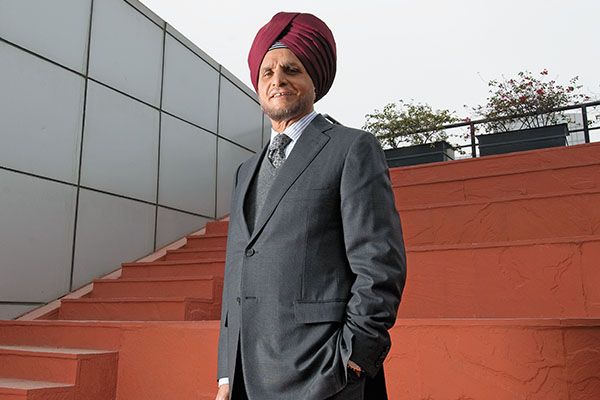
Onkar Singh Kanwar says his decision to take Charge of Apollo Tyres was instrumental in pulling the company back from the brink of bankruptcy

topimg_21803_onkar_kanwar_600x400

Do I quit, even before I have begun the job?’ and ‘do I fight the person I respect the most just because I believe in something different?’ As I look back, in my 50 years-plus professional life, I think these two questions have defined everything I know about friendship, values and business, and have touched every aspect of my life—personal and professional. These are moments that either made me what I am or showed me who I am. In 1979, I had taken upon myself to revive the ailing tyre business of my father Raunaq Singh.
The accounts showed that in just two years, Apollo Tyres had wiped out its net worth four times over and on a capital base of Rs 80 million; the losses were Rs 300 million; tyres were being returned faster than they were being produced, as the technology was coming from an international company and had not been localised; shop floor employees had stopped work. Not ideal conditions to step into business for anyone!  Read more of this post