South Korea fosters start-ups to boost economic shift

South Korea fosters start-ups to boost economic shift

AP

JUN 1, 2013

SEOUL – Kwon Sun-beom’s future was mapped out. Talented in math and science, he attended a specialized high school and majored in electronic engineering at a prestigious university. Lifetime employment at one of South Korea’s towering conglomerates beckoned.

Instead, while his peers were seeking jobs at Samsung and LG, he scaled back his studies and started a company with friends. Together they invented a garbage bin that compresses rubbish using solar power and wirelessly communicates to be collected when full. Read more of this post

North Korean economy surrenders to foreign currency invasion

North Korean economy surrenders to foreign currency invasion

Sun, Jun 2 2013

By John Ruwitch and Ju-min Park

CHANGBAI, China/SEOUL (Reuters) – Chinese currency and U.S. dollars are being used more widely than ever in North Korea instead of the country’s own money, a stark illustration of the extent to which the leadership under Kim Jong-un has lost control over the economy.

The use of dollars and Chinese yuan, or renminbi, has accelerated since a disastrous revaluation of the North Korean won in 2009 wiped out the savings of millions of people, said experts on the country, defectors and Chinese border traders.

On the black market the won has shed more than 99 percent of its value against the dollar since the revaluation, according to exchange rates tracked by Daily NK, a Seoul-based news and information website about North Korea. Read more of this post

Banks Battle Phone Companies for Hidden Cash in Africa Townships; For millions of Africans, a simple Nokia mobile phone acts as a bank account, allowing them to transfer funds with services like M-Pesa, run by Vodacom and Safaricom

Banks Battle Phone Companies for Hidden Cash in Africa Townships

Standard Bank Group Ltd. (SBK) hired Itumeleng Heymann to persuade her neighbors that for about $6 a month, their cash would be better off with Africa’s largest lender than in its current hiding place: under the bed.

For millions of Africans, a simple Nokia mobile phone acts as a bank account, allowing them to transfer funds with services like M-Pesa, run by Vodacom Group Ltd. (VOD) and Safaricom Ltd. Now Standard Bank is turning to an army of 1,000 township residents such as Heymann as it tries to block Vodacom, South Africa’s largest wireless operator, and companies like it from muscling in on the nation’s expanding banking market as they have in Kenya, Tanzania and elsewhere. So far, the banks are winning.

“A lot of people around here don’t have accounts,” said Heymann, 27, wearing braids and a bright blue Standard Bank T-shirt as she worked the morning rush at a market in South Africa’s Tembisa township. “A lot of people don’t want to open accounts because they are scared that maybe there’s lots of fees. We explain to them why it’s better to have an account instead of putting money under your bed.” Read more of this post

As Philippines booms, overseas workers begin to return home

As Philippines booms, overseas workers begin to return home

MANILA — Last year, Mr Mateo Ragonjan took a leap of faith. The executive sous-chef of a seven-star luxury hotel in Abu Dhabi packed his bags to take up a similar job back home in the Philippines.

BY –6 HOURS 39 MIN AGO

MANILA — Last year, Mr Mateo Ragonjan took a leap of faith. The executive sous-chef of a seven-star luxury hotel in Abu Dhabi packed his bags to take up a similar job back home in the Philippines.

He is one of a small group of like-minded Filipinos returning home, a sign of confidence in an economy that for decades has seen millions leave in search of better prospects.

Mr Ragonjan, 41, now helps run a 300-man kitchen that caters to guests and high-rollers of Manila’s newest and most luxurious casino resort. He is one of 400 overseas Filipinos who came home to work at the US $1.2 billion (S$1.5 billion) Solaire Resort & Casino in Manila Bay.

“The Philippines is booming at the moment, so I thought it was the right time to go back,” Mr Ragonjan said. Read more of this post

Deficit Deal Even Less Likely, to delay until after the 2014 midterm elections

Updated June 2, 2013, 8:25 p.m. ET

Deficit Deal Even Less Likely

Improving U.S. Fiscal Health Eases Pressure for a ‘Grand Bargain’ Amid Gridlock

By PETER NICHOLAS, JANET HOOK and DAMIAN PALETTA

Shrinking near-term federal deficits, slowing health-care cost increases and partisan gridlock have all but wiped out the likelihood for a deal this year to reduce long-term U.S. deficits, perhaps delaying a compromise until after the 2014 midterm elections, White House officials and congressional lawmakers said.

The prospects for such a “grand bargain” this year have been unclear for some time, but parties to the discussions said in recent days the chances appear to have further diminished due to signs the government’s fiscal health is improving. That has removed the pressure needed to force compromises. Read more of this post

Mortgage Investors Get Blindsided; Bonds Backed by Subprime Loans Had $1 Billion of Previously Undisclosed Losses

June 2, 2013, 8:26 p.m. ET

Mortgage Investors Get Blindsided

Bonds Backed by Subprime Loans Had $1 Billion of Previously Undisclosed Losses

By AL YOON

Some mortgage investors got an unexpected refresher course on the risks of subprime debt when they received notice of $1 billion of previously undisclosed losses.

The unhappy surprise came with May’s monthly statements on dozens of bonds backed by 75,743 home loans made before the financial crisis to borrowers with less-than-pristine credit. Many of the losses on the $15.2 billion of loans outstanding likely weren’t reported to bondholders for a year or longer.

Behind the sudden losses is a standoff between Wells Fargo WFC -1.70% & Co., the nation’s largest mortgage lender, and Ocwen Financial Corp., OCN -1.31% the largest servicer of subprime loans, over the treatment of loans subject to a type of modification in which the borrower’s repayment schedule has been extended to reduce the monthly payment. Read more of this post

Bonds’ Point of No Return About a Standard Deviation Away

Bonds’ Point of No Return About a Standard Deviation Away

The biggest monthly loss in fixed-income securities since 2004 has still left global yields short of the tipping point that would signal a bear market in bonds.

Yields on U.S. Treasuries (USGG10YR), German bunds and Japanese government bonds are about one standard deviation above their historical norm. Treasury 10-year rates have reached two standard deviations above the average twice since 2009, and each time the notes rallied. While sovereign yields at 1.39 percent are above the record low of 1.14 percent set May 2, they are about half the 3.64 percent average of the past 20 years, based on Bank of America Merrill Lynch’s Global Government Index.

Bonds lost 1.5 percent in May after Federal Reserve policy makers sent mixed signals about whether they would slow the pace of their $85 billion a month in debt purchases this year. Tame inflation and lower global growth estimates from the International Monetary Fund indicate the world’s central banks won’t pull back anytime soon, averting a further rout. Read more of this post

BIS warns of dangers of cheap money driving up stock prices

June 2, 2013 8:24 pm

BIS warns of dangers of cheap money driving up stock prices

By Claire Jones, Economics Reporter

Markets are “under the spell” of the world’s central bankers, with cheap money driving stock prices to record highs despite a lack of good economic news, the Bank for International Settlements has said.

The BIS, the so-called central bankers’ bank, on Sunday became the latest high-profile financial institution to warn that low rates and a plentiful supply of cash from quantitative easing had prompted investors to drive asset prices to record highs in spite of signs that a meaningful recovery continues to elude the global economy.

In the latest edition of its influential quarterly review, the BIS said further easing by some of the world’s big central banks in recent months had “helped market participants tune out signs of a global growth slowdown”. Read more of this post

John Kay: Financial system ‘waiting for next crisis’

June 2, 2013 10:33 pm

Financial system ‘waiting for next crisis’

By David Oakley, Investment Correspondent

John Kay, the economist and author, will warn this week that the world is heading for another financial crisis because the economic system is geared around trading profits that create market bubbles that inevitably burst.

Almost a year after the publication of his groundbreaking review of the UK’s equity markets, the London School of Economics professor will say in a keynote speech this week that the world is “waiting for the next crisis”.

Prof Kay, who is a columnist for the Financial Times, warns: “I think the eurozone does look likely to be it [the next crisis].” Read more of this post

Low interest rates spell doom for some pension plans in U.S.

Low interest rates spell doom for some pension plans in U.S.

BY MICHAEL A. FLETCHER

THE WASHINGTON POST

JUN 3, 2013

INDIANAPOLIS – It was no small matter for the ILM Group’s executives when they froze the pension plan that has provided retirement security for the firm’s employees since 1947.

The financial pressure of maintaining the plan had been mounting on the small insurer for years. But until March, ILM had not given in, even as tens of thousands of other employers did. It held on when the Sept. 11, 2001, terrorist attacks rocked the economy, flat-lining the stocks that fund the pension payments. It also kept the plan intact when the Great Recession shrank its holdings by 29 percent. Read more of this post

The New R&D: Repurchases and Dividends

The New R&D: Repurchases and Dividends

Joshua M Brown

May 30th, 2013

“If you look at total R&D growth, including the corporate and government side, the U.S. is now at the low end. We’re seeing other countries, from Germany to Korea to China, make much bigger bets. And if that persists for long enough, it’s going to have an impact.”
– Rob Atkinson, president of the Information Technology and Innovation Foundation (ITIF)

Shut up, Rob.

What do you mean America doesn’t do R&D anymore? We do it all day long – so long as the R&D we’re talking about means Repurchases & Dividends.

Buybacks, payouts, more buybacks, more payouts – it’s like Candyland for the 20% of America that owns 90% of the stock market and everyone else can go wait in the Home Depot parking lot where we’ll pick them up to dig us a swimming pool later on. Read more of this post

Treasuries Decline Will Be Volatile on Stimulus Exit, BIS Says; “With the outstanding volume of government bonds greater than ever, interest-rate risk” is at a record high in most advanced economies

Treasuries Decline Will Be Volatile on Stimulus Exit, BIS Says

Treasuries are set to extend losses and price swings may intensify as growth allows central banks to withdraw stimulus, the Bank for International Settlements said.

“Yields will go up as the economy recovers,” Stephen Cecchetti, economic adviser and head of the monetary and economic department at the BIS in Basel, Switzerland, told reporters on a conference call on May 31. “The ride to normality will almost surely be bumpy, with yields going through calm and volatile periods.”

Benchmark 10-year note yields rose the most since December 2010 last month amid speculation that the Federal Reserve will begin tapering its $85 billion a month bond-buying program. Chairman Ben S. Bernanke said on May 22 that the central bank could cut the pace of its purchases if policy makers see indications of sustained improvement in growth. Read more of this post

ZEW’s Fuest Sees Japan-Style Stagnation as ECB Tools Exhausted

ZEW’s Fuest Sees Japan-Style Stagnation as ECB Tools Exhausted

Europe faces Japan-style stagnation as governments delay reforms and the European Central Bank comes close to exhausting its options, said Clemens Fuest, president of the ZEW Center for European Economic Research.

“I would expect the politicians to really take the problems in hand and face the need to restructure the banking system,” Fuest said in an interview in Mannheim, Germany. “But I see the risk that what’s concentrated on now is shunting the problems down the road and going the Japanese way, into stagnation. The ECB has done its part to solve the crisis. The central bank has used up most of its ammunition.” Read more of this post

Economic Crisis Renewed Quest for Answers

June 2, 2013, 3:46 p.m. ET

In Economics, Hunt for Answers

By BRENDA CRONIN

P1-BL745_Risk_G_20130602181808

CAMBRIDGE, Mass.—On Tuesday mornings, graduate students and professors fill a classroom here to watch doctoral candidates run the economic gantlet. For an hour and a half, the presenters explain their works in progress to the crowd, who pepper them with questions, critiques and suggestions. The sessions weren’t always so lively, said Harvard professor Benjamin Friedman, who has been participating in the university’s Research in Macroeconomics seminars for years. The packed classrooms these days—a contrast with the thinly attended presentations a decade ago—illustrate how the 2008 financial crisis and the accompanying recession have revived scholarship in macroeconomics. “Academics are looking…for areas that have lots of unsolved questions,” said James Poterba, a professor at the Massachusetts Institute of Technology and president of the National Bureau of Economic Research. There has been “a substantial uptick in interest and excitement around macroeconomic research.”

Read more of this post

Sweden Housing Crash Coming Up; Average Swede to Repay Mortgage in 140 Years; Swedish Central Bank Ponders New Rules

Sweden Housing Crash Coming Up; Average Swede to Repay Mortgage in 140 Years; Swedish Central Bank Ponders New Rules

Posted: 01 Jun 2013 10:01 PM PDT

Average Swede to Repay Mortgage in 140 Years

Swedish repay their mortgages so slowly that it will take 140 years on average, according to the IMF.

The International Monetary Fund lamented Friday that Swedish households pay their mortgages so slowly that they are planning to do an average of 140 years.

“Financial stability is […] reinforced by a steady reduction in repayment schedules – that exceed an average of 140 years,” the IMF said in a statement after a mission in Sweden. Read more of this post

The Many Ways That Cities Cook Their Bond Books; The $3 trillion municipal debt market is rife with creative accounting

Updated May 31, 2013, 7:01 p.m. ET

The Many Ways That Cities Cook Their Bond Books

The $3 trillion municipal debt market is rife with creative accounting.

By STEVE MALANGA

It has been a busy few weeks for the Securities and Exchange Commission. In May, the SEC charged two cities—Harrisburg, Pa., and South Miami, Fla.—with securities fraud for allegedly deceiving investors in their municipal bonds.

This follows similar fraud charges against states, New Jersey in 2010 and Illinois in March, after SEC investigators uncovered what they called “material omissions” and “false statements” in bond documents related to those state’s pension funds. Read more of this post

Trust: Easy to Break, Hard to Repair; renowned short-seller Jim Chanos points out that the average investor is right not to trust the integrity of the financial markets

May 28, 2013, 11:18 AM

Trust: Easy to Break, Hard to Repair

By Jason Zweig

In this interview, the renowned short-seller Jim Chanos points out that the average investor is right not to trust the integrity of the financial markets. (Someone showed a nice touch by posting it on April Fool’s Day.)

In the interview, Chanos makes three important points.

First, in recent years financial fraud has rarely been detected and exposed by the people the public might reasonably expect to do so: accountants, regulators and law-enforcement authorities, whom Chanos calls “the normal guardians of the marketplace.” Instead, frauds more often have been rooted out by whistleblowers, short-sellers and journalists. Read more of this post

China’s Economic Empire: The biggest threat from Beijing is the aggressive spread of state capitalism.

June 1, 2013

China’s Economic Empire

By HERIBERTO ARAÚJO and JUAN PABLO CARDENAL

world

HONG KONG — THE combination of a strong, rising China and economic stagnation in Europe and America is making the West increasingly uncomfortable. While China is not taking over the world militarily, it seems to be steadily taking it over commercially. In just the past week, Chinese companies and investors have sought to buy two iconic Western companies, Smithfield Foods, the American pork producer, and Club Med, the French resort company. Europeans and Americans tend to fret over Beijing’s assertiveness in the South China Sea, its territorial disputes with Japan, and cyberattacks on Western firms, but all of this is much less important than a phenomenon that is less visible but more disturbing: the aggressive worldwide push of Chinese state capitalism.

By buying companies, exploiting natural resources, building infrastructure and giving loans all over the world, China is pursuing a soft but unstoppable form of economic domination. Beijing’s essentially unlimited financial resources allow the country to be a game-changing force in both the developed and developing world, one that threatens to obliterate the competitive edge of Western firms, kill jobs in Europe and America and blunt criticism of human rights abuses in China. Read more of this post

Why Canadians may never realize their dream of having U.S. prices

Why Canadians may never realize their dream of having U.S. prices

Dan Ovsey | 13/05/23 | Last Updated: 13/05/23 10:36 AM ET
In 2011, an average of 3.4 million Canadians made a conscious choice to hop in their vehicles each month and make a run for the border — to shop.

That trend is likely to grow in the near future given that the federal government’s 2013 budget announced the introduction of new tariffs to be imposed on goods entering Canada from 70 different countries, costing Canadian consumers an estimated $330-million more each year in retail prices.

Cross-border shopping is far from new, of course. For decades, Canadians have been traversing the 49th parallel for deals on everything from clothing and accessories to household goods, electronics and furniture. Even when the exchange rate was unfavourable and duties had to be paid at the border, the price difference still made a cross-border shopping trip worthwhile. Read more of this post

Vending machines in Japan have become a stubborn barometer of the country’s struggle against deflation

May 31, 2013

One Obstacle Won’t Budge in Japan’s Fight With Deflation

By HIROKO TABUCHI

TOKYO — Vending machines stocked with sodas are ubiquitous here, tucked away, it seems, in every nook and cranny of the country. They are found along Omotesando, the tree-lined shopping avenue known as the Champs-Élysées of Tokyo, and their glow lights up the back streets of hot spring towns like Hakone. They are even atop Mount Fuji, Japan’s 12,000-foot, snow-capped mountain.

The vending machines are also a symbol of the country’s big economic problem: deflation. The price of a soda in a vending machine has stubbornly remained the same for 15 years. Now, as back then, a can of Georgia Coffee, Pocari Sweat sports drink or Kirin Lemon soda typically sells for 120 yen, roughly $1.20. Some discount machines sell cans for as little as 80 yen, less than the price they fetched in the 1980s. Read more of this post

Infosys Brings Back Founder as Chairman in response to shareholder demands to revive the struggling technology company

June 1, 2013, 5:43 a.m. ET

Infosys Brings Back Founder

By DHANYA ANN THOPPIL

BANGALORE—India’s Infosys Ltd. 500209.BY +3.00% brought back its founder, N.R. Narayana Murthy, in response to shareholder demands to revive the struggling technology company.

Mr. Murthy was named executive chairman and added to the board Saturday. He will hold the post for five years. He served as the chief executive, chairman and chief mentor of Infosys before being appointed chairman emeritus in 2011. Read more of this post

Treasuries Loss Is Biggest in 3 Years as Fed Considers Tapering; Europe Bond Investors Lose in May as End of Cheap Cash Signaled

Treasuries Loss Is Biggest in 3 Years as Fed Considers Tapering

Treasuries recorded the steepest monthly loss since 2009 amid speculation the Federal Reserve could curtail its unprecedented monetary stimulus program if recent improvement in domestic economic data is sustainable.

U.S. government debt tumbled 1.8 percent in the month through May 30, the most since December 2009, according to Bank of America Merrill Lynch index data. Yields extended gains yesterday after a report showed consumer confidence rose in May to the highest level since 2007. A government report on June 7 is forecast to show the U.S. added 165,000 jobs in May and the unemployment rate remained at a four-year low of 7.5 percent. Read more of this post

Spanish has more native speakers than any language other than Mandarin. Yet its success could not have been foreseen

Spanish has more native speakers than any language other than Mandarin. Yet its success could not have been foreseen

Jun 1st 2013 |From the print edition

The Story of Spanish. By Jean-Benoît Nadeau and Julie Barlow. St Martin’s Press; 496 pages; $27.99. Buy from Amazon.com

THE Iberian peninsula was conquered and settled many times, but only one of those conquests was a long-term linguistic success. The languages of the Celts and the Iberians left little mark on Spain. The Phoenicians were no more successful, although they bequeathed a memorable nickname to posterity: I-shepan-ha, “land of hyraxes” (more familiar as Hispania). The Romans had better luck. Their soldiers’ and settlers’ vulgar Latin (always distinct from the written, classical kind) spread to the masses.

The overrunning of Spain by Germanic-speaking Goths failed to root out that rustic Latin. Nor did the long-term Muslim conquest of “al-Andalus”, beginning in 711 and continuing until the fall of Granada to Christian monarchs in 1492. Arabic gave many words to the local Castilian, but never replaced it. Nor was it ever obvious that Castilian would one day become Spanish. Of the kingdoms that reconquered Spain for Christianity, Castile was one of the least important. Neighbouring Asturias and Navarre were originally much bigger. But Castile’s place astride the pilgrimage route to Santiago de Compostela helped it grow richer and more important, and after its merger with Léon it leapfrogged the others to lead the reconquest. Read more of this post

Muslim consumers are looking beyond the traditional religious stipulations on meat and finance. Time to have fun

Halal business

Consuming passions

Muslim consumers are looking beyond the traditional religious stipulations on meat and finance. Time to have fun

May 25th 2013 | BEIRUT |From the print edition

“EVEN in Mecca and Medina people have intercourse,” says Abdelaziz Aouragh, a Dutch Muslim who runs a “sensuality shop” (not a “sex shop”, he insists) for his co-religionists, under the slogan “Feel admired. Feel loved. Feel sensual”. El-Asira, which means “society” in Arabic, sells online and at Amsterdam airport. Bestselling items include massage oils and lingerie. Turnover this year is predicted to be €1m ($1.29m).

That is only the tiniest sliver of the sales to the world’s 1.8 billion Muslim shoppers, a market likely to grow by 35% by 2030. But stereotypes of joyless zealotry are as misleading as the idea that the Muslim market involves only interest-free finance and hand-slaughtered meat. Sharia law forbids meat such as pork and birds of prey, plus blood and carrion. But views on what else is prohibited differ. Inglot, for example, is a nail varnish made in Poland which markets itself as Muslim-friendly because the lacquer is permeable, so it does not need to be removed before Islamic washing rituals. The Koran is silent on such issues; sceptics doubt they matter. Read more of this post

The 100% Stock Solution

May 31, 2013, 5:43 p.m. ET

The 100% Stock Solution

By LIAM PLEVEN

BF-AF044_01WIcv_G_20130531222703BF-AF069_ALLSTO_G_20130531152422

Most investors hold a mix of stocks and bonds, hoping for both growth and safety. Then there are people like Daniel White.

The 36-year-old Chicago lawyer keeps all his investments in the stock market. His 401(k) plan is invested in equities, and so is his wife’s. The college-savings accounts for their four young children also are in stocks. His separate brokerage accounts are, too. The total sum at risk is in the high six figures, he says.

“I’m not an adrenaline junkie,” says Mr. White, who sees the stock-market wagers as part of a broader personal portfolio that includes his job, enough cash to cover the family’s living expenses for an extended period and a house that is fully paid for. Read more of this post

China’s Fifth-Richest Man Wei Jianjun of Great Wall Motor Targets to Sell More SUVs Than GM’s Jeep

China’s Fifth-Richest Man Targets to Sell More SUVs Than Jeep

Chinese billionaire Wei Jianjun has set a target for Great Wall Motor Co. (2333)’s Haval marque to surpass Chrysler Group LLC’s Jeep and become the world’s best selling SUV brand in three to four years. As part of the plan, Great Wall’s chairman has started construction of a new research center the size of 35 soccer fields in the city of Baoding, about 160 kilometers (100 miles) from Beijing. He plans to increase the number of engineers by at least 40 percent to more than 10,000.“We want Haval to have the highest value for money,” Wei, who is China’s fifth-richest man with an estimated net worth of $6.6 billion according to the Bloomberg Billionaires Index, told reporters today at the company’s factory in northern Hebei province. “We want to surprise our customers by that instead of just satisfying them.” Read more of this post

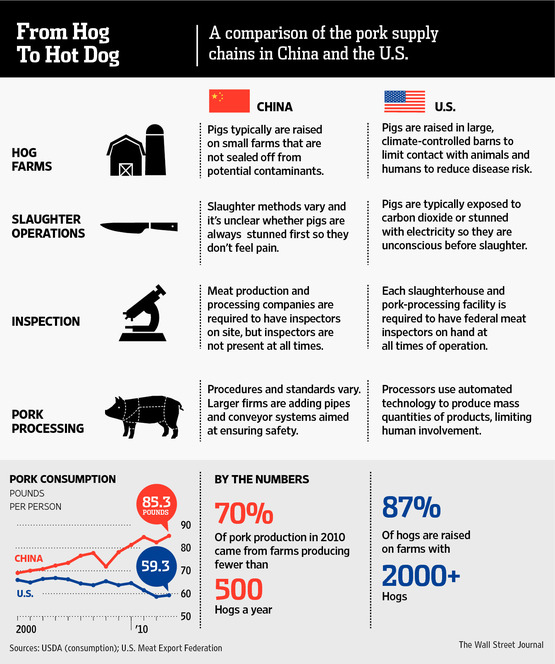
What China Can Learn From America’s Hot Dogs

May 31, 2013, 7:02 p.m. ET

What China Can Learn From America’s Hot Dogs

By DAVID KESMODEL, JULIE JARGON and LAURIE BURKITT

BF-AF085_BIGPOR_G_20130531182111

Behind the planned takeover of Smithfield Foods Inc. SFD +0.61% by China’s biggest meat processor is an intensifying push by the Asian nation to industrialize its archaic food-production system to address rampant health problems and feed an increasingly wealthy population.

In addition to Smithfield’s enormous distribution network and market share in the U.S., owning the American company would enable Shuanghui International Holdings Ltd. to borrow from Smithfield’s playbook to speed the development of hog farms and processing plants in China that mirror the U.S. system. Read more of this post

Korea’s financial watchdog will launch an audit into Woori Bank because it is suspected of holding hundreds of “borrowed name” accounts for CJ Group, the subject of ongoing investigations into tax evasion and slush fund creation

2013-05-31 16:57

Regulator to look into Woori for CJ accounts

By Kim Tae-jong

The nation’s financial watchdog will launch an audit into Woori Bank because it is suspected of holding hundreds of “borrowed name” accounts for CJ Group, the subject of ongoing investigations into tax evasion and slush fund creation.

The bank is suspected of abetting the group’s wrongdoings, if proven to be true, this will be another setback, coming right after the Board of Audit and Inspection (BAI) blamed it for having poor management practices. Read more of this post

Chinatrust’s fomer vice chairman Jeffrey Koo Jr given lengthy prison sentence for financial scam

Chinatrust’s Koo Jr given lengthy prison sentence for scam

CNA 2013-06-01

E418TB12H_2013資料照片_copy1

The former vice chairman of Chinatrust Financial Holding Co was sentenced Friday to nine years and eight months in prison and fined NT$150 million (US$5 million) for his role in a financial scandal.

The Taiwan High Court found Jeffrey Koo Jr guilty of violating the Securities and Exchange Act and the Banking Act with regard to irregularities in transactions of structured notes linked to Mega Financial Holdings during the period 2005-2006. Read more of this post

Huge debts of US$434 billion could see China Railway Corp hit the buffers

Huge debts could see China Railway Corp hit the buffers

Staff Reporter

2013-05-31

With debts of 2.66 trillion yuan (US$434 billion) and its staff yet to be finalized, uncertainties remain at the newly established China Railway Corp, which is now the country’s largest state-owned company, Guangzhou’s Time Weekly reports.

The company, which was set up in March after the dissolution of the Ministry of Railways, is struggling with massive debts, which has led to delays in making arrangements for the 903 staff members of the now defunct ministry, a source close to the company told the newspaper. Read more of this post