The Richest Families In The World Are Staging A Quiet Rebellion Against Hedge Funds

The Richest Families In The World Are Staging A Quiet Rebellion Against Hedge Funds

Linette Lopez | Jun. 5, 2013, 10:54 AM | 9,873 | 13

It’s no secret that since 2008, most hedge funds have lagged the S&P 500. Because of that, now the world’s richest families are starting to wonder if hedge funds are really worth their incredibly expensive price tag.

And they’re starting to ask hedge fund managers some tough questions about it.

Yesterday, Bloomberg hosted a conference called “The Hedge Funds Summit” for (you guessed it) hedge funds and the people that invest in them. Many of the attendees were from Family Offices — investment houses where the fortunes of the world’s wealthy are put to work. Read more of this post
Should We Trust Economists? They’re fractious, frequently wrong, and have lost much of the public’s faith. But their insights are still valuable — as long as you don’t expect them to predict the future

Should We Trust Economists?

They’re fractious, frequently wrong, and have lost much of the public’s faith. But their insights are still valuable — as long as you don’t expect them to predict the future.

NOAH SMITHJUN 4 2013, 9:59 AM ET

Imagine you are the Royal Physician in England some time during the 14th century. The prince is sick, and you’ve been summoned to help. You call in two experts for advice. The first says: “Use leeches to suck out the evil humors.” The second says “No, you must bleed him to get the evil humors out.” They start to argue, insulting each other in nasty epistles. “Leech guy is secretly working for the French!” alleges Bleeding Guy. “Bleeding Guy just wants the prince to die because the prince wanted higher taxes on the nobles!” Leech Guy fires back. Read more of this post

What to Do When the Invisible Hand Stops Working

What to Do When the Invisible Hand Stops Working

Economists rave about the power of the market to deploy productive resources better than any central planner possibly could. A mysterious process, which Adam Smith called the “invisible hand,” guides countless individuals with conflicting aims to somehow coordinate into a remarkably effective economic organization. Usually.

But as the British economist John Maynard Keynes famously argued, markets can also fall into dysfunction. A crisis can set off a downward spiral: Spending declines, companies fail, people lose jobs, spending declines further. Much of the wonderful coordination disappears, as if the invisible hand were injured.

None of this is controversial. But if you ask how best to cure an afflicted economy, you get vicious and sometimes hysterical argument, typically polarized along political lines. Should markets be left alone, because the invisible hand is self-healing and intervention can only make matters worse? Or does an economy, like a real living thing, sometimes need direct medical (or governmental) intervention? Read more of this post

Alcoa Junk Downgrade Is Rare Trauma for Dow Stocks; Alcoa is the second junk-rated Dow Jones Industrial Average company in at least three decades. It took four years for the first to be ejected

Alcoa Junk Downgrade Is Rare Trauma for Dow Stocks: Commodities

Alcoa Inc. (AA)’s speculative-grade credit ranking at Moody’s Investors Service makes it only the second junk-rated Dow Jones Industrial Average company in at least three decades. It took four years for the first to be ejected. The New York-based aluminum producer was lowered last week by Moody’s, following General Motors Corp. as the only Dow member below investment grade since at least 1980, according to Howard Silverblatt, an analyst at S&P Dow Jones Indices. While the guidelines don’t mention debt ratings, Dow companies become vulnerable when their finances deteriorate, says Richard Moroney, editor of Dow Theory Forecasts newsletter.

Alcoa shares have declined 67 percent in the past decade through yesterday, leaving the company with the lowest share price and market value in the Dow, as surging aluminum production in China led to a supply glut. While S&P Dow Jones says inclusion in the average is not governed by quantitative rules, the index provider prefers “sustained growth.” Alcoa’s revenue has declined for four straight quarters and 2012 net income was less than a tenth what it was five years earlier. Read more of this post

Loews’ James Tisch Says Hedge Funds Envy Him Amid Withdrawal Concerns; Tisch, 60, and his family have built Loews into a $17.7 billion business

Tisch Says Hedge Funds Envy Him Amid Withdrawal Concerns

James Tisch, who invests in hedge funds to boost returns at Loews Corp. (L), said he avoids managers with the largest pools of money and sleeps better at night knowing he doesn’t face the same prospect of client withdrawals.

“We are very wary of managers that have $10 billion, $15 billion, $20 billion, because you have to wonder, how can they generate outsize returns with so much money,” Tisch, Loews’s chief executive officer, said today at the Bloomberg Hedge Funds Summit in New York. “We are constantly looking and probing and trying to find the new guys on the street, the people that aren’t loaded to the gills.”

Tisch, 60, and his family have built Loews into a $17.7 billion business by investing in hotels, energy companies and insurer CNA Financial Corp. (CNA) Most of Loews’s investment portfolio is held by CNA, which gets to oversee money for years in some cases before paying claims and can raise cash by selling more policies. Managers of the largest funds are “really insecure,” because clients can demand their money back, he said. “They’re phenomenally jealous of me, believe it or not,” Tisch told Bloomberg Television’s Stephanie Ruhle at the event. “They say to me, Jim, you’ve got permanent capital. Your money can’t leave. But all these other guys if they have a bad quarter, a bad year, boom! Look at SAC Capital.” Read more of this post

Waiting for Indonesian Leadership; Fifteen years after Suharto, corruption has undercut political and economic progress at every turn

June 4, 2013, 9:38 a.m. ET

Waiting for Indonesian Leadership

Fifteen years after Suharto, corruption has undercut political and economic progress at every turn.

By JOHN KURTZ AND JAMES VAN ZORGE

A little more than 15 years ago, on May 21, 1998, Suharto stepped down from the Indonesian presidency and ended three decades of autocratic rule. Student demonstrators, white collar professionals, laborers and housewives alike poured into the streets to celebrate. Suharto’s successor, B.J. Habibie, quickly promised reform.

Today in the streets of Jakarta, the din of protest and change that defined 1998 is a distant memory. While Indonesians appreciate the voting rights and civil freedoms gained that year, many also wax eloquent about the “good old days” under Suharto.

They do so because democracy has not brought Indonesia far-sighted leadership. The good news in Indonesia has been widely recognized and recently celebrated—increases in foreign direct investment, continued press freedom, a stable banking sector, solid growth rates—but underneath lies a restlessness for real change that would affect the common person. Elections next year offer the country’s politicians a chance to restore voters’ faith in democracy and reform-–but they also create a dangerous opening for illiberal candidates to lead the country astray by playing on ill-founded nostalgia. Read more of this post

Korean government to inject $36 billion to spur ‘creative economy’

2013-06-05 18:09

Gov’t to inject $36 billion to spur ‘creative economy’

By Yi Whan-woo

The government will invest 40 trillion won ($35.8 billion) over the next five years to turn Korea into a creative economy centered on science and information technologies as well as small and mid-sized enterprises.

Unveiling the master plan to spur the transition, Choi Mun-kee, minister of Science, ICT and Future Planning, said the government’s goal is to foster an environment where creative ideas and innovative technologies lead to new jobs and markets. Read more of this post

Diabetes Is the Price Vietnam Pays for Progress

June 4, 2013

Diabetes Is the Price Vietnam Pays for Progress

By THOMAS FULLER

HO CHI MINH CITY — He survived the deprivation of the Vietnamese countryside and decades of war, but Pham Van Dang, 70, lay dazed in his hospital bed, the stump of his freshly amputated leg sewn up like the seams of a leather bag. Mr. Dang and many younger patients in the diabetes ward here at Nguyen Tri Phuong Hospital are casualties of rising affluence, his doctor says. “I see more and more patients with diabetes,” said Dr. Tran Quang Khanh, who is chief of the endocrinology department, whose ward receives 20 new patients a day. The precise reasons for a spike in diabetes cases are hard to pin down — people are living longer, for one — but doctors in Vietnam say the prime culprits are “Westernization and urbanization.” “Now we have KFC and many fast-food restaurants,” Dr. Khanh said.

Read more of this post

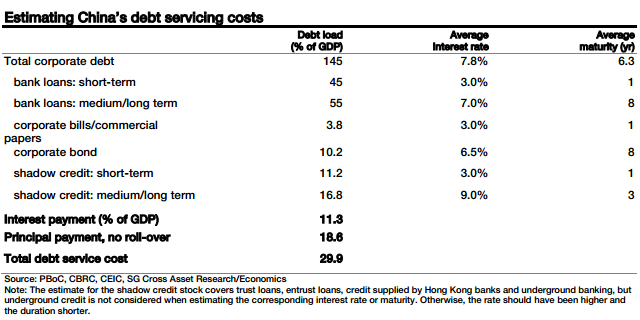
China’s debt servicing cost and that Minsky moment; with shockingly high debt service ratio of 29.9% of GDP, no wonder that credit growth is accelerating without contributing much to real growth

China’s debt servicing cost and dat Minsky moment

Kate Mackenzie

| Jun 04 12:48 | 32 comments | Share

Part of the CHINA’S CREDIT CONUNDRUM SERIES

ChinaDSR-estimate-SocGen

A little update on China’s growing debt-to-GDP ratio, which has caused much alarm and puzzlement this year. We’ve mentioned before a very interesting 2012 BIS paper on national debt servicing ratios, which found the following: …the DSRs’ peak levels are surprisingly similar across countries and time despite different levels of financial development. As a broad rule of thumb, the graph panels suggest that a DSR above 20–25% reliably signals the risk of a banking crisis. There are certainly exceptions to this — the authors of the BIS paper, Mathias Drehman and Mikael Juselius, point out that South Korea well exceeded this range before experiencing a financial crisis; while German and Greek crises occurred before 20 per cent was reached. What about China? Read more of this post

More than 40% of managers that are sent abroad fail

More than 40% of managers that are sent abroad fail

By Vickie Elmer June 4, 2013

Getting a job placement overseas sounds like a dream until it’s not.

The failure rate of expatriates is amazingly high, and experts blame a lack of corporate support and an abundance of family issues.

Some 42% of overseas assignments are judged to be failures by senior executives in a new Right Management survey. That ratio is consistent whether the manager is leaving a company based in Asia, Europe or North America. Executives used their internal targets or perspectives in judging the ex-pat assignment a success or failure. These include whether the worker hit her sales targets or returned early.

“You would think in the globalization of business, of workforce of talent mobility that clearly is at its peak today that companies would smartly invest and think and plan on how to do this,” said Bram Lowsky, group executive vice president for Right Management in Toronto. Read more of this post

This shell that is buying Smithfield has no legal or operational connection to Henan Shuanghui whose Chinese assets are reportedly being used as collateral for the shell company to finance a very highly-leveraged acquisition

Smithfield Foods – Shuanghui International: The Biggest Chinese Acquisition That Isn’t

June 2nd, 20131 comment

Peter Fuhrman is Chairman, Founder & CEO at China First Capital, (中国首创)a leading China-focused specialist international investment bank and advisory firm for private capital markets and M&A transactions.

It is, if voluminous press reports are to be believed, the biggest story, the biggest deal, ever in China-US business history. I’m talking about the announced takeover of America’s largest pork company, Smithfield Foods, by a company called Shuanghui International. The deal, it is said in dozens of media reports, opens the China market to US pork and will transform China’s largest pork producer into a global giant selling Smithfield’s products alongside its own in China, while utilizing the American company’s more advanced methods for pork rearing and slaughtering.

One problem. A Chinese company isn’t buying Smithfield. A shell company based in Cayman Islands is. Instead of a story about “China buying up the world”, this turns out to be a story of a precarious leveraged buyout deal (“LBO”) cooked up by some large global private equity firms looking to borrow their way to a fortune. Read more of this post

Wang Huning, head of a secretive Communist Party office and a key architect of President Xi Jinping’s ‘China Dream’ campaign, is one of the most influential but least known figures in China today; Wang occupies a unique place in the party as the only person to have served as a top policy adviser and speechwriter to three successive presidents: Jiang Zemin, his successor Hu Jintao, and now Mr. Xi

June 4, 2013, 10:37 p.m. ET

The Wonk With the Ear of Chinese President Xi Jinping

By JEREMY PAGE

BEIJING—When Xi Jinping sat down with Russian and African leaders in March during his first overseas visit as China’s new leader, at his shoulder in every meeting was a bookish, bespectacled figure, listening intently and occasionally taking notes. Look for him to be there too in Rancho Mirage, Calif., on Friday when Mr. Xi and President Barack Obama meet for a summit.

P1-BL770_CWANG__G_20130604181034P1-BL769_CWANG_DV_20130604190256

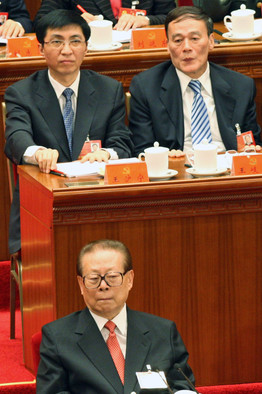
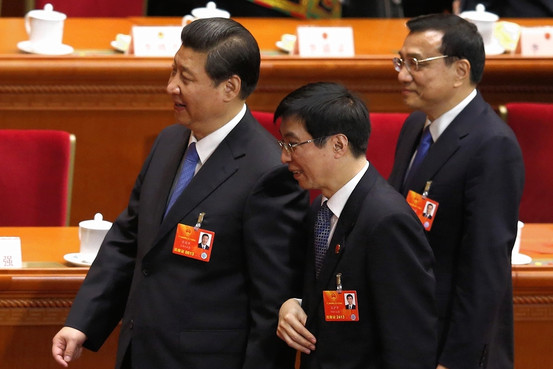
Wang Huning has advised three presidents. Mr. Wang, center, with President Xi Jinping left, in March. Mr. Wang sits behind former President Jiang Zemin in 2007

Even in China, few people would recognize Wang Huning, head of the Communist Party’s secretive Central Policy Research Office. And small wonder: The former university professor almost never talks in public, barely speaks to old acquaintances and makes a point of not associating with foreigners.

Yet party insiders and experts on Chinese politics consider him one of the most influential figures in China today, a key architect of its domestic and foreign policy over the past decade, and now of Mr. Xi’s signature “China Dream” campaign that evokes a militarily and economically strong nation reclaiming its place of prominence in the world.

Mr. Wang, who briefly studied in the U.S. and has headed the Research Office since 2002, occupies a unique place in the party as the only person to have served as a top policy adviser and speechwriter to three successive presidents: Jiang Zemin, his successor Hu Jintao, and now Mr. Xi. Read more of this post

If Chinese IPO Booms, This Is a Bubble

If Chinese IPO Booms, This Is a Bubble

There’s something familiar about the Beijing-based online retailer LightInTheBox Holding Co., which plans to price its initial public offering this week on the New York Stock Exchange. Looking at the company’s website reminds me of an old spoof in the Onion about a Chinese factory worker who can’t believe the sheer amount of cheap junk Americans will buy. “Why the demand for so many kitchen gadgets?” the fictional worker was quoted as saying in a 2005 article for the satirical newspaper. “Where do the Americans put them? How many times will you use a taco-shell holder? ‘Oh, I really need this silverware-drawer sorter or I will have fits.’ Shut up, stupid American.” Many of the items break after a few uses, he noted. On the list of “best deals” on LightInTheBox: a “capless short bob high quality synthetic dark brown straight hair wig” for $27.99, and a “cast iron revolver design tattoo gun kit” for $109.99. Kitchen items include a “cool steamship and iceberg shaped ice tray mold” for $3.79. There’s also free shipping on many items of the 220,000 products offered (even the ice tray), but no recognizable brand names — just a lot of knockoffs.

Read more of this post

Poultry Plant in Deadly Fire Won Plaudits From Chinese

June 4, 2013

Poultry Plant in Deadly Fire Won Plaudits From Chinese

By EDWARD WONG

BEIJING — A local Communist Party official called it an “inspiring” factory three years ago. Local officials later gave it the “leading enterprise” label for its innovation in processing chickens. But the official homages to the Jilin Baoyuanfeng Poultry Plant, where at least 120 people died this week in a fast-moving fire, now serve as little more than stark reminders of the blind eyes turned to the dangerous conditions facing many workers in China.

The tragedy, which some state media reports attributed to an ammonia leak, was China’s worst workplace fire in many years. That, coupled with the earlier glowing assessments of the factory, underscored how government regulation in China is weakened by an evaluation system that bases the promotion of officials on economic growth above virtually all else. How well companies expand the local economy trumps workplace conditions, product safety and pollution — top concerns for many ordinary Chinese and growing sources of unrest. Read more of this post

Confronting China’s Cadmium-Laced Rice Crisis: Doing nothing about toxic cadmium in rice paddies appears to be no longer an option in Hunan Province

06.05.2013 18:31

Confronting China’s Cadmium-Laced Rice Crisis

Doing nothing about toxic cadmium in rice paddies appears to be no longer an option in Hunan Province

By staff reporters Pang Jiaoming, Gong Jing and Liu Hongqiao

Seller’s stalls are empty and aisles have fallen silent at one of China’s largest wholesale markets for rice, the Lianxi Rice Market in the city of Yiyang, north-central Hunan Province. Business at the market – traditionally a trading center for about 20 percent of all rice grown in Hunan – has come to a standstill in the face of a heavy-metal contamination scare. The scare lay dormant for years before exploding onto the public stage in February with frightening media stories about high levels of the heavy metal cadmium in Hunan-grown rice. Follow-up reports were continuing in June as consumers, wholesalers, retailers and farmers digested results of government lab tests and mulled over reports of entire villages being poisoned over the past decade. Read more of this post

A nationwide boom in campus construction in China has provided ample opportunity for graft

Corruption on College Campuses

By Shen Nianzu (沈念祖)
Issue 622, June 2, 2013

In May, Nanchang University President Zhou Wenbin (周文斌) was detained and removed from the 12th National People’s Congress. A source close to the Jiangxi provincial Commission for Discipline Inspection revealed that the case is related to construction of the school’s new campus.

In the past five years, 14 university officials in Jiangxi have been involved in corruption related to campus construction – three of whom were university presidents.

Du Zhizhou (杜治洲), vice-director of the Clean Politics Institution in Beijing University of Aeronautics & Astronautics, found that from 1988 to 2009, out of 200 corruption cases in public universities nationwide, 34 percent were related to construction. Read more of this post

For the first time in a decade, Wall Street is shrinking their footprint in the natural-gas storage business, as booming output damps price volatility and potential profits

June 4, 2013, 6:52 p.m. ET

Wall Street Takes Foot Off the Gas

By DAN STRUMPF

For the first time in a decade, Wall Street banks and trading firms are shrinking their footprint in the natural-gas storage business, as booming output damps price volatility and potential profits. Banks stampeded into commodities in the past two decades in search of big bets. Natural gas held a particular allure because for years the heating fuel was scarce and vulnerable to output disruptions that allowed traders to capitalize on big price swings. But that allure is fading for some. At the end of the first quarter, the amount of storage space leased by financial firms declined 0.8%, the first such drop since 2003, according to an analysis of Federal Energy Regulatory Commission data conducted by BNP Paribas BNP.FR -0.14% . “It’s really difficult for commodities traders to make the kind of money they used to make,” said Brad Hintz, an analyst who tracks investment banks for Sanford C. Bernstein. “The dynamic is changing, and it’s pretty tough for the traders to generate the profitability they’re used to.” Read more of this post

The Threat to the Central-Bank Brand

The Threat to the Central-Bank Brand

04 June 2013

Mohamed A. El-Erian

NEW YORK – The “branding” of modern central banking started in the United States in the early 1980’s under then-Federal Reserve Board Chairman Paul Volcker. Facing worrisomely high and debilitating inflation, Volcker declared war against it – and won. In delivering secular disinflation, he did more than change expectations and economic behavior. He also greatly enhanced the Fed’s standing among the general public, in financial markets, and in policy circles.

Volcker’s victory was institutionalized in legislation and practices that granted central banks greater autonomy and, in some cases, formal independence from long-standing political constraints. To many, central banks now stood for reliability and responsible power. Simply put, they could be trusted to do the right thing; and they delivered. Read more of this post

Don’t Sell Your Soul for Yield, Pimco’s Simon Says; “The road to hell is paved with positive carry”

Jun 3, 2013

Don’t Sell Your Soul for Yield, Pimco’s Simon Says

By Al Yoon

Eking out a little bit of extra yield might be the death knell for an investment manager. That sums up some parting words from Scott Simon as he approached his May 31 retirement after three decades of mortgage-backed securities trading and investing, including the last 13-and-a-half years at bond fund giant Pacific Investment Management Co. Buying bonds for their yield, or “carry” over and above the cost of buying them is not the best approach if investors are sacrificing attention to the bonds’ prices, Simon said. Investors too often mistakenly focus on buying bonds for the interest they pay rather than their fundamental value, particularly after a period of prolonged low interest rates when buyers become starved for higher yields, he said.

“The road to hell is paved with positive carry,” he said, repeating a mantra that traders say he’s proffered before. Read more of this post

Investors are once again clamoring for a risky investment blamed for helping unleash the financial crisis: the synthetic CDO

June 4, 2013, 9:06 p.m. ET

One of Wall Street’s Riskiest Bets Returns

Before the financial crisis, CDOs and synthetic CDOs were a big cog in Wall Street’s so-called structured-finance machine, bringing in substantial fees for securities firms that put together the deals.

By KATY BURNE

P1-BL772_CDO_NS_20130604185705

Investors are once again clamoring for a risky investment blamed for helping unleash the financial crisis: the synthetic CDO. In a sign of how hard Wall Street is trying to satisfy voracious demand for higher returns amid rock-bottom interest rates, J.P. Morgan Chase JPM -1.22% & Co. andMorgan Stanley MS -1.28% bankers in London are moving to assemble so-called synthetic collateralized debt obligations.

CDOs give investors a chance to bet on the creditworthiness of a basket of companies. Basic CDOs pool bonds and offer investors a slice of the pool. Synthetic CDOs pool, instead of the bonds themselves, insurance-like derivative contracts on the bonds. Read more of this post

The Federal Housing Administration’s projected losses over 30 years could reach as high as $115 billion under a previously undisclosed “stress test” conducted last year

Updated June 4, 2013, 6:39 p.m. ET

FHA Losses Could Hit $115 Billion in Extreme Scenario

By NICK TIMIRAOS

NA-BW675_FHA_NS_20130604182404

The Federal Housing Administration’s projected losses over 30 years could reach as high as $115 billion under a previously undisclosed “stress test” conducted last year to determine how the agency would fare under an extremely severe economic scenario, according to documents reviewed by a congressional committee.

The forecast was significantly worse than the most severe estimate included in the government mortgage-insurance agency’s independent actuarial review released last November. The FHA’s outside actuaries modeled the analysis along the lines of the annual stress test employed by the Federal Reserve Board, which gauges how the nation’s largest financial institutions would fare in the event of a significant economic shock. The FHA isn’t required to use the Fed test. Read more of this post

Will Mortgage Bonds Enter the Vortex?

Will Mortgage Bonds Enter the Vortex?

In my previous post, I argued that bondholders will probably be able to tolerate any “tapering” of the Federal Reserve’s asset purchases so long as they aren’t using much leverage and are willing to hold to maturity. After all, the Fed has been bidding up financial asset prices to stimulate the economy, and I doubt financial policymakers would consciously choose to inflict substantial losses on savers.

That said, the prices of bonds could get a lot more volatile over the next few years. One possible scenario: the Fed starts tapering its asset purchase program only to observe large increases in interest rates, thereby leading to an increase in stimulus. This sort of start-stop (or slow-down, speed-up) behavior would fit with the pattern we have seen over the past few years with QE1 and QE2. Read more of this post

Cash Outflows Turn World’s Best Stocks to Worst: Southeast Asia

Cash Outflows Turn World’s Best Stocks to Worst: Southeast Asia

Stock markets in Indonesia, the Philippines and Thailand have gone from being the world’s best to among the worst as the threat of reduced bond purchases by the U.S. Federal Reserve sends foreign investors to the exit.

Equity indexes in the three markets have declined more than 3.5 percent since May 22, when Fed Chairman Ben S. Bernanke said policy makers could consider reducing stimulus if the U.S. labor market improves. International money managers pulled a combined $1.6 billion from the Southeast Asian countries in that period, the most since August 2011, data compiled by Bloomberg show. Read more of this post

Investors in Myanmar should heed lessons from Vietnam, which opened up to the world in a similar fashion two decades ago. The failure rate for early investors in that market may have been as high as 90%

Updated June 4, 2013, 3:56 a.m. ET

Myanmar Investors Need Vietnamese Lessons

By DUNCAN MAVIN

AM-AY816_BURMAH_NS_20130604034505

The flavor of the month in emerging markets is a fish-based broth with rice noodles, ginger and lemongrass called mohinga. Myanmar’s national dish, it’s sure to be on the menu at this week’s World Economic Forum event in the former pariah state. While Myanmar is a mouthwatering a proposition, gorging on it too soon carries a lot of risk. The country ticks many boxes in terms of potential. Its population of 60 million has almost zero cellphone penetration. It’s in a logistical sweet spot between China and India and is rich in natural resources. New laws, including measures to allow 100% foreign ownership of companies in some sectors, show the politicians are open to foreign investment. To say that these are the early days in a frontier economy is an understatement: There is virtually no ATM network and very few commercial bank branches, for instance. Read more of this post

The S.E.C. Is ‘Bringin’ Sexy Back’ to Accounting Investigations to crack down on accounting fraud

JUNE 3, 2013, 11:38 AM

The S.E.C. Is ‘Bringin’ Sexy Back’ to Accounting Investigations

By PETER J. HENNING

In April 2003, a New York Times article discussed the push by federal prosecutors to crack down on accounting fraud in which one expert said, “These have become the hot, sexy cases.” What followed were the convictions of chief executives including Jeffrey K. Skilling of Enron, Bernard J. Ebbers of WorldCom and John J. Rigas of Adelphia Communications. The attraction seems to have worn off. The number of corporate accounting cases at the Securities and Exchange Commission has dropped to its lowest level in a decade, with only 79 such cases filed in the most recent fiscal year. In the past, the S.E.C. relied mainly on the market to flag accounting problems at companies that would lead to an investigation. Enron’s demise, for example, began when questions were raised about its complex reporting of various off-balance-sheet transactions amid a rapidly falling stock price, which led to the issuance of subpoenas to the company and its outside auditor, Arthur Andersen.

Today, the S.E.C. wants to be more proactive by using risk modeling to analyze corporate filings to identify companies that might be outliers in reporting their results. In a speech in December, Craig M. Lewis, director of the agency’s division of risk, strategy and financial innovation, talked about a new “accounting quality model” that could help the S.E.C. “assess the degree to which registrants’ financial statements appear anomalous.” Read more of this post

US funds left bruised by heavy bond losses; Every one of the most popular class of US mutual funds investing in bonds lost money in May, highlighting the risks for investors as interest rates rise

June 3, 2013 7:44 pm

US funds left bruised by heavy bond losses

By Dan McCrum in New York

Every one of the most popular class of US mutual funds investing in bonds lost money in May, highlighting the risks for investors as interest rates rise. Bond yields around the world soared from some of the lowest levels in decades last month as investors anticipated an end to the extraordinary measures the Federal Reserve has used to stimulate the US economy. US funds that invest in higher-rated bonds with average maturities of under 10 years lost an average 1.8 per cent in May, marking their worst performance since the depths of the financial crisis in October 2008, according to Lipper, a research group. Such a broad decline has been rare for these funds. With more than $900bn in assets, these investment vehicles have attracted the lion’s share of inflows from savers in search of regular income and low risk since the crisis. Read more of this post

Bond haircuts in fashion for banks; There is a growing belief that even banks that are relatively rich in deposits should be forced to hold large quantities of bonds that can be “bailed in” if crisis hits.

June 3, 2013 8:10 pm

Inside business: Bond haircuts in fashion for banks

By Patrick Jenkins

Go back a decade and the only reason the Co-operative Bank was in the headlines was because it had raised a chunk more charity money or found a way to make cheque books out of recycled paper.

Today’s news agenda at the UK’s main ethically-minded lender is rather more existential. Over the weekend there was another spate of jitters over the Co-op. A few months after it first emerged that the bank faced a capital hole of up to £1bn, and three weeks on from its dramatic six-notch credit rating downgrade at the hands of Moody’s, there were fresh revelations. First the Financial Times reported that some institutional depositors had begun withdrawing funds. Then it emerged that the umbrella Co-op group, which spans supermarkets and funerals, was weighing some dramatic financial restructuring that would hurt bondholders. Read more of this post

No more Mr Nice Guy: Indian bankers suit up for war on debt defaulters as banks are weighed down by stressed loans of nearly $150 billion – equivalent to more than 10 percent of bank assets in the country

No more Mr Nice Guy: Indian bankers suit up for war on debt defaulters

Sun, Jun 2 2013

By Swati Pandey

MUMBAI, June 3 (Reuters) – Fed up with a profitable textile company’s failure to repay its loan, India’s UCO Bank has taken its grievance public, placing newspaper ads last month that brand the industrialist owner of S. Kumar’s Nationwide Ltd a defaulter. State Bank of India (SBI), Bank of India Ltd and Bank of Baroda are also preparing to name and shame corporate borrowers which are not paying them back, bank executives told Reuters. This aggressive tactic for dealing with bad debt marks a major departure from the traditional laid-back approach of Indian state lenders. Weighed down by stressed loans of nearly $150 billion – equivalent to more than 10 percent of bank assets in the country – and against a backdrop of the slowest economic growth in a decade, Indian banks are bringing an unprecedented intensity to their recovery efforts. Read more of this post

CJ Group Chairman Lee Jay-hyun said he will take full responsibility for the slush fund scandal that has engulfed the country’s 14th largest conglomerate and his family

2013-06-03

CJ chairman pledges to take responsibility

By Na Jeong-ju

CJ Group Chairman Lee Jay-hyun said Monday he will take full responsibility for the slush fund scandal that has engulfed the country’s 14th largest conglomerate and his family. “This firm is not mine. It’s yours. I will take all possible measures to protect your workplaces and help you keep dreaming,” Lee said in an email to CJ employees. “I will give up all my own interests. Your pride should not be hurt. My top priority is to help this firm maintain stable growth.” This was his first public statement since the prosecution launched an investigation into multiple suspicions surrounding him and his firm, ranging from tax evasion, stock price rigging to violations of fair competition rules. Lee’s remarks triggered speculation that he may make a strategic decision of giving up his chairmanship just as many other Korean conglomerate chiefs previously entangled in corruption have done. Read more of this post

Kraft changed its biscuits for China

June 3, 2013 5:23 pm

Kraft changed its biscuits for China

By Srinivas Reddy and Kevin Sproule

The story. Kraft Foods’ flagship Oreo brand first went on sale in China in 1996. But sales were lacklustre and by 2005 it was clear that one of the world’s largest biscuit brands was falling far short of expectations in this fast- growing retail market. Shawn Warren, regional head of biscuits, and his team knew they had to take radical action or risk the distinctive black-and-white-layered round biscuits being pulled off the shelves in China.

The challenge. Growth was stalling at a time when the biscuit sector overall was experiencing record growth in China. Apart from a small rise in 2003, Oreo sales had been sluggish from the outset, and shipments into China were projected to drop by more than 10 per cent in 2005. To make matters worse, the company was losing money on each Oreo sold. Even a near-40 per cent rise in marketing spend yielded no boost in sales. Read more of this post