China Penalizes (Only) Two Brokerages in Crackdown on IPO Fraud

China Penalizes Two Brokerages in Crackdown on IPO Fraud

China’s securities regulator punished two brokerages for violating the country’s securities rules and banned four bankers from the industry for life as it steps up a crackdown on fraud in initial public offerings.

The China Securities Regulatory Commission plans to fine Minsheng Securities Co. 2 million yuan ($326,024) for failed due diligence in Shanxi Tianneng Technology Co.’s bid to list shares in 2011 and confiscate the 1 million yuan fee it earned from the deal, the agency said on its website today. Nanjing Securities Co. will be given a warning for a similar offense committed when it advised Guangdong Xindadi Biotechnology Co. in 2012, the CSRC said. The agency said both IPOs were pulled after reports of fraud were published by unidentified media. Read more of this post

Shenzhen banks suspend financing amid dodgy trade figures

Shenzhen banks suspend financing amid dodgy trade figures

Staff Reporter

2013-06-01

An unusual amount of speculative capital has flooded into Shenzhen of late, with speculators using false trade to conduct heavy cross-border arbitrages, thus forcing the renminbi to repeatedly hit new highs against the dollar and confounding the true figures of China’s imports and exports. The Shenzhen city government has therefore announced a new policy to suspend trade financing by partial banks, our affiliate Commercial Times reports.

The move has triggered plenty of complaints, however, especially from banks and foreign traders who say suspending financing will cause genuine import/export businesses to find it difficult to secure credit. Read more of this post

Bumi Says $201 Million Missing After Review of Berau Finances

Bumi Says $201 Million Missing After Review of Berau Finances

Bumi Plc (BUMI), the coal producer at the center of an ownership dispute between its founders, said a review of spending at one of its two Indonesian units found $201 million of outlays with “no clear business purpose.”

In addition to the $152 million determined to be missing from PT Berau Coal Energy’s finances in 2012, $49 million was identified for the 2011, Bumi said in a statement. The Berau Coal review delayed Bumi’s results by more than two months. It today reported a net loss of $2.3 billion for 2012, compared with the year-earlier loss of $337 million after booking charges of $2.2 billion on its Indonesian coal businesses.

Bumi has been at the center of a battle for control between co-founders Nathaniel Rothschild and Indonesia’s Bakrie family since the $3 billion deal that brought them together started to sour in late 2011. Trading in the stock will remain suspended while the company “continues to enhance its internal systems and controls,” it said today.

Bumi took an impairment charge of $815 million on the Berau assets. PT Bumi Resources, in which Bumi Plc holds a 29 percent stake, posted a net loss of $666.2 million for 2012 as lower coal prices hurt sales at Indonesia’s biggest coal producer. Bumi took a non-cash charge of $1.4 billion on the value of its equity stake in Bumi Resources, it said today. Read more of this post

Frustration Mounts as Brazil’s Real Tumbles

Updated May 31, 2013, 3:56 p.m. ET

Frustration Mounts as Brazil’s Real Tumbles

By PAULO WINTERSTEIN

SÃO PAULO—Brazil’s currency tumbled to a four-year low Friday, underscoring investors’ frustration with the world’s sixth-largest economy.

The real dropped as low as 2.1443 reais per dollar, its weakest since May 2009, while stocks slipped to a six-week low. Friday’s selloff capped a week that saw Brazilian markets battered by mounting evidence that a hoped-for economic recovery isn’t materializing, as well as an interest-rate increase that threatens to further reduce growth.

With the economy slowing, inflation pressures rising and the country’s fiscal situation worsening, policy makers are running out of options to steady what was once South America’s rising star. Read more of this post

US bond investors wake up to QE withdrawal

Last updated: May 31, 2013 9:54 pm

US bond investors wake up to QE withdrawal

By Ralph Atkins in London and Michael MacKenzie in New York

What is the difference between 1.6 per cent and 2.2 per cent? Either: not much, or a potentially explosive shift in the way global investors view the world that presages turbulent market conditions ahead.

Yields on US government debt, which move inversely to prices, have surged during May and peaked this week, leaving holders nursing their worst monthly loss since December 2010. Ten-year Treasury yields hit 2.23 per cent on Wednesday, up from 1.61 per cent at the start of May, and were back to 2.20 per cent in volatile Friday trading. Read more of this post

A New Twist in Monetary Policy: Divergence Between Emerging and Developed Markets; Emerging markets are cutting interest rates in response to disinflation and slowing growth while investors speculate on an early exit, or taper, by the Fed

A New Twist in Monetary Policy: Divergence Between Emerging and Developed Markets

31 MAY 2013 – TOM BUERKLE

For the past five years, policymakers in emerging-markets countries have criticized their U.S. counterparts, arguing that the Federal Reserve Board’s zero interest rates and quantitative easing have flooded the world with cheap money, pushed up asset prices and fanned inflationary pressures in their economies. Japan’s recent entry into the QE club merely generated more such complaints.

Behind that chatter, however, a significant shift is taking place. Advanced economies and emerging markets remain out of sync, but with a twist: While investors are increasingly speculating that the Federal Reserve Board will begin exiting or tapering its easy-money policies sooner than expected this year in response to stronger growth, emerging markets have been cutting rates lately in the wake of a slowdown in growth and waning inflation pressures. Many analysts and investors believe this new trend has plenty of room to run. Read more of this post

Jim Rogers: “Nobody Gets Out Of This Situation Until There’s A Crisis”; new book Street Smarts is the best book written by Jim Rogers

Jim Rogers: “Nobody Gets Out Of This Situation Until There’s A Crisis”

Tyler Durden on 05/30/2013 22:48 -0400

The following is GoldMoney contributing author Felix Moreno’s interview with famed investor Jim Rogers. We hope you enjoy it.

Félix Moreno: Please tell us about your new book, Street Smarts. What was your motivation for writing it?

Jim Rogers: To my surprise people tell me it’s my best book. I never would have expected this reaction. I’ve written a few books about specific things, but my publisher said, “look, you’ve never sort of pulled it together: how did you get from the backwoods of Alabama to Singapore” – among a few things. I had a few setbacks along the way, and a couple of successes. So I sat down to put it all together in the book, how it all worked and everything seemed to be worth it. Some people seem to enjoy it, to my delight. Read more of this post

Is This China’s ‘Minsky Moment’?

Is This China’s ‘Minsky Moment’?

Tyler Durden on 05/30/2013 22:18 -0400

20130530_china120130530_china2

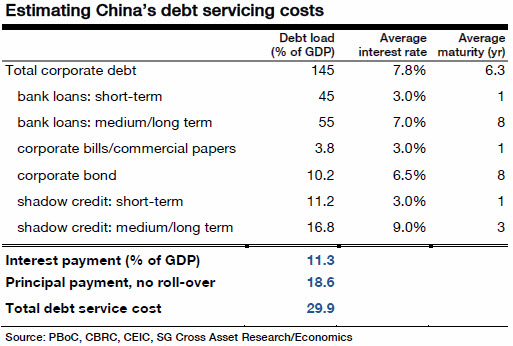
China’s credit growth has been outstripping economic growth for five quarters with the corporate debt bubble looking increasingly precarious (as we explained here and here). This raises one key question: where has the money gone? As SocGen notes, although such divergence is not unprecedented, it potentially suggests a trend that gives greater cause for concern – China is approaching a Minsky moment. At the micro level, SocGen points out that a non-negligible share of the corporate sector and local government financial vehicles are struggling to cover their financial expense. At the macro level, they estimate that China’s debt servicing costs have significantly exceeded underlying economic growth. As a result, the debt snowball is getting bigger and bigger, without contributing to real activity (see CCFDs for a very big example).This is probably where most of China’s missing money went. Read more of this post

Former Prime Minister Kevin Rudd Puts Canberra House Up for Sale for A2.25m; bought in Sep 2010 at A$2.175m

Former Prime Minister Kevin Rudd Puts House Up for Sale

Former Australian Prime Minister Kevin Rudd has put his five-bedroom house in Canberra up for sale with an asking price of A$2.25 million ($2.18 million) after abandoning any aspirations to again lead the country.

The 465-square-meter (5,005-square-foot) house in the suburb of Yarralumla, a five-minute drive from Australia’s Parliament House, was listed for sale on May 29, said Shane Killalea, an agent at broker Peter Blackshaw Canberra, who is marketing the property. Rudd and his wife Therese bought the house in 2010. They moved out at the end of 2011 after their son Marcus completed his schooling in Canberra, Rudd’s office said in an e-mailed statement.

Rudd, 55, became prime minister when the Labor party won power in the November 2007 election. The former diplomat, who represents the seat of Griffith in Brisbane where he lives, was ousted in a late-night coup that installed current Prime Minister Julia Gillard in June 2010. Read more of this post

Growth Not Missile Threat Tops President Park’s South Korea Agenda; “If there are more people like you, we will be able to create the world we dream of,” Park, 61, told the smiling Gates

Growth Not Missile Threat Tops Park’s South Korea Agenda

With North Korea escalating its threats to test a ballistic missile, South Korean President Park Geun Hye was conferring with Bill Gates on another pressing matter. Seated across from Microsoft Corp.’s billionaire co-founder on April 22 at a formal dining table in the Blue House, her official residence, Park picked the tech mogul’s brain about how to nurture entrepreneurs to keep the world’s 15th-largest economy humming.

“If there are more people like you, we will be able to create the world we dream of,” Park, 61, told the smiling Gates.

By most measures, South Korea has already implanted itself among the globe’s economic success stories, Bloomberg Markets magazine will report in its July issue. The one-time agrarian backwater has emerged as an icon of manufacturing, technology — and cool. Read more of this post

Taiwan Capital Gains Tax Revisions Delayed by Opposition Party; Lawmakers are weighing a tax cut after stock trading volume declined by as much as 30 percent in the first four months of the year

Taiwan Capital Gains Tax Revisions Delayed by Opposition Party

Taiwanese opposition lawmakers today delayed cutting a controversial capital gains tax on share sales of more than NT$1 billion ($33.3 million) and removing an index price threshold that depressed shares.

Tsai Chi-chang, a Democratic Progressive Party lawmaker, said his party doesn’t support the ruling Kuomintang’s proposals and favors its own plan for a flat tax on all capital gains, which “fits the idea of fairness and justice and increasing government revenue.” The benchmark Taiex index rose 0.5 percent to 8,281.42 as of 11:21 a.m. local time.

Lawmakers are weighing a tax cut after stock trading volume declined by as much as 30 percent in the first four months of the year, according to Credit Suisse Group AG. President Ma Ying-jeou’s administration and legislators argued over about 10 versions of the tax last year, prompting then-Finance Minister Christina Liu to step down. The Taiex lost 13 percent during the period. Read more of this post

China’s shadow banks: The credit kulaks

China’s shadow banks: The credit kulaks

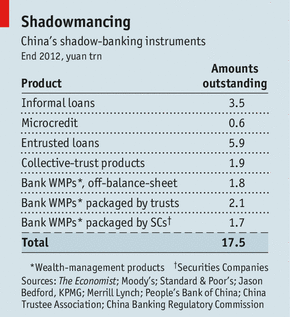
The growth in wealth-management products reflects deeper financial distortions

Jun 1st 2013 | HONG KONG |From the print edition

20130601_FND00120130601_FNC719

AS THE grandson of a “rich farmer”, a stigmatised class in communist China, Joe Zhang grew up on the wrong side of the ideological tracks. At school he envied the town-kids who could look forward to a cushy job minding grain-stores or writing propaganda. But after winning a spot at university, he eventually escaped into central banking in Beijing and, later, investment banking in Hong Kong. By pleading, petitioning and playing a lot of ping pong (a sport he hates) he was even admitted into the Communist Party in 1985.

Then, in 2011, his social climb suffered an abrupt reversal. He took on a role that remains stigmatised and discriminated against in today’s China: he became a shadow banker. His new book, “Inside China’s Shadow Banking: the Next Subprime Crisis?”, recounts his trials as the head of a microlender in Guangdong. Elsewhere in the world, microcredit is a respectable, even canonised, endeavour. In China, Mr Zhang complains in his book, it is “only slightly more respectable than perhaps massage parlours or nightclubs.”

He describes the variety of institutions and instruments that operate and innovate in the shadow of China’s mammoth banks, where they are hard for the authorities to see. They include the informal lenders, kerbside capitalists and back-alley bankers for which China is famous. But the most important institutions are China’s 67 trust companies, lightly regulated finance firms that make loans and other investments but cannot collect deposits. And the most significant instruments are the uncountable wealth-management products (WMPs), which raise money from better-off investors, in large increments (at least 50,000 yuan, about $8,160) and for short periods (typically less than six months, sometimes much less). Read more of this post

Wan Long: Former factory worker who rose to lead Shuanghui as chairman to take over US pork producer Smithfield

Last updated: May 30, 2013 1:47 pm

Wan Long: Former factory worker who rose to lead Shuanghui

By Paul J Davies in Hong Kong

wanlong pledges

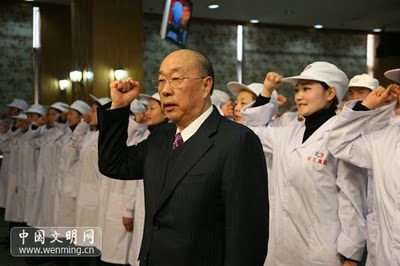
For Wan Long, the $4.7bn deal to take over US pork producer Smithfield is a long way from the Shuanghui International chairman’s simple beginnings. “What I do is kill pigs and sell meat,” he told a local paper last year. A native of Luohe in Henan province, home to the group’s headquarters, he joined Shuanghui as an ordinary factory worker in 1968 after a stint in the army. It was a single money-losing plant, ranked ninth out of 10 state-owned meat processing companies in Henan, according to the Chinese magazine Caixin. Mr Wan, now in his early seventies, was elected plant manager in 1985. That year it reported profits of Rmb5m, the magazine said. He now runs a business that turned a net profit of Rmb2.9bn last year. As China’s biggest meat producer, it produces 2.7m tonnes of meat annually from 30m pigs. It also gets through 300,000 heads of cattle, 600,000 tonnes of chicken, 50,000 tonnes of eggs and 50,000 tonnes of soy protein in processing pork into an array of cooked, fresh and frozen products. “Our goal is to achieve sales revenue of Rmb100bn within the period of the 12th five-year plan [ending in 2015], then I’ll retire,” Mr Wan told Caixin in an interview two years ago. Shuanghui is forecast to hit Rmb50bn ($8.2bn) in sales this year, according to Bloomberg data, whileSmithfield should generate $13bn – so this deal will help Mr Wan hit his target two years early. It is by far the largest takeover ever pursued by a Chinese company overseas in the food and beverage sector, according to Dealogic. Given China’s population and its growing appetite for a higher protein diet as it becomes wealthier, bankers expect to see many more deals for meat, fish and dairy producers. The past decade was about China’s hunt for energy and metals, but the next could well be about its need to secure safe food supplies. “This deal looks like a wonderful opportunity for two complementary companies to come together and for Shuanghui to access the technology it needs to take its food safety and productivity to a higher level,” says a Beijing based agri-industry expert. The homespun charm of the companies’ two executives appear to complement each other as well, with Mr Wan’s simple take on the pig industry chiming with words from Larry Pope, Smithfield’s chief executive. “We’re not exporting tanks and guns and cyber security,” he said on Wednesday in assessing concerns about US regulatory intervention. “These are pork chops.” Read more of this post

Closely held Seventh Generation Inc. is buying a maker of reusable filtered water bottles known as bobble, the company’s first brand acquisition outside of its namesake household cleaners and baby products

May 30, 2013, 7:43 p.m. ET

Seventh Generation Picks Up Bobble Brand

In Bid to Expand Reach, Firm to Buy Filtered Water Bottle Maker

By SERENA NG

MK-CD631_Sevent_G_20130530194508

Seventh Generation, known for its household cleaners, is buying the bobble, the reusable filtered water bottle brand, for an undisclosed sum.

Closely held Seventh Generation Inc. is buying a maker of reusable filtered water bottles known as bobble, the company’s first brand acquisition outside of its namesake household cleaners and baby products.

The acquisition for an undisclosed sum comes as Seventh Generation is looking to expand into new product areas through acquisitions, said Chief Executive John Replogle. The Burlington, Vt., company is looking for more brands and consumer products that fit with its mission of healthy living and sustainability, he said.

Seventh Generation was founded 25 years ago as a catalog company and now makes plant-based cleaning products, diapers and baby wipes that it touts as safer for people and the environment. Retail sales of its products topped $200 million last year and grew in double-digit terms during the recession, Mr. Replogle said. Read more of this post

Macro control, micro problems; History shows the limits of macroprudential policy in curbing dangerous risk-taking

Macro control, micro problems

History shows the limits of macroprudential policy in curbing dangerous risk-taking

Jun 1st 2013 |From the print edition

AMERICA’S Federal Reserve faces a dilemma: to put the economy back on its feet it is keeping interest rates at zero and buying bonds; but in doing so, it worries, it is egging on dangerous risk-taking. Cue “macroprudential” policy. In theory, central banks would use regulatory and supervisory authority to stamp out excesses in specific markets while leaving monetary policy to take care of inflation and employment.

History suggests this is easier said than done. “Macroprudential” may be new jargon, but America has tried variants of it for decades, from credit controls to down-payment limits. And the record is not a ringing endorsement for macroprudential policy, according to a new working paper by Douglas Elliott of the Brookings Institution, Greg Feldberg of America’s Treasury Department and Andreas Lehnert of the Fed. They found controls were often circumvented by regulatory arbitrage. And when controls worked, political pressure sometimes led to their repeal. Read more of this post

China’s second-largest wind turbine maker Sinovel Announces It Is Under securities regulator CSRC Investigation which questions company financial data

05.30.2013 17:59

Sinovel Announces It Is Under CSRC Investigation

Wind turbine maker says it will coordinate with securities regulator, which questions company financial data

By staff reporter Cao Wenjiao

(Beijing) – Sinovel Wind Group Co. Ltd. announced on May 29 that it was being investigated by the China Securities Regulatory Commission (CSRC) over suspected violations of securities laws and regulations. Sinovel, one of the largest wind turbine manufacturers in the country, said it would coordinate with the CSRC in its investigation and disclose the required information. The CSRC’s Beijing bureau said on April 11 that some of Sinovel’s financial data was not accurate, and the profit the company reported for 2011 was inflated. On April 7, the company said there were accounting errors in its 2011 financial report, which originally gave a net profit figure of 776 million yuan. After correcting for accounting errors, the company said this figure was 168 million yuan too high. A source at the company said Sinovel would make a detailed announcement later. Sinovel listed in Shanghai in January 2011 and its issue price was 90 yuan per share. On May 29, the company’s closing share price was 5.76 yuan. Sinovel had operating revenue of 684 million yuan in the first three months of this year, down 40.98 percent compared to the same period in 2012, the company’s financial report shows. Its net profit was down 968.86 percent. Wei Wenyuan, Sinovel chairman and acting president, resigned on May 13. Company director Liu Hui resigned the same day.

Korean firms urged to overhaul business models

2013-05-30 21:59

Korean firms urged to overhaul business models

By Park Ji-won

A global IT expert has called for major Korean technology giants, such as Samsung and LG, to reinvent themselves as software-centered companies to survive an ongoing transition in the IT industry led by two key trends ― integration and convergence.

In a recent interview with The Korea Times, Wilbert Charlton Adams, former president of the Institute of Electrical and Electronics Engineers Standard Association (IEEE-SA), suggested Korean players overhaul their business models to become more agile. Read more of this post

Aging Chinese Face a Bleak Picture; High Rates of Poverty, Disability and Mental Illness Haunt Elderly, Pose Growing Economic Challenge

Updated May 30, 2013, 11:43 p.m. ET

Aging Chinese Face a Bleak Picture

High Rates of Poverty, Disability and Mental Illness Haunt Elderly, Pose Growing Economic Challenge

By TOM ORLIK

WO-AN968D_CELDE_G_20130530225704

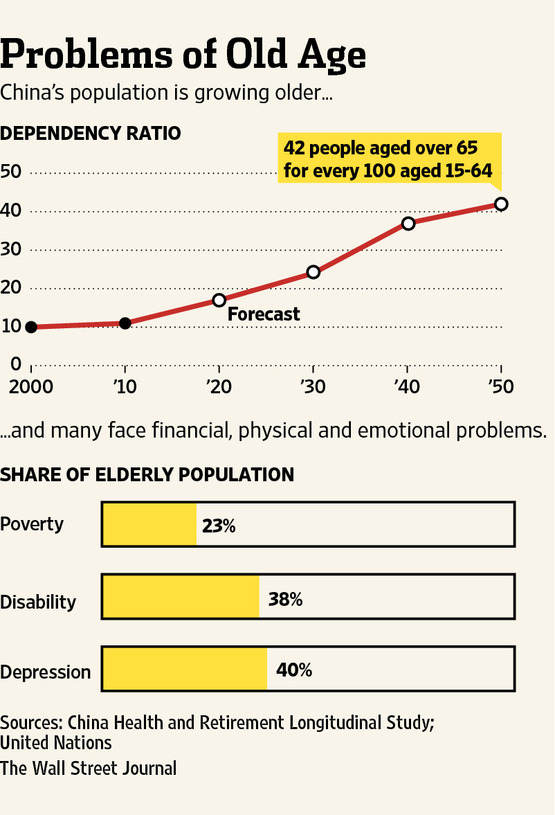
BEIJING—China’s elderly are poor, sick and depressed in alarming numbers, according to the first large-scale survey of those over 60, an immense challenge for Beijing and one of the greatest long-term vulnerabilities of the Chinese economy.

The survey of living conditions for China’s 185 million elderly paints a bleak picture that defies the efforts of the government to build what it calls a “harmonious society,” one dedicated to human welfare rather than simply economic growth. Of the generation that built China’s economic boom, 22.9%—or 42.4 million—live in poverty with consumption of less than 3,200 yuan a year ($522).

The fear of being old and poor, which prompts many Chinese to stash away their earnings, also cuts against another of Beijing’s priorities: to rebalance the economy toward stronger consumption. Read more of this post

Promising African Development Fund Collapses; A program financed by the Agency for International Development is dissolving because of mismanagement, insider dealings and a lack of federal oversight.

Promising African Development Fund Collapses

By BARRY MEIER and RON NIXON

Published: May 30, 2013

The initiative began two decades ago, with the best of intentions, after apartheid fell and southern Africa’s future brightened.

Today that program, the Southern Africa Enterprise Development Fund, is in its death throes, apparently victimized by mismanagement, insider dealings and a lack of oversight by federal officials. Current and former fund officials are fighting over money, and the eventual cost to American taxpayers of the fund’s missteps could run into the tens of millions of dollars, public filings indicate.

On one level, the plight of this obscure fund is a common tale involving the hazards of foreign aid. But on another level, experts say, it points to wider problems bedeviling the federal agency that financed the fund, the United States Agency for International Development, orU.S.A.I.D. In fiscal 2013, the agency had a budget of $1.6 billion and helped administer more than $40 billion in foreign assistance. Read more of this post

Americans have rebuilt less than half of wealth lost to the recession, study says

Americans have rebuilt less than half of wealth lost to the recession, study says

By Ylan Q. Mui, Friday, May 31, 12:00 AM

American households have rebuilt less than half of the wealth lost during the recession, leaving them without the spending power to fuel a robust economic recovery, according to a new analysis from the Federal Reserve.

From the peak of the boom to the bottom of the bust, households watched a total of $16 trillion in wealth disappear amid sinking stock prices and the rubble of the real estate market. Since then, Americans have only been able to recapture 45 percent of that amount on average, after adjusting for inflation and population growth, according to the report from the St. Louis Fed released Thursday.

In addition, the report showed most of the improvement was due to gains in the stock market, which primarily benefit wealthy families. That means the recovery for other households has been even weaker. Read more of this post

Indian power shortage is Achilles heel of economy

May 30, 2013 11:07 am

Indian power shortage is Achilles heel of economy

By Victor Mallet in Noida, India

Electricity, 24 hours a day, is a service taken for granted in industrialised economies. But not in the industrial zone of Noida on the outskirts of New Delhi – and especially not in the baking heat of summer. “We hardly get 50 per cent of our requirement,” says S. Singhvi, finance director of Ginni Filaments, a textiles and clothing company with 5,000 employees across India. “Compared to last year, it’s getting worse.” With daytime temperatures reaching nearly 50C, and householders and farmers demanding ever more power for air conditioners and water pumps, he complains that Ginni’s Noida garment factory must deal with repeated power disruptions and run its own generators to produce electricity at five times the cost of the supply from the grid.

Read more of this post

“What do you know about making cars?” President Park Chung-hee asked Hyundai’s founder Chung Ju-yang at the opening ceremony. According to legend, Chung replied: “I can do it.”

May 30, 2013 6:46 pm

Hyundai: Changing the mould

By Simon Mundy

The carmaker focuses on forging a premium brand

Snaking over 266 miles from Seoul to the port city of Busan, the Gyeongbu Expressway was one of the proudest achievements of Hyundai Group founder Chung Ju-yung. But when it opened in 1970, some ridiculed South Korea’s decision to build an eight-lane motorway across two mountain ranges, because the poor country only had 60,000 cars.

“What do you know about making cars?” President Park Chung-hee asked Chung at the opening ceremony. According to legend, Chung replied: “I can do it.”

In fact, he had already been assembling cars for two years but no one expected the scale of Hyundai’s transformation over the next four decades. Chung’s expressway is now thronged with millions of cars each year, most of them made by the automotive group he founded. Millions more Hyundai vehicles are now an increasing presence around the world, proof of the company’s evolution into the world’s fifth-biggest carmaker by unit sales. Read more of this post

China: a bubble in the tea market?

China: a bubble in the tea market?

May 30, 2013 11:05am by Julie Zhu

Commodity markets may have lost their lustre as many investors have gone elsewhere. But there’s often a chance of a profit for those who know where to look.

Pu’er, a strong, earthy tea produced in China’s Yunnan province has seen its price rise by as much as 80 per cent over the past six months – even as prices for other Chinese teas have remained stable. Pu’er traders have seen it before – in a speculative bubble that burst six years ago. This time the run-up in prices has been more modest – so far.

In Kunming, capital of Yunnan province, Old Banzhang, a type of the finest Pu’er, last year went for Rmb5,000 a kilo in the form of tea leaves pressed into cakes. Now it commands almost Rmb9,000 a kilo, according to China Securities Journal, citing a local tea shop manager.

Zhou Chonglin, a Kunming-based tea expert and co-author of “War of Tea”, believes the price surge of Pu’er could have been predicted. He told beyondbrics that Pu’er investors, who left the market in 2007, started to come back late last year, in response to the increasing demand from the public for the tea, which is widely believed to have medicinal value. Read more of this post

The political scandal and criminal investigation that has accompanied the shutdown of the Hong Kong Mercantile Exchange has created more drama than the exchange ever did trading gold and silver futures.

Updated May 30, 2013, 2:21 p.m. ET

Inquiry Into Bourse Widens

Sixth Person Arrested Amid Closure of the Hong Kong Mercantile Exchange

By TE-PING CHEN

HONG KONG—The political scandal and criminal investigation that has accompanied the shutdown of the Hong Kong Mercantile Exchange has created more drama, including a sixth arrest on Thursday, than the small, struggling exchange ever did trading gold and silver futures.

The exchange’s closure after two years of trading was a blow to the ambitions of its backers, including a close ally to Hong Kong’s top official and Russian billionaire Oleg Deripaska, whose EN+ Group took a 10% stake in the exchange to help launch it in 2010. They had hoped the HKMEx would capitalize on China’s voracious appetite for commodities, but it failed to survive stiff competition from better-established players in Hong Kong and Shanghai, as well as in the West. Read more of this post

South Korea Can’t Just Order Up Creative Economy

South Korea Can’t Just Order Up Creative Economy

South Korea’s economy has yet to catch up to its people. They are the world’s most-wired citizenry and the most advanced at using smartphones. Korean stars are Asia’s most popular; Korean gadgets and fashions the coolest.

Yet at home, huge manufacturing conglomerates, or chaebol, such as Hyundai Motor Group (005380), Samsung Group (005930) and LG Group (066570) remain the mainstays of an export-focused system established after the Korean War by strongman Park Chung Hee. In fact, as the July edition of Bloomberg Markets magazine points out, the chaebols have become even more dominant. Sales of the top 30 conglomerates accounted for 82 percent of South Korea’s gross domestic product in 2012, compared with 53 percent in 2002.

As in other parts of Asia, in Korea a top-heavy system no longer delivers for ordinary citizens. Wage growth has slowed, while the costs of housing and education have jumped: According to the McKinsey Global Institute, most middle-income Korean households are now cash-flow constrained. The ranks of the middle class have shrunk from more than three-quarters of the population to about two-thirds. Read more of this post

Swoon in Bonds Puts Eye on Fed

May 30, 2013, 8:06 p.m. ET

Swoon in Bonds Puts Eye on Fed

Investors Debate: Bubble, Confusion or Sign of Health?

By DAVID WESSEL and VICTORIA MCGRANE

P1-BL730_BONDS_G_20130530190606

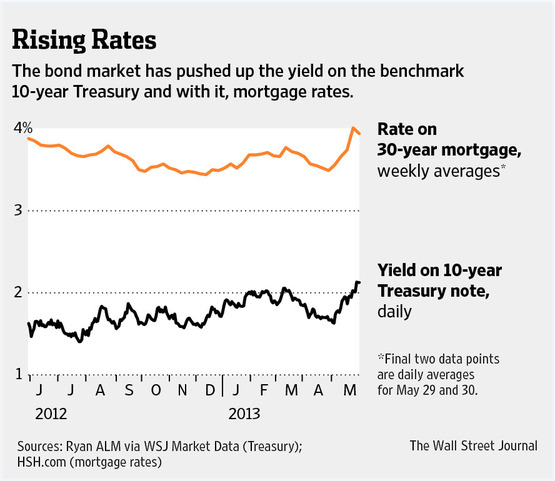
The bond market’s monthlong plunge has pushed long-term interest rates on mortgages and U.S. Treasurys to their highest levels in more than a year, sparking a debate: Is this a bursting bubble, the aftereffect of clumsy Federal Reserve communication or a welcome sign the U.S. economy is, at last, on the mend.

Yields on the benchmark 10-year U.S. Treasury note now stand above 2.1%—still low by historic standards, but nearly half a percentage point higher than at the start of May.

Rates on 30-year fixed-rate mortgages rose a hair above 4% this week, according to HSH Associates. Six months ago, they were below 3.5%. Read more of this post

NYC Pension Chief Seeks $500,000 Managers Not Wall Street

NYC Pension Chief Seeks $500,000 Managers Not Wall Street

New York City’s $140 billion retirement system pays Wall Street money managers about $360 million a year, the only one of the 11 biggest U.S. public-worker pensions that refuses to manage any assets internally. Larry Schloss, the city’s chief investment officer, says the practice must end.

Schloss, 58, points to Ontario’s C$130 billion ($126 billion) teachers’ pension fund, which has returned an average 9.6 percent annually on its investments since 2003 — 1.6 percentage points better than New York’s funds. The Canadian system reaped those gains mostly without paying outside asset managers. Schloss says the same in-house approach could work in New York.

“I’m not looking for John Paulson,” said Schloss, who earns $224,000 a year, referring to the billionaire hedge-fund manager. “I’m just looking for a VP at MetLife (MET) who makes 500,000 bucks.” Read more of this post

Oil Fields Under Olive Groves Offer Italy Economic Boost

Oil Fields Under Olive Groves Offer Italy Economic Boost

Underneath the groves that make southern Italy the world’s second-largest olive oil producer, geologists have found a more lucrative liquid: Europe’s biggest onshore crude oil fields.

Basilicata, a mountainous, sparsely populated province that sits in the arch of Italy’s boot, holds more than 1 billion barrels, offering the country a weapon to fight a two-year recession. Rome-based Eni SpA (ENI) and France’s Total SA (FP) plan to double production raising Italy’s output to almost 200,000 barrels a day, making the country Europe’s third-largest oil producer behind the U.K. and Norway.

Since the field started production in the 1990s, its development has been held back by environmental campaigns and bureaucratic delays. Those impediments are falling away, analyst Carlo Stagnaro said, because the priority for Italy’s government is kickstarting an economy that’s shrunk for six straight quarters and where more than 35 percent of young people are unemployed. Read more of this post

Dividend stocks lose shine as U.S. bond yields rise

Analysis: Dividend stocks lose shine as U.S. bond yields rise

7:08pm EDT

By Chuck Mikolajczak

NEW YORK (Reuters) – As the S&P 500 stormed to a gain of 16 percent for the first five months of the year, the run was fueled by investors searching for yield.

With central banks driving interest rates lower, slower-growth sectors with big dividends like utilities and telecom were attractive because they offered better returns over government debt along with the possibility of price appreciation.

Those sectors led stocks higher for several months – but that outperformance appears to have come to an end as U.S. Treasury bond yields climbed to 13-month highs this week. The economic outlook in the United States has improved, and rumblings of a pullback in the Federal Reserve’s massive bond-buying program have caused investors to pull away from the big dividend payers. Read more of this post

Running out of cash, Australian miners get creative to survive

Running out of cash, Australian miners get creative to survive

6:51pm EDT

By James Regan

SYDNEY (Reuters) – From pooling office space to paying bills with company stock, small and mid-sized Australian miners are finding new ways to stay afloat during one of the sector’s worst downturns. China’s slowdown has helped cool a decade-long commodities boom that pushed gold, copper, iron ore and coal prices to record highs, leaving Australian miners facing a painful transition to lower margins and weak investment interest. Only a year ago, with miners flush with cash and desperate to retain staff, six-figure salaries and executive-style perks for everyone from truck drivers to kitchen help were commonplace. Now, with traditional funding drying up, smaller miners are devising novel ways to keep from going broke. Unable to pay bills in cash, some are offering drill rig operators, caterers and even public relations firms company stock to keep them on the job – acts of desperation last seen at the height of the 2008-2009 financial crisis. Read more of this post