Presenting The Full Impact Of Stock Buybacks On S&P 500 “Earnings”

Presenting The Full Impact Of Stock Buybacks On S&P 500 “Earnings”

Tyler Durden on 05/28/2013 14:23 -0400

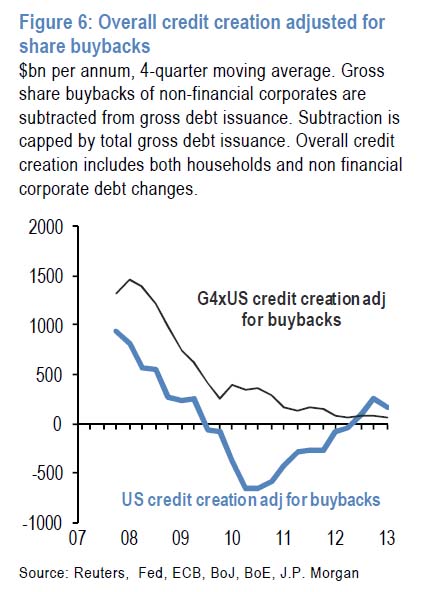
There has been much speculation in the recent past over what the bottom-line impact of surging stock buyback activity has been on the overall S&P earnings: after all, by removing shares from circulation, the denominator in “per share” calculation gets smaller and smaller with every incremental buyback. Courtesy of JPM we finally have a definitive answer to this long-running question. Of the change in S&P TTM operating earnings between Q3 2011 and the just completed Q1 2013, a stunning 60% or $2.20, of all “gains” of $3.70 have been the result of buybacks. The remainder: a tiny $1.50 is due to actual organic growth. This means that nearly 60% of the bridge between the LTM operating earnings of $94.60 as of Q3 2011 to $98.30 at Q1 2013 has come from corporate management teams engaging in shareholder friendly activity.

S&P divisorStock buybacks vs cash flow_0credit creation Read more of this post

What can you do with a DSGE model?

Monday, May 27, 2013

What can you do with a DSGE model?

When the Bank of England invited me to give a talk at their workshop on macroeconomics, I wasn’t sure if they wanted me to provoke (i.e. troll) them with the kind of skeptical stuff I usually write on this blog, or to talk about my own research on artificial markets and expectations. So I did both. Now, this is a central bank event, which means secrecy prevails – so I can’t tell you what the reaction was to my talk, or what other people said in theirs. But I thought I’d reproduce part of my talk in a blog post – the part where I talked about DSGE models. (In other words, the provocative part.)

“DSGE” is a loose term. It usually implies much more than dynamics, stochastics, and general equilibrium; colloquially, to be “DSGE” your model probably has to have things like infinitely far-sighted rational expectations, rapid clearing of goods markets, certain simple types of agent aggregation, etc. So when I talk about “DSGE models”, I’m loosely referring to ones whose form is based on the 1982 Kydland & Prescott “RBC” model. Read more of this post

India is considering letting its business houses run banks. It should think twice

India is considering letting its business houses run banks. It should think twice

May 25th 2013 | MUMBAI |From the print edition

20130525_FND001_0

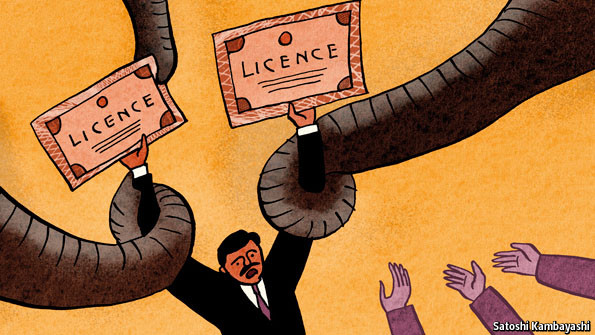
BANKING in India is a vast problem and a huge opportunity. Only 35% of adults have formal accounts. A grim reminder of the risks for the 600m-odd unbanked folk came in April. A multi-billion-dollar, barely regulated, “chit fund” in Kolkata collapsed, destroying the savings of hundreds of thousands of poor people. Up to a dozen committed suicide, one by immolation. Precisely because the banking market is so underpenetrated, it should offer lots of growth. Although there are 196 domestic banks, a majority are state-controlled and stodgy. Lending margins are high. So when new licences for private players are granted, fortunes are made. The last two permits, awarded in 2003-04 when the industry was recovering from bad debts, have helped make $10 billion for their backers. Now the Reserve Bank of India (RBI), the central bank, plans to issue new licences. Applications are due by July 1st and a frenzy is building. Vikram Pandit, the Indian-born ex-boss of Citigroup, an American bank, has teamed up with a local outfit. There could be up to 100 entries for perhaps ten licences, reckons a banker.

Read more of this post

Why Myanmar’s military rulers are giving power to the people; Why investors still need to proceed with caution

Why Myanmar’s military rulers are giving power to the people

May 25th 2013 |From the print edition

20130525_SRM937 20130525_SRC485 20130525_src935 20130525_SRM934

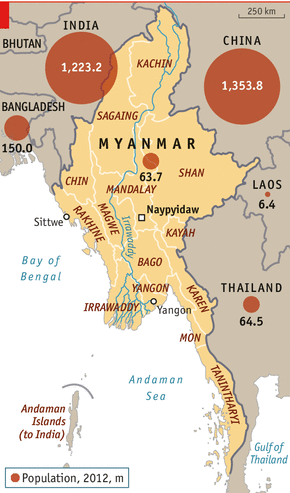
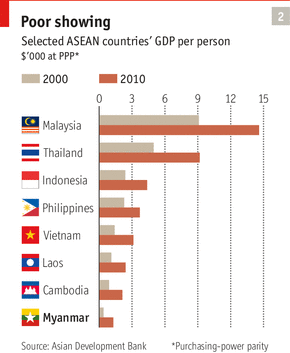
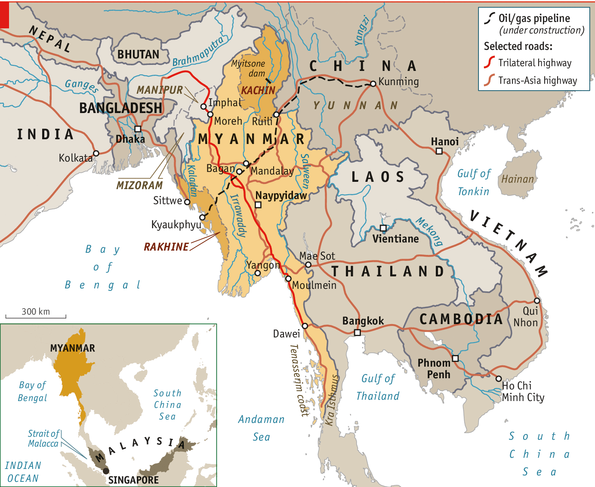
MYANMAR’S TRANSITION HAS been a top-down affair. This, more than anything, distinguishes it from other recent upheavals such as the “people power” revolutions of the Arab spring, the fall of communism in Europe and the toppling of Indonesia’s President Suharto. At crucial moments the threat of mass protests hurried the process along. Government advisers concede that in 2011 they were afraid of an Arab spring on the streets of Yangon. The army had mercilessly oppressed protests such as the aborted “saffron revolution” in 2007, led by monks, and the pro-democracy uprising in 1988 that had first propelled Miss Suu Kyi to national prominence. Those 1988 protests led to elections in 1990 which were won by the NLD but annulled by the government. For the main part, though, Myanmar now stands as a rare example of an authoritarian regime changing itself from within. Read more of this post

Indonesia’s Weak Institutions Spark Nostalgia for New Order; power abuse by elites and uneven growth has left people yearning for Suharto

Indonesia’s Weak Institutions Spark Nostalgia for New Order

A jurist and an economist say power abuse by elites and uneven growth has left people yearning for Suharto

By Ezra Sihite on 8:55 am May 27, 2013.

310313poster-soeharto2.jpg

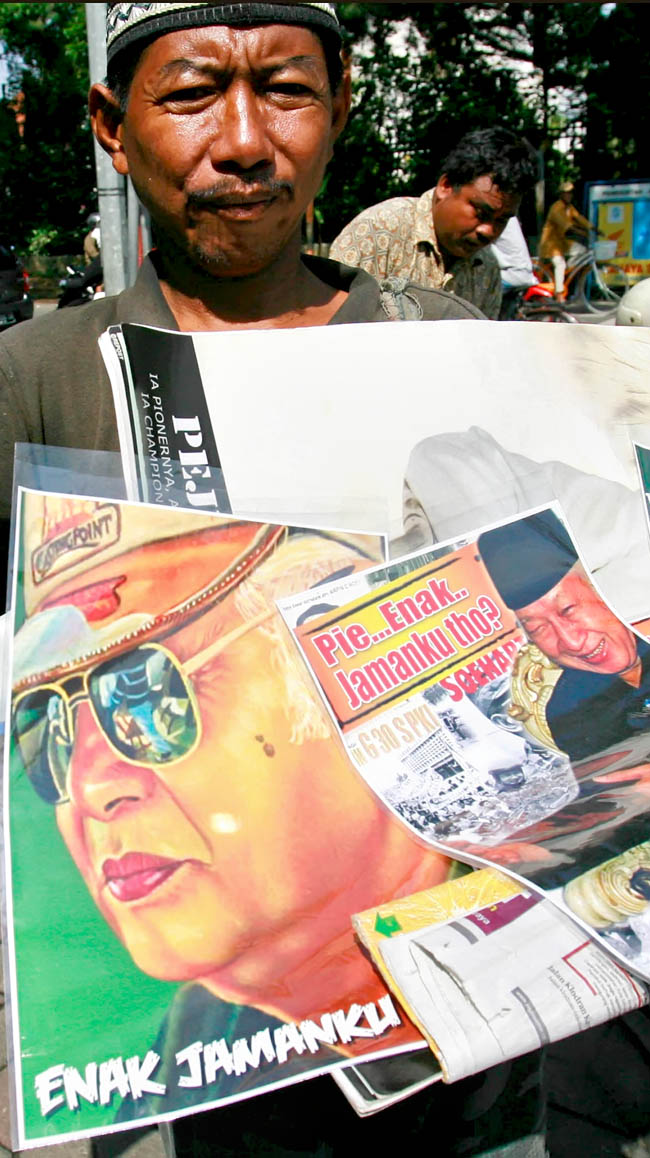
President Suharto’s image can be found on posters around Indonesia in increasing numbers, as people seek the stability that his often-brutal leadership brought to the country. (JG Photo/Ali Lutfi)

Many Indonesians believe that life in the New Order era under President Suharto was better than today and that social elites dominate modern politics and law, according to a senior former jurist.

Speaking at a forum in Jakarta, former Constitutional Court chief justice Mahfud M.D. said that Indonesia is blighted by an oligarchy of elites that prioritize their interests over the public interest and do not abide by social rules, causing disillusionment and a lack of confidence in the law.

“Don’t be surprised to see people today wanting to see the military back [in power] because of oligarchic [conditions]. In Yogyakarta, you see stickers on cars with picture of a smiling Suharto reading, ‘Wasn’t it good during my time?’ ” Mahfud said. Read more of this post

Sick workers pay price for Chinese growth

Sick workers pay price for Chinese growth

By Carol Huang (AFP) – 1 hour ago

SHUANGXI, China — As China boomed around 200 men set out from Shuangxi’s rural idyll to build its infrastructure and skyscrapers. Now lung disease from dust has killed a quarter of them and 100 more are waiting to die.

Back home amid rice paddies and forested hills, Xu Zuoqing walks outside and his face contorts in pain from the effort. As he struggles to breathe, his wife rushes over a stool so he can recuperate.

“It’s like my lungs are being choked. My chest feels so tight,” says the 44-year-old who worked on construction sites for about 15 years, his voice strained at times.

“I just wish I could die comfortably… Well, I wish I didn’t have to die.” Read more of this post

The Ultimate Resume-Booster: Communist Party Membership; How China maintains interest in its ruling party, even as communist belief fades away

May 27, 2013 | by Lotus Yuen

The Ultimate Resume-Booster: Communist Party Membership

How China maintains interest in its ruling party, even as communist belief fades away

Zhang Xi’en, professor from the School of Politics and Public Administration at Shandong University, recently suggested that the Chinese Communist Party (CPP) should limit the number of its incumbent party members to 30 million and maintain a “moderate scale” of 51 million members in the future. Professor Zhang deemed this necessary because:

Various people, speculators included, have attempted to make personal gains in the name of being a ruling party member. They swarm into the Party, rapidly expanding its scale, and bringing tremendous danger to the Party.

The CCP, the largest political party in the world, had over 82 million party members as of 2011, 2.33 million more than in the previous year. It takes up around 6% of the total population of mainland China, and the total number is increasing by an average of one million people each year. Read more of this post

Corrupt Chinese officials turn to paying ‘black’ PR firms who claim to help them vanish from sight, with all negative stories about them scrubbed from the internet

Corrupt Chinese officials turn to ‘black’ PR

In the middle of the biggest anti-corruption campaign for years, crooked Chinese politicians are paying to vanish from sight, with all negative stories about them scrubbed from the internet.

The black PR firms are claiming “We can clean your name from blogs, forums, news websites, Weibo [China’s version of Twitter], everything,”  Photo: ALAMY

By Malcolm Moore, Beijing

5:46PM BST 26 May 2013

“It does not matter how big or sensitive the story is, we can make it disappear,” promised a manager at Yage Times, China‘s largest and most notorious “black” public relations (PR) firm. Dozens of Chinese officials have been put under investigation in recent months, and Communist Party members at every level are genuinely worried, according to the children of two senior cadres. In particular, they fear the internet, where stories about corrupt officials often go viral, putting pressure on the Communist party to launch a high-profile investigation. Read more of this post

Following defaults, Chinese Banks Cut Back on wealth-management products which grew from close to zero a few years ago to $1.2 trillion has rung alarm bells about growing risks for banks and retail investors

Updated May 27, 2013, 5:53 p.m. ET

Chinese Banks Cut Back on Wealth-Management Products

BEIJING—New rules aimed at reducing risks in China’s financial-services industry have dented the appeal of high-yield alternatives to deposits and threaten to crimp profits for banks.

Bank issuance of wealth-management products—retail investments that offer some of the security of deposit accounts but higher yields—dropped 8.8% in April from March, according to Cnbenefit, a research firm in the city of Chengdu. The average yield edged down to 4.3% in May from 4.4% in March, Cnbenefit said.

A default on a product sold by Huaxia Bank last year fanned concerns over inadequate disclosure and opaque investment structures.

China’s banking regulator introduced strict new rules in March governing where wealth-management products can be invested, how assets are managed, and standards of disclosure to investors. The rules give China’s banks until the end of the year to reduce the share of wealth-management products invested in illiquid assets to 35% of wealth products, or 4% of total assets. If they don’t, they could be forced to make moves that reduce their profitability, such as allocating more capital to back those assets.

The prospect of lower growth in the sector, combined with reduced returns and higher management costs, gives China’s banks with an unpalatable choice: reduce returns to investors and risk losing market share, or keep returns high and accept lower margins.

Smaller banks could be particularly hard hit. Small and medium-size banks collectively have a 60% share of the wealth-management market, and 15% of their products are in breach of the new rules, according to estimates from Bernstein Research. Read more of this post

Power struggle in Beijing leaves China Investment Corp (CIC) leaderless; Empty chair in sovereign wealth fund’s corner office worries investment industry observers and casts shadow over economic reform plans

Power struggle in Beijing leaves CIC leaderless

Monday, 27 May, 2013, 12:00am

George Chen george.chen@scmp.com

Empty chair in sovereign wealth fund’s corner office worries investment industry observers and casts shadow over economic reform plans

China’s US$480 billion sovereign wealth fund may well have to wait a few more months before it gets its new chairman, thanks to a power struggle in Beijing.

The chairman’s office at China Investment Corp (CIC) has been empty for about three months since former chairman Lou Jiwei , who helped establish CIC in 2007, was promoted to become finance minister as part of the Communist Party’s once-a-decade leadership transition earlier this year. Read more of this post

As the economy slows and midtier brands lose favor with consumers who are switching to premium brands and to shopping online, China’s retail sector is changing

Updated May 27, 2013, 11:07 a.m. ET

Change Afoot for Investors in China’s Retail Sector

By CHAO DENG

AM-AY684_AMONEY_NS_20130527030010

As the economy slows and midtier brands lose favor with consumers who are switching to premium brands and to shopping online, China’s retail sector is changing. The result is that private-equity firms that once bet on sky-high consumer growth are now buying into restructuring situations or into companies that cater to more-sophisticated tastes. “Going from a founder focused on growth to a team focused on modern management techniques is a hard curve for Chinese companies,” said André Loesekrug-Pietri, chairman of private-equity firm A Capital, which has invested in the sector. “Retail is not only about branding and fast growth but about efficient inventory management and logistics.” Read more of this post

South Korea’s Plastic Surgery Fad Goes Extreme

South Korea’s Plastic Surgery Fad Goes Extreme

By Jung Ha-Won on 10:56 am May 27, 2013.

Seoul. South Korea’s obsession with plastic surgery is moving on from standard eye and nose jobs to embrace a radical surgical procedure that requires months of often painful recovery. A stream of celebrities boast on TV shows how it gave them a “new life,” while advertisements extolling its cosmetic benefits are everywhere from street billboards to subway stations, magazines and popular Internet sites.

But there’s nothing really “cosmetic” about double-jaw surgery. A radical solution to congenital facial deformities or for people unable to chew properly due to excessive over or underbite, the operation involves realigning the upper and lower jaws. Read more of this post

Korean chaebols including Samsung tense over economic bills; restrictions of shareholders’ voting rights could have a major impact on its web of cross shareholdings among affiliates

2013-05-27 17:10

Chaebol tense over economic bills

By Jun Ji-hye
Ruling Saenuri Party and main opposition Democratic Party (DP) will open an extraordinary session on June 3 to handle bills on key economic issues.
Conglomerates and financial firms are paying keen attention on which bills will be legislated into laws as they will influence their business substantially.
Both parties have in principle agreed to handle bills aimed at removing unfair business practices by chaebol. However, they have yet to narrow differences on key issues before passing them.
One of the sensitive bills on “economic democratization” is the one to restrict voting rights of major shareholders of financial companies if they are caught embezzling corporate funds. Read more of this post

Korean chaebol CJ, Home Plus and other large companies received the lowest rating in terms of relationship with SME

2013-05-27 17:03

Home Plus, CJ among worst in SME relationship

By Yi Whan-woo
Home Plus and seven other large companies received the lowest rating from a corporate watchdog on Monday in terms of relationship with smaller business groups.
Also on the list were CJ O Shopping, Hyundai Home Shopping, Hyundai Department Store, KCC Corp., STX Heavy Industries, LSIS and Kolon Global.
The National Commission for Corporate Partnership (NCCP) made the evaluation of 73 firms on the basis of a survey of some 9,500 small- and medium-sized enterprises (SMEs).
They were the subcontractors of those large firms. Read more of this post

Why Turkey is Thriving; There is nothing flashy about Turkey’s rise, which has been based on fundamentals, rather than bubbles or resource discoveries

Jeffrey D. Sachs, Professor of Sustainable Development, Professor of Health Policy and Management, and Director of the Earth Institute at Columbia University, is also Special Adviser to the United Nations Secretary-General on the Millennium Development Goals. His books include The End of Poverty and Common Wealth.

Why Turkey is Thriving

27 May 2013

NEW YORK – A recent visit to Turkey reminded me of its enormous economic successes during the last decade. The economy has grown rapidly, inequality is declining, and innovation is on the rise.

Turkey’s achievements are all the more remarkable when one considers its neighborhood. Its neighbors to the west, Cyprus and Greece, are at the epicenter of the eurozone crisis. To the southeast is war-torn Syria, which has already disgorged almost 400,000 refugees into Turkey. To the east lie Iraq and Iran. And to the northeast lie Armenia and Georgia. If there is a more complicated neighborhood in the world, it would be difficult to find it. Read more of this post

Sony’s Bread and Butter? It’s Not Electronics; selling life, auto and health insurance accounts for 63 percent of Sony’s total operating profit

May 27, 2013

Sony’s Bread and Butter? It’s Not Electronics

By HIROKO TABUCHI

TOKYO — Sony is best known as a consumer electronics company, making PlayStation game consoles and televisions. And it loses money on almost every gadget it sells.

Sony has made money making Hollywood movies and selling music. That profitable part of the business is what Daniel S. Loeb, an American investor and manager of the hedge fund Third Point, wants Sony to spin off to raise cash to resuscitate its electronics business.

But as Mr. Loeb pressures Sony executives to do more to revive the company’s ailing electronics arm, some analysts are asking, Why bother?

Sony, it is suggested, might be better off just selling insurance. Or just making movies and music. But not electronics. Read more of this post

Financial innovation for once works for the investor

Financial innovation for once works for the investor

Posted by: abnormalreturns, May 27th, 2013 at 4:08 pm

True, long-lasting innovations ares a rare thing in the world of finance. In my book I argue that the introduction of the ETF or exchange-traded fund was exactly that. It has taken two some decades but we are now seeing real changes in how people invest due to ETFs. I wrote:

Like all upheavals, the ETF revolution has both its benefits and its drawbacks. On the whole, ETFs have made investing easier, more diverse, and cheaper. On the other hand, the introduction of ETFs has changed the actual underlying nature of some markets, and the rapid introduction of new ETFs has diluted the benefits seen early on. Unlike many revolutions, we are not likely to see a counterrevolution unseating the ETF regime any time soon.

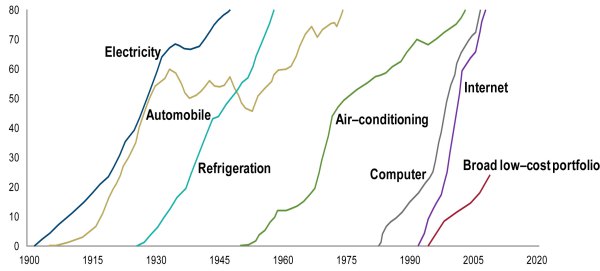
You can see how the introduction of ETFs has driven the adoption of “broadly diversified, low-cost portfolios.”Joe Davis and Andy Clarke at the Vanguard Blog compare the rise of these portfolios to other “great ideas. They write:

The adoption of great ideas typically follows an “S” curve, starting slowly, then accelerating. Eventually, the great idea becomes commonplace. The adoption of the “broad low-cost portfolio” seems to be following this pattern.

MPR_0513

Source: Vanguard. Adapted from Visualizing Economics and The New York Times. Vanguard calculated the growth in the low-cost portfolio based on data from Morningstar, Inc. The calculation represents the percentage of U.S. mutual fund and ETF assets under management with annual expense ratios of less than 25 basis points.

They note that we are still in the “second or third” inning of this process. Of course there is a limit as to just how much of the asset management industry can (or will) shift towards this approach. To be clear the definition of these portfolios is low cost, not necessarily indexed. In any event if too much money becomes indexed there should be a resulting increase in opportunities to generate alpha. Read more of this post

U.S. securities regulators are turning back toward Main Street, renewing their focus on accounting fraud and other financial-disclosure failings

May 27, 2013, 5:56 p.m. ET

Accounting Fraud Targeted

With Crisis-Related Enforcement Ebbing, SEC Is Turning Back to Main Street

By JEAN EAGLESHAM

U.S. securities regulators are turning back toward Main Street, renewing their focus on accounting fraud and other financial-disclosure failings.

Such cases were long a staple of the Securities and Exchange Commission’s enforcement efforts, leading to more than 25% of civil-enforcement actions filed by the agency in its 2003 to 2005 financial years. The financial crisis shifted attention and money elsewhere. In the year ended last September, accounting fraud and financial-disclosure problems made up just 11% of SEC enforcement actions. Read more of this post

Over-optimism raises risk of global recession

Over-optimism raises risk of global recession

In April 2010, the International Monetary Fund’s World Economic Outlook offered an optimistic assessment of the global economy, describing a multi-speed recovery strong enough to support roughly 4.5 per cent annual GDP growth for the foreseeable future — a higher pace than during the bubble years of 2000-2007.

27 MAY

In April 2010, the International Monetary Fund’s World Economic Outlook offered an optimistic assessment of the global economy, describing a multi-speed recovery strong enough to support roughly 4.5 per cent annual GDP growth for the foreseeable future — a higher pace than during the bubble years of 2000-2007.

But, since then, the IMF has steadily pared its economic projections. Indeed, this year’s expected GDP growth rate of 3.3 per cent — which was revised downward in the most recent WEO — will probably not be met.

Persistent optimism reflects a serious misdiagnosis of the global economy’s troubles. Most notably, economic projections have vastly underestimated the severity of the eurozone crisis, as well as its impact on the rest of the world. And recovery prospects continue to depend on the emerging economies, even as they experience a sharp slowdown. The WEO’s prediction of a strengthening recovery this year continues the misdiagnosis. Read more of this post

Li Says China Confronts ’Huge Challenges’ as Growth Levels Slow

Li Says China Confronts ’Huge Challenges’ as Growth Levels Slow

Chinese Premier Li Keqiang said his country is confronted by “huge challenges” as it opens up the economy and that the new government’s reform measures will be accompanied by tapered-off levels of growth.

Speaking in Berlin during his first trip abroad as premier, Li said the Chinese government will move forward with market-oriented reforms to generate stable growth after the economy unexpectedly slowed in the first quarter. Read more of this post

Asia seen as least creditworthy relative to their global peers

‘Asia seen as least creditworthy relative to their global peers’

Published: 2013/05/28

BEIJING: Borrowers in Asia are seen as the least creditworthy relative to their global peers in almost a year on signs of faltering growth in China.

The Markit iTraxx Asia index of credit-default swaps traded as much as 20 basis points higher than the average of four others from around the world this month, the biggest premium since June, according to data provider CMA. As recently as March, Asian borrowers were seen as better credits than the rest of the world.

Confidence in Asia is being dented by slowing growth in the region’s biggest economy, where manufacturing is contracting for the first time in seven months.  Read more of this post

Mudslinging in China’s Heavy-Machinery Sector

May 27, 2013, 9:21 a.m. ET

Mudslinging in China’s Heavy-Machinery Sector

By DUNCAN MAVIN

Digging for dirt on China’s machinery sector can be productive, especially when the economy’s stuck in the mud. Several companies that supply excavators, loaders and other construction equipment ran into trouble in 2012 and in the first few months of this year. The main problem was slowing economic growth, though oversupply of equipment was a big factor too. That led to slumping sales, rising inventory levels and a sharp uptick in accounts receivable as hard-up customers took longer to pay. Read more of this post

HSBC’s $1.9bn money laundering settlement with US authorities could be rejected, leaving the bank open to criminal prosecution and a ban from operating in America

HSBC’s $1.9bn money laundering settlement could be rejected

HSBC’s $1.9bn settlement deal with US authorities over money laundering charges could be rejected, it was reported on Thursday night.

By Andrew Trotman

10:41PM BST 23 May 2013

Judge John Gleeson is considering cancelling December’s so-called deferred prosecution agreement that gave HSBC immunity from claims it allowed terrorists to move at least $881m (£584m) around the financial system. This could leaving the bank open to criminal prosecution and a ban from operating in America. However, HSBC disputes this. The US Department of Justice (DoJ) is reportedly challenging Mr Gleeson’s need to sign off on the deal. The judge last mentioned the case in February, stating that he had not yet approved nor disapproved of the settlement. Read more of this post

Bitter Election Creates Long-Term Headache for Malaysia’s Najib

Bitter Election Creates Long-Term Headache for Malaysia’s Najib

By Niluksi Koswanage on 10:07 am May 26, 2013.

Demonstrators hold up lighters during a protest against recent election results in Petaling Jaya, outside Kuala Lumpur, in this May 25, 2013 file photo. Malaysia’s divisive election has left a bitter taste for millions of people that risks creating a long-term problem of legitimacy for Prime Minister Najib Razak’s long-ruling Barisan Nasional (BN) coalition. (Reuters Photo/Bazuki Muhammad)

Kuala Lumpur. Malaysia’s divisive election has left a bitter taste for millions of people that risks creating a long-term problem of legitimacy for Prime Minister Najib Razak’s long-ruling Barisan Nasional (BN) coalition.

The outrage was clear at a busy intersection across from one of Kuala Lumpur’s fanciest shopping malls, where a huge poster of Najib and his deputy had been defaced – a rare display of public disrespect in the Southeast Asian nation.

One of the scrawled comments poked fun at the unconvincing share of the votes won by Najib’s ruling coalition in its May 5 election victory: “47 percent PM,” it said. Read more of this post

The world’s biggest energy companies have warned Australia has less than two years to fix the high cost of building big projects or risk being frozen out of a new $150 billion wave of global investment in LNG

LNG costs risk $100 billion of projects

PUBLISHED: 10 HOURS 39 MINUTES AGO | UPDATE: 0 HOUR 45 MINUTES AGO

GEMMA DALEY AND ANGELA MACDONALD-SMITH

The world’s biggest energy companies have warned Australia has less than two years to fix the high cost of building big projects or risk being frozen out of a new $150 billion wave of global investment in liquefied natural gas ­supply.

Senior executives said Australia needed to reduce the world’s most expensive labour costs, cut regulation and deliver a stable tax and political ­environment to have a chance of competing against East Africa, West Canada and the United States to fill ­­in a looming 160 million tonne annual ­global shortfall in LNG supply.

Projects hanging in the balance include Woodside Petroleum’s Browse venture, Shell and PetroChina’s Arrow project in Queensland, the Scar­borough floating plant proposed by ExxonMobil and BHP Billiton and the GDF Suez-Santos Bonaparte floating venture. Read more of this post

Boom or bust? Bras cost more than properties, says Chinese developer

Boom or bust? Bras cost more than properties, says Chinese developer

Staff Reporter

2013-05-27

When Peggy Yu, executive chairwoman of Chinese online retailer Dangdang, complained about expensive property prices to the chairman of Beijing-based developer Huayuan Group, Ren Zhiqiang, at a meeting held by China Entrepreneur Magazine on May 18, Ren replied by saying that bras are in fact more expensive than properties.

“A property project takes several years to complete, but how long does it take for you to make a suit of clothes?” Ren said. “A small bra may cost hundreds of yuan, so it’s much more expensive than a house, if you go by price per square meter.” Ren’s “bra theory” triggered widespread debate online, with some internet users asking Ren if he would be willing to sell his smallest house to exchange for three good bras. Read more of this post

How much is an apology worth? Ge Wenyao, chairman of Shanghai Jahwa United Co, just paid more than 300 million yuan ($50 million) to make one

Argument prompts introspection

Updated: 2013-05-27 05:34

( China Daily)

f04da2db1122130ccba915

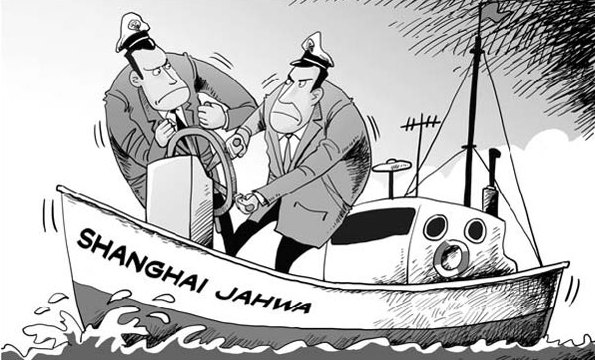
How much is an apology worth? Ge Wenyao, chairman of Shanghai Jahwa United Co, just paidmore than 300 million yuan ($50 million) to make one. Read more of this post

China’s second-largest construction equipment maker Zoomlion Bonds Fall, Stock Trading Halted After Media Report accusing it of falsifying sales

Zoomlion Bonds Fall, Stock Trading Halted After Media Report

Zoomlion Heavy Industry Science and Technology Co., China’s second-largest construction equipment maker, halted stock trading and saw its bonds decline after a report on Sina.com accused it of falsifying sales. The Shenzhen-listed shares were halted because of the report and trading will resume after the company posts a filing on the issue, Changsha-based Zoomlion said in a statement. The Hong Kong-traded stock was also suspended. Zoomlion’s $600 million of 6.125 percent bonds due December 2022 slumped 2.1 cents on the dollar to 95.4 cents as of 11:21 a.m. in Hong Kong, the lowest level since March 6 and heading for the biggest daily decline since Feb. 4, Bloomberg prices show. Zoomlion’s Hong Kong-traded stock has slumped 31 percent this year as its first-quarter profit plummeted 72 percent. Construction-equipment makers, including bigger rival Sany Heavy Industry Co. (600031), face a drop in orders as slowing economic growth and government curbs on the property market sap demand. Hong Xiaoming, a Zoomlion vice president in charge of the finance department, said in a mobile-phone text message that the company will issue a clarification today. She didn’t elaborate.

To contact the reporters on this story: Jasmine Wang in Hong Kong at jwang513@bloomberg.net; Rachel Evans in Hong Kong at revans43@bloomberg.net

President Xi Joins Premier Li in Indicating China Tolerance for Slower Growth Rate

Xi Joins Li in Indicating China Tolerance for Slower Growth Rate

China’s President Xi Jinping indicated a tolerance for slower expansion to avoid environmental degradation, adding to signs that the government will limit temporary boosts for the economy as officials map out plans for market-based changes to drive long-term expansion.

The country won’t sacrifice the environment to ensure short-term growth, Xi said during a study session of the Communist Party’s top leadership on May 24. His comments follow a statement issued on the same day that the State Council, or cabinet, which is chaired by Premier Li Keqiang, approved a series of measures aimed at revamping the economy.

China’s new leaders may be reluctant to implement stimulus to reverse an unexpected slowdown in first-quarter growth after a 4 trillion yuan ($586 billion at the time) package to support the economy during the global financial crisis led to inflation, a housing bubble and industrial overcapacity. Since taking office in March, Li has pledged to cut government interference in the economy, give market forces more power and boost the role of private companies. Read more of this post

Korea eyes Western model for funding ecosystem

2013-05-26 14:52

Korea eyes Western model for funding ecosystem

By Kim Da-ye

The word “venture” is in vogue again. Tech start-ups thrived in the late 1990s and early 2000s. Internet portal Naver, game developers Nexon and NCsoft, and set-top box manufacturer Humax are the so-called first-generation ventures from this era. Along with the worldwide burst of dot.com bubbles, the domestic venture culture disappeared, and Korea Inc. became dominated by large conglomerates.

The wide distributions of smartphones and ubiquitous connectivity in the past few years have reignited interests in venture firms. The trend is, however, limited to creating apps and mobile games. For a real start-up culture to form, ventures should also look into other serious areas of technology and science such as medical equipment, biotechnology and clean energy. The new government says it is determined to turn the trend into a second venture boom. Read more of this post