ASEAN Economies Aim to Avoid the Mistakes of European Integration

ASEAN Economies Aim to Avoid the Mistakes of European Integration

24 MAY 2013 – AARON TIMMS

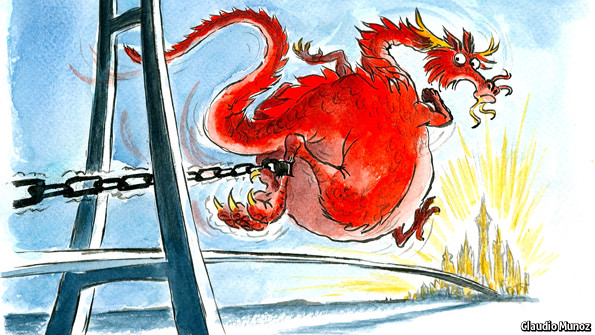
AS THE EURO ZONE HAS STAGGERED THROUGH MULTIPLE rounds of crisis over the past three years, the nations of Southeast Asia have been looking on with more interest than most. These countries have ambitions of closer economic integration that some liken to the European Union, but regional officials are keen to stress the differences. “It’s important to look at the example of Europe and make sure we don’t make the same mistakes they have made,” says Cesar Purisima, Finance secretary of the Philippines.

The Association of Southeast Asian Nations (Asean), conceived in the late 1960s against a backdrop of regional disputes and an escalating war in Vietnam, has proven remarkably durable. Dismissed by many as an ineffective talking shop, the bloc has grown steadily in size and ambition, forging a free-trade area among ten nations with a combined population of 600 million. Read more of this post

Europe Opens $80 Trillion Shadow Banking Pandora’s Box: Will Seek To Collapse Repo “Collateral Chains”; Banks and brokers face a clampdown on using assets they hold for clients as collateral for their own trades

Europe Opens $80 Trillion Shadow Banking Pandora’s Box: Will Seek To Collapse Repo “Collateral Chains”

Tyler Durden on 05/24/2013 10:51 -0400

In what may be the most important story of the day, or maybe year, for a world in which there already is an $11 trillion shortfall in high-quality collateral (and declining every day courtesy of Ben’s monetization of Treasury paper) so needed to support the deposit-free liability structures of the shadow banking system (as most recently explained here), Bloomberg has just reported that Europe may begin a crackdown on that most important credit money conduit: the $80 trillion+ global shadow banking system, by effectively collapsing collateral chains, and by making wanton asset rehypothecation a thing of the past, permitted only with express prior permission, which obviously will never come: who in their right mind would allow a bank to repledge an asset which may be lost as part of the counterparty carnage should said bank pull a Lehman. The result of this, should it be taken to completion, would be pervasive liquidations as countless collateral chain margin calls spread, counterparty risk soars all over again, and as the scramble to obtain the true underlying assets finally begins.

From Bloomberg:

Banks and brokers face a clampdown on using assets they hold for clients as collateral for their own trades as part of European Union moves to bolster market stability and rein in shadow banking. The European Commission is weighing whether firms should have to obtain formal consent from their clients before being allowed to reuse assets to back other trades, according to a document obtained by Bloomberg News. The consent would be enshrined in a “contractual agreement” between the parties. The handing over of collateral is an integral part of repurchase agreements, or repos — one of the activities under review by global regulators as part of their efforts to regulate shadow banking. The reuse of clients’ assets poses a potential threat to financial stability should one of a chain of firms that handled the securities go bankrupt, according to the document prepared by commission officials and dated May 15. Uncertainty about who holds an asset can fuel panic in times of market stress, according to the paper. “Complex” chains of collateral can make it difficult for investors to “identify who owns what, where risk is concentrated and who is exposed to whom,” according to the document. “This has consequences for transparency and financial stability.” Under the plans being weighed by the commission, banks and brokers holding securities for clients wouldn’t be allowed to reuse the assets for trading on their own account — speculation on the markets aimed solely at boosting their own revenues, according to the document. The Financial Stability Board has estimated that the global shadow-banking system was worth $67 trillion in 2011, with EU-based activities accounting for about $31 trillion.

Here’s the kicker: collateral chains collapse on their own when confidence and faith in the financial system is evapoarting. This is usually manifested in soaring variation margin, and demand for delivery of collateral (which having been pledged at 10 or more different places just doesn’t actually exist). In other words, the last thing Europe needs is to force the aftereffect of a plunge in systemic confidence to be imposed upon the market participants! And yet, it is doing just that.

The mismanagement of Indian cricket reveals India’s wider failings

The mismanagement of Indian cricket reveals India’s wider failings

May 25th 2013 |From the print edition

20130525_LDD001_0

CRICKET is like a religion in India, it is said—especially by Indians, who take almost as much delight in their love of the sport as in the contest between bat and ball. Nothing, they suggest, unites their vast and varied country so much as its devotion to what was once an English summer game. That is one reason why the epic mismanagement of Indian cricket matters. The other is that it gets to the heart of the cronyism and high-level abuse that plague India more widely.

Every cricket season brings news of a fresh scam or intrigue including, on May 16th, the arrest of three cricketers and a dozen bookmakers for alleged match-fixing in the country’s most popular domestic tournament, the Indian Premier League (IPL). Investigators in Delhi hint that the players were paid indirectly to underperform by the Mumbai gangsters who control much of India’s enormous illegal gambling industry (betting on cricket is against the law in India). If they are right, the nexus between racketeers, bookmakers and greedy cricketers, exposed in 2000 in one of the biggest scandals in modern sport, remains in place. This would not be surprising: India’s government and the men who run cricket there have done almost nothing to dismantle it. Read more of this post

I hate to say it, but what this country needs is another financial crisis

I hate to say it, but what this country needs is another financial crisis

By Allan Sloan, Friday, May 24, 10:38 AM

Almost a century ago, Thomas Marshall, Woodrow Wilson’s vice president, got tired of listening to senators blather on about the nation’s needs and uttered the words that made him immortal: “What this country needs is a good five-cent cigar.” Today, with 24/7 blathering as our national political pastime, let me adapt Marshall’s 1917 remark: What this country needs to get its act together is a good five-alarm financial crisis.

I mean, look around. Except for the Federal Reserve, which has consistently tried to help the economy, misguided though some of its actions may be, about the only real changes our government has made since the onset of the financial crisis were induced by fear. The Troubled Assets Relief Program, which played a vital role in restoring confidence and stability to the financial system, was passed only because the House’s rejection of it on Sept. 28, 2008, set off a 778-point plummet in the Dow. That scared the House into reversing itself. Read more of this post

Abruptly, P.&G. Chief Robert McDonald, 59, Ends Career of 33 Years and was being replaced by his predecessor, Alan G. Lafley, 65.

May 23, 2013

Abruptly, P.&G. Chief Ends Career of 33 Years

By MICHAEL J. de la MERCED

In a surprise move, Procter & Gamble, the world’s biggest consumer products company, said on Thursday that its chief executive had resigned and was being replaced by his predecessor, Alan G. Lafley. Robert A. McDonald, 59, the company’s chief executive and president since 2009, notified the board a few days ago of his decision to retire, said a P.& G. spokesman, Paul Fox. Procter & Gamble had been under pressure from the prominent hedge fund manager William A. Ackman, who has criticized Mr. McDonald for the company’s poor stock performance. Mr. Ackman is known for publicly challenging management teams, having agitated for change at the likes of J. C. Penney and Fortune Brands. Mr. Fox said he was unaware of any health or personal reasons behind the abrupt decision by Mr. McDonald, who had worked at the company for 33 years. He also said that Mr. McDonald’s decision was not spurred by pressure from company directors. Read more of this post

Southeast Asia’s booming bond market has sparked fears of a bubble

May 22, 2013 6:57 pm

Asian debt: Beware of bubbles

By Paul J Davies in Hong Kong

Southeast Asia’s booming bond market has sparked fears of a bubble

P1-BL652A_AsiaD_G_20130523184805

Gresik is a small industrial town of fewer than 100,000 people, just to the north of Indonesia’s second-largest city, Surabaya in East Java. But its position is critical. It sits near the Lombok Strait, the second most important shipping gateway between the Indian Ocean and the South China Sea and the vital trade route for fuel and resources between China and Australia. That is why AKR Corporindo has picked Gresik for what it hopes will become one of East Java’s biggest seaports and the only one tied directly to an industrial estate. The Indonesian logistics group has a 2,500-hectare site and has invested Rp675bn ($70m) of a projected Rp7tn-Rp8tn in the first phase of the development of both facilities. One of the most notable things about this investment is where AKR got the money: Asia’s local currency bond markets. These markets have their roots in the Asian financial crisis of 1997-98 but they have bloomed since the global financial collapse of 2008 unleashed easy money. However, the hot money flooding out of the west in search of higher returns in growing markets has stoked fears about the biggest credit boom in Asia since the spectacular implosion of the late 1990s. Read more of this post

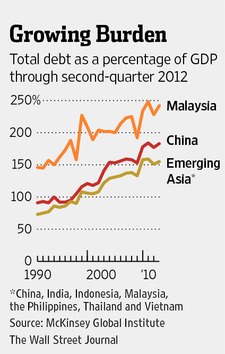
Asia Goes on a Debt Binge as Much of World Sobers Up

May 23, 2013, 11:02 p.m. ET

Asia Goes on a Debt Binge as Much of World Sobers Up

By ALEX FRANGOS in Kuala Lumpur, Malaysia, and BOB DAVIS in Beijing

P1-BL651_AsiaDe_NS_20130523183622P1-BL652A_AsiaD_G_20130523184805

A debt-fueled building boom is under way in Kuala Lumpur, Malaysia, above. The country says investing in industry will result in faster economic growth.

In the heart of Kuala Lumpur lies the abandoned foundation of Plaza Rakyat, a never-built skyscraper and shopping mall. Rusty rebar jutting from concrete pilings and fetid green pools of rainwater serve as an unintended monument to the debt crisis that ravaged Asia in the late 1990s.

Today, less than a half mile from the abandoned project, the next boom is under way in the Malaysian metropolis. Construction has begun on a new subway line, and next to one station plans call for a 118-story zigzagging skyscraper that would be the third-tallest building in the world. Cheap credit is fueling the building spree. Read more of this post

Buyer Beware: The Risk to Institutional Investors Financing China’s Local Government Debt

Buyer Beware: The Risk to Institutional Investors Financing China’s Local Government Debt

by Ryan Rutkowski | May 23rd, 2013 | 12:16 pm

Owners of the debt of local government special purpose vehicles (SPVs) should choose wisely and be cautious. At least this is the message central government officials are communicating to China’s financial markets. Two weeks ago, Premier Li Keqiang identified “controlling the risks of local government debt” as one of his administrations key reform initiatives. But who exactly should be worried about the risk of holding local government debt? The answer used to be banks but recently institutional investors have increased their role.

During the late 1990s up to 2008, China Development Bank (CDB) used to be behind most of local government debt in China. The policy bank pioneered the model of lending to local government SPVs. The bank was able to provide long term loans to localities which the localities paid off using revenues from local land sales to pay down interest and principal until project cash flows came online. This system seemed to work well until 2008 when the return-on-assets of CDB began to fall behind most commercial banks. CDB’s difficulties were not soon enough to discourage commercial banks from lending to local governments. Read more of this post

Exclusive: China $6.5 trillion urbanization plan hits roadblock over spending fears

Exclusive: China urbanization plan hits roadblock over spending fears – sources

9:44am EDT

By Kevin Yao

BEIJING (Reuters) – China’s plan to spend $6.5 trillion on urbanization to bolster the economy is running into snags, sources close to the government said, as top leaders fear another spending binge could push up local debt levels and inflate a property bubble. Premier Li Keqiang has rejected an urbanization proposal drafted by the National Development and Reform Commission (NDRC), seeking changes to put more emphasis on economic reform, according to the sources, who are familiar with the matter. Many local authorities have already lobbied to get funding for projects, ringing alarm bells among top leaders in Beijing. Read more of this post

CJ Group Chairman Lee Jay-hyun has been banned from leaving the country in a widening investigation into his massive slush fund, prosecutors said Thursday

2013-05-23 17:15

CJ chairman banned from leaving nation

By Kim Jae-won
CJ Group Chairman Lee Jay-hyun has been banned from leaving the country in a widening investigation into his massive slush fund, prosecutors said Thursday.
Besides the initially-cited 7 billion won, prosecutors suspect that the size of Lee’s slush funds is far larger and gave a significant portion of it to his children, they said.
Sources in the Seoul Central District Prosecutors’ Office say that in 2006 Lee allegedly transferred a combined 50 billion won to his two children — 25 billion won each — in cash without paying gift taxes, raising suspicions that it was part of the slush fund. The group also is suspected of helping CJ America and CJ Indonesia expand their businesses by buying their products at inflated prices. Read more of this post

Chinese banks barred from sponsoring IPOs; Securities brokerages at centre of China regulator’s crackdown

May 23, 2013 3:29 pm

Securities brokerages at centre of China regulator’s crackdown; Chinese banks barred from sponsoring IPOs

By Simon Rabinovitch

On the first anniversary of its stock market listing last month, Xi’an Longi Silicon Materials Corp served its factory workers steaming plates of simmered fish, an unusual delicacy for the staff canteen. It was to “ensure that all employees would share in the happy occasion”, the company says.

Just over three weeks later, on May 3, Xi’an Longi received a visit from the stock market regulator. The China Securities Regulatory Commission was launching an investigation, on suspicion that the company had violated the nation’s securities law by failing to disclose a steep fall in profits in the run-up to its listing.

The questions surrounding Xi’an Longi, a producer of silicon wafers and semiconductor ingots, are just one front in a much bigger battle being fought over how China polices its financial industry. At the centre of this battle are the securities brokerages that bring companies to the stock market in initial public offerings. Read more of this post

In Indonesia, soccer is kicked around by political parties; “If you can control football, you are half way to controlling Indonesia”

In Indonesia, soccer is kicked around by political parties

Thu, May 23 2013

By Janeman Latul

JAKARTA (Reuters) – As monsoon rains swept the stadium, the chanting grew louder. “Indonesia! Indonesia!” More than 60,000 people packed into Gelora Bung Karno Stadium in Jakarta on a recent Saturday night to see the national soccer team play. Another 100 million tuned in to television to watch the match, underlining the appeal of soccer in Indonesia where attendance rivals the top English and German soccer leagues. Among the fans are two of Indonesia’s most powerful people – President Susilo Bambang Yudhoyono and politically ambitious businessman Aburizal Bakrie. Their parties have long been battling for control over the sport and its huge audience, hoping this could be a factor in elections next year. Bakrie, who leads the Golkar party and has said he will be a presidential candidate, seems to have wrested control of a unified soccer association that was formed in March after almost two years of the two groups running parallel associations and parallel leagues. The association in charge of the sport controls marketing in the stadiums and on television. “If you can control football, you are half way to controlling Indonesia,” said a senior official at the Indonesian national soccer association, or PSSI. Read more of this post

No trespassing: Instituting better property protections is essential to China’s transitioning economy

No trespassing

Thursday, May 23, 2013

Instituting better property protections is essential to China’s transitioning economy, writes Andrew Sheng and Xiao Geng

Andrew Sheng, President of the Fung Global Institute, is a former chairman of the Hong Kong Securities and Futures Commission, and is currently an adjunct professor at Tsinghua University in Beijing. Xiao Geng is Director of Research at the Fung Global Institute.

Too often, debate about the relationship between the state and the market casts them as opposing forces locked in a zero-sum struggle. But this simplistic approach quickly turns constructive discussion into a casualty of the ideological battle between advocates of both sides. Read more of this post

Party ends for Western Australia’s investment boom

Party ends for Western Australia’s investment boom

English.news.cn   2013-05-24 by Christian Edwards

SYDNEY, May 24 (Xinhua) — It’s over. Official figures released Thursday by the Bureau of Resources and Energy Economics (BREE) show that Australia’s burgeoning resource state of Western Australia is staring down at the now empty barrel of the China- driven investment boom, leaving experts scanning the economic horizon for the next ray of hope. Projects worth over 175 billion Australian dollars, which have already been on the pipeline or under construction, are now slowly being shelved.

New gas projects that have been planned include the 53 billion Australian dollar Gorgon gas project, the 30 billion Australian dollar Browse LNG (liquefied natural gas) project, and the 29 billion Australian dollar Chevron-Wheatstone LNG project, in addition to a range of iron ore, gold and other projects. For more than six months fears have been growing that the party could be over. Read more of this post

Aussie Dollar Is Villain as Ford Ends Mad-Max Land Output

Aussie Dollar Is Villain as Ford Ends Mad-Max Land Output

Ford Motor Co. (F) Falcons, driven by Mel Gibson in Australia’s 1979 movie “Mad Max,” have rolled off a Melbourne production line for 53 years. Now, like Max’s “last of the V-8s,” their days are numbered. Ford, in Australia since 1925, said yesterday it will close its local manufacturing plants in October 2016, resulting in 1,200 job losses. General Motors Co. (GM)’s Holden unit, which traces its roots to 1856 when it started as a saddler business, said on April 8 it will cut about 500 workers as currency devaluations overseas make its operations among the world’s costliest.

The villain has been Australia’s dollar: Up 76 percent versus the yen since October 2008, it has helped send Japanese car imports to a record and sales of domestically made vehicles down 18 percent in four years. Ford’s local President Bob Graziano yesterday said that costs are double those in Europe and four times those of its Asian divisions, and that even twice as much government aid couldn’t make the unit sustainable. Read more of this post

The U.S. and China have struck an agreement giving U.S. accounting regulators access to documents from Chinese accounting firms.

Updated May 24, 2013, 1:08 a.m. ET

U.S., China Set Pact On Auditor Access

By MICHAEL RAPOPORT

The U.S. and China have struck an agreement giving U.S. accounting regulators access to documents from Chinese accounting firms. The deal, expected to be announced Friday, could help U.S. regulators investigate the auditors of U.S.-listed Chinese companies that might have been involved in accounting fraud. The agreement will allow the U.S. Public Company Accounting Oversight Board to see audit records and other documents held by Chinese audit firms. The China Securities Regulatory Commission and China’s Ministry of Finance will help the PCAOB obtain the documents. More than 100 Chinese companies listed in the U.S. have faced questions about their accounting and disclosure from regulators, auditors and short-sellers, and investors lost billions of dollars when those companies’ shares plunged. Read more of this post

Many investors may not be living in the real world

May 23, 2013 7:39 pm

Many investors may not be living in the real world

By Stephen King

A recovery in the global economy would appear to be hallucinatory, writes Stephen King

No one can be strong when China is weak. That, at least, appeared to be the message from the economic data this week. New data suggest lacklustre growth in China – sparking nervous sell-offs in other countries. A one-day decline of over 7 per cent in the Nikkei stock market index might seem like an overreaction but, last year, China was Japan’s most important export destination, accounting for more than 18 per cent of its goods exports. China now accounts for one-quarter of South Korea’s exports. China is also the third-largest destination for US exports, after Mexico and Canada.

Stock market wobbles cannot be attributed toChina alone. Ben Bernanke, Federal Reserve chairman, revealed that asset purchases associated with quantitative easingmight be tapered earlier than investors expected, providing another reason for stock markets to lurch down. Meanwhile, rising bond yields in Japan have led to a new sense of unease: financial bets are no longer all one way. Read more of this post

Imprisoned Entrepreneurs and Russia’s Economic Slump

Imprisoned Entrepreneurs and Russia’s Economic Slump

President Vladimir Putin’s popularity throughout much of Russia is founded on an implicit social compact: People have given up some freedom in return for economic prosperity.

Now, Putin’s authoritarian ways could be killing the economic growth that has helped keep him in power.

Time and time again, Russia’s leaders have pledged to restructure the country’s economy, making it less dependent on oil and gas. In an interview this week to mark the first anniversary of his move to the prime minister’s job from the presidency, Dmitri Medvedev effectively admitted failure. “We must change the structure of our economy,” he told the popular daily Komsomolskaya Pravda. “In the past 13 to 14 years we just did not have enough time to do it.” Read more of this post

Bundesbank chief says ECB has done a lot to fight crisis, can’t solve it

Bundesbank chief says ECB has done a lot to fight crisis, can’t solve it

Filed 13 hours ago

Germany’s federal reserve Bundesbank President Jens Weidmann stands beside the door of a giant safe as he poses for a photograph at the money museum next to the Bundesbank headquarters during a photo shoot with Reuters in Frankfurt May 17, 2013. REUTERS/Kai Pfaffenbach

By Ingrid Melander

PARIS – Bundesbank chief Jens Weidmann said on Thursday it was not up to the European Central Bank to solve the euro zone crisis, resisting pressure from other ECB policymakers for the bank to widen its range of policy tools. Speaking in Paris, Weidmann declined to comment on U.S. Federal Reserve chairman Ben Bernanke’s remarks that the U.S. central bank may start to trim its bond purchases at one of its next policy meetings. Focusing on the situation in the euro zone he said: “Monetary policy, that is to say the Eurosystem (of euro zone central banks) has already done a lot to curtail the crisis.” “But monetary policy cannot solve the crisis, we are completely united on that in the ECB Governing Council,” Weidmann, a member of the policymaking body, told a conference. Read more of this post

Primary Dealers Saw Fed’s Confusing Strategy Reducing QE Impact

Primary Dealers Saw Fed’s Confusing Strategy Reducing QE Impact

The 21 primary dealers that trade securities directly with the Federal Reserve Bank of New York, said that confusion about the central bank’s intentions for its bond-buying program is reducing the policy’s effectiveness.

The dealers’ views were shared with the New York Fed in a survey of primary dealers that the Federal Open Market Committee reviewed at their April 30-May 1 meeting. A diversity of Fed speakers expressing different views has left the primary dealers unsure of the central bank’s intentions, according to the survey results released today by the New York Fed.

“Some dealers noted that the dispersion of views expressed by FOMC participants as to how the FOMC would make decisions regarding the future pace of asset purchases has decreased clarity around the program,” the survey said. “Of these dealers, several suggested that the differing views on monetary policy may reduce the policy’s effectiveness.” Read more of this post

Bonds Rigged as Stocks Expensive for Scots Manager Doubling Fund

Bonds Rigged as Stocks Expensive for Scots Manager Doubling Fund

From his view of the world in Scotland, Bruce Stout says investors risk getting burned because optimism is too high for stocks and bond yields are too low. The markets might be proving him right.

The MSCI World Index, a gauge of developed stock markets, sank by the most yesterday since April 15, while Japan’s Topix Index lost 6.9 percent. Stout, whose 1.5 billion-pound ($2.3 billion) Murray International Trust (MYI) at Aberdeen Asset Management Plc (ADN) posted triple-digit returns during the past four years, has been selling shares he reckons are now too expensive, while his fixed-income holdings are the lowest in 25 years.

“The higher prices go the more short-term expectations can distort things and then you can lose your money,” Stout said at his office in Edinburgh. “That’s why we’re in a capital preservation mode to try and not lose money.” Read more of this post

Fears grow over EM sovereign bond bubble

May 23, 2013 9:18 am

Fears grow over EM sovereign bond bubble

By Robin Wigglesworth

As far as financial follies go, tulip mania takes some beating. But future economic historians may look back at the time when investors financed a convention centre in Rwanda as the moment that the rush into emerging market bonds became frothy.

Despite a large chunk of Rwanda’s budget coming from overseas aid – some of which was withheld last year after it was accused of backing rebels in neighbouring Democratic Republic of Congo – investors rushed to get a slice of the country’sinaugural $400m bond last month. The proceeds are largely to be used to pay for a new conference centre in Kigali, the central African country’s capital. Read more of this post

Delinquent Student Loans Hit Record, 30% Of 20-24 Year Olds Are Unemployed And Not In School

Delinquent Student Loans Hit Record, 30% Of 20-24 Year Olds Are Unemployed And Not In School

Tyler Durden on 05/23/2013 11:37 -0400

Almost a year ago we shared a calculation according to which “Over $120 Billion In Federal Student Loans In Default“, suggesting that the next credit crisis has already arrived. Since then the topic of the student loan bubble has become a household topic. Sadly, that does not mean it has gotten any better. In fact, according to the latest Education Department data it has gotten as bad as it has ever been. As Bloomberg reports, not only have overdue student loans reached an all-time high but the number of young people aged 20-24 out of school and unemployed is at a record high: not quite astronomic by European standards, but hardly a ringing endorsement of an economy set to transition labor tasks to the next generation, especially with the employment of those 55 and older at all time highs. Read more of this post

As Of This Moment Ben Bernanke Own 30.5% Of The US Treasury Market… And Will Own All By 2018

As Of This Moment Ben Bernanke Own 30.5% Of The US Treasury Market… And Will Own All By 2018

Tyler Durden on 05/23/2013 21:37 -0400

As is well-known by everyone, the Fed monetizes the US deficit on a daily basis, thanks to the 45 minutes of POMO love each day when it buys Treasuries from Dealers. Of course, the Fed monetizes bonds from across the entire curve (mostly the longer end), which is why it is somewhat complicated to express the amount of risk transfer the Fed takes on every time the S&P posts an uptick as a result of yet another bond purchase by the hedge fund with the largest fixed income portfolio in the history of the world. However, one simple way of expressing just this risk is through the use of ten year equivalents: Ten-year equivalents are the amount of 10-year notes that must be held by the Fed in order to remove the same amount of interest rate risk from the market as its current holdings. What this methodology allows is to represent the Fed’s holdings of all marketable securities on a linear continuum, and represent the remainder, or those bonds held by the private sector, on the side. So what may come as a surprise to most, is that as of this week’s H.4.1 update, the amount of ten-year equivalents held by the Fed increased to $1.583 trillion from $1.576 trillion in the prior week, which reduces the amount available to the private sector to $3.637 trillion from $3.668 trillion in the prior week. And also, thanks to maturities, and purchase by the Fed from the secondary market, there were $5.219 trillion ten-year equivalents outstanding, down from $5.244 trillion in the prior week.

Fed holdings 5.23-2_0 Read more of this post

The Bronze Swan Arrives: Is The End Of Copper Financing China’s “Lehman Event”?

The Bronze Swan Arrives: Is The End Of Copper Financing China’s “Lehman Event”?

Tyler Durden on 05/23/2013 10:06 -0400

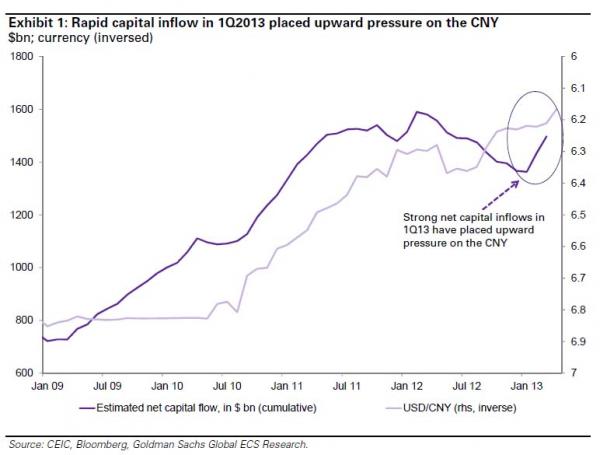
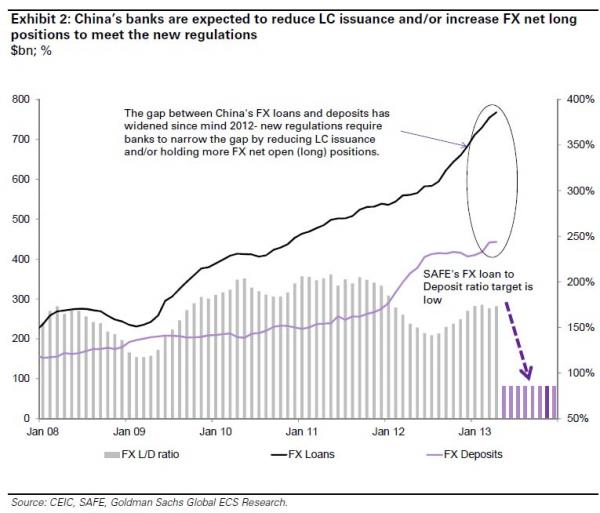
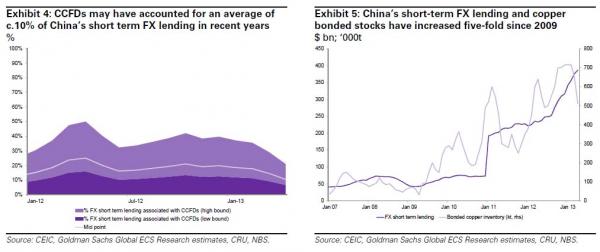
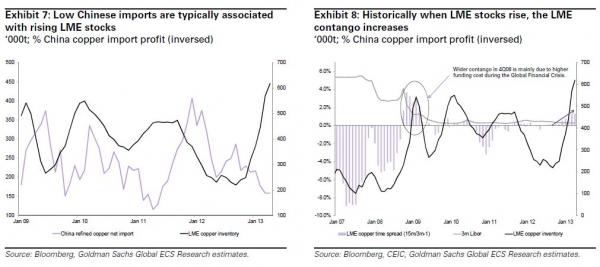
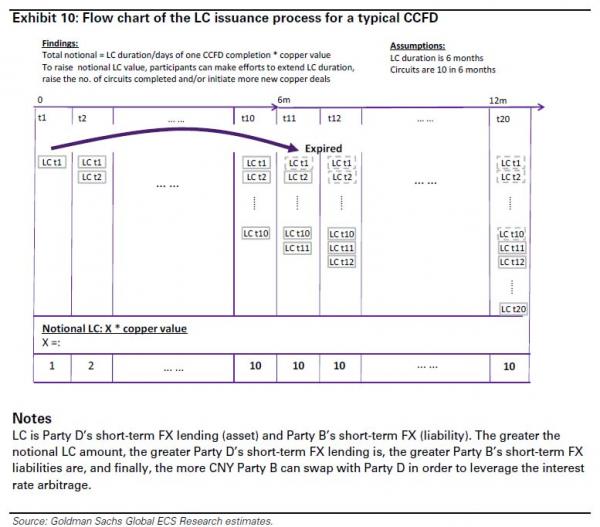
In all the hoopla over Japan’s stock market crash and China’s PMI miss last night, the biggest news of the day was largely ignored: copper, and the fact that copper’s ubiquitous arbitrage and rehypothecation role in China’s economy through the use of Chinese Copper Financing Deals (CCFD) is coming to an end. Copper, as China pundits may know, is the key shadow interest rate arbitrage tool, through the use of financing deals that use commodities with high value-to-density ratios such as gold, copper, nickel, which in turn are used as collateral against which USD-denominated China-domestic Letters of Credit are pleged, in what can often result in a seemingly infinite rehypothecation loop (see explanation below) between related onshore and offshore entities, allowing loop participants to pick up virtually risk-free arbitrage (i.e., profits), which however boosts China’s FX lending and leads to upward pressure on the CNY. Since the end result of this arbitrage hits China’s current account directly, and is the reason for the recent aberrations in Chinese export data that have made a mockery of China’s economic data reporting, China’s State Administration on Foreign Exchange (SAFE) on May 5 finally passed new regulations which will effectively end such financing deals. The impact of this development can not be overstated: according to independent observers, as well as firms like Goldman, this will not only impact the copper market (very adversely) as copper will suddenly go from a positive return/carry asset to a negative carry asset leading to wholesale dumping from bonded warehouses, but will likely take out a substantial chunk of synthetic shadow leverage out of the Chinese market and economy. Naturally, for an economy in which credit creation is of utmost importance, the loss of one such key financing channel will have very unintended consequences at best, and could potentially lead to a significant “credit event” in the world’s fastest growing large economy at worst.

China 1_0China 2_0China 3_0China 4_0China 5_0China 6_0 Read more of this post

Can China’s leaders revive the economy and reform it at the same time?

Can China’s leaders revive the economy and reform it at the same time?

May 18th 2013 | HONG KONG |From the print edition

20130518_CND001_0

EVERY economy, like every story, has two sides: supply and demand. The supply side of China’s economy is the stuff of legend: 767m workers, perhaps $20 trillion-worth of machinery, buildings and other kinds of capital, combined with rapidly advancing techniques and technologies, many of them assimilated from abroad. This combination of labour, capital and know-how dictates how much the economy can produce. But whether it actually does produce all it can depends on the other side of the economy—the demand side—which reflects the spending decisions of consumers and investors. The supply side sets the scene; the demand side provides the drama. Sadly, demand is recovering more slowly than expected. Figures released this week showed somewhat disappointing growth in fixed-asset investment and industrial production last month, following a similarly underwhelming first quarter. Economists who were expecting growth of 8-8.5% this year are now projecting something closer to 7.5%.

But as the drama darkens, the scene may also be shifting. A meeting of the State Council, China’s cabinet, on May 6th outlined a long list of structural reforms designed to improve the supply side of the economy. Some of the reforms, such as extending the value-added tax to services, are already under way. Others, such as liberalising capital flows, will reach fruition only gradually. The reforms are also in keeping with pronouncements by former leaders like Wen Jiabao, who liked to talk the reform-talk. But the new agenda “goes far beyond Wen-era platitudes in its boldness and specificity,” argues Andrew Batson of GaveKal Dragonomics, a consultancy in Beijing. The “walk-to-talk” ratio is improving, he believes. Read more of this post

About China’s capacity to absorb more capital

About China’s capacity to absorb more capital

Kate Mackenzie | May 22 10:30 | 42 comments | Share

We’ve all heard, many times, the story that China’s capital stock is nowhere near that of more advanced economies, therefore it will inevitably increase. And we can count on continued efforts to build roads, buildings, airports, and other infrastructure — just look at how the less-developed eastern provinces have been pouring money into new projects, the argument has gone, more recently. Or went. We really hope it’s not necessary, here, to go into the weaknesses of that argument. Here are a few places to start, but it’s partly a causal problem — does growth cause increased capital stock or vice versa? What kind of growth are we talking about, anyway? Fine. But surely investment is still a net positive if it creates infrastructure that people will actually use, sooner or later? Leaving aside the question of financing burdens, we’ve struggled here with the idea that there’s ‘bad’ and ‘good’ investment. How does one know, in the short term, which is which? Read more of this post

China Should Stop ‘Micromanaging’ Auto Industry, Researcher Says

China Should Stop ‘Micromanaging’ Auto Industry, Researcher Says

China should refrain from “micromanaging” the automotive industry and allow market competition to spur innovation and weed out weaker automakers, the Chinese Academy of Social Sciences said in a report.

The government should focus instead on building a fair and competitive environment and abandon monopolistic polices aimed at creating fewer and bigger automakers, the state-backed research institute said in an annual report on industrial competitiveness released this week. Read more of this post

China Rule Changes May Halt Copper-Financing, Goldman Says

China Rule Changes May Halt Copper-Financing, Goldman Says

New rules from China to control capital inflows are likely to end commodity-financing deals, hurting the short-term outlook for copper, analysts at Goldman Sachs Group Inc. wrote in a research report today.

The regulations from the State Administration of Foreign Exchange, effective from June, will probably mean an end to Chinese use of copper as a tool to enable interest rate arbitrage, Goldman said. The London Metal Exchange market may need to “carry” as much as 250,000 metric tons of additional physical copper over one to three months, about 4 percent to 5 percent of quarterly global supply, the bank said. Read more of this post

In China, food scares put Mao’s self-sufficiency goal at risk

In China, food scares put Mao’s self-sufficiency goal at risk

Wed, May 22 2013

By David Stanway and Niu Shuping

BEIJING (Reuters) – The discovery of dangerous levels of toxic cadmium in rice sold in the southern city of Guangzhou, the latest in a series of food scandals, has piled more pressure on China to clean up its food chain – possibly at the expense of Mao Zedong’s cherished goal of self-sufficiency.

The ruling Communist Party has long staked its legitimacy on its ability to guarantee domestic staple food supplies, and has pledged to be at least 95 percent self-sufficient even as demand increases and the fastest and biggest urbanization process in history swallows up arable land. Read more of this post