China’s Not Hiring; the number of new jobs advertised on leading recruitment website Zhaopin.com fell sharply by 22% in April, the steepest decline since Zhaopin started collecting data in 2010

May 22, 2013, 11:29 p.m. ET

China’s Not Hiring

By TOM ORLIK

China’s labor market has been a bright spot amid economic gloom. Strong jobs data over the past year has helped offset concerns about slowing growth. But there are signs employment is beginning to weaken too. The official job numbers in China are irregular and, in some cases, inaccurate. But other sources of data fill in the blanks. For instance, the number of new jobs advertised on leading recruitment website Zhaopin.com fell sharply in April. With the first quarter peak hiring season, some falling off in April is expected. But a 22% drop in new job postings from the previous month was the steepest decline since Zhaopin started collecting data in 2010. Business surveys suggest the downturn is broad-based across manufacturing and services too. The preliminary reading for the HSBC HSBA.LN -3.23% China Manufacturing Purchasing Managers’ Index in May showed factories trimming their workforce for a second month. Worryingly, the HSBC Markit services PMI also points to job losses. If labor markets are turning down, they are at least doing so from a position of strength. China’s private sector wages rose 14% in real terms in 2012 according the National Bureau of Statistics. Demand for workers outstripped supply by a record amount in the first quarter. The drop in new job adverts on Zhaopin came after a record high in March. Read more of this post

China’s SASAC Steps in to Save Bleeding SOEs

SASAC Steps in to Save Bleeding SOEs

By Kang Yi (康怡) and Zhang Xiangdong (张向东)
Issue 620, May 20, 2013
Over recent weeks, some of China’s biggest state-owned enterprises have been visited by their biggest investor – the State-owned Assets Supervision and Administration Commission (SASAC).  The supervisory body that administers the operations of more than a hundred of China’s biggest and most powerful state-owned companies has been dropping by the offices of those companies that have dragged down the overall profits of the state sector in 2012 with their huge losses.  Read more of this post

Local government financing platforms have “prominent potential risks” that pose grave challenges to controlling debt, the China Banking Regulatory Commission (CBRC) said

05.22.2013 15:58

Risks in Financing Platforms Pose a Challenge, CBRC Says

Regulator’s calculations show debts have risen to 9.5 trillion yuan, 50 percent more than government revenues last year

By staff reporter Wen Xiu

(Beijing) – Local government financing platforms have “prominent potential risks” that pose grave challenges to controlling debt, the China Banking Regulatory Commission (CBRC) said in a recent meeting. The debts they have taken on are a heavy burden on public finance, the banking regulator said. The CBRC’s calculations show that the amount of outstanding platform debts has reached almost 9.5 trillion yuan this year, not including those borrowed through trust products. That is more than 50 percent higher than local governments’ revenue last year, and up to 40 percent of the debts will mature within the next three years. The CBRC aims to stop platform loans from further increasing and wind down existing loans orderly while guaranteeing the financing needs of important projects. But the task is getting harder to achieve because local governments are electing leaders and new officials always tend to splash out on investments, the regulator said. The platforms have increasingly relied on bank loans to finance new projects because most other channels to raise funds have been blocked over risk concerns, the CBRC said. That said, the banking regulator noted that some financing platforms had been circumventing restrictions to borrow through less-regulated channels because they could not get loans from banks. Many local officials resorted to personnel connections with bankers to try to get more loans, a bank executive said. But that means cutting into others’ lending quota because the overall amount of loans banks can make to financing platforms had been capped, he said. That is all the more concerning from a regulatory perspective, the CBRC said, since local small banks could be forced to bend lending rules.

Honeymoon’s Over for Sweethearts of SOE Reform; Less than two years after tying the knot, Ping An Trust’s relationship with Jahwa Group, held as a model for SOE reform, is on the rocks

05.22.2013 18:19

Honeymoon’s Over for Sweethearts of SOE Reform

Less than two years after tying the knot, Ping An Trust’s relationship with Jahwa Group is on the rocks

By staff reporters Shen Hu, Zheng Fei and Wang Xiaoqing

Corporate wedding bells were ringing in 2011 when a trust controlled by insurer Ping An Insurance Group forged a partnership with a Shanghai-based cosmetics maker called Jahwa Group and its listed subsidiary Jahwa United. The tie-up was duly praised for diversifying Jahwa’s ownership in line with a Chinese government push to reform the shareholder structures at state-owned enterprises (SOEs). China Ping An Trust Co. paid the Shanghai government’s Municipal State-owned Assets Supervision and Administration Commission some 5.1 billion yuan for 100 percent of Jahwa Group. It also got a 27.8 percent stake in Jahwa United. But what looked like a match made in corporate heaven – and a model for SOE reform – is now on the rocks. Read more of this post

Chinese enterprises are expanding overseas rapidly and on a large scale, but many of these projects are seeing poor returns

Chinese Enterprises Struggle Overseas

By Sun Qizi (孙琦子)
Issue 620, May 20, 2013
Chinese enterprises are expanding overseas rapidly and on a large scale, but many of these projects are seeing poor returns. China Mobile Communications Corporation (CMCC), for example has invested in six major overseas projects since 2005. But according to data from the National Audit Office, among these projects three have suffered losses altogether totaling nearly 3.2 billion yuan. Why do so many of these projects fail to take off? How does one choose an overseas investment that will see a reasonable return? Economic Observer asked Xu Jing (许京), vice president of China International Trade Association, Chen Weidong (陈卫东), chief economist at the Energy Economics Research Institute of China National Offshore Oil Corp, Andrew Zhu (朱桉), a tax partner and cross-border mergers and acquisitions specialist at Deloitte, and Claire Yang, managing director of Accenture Greater China. Read more of this post

Overcapacity set to blight China’s LED industry

Overcapacity set to blight China’s LED industry

Staff Reporter 2013-05-23

The same overcapacity issues that rocked China’s solar power sector now threaten to take their toll on the country’s LED industry, the Chinese-language Beijing Business Today reports. A recent announcement by the Shenzhen city government that it will suspend its 2009-2015 plan to develop the local LED industry has sparked concerns that it may soon suffer a similar fate as the photovoltaic industry, with the solar sector seeing a capacity utilization rate of 60%. When the Shenzhen government first revealed its plan in March 2009, it declared the city would become an global base for the industrial development, research and manufacture of LED products. In the same year, 44.3% of China’s’s LED businesses were based in Shenzhen, with a further 24.7% in other cities in the southern province of Guangdong. Luo Qi, general manager of Zongke Optoelectronics Equipment, a Shenzhen-based LED company, said that he was yet to be received confirmation concerning the government’s suspension of its investment plan, though it is not a surprise as the industry has already encountered a series of operational difficulties, with high costs and excess inventories resulting in overcapacity. According to market research website gg-ii.com, over 80 LED enterprises in Shenzhen closed down last year alone. Chen Yansheng, deputy chairman of the China Association of Lighting Industry, also forecasts that more companies will face economic difficulties in the near future due to the expected increase in companies within the upstream LED chip manufacturing industry this year. Last year, several LED companies recorded a significant drop in their sales and net profit, with LED chip maker Elec-Tech International recording a net profit of 168 million yuan (US$27.4 million), down by 57% from the previous year. Luo said his company’s orders had steadily declined from October and so far this year, the volume of orders has fallen by 40%-50%, compared with the same period last year. He Zaihua, a senior researcher at CI Consulting, said the key to resolving the overcapacity crisis is in the hands of those in the LED sector and the government. Companies must take active measures to expand both the overseas and domestic markets, while trying to expand their core technology research and development at the same time, he added.

Luxury brands to be sold at supermarkets in China

Luxury brands to be sold at supermarkets in China

Staff Reporter

2013-05-23

Luxury goods brands are breaking the confinements of major department stores and boutiques to enter supermarkets in cities across China, reports the Chinese-language Guangzhou Daily. Some experts note that the move is in response to the recent sluggish demand for luxury goods but added that offering discounts on their products and entering the new market may not be enough, the paper said. China’s largest domestic retailer, Lianhua Supermarket, recently began to sell seven brands of luxury products in its outlets, including international brands Gucci, Prada and Armani. A representative of Okaicheng, a luxury brand agent that will help sell the products, said that Lianhua’s decision to sell luxury goods in their stores was based on appealing to the company’s 2 million store-value card holders. In the first two hours of the luxury goods being place on the supermarket shelves, Okaicheng closed six deals, four of which were carried out by store card customers. It’s hard to imagine purchasing high-end items at a supermarket, since many consumers that purchase luxury goods prefer a topnotch shopping environment and experience, a luxury goods salesman told the paper. Ms Li, who often buys luxury brands, said that “Luxury goods are no longer luxury goods once they are sold in a supermarket, they become like oil, rice and salt.” Luxury goods have suffered from sluggish sales in China this year. Fondazione Altagamma, the Italian luxury goods industry trade association, reported recently that due to slowing sales in Europe and the global economic slowdown, luxury-goods sales are expected to grow by only 4%-5% this year, lower than the 5% growth achieved in 2012. The current market climate has led Gucci and Louis Vuitton to slow down the pace of their expansion in China, the Guangzhou Daily said.


Korean chaebol woes: Prosecutors are investigating the three siblings who control CJ Group to uncover the whereabouts of an estimated 500 billion won ($450 million) in Hidden Assets

2013-05-22 16:06

CJ probe expands

By Kim Jae-won
Prosecutors are Investigating The Three siblings who Control CJ Group to uncover The whereabouts of an estimated 500 billion won ($ 450 million) in Hidden Assets, Sources said Wednesday.  Read more of this post

Billionaire The Ning King Emerges on Indonesian Property

Billionaire The Ning King Emerges on Indonesian Property

Not many finance professionals who cover Indonesia’s biggest property companies have heard of The Ning King, the 82-year-old founder of closely held Indonesian conglomerate Argo Manunggal Group.

The — pronounced Tay — owns half of PT Alam Sutera Realty (ASRI), which developed for almost two decades a town west of Jakarta comprised of 30 residential clusters, each with as many as 500 houses. The company’s shares have doubled since October.

He also owns 64 percent of PT Bekasi Fajar Industrial Estate (BEST), which controls the largest industrial land bank among its publicly traded peers in Indonesia. Bekasi Fajar has partnered with Japanese companies to develop industrial parks and is up 46 percent year-to-date. Read more of this post

A more detailed look at China’s economic performance in 2012 shows it tipped further off balance, relying more than ever on credit-fueled investment, a trend it had tried to rein in

May 22, 2013, 1:58 p.m. ET

China Tilts Back to Big Spending

By TOM ORLIK

BEIJING—A more detailed look at China’s economic performance in 2012 shows it tipped further off balance, relying more than ever on credit-fueled investment, a trend it had tried to rein in. A further tilt toward capital spending flies in the face of Beijing’s goals to shift to a consumption-driven economic model and threatens to add to a mounting debt problem, exacerbate industrial overcapacity that is dragging down profits, and produce more empty “ghost cities”. The share of fixed investment in China’s GDP rose to 46.1% in 2012, up from 45.6% in 2011, according to National Bureau of Statistics data, published by data provider CEIC. China’s headline GDP data have been available for some time, but the detailed breakdown between the shares of investment, consumption and exports has only been published this week. Read more of this post

For Proxy Advisers, Influence Wanes; ISS and Glass Lewis dominate an industry that evolved to bring a critical lens to the management proposals that mutual funds and asset managers traditionally had rubber-stamped in corporate elections

Updated May 22, 2013, 6:42 p.m. ET

For Proxy Advisers, Influence Wanes

By JOANN S. LUBLIN and KIRSTEN GRIND

MI-BW134_ISSPRO_G_20130522180304

The landscape for proxy advisers is getting rockier.

Big firms that sell recommendations on how to vote in corporate elections are losing some of their relevance, as companies more aggressively court key investors ahead of big votes and those investors handle more of the voting analysis themselves.

Consider J.P. Morgan ChaseJPM +1.15% & Co. The two biggest proxy advisers—Institutional Shareholder Services Inc. and Glass, Lewis & Co.—recommended that shareholders support a nonbinding proposal to split the roles of chairman and chief executive held by James Dimon. Read more of this post

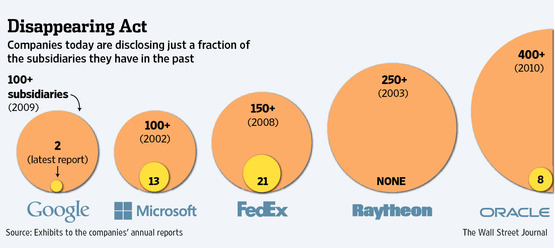
From Google to FedEx: The Incredible Vanishing Offshore Subsidiary from publicly disclosed financial filings

Updated May 22, 2013, 7:38 p.m. ET

From Google to FedEx: The Incredible Vanishing Subsidiary

By JESSICA HOLZER

WASHINGTON—Some of the biggest U.S. companies, including Google Inc.GOOG -1.94% and FedEx Corp., FDX -2.47% have quietly removed hundreds of offshore subsidiaries from their publicly disclosed financial filings over the past several years. Software maker Oracle Corp., ORCL -2.79% for instance, disclosed more than 400 subsidiaries in its 2010 annual report. By 2012 the list had been whittled to eight—five of which were located in Ireland. Oracle declined to comment. The vanishing subsidiaries don’t stem from asset sales or corporate restructuring. Companies across industries say they are taking advantage of Securities and Exchange Commission rules that demand disclosure only when subsidiary operations are “significant.”

MK-CD451_OFFSHO_G_20130522170008 Read more of this post

Hedge Funds Trail S&P 500 by 10 Percentage Points, Goldman Says

Hedge Funds Trail S&P 500 by 10 Percentage Points, Goldman Says

Hedge funds’ returns have stayed “lackluster” this year, with the $2.3 trillion industry trailing the gains of the Standard & Poor’s 500 Index by about 10 percentage points, according to Goldman Sachs (GS) Group Inc.

Hedge funds gained 5.4 percent on average through May 10, compared with a 15.4 percent rise for the S&P 500 (SPX) and a 14.8 percent increase for the typical mutual fund, a team of Goldman Sachs analysts led by Amanda Sneider and David Kostin wrote in a report released today.

Hedge-fund managers have been hurt in 2013 by their bearish wagers on stocks, with “popular” shorts such as Johnson & Johnson (JNJ) and Gilead Sciences Inc. rising more than the broader equity market, Goldman Sachs said. Fewer than 5 percent of the hedge funds tracked by New York-based Goldman Sachs are beating the S&P 500 or a typical mutual fund that buys stocks of the biggest U.S. companies. Read more of this post

Oil-tanker owners will struggle to retain crews and maintain ships after losing the most money in four decade

Oil-Tanker Crews Seen Quitting on 40-Year High in Losses

Oil-tanker owners will struggle to retain crews and maintain ships after losing the most money in four decades, according to the industry’s biggest trade group.

The problems won’t ease any time soon because some vessel rates may take as long as four years to rebound, said Katharina Stanzel, the managing director of the International Association of Independent Tanker Owners, or Intertanko. Its members operate more than half of the world’s tankers by capacity.

Owners lost about $27 billion since 2009 and rates for the largest vessels may only recover by 2017, according to Intertanko. Daily rates for the biggest carriers slid 68 percent over the past year because of a glut of capacity, figures from London-based Clarkson Plc (CKN), the largest shipbroker, show. Read more of this post

U.S. Bank Capital at Risk When Bond Gains Evaporate, Fitch Says

U.S. Bank Capital at Risk When Bond Gains Evaporate, Fitch Says

About $25 billion in unrealized bond gains are at risk from rising interest rates that may erode capital levels at some of the largest banks by 1 percentage point or more, according to Fitch Ratings.

Four years of price appreciation and growth in the bond portfolios of the 15 largest banks have left them with unrealized gains approaching a two-decade high, Fitch said today in an e-mailed statement. The gains may be erased by rising interest rates in a manner that could be worse than the last cycle when gains topped out in 2002, according to the ratings firm. Read more of this post

Canada’s Bond-Dumping Frenzy Escalates as Pensions Unload

Canada’s Bond-Dumping Frenzy Escalates as Pensions Unload

Canada’s biggest pension-fund manager will “significantly” cut its C$64 billion ($62.3 billion) allocation to bonds as the fixed-income market’s foothold among its most loyal base of investors grows less certain.

Caisse de Depot et Placement du Quebec Chief Executive Officer Michael Sabia said he’s scaling back fixed-income investments that account for 36 percent of its C$176 billion of assets under management, joining the Canadian units of HSBC Global Asset Management and Sun Life Global Investments Inc., which combined oversee about C$20 billion of assets. Canadian government bond yields have fallen to almost record lows, draining income for pension funds that have traditionally relied on fixed-income to fund decades-long pension liabilities. Read more of this post

Oil Pipelines to Drive Canada Economy Like 1880s Railroad

Oil Pipelines to Drive Canada Economy Like 1880s Railroad

Oil pipelines, under attack from environmentalists, are essential to Canada’s economic growth just as railroads were in the 1880s, Enbridge Inc. (ENB) Chief Executive Officer Al Monaco said.

“Pipelines are very similar to railroads,” Monaco said yesterday at the Bloomberg Canada Economic Summit in Toronto. “When you really get down to it, Canada is an export-driven resource economy. This is our foundation.”

Pipelines already carry 15 percent of Canadian exports in the form of crude, mostly to U.S. markets. Plans by Enbridge and TransCanada Corp. (TRP) to spend more than a combined C$50 billion ($49 billion) to expand networks to the Pacific and Atlantic coasts, are opposed by environmental groups such as ForestEthics. The nation’s oil trade rose 7 percent to about C$73 billion last year, according to Statistics Canada, and is set to grow faster than the total economy. Read more of this post

HSH Nordbank, the world’s largest shipping lender, Says Shipping Crisis May Worsen Through 2014

HSH Nordbank Says Shipping Crisis May Worsen Through 2014

HSH Nordbank AG, the world’s largest shipping lender, said the crisis buffeting the industry may worsen through 2014 as clients contend with a drop in demand and the arrival of a new generation of container vessels.

HSH Nordbank, which holds 27 billion euros ($35 billion) of shipping loans in its portfolio, has taken provisions to prepare for the worst-case scenario, HSH Chief Executive Officer Constantin von Oesterreich told journalists in Hamburg, the bank’s home city, last night. Read more of this post

The New Buyers of ETFs: According to Morningstar, hundreds of mutual funds now own passive ETFs

The New Buyers of ETFs

Stan Luxenberg

Fri, 2013-05-17 09:21

Many actively managed mutual funds are now in the market for ETFs for their low costs of ownership and ease of trading. But should shareholders be annoyed? During the past decade, ETFs have spread relentlessly, appealing to pensions, retail investors, and financial advisors. But lately a new group has begun buying: actively managed mutual funds. According to Morningstar, hundreds of mutual funds now own passive ETFs. More than 100 mutual funds hold SDPR S&P 500 (SPY), while more than 70 portfolios use iShares iBoxx High Yield Corporate (HYG). Mutual Funds with ETF stakes include Columbia Dividend Income (LBSAX), Monetta (MONTX) and Vanguard Windsor II (VWNFX). ETF provider SPDR says that 21 of the 25 largest fund companies hold at least some ETFs.

new-buyers-etfs-table Read more of this post

To Spark Buyers for Electric Cars, Drop the Price to Nearly $0

Updated May 22, 2013, 3:34 a.m. ET

To Spark Buyers for Electric Cars, Drop the Price to Nearly $0

By JOSEPH B. WHITE

This car deal sounds too good to be true: Drive a car, almost free. To entice drivers to try electric-powered cars, auto makers are lowering the price of entry to the zero-emission lifestyle. A new round of discount leases on mainstream-brand plug-in cars such as theNissan 7201.TO -1.38% Leaf or Fiat F.MI +0.93% 500e, combined with federal, state and local electric-vehicle incentives, could make a battery-electric car an extraordinarily economical way to get around for drivers. There are two big caveats: Drivers need to live in states offering tax incentives and can’t drive very far in a single day.

PJ-BO412_EYESRO_G_20130521230902 Read more of this post

China’s Toxic Rice Bowl; 44% of rice samples collected locally contained dangerously high levels of cadmium, a heavy metal that causes cancer, kidney failure and other diseases

May 22, 2013, 12:47 p.m. ET

China’s Toxic Rice Bowl

Elections are the only antidote for cadmium rice and other horrors.

The Guangzhou Food and Drug Administration says that 44% of rice samples collected locally contained dangerously high levels of cadmium, a heavy metal that causes cancer, kidney failure and other diseases. Local residents are rightly worried—and furious. So are Chinese across the country: Rice is the staple food for most of the population, so widespread cadmium exposure is another wake-up call that unaccountable government causes public health disasters.

Cases of cadmium in rice and other crops are not new. In February, a Guangdong newspaper reported that the state-owned Shenzhen Cereals Group distributed a large shipment of cadmium-tainted rice from Hunan in 2009. The company denied the report. But researchers at Nanjing Agricultural University found that 10% of China’s rice crop is contaminated with the metal. The full extent of soil pollution is deemed a state secret, and activists who expose polluters are regularly imprisoned. Read more of this post

Richemont Departure Signals Fashion Is an Accessory

Richemont Departure Signals Fashion Is an Accessory

For luxury-goods maker Richemont (CFR), clothing and bags are going out of fashion.

While Richemont last week reported a 30 percent gain in annual profit as shoppers spent more on its Cartier jewelry and IWC watches, leather goods and fashion brands such as Lancel and Chloe have struggled. Earnings at Richemont’s so-called soft luxury unit fell by more than half in the last fiscal year.

Chairman Johann Rupert last week said Richemont (CFR) should have been quicker to get rid of brands that disappoint. Then yesterday, the Geneva-based company announced the departure of Marty Wikstrom, the head of the fashion and accessories business — which accounts for less than a fifth of the company’s 10 billion euros ($12.9 billion) in revenue. Read more of this post

Hong Kong Police Probe Mercantile Exchange at SFC Request, which said it found “serious” suspected financial irregularities at the shuttered commodities market.

Hong Kong Police Probe Mercantile Exchange at SFC Request

Police began probing the Hong Kong Mercantile Exchange Ltd. at the request of the Securities and Futures Commission, which said it found “serious” suspected financial irregularities at the shuttered commodities market.

The financial regulator started its own investigation on May 15 and then referred the matter to Hong Kong Police’s Commercial Crime Bureau, according to a statement published on the SFC’s website yesterday. Read more of this post

Death in Parched Farm Field Reveals Growing India Water Tragedy

Death in Parched Farm Field Reveals Growing India Water Tragedy

Sachin Ingale slipped out of his family’s two-room, white-painted mud hut about 4 p.m. and walked into their farm field where the 22-year-old took a deep swig of pesticide from a plastic bottle. He died later that evening.

Four months later, the mercury is pushing 50 degrees Celsius (122 degrees Fahrenheit) in his village in India’s Maharashtra state. Inside the family hut, a picture of a serene Buddha decorates a wall above a cracked concrete floor.

Elder brother Satish Ingale is sitting on a plastic chair in a white singlet as he explains the pesticide killed Sachin, but it’s the loss of water rights to heavy industry, the worst drought in four decades and the rise in debt that follows that’s causing farmers to take their own lives. Read more of this post

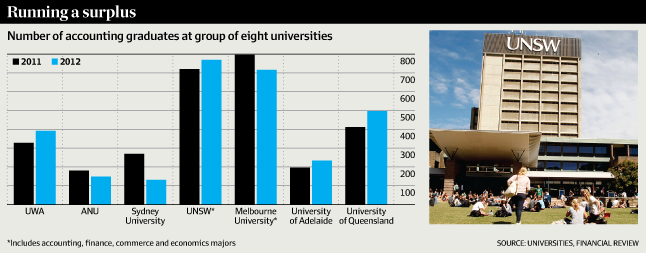
Accounting graduates face job market squeeze. And the notion of an accounting degree as a safe bet is under threat.

Accounting graduates face job market squeeze

PUBLISHED: 12 HOURS 11 MINUTES AGO | UPDATE: 4 HOURS 20 MINUTES AGO

e73cce96-c1ee-11e2-9cbc-90803cd1267c_22p33gradRESIZED

‘The supply of accounting education providers has increased – the market will become saturated and it will become difficult to get jobs,’ says Professor Raymond da Silva Rosa Photo: Bohdan Warchomij

AGNES KING

The trend towards offshoring low-level finance jobs and the fragmentation of financial services are affecting the job outcomes of accounting graduates. Confidential data being circulated among academics shows 25 per cent to 40 per cent of accounting graduates from the nation’s top universities haven’t secured work in the sector within a year of graduating. The market for accounting roles is becoming saturated. And the notion of an accounting degree as a safe bet is under threat. Read more of this post

Federal Reserve Bank of New York President Bill Dudley Says He Can’t Be Sure If Next QE Move Is ‘Up or Down’

Dudley Says He Can’t Be Sure If Next QE Move Is ‘Up or Down’

Federal Reserve Bank of New York President William C. Dudley said he has not decided whether the Fed’s next move should be to enlarge or shrink its bond buying program as he called for a fresh look at its eventual retreat from record asset purchases.

“Because the outlook is uncertain, I cannot be sure which way — up or down — the next change will be,” Dudley said in a speech today in New York.

Dudley adds his voice to a debate on the Federal Open Market Committee about what to do with its program of bond purchases, designed to lower the 7.5 percent unemployment rate. While many Fed officials have voiced support for shrinking purchases as the next step, Dudley, who is also vice chairman of the FOMC, signaled willingness to increase purchases. Read more of this post

Gold ETF Sellers Facing Tax Surprises at 28% Gains Rate

Gold ETF Sellers Facing Tax Surprises at 28% Gains Rate

Investors who dumped shares in gold exchange-traded funds amid the biggest selloff in the metal in four years may be in for a shock: capital-gains taxes are higher than for stocks and bonds.

Profits from investments in ETFs that back their shares with physical holdings of precious metals face taxes as high as 28 percent for investments held at least a year. That’s the rate the U.S. Internal Revenue Service applies to items it considers “collectibles,” such as coins, art, silver and gold. Long-term gains from stocks and bonds, including equity and fixed-income ETFs, are taxed at a maximum 20 percent.

“There are some tax surprises out there lurking for them when they go to sell,” Tim Steffen, director of financial planning at wealth-management firm Robert W. Baird & Co. in Milwaukee, said of gold exchange-traded product investors. Read more of this post

Gold’s Fall Stings University Endowment, saddling the second-largest U.S. college endowment with more than $300 million in paper losse

May 21, 2013, 5:22 p.m. ET

Gold U. Takes It on the Chin

Hit Is $300 Million at Endowment for Texas Schools, Which Invests in the Metal

By GREGORY ZUCKERMAN

MI-BW112_TEXAS_G_20130521183008

Gold’s slump has saddled the second-largest U.S. college endowment with more than $300 million in paper losses. But the swoon hasn’t shaken the faith of Bruce Zimmerman, who since 2007 has been chief executive of University of Texas Investment Management Co.

“We always prefer that our assets go up, rather than down, but we’re not day traders,” said Mr. Zimmerman, whose company invests $29.5 billion for the benefit of the University of Texas and Texas A&M systems. “Gold is a hedge, and it still fills that role.” Lately, investors have been dumping gold anew, citing limp inflation, a raging stock market and a reduced need for a safe-harbor investment. Gold prices fell Tuesday, their eighth decline in the past nine sessions. Few investors have suffered from the recent tumble like Utimco, which ranks behind only Harvard Management Co. in terms of assets in the university-endowment world. The organization holds about $1.1 billion of gold-related investments, down from about $1.4 billion before gold began heading south last October. Read more of this post

Hidden Bad Loans in Chinese Banks Raising Ponzi Risk

Hidden Bad Loans Raising Ponzi Risk

05-21 17:19 Caijing

Interest arbitrage practices, which constitute a self-loop within the financial sector, are likely to weaken the links between finance and the real economy and negatively impact the real economy.

By staff reporters Wang Peicheng, Dong Yuxiao, and You Xi

Official statistics show that the banking industry in China had 526.5 billion yuan worth of non-performing loans and a bad loan ratio of 0.96 percent by the end of the first quarter of 2013, which represents a 0.01 percent increase in the bad loan ratio since the end of 2012. However, the ratio is still below general expectations, given the slow and zigzagging growth in the real economy.

The real condition is far more serious than that reflected on financial reports, as are the potential risks in certain areas. “There is no point trying to gauge the actual risks facing the domestic banking industry with the bad loan ratio,” said an official at the China Banking Regulatory Commission (CBRC). Read more of this post

China’s banks face no-win situation; Given the continued downgrading of Chinese prospects, there may well be worse to come

May 21, 2013 5:29 pm

Inside Business: China’s banks face no-win situation

By Henny Sender

Given the continued downgrading of Chinese prospects, there may well be worse to come

When hundreds of private equity executives met in Washington last week to discuss emerging markets, China dominated the debate. This outcome at the International Finance Corporation and Emerging Markets Private Equity Association conference is hardly surprising, given how important China is for the health of the world economy and for the price of everything from coal to copper to credit.

Analysts have downgraded China’s growth prospects once more, making it clear that its slowdown is more than a cyclical phenomenon. Growth of 8 per cent used to be the floor and has instead become the ceiling, as Ruchir Sharma, managing director of Morgan Stanley Investment Management, puts it. Slowing growth is not necessarily a bad thing, if the quality of the growth improves. Maybe in time, it will. But not today. The rebalancing is still more aspiration than reality. Read more of this post