Korean chaebol CJ Group is under a prosecution investigation over an alleged slush fund

CJ hit by slush fund probe

2013-05-21

By Kim Jae-won prosecutors target chairman, raid offices

Prosecutors on Tuesday raided CJ Group’s Main Office and Affiliate firms, along with The Homes of a Number of executives in What appears to be an Investigation targeting Chairman Lee Jay-Hyun who is Suspected of Running a Slush Fund.  Read more of this post

Pesticides Make a Comeback; Many Corn Farmers Go Back to Using Chemicals as Mother Nature Outwits Genetically Modified Seeds

May 21, 2013, 8:28 p.m. ET

Pesticides Make a Comeback

Many Corn Farmers Go Back to Using Chemicals as Mother Nature Outwits Genetically Modified Seeds

By IAN BERRY

MK-CD405_PESTIC_NS_20130521181204

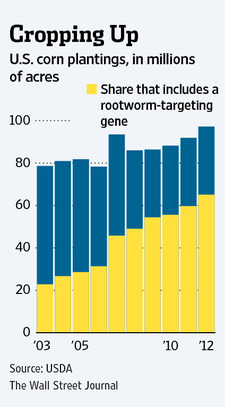
Insecticide sales are surging after years of decline, as American farmers plant more corn and a genetic modification designed to protect the crop from pests has started to lose its effectiveness. The sales are a boon for big pesticide makers, such as American Vanguard Corp.AVD +0.94% and Syngenta SYNN.VX -2.64% AG. But it has sparked fresh concerns among environmental groups and some scientists that one of the most widely touted benefits of genetically modified crops—that they reduce the need for chemical pest control—is unraveling. At the same time, the resurgence of insecticides could expose both farmers and beneficial insects to potential harm. Read more of this post

The Debt Problem Hasn’t Vanished; While deficit projections have recently moderated, the cost of servicing the national debt will explode once interest rates begin to rise

May 21, 2013, 6:59 p.m. ET

Gramm and McMillin: The Debt Problem Hasn’t Vanished

While deficit projections have recently moderated, the cost of servicing the national debt will explode once interest rates begin to rise.

By PHIL GRAMM AND STEVE MCMILLIN

President Obama has raised the national debt by nearly $6.2 trillion, the equivalent of $78,385 per family of four. It is true that projected deficits recently have been reduced. April tax filings increased 28% from 2012, but much of this was thanks to a one-time rush at the end of 2012 to report income before rates rose in January. The second largest reduction in the deficit came from Fannie Mae FNMA +11.04% taking a one-time accounting adjustment.

But unless the economy soars, or a significant budget agreement is reached, the most lasting legacy of the Obama presidency will be a $10 trillion increase in the national debt—a burden that bodes ill for the nation’s future.

Once the Federal Reserve’s easy-money policy comes to an end and interest rates return to their post-World War II norms, the cost of servicing this debt will explode. The cost will increase further as the Fed sells down its $1.85 trillion holding of government bonds, and the Social Security system runs deeper and deeper into the red. The Treasury will then have to pay interest on an ever-growing percentage of the debt. Read more of this post

Canada Real Estate Slump Only Just Beginning, Madani Says

Canada Real Estate Slump Only Just Beginning, Madani Says

Canada’s housing slump has only just begun and it is premature to say the market will have a so-called soft landing, said David Madani, an economist at Toronto-based Capital Economics Ltd.

“We don’t expect prices to rebound this year,” Madani said today at the Bloomberg Economic Summit in Toronto.

Finance Minister Jim Flaherty has acted four times in the past five years to make mortgage-lending rules more restrictive amid concern that the Vancouver and Toronto markets were overheating. Flaherty has said he welcomes a slowdown of condominium construction in the two cities and has warned consumers, who have a record debt-to-disposable-income ratio of 165 percent, not to become overextended. Read more of this post

US farmland faces asset bubble test

May 21, 2013 5:23 pm

US farmland faces asset bubble test

By Gregory Meyer in New York

A century ago, US farmland real estate enjoyed a huge boom. Interest rates were low. Grain prices were high. The world’s appetite for agricultural exports seemed endless. Now, as a strikingly similar story unfolds, land investors are hoping for a different ending. From 1900-19 US farmland gained 70 per cent. Then the farming economy was hit by a rise in interest rates and a slowdown in food imports after the first world war. Land prices collapsed back to turn-of-the-century levels by 1940. Over the past decade, US farmland prices have doubled as the Federal Reserve has held interest rates at historic lows and demand has stayed strong. The big question is what will happen when monetary policy is tightened and the supply of grain grows. The question is important not only for farmers bidding at country auctions, but also for big investors that have poured billions of dollars into farmland as a “real asset”. After embracing timber land and commodity futures, some are touting acreage planted with corn, cotton, almond or soya as a wager on rising population and incomes. “It’s a long-term belief in an upward trend,” says Linda Assante of investment firm Jasper Ridge Partners.

That belief is about to undergo a stiff test. First, most US crop prices are falling – CBOT corn delivered after the harvest is about $5 a bushel, the lowest in almost a year, as US, Brazilian and Argentine farmers eye record crops. Second, interest rates have nowhere to go but upwards. “When we get a combination of those two things – declining grain prices and rising interest rates – we’re going to see an adjustment in farmland values in the Midwest,” says Stephen Gabriel, chief economist at the Farm Credit Administration, which oversees government-sponsored agricultural lenders. “A 20 per cent decline would not be out of the question.” Read more of this post

Coal miners in Australia are auctioning port assets worth tens of millions of dollars, an unthinkable prospect as recently as 18 months ago, when they were scrambling to secure berths

May 21, 2013

Coal Miners Try to Unload Australian Port Assets

By Rhiannon Hoyle and David Winning

Coal miners in Australia are auctioning port assets worth tens of millions of dollars, an unthinkable prospect as recently as 18 months ago, when they were scrambling to secure berths.

Australia exports more than 80% of its coal output, and miners signed long-term deals with port operators to lock in space at export terminals when coal prices were high. Now, these contracts are weighing on profits as companies face delays to new projects and battle falling coal prices.

Miners like Glencore Xstrata PLC GLEN.LN +3.30%and Yancoal Australia Ltd. YAL.AU 0.00%are putting excess port capacity on the block, signaling a lack of confidence that coal prices will rebound soon. But slack demand for coal and rising supply from Russia and Indonesia suggest the auctions will likely attract few bidders. Read more of this post

China Development Bank Calls Meeting as Bundled SME Bond Sours; maker of baby formula has stopped operations, its owner can’t be contacted and it’s no longer able to repay principal or interest

China Development Bank Calls Meeting as Bundled SME Bond Sours

China Development Bank Corp. will call a meeting of investors in a bundled bond that the bank underwrote to arrange for payment of interest and principal after one of the borrowers became insolvent.

Harbin Huijiabei Foods Co. was one of four companies that issued the 170 million-yuan ($27.7 million) three-year bond in 2010, the bank said in a statement today on the website of the National Association of Financial Market Institutional Investors. The maker of baby formula has stopped operations, its owner can’t be contacted and it’s no longer able to repay principal or interest, according to the statement.

China introduced bundled bonds in 2009 to help smaller companies raise funds by combining the debt of several enterprises into one security. The Shenzhen Small & Medium Enterprises Credit Financing Guarantee Group Co., the guarantor of the bundled bond, will make payments if Huijiabei can’t, according to the statement.

The investor meeting, scheduled for May 24 in the city of Harbin, comes as slowing economic growth spurs concerns that more companies may be unable to repay borrowing. Bad loans at Chinese banks increased for a sixth straight quarter in the first three months of this year, when economic growth slowed to 7.7 percent from 7.9 percent in the fourth quarter of last year. Read more of this post

Muddy Waters’ Carson Block Says China Banks’ Bad Loans Spread Beyond Government Debt

Block Says China Banks’ Bad Loans Spread Beyond Government Debt

Carson Block, the short seller who runs Muddy Waters LLC, said China’s bad-loan problem is more widespread than just local government debt and includes public and private sector borrowing.

Non-performing loan “figures greatly understate the potential scope of the problem of poor-quality loans,” Block said in an e-mail. “We believe that the PRC banking system will be hit hard by the unwind, and that the government will be forced to recapitalize a number of the banks.”

Chinese banks are grappling with rising defaults and slowing profit growth as regulators ease controls over loan pricing and deposits to spur competition. The country’s soured debt, which has risen for six straight quarters, in part prompted Block to bet against the bonds of Standard Chartered Plc, the U.K. bank that earns most of its profit in Asia.

Bad debt in China climbed to 526.5 billion yuan ($86 billion) in the three months through March, marking the longest deterioration streak in at least nine years, according to regulatory data released this month. Read more of this post

Singapore’s GIC Cautious About Seeking Higher Returns as Yields Remain Low

GIC Cautious About Seeking Higher Returns as Yields Remain Low

Government of Singapore Investment Corp., which manages more than $100 bilion of assets, said it’s more “cautious” about seeking higher returns on its assets as yields remain low. The average annual return on bond yields will be about 1.9 percent over the next decade, while equities may offer a 1.6 percent median real return a year during that period, said Lim Chow Kiat, chief investment officer of the fund, citing different portfolio models.

“We are getting more cautious in reaching out for higher yielding assets,” Lim, who assumed his position in February, said at a conference in Singapore today. “No one can predict when the end game will be, but we can prepare for it.” Central banks are putting downward pressure on benchmark borrowing costs, leading investors to seek higher-yielding assets outside of government bond markets. U.S. 10-year rates fell to an all-time low of 1.38 percent in July, and the Standard & Poor’s 500 Index rallied to a record this week. “Central banks will find it hard to exit from this quantitative easing policy,” Lim said, adding that “substantial risks remain.”

Read more of this post

China Trade Surplus Seen by BofA at One-Tenth Official Figure

China Trade Surplus Seen by BofA at One-Tenth Official Figure

China’s trade surplus is one-tenth the official $61 billion reported so far this year after accounting for fake transactions used to disguise hot-money inflows, Bank of America Corp. says.

The true surplus is about $6 billion, according to Lu Ting, Bank of America’s head of Greater China economics in Hong Kong. That would be the smallest for January-April since the nation posted a $10.8 billion deficit in 2004.

Lu’s calculations suggest the surplus shrank instead of tripling from a year earlier, a sign that global demand is restraining rather than boosting the world’s second-largest economy. Bank of America’s estimate underscores the size of possible discrepancies in the trade data, which has been disputed by analysts for four months, and broader skepticism about Chinese statistics from gross domestic product to jobs. Read more of this post

Artificial Growth Exhibit A: China’s Inventory Stockpiling Hits All Time High

Artificial Growth Exhibit A: China’s Inventory Stockpiling Hits All Time High

Tyler Durden on 05/20/2013 15:49 -0400

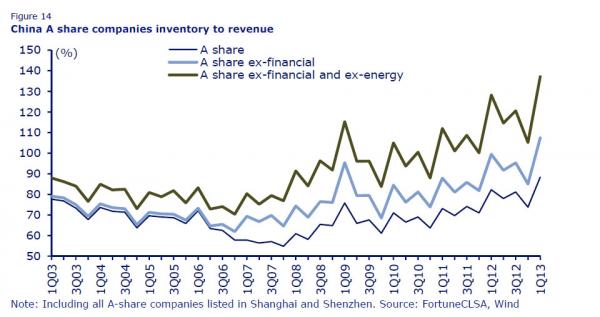
Need a quick GDP boost in a world in which the uber levered consumer is tapped out and has no more savings or purchasing power, in which the government is facing an existential socialism or bust crisis even as global sovereign debt levels are at unseens before levels, and in which global trade has collapsed (so there go the C, G and (X-M) components of GDP)? No problem, just add some I for Inventory. Better yet, add a whole lot of I, especially if you are that global growth dynamo, China, which over the years many have accused of having taken the term “overcapacity” and put it through the Barry Bonds juicer yet where courtesy of a central-planning regime that has made sure nothing appears to be unused, except for the occasional ghost city or empty mall, proof of such overcapacity has been scarce in official, government data. Well, today we have definitive evidence – once again courtesy of the private sector where fudging and manipulating data is that much more difficult – that Chinese Inventory is now at absolutely all time record highs. Below, courtesy of CLSA’s Chris Wood, is a chart of rising inventories as a percentage of revenue. What is visible is that the inventory-to-revenue ratio of A share companies, excluding financials and energy, increased to a historical high of 1.37x in 1Q13, while the receivable-to-revenue ratio also rose to a 10-year high of 0.52x. And that’s were the bulk of Chinese “growth” has come from, which in turn is supposed to be the global growth buffer because without China growing at a comfortable 7.5%-8%, the rest of the world is lost. But don’t worry, “if you stock up on enough inventory, they will come.“… Unless they don’t. In which case the resultant massive wholesale inventory dump will be an epic sight to behold.

China Inv Sales Ratio_0

Chinese businesses grapple with succession

Chinese businesses grapple with succession

Staff Reporter

2013-05-19

Several Chinese companies established after the country introduced economic reforms in the 1980s, are facing succession issues, as company founders and key executives near the age of retirement, the mainland-based China Times reports. Some of the first-generation entrepreneurs, who successfully built their businesses or state-owned companies, see the company as their own personal assets and find it difficult to leave their positions quietly to make way for the next generation, the paper said. Read more of this post

Hunan Rice Sales Plunge as China Probes Cadmium Contamination

Hunan Rice Sales Plunge as China Probes Cadmium Contamination

Sales of rice from China’s top producing province have slumped amid reports that supplies from Hunan contain traces of cadmium that exceed government limits, a state-owned agriculture researcher said.

Rice traders in Hunan reported sales dropping by more than half from a year ago since media reports of the pollutant in began appearing, Cngrain.com said on its website. The researcher, which is owned by China Grain Reserves Corp., a custodian of government food reserves, didn’t provide figures for the drop in sales.

The Nanfang Daily first reported in February that rice from Hunan sold in southern Guangdong province contained excessive levels of toxic metal and the Guangzhou Food and Drug Administration reignited concerns with reports on its website last week. It is a blow to farmers in the region because sales of indica rice, a long-grain variety consumed in southern China and used for milling and brewing, were already being hurt by low-cost imports, Zhang Zhixian, analyst of Cngrain.com, said by phone from Zhengzhou in central China. Read more of this post

China’s tea companies hard-pressed to successfully list

China’s tea companies hard-pressed to successfully list

Staff Reporter

2013-05-20

20130520000027

A Bama Tea store. (Photo/CFP)

Despite having capital support, tea enterprises find it very challenging to get listed on the A-share market in China, owing to their small revenue scale, limited profit-earning capabilities, poor internal management and limited scope for business expansion.

The Fujian-based Bama Tea recently hit headlines on the mainland with news of it preparing to launch an initial public offering (IPO) after acquiring funds totaling 150 million yuan (US$24.4 million) from four venture capital companies.

However, Bama’s ambition to become China’s first listed tea company is “very unlikely,” China Business News reported. “The possibility is very small,” the newspaper said, citing Ouyang Daokun, secretary-general of the China Tea Leaders Club. Read more of this post

Australian mining and resources sector contractors are suffering with major customers deferring projects as commodity prices fall and costs rise

Transfield Leads Slump in Infrastructure Providers: Sydney Mover

Transfield Services Ltd. (TSE) plunged to the lowest in 12 years in Sydney, leading a slump in mining and infrastructure contractors, after cutting its earnings forecast amid a slowdown in mining and processing activity.

Transfield fell 24 percent to 97 Australian cents, the lowest since May 3, 2001. Fleetwood Corp., which sells and rents portable buildings to infrastructure and mining customers, tumbled 25 percent after saying yesterday that second-half earnings will be below the first half amid a “softening resources sector.” The two companies were among the three worst performers in the benchmark S&P/ASX 200 (AS51) Index.

Mining and resources sector contractors are suffering with major customers deferring projects as commodity prices fall and costs rise. BHP Billiton Ltd. (BHP), the world’s largest mining company, is targeting an 18 percent cut to capital spending in fiscal 2014, its new chief executive, Andrew Mackenzie, said May 14. Rio Tinto Group is seeking to cut $2 billion in costs this year across its mining and corporate offices. Read more of this post

Hershey Keen for Piece of China

May 20, 2013, 2:56 p.m. ET

Hershey Keen for Piece of China

By COLUM MURPHY in Shanghai and LAURIE BURKITT in Beijing

AM-AY591_CHERSH_G_20130520135107

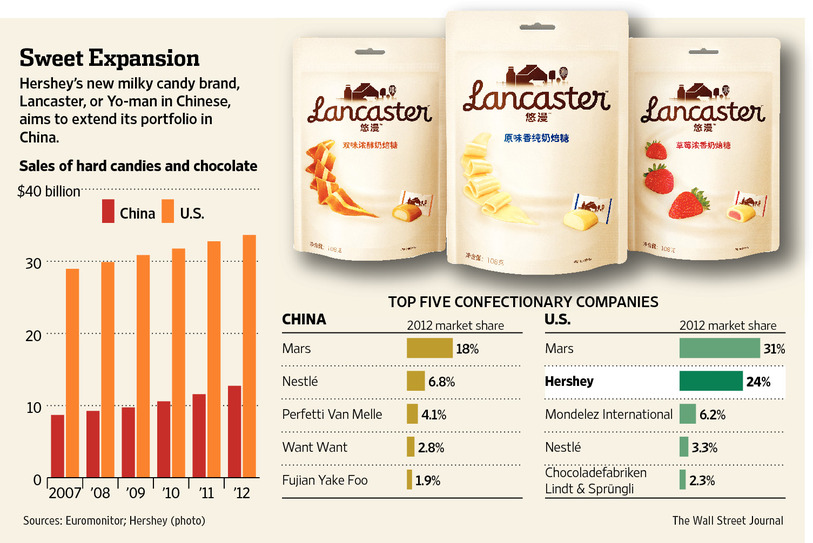
Aware that it needs China’s sweet tooth, Hershey Co. HSY -1.44% is rolling out a Chinese brand designed for the world’s fastest-growing candy market.

In a first launch beyond the U.S. market, Hershey is unveiling on Tuesday a candy known in English as the Lancaster and in Chinese as Yo-man. The Pennsylvania company plans to spend “several million dollars” marketing three kinds of the condensed-milk candy to gain a share of China’s market for milk candy, which Hershey estimated to be worth 7.5 billion yuan ($1.2 billion).

Premium milk candy is the fastest-growing segment in China’s candy market, Hershey said. Read more of this post

Half of the silk on sale in Beijing contains little or no silk, study finds

Half of the silk on sale in Beijing contains little or no silk, study finds

Monday, 20 May, 2013, 12:19pm

Ernest Kao ernest.kao@scmp.com

Study finds some silk on sale in Beijing doesn’t contain any silk

Another product has been added to the list of unsafe Chinese exports, but consumers can breathe a sigh of relief because unlike ginger, cooking oil, milk powder and rice, this one is not to be ingested.

At least half of the silk products on sale in China’s capital do not meet safety and quality standards, according to a Beijing Consumers Association study, with most cases finding that the product contained little or no silk at all. The study tested 40 types of silk products bought from local retailers, department stores and online stores including Wal-Mart, Wumart, Sogo and e-commerce site Jingdong Mall. Read more of this post

There’s a catch to Chinese President Xi’s tiger trap; is this beginning of the end of Xi’s campaign against corruption? Xi will need to be careful not to be trapped by powerful entrenched internal resistance from within the Party’s most senior levels

There’s a catch to Xi’s tiger trap

Geoff Raby7 hours ago1

A cardinal rule in politics is to under-promise and over-deliver. When Xi Jinping late last year, on becoming Communist Party of China general secretary, announced (yet another) crackdown on corruption, he raised the bar by declaring that it would not be enough to “swat flies” but “tigers” also had to be caught. In doing so, he immediately raised expectations which he seemed in danger of disappointing.

Last week’s sensational announcement that Liu Tienan was under investigation for corruption may now have changed all that. In March, Liu was removed from his post as director of the National Energy Agency in the all-powerful National Development and Reform Commission – but continued on as an NDRC vice chairman. Read more of this post

CHART OF THE DAY: This Chart Comparing Caterpillar To Citi Shows How The US Is Kicking China’s Butt

CHART OF THE DAY: This Chart Comparing Caterpillar To Citi Shows How The US Is Kicking China’s Butt

Matthew Boesler | May 20, 2013, 10:20 AM | 2,382 | 1

The chart below, via BofA Merrill Lynch strategist Michael Hartnett, provides an interesting visualization of one of the big themes playing out in global markets right now. Bloomberg TV anchor Scarlet Fu called this her “single best chart” this morning. Citigroup, one of America’s largest banks and something of a poster child for the global financial crisis, is taking back ground against Caterpillar, the global construction machinery giant seen as a bellwether for global growth, particularly in China. The chart underscores both the outperformance of the U.S. economy relative to the rest of the world that everyone is buzzing about and concurrent fears over a global growth slowdown in general, a story in which China plays a central role.

moneygame-cotd-052013

Unclear whether Fed’s QE bond buying has helped economy: Fisher

Unclear whether Fed’s bond buying has helped economy: Fisher

8:36am EDT

(Reuters) – While the Federal Reserve’s accommodative policies have boosted stocks and helped the rich, it is unclear whether they are doing enough for the broader U.S. economy, a top central bank official said on Monday. “We’ve made rich people richer…,” Dallas Fed President Richard Fisher said on CNBC television. “Question is what have we done for working men and women in America?” Fisher, who has long opposed the Fed’s bond-buying program and wants to reduce it, added he expects real gross domestic product growth of more than 2.5 percent by year end. The central bank is buying $45 billion in Treasury bonds and $40 billion in mortgage bonds each month in an effort to encourage investment, hiring and economic growth in part because the unemployment rate remains high at 7.5 percent. Read more of this post

Bond Love Endures for Investors Unconvinced Rally’s Over

Bond Love Endures for Investors Unconvinced Rally’s Over

Bill Gross, the world’s largest fixed-income manager, says the bull market for bonds may have ended last month. Investors are staying put.

Four years into the biggest rally in U.S. stocks since 2000, bond mutual funds are attracting more money than their equity counterparts. After at least three warnings from Gross that the fixed-income market has peaked, there’s no evidence of what strategists including Michael Hartnett of Bank of America Corp. have predicted would be a ‘great rotation’ out of fixed income into stocks.

“For the past 25 years, you’ve seen the stable decline of interest rates and a level of comfort that bonds are the stable asset,” Rick Rieder, New York-based BlackRock Inc.’s co-head of fixed income in the Americas, said in an interview. “Money will still flow into bond funds for the next couple of years because of the tremendous need for income by an aging population.” Read more of this post

Gross to Buffett Omens Disregarded as Sales Soar: Credit Markets

Gross to Buffett Omens Disregarded as Sales Soar: Credit Markets

Sales of corporate bonds in the U.S. are surging toward the busiest May ever as borrowers race to the market before demand dries up with Bill Gross and Warren Buffett cautioning against buying debt at all-time low yields.

Petroleo Brasileiro SA’s $11 billion deal, the biggest on record for an emerging markets issuer, leads sales this month of $120.2 billion, on pace to exceed the unprecedented $162.6 billion sold in May 2008, data compiled by Bloomberg show. Issuance has already eclipsed the $108.2 billion sold in all of May 2012.

Borrowers are accelerating sales as speculation mounts that yields may only rise amid signs the economy is improving. Three Federal Reserve regional bank presidents called last week for phasing out the central bank’s monthly purchases of $40 billion in mortgage-backed securities as the housing recovery shows signs of gaining momentum, potentially reducing demand for riskier assets from stocks to speculative-grade bonds.

“Many issuers may decide it is not worth tempting that fate,” Edward Marrinan, a macro credit strategist at RBS Securities in Stamford, Connecticut, said in a telephone interview. The firm is one of the 21 primary dealers of U.S. government securities authorized to trade with the Fed. Read more of this post

Knesset to vote on law tightening pyramid structure of Israeli businesses

Knesset to vote on law tightening pyramid structure of Israeli businesses

Lawmakers agree to give holding groups six years to dismantle excess layers of their “pyramid” structure after the bill becomes law.

By Zvi Zrahiya | May.21, 2013 | 9:11 AM

The Knesset Finance Committee is scheduled to vote on Tuesday on the Business Concentration Law, after lawmakers agreed to toughen its terms to permit no more than two tiers of chained ownership, committee chairman Nissan Slomiansky ‏(Habayit Hayehudi‏) said Monday.

However, lawmakers agreed to give holding groups six years to dismantle excess layers of their “pyramid” structure after the bill becomes law. That is two more years than the government panel proposing the law wanted to allow. That panel had also proposed limiting pyramids to two tiers only for new holding groups, while letting existing groups retain three. Read more of this post

ThyssenKrupp Woes Tarnish 99-Year-Old German Steel Baron’s Legacy

ThyssenKrupp Woes Tarnish 99-Year-Old Steel Baron’s Legacy

For 60 years, the name of Berthold Beitz has been synonymous with Germany’s biggest steelmaker, ThyssenKrupp AG (TKA), at first for his role in rebuilding the former arms supplier and helping it break with its Nazi past.

Now, as head of the foundation that holds a 25.3 percent blocking minority, the 99-year-old has become a symbol of much that has gone wrong at the Essen-based company, whose stainless steel was used in Manhattan’s Chrysler and Empire State buildings. ThyssenKrupp is again seeking renewal after a botched expansion in the Americas and bribery and price-fixing scandals pushed it to a 4.7 billion euro ($6.1 billion) annual loss.

The power wielded by the German industrialist, who was a little known insurance executive when he was hired as general manager by the last Krupp family owner in 1953, is under attack from investors who hold him partly accountable for lax corporate governance that led to the missteps. With the company on May 15 refusing to rule out a capital increase to repair its balance sheet, the foundation over which Beitz presides risks losing its influence. Read more of this post

Mexico’s 400,000 Abandoned Homes Draw Venture Capital

Mexico’s 400,000 Abandoned Homes Draw Venture Capital

Mexico’s attempt to solve the country’s housing shortage by constructing millions of new homes far from city centers has crippled the nation’s homebuilders and fueled record foreclosures. For Antonio Diaz, a former investment banker with Banco Santander SA, it’s an opportunity.

Diaz’s company, backed by a venture-capital firm whose funders include JPMorgan Chase & Co. and the Soros Economic Development Fund, is buying foreclosed homes for as little as 60 percent of face value, refurbishing them and then selling them for up to 90 percent of a new home price. The number of properties sold by Tijuana-based Comunidades que Renacen SAPI, or ProVive, climbed 10-fold to 530 last year, and its target is to sell 1,300 units in 2013, said Diaz.

For Diaz, 53, it’s not just about making money. It’s an attempt to repopulate towns that face an exodus and plunging property values after the government subsidized developments that sprawled too far from cities and led to unattended buildings that lured criminals and illegal tenants. He estimates there are 400,000 deserted homes and another 200,000 held by squatters, even as the economy is projected by the government to grow 3.1 percent this year.

The number of empty properties “creates a very interesting universe for doing business,” Diaz said. Read more of this post
As Greece Struggles with Debt Crisis, Its Shipping Tycoons Still Cut a Profit

As Greece Struggles with Debt Crisis, Its Shipping Tycoons Still Cut a Profit

By Yannis Palaiologos / AthensMay 16, 201312 Comments

On December 5 last year, the Ob River, an 288-metre LNG (Liquefied Natural Gas) tanker with a capacity of 84,682 deadweight tonnes chartered by Russian energy giant Gazprom, arrived at the Japanese port of Tobata. The ship belonged to Dynagas, a privately held company owned by George Prokopiou, one of Greece’s preeminent shipping magnates.

It was a delivery of historic significance. To make it, the Ob River had traveled through more than 3,000 miles of the bleak, icy expanse of the Northern Sea Route, accompanied by two nuclear-powered Russian icebreakers. It was the first ever sea voyage of an LNG cargo through the frozen waters north of Siberia, cutting the distance traveled from Norway to Japan by more than 5,000 miles compared to the Suez Canal route. Read more of this post

Financial markets are at risk of a ‘big data’ crash

May 20, 2013 6:37 pm

Financial markets are at risk of a ‘big data’ crash

By Maureen O’Hara and David Easley

Regulation needs to adapt to computerised details, write Maureen O’Hara and David Easley

Regulators and investors are struggling to meet the challenges posed by high-frequency trading. This ultra-fast, computerised segment of finance now accounts for most trades. HFT also contributed to the “flash crash”, the sudden, vertiginous fall in the Dow Jones Industrial Average in May 2010, according to US regulators. However, the HFT of today is very different from that of three years ago. This is because of “big data”.

The term describes data sets that are so large or complex (or both) that they cannot be efficiently managed with standard software. Financial markets are significant producers of big data: trades, quotes, earnings statements, consumer research reports, official statistical releases, polls, news articles, etc. Read more of this post

Adaro Energy Chief Says Thermal Coal at $100 a Ton Is New Normal, which is half a peak reached in 2008

Adaro Energy Chief Says Coal at $100 a Ton Is New Normal

PT Adaro Energy (ADRO), Indonesia’s second-biggest producer of power-station coal, said miners will have to adjust to prices of about $100 a metric ton, which is half a peak reached in 2008.

“The new normal, I think, would be $95 to $100 a ton, based on the marginal cost of production in the region,” Adaro Energy President Director Garibaldi Thohir said in an interview.

A slump in coal prices will help ease oversupply as it would prompt some small and high-cost miners to reduce output or stop production, Thohir said in his office in Jakarta on May 17. Adaro is expected to report lower net income this year than in 2012, Thohir said, without giving a specific forecast.

The price of coal has fallen by more than half since a peak in mid-2008 amid slowing Chinese imports and rising output from producers including Indonesia and Colombia. The decline is forcing companies including Adaro to trim costs to safeguard margins. Thohir said the price may have bottomed. Read more of this post

15 years on, debate over Suharto’s legacy still simmers

15 years on, debate over Suharto’s legacy still simmers

BY – 5 HOURS 11 MIN AGO

JAKARTA — Tree-lined Cendana street in an upscale neighbourhood in central Jakarta has not changed much in recent decades, save for the demolition of a few Dutch colonial homes in favour of modernist villas. Yet, a former resident whose home once took up the entire middle of the block initiated dramatic changes in his country and, 15 years after he disappeared from Indonesia’s political scene, debate still rages about whether they were for better or worse.

Cendana is synonymous with Suharto, the army general-turned-President who ruled Indonesia for 32 years while residing in the houses at Nos 6, 8 and 10, which were renovated and connected. After his death in 2008, an Indonesian Web portal dedicated to paranormal activity published an account by an elderly servant who said Suharto’s ghost was still there and occasionally pinched and poked him.

Perhaps. But more certain is that Suharto’s spirit continues to loom over modern-day Indonesia. Read more of this post

Japan Inc. averse to further yen drop, poll finds

Exclusive: Japan Inc. averse to further yen drop, poll finds

By Kaori Kaneko, Tetsushi Kajimoto

Filed 10 hours ago

TOKYO – Signs are that most firms in export-driven Japan Inc, having got the weaker yen they craved, now want the currency to either stabilize or recover ground, rather than continue a slide that will increasingly raise their costs.

About half the Japanese companies in a new Reuters survey say the yen has fallen enough, just 15 percent want a further yen decline and more than one-third would in fact like to see the currency rebound from its 4-1/2-year lows.

At the same time, top officials in Prime Minister Shinzo Abe’s half-year-old government — who used to stress the urgency of reversing the yen’s strength — have also begun highlighting the downside of the yen’s steep slide, such as higher imported-energy costs. Read more of this post