A Japanese government panel warns there is “absolutely no guarantee” that domestic investors will keep financing the country’s massive public debt, citing the risk of a spike in bond yields that could crimp long-term growth prospects

Exclusive: Japan panel warns of dangers if debt not addressed

8:57am EDT

By Takaya Yamaguchi

TOKYO (Reuters) – A Japanese government panel warns there is “absolutely no guarantee” that domestic investors will keep financing the country’s massive public debt, citing the risk of a spike in bond yields that could crimp long-term growth prospects, according to a draft report seen by Reuters on Monday.

The warning from the advisory panel to Finance Minister Taro Aso comes at a critical time – when the government bond market has seen volatile price falls, underscoring a delicate balancing act for Prime Minister Shinzo Abe’s government.

Abe has unleashed huge fiscal and monetary stimulus to spur short-term growth, sending stock prices .N225soaring. But at the same time, he is trying to convince investors that over the longer term Japan will tackle a public debt that, at more than twice the nation’s annual economic output, is the biggest in the developed world. Read more of this post
Japan Inc. Should Take a Look in the Mirror

Japan Inc. Should Take a Look in the Mirror

Sony Corp.’s curt dismissal of a foreigner’s advice last week didn’t shock Michael Woodford, the former chief executive officer of Olympus Corp.

“The club, meaning corporate Japan, will do everything it can to mask and hide what’s wrong. That’s what’s most important,” said Woodford, a Briton who was fired in late 2011 after he exposed a $1.7 billion accounting fraud in his own company.

Woodford’s tale is worth revisiting as Sony rebuffs a proposal from hedge-fund investor Daniel Loeb for the company to sell off its entertainment divisions and focus on hardware. Far from being rewarded for trying to clean up the 93-year-old Olympus, Woodford was ousted by his board, which criticized him for being culturally insensitive. Clearly the non-Japanese CEO didn’t understand the clubby, docile ways of Japan Inc.

Now Loeb is running into a similar wall of disdain. Sony CEO Kazuo Hirai has 100 billion reasons — the market value in dollars the company has lost since 2000 — to consider the American’s plea to bring more focus to Sony’s disjointed businesses. Yet Hirai is unmoved. Why? Even though Loeb holds a sizable $1.1 billion stake in the company, Hirai knows a critical mass of domestic investors, the ones who really matter, are certain to support him against any brash outsider. Read more of this post

China trying to manage exposure of corruption online

China trying to manage exposure of corruption online

7:29am EDT

By Terril Yue Jones

BEIJING (Reuters) – China’s Internet is brimming with disclosures of officials collecting bribes, homes and luxury accessories as casually as they do mistresses.

But while the government tolerates such anti-corruption vigilantism, it is also extremely leery of the threat the Internet can pose to Communist Party rule.

The Internet is the new tool in the fight against corruption – a cornerstone policy of new President Xi Jinping, who has pledged to tackle the problem head-on.

But while acknowledging that China’s online world is helpful, authorities have also moved quickly to quash rumors that might fan protests that could escalate out of control, deleting microblog posts or even entire accounts. Read more of this post

The only Fortune 500 company that’s grown faster than Apple; A big player in a low-profile business has outpaced the tech giant in both revenue growth (10-Yr) and stock return (5-Yr)

The only Fortune 500 company that’s grown faster than Apple

May 20, 2013: 10:38 AM ET

A big player in a low-profile business has outpaced the tech giant in both revenue growth and stock return.

World Fuel Services sells fuel to cargo ships and tankers globally.

By Brian O’Keefe, assistant managing editor

Fortune — The growth of Apple (AAPL) over the past decade is one of the most extraordinary stories in American business history. Ten years ago, the computer giant ranked No. 300 on the Fortune 500 with $5.7 billion in revenues. This year — millions of iPods, iPhones, and iPads later — Apple is ranked No. 6 on the 500 with $156.5 billion in revenues. And yet, Apple is not the fastest-growing company in the Fortune 500 over that span — at least on a percentage basis. That honor belongs to a company called World Fuel Services (INT), which ranks No. 74 on this year’s 500 list with $38.9 billion in revenues. Over the past decade, World Fuel grew its revenues at a blistering annual rate of 39.8%, or just good enough to edge out Apple’s average annual growth rate of 39.2%. Here’s another surprising fact about World Fuel Services: Its stock has easily trounced both Apple and the broader market over the past five years: In that span World Fuel shares have risen 230% vs. 131% for Apple and just 17% for the S&P 500. Read more of this post

Investors Turn Choosy on Chinese Debt after a deluge of offerings

Updated May 20, 2013, 12:22 p.m. ET

Investors Turn Choosy on Chinese Debt

By FIONA LAW

AM-AY597_CBOND_NS_20130520084504

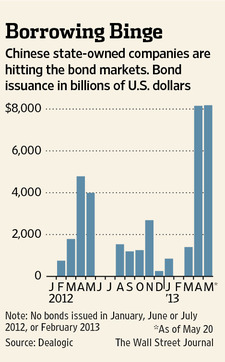
State-owned China International Marine Containers 000039.SZ +0.72% (Group) Co., the world’s largest producer of shipping containers, has postponed a bond sale after global fund managers balked at the interest rate, according to two people with direct knowledge of the matter. The delay may signal that investors are getting picky after a deluge of offerings. Investors had gorged on a record $18.6 billion in dollar-denominated bonds issued this year by Chinese state-owned companies, which typically offer higher returns than investment-grade companies in developed markets. “There’s been a lot of supply, and the beauty of that is, I can choose not to buy some of them,” said Bryan Collins, Hong Kong-based fixed-income portfolio manager at Fidelity Worldwide Investment, referring to the state-owned enterprises’ rising debt. He declined to comment on specific bonds.

Read more of this post

Rival inflation index created by Chinese e-commerce giant Alibaba that suggested China’s official inflation numbers might be too low prompts China’s National Bureau of Statistics into rebuttal action

May 20, 2013, 7:04 PM

Inflation Deflated? Evaluating the ‘Alibaba Index’

AI-CB077_CRT_bl_NS_20130520054205

How high is inflation in China? Some suspect it is higher than is captured in the official consumer price index. A new measure developed by e-commerce giant Alibaba Group Holding Ltd. seems to give that idea some credibility. The official CPI puts inflation at 2.4% year-on-year in April. Alibaba’s Internet Shopping Price Index – based on transactions on the firm’s Taobao and Tmall websites – puts it at 6.9%. After an article in The Wall Street Journal drew attention to the discrepancy, China’s National Bureau of Statistics went into action. They pored over the description of the Alibaba index (in Chinese), and dispatched researchers to Hangzhou to interview its creators. They came back with two key conclusions.

Read more of this post

Oil Out of Sync With Market Forces; Prices of many commodities are down this year, but U.S. oil futures have rallied. Skeptics say the mismatch is a sign of trouble.

Updated May 19, 2013, 5:58 p.m. ET

Oil Out of Sync With Market Forces

By CHRISTIAN BERTHELSEN

MI-BW041_Abreas_G_20130519173904

Prices of many commodities are down this year, but U.S. oil futures have rallied. Skeptics say the mismatch is a sign of trouble. U.S. benchmark crude-oil futures ended Friday at $96.02, up 4.6% since the start of 2013. Oil is a standout in a mostly dismal year for commodities, as the Dow Jones-UBS UBSN.VX +1.65% Commodity Index has fallen 5.6%. The decline has been even steeper for gold, copper and other former darlings. Oil isn’t a gusher compared with stocks, such as the Dow Jones Industrial Average, which is up 16% this year. But some analysts and investors say oil’s rise is remarkable because it came despite several factors that often push prices lower. For example, U.S. economic growth is tepid, domestic oil stockpiles are at their highest in more than three decades, the unemployment rate is at 7.5% in the U.S., and inflation is lower than the Federal Reserve’s target of 2%. Meanwhile, domestic oil production is soaring and U.S. fuel demand is soft.

Read more of this post

India’s industrial dreams sputter

India’s industrial dreams sputter

There is an urgent need for manufacturing to expand to boost growth and create jobs. -ST
Krittivas Mukherjee
Sun, May 19, 2013
The Straits Times

NEW DELHI – A US$ 12 billion (S$15 billion) steel factory in eastern India was supposed to be the country’s biggest foreign investment, the symbol of a nation’s rush to become an industrial giant. Seven years on, the site is still a patch of sand with a few beat-up containers.

The steel mill that was to be built by South Korean giant Pos- co has been caught up in a drawn-out battle with villagers for land and for government environmental clearances. Thus it has become a symbol of all that needs to change if India is to become a global manufacturing hub.

India is expanding at its slowest in a decade. If it wants to revive lasting growth and absorb some 10 million Indians set to join the workforce annually over the next decade it must shift its economic engine towards manufacturing, industry and analysts say. Instead, factory output has steadily declined, underlining the challenge India faces in achieving its target of expanding manufacturing’s share of gross domestic product to a quarter by 2022 from about 15 per cent now. Read more of this post

China Development Bank Says $8.1 Trillion Needed for Urban Shift; China must urgently find special financing channels to support the urbanization process because local governments can’t afford the spending

China Development Bank Says $8.1 Trillion Needed for Urban Shift

China needs at least 50 trillion yuan ($8.1 trillion) in new investment by 2020 to accommodate a burgeoning population of city-dwellers, according to the president of China Development Bank.

China must urgently find special financing channels to support the urbanization process because local governments can’t afford the spending, Zheng Zhijie, the bank’s president, wrote in an article in the May 16 issue of China Finance, a journal run by the People’s Bank of China. Zheng didn’t elaborate on the estimate, which is about equal to the nation’s nominal gross domestic product in 2012.

The figure shows the extent to which China will need to come up with funds for roads and benefits as part of Premier Li Keqiang’s efforts to make urbanization a key engine of growth. China Development Bank, the world’s largest policy lender, created the the nation’s system of local financing for infrastructure projects. Read more of this post

Vietnam Says Economy at Great Risk of Macroeconomic Instability

Vietnam Says Economy at Great Risk of Macroeconomic Instability

Vietnam still faces “great risk” of macroeconomic instability, a deputy premier said, as credit growth trails behind targets while banks work to reduce elevated bad debt that has hampered growth. While Vietnam is targeting a 12 percent expansion in credit this year, local businesses are facing difficulties getting loans, Deputy Prime Minister Nguyen Xuan Phuc told the National Assembly in Hanoi today. Credit grew about 2 percent in the first four months of the year, the government said last week. The economy expanded 5.03 percent last year, the slowest pace since 1999, and the International Monetary Fund last month cut this year’s forecast to 5.2 percent from 5.8 percent. Lending grew last year by what the World Bank described as an “anemic” 9 percent, and while the central bank has cut policy rates, its attempts to spur growth have been countered by delays in forming a vehicle to address bad debt.

Read more of this post

“Whiskey is for drinking, and water is for fighting.”: The fight for North Dakota’s fracking-water market

Insight: The fight for North Dakota’s fracking-water market

12:48am EDT

By Ernest Scheyder

WATFORD CITY, North Dakota (Reuters) – In towns across North Dakota, the wellhead of the North American energy boom, the locals have taken to quoting the adage: “Whiskey is for drinking, and water is for fighting.”

It’s not that they lack water, like Texas and California. They are swimming in it, and it is free for the taking. Yet as the state’s Bakken shale fields have grown, so has the fight over who has the right to tap into the multimillion-dollar market to supply water to the energy sector.

North Dakota now accounts for over 10 percent of U.S. energy output, and production could double over the next decade. The state draws water from the Missouri River and aquifers for its hydraulic fracturing, the process also known as fracking and the key that has unlocked America’s abundant shale deposits. The process is water-intensive and requires more than 2 million gallons of water per well, equal to baths for some 40,000 people. Read more of this post

China’s national problems start in local government; Appeals for financial restraint and prudent investment have failed

May 19, 2013 6:32 pm

China’s national problems start in local government

By George Magnus

Appeals for financial restraint and prudent investment have failed, writes George Magnus

The structural slowdown in China’s economy is starting to cause waves in Beijing, prompting trenchant questions about what the government should do about it. Premier Li Keqiang has recently played down the expectation that there is much the government could or should do, saying that China must rely more on “market mechanisms”. This is, in effect, an acknowledgment of a contradiction in China’s economic model.

Local governments and state enterprises, pillars of that model and its investment-driven growth, have become the agents of both the downswing in growth and increased concerns about financial risk. Fixing this problem, as Mr Li suggested, would be transformational, if the party can do it. Driven by vigorous internal competition and a considerable degree of political autonomy, local governments play a pivotal role in promoting local economic, investment and political interests, and delivering economic growth. Despite strong demands for greater provision of public services, local officials are incentivised by reward and patronage to focus on gross domestic product. Local government spending, however, is having less traction with the economy. Read more of this post

As growth in its core catering business slows, Sodexo (SW) is helping oil rig workers stay fit and convicts get in touch with their inner artist as it seeks a bigger share of life outside the kitchen

Sodexo Tackles Slowdown With Rig Workers and Prison Art

As growth in its core catering business slows, Sodexo (SW) is helping oil rig workers stay fit and convicts get in touch with their inner artist as it seeks a bigger share of life outside the kitchen.

Better known for operating office canteens and cleaning college campuses, the world’s second-biggest caterer is expanding into prison management, office maintenance, and concierge services such as booking hair appointments.

Those initiatives are aimed at making up for slowing growth as the company last month reported a slide in first-half earnings and cut its full-year profit forecast, sending its shares down 10 percent.

“The business is evolving and clients are looking more and more for an end-to-end solution” that encompasses services beyond food, said Lindsay Tocher, chief operating officer of Sodexo’s offshore business unit, which assists energy companies. Read more of this post

Demise of Swiss banking secrecy heralds new era

Last updated: May 19, 2013 9:39 pm

Demise of Swiss banking secrecy heralds new era

By James Shotter in Zurich

Over the past five years, Switzerland has fought tooth and claw to keep its 80-year-old tradition of protecting the secrecy of its banks’ clients alive. It is looking like an increasingly forlorn cause. The latest blow came last week, when EU states – under mounting pressure to crack down on tax evasion following a rash of high-profile scandals – finally agreed to open negotiations on a new tax accord with Switzerland. The precise nature of the EU’s demands is not yet clear. It seems likely, however, that the bloc will request that Swiss banks automatically share information about the offshore wealth stashed away in their vaults by EU citizens.

Such a move, says Stéphane Garelli, a professor at the IMD business school in Lausanne, would be the “final nail in the coffin” for the system of secrecy that has helped Swiss lenders suck in SFr2.7tn ($2.8tn) of foreign assets. “Switzerland is now moving towards an orderly retreat,” he says. Read more of this post

Former Korean Prime Minister Nam Duck-woo, who led the nation’s economic development in the 1970s, died of complications from prostate cancer at 89

2013-05-19

Architect of economic development Nam dies

By Kim Rahn

Former Prime Minister Nam Duck-woo, who led the nation’s economic development in the 1970s, died of complications from prostate cancer, Saturday. He was 89

Born in 1924, Nam Obtained a master’s degree in economics at Seoul National University and a doctorate at Oklahoma State University

in 1969 when he was teaching at Sogang University, then President Park Chung-hee picked him as finance minister. Nam maintained the position for five years, leading Korea’s industrial Development called the “miracle of the Han River.”

Between 1974 and 1978, he served as deputy prime minister and minister of economic planning, and as an economic advisor to the Park in 1979.

It is said that the former president selected Nam after reading one of His papers critical of the government’s economic Policies.  Read more of this post

CJ Group, Koreas 20th largest conglomerate, has adopted an emergency strategy as a steep decline in profits of its key affiliates is directly hitting the companys bottom line

2013-05-19 19:15

CJ adopts emergency strategy

By Kim Yoo-chul

CJ Group, Koreas 20th largest conglomerate, has adopted an emergency strategy as a steep decline in profits of its key affiliates is directly hitting the companys bottom line, CJ officials said Sunday. Chairman Lee Jay-hyun is considering closing some of its money-losing businesses while focusing on core and lucrative areas to enhance profitability. The money that will be saved from the cost-cutting efforts will be used to find new cash-cows and to expand its overseas businesses. All of our affiliates went into emergency management mode since early this month. Weve told employees to start work about an hour early, said a group official. Thats part of efforts to boost competitiveness amid market uncertainty. CEOs of the group affiliates agreed to draw up survival plans. The group is tightening its belt. It asked executives to reduce expenditures using corporate credit cards. Only sales personnel are allowed to use cards to treat clients and business partners after regular working hours. Read more of this post

On Hong Kong Shelves, Illicit Dirt on China’s Elite

May 18, 2013

On Hong Kong Shelves, Illicit Dirt on China’s Elite

By CHRIS BUCKLEY

HONG KONG — Visitors from mainland China climb the narrow stairs to a cramped room here filled with forbidden delights: shelves of scandal-packed exposés about their Communist Party masters.

The People’s Recreation Community bookstore and several others on Hong Kong’s teeming shopping streets specialize in selling books and magazines banned by the Chinese government, mostly for their luridly damning accounts of party leaders, past and present. And at a time when many Chinese citizens smolder with distrust of their leaders, business is thriving.

“We come here to buy books that we can’t read in China,” said Huang Tao, a salesman of nutritional supplements from southeast China, who picked out a muckraking volume recently about corruption among senior party leaders. “There are so many things that we’ve been deceived over,” he said, waving toward books on the devastating famine of the late 1950s and early 1960s, an episode that official histories have muffled in euphemisms. “We can’t learn the truth, so black becomes white and white becomes black.” Read more of this post

The most-indebted U.S. companies are rallying more than any time in almost four years compared with the rest of the stock market amid the broadest rally since at least 1995

Leverage Loved in Equities Spurs Broadest U.S. Rally Since 1995

The most-indebted U.S. companies are rallying more than any time in almost four years compared with the rest of the stock market amid the broadest rally since at least 1995.

Federal Reserve interest rates near zero and the expanding economy are allowing Standard & Poor’s 500 Index companies with the lowest working capital, smallest earnings and highest debt ratios to reduce borrowing costs and avoid default. The stocks surged 27 percent this year, almost double the gains for businesses with the most cash and least borrowing, according to data compiled by Bloomberg and Goldman Sachs Group Inc.

Bulls say the spread shows the futility of fighting the Fed at a time when more than 90 percent of the companies in the Russell 1000 Index have risen in 2013, the most in at least 18 years. Bears say loose monetary policy has inflated prices and owners of the riskiest stocks will suffer the biggest losses when the Fed curtails bond purchases.

“The rally is so broad that the weakest companies that hadn’t been participating have finally caught fire and roared ahead,” said Anthony Lawler, a fund manager who helps oversee about $53 billion at GAM Holding AG in London. “A rally can stay broad-based for a period of time. It’s not an indication that it’s toppy.” Read more of this post

Aquino’s New Philippine Senate Majority Boosts Political Mandate

Aquino’s New Philippine Senate Majority Boosts Political Mandate

Philippine President Benigno Aquino won control of the 24-member Senate in mid-term elections, giving him a political boost as he starts the process of choosing his successor.

Candidates backed by Aquino, who’s halfway through his single six-year term, won nine of 12 Senate seats contested in the May 13 vote, according to the official results, meaning his allies now hold 13 seats in the upper house. Aquino’s Liberal Party continued to be the single-biggest bloc in the House of Representatives.

Aquino, who has overseen an economic revival during his three years in office, wants a tighter grip on the Senate to push for stronger anti-graft measures, speedier trials and a more efficient procurement system. The 53-year-old leader is now in a better position to anoint a successor who will continue his reforms, Joseph Abaya, who heads the Liberal Party, said in a mobile-phone message. Read more of this post

Despite curbs, China’s vast hot money triangle flourishes

Despite curbs, China’s vast hot money triangle flourishes

4:59pm EDT

By James Pomfret and Matthew Miller

ZHUHAI, China/HONG KONG (Reuters) – In an underground mall just a stone’s throw from China’s teeming border with Macau, a row of 30 small shops with identical golden plaques does a brisk, though shadowy trade with mainland Chinese visitors, many of them bound for the gambling hub.

“Good rates. Better than the banks,” shout salespeople jostling to usher clients into shops where thick wads of Chinese 100 yuan ($16.31) and HK$1,000 ($130) bank notes change hands and shuffle noisily through electronic cash-counting machines. Licensed as liquor and dry goods stores with stacked shelves of rice wine and cigarettes, many conduct their real business in back rooms – as underground bankers and remittance agents.

“It’s very simple,” said one agent surnamed Choi, dressed in sandals and ripped jeans, as he served tea in a back office where larger transactions are typically carried out. “You give me renminbi here. Then we deliver Hong Kong dollars to you in Macau. We can move tens of millions each day,” he said, glancing up at six security camera images of his shop front flickering on a flat-screen TV. Read more of this post

On fleeting Hong Kong trips, Chinese make frugal fashionable

On fleeting Hong Kong trips, Chinese make frugal fashionable

2013-05-20 01:48:01 GMT2013-05-20 09:48:01(Beijing Time)  SINA.com

Armed with empty suitcases and same-day return tickets, an army of mainland Chinese is descending on suburban outlet shopping malls and international fashion chains in Hong Kong, turning cheap into the new chic as luxury falls out of favor.

Wealthy Chinese used to stop over in Hong Kong for a few days to pick up a Louis Vuitton (LVMH.PA) bag or a wristwatch for up to 40 percent less than in Beijing or Shanghai.

These well-heeled tourists have now been overtaken by bargain-hunters that stay for a few hours, spend more at shops like Inditex SA’s (ITX.MC) Zara and malls such as Citygate Outlets (1972.HK), turning Hong Kong into a must-be location for retailers who are braving some of the world’s most expensive commercial rents. Read more of this post

China Spends $125 Billion Per Year On Riot Gear And ‘Stability Maintenance’

China Spends $125 Billion Per Year On Riot Gear And ‘Stability Maintenance’

Agence France Presse | May 19, 2013, 8:34 AM | 2,595 | 3

Two Chinese paramilitary police test a telescopic sight fitted on a gun model at the China International Exhibition and Symposium on Police Equipment and Anti-Terrorism Technology and Equipment in Beijing on May 15, 2013.

Mannequins in riot gear, armoured cars and drones line a police equipment and “anti-terrorism technology” trade fair in Beijing as vendors seek to profit from China’s huge internal security budget.

The country is estimated to have more than 180,000 protests each year and the ruling Communist Party spends vast sums on ensuring order — more even than on its military, the largest in the world. Read more of this post

Chinese cyber crime: More crooks than patriots

May 19, 2013 3:22 pm

Chinese cyber crime: More crooks than patriots

By Kathrin Hille

The biggest threat is posed by online criminals the state is ill-equipped to police, says Kathrin Hille

On a muggy spring night five years ago in the southern Chinese city of Shenzhen, six young men were slowly getting drunk. “We’d all had a few beers when someone first mentioned Foxconn,” one of them recalls. “But we immediately saw that it was a great idea.” The plan was to hack into the computer systems of the giant Taiwanese contract manufacturer, which assembles many of the world’s best-selling electronic gadgets, such as Apple’s iPhones. This was no drunken whim. Four months later, the six hackers had breached Foxconn’s email system, according to three people with knowledge of the operation. Foxconn’s position at the heart of the global technology value chain made it an alluring target for potential blackmailers. The company’s 1.4m workers assemble products for the cream of the global technology industry including HP, Dell, Cisco, Acer, IBM, Microsoft and Sony. Read more of this post

Why China’s Riches Won’t Bring It Freedom

Why China’s Riches Won’t Bring It Freedom

Modern history is the story of how liberal democracy, originating in the U.K. and America, spread around the world. This may sound like an absurd fantasy. In actuality, this Whiggish narrative of progress underpins most newspaper editorials, political commentary and speeches in the West, and frames larger views of political developments in the non-West.

It accounts for the gloomy undertone to Freedom House’s latest report, which records the shrinking of liberal democracy worldwide. Even countries with regular elections, such as India, are far from upholding the notion of liberalism, which advocates the maximizing of individual rights for the fullest realization of human potential.

Perhaps we should discard the ideological prejudice that assumes the universalization of liberal democracy. We might then be able to see dispassionately the true multiplicity of political forms, how they came into being and what they portend.

The specific socioeconomic conditions that enabled both liberalism and democracy, such as the Reformation’s stress on individual responsibility or industrial capitalism, were particular to Western Europe and America. Read more of this post

Power Grab Trumps Nanotechnology in Putin’s Russia

Power Grab Trumps Nanotechnology in Putin’s Russia

Russian President Vladimir Putin’s changing attitude toward two giant government-led high-tech projects sends a troubling message about his third term in office: Maintaining power is more important than modernizing the economy.

The projects, known as Rusnano and Skolkovo, were meant to propel Russia’s raw-material economy into the technology age. They involved multibillion-dollar government investments, the first in nanotechnology and the second in a new city that would become Russia’s answer to Silicon Valley. They were supposed to provide the infrastructure and stability required to attract large amounts of foreign investment.

Now, both have become targets in Putin’s campaign to demonstrate that he’s being tough on corruption and mismanagement of government funds. As a result, their chances of succeeding are looking increasingly remote. Read more of this post

China Small-Cap Bubble Seen Bursting by Chen After 43% Advance

China Small-Cap Bubble Seen Bursting by Chen After 43% Advance

Chen Li, the UBS AG (UBSN) strategist who predicted the tumble in China’s smallest shares two years ago, says the companies are poised to retreat again after valuations rose to the biggest premium over larger stocks since 2010. The ChiNext index of Shenzhen-listed companies with a median market value of $765 million has climbed 43 percent this year while the CSI 300 Index, which has a median capitalization of $3.5 billion, rose 2.7 percent. The smaller-company gauge trades for 4.6 times net assets versus 1.7 for the CSI index, the widest gap since June 2010, data compiled by Bloomberg show. Small-cap stocks have surged on speculation President Xi Jinping’s plan to boost the consumer, technology and alternative energy industries will benefit companies from Huayi Brothers Media Corp. (300027) to Leshi Internet Information & Technology Co. (300104) The rally may get derailed by tighter monetary policy, which helped spur the last slump, according to Chen.

“The bubble may burst” within two months, Chen said in a May 9 phone interview. The Shanghai-based strategist predicted in January 2011 that small-cap stocks would drop as much as 20 percent. The ChiNext gauge fell 21 percent in nine months. Investors will rotate out of smaller companies and into larger stocks as liquidity tightens, Chen said.

Read more of this post

Japan Biotech Ventures Surge as Abenomics Cash Spurs Speculation

Japan Biotech Ventures Surge as Abenomics Cash Spurs Speculation

Japanese biotech ventures promising to make jet fuel from algae and to produce synthetic cartilage are soaring in Tokyo trading as cash pumped into the economy by the central bank cascades into speculative investments.

Five of the 10 best-performing stocks this year traded on JASDAQ, which has lower minimum profit requirements than Japan’s main bourse, are biotech firms.

The companies have surged as the Bank of Japan last month voted to double debt-buying to more than 7 trillion yen ($68 billion) a month to achieve 2 percent inflation in two years. Prime Minister Shinzo Abe’s proposal this month to provide 110 billion yen in support to stem cell research over the next 10 years is also helping the shares.

“The market expects quantitative and qualitative easing to continue long term, boosting liquidity and drawing investors to speculative shares like biotech,” said Kazuyuki Terao, chief investment officer at Allianz Global Investors Japan, in an interview. “Abe raised health-care reform as a part of his growth plan and that’s also supporting the buy.”

Japan’s regenerative medicine market will probably increase by 62 times to 1.6 trillion yen by 2030 from 26 billion yen in 2012, the economy ministry estimates. Read more of this post

Oil prices are likely to fall over the next few years, the chief executive of Eni, one of Europe’s largest energy companies has said, suggesting a tough time ahead for oil producers

May 19, 2013 7:16 pm

Tough oil pricing ahead, says Eni chief

By Ed Crooks

Paolo Scaroni: ‘Where we can add most value is in countries that are complex and not easy to work in’

Oil prices are likely to fall over the next few years, the chief executive of one of Europe’s largest energy companies has said, suggesting a tough time ahead for oil producers.

Paolo Scaroni, chief executive of Eni, the Italian oil and gas group, said that unless there was another boom in the world economy, sluggish demand and new supply coming on to the market meant the price of crude was “more likely to go down than up” over the next two to five years. However, he suggested his company could survive at much lower prices, and identified Asia as the main target in its plans for future growth.

Mr Scaroni’s expectation of lower oil prices is based on his view that there are two glaring “anomalies” in world energy markets resulting from the US shale revolution, which has caused a surge in gas and oil production. Benchmark US gas at Henry Hub in Louisiana is about $4 per million British thermal units, which compares with about $15 per mBTU for liquefied natural gas imported to Asia, and about $16 per mBTU for the energy content of US crude oil. Over time, Mr Scaroni believes, market forces will narrow both of those gaps. Read more of this post

Enron No Lesson to Traders as EU Probes Oil-Price Manipulation

Enron No Lesson to Traders as EU Probes Oil-Price Manipulation

Enron Corp.’s 2001 collapse revealed the extent of its manipulation of spot gas prices. Twelve years later, European Union regulators may discover energy traders never learned the lessons of the scandal.

BP Plc (BP/), Royal Dutch Shell Plc (RDSA) and Platts were visited by EU inspectors last week over allegations they “colluded in reporting distorted prices” to manipulate the published prices of oil and biofuel products, the European Commission in Brussels said after the raids.

Shell, London-based BP and Statoil ASA (STL), three of Europe’s biggest oil explorers, are under investigation for potential manipulation of prices in the $3.4 trillion-a-year global crude market. The involvement of McGraw Hill Financial Inc. (MHFI)’s Platts, which publishes pricing data, hearkens back to other pricing scandals including Enron, and more recently, Libor.

“We’re making exactly the same mistakes we did with Enron, just with a different commodity,” Robert McCullough, an energy consultant, said by telephone from Portland, Oregon. “The same manipulation we saw in electricity and gas pricing is what we’re seeing in oil.”

The Enron scandal started in 2001 as traders used trading strategies called “Fat Boy” and “Get Shorty” to create phantom congestion in the California energy markets. Electricity prices rose 10-fold on average and California consumers endured days of rolling blackouts. Read more of this post

US shale gas may become export rival to Australia

US shale gas may become export rival to Australia

May 20, 2013, Peter Ker

Fears that the US could become a gas export rival to Australia are firming, after the Obama administration approved more liquefied natural gas exports at the weekend.

In a positive indicator for BHP Billiton’s petroleum business, the US Department of Energy gave conditional approval for the Freeport LNG project in Texas to export to nations that do not have a free trade agreement with the US.

The US has traditionally been reluctant to allow energy exports, given the nation has needed imports to meet its energy needs, but the recent shale boom has created a gas glut that has allowed the nation to consider more exports. Read more of this post