Toyota Pulls Bond Deal Due To Soaring Yields: The Japanese “VaR Shock” Feedback Loop Is Back

Toyota Pulls Bond Deal Due To Soaring Yields: The Japanese “VaR Shock” Feedback Loop Is Back

Tyler Durden on 05/19/2013 12:18 -0400

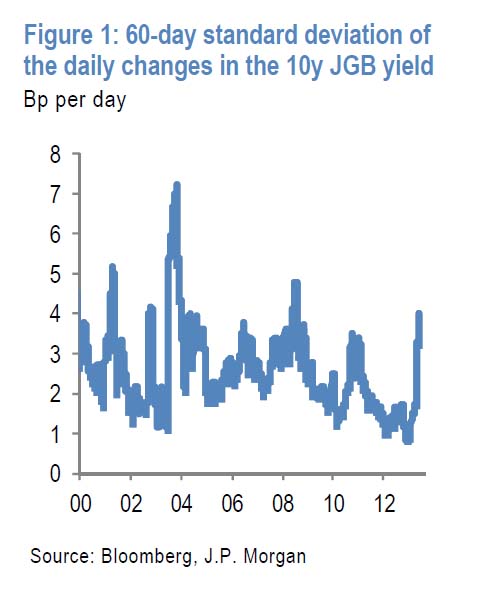
Despite the eagerness of Abenomics and the new BOJ head Kuroda to have their cake and eat it too, in this case manifesting in soaring stock prices, plunging Yen, rising GDP and exports, and most importantly, flat or declining bond yields, so far they have succeeded in carrying out three of the four (assuming Japanese economic data reporting is more accurate than that of its neighbor China), as it is physically impossible for any central planner to completely overrule the laws of math, economics and physics indefinitely. In this vein, we have described on numerous occasions in the past several days the shock to the system that the massive one-way transfer out of all asset classes and into equities has engendered, and resulted in several JGB futures trading halts in an attempt to normalize a market where bond volatility has suddenly exploded. Volatility aside (and it shouldn’t be as the below section from JPM explains), the recent surge in yields higher is finally starting to take its tool on domestic bond issuers. As Bloomberg reports, already two names have pulled deals from the jittery bond market due to “soaring” borrowing costs.The first is Toyota Industries which as NHK reported, canceled the sale of JPY20 billion debt. Toyota is among Japanese firms that put off selling debt as long-term yields on government debt have risen, increasing borrowing costs, public broadcaster NHK says without citing anyone. Last week JFE Holdings announced it would delay plans to sell bonds due to market volatility. Two names down… and the 10 Year is not even north of 1%.
Var Shock 1Var Shock 2_0 Read more of this post

Greying China taps rural elderly to care for those even older

Greying China taps rural elderly to care for those even older

1:08pm EDT

By Li Hui and Maxim Duncan

QIANTUN, China (Reuters) – Two years short of 70, Zhang Guosheng spends his days caring for an 81-year-old fellow villager – washing his clothes, bringing meals to his bed, and keeping him company – a routine he’ll keep up until he himself needs the type of care he is now giving.

“Living here is better than staying at home alone. We help each other and have a common language,” said the spritely Zhang, an enthusiastic dancer. “We are very happy here.”

With younger villagers who would traditionally have looked after their parents and grandparents flocking to the booming cities to seek work as part of Beijing’s urbanization drive, Qiantun village in northern China’s Hebei province has had to pioneer a new model – the old looking after the even older. Read more of this post

The Giant of Shareholders, Quietly Stirring; BlackRock, the world’s largest asset manager, is far from being an activist investor, but it is starting to ask more questions about companies in which it has stakes.

May 18, 2013

The Giant of Shareholders, Quietly Stirring

By SUSANNE CRAIG

Blackrock

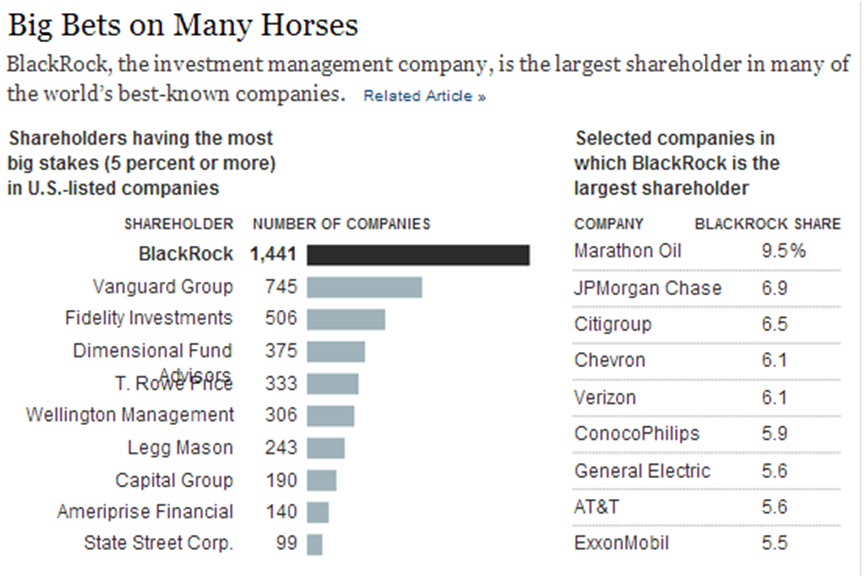
AT 11 a.m. on a Wednesday earlier this month, Michelle Edkins and her team began wheeling extra chairs into a cramped conference room in a San Francisco office tower, preparing for the corporate-governance equivalent of speed dating. Once settled, Yumi Narita started describing the disappointing qualities of a big entertainment company she’d been checking out. “I’m inclined not to trust this compensation committee,” she told the group.  “Year-over-year, they pay their C.E.O. more, and the metrics are often questionable.” There were sympathetic nods around the room. Ms. Narita is one of about 20 analysts on the corporate governance team at BlackRock, the world’s largest asset manager. BlackRock’s size is mind-boggling. With almost $4 trillion under management, it is, according to a recent University of Michigan study, the single largest shareholder in one of every five United States companies. It manages money from pension funds and endowments as well as retail investors, controls large stakes in companies like JPMorgan Chase, Wal-Mart and Chevron and owns 5 percent or more of roughly 40 percent of all publicly traded companies in the country.

Read more of this post

Is This the Best Time for Investors? Don’t Bet On It.

Updated May 18, 2013, 8:34 p.m. ET

Is This the Best Time for Investors? Don’t Bet On It.

By BRETT ARENDS

SJ-AG481_LEDE_C_G_20130517163304

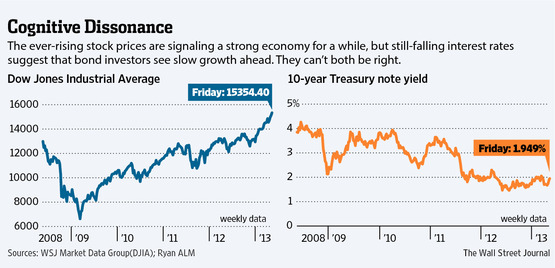
These have been good times—surprisingly good times—for investors. Stock prices have hit record highs. The Dow Jones Industrial Average has rocketed above 15000 for the first time, leaving even Wall Street bulls scrambling to raise their year-end forecasts to catch up. Meanwhile, even the normally staid bond market, as measured by the Barclays U.S. Aggregate Bond index, is up about 30% over the last five years. Interest rates on Treasury bonds are near historic lows. Corporate bonds, including those for blue-chip and riskier companies, are booming. Those who stuck with markets through the crisis of 2008, and especially those who held a balanced portfolio of stocks and bonds, are probably feeling very pleased with themselves, and well they might. But there’s a problem at the heart of financial markets. Psychologists would call it cognitive dissonance—the problem of trying to believe two incompatible things at the same time.

Read more of this post

Adrian Cheng: updating the Hong Kong family empire of Chow Tai Fook/New World for a changing China

Saturday May 18, 2013 MYT 10:05:00 PM

Adrian Cheng: updating a Hong Kong family empire for a changing China

HONG KONG: He has trained on Broadway and been a Wall Street banker.

Now, Adrian Cheng, 33-year-old scion of the world’s largest jewellery retailer and one of Asia’s leading property developers is gearing up for his latest challenge – modernizing his family’s $25 billion empire for what he calls a “new era”.

The grandson of Hong Kong billionaire Cheng Yu-tung, who built up jeweler Chow Tai Fook (1929.HK) and real estate titan New World Development (0017.HK), Cheng is one of a new generation of business leaders in Asia who are taking over the corporate reins from their ageing rags-to-riches forebears. Read more of this post

Meet the man who is betting against China; Muddy Waters’ Carson Block believes that China’s banks hold more toxic assets than Western peers did ahead of the 2008 financial crash

Meet the man who is betting against China

Carson Block, the founder of Muddy Waters Research, believes that China’s banks hold more toxic assets than Western peers did ahead of the 2008 financial crash .

Earlier this month, Mr Block caused shares in Standard Chartered to fall and the cost of insuring its debt to spike after he warned the emerging market-focused lender had more risk on its balance sheet than the market commonly believed and suggested that betting against the bank was a good way to profit from any Chinese downturn. Photo: Bloomberg

By Harry Wilson

10:00PM BST 18 May 2013

He is listened to by institutional investors, regulators and politicians but he rarely speaks publicly. Last week, his analysis of Standard Chartered’s exposure to China caused a tremble in its share price and its backers to leap to the bank’s defence. Carson Block has broken his silence this weekend to reveal his fears for the global economy. The secretive fund manager said the risks within China’s banking system are more severe than those in Western financial institutions before the crisis. Mr Block, founder of Muddy Waters Research, which has gained a reputation over the past three years for its in-depth reports on financial irregularities in scores of Chinese companies, said the country’s banks hold more toxic assets than their peers in the West did ahead of the 2008 financial crash. “We believe that the domestic Chinese banking system is a mess, with an enormous amount of bad loans, or loans waiting to go bad,” he told theSunday Telegraph. Read more of this post

Chinese enterprises’ globalization ‘big in scale but weak’: Accenture

Chinese enterprises’ globalization ‘big in scale but weak’: Accenture

Staff Reporter

2013-05-19

The globalization of Chinese enterprises has been “big in scale but weak,” Claire Yang, head of Accenture’s Greater China talent and organization service line, was quoted May 14 in a report on the caixin.com Chinese business news website.

In terms of business scale, direct overseas investments made by Chinese enterprises touched US$77.2 billion in 2012, posting a growth rate of more than 20 times the levels seen less than a decade ago, the report said.

However, the global percentage of Chinese foreign investments remained at a low level compared with other countries. An Accenture report indicated that in 2011, capital flow involving Chinese direct foreign investment accounted for 16% of that of the United States and 57% of Japan, and was ranked the world’s ninth largest.

The ratio of Chinese enterprises overseas revenue was low. Using Standard and Poor’s 500 index, the average overseas revenue recorded for an enterprise accounted for 27% of the total the enterprise generated in a year. Read more of this post

Dongguan, one of China’s richest cities, suspends free services as debt crisis bites

Dongguan suspends free services as debt crisis bites

Saturday, 18 May, 2013, 12:00am

Charlotte So in Dongguan charlotte.so@scmp.com

In a telling sign of the mainland’s mounting local government debt crisis, some towns in Dongguan – one of the richest cities – are being forced to suspend free public services and infrastructure projects.

In February, Shipai town terminated the free bus services that it introduced with much fanfare about two years ago. Then in March, the township government said it was reviewing a policy of providing free education to all residents aged below 25 because the government’s coffers had dried up.

The town of Zhangmutou – dubbed little Hong Kong because of its popularity as an investment and holiday destination – has scrapped an ambitious plan to build a 100-million yuan (HK$126.4 million) recreational park, leaving a large chunk of empty land in the town centre.

Many local township authorities in Dongguan are struggling to pay the salaries of their employees.

Their problems underline the magnitude of local government debt issues on the mainland. Read more of this post

S&P warns it may lower India rating to junk status

S&P warns it may lower India rating to junk status

India faces at least “a one-in-three” chance of losing its prized sovereign grade rating. -AFP
Sat, May 18, 2013
AFP

NEW DELHI – India faces at least “a one-in-three” chance of losing its prized sovereign grade rating, global ratings agency Standard and Poor’s has warned, in another blow to the scandal-tainted Congress government. The announcement late on Friday comes after finance ministry officials have been arguing for a ratings upgrade, saying the government has been taking strong steps to curb India’s financial deficit and promote investment. India’s BBB-minus investment rating is already the lowest among its BRICS peers Brazil, Russia, China and South Africa, and cutting it to “junk status” would push up the country’s hefty borrowing costs as it would signal higher risk. Read more of this post

US energy revolution gathers pace as the Obama administration approved wider exports of liquefied natural gas and international companies committed billions of dollars for new infrastructure.

Last updated: May 17, 2013 9:21 pm

US energy revolution gathers pace

By Ed Crooks in New York, Jonathan Soble in Tokyo and Guy Chazan in London

The growing role of the US in world energy markets was underlined on Friday as the Obama administration approved wider exports of liquefied natural gas and international companies committed billions of dollars for new infrastructure.

The developments were both consequences of the shale revolution in the US, in which improvements in the techniques of horizontal drilling and hydraulic fracturing, or “fracking”, have unlocked new supplies of oil and gas, and raised the prospect that the US will be an increasingly important supplier of energy to the rest of the world.

The Department of Energy on Friday authorised the Freeport LNG project in Texas to export to countries that do not have a trade agreement with the US, including Japan and the members of the EU. It was the first such approval to be granted for two years and only the second ever. Read more of this post

China deal ends distraction, but not questions, for Caterpillar

China deal ends distraction, but not questions, for Caterpillar

Fri, May 17 2013

By James B. Kelleher

CHICAGO (Reuters) – Caterpillar Inc’s (CAT.N: Quote,Profile, Research, Stock Buzz) deal to cut the purchase price of a Chinese mining-equipment maker it bought last year ends an embarrassing episode that overshadowed the company’s effort to expand in China and distracted its executives for months. Now, analysts say, comes the hard part: Proving to investors that ERA Mining Machinery, the Chinese maker of hydraulic roof supports that Caterpillar purchased, really can help penetrate China’s huge underground mining market. In January, Caterpillar took a $580 million impairment related to the ERA deal after discovering what it characterized as a “deliberate, multi-year, coordinated accounting misconduct” at Siwei, a subsidiary that handled ERA’s principal business. Late on Thursday, Caterpillar said it reached a deal with the former controlling shareholders of ERA to cut $135 million from the $886 million purchase price – a move welcomed by analysts even if the money involved was, in the words of one, “a blip” in the U.S. company’s overall finances. “Outside of the reduction in purchase price, the chief benefit of the settlement is to eliminate the management distraction caused by the issue and get on with realizing the potential that led Caterpillar to buy this company in the first place,” said Alex Blanton, a senior analyst at Clear Harbor Asset Management in New York. “Whether or not it realizes the potential is another question,” he said. Read more of this post

Coming to terms with China’s growth prospects

Coming to terms with China’s growth prospects

Yukon Huang

May 16, 2013

Markets have not been enthused by the numbers coming out of China in recent months. Typical headlines are “China’s production indicators disappoint” or “analysts are worried that rapid expansion is faltering”. Estimates of China’s economic growth this year are slipping from more than 8 per cent to something closer to 7.5 per cent. Those concerned about the country’s longer-term growth challenges, however, tend to be more relaxed about near-term outcomes but preoccupied with the new leadership’s commitment to reforms. Is there a trade-off between reviving the economy and establishing a sustainable basis for longer-term growth? Unfortunately there is. Beijing has run out of good options to further stimulate the economy as a strategy to buy time until western economies rebound. There are lessons from what happened in the aftermath of China’s post Asian financial crisis stimulus more than a decade ago. At that time China responded with a massive programme comparable to its more recent effort in the aftermath of the global financial/fiscal crisis spurred by the economic collapse in the US and Europe. China’s confidence in stimulus programmes was unrealistically buoyed by its success in dealing with the Asian crisis which resulted in a soft landing followed by years of sustained and rapid growth. But the lingering consequences of the 2009 stimulus package have not been as benign, with no signs that the resulting high debt levels are moderating and that continued expansionary credit policies are spurring production and real demand. Read more of this post

As cost of living rises, Singaporeans turn to pawnshops; Economist Intelligence Unit has ranked Singapore the world’s sixth most expensive city to live in.

As cost of living rises, Singaporeans turn to pawnshops

Agence France-Presse

Posted at 05/18/2013 12:31 PM | Updated as of 05/18/2013 12:32 PM

SINGAPORE – Singaporean housewife Siti Khadijah Abdul Rahman accumulated a few thousand dollars’ worth of gold accessories over the past two decades, but now a rising cost of living is forcing her to pawn them.

With a stretched household budget that must also cater to school expenses for her two teenaged children, the 49 year-old is pawning her gold to relieve pressure on her security guard husband, who earns Sg$1,500 ($1,211) a month.

“Pawning is better than going to friends or family when you have budget problems,” said Abdul Rahman. “When I have money, I will claim it back.”

She is one of a rapidly increasing number of people opting to take short-term pawnshop loans to try to keep up with rising prices, in what the Economist Intelligence Unit has ranked the world’s sixth most expensive city to live in. Read more of this post

American Capital Fights Fed Exit Worry as Investors Flee

American Capital Fights Fed Exit Worry as Investors Flee

Gary Kain built American Capital Agency Corp. (AGNC) into the fastest growing real estate investment trust as the Federal Reserve pushed borrowing costs to record lows. Now he’s trying to persuade investors to stay with him as he navigates the central bank’s retreat.

American Capital slumped 11 percent since May 2 through yesterday, the worst performance in a Bloomberg index of 34 companies that invest in mortgage bonds, after reporting an 8.6 percent drop in book value from the prior quarter. Annaly Capital Management Inc. (NLY), the only mortgage REIT bigger than American Capital, said its book value, a measure of its assets minus its liabilities, fell 4 percent.

“The issue isn’t if the Fed exits, it’s a question of whether they exit way earlier than expected,” Kain said in a telephone interview. “We feel like positions are in much better shape now than they were in the January-February time frame.”

Firms that buy government-backed home-loan bonds are under pressure as investors speculate the Fed will withdraw from buying $40 billion of mortgage securities each month as the economy shows signs of strengthening. American Capital, which increased assets over three years more than 20-fold to $100.5 billion at the end of 2012, plunged the most of mortgage REITs after targeting higher-priced bonds that would benefit from continued Fed intervention. Read more of this post

Europe’s EUR 500 Billion Ticking NPLTime Bomb

Europe’s EUR 500 Billion Ticking NPLTime Bomb

Tyler Durden on 05/17/2013 20:14 -0400

Europe’s non-performing loan problem is such an issue that there is increasing bluster that the ECB may take this garbage on to its balance sheet since policymakers realize that bad debts and non-performing loans (NPLs) reduce the capacity of banks to lend, hindering the monetary policy transmission mechanism. Bad debts consume capital and make banks more risk averse, especially with respect to lending to higher risk borrowers such as SMEs. With Italy (NPLs 13.4%) now following the same dismal trajectory of Spain’s bad debts, the situation is rapidly escalating (at an average of around 2.5% increase per year). As we discussed in detail here, the bottom line is that at its core, it is all simply a bad-debt problem, and the more the bad debt, the greater the ultimate liability impairments become, including deposits. As we answered at the time – the real question in Europe is: how much impairment capacity is there in the various European nations before deposits have to be haircut? With Periphery non-performing loans totaling EUR 720bn across the whole of the Euro area in 2012 and EUR 500bn of which were with Peripheral banks, it seems the Cyprus deposit haircut non-template may indeed become the key template. Simply put, the greater the unemployment the more the strain on banks to generate “profits” by any means possible (GGBS?) to cover the capitalization shortfall from NPLs until at some point liability haircuts have to begin… 

Non-performing loans as % of total loans across the Euro area; Unemployment rates across Euro area countries

20130517_NPL1_020130517_NPL2_0

Via JPMorgan: It is not surprising that the periphery is exhibiting a rising pattern in terms of NPL ratios. What is worrying is the speed of increase, at 2.5% per year. Within the periphery, Greece is the outlier with a NPL ratio of 25%, and no signs of abating yet. Ireland follows with a NPL ratio of 19%. Italy (at 13.4%) is above Spain and Portugal (at close to 10%)… The German divergence is making the task of the ECB very difficult both in terms of setting monetary policy for the whole region, but also in terms of dealing with an impaired transmission outside Germany. Draghi clarified in its latest press conference that it is not the ECB’s role to clean up banks’ balance sheets, meaning that the ECB is unlikely to deal itself with the €500bn large non-performing loan problem in periphery.

Stranded Dad Decries Frankfurt Ban on Night Flights Aiding Dubai; “You can hub through Dubai rather than Heathrow or Frankfurt. There is no curfew in Dubai.”

Stranded Dad Decries Frankfurt Ban on Night Flights Aiding Dubai

Shortly after 10 p.m. in Frankfurt, Peter Meany settled into his seat on Qantas Airways Ltd. (QAN) flight QF6, looking forward to reuniting with his family in Sydney for his son’s birthday after a two-week business trip across Europe.

Meany, a 38 year-old fund manager with Qantas frequent-flier status, would miss the party. As the plane crawled to the runway, passengers were surprised to learn that they were five minutes over the last permitted takeoff time and would need to turn back. Frustrated and tired, Meany and his fellow travelers spilled back into the deserted airport building.

“People knew they weren’t going to see their families as planned, or wouldn’t make their meetings,” Meany said. “Bad weather is unavoidable, but I haven’t been in a situation like this in 20 years of flying.”

Meany is among more than 28,000 passengers who have been left stuck on the outskirts of Germany’s financial capital since Frankfurt introduced the night-flight ban in October 2011. While creating a steady stream of involuntary guests for local hotels, the directive has eaten into Deutsche Lufthansa AG (LHA)’s earnings and encourages long-distance passengers to travel via Dubai, where operations run around the clock. Read more of this post

EU Ban Leaves Buyers Holding 144 Million Homeless Carbon Credits

EU Ban Leaves Buyers Holding 144 Million Homeless Carbon Credits

Companies holding United Nations carbon offsets equivalent to 7 percent of the European Union’s annual emissions cap risk losing their investment unless they find a buyer for the credits the bloc banned earlier this year. Power stations and factories in the EU’s emissions-trading system still hold 144 million of the UN offsets after surrendering 552 million in the five years through 2012, EU data compiled by Bloomberg show. The bloc banned the use of credits awarded to projects that destroy nitrous oxide and hydrofluorocarbon-23, two powerful greenhouse gases. The UN’s Clean Development Mechanism awards Certified Emission Reductions, or CERs, to projects in developing countries that reduce climate pollution. The projects can sell the offsets to buyers in cap-and-trade markets such as Europe’s, who use the credits to cover emissions, or to governments seeking to meet Kyoto Protocol emissions targets. The banned credits, known as grey CERs, will “either end up in the hands of the sovereigns, or they become worthless,” Trevor Sikorski, an analyst in London at Energy Aspects Ltd., said by e-mail May 16. “With market prices where they are, one should be able to pick up an issued grey CER spot for 10 euro cents or so.”

Read more of this post

Purloined Picassos Chased by FBI Art Sleuths for Wealthy; “Stolen art, stolen antiquities move into a legitimate market very easily.”

Purloined Picassos Chased by FBI Art Sleuths for Wealthy

Stored inside a laptop at FBI headquarters are photos of thousands of paintings, sculptures and artifacts, works by Vincent Van Gogh and Henri Matisse, Pablo Picasso and Paul Cezanne — international treasures worth millions of dollars each. All are missing.

The computer belongs to Bonnie Magness-Gardiner, a PhD in Near Eastern archeology who leads the agency’s art-theft program and considers herself one of the least-likely employees walking through the doors of the J. Edgar Hoover Building headquarters in Washington each morning.

As wealthy investors seek to diversify their assets and Wall Street art enthusiasts like SAC Capital Advisors LP founder Steven Cohen beef up their collections, art crime is a growth industry and an increasingly important target for the Federal Bureau of Investigation. Read more of this post

Secret Rocks: The $10 billion jewels industry is shrouded in beauty—and mystery. Is change about to come?

Updated May 17, 2013, 12:47 a.m. ET

Secret Rocks

The $10 billion jewels industry is shrouded in beauty—and mystery. Is change about to come?

By SHIBANI MAHTANI AND PATRICK BARTA

OB-XJ670_OBXJ66_G_20130507145913

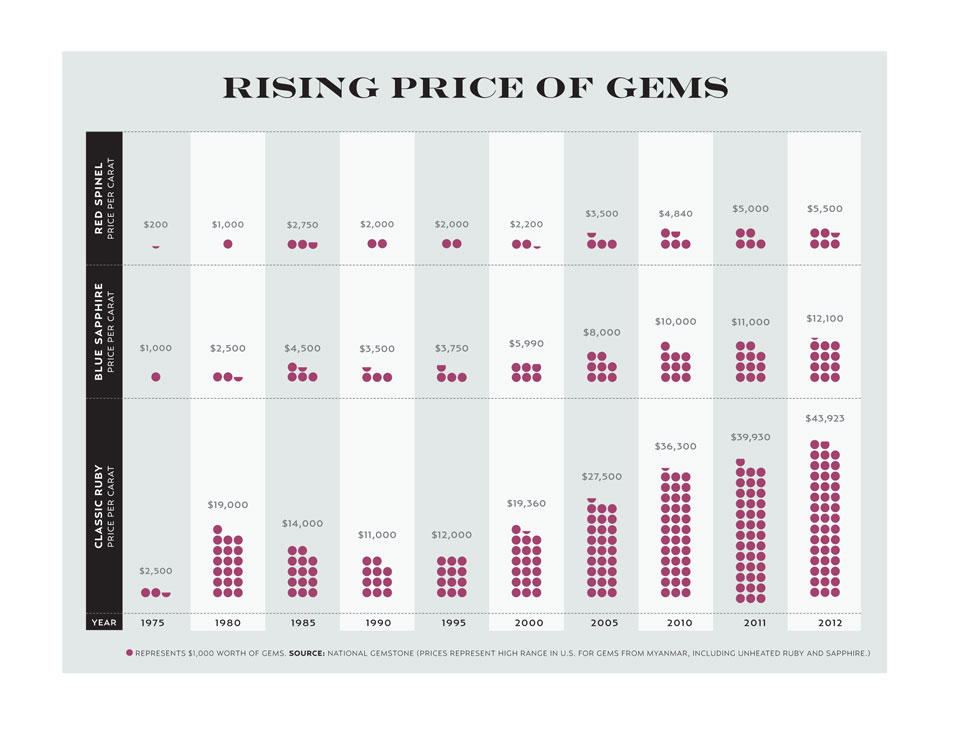
TO HEAR RICHARD HUGHES tell it, the journey was like something straight out of “Indiana Jones and the Temple of Doom.” One of the world’s leading modern-day gem hunters, he was hell-bent on reaching the fabled jade mines of upper Myanmar—a jungle redoubt so remote and closely guarded that few living Westerners have ever laid eyes on it. Before he could get close, he had to spend months ahead of his trip convincing Myanmar’s secretive military, which controlled access to the country’s mines, to let him in. Then he had to navigate some of the most punishing, malaria-ridden terrain east of the Congo, capped by a grueling climb along a dirt road his handlers said would only take seven hours to ascend. The trail quickly turned into a river of sludge under Myanmar’s brutal monsoons, trapping vehicles in mud to their doors until teams of elephants showed up to haul them out. Days passed by as Hughes and his companions fought their way through the muck. In ramshackle villages along the way, residents smoked opium and told wild tales of the mining world beyond the ridges above. Read more of this post

China’s Next Crisis Lurks in Shadow Banking; “The longer the government takes to address this, the bigger the problem becomes.”

China’s Next Crisis Lurks in Shadow Banking

By Dexter Roberts on May 16, 2013

http://www.businessweek.com/articles/2013-05-16/chinas-next-crisis-lurks-in-shadow-banking

China’s growing reliance on shadow banking is contributing to its debt problem. Since 2010 the value of the unregulated loans, investments, and other financial products of this sector has almost doubled, to as much as 36 trillion yuan ($5.86 trillion). That’s equal to 69 percent of gross domestic product, says Haibin Zhu, chief China economist at JPMorgan Chase (JPM) in Hong Kong. “Shadow banking poses systemic risks,” warned Moody’s (MCO) in a May 13 report.

The question is how much of this capital carries an implicit guarantee that the national government must cover. “It is our belief that at some point the central government will have to take responsibility for local debt,” says Derek Ovington, head of regional banks in Asia at CLSA Asia-Pacific Markets. The official debt burden of central and local government, which does not take the localities’ shadow banking activities into account, is just below 30 percent of GDP, Moody’s says. In contrast, Ovington estimates that shadow banking liabilities and consumer, corporate, and government debt are now more than 200 percent of GDP. “The longer the government takes to address this, the bigger the problem becomes.” Read more of this post

Phoney QE peace masks rising risk of instability

May 16, 2013 3:48 pm

Markets Insight: Phoney QE peace masks rising risk of instability

By Gillian Tett

Profound tensions lurk beneath surface calm

Are the markets going mad? That is a question many investors might have asked in recent weeks, as stocks in the UK, eurozone and US have soared – even as bond spreads decline.

But, if you want another sign of how peculiar market patterns now seem, take a look at a report recently compiled by Matt King, an analyst at Citigroup. For what is most striking about the current market trends, Mr King argues, is not simply those dazzling equity and bond prices; instead the really notable issue is how many long-standing data patterns have broken down*.

Take a look at the link between unemployment and equity markets. Between 1997 and 2011 the level of unemployment in the eurozone was always inversely correlated to the Stoxx index. However, since 2011 the eurozone jobless rate has jumped from 10 to 12 per cent – even as the Stoxx has risen 10 per cent. Read more of this post

Companies might be forced to boost the amount of debt they report on their balance sheets by hundreds of billions of dollars under a proposal announced to overhaul the accounting for leases

May 16, 2013, 1:05 p.m. ET

Accounting Change Could Boost Companies’ Debt

Proposed Rule Would Require Most Leases to be Treated on the Books as Debt

By MICHAEL RAPOPORT

Companies might be forced to boost the amount of debt they report on their balance sheets by hundreds of billions of dollars under a proposal announced Thursday to overhaul the accounting for leases.

If adopted, the changes could affect retailers and restaurant chains, which lease real estate at hundreds or thousands of locations. Other companies that may feel the impact are airlines and package-delivery companies, which finance aircraft through leases, and companies that lease printers, copiers and other office equipment.

The new proposal from the Financial Accounting Standards Board and International Accounting Standards Board, which set accounting rules for the U.S. and most of the rest of the world, respectively, would require companies to add all but the shortest leases to their balance sheets as obligations akin to debt. That could have a major impact, experts said, given the estimated $800 billion in new lease contracts world-wide every year. Read more of this post

The Risky Business of Investing

The Risky Business of Investing

14 MAY 2013 – ASHBY MONK

Note to readers: institutional investors are not in the business of making investments or managing investment returns. I know I’ve said this before, but that’s really not what pension funds, sovereign funds, endowments or foundations ultimately do. Investors are, at their core, risk takers. They assess, mitigate, manage, bear and trade risks. If they perform these tasks well, they make money in the process. Risk, then, isn’t just something to mitigate; it’s something to be actively sought out. Risk is the oxygen that gives life to financial markets; it’s the currency upon which all assets are traded. You get the picture.

Given the enormous importance of risk in the investment business, you’d think that risk management would be fully integrated into everything these investors do. But… you’d be wrong. As it turns out, over the past few decades, many institutional investors have moved away from a ‘risk based’ approach to investing and have preferred to think about investing in terms of products and expected returns. This was deemed to be a useful abstraction that rendered modern finance consumable by the masses. However, this wound up be being somewhat problematic, as focusing on returns to the exclusion of risk resulted in some unhealthy distortions in the way we think about investments. Read more of this post

STX Group Chairman Kang Duck-soo is under mounting pressure to pay some of the debts held by the struggling units of the country’s 19th largest conglomerate using his own assets

2013-05-16

STX boss pressured to give up private assets

By Na Jeong-ju

STX Group Chairman Kang Duck-soo is under mounting pressure to pay some of the debts held by the struggling units of the country’s 19th largest conglomerate using his own assets. Government officials and creditor banks say the 63-year-old executive should give up a considerable part of his fortune to take responsibility for the ongoing liquidity crisis in STX. “That’s a pre-condition for a financial lifeline. All creditor banks and the government want him to join their rescue efforts,” said an official from the Financial Supervisory Service (FSS). “They will take extreme measures, including requesting the court to seize his property, if needed.” Kang recently handed over his controlling stake in STX Offshore & Shipbuilding, which generates more than 50 percent of the group’s total revenue, to creditors. He is also considering selling the group’s overseas assets to secure cash. However, creditor banks claim that’s far from being enough to get STX out of its financial hole. Some bank officials told media Kang should pay the price for mismanaging the firm. They alleged that some of Kang’s relatives are working in key positions at STX affiliates, indicating he abused his status and power to give them jobs.  Read more of this post

Jakarta Governor Joko Widodo, an untested outsider to Indonesian politics, has attracted an unexpected national following in this fledgling democracy amid a void of young leaders

May 16, 2013, 1:32 p.m. ET

With Little to Show, Jakarta Governor Attracts Following

By BEN OTTO

JAKARTA, Indonesia—An untested outsider to Indonesian politics has attracted an unexpected national following in this fledgling democracy amid a void of young leaders.

Joko Widodo, the 51-year-old governor of Jakarta, is taking on the major challenges of the capital—flooding, poverty and traffic—and though evidence is scant so far that he can fix the problems, he has attracted intensive media coverage and is even mentioned as a strong presidential contender in 2014, when President Susilo Bambang Yudhoyono is due to step down after a decade in power. Read more of this post

Former Malaysian Prime Minister Mahathir’s influence in new Cabinet ‘likely to hamper reform’

Mahathir’s influence in new Cabinet ‘likely to hamper reform’

KUALA LUMPUR — The new Malaysian Cabinet, which is filled with established leaders of United Malays National Organisation (UMNO), shows the influence of former Prime Minister Mahathir Mohamad, opposition Pakatan Rakyat (PR) leaders said yesterday.

BY –6 HOURS 43 MIN AGO

KUALA LUMPUR — The new Malaysian Cabinet, which is filled with established leaders of United Malays National Organisation (UMNO), shows the influence of former Prime Minister Mahathir Mohamad, opposition Pakatan Rakyat (PR) leaders said yesterday.

“You don’t see any intention of breaking away from the past,” Democratic Action Party (DAP) strategist Liew Chin Tong told The Malaysian Insider. “The appointment of Shahidan furthers the UMNO agenda … there is no intention to reform,” he added, referring to former Perlis Mentri Besar Shahidan Kassim’s appointment as a minister in the Prime Minister’s Department. Read more of this post

Unhappy Malaysians can leave country: Home Minister Zahid

Unhappy Malaysians can leave country: Zahid

PETALING JAYA — Malaysia’s new Home Minister Ahmad Zahid Hamidi (picture) has told Malaysians who are dissatisfied with its political system after the general election — which handed victory to the long-ruling Barisan Nasional (BN) coalition — to migrate to other countries, as those who are loyal would accept the rule of law.

BY –6 HOURS 42 MIN AGO

PETALING JAYA — Malaysia’s new Home Minister Ahmad Zahid Hamidi (picture) has told Malaysians who are dissatisfied with its political system after the general election — which handed victory to the long-ruling Barisan Nasional (BN) coalition — to migrate to other countries, as those who are loyal would accept the rule of law.

Mr Zahid made the comments in an editorial for Utusan Malaysia, a newspaper controlled by the BN’s dominant party, United Malays National Organisation, a day after he was appointed Home Minister by Prime Minister Najib Razak, news website Malaysiakini reported yesterday. Read more of this post

Vietnam to Force Bank Bad-Debt Sales to State Asset Company

Vietnam to Force Bank Bad-Debt Sales to State Asset Company

Vietnam will force banks to sell bad debt to a soon-to-be established asset management company, according to State Bank of Vietnam Chief Inspector Nguyen Huu Nghia, as the government steps up efforts to revive the economy.

Lenders assessed by the central bank to have bad-debt ratios of 3 percent and above will be required to comply, Nghia said today, citing a final proposal that is awaiting the prime minister’s review and approval. The government plans to set up the company this month, according to Cao Sy Kiem, member of the National Financial and Monetary Policy Advisory Council. Read more of this post

Chinese graduates face toughest job market ever

Chinese graduates face toughest job market ever

May 16, 2013 11:18am by Julie Zhu

While many Chinese of a certain age are reliving their college days through the movie “So Young”, the country’s students of today are facing the fiercest ever competition for jobs, with a record high number of nearly 7m graduates this year.

“So Young” – a nostalgic look at student lives and loves of the 1990s from actress-turned-director Zhao Wei – has successfully captured the collective memories of those who left campus all those years ago. But when they look at the pressures facing today’s graduates, they may be glad their own student days are in the distant past.

According to the ministry of education, 6.99m students will graduate from university this summer, 190,000 more than last year and the most since records began in 1949.

Tough competition and slackness in China’s economy have made 2013 what many in the media have described as the “hardest” yet for graduates looking for jobs. According to Shanghai Evening Post, the situation is even more severe than it was in late 2008, when the global financial crisis was at its height. Read more of this post

As Jade Becomes Rarer, a Thirst for More

May 15, 2013

As Jade Becomes Rarer, a Thirst for More

By SONIA KOLESNIKOV-JESSOP

To judge by auction prices, the appetite of collectors for top quality jade jewelry remains unsated, despite recent talk of slowing demand for luxury goods in China, where jade has traditionally been held in near-mystical reverence.

At Christie’s London last month, a simple necklace featuring two rows of graduated jadeite beads with an Art Deco diamond clasp realized £49,875, or $77,625, far exceeding its pre-sale estimate of £5,000 to £6,000. At Sotheby’s New York, also last month, a suite of gold, jade and diamonds, comprising a necklace, brooch, ear clips and ring, estimated at $30,000 to $50,000, sold for $149,000.

At Sotheby’s Hong Kong, a jadeite bangle estimated at 200,000 to 250,000 Hong Kong dollars, or $26,000 to $32,000, sold for 1.12 million, and a jadeite and diamond ring estimated at 350,000 to 500,000 dollars sold for 1 million.

Yet, not all the jade on offer at recent sales has fared so well. Some lots have barely made their estimates, and others have remained unsold. Read more of this post