Biofuel Pioneer Alan Shaw Forsakes Renewables to Make Gas-Fed Fuels; “Everybody but me is still in this nightmare. This model is broken.”

Biofuel Pioneer Forsakes Renewables to Make Gas-Fed Fuels

Alan Shaw, the chemist and executive who led a six-year effort to turn inedible crops into fuels to displace gasoline, has renounced the industry he helped pioneer and decided the future instead lies with natural gas.

Formerly chief executive officer of Codexis Inc. (CDXS), the first advanced biofuel technology company to trade on a U.S. exchange, Shaw now says it’s impossible to economically turn crop waste, wood and plants like switchgrass into fuel. He’s trying to do it instead with gas, in his new post as CEO of Calysta Energy LLC.

Shaw’s views put him at odds with the emerging segment of biofuels that’s invested about $3 billion since 2008 in the U.S. developing processes that turn biomass into new types of fuel. Amyris Inc. (AMRS) and Gevo Inc. (GEVO) are among producers that have yet to make fuel on commercial scales and slid since their initial public offerings.

“Everybody but me is still in this nightmare,” Shaw, 50, said in an interview in San Francisco. “This model is broken.” Read more of this post

Feedback Loops And The Unsustainability Of China’s ‘Moderate’ Growth; the ‘rage’ among the Chinese at any suggestion of the sustainability of their growth model suggest a level of fragility in China’s social fabric

Feedback Loops And The Unsustainability Of China’s ‘Moderate’ Growth

Tyler Durden on 05/01/2013 19:11 -0400

With last night’s China PMI disappointing expectations and eking out a just-expansionary miasma of hope for the growth enthusiasts, the very real question of global growth sustainability (while not on US equity market participants’ minds) is coming to the fore. As Michael Pettis notes, Martin Wolf’s recent perspective that it may be useful to think about Japan as a model for understanding the adjustment process in China since the Japanese model shows how risky it is to shift to a slow-growth model.

Being in the significant non-consensus camp of “malevolent outsiders”, Pettis fears the ‘rage’ among the Chinese at any suggestion of the sustainability of their growth model suggest a level of fragility in China’s social fabric and its self-confidence that could make any slowdown more difficult to manage. The reason he is most-concerned is ‘feedback loops’; self-reinforcing mechanisms that are virtuous (with surprising growth expectations on the way up), but become vicious in an equally destructive manner. Read more of this post

Crude Inventories Surge To Record High As Energy Demand Collapses

Crude Inventories Surge To Record High As Energy Demand Collapses

Tyler Durden on 05/01/2013 11:38 -0400

20130501_DOE_0

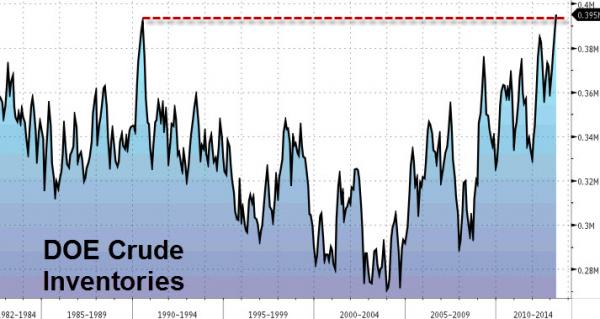
A month ago we highlighted the somewhat stunning reality of the real economy via the EIA’s detailed energy supply and demand data. The key takeaway was  that we hoped this did not represent the true state of the economy since the data was so dismal. Fast forward to today and the DOE just released a much higher than expected build in crude inventories that took the stuffed-channel of oil products to all-time highs.The 395.3 million barrels is higher than the previous record in July 1990. There appears to be a number of factors at play – none of which are positive. There is a surge in supply due to the incessant harvesting of shale oil (which could have its own problems as we noted here). Second, we suspect there is a degree of ‘channel-stuffing’ occurring – if we pump it, they will buy – as producers and transporters are desperate to keep active and show incremental business (despite fading railcar loadings). But perhaps most important, as EIA data has shown, there has been a collapse in end demand for crude products not seen since the 1990s. Today’s surge in inventories appears to confirm demand remains subdued at best.

Crude Declines for Second Day on Record Inventories

West Texas Intermediate oil fell for a second day as U.S. inventories reached a record high last week and on signs of economic slowdown in the U.S. and China.  Read more of this post

Bloomberg has calculated ratios of CEO compensation relative to average employees for the Top 250 companies in the S&P 500

How Much More Is Your CEO Making Than You?

Tyler Durden on 04/30/2013 13:32 -0400
Three years after Congress first told the SEC that it required public companies to uncloak the details of their CEO compensation relative to his lowly employees; the ever-ready SEC has yet to implement any rules. However, in an effort to ease the tough job that the SEC has, Bloomberg has calculated ratios for the Top 250 companies in the S&P 500, based on industry-specific averages for pay and benefits for the rank-and-file (since companies don’t disclose median worker pay). The table below, of the top 50 companies (meaning highest CEO pay relative to workers), suggests it remains good to be king (and Ron Johnson just made another #1 Spot earning an estimated 1,795x the average JCP employee – money well spent…).

20130430_CEO_0

In China, a Persistent Edge for Big Insiders: Study

April 30, 2013, 1:30 P.M. ET

In China, a Persistent Edge for Big Insiders: Study

By Ben Levisohn

The U.S. has gone to great lengths to root out insider trading–just ask Martha Stewart, Rajat Gupta or any one of the folks at SAC Capital that have been charged with the crime. In China, however, it might just be how the game is played. In the NBER working paper Informed Trading and Expected Returns, authors James Choi,Li Jin, and Hongjun Yan tracked institutional buying of Chinese stocks. Their finding: Stocks that are bought aggressively by institutions outperform those with the least by a wide margin. NBER summed up the report,which is available here:

The authors first show that stocks bought heavily by institutions subsequently outperform stocks sold heavily by institutions. Thus, institutions appear to have a strong information advantage over individual investors, and that is true for stocks of all sizes. Moreover, the authors confirm that the institutional sector’s future information advantage is larger in stocks that it previously traded more aggressively. Therefore, the aggressiveness of institutional trading in a stock, as measured by prior institutional ownership volatility, can be used as an ex ante predictor of future information asymmetry in this stock.

…the authors find that the 20 percent of stocks with the greatest information asymmetry have future annualized returns that are 10.8 percentage points higher than the 20 percent of stocks with the least information asymmetry. Read more of this post

Chinese Way of Doing Business: In Cash We Trust; Many experts say it is not a refusal to enter the 21st century as much as wariness, of the government toward its citizens and vice versa

April 30, 2013

Chinese Way of Doing Business: In Cash We Trust

By DAVID BARBOZA

SHANGHAI — Lin Lu remembers the day last December when a Chinese businessman showed up at the car dealership he works for in north China and paid for a new BMW 5 Series Gran Turismo — entirely in cash. “He drove here with two friends in a beat-up Honda,” Mr. Lin recalled. “One of his friends carried about $60,000 in a big white bag, and the buyer had the rest in a heavy black backpack.” Lugging nearly $130,000 in cash into a dealership might sound bizarre, but it’s not exactly uncommon in China, where hotel bills, jewelry purchases and even the lecture fees for visiting scholars are routinely settled with thick wads of renminbi, China’s currency. This is a country, after all, where home buyers make down payments with trunks filled with cash. And big-city law firms have been known to hire armored cars to deliver the cash needed to pay monthly salaries.

For all China’s modern trappings — the new superhighways, high-speed rail networks and soaring skyscrapers — analysts say this country still prefers to pay for things the old-fashioned way, with ledgers, bill-counting machines and cold, hard cash. Many experts say it is not a refusal to enter the 21st century as much as wariness, of the government toward its citizens and vice versa. Doing business in China takes a lot of cash because Chinese authorities refuse to print any bill larger than the 100-renminbi note. That’s equivalent to $16. Since 1988, the 100-renminbi note, graced by Mao Zedong’s visage, has been the largest note in circulation, even though the economy has grown fiftyfold. (The country’s national icon, Chairman Mao, appears on nearly every note: the 1-, 5-, 10-, 20, 50- and 100- renminbi note.) Read more of this post

Qianhai zone may become China’s Cayman Islands

Qianhai zone may become China’s Cayman Islands

Staff Reporter

2013-05-01

Many foreign private equity firms are interested in registering their companies in the Qianhai Special Financial Zone in Shenzhen, although most have no interest in actually operating there. This makes the zone akin to a Chinese version of the Cayman Islands tax haven, the Guangzhou-based 21st Century Business Herald reports.

At least two private equity firms have already registered in Qianhai, and several others are considering a move. The firms are less interested in actually operating within the zone but instead are seeking the tax breaks offered to businesses there, the report said. The zone is desirable because it enables the inflow of overseas-held renminbi, since firms registered in the zone can invest in China’s economy using assets they raise overseas. The zone will start to look something like the Cayman Islands if firms don’t actually rent offices or hire staff in Qianhai, effectively negating the government’s plans to boost the local economy, said one accountant.

Read more of this post

Economic revolution sprung from China’s grassroots rather than top-down approach

Economic revolution sprung from China’s grassroots: scholars

Staff Reporter

2013-05-01

China’s economic reforms, which begun under the late Deng Xiaoping more than 30 years ago, are often thought of as a top-down revolution presided over by the ruling Communist Party. The country’s rapid economic growth in the last three decades proves that the party’s plan was well-conceived and executed and the credit for China’s economic miracle thus accrues to them, says the Beijing-based Economic Observer.

This view has been challenged however by Nobel laureate Ronald Coase, an economist at the University of Chicago, and his coauthor Wang Ning. Coase and Wang have pointed to the vital role played in China’s economic reforms by people at the grassroots level. Read more of this post

Puffer-fish protests and Xi’s China dream; ordinary Chinese have been watching their unelected representatives gorge themselves on their tax renminbi for decades

April 30, 2013 6:19 pm

Puffer-fish protests and Xi’s China dream

By Patti Waldmeir in Shanghai

Officials are discovering the power of the middle-class Nimby, writes Patti Waldmeir

Something about the tale just did not add up: several hundred people turn up to protest because officials of a provincial city in China are eating swordfish, puffer fish and other forms of lethal seafood at the taxpayer’s expense?

Sure, there’s an austerity drive on in China: these days, bloated bureaucrats are not meant to be eating, drinking or being merry at public expense. But ordinary Chinese have been watching their unelected representatives gorge themselves on their tax renminbi for decades. Surely it takes more than another government anti-corruption campaign to rouse them to revolution? Read more of this post

Korea behind Japan in entrepreneurship; Only 11 of Korea’s top 50 richest businesspeople are self-made, the rest inherited their fortunes

2013-04-30 17:13

Korea behind Japan in entrepreneurship

By Na Jeong-ju
Only 11 of Korea’s top 50 richest businesspeople are self-made, the rest inherited their fortunes from their father or grandfather, a survey showed Tuesday.
In contrast, 34 of the 50 richest people in Japan earned their success through Their own means.  Read more of this post

North Dakota Has Way More Energy Than We Previously Thought, US Government says

US GOVERNMENT: North Dakota Has Way More Energy Than We Previously Thought

Rob Wile | Apr. 30, 2013, 3:58 PM | 2,905 | 15

The USGS just doubled the amount of oil it thinks can be recovered from North Dakota’s Bakken formation. According to its release, the agency now puts the figure at 7.38 billion barrels, compared with 3.65 in their 2008 estimate. They also tripled their gas estimates for the area — to 6.7 trillion cubic feet of undiscovered, technically recoverable gas and gas liquids. The revisions are almost entirely the result of adding a new section, Three Forks, to the estimates. Anne-Berry Wade told us hydraulic fracturing — fracking — in that section has allowed geologists to up their estimates for what is technically recoverable.  Here’s new Interior Secretary Sally Jewell’s comment:

These world-class formations contain even more energy resource potential than previously understood, which is important information as we continue to reduce our nation’s dependence on foreign sources of oil. We must develop our domestic energy resources armed with the best available science, and this unbiased, objective information will help private, nonprofit and government decision makers at all levels make informed decisions about the responsible development of these resources.

Peak oil: still dead.

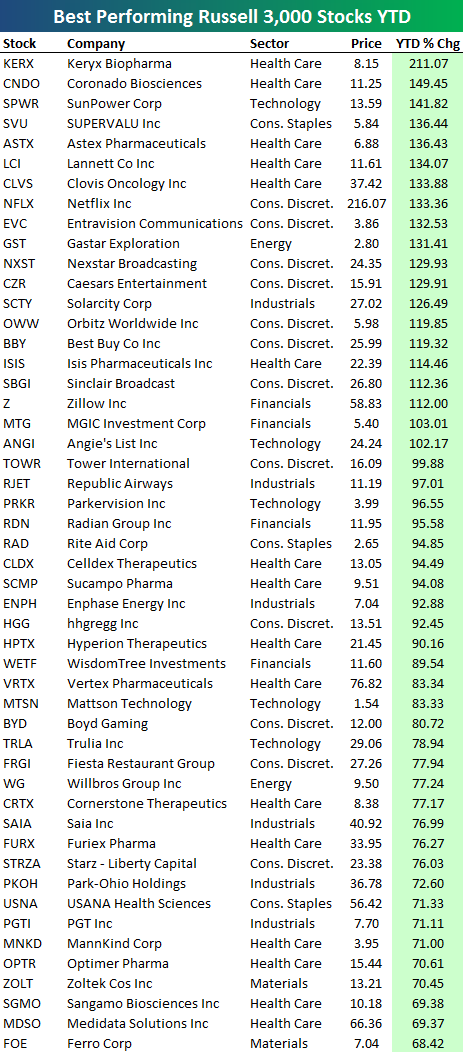
Best Performing Russell 3,000 Stocks YTD

bestytd430

S&P 500’s Best and Worst Months of May Since 1928

S&P 500’s Best and Worst Months of May Since 1928

TUESDAY, APRIL 30, 2013 AT 10:22AM

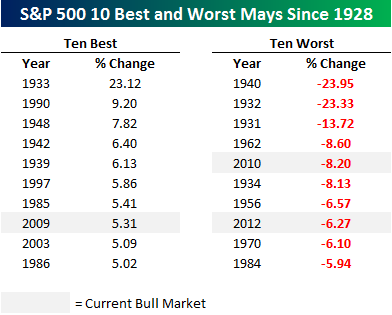
With the month of May beginning tomorrow, we wanted to highlight the best and worst S&P 500 performances during the month since 1928.  Overall, the S&P 500 has averaged a decline of 0.15% during the month, which is among the weaker average monthly performances of the year.

While investors debate the merits of sell in may and go away, we thought it was worth pointing out that May has increasingly become a volatile month in recent years.  As shown in the table below, two of the ten worst months of May going all the way back to 1928 have both occurred during the current bull market (2010 & 2012).  Furthermore, one of the ten best Mays of all time also came during the current bull market (2009).  In other words, three of the four Mays during the current bull market have qualified as one of the ten best or worst Mays of all time.  That leaves 2011 as the only year where May was not one of the ten best or worst Mays ever.  In that year, the S&P 500 declined 1.4%.  With the month of May averaging a decline of 2.64% during the current bull market, you can’t blame bulls for wanting to take the month off in 2013.

Mays best and Worst

Lethal H7N9 bird flu virus batters China’s holiday travel bug; number of tourists to some eastern Chinese cities where the outbreak is concentrated has plunged by half

Bird flu virus batters China’s holiday travel bug

The number of tourists to some eastern Chinese cities where the outbreak is concentrated has plunged by half for some tour agencies over H7N9 fears. -ST 
Grace Ng

Wed, May 01, 2013
The Straits Times

Women wear face masks on a street in Shanghai on April 16, 2013 as China’s H7N9 bird flu virus spreads further afield. In spite of the deadly bird flu virus outbreak that has spread to new locations in China including south-eastern Fujian province and central Henan, Beijing housewife Xu Jia, 44, and her family decided to press on with their trip to Xiamen for the three-day Labour Day holiday which started on Tuesday. The family booked their trip to the scenic coastal city in Fujian earlier this month. Last Friday, news broke that one case of the H7N9 virus had surfaced in the province. Still, this has not stopped them from setting off two days ago. “We’re not concerned about the avian flu. There are just 100-odd cases across the whole country and there hasn’t been discovery of human-to-human transmission,” Ms Xu told The Straits Times. But her gung-ho attitude does not appear to be shared by many of her countrymen.

The number of tourists to some eastern Chinese cities – where the outbreak, which has sickened 124 people and killed 24, is concentrated – has plunged by half for some tour agencies over H7N9 fears. This is traditionally a peak tourism period, with tour prices rising as much as 30 per cent last year. Read more of this post

China Manufacturers Survive by Moving to Asian Neighbors

April 30, 2013, 4:00 p.m. ET

China Manufacturers Survive by Moving to Asian Neighbors

By KATHY CHU

MK-CC856_CLABOR_G_20130430141203

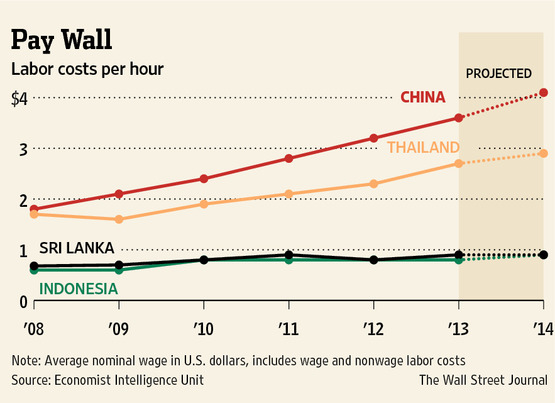
SHENZHEN, China—In a corner of a sprawling factory in this coastal southern city, sewing machines that stitched blouses and shirts for Lever Style Inc.’s clients now gather dust. As the din on the factory floor has dropped, so, too, has the payroll. Over the past two years, Lever Style’s employee count in China has declined by one-third to 5,000 workers. The company in April began moving apparel production for Japanese retail chain Uniqlo to Vietnam, where wages can be half those in China. Lever Style also is testing a shift to India for U.S. department-store chain Nordstrom Inc. JWN +0.09% and moving production for other customers. It’s a matter of survival. After a decade of nearly 20% annual wage increases in China, Lever Style says it can no longer make money here. Read more of this post

Chinese President Xi follows in Mao’s footsteps on path to consolidate power

Xi follows in Mao’s footsteps on path to consolidate power

Monday, 29 April, 2013, 12:00am

Wang Xiangwei xiangwei.wang@scmp.com

The president’s push to clean up the party may employ old tactics, but there’s reason to hope he wants more than just another purge

“Look in the mirror, dress properly, take a bath and see a doctor.”

Such advice might strike the ears of most people as plain and harmless. But that kind of order coming from the president and party chief surely sends shivers down the spines of many of the Communist Party’s 80 million members. Most of them understood that when the Politburo announced Xi Jinping’s campaign rid the party of “formalism, bureaucratism and behaviour that suggests mediocrity, laziness, laxity and extravagance”, what it really meant was: “Clean up your act. Or we’ll clean it up for you.” The year-long campaign, unveiled on April 19, requires any officials from the county level or higher to “reflect on their own practices and correct any misbehaviour”, according to Xinhua. It aims is to improve the party’s bond with the people, as well as fight corruption. Read more of this post

China Affair With Cheap Diamonds Heats Mass Market

China Affair With Cheap Diamonds Heats Mass Market: Commodities

China’s burgeoning middle class is buying diamonds so quickly that the price of mass-market stones is rising faster around the world than for top-quality jewels affordable only to the super-rich. Prices for a 1-carat internally flawless “top white” diamond have gained about 7 percent in two years, while a stone of similar size and color with slight imperfections jumped 24 percent, according to consultant PolishedPrices.com data. “The Chinese consumer’s fascination with luxury goods has grown dramatically, along with their pockets,” said Angelito Tan, founding partner of Robert, Tan & Gao, a consulting firm on luxury market strategy with offices in Shanghai and Beijing.

The price jump in more flawed diamonds benefits producers such as Russia’s OAO Alrosa, the world’s biggest by volume with 30 percent of output in 2011, and De Beers, the largest by revenue. Chow Tai Fook Jewellery Group Ltd. (1929), a retailer with a $13.5 billion market value, said its average selling price dropped in the last six months as it sold more pieces. Even as shoppers go down market in China, the world’s second-largest diamond buyer since 2011, the gap to top-flight stones is still large: A flawless 1 carat “top white” round diamond would cost about $28,800, according to online retailer Blue Nile, while a benchmark middle-market SI1-category diamond of the same size and color would cost about $7,200. China’s market was initially fueled by a rich elite pursuing the best diamonds available. As the economy grew, a new wave of buyers emerged, opening the market to lower-quality stones that form the bedrock of U.S. and European demand.

Read more of this post

Negatively geared Australian property investors lost an astonishing $13.2 billion in 2010-11, up from $10.1 billion the year before

Negative geared investors lose $13 billion

May 1, 2013

Peter Martin

Negatively geared property investors lost an astonishing $13.2 billion in 2010-11, up from $10.1 billion the year before. The latest Tax Office statistics show the average loss per negatively geared investor was $10,950, up from $9130 the year before. The average loss for a high-income negatively geared investor earning more than $180,000 was $23,800. Higher interest rates and rising property prices during 2010-11 swelled the losses. The figures identify negative gearing as one of the key drains on personal tax collections with one in every seven Australian taxpayers now a property investor and one in every 10 negatively geared.

Read more of this post

Most Chinese Cities Don’t Need And Can’t Afford The Subway Systems They’re Building: The Economist

Most Chinese Cities Don’t Need And Can’t Afford The Subway Systems They’re Building

The Economist | Apr. 29, 2013, 10:30 AM | 1,604 | 7

NOT many global cities of nearly 9m people lack an underground line, but until the end of last year the eastern city of Hangzhou was one of them. Now city slickers and rural migrants squeeze together inside shiny new carriages, checking their smartphones and reading free newspapers like commuters the world over. There is standing-room only in the rush hour and, with tickets at less than a dollar, the metro is revolutionising the way people travel across town. Two other Chinese cities—Suzhou and Kunming—have also opened their first underground lines in the past year, and the north-eastern city of Harbin is preparing to open one too. Four more cities have just added a new line to their existing systems. At least seven others have begun building their first lines.

If all the metros approved by central officials are built, 38 cities will have at least one line by the end of the decade, with more than 6,200km (3,850 miles) of track (London has nearly 400km.) As with many infrastructure projects in China, including the high-speed rail network above ground, questions abound about the wisdom and potential wastefulness of such ambitions. Many of the underground systems are needed, but some are being built in cities that are too small to justify the exorbitant expense. By some estimates the total bill could approach $1 trillion, not including the cost of operation. Zhao Jian of Beijing Jiaotong University reckons that metros in fewer than 20 of the 38 designated cities make sense. He says that perhaps ten of those could be replaced with cheaper light rail, which runs above ground. The minimum core urban population that can qualify a city for an underground system is 3m people, but even a place that big may find the operating costs crippling. Mr Zhao says the systems in Harbin and Kunming are unnecessary. Read more of this post

Hong Kong-based Richland Capital is shutting down its hedge funds despite outperforming peers, an unexpected move for a successful operator in an Asian industry which is struggling to raise assets

Hong Kong-based Richland to shut hedge funds in surprise move

Mon, Apr 29 2013

By Nishant Kumar

HONG KONG (Reuters) – Hong Kong-based Richland Capital Management Ltd is shutting down its hedge funds despite outperforming peers, four sources said, an unexpected move for a successful operator in an Asian industry which is struggling to raise assets. Richland is one of Asia’s best-known hedge funds. It manages $100 million between two funds and advises on an additional $150 million for wealthy clients, according to a fund information document obtained by Reuters. The hedge fund, founded in 2006 by former HSBC Holdings Plc (HSBA.L: Quote, Profile, Research, Stock Buzz) trader Alex Au with Eva Lo, who earlier worked at Credit Suisse Group AG (CSGN.VX: Quote, Profile,Research, Stock Buzz), has made money for its main Richland Asia Absolute Return Fund each year since launch, including a 5.3 percent gain in 2008. An e-mail to Lo and Au remained unanswered. The sources, who have direct knowledge of the matter, declined to be named as they were not authorized to speak on the matter. It was not immediately clear why Richland was closing. Typically, hedge funds shut down in response to poor performance or clients withdrawing large amounts of money, but Richland has suffered from neither. “Today is the day when funds are winding down,” one of the sources said. Launched in December 2006 with $10 million, the Richland Asia Absolute Return Fund managed about $75 million in February this year, the fund document showed. The fund gained 14.1 percent in 2012 and was up about 6 percent in the first quarter of 2013, according to fund performance data seen by Reuters, outperforming a 10 percent gain in the benchmark Eurekahedge Asia index last year and 5.8 percent in the March quarter. The second fund, Richland Emerging Opportunities Fund, returned 13.1 percent last year and was up about 18 percent in the first quarter of 2013. So far, 23 hedge funds have shut down in Asia, compared with 18 launches, according to data from Eurekahedge. Last year, 169 hedge funds closed in Asia, exceeding 139 launches.

CEO Pay 1,795-to-1 Multiple of Wages Skirts U.S. Law

CEO Pay 1,795-to-1 Multiple of Wages Skirts U.S. Law

Former fashion jewelry saleswoman Rebecca Gonzales and former Chief Executive Officer Ron Johnson have one thing in common: J.C. Penney Co. (JCP) no longer employs either. The similarity ends there. Johnson, 54, got a compensation package worth 1,795 times the average wage and benefits of a U.S. department store worker when he was hired in November 2011, according to data compiled by Bloomberg. Gonzales’s hourly wage was $8.30 that year. Across the Standard & Poor’s 500 Index of companies, the average multiple of CEO compensation to that of rank-and-file workers is 204, up 20 percent since 2009, the data show. The numbers are based on industry-specific estimates for worker compensation. Almost three years after Congress ordered public companies to reveal actual CEO-to-worker pay ratios under the Dodd-Frank law, the numbers remain unknown. As the Occupy Wall Street movement and 2012 election made income inequality a social flashpoint, mandatory disclosure of the ratios remained bottled up at the Securities and Exchange Commission, which hasn’t yet drawn up the rules to implement it. Some of America’s biggest companies are lobbying against the requirement.

Read more of this post

Why the China Dream Might Be a Mirage; Will the vested interests getting obscenely rich in Beijing let President Xi rewrite China’s model?

Why the China Dream Might Be a Mirage

If global economists are distraught over the gloomy numbers coming out of China, imagine how Xi Jinping must feel. China’s president, officially in the post for barely a month, is still consolidating his power. At home, he confronts a widening rich-poor gap and endemic pollution, not to mention bird flu and rivers overrun with dead pigs. Abroad, China’s erstwhile ally North Korea is looking increasingly unhinged. Now Xi faces intense pressure to retool the Chinese economy if he wants to build on gains the Communist Party has delivered over the last 30 years. Xi could be excused for feeling a tad bitter. He’s in this awkward position largely because of the failings of his predecessor, Hu Jintao. That may sound like an odd way to characterize Hu’s tenure. During his decade in office, China grew at rates of more than 10 percent, surpassed Japan to become the world’s No. 2 economy and matured into a key diplomatic actor. Hu and his premier, Wen Jiabao, should have used this time to wean the Chinese economy off its obsessive reliance on exports and investment. Yet too many well-placed figures were getting too rich. Modestly paid politicians mysteriously became multimillionaires. Local governments amassed mountains of debt for boondoggle projects. Hu and Wen presided over a robber-baron era that would have made Cornelius Vanderbilt and J.P. Morgan blush.

By contrast, Xi has been saying all the right things about revamping the economy so that domestic demand, not sweatshop labor, drives growth. He talks about the need to attack chronic graft and to preserve the environment. He has made noises about increasing spending on research and development, and has promised to institute a more inclusive urbanization strategy. One of the most tantalizing questions in economics is whether Xi has the courage to oversee such an ambitious rewriting of China’s model. Yet the real question is this: Will the vested interests getting obscenely rich in Beijing let him? Read more of this post

Japan’s “Abenomics” detractors brace for “I told you so” moment

Japan’s “Abenomics” detractors brace for “I told you so” moment

Mon, Apr 29 2013

By Tomasz Janowski and Chikako Mogi

TOKYO (Reuters) – In the shadows of Prime Minister Shinzo Abe’s formidable PR machine, a small, tenacious group of “Abenomics” detractors is battling to be heard and waiting for their “I told you so” moment. Being a contrarian in a society that values consensus and conformity is hard enough, but it is even harder for academics, commentators and investors who are attacking Abe’s economic revival plan as misguided and potentially dangerous. The plan relies so much on changing attitudes formed during years of decline that critical voices are more than just part of the political debate. Criticism could undermine Abe’s efforts and there are many skeptics reluctant to openly challenge policies that are giving Japan long-forgotten optimism and hope.

Read more of this post

Goldman Sachs Jim O’Neill’s Farewell Letter

Jim O’Neill’s Farewell Letter

Tyler Durden on 04/29/2013 12:03 -0400

Over the years, Jim O’Neill, former Chairman of GSAM, rose to fame for pegging the BRIC acronym (no such luck for the guy who came up with the far more applicable and accurate PIIGS, or STUPIDS, monikers, but that’s neither here nor there). O’Neill was correct in suggesting, about a decade ago, that the rise of the middle class in these countries and their purchasing power would prove to be a major driving force in the world economy. O’Neill was wrong in his conclusion as to what the ultimate driver of said purchasing power would be: as it has become all too clear with the entire world drowning in debt (and recently China), it was simply debt, which moved from the funding developed world consumption to handing out credit cards to consumers in the developing world. O’Neill was horribly wrong after the Great Financial Crisis when he suggested that it would be the BRIC nation that would push the world out of depression. To the contrary, not only is the world not out of depression as the fourth consecutive year of deteriorating economic data confirms (long since disconnected with the actual capital markets), but it is the wanton money (and bad debt) creation by the central banks of the developed world (as every instance of easing by China has led to an immediate surge of inflation in the domestic market) that has so far allowed the day of reckoning, and waterfall debt liquidations, to take place (and certainly don’t look at the stock index performance of China, Brazil, India or Russia). Despite his errors, he has been a good chap having taken much of the abuse piled upon him here at Zero Hedge somewhat stoically, as well as a fervent ManU supporter, certainly at least somewhat of a redeeming quality. Attached please find his final, farewell letter as Chairman of the Goldman Asset Management division, as he moves on to less tentacular pastures.

From Jim O’Neill

The World.

For my last Viewpoint, I have chosen to focus on the world. Attached is the opening presentation I gave at the 2013 GSAM Growth Markets Summit last Thursday in New York. It was a brilliant event and I wanted to thank all our guests who joined us as speakers, panellists, and in particular our clients who attended. The main theme was the growth that has taken place in the evolving world and the challenges that go with it.

Trillion-Dollar Student Loan Bubble Cracks With Pulled Sallie Mae Bond Deal

Student Loan Bubble Cracks With Pulled Sallie Mae Bond Deal

Tyler Durden on 04/29/2013 08:19 -0400
MI-BV584_SALIEM_G_20130425181804

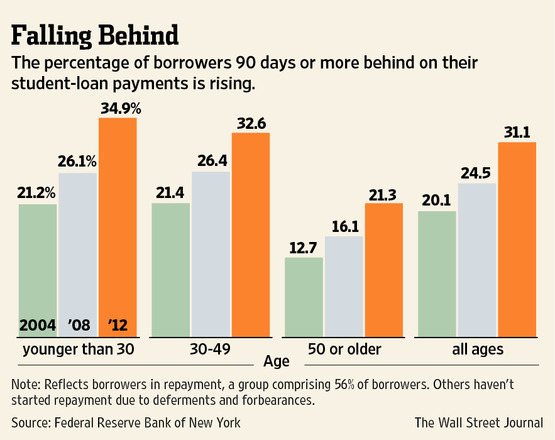
In 2007 a small number of French hedge funds imploded over sudden losses stemming from highly leveraged bets made on the unstoppable subprime mortgage market. At the time, a few saw the writing on the wall; but many simply wrote it off as just another over-levered hedge fund and the subprime mortgage market was ‘fine’. Fast forward six years and as we have discussed numerous times (most recently here and here) there is a bubble, potentially far bigger than subprime, in student loan debt. As one of the last remaining outlets for state-sanction credit creation, this is a big deal; but, of course, the popping of the bubble (or even a slight leak) is eschewed since there is so much ‘reach for yield’ and the Fed’s got your back. That is until this week. As WSJ reports, Sallie Mae (SLM), the nation’s largest non-government student lender just cancelled a $225 million debt offering as investors  decided they simply were not getting paid enough for risk – amid rising student loan defaults. Simply put, there’s a limit to what investors will tolerate. SLM was offering a stunningly low 3.5% interest on the deal and investors snubbed it, “There are certain limits that can’t, or shouldn’t, be crossed if you’re an investor,” adding that, “we’re beginning to see what the tolerances are.” This is a significant shift since SLM and other issuers of debt backed by student loans sold $7.8 billion worth of securities this year through last week, up from $5.7 billion in the same period of 2012. With the portion of student borrowers who are late on their debt payments by 90 days or more climbing to 31% in 2012, from 24% in 2008; we wonder if this is the tipping point for the student debt in 2013 that was generally ignored in subprime in 2007, until it was too late.

Updated April 25, 2013, 7:23 p.m. ET

Investors Say No to Sallie Mae Bond Deal

Poor Demand for Security Backed Only by Excess Cash Flows Shows Limits to Appetite for Risk

By AL YOON

There’s a limit to how much risk investors will tolerate.

Student-loan company Sallie Mae SLM +0.24% canceled a $225 million bond offering on Thursday after about two weeks on the market, according to people familiar with the deal. The move may mark a line in the sand: Investors whose thirst for yield has revived all manner of riskier asset classes decided they weren’t getting paid enough to buy at the offered price amid rising student-loan defaults. Read more of this post

P&G has a higher PE than Google as investors drive up the shares of dividend-paying companies, fueling a debate over whether these haven stocks are getting dangerously expensive

Updated April 28, 2013, 4:42 p.m. ET

In Stocks, Payouts Trump Potential

By JONATHAN CHENG

AM-AY259_ABREAS_G_20130428133605

Analysts expect paper-towel, toothpaste and soap maker Procter & GamblePG +0.68% to churn out per-share earnings growth of about 6% this year. Google‘sGOOG -0.95% profits will jump 18%, other analysts predict. So which stock is hotter? The answer: P&G, trading at 18 times projected per-share earnings and far above its five-year average of 15.4, according to data provider FactSet. In contrast, Google has a P/E ratio of 16.6, below its five-year average of 17.2. Investors are attracted by P&G’s sturdy dividend yield of 3.1%, assuring them at least a modest return on a stock known for its reliable performance. Google pays no dividend.

Investors searching for higher yields are driving up the shares of dividend-paying companies, fueling a debate over whether these traditional haven stocks are getting dangerously expensive. Some buyers argue that dividend stocks have entered a period where demand for income will keep valuations high, perhaps for years, thanks to Federal Reserve easy-money policies that are expected to remain in place at least into 2015. Skeptics say the “this time is different” thesis will prove wrong, and that investors will discover they have overpaid. Read more of this post

Switzerland Shorn of Bankers Proves Industrial Juggernaut; “Switzerland is like a Silicon Valley for the manufacturing industry. It would be a mistake to move to a pure service economy.”

Switzerland Shorn of Bankers Proves Industrial Juggernaut

Behind the headline-grabbing job reductions at Switzerland’s biggest banks is a manufacturing boom that is keeping the economy ahead of the rest of Europe.

Even after 10,000 Swiss job losses at banks led by UBS AG (UBSN) and Credit Suisse Group AG (CSGN) in the past five years, the nation’s unemployment rate has fallen to 3.1 percent, the lowest of Europe’s 10 biggest economies and less than the rate a decade ago. The nation of 8 million is adding workers in factories that make electrical equipment, airline seating, toilets and drugs.

“People think that precision engineering, watchmaking and the medical industry are minor, but collectively added up, they are quite sizeable in Switzerland,” said Hubertus Von Gruenberg, chairman of Zurich-based ABB Ltd. (ABBN), the world’s largest maker of power transformers. Banks are “overemphasized” in the public perception as there’s a big finance industry relative to the size of the country, he said, adding that the industrial base is “powerful and important.”

Banks and insurers had 152,000 full-time employees last year, compared with 588,000 who work for industrial companies. The banking industry’s share of domestic economic output fell to 6.2 percent in 2011 from 8.7 percent in 2007, according to the most recent data from the Swiss Bankers Association.

“Switzerland is like a Silicon Valley for the manufacturing industry,” said Markus Koch, a partner at Deloitte AG in Zurich. Given the higher cost base, no Swiss manufacturer would survive if it’s not world leading or top quality, he said. Read more of this post

GM’s China Bet Mimics Toyota’s Bet on U.S. Last Century

GM’s China Bet Mimics Toyota’s Bet on U.S. Last Century

General Motors Co. (GM), the largest carmaker in the U.S., is shifting its center of gravity to China, where it sells more cars and now invests more money. GM’s announcement at the Shanghai auto show this month that it is spending $11 billion by 2016 on new plants, products and people in China demonstrates a change in priorities. GM is investing $1.5 billion in North America this year, where it has a more modest factory footprint. GM’s focus on China parallels the strategy Toyota Motor Corp. (7203) employed in the last century, when the Japanese automaker poured investment in the U.S. market, where it saw its greatest growth potential. Now, Detroit-based GM is taking the lead in the world’s largest auto market by building four new assembly plants in China to boost its factory capacity to 5 million vehicles annually, twice what it sold in the U.S. last year.

“This is what the Japanese did in the ’70s when the U.S. became their most important market,” said Rebecca Lindland, an automotive consultant with Rebel Three Media & Consultants in Cos Cob, Connecticut. “What GM is doing is really smart because it’s proactively investing in a market that, for the foreseeable future, is going to be the world’s largest.” GM rose to a 52-week high of $30.71 last week. It fell 0.7 percent April 26 to $30.50. It has gained 5.8 percent so far this year compared with an 11 percent increase in the Standard & Poor’s 500 Index. The company will announce quarterly results later this week. Read more of this post

China’s Military Says No Plates for Porsches in Corruption Crackdown

China’s Military Says No Plates for Porsches in Crackdown

China will ban the use of military number plates on luxury cars, including Porsche and Bentley, in a crackdown on abuse of vehicle management within the armed forces amid President Xi Jinping’s campaign against corruption.

The change was ordered by the Central Military Commission, headed by Xi, and is part of the military’s effort to reinforce discipline and protect its image, the PLA Daily, the armed forces’ official newspaper, said in a report yesterday.

A new license system will go into force on May 1 to clamp down on the sale and use of legal and counterfeit military plates in order to “maintain social harmony, stability and the reputation of the military,” the paper said. Existing plates for all military vehicles will be canceled, it said.

The use of military license plates on luxury cars “is at odds with our army’s glorious tradition and not conducive to building the military’s morals,” according to a commentary in the newspaper. Vehicle management is “a political task to maintain forever the nature, principle and true color of the armed forces,” it said. Read more of this post

Highest-Paid Workers Driving Shell Off Australian Shores

Highest-Paid Workers Driving Shell Off Australian Shores

Escalating costs to build liquefied natural gas plants on land in Australia, where energy workers earn the highest salaries in the world, are driving developers out to sea in search of billions of dollars in savings.

Exxon Mobil Corp. (XOM) plans to use the world’s largest ship to turn gas into liquid at an offshore field, eliminating the need for investment in pipelines and port facilities. Woodside Petroleum Ltd. (WPL) is studying sea-based technology since ditching plans this month for an onshore plant for its Browse project.

After starting work on $180 billion in LNG terminals on land, developers are considering about $85 billion in floating projects to keep Australia competitive with suppliers in North America and East Africa. The floating export terminals will be built in Asian shipyards where labor costs are lower, including South Korea, the world’s biggest shipbuilder after China. Read more of this post