“Indonesia was a hot market about seven to eight years ago. But the time of the low-hanging fruits is over. The whole environment has become too frothy.”

Symphony Shies From Frothy Prices in Indonesia: Southeast Asia

Symphony International Holdings Ltd. (SIHL) said it’s seeking private-equity deals in markets including Malaysia and Thailand as assets in Indonesia, where it has invested for more than two decades, have become overvalued. An increasing number of buyout firms seeking companies that serve the growing middle class in the world’s fourth-most populous nation has pushed prices of privately-owned businesses higher, Anil Thadani, director at Symphony, an Asia-Pacific private-equity firm founded in 1981. “Indonesia was a hot market about seven to eight years ago,” Thadani, who is chairman of Symphony’s investment manager, said in an interview on April 26. “But the time of the low-hanging fruits is over. The whole environment has become too frothy.” Buyout firms are counting on rising domestic consumption in Southeast Asia’s biggest economy to boost returns as a slowdown in global growth has weakened prices of commodities such as coal and palm oil. Private spending accounts for more than 60 percent of the economy, according to government data. “We invested in Indonesia in the ’80s, and we did very well,‘‘ said Thadani, 66. ‘‘So over the last couple of years, we stayed away as we always do when we see herd behavior. Private equity is a lot about buying at the right price. And at the moment, the price isn’t right in that country.’’ Read more of this post

Billionaires Flee Havens as Trillions Pursued Offshore

Billionaires Flee Havens as Trillions Pursued Offshore

Billionaire Dmitry Rybolovlev, Russia’s 14th-richest person, and his wife, Elena Rybolovleva, have been brawling for almost five years in at least seven countries over his $9.5 billion fortune. In a divorce complaint originated in Geneva in 2008, Rybolovleva accused her husband of using a “multitude of third- parties” to create a network of offshore holding companies and trusts to place assets — including about $500 million in art, $36 million in jewelry and an $80 million yacht — beyond her reach. She has brought legal action against the 48-year-old Rybolovlev in the British Virgin Islands, England, Wales, the U.S., Cyprus, Singapore and Switzerland, and is seeking $6 billion.

The suits provide a window into the offshore structures and secrecy jurisdictions the world’s richest people use to manage, preserve and conceal their assets. According to Tax Justice Network, a U.K.-based organization that campaigns for transparency in the financial system, wealthy individuals were hiding as much as $32 trillion offshore at the end of 2010. Fewer than 100,000 people own $9.8 trillion of offshore assets, according to research compiled by former McKinsey & Co. economist James Henry.

“For a lot of people, it’s not just the objective of not paying taxes,” Philip Marcovici, an independent Hong Kong-based tax lawyer and board member of Vaduz, Liechtenstein-based wealth adviser Kaiser Partner Group, said in a telephone interview. “It’s the objective of obtaining the human right to privacy and seeking confidentiality about their financial affairs.” Read more of this post

Venture Capitalists Are Making Bigger Bets on Food Start-Ups

April 28, 2013

Venture Capitalists Are Making Bigger Bets on Food Start-Ups

By JENNA WORTHAM and CLAIRE CAIN MILLER

FOOD-articleLarge (1)

Unreal, a candy company based in Boston, says it uses 25 percent less sugar than other candy on the market.

What if the next big thing in tech does not arrive on your smartphone or in the cloud? What if it lands on your plate? That idea is enticing a wide group of venture capitalists in Silicon Valley into making big bets on food. In some cases, the goal is to connect restaurants with food purveyors, or to create on-demand delivery services from local farms, or ready-to-cook dinner kits. In others, the goal is to invent new foods, like creating cheese, meat and egg substitutes from plants. Since this is Silicon Valley money, though, the ultimate goal is often nothing short of grand: transforming the food industry.

“Part of the reason you’re seeing all these V.C.’s get interested in this is the food industry is not only is it massive, but like the energy industry, it is terribly broken in terms of its impact on the environment, health, animals,” said Josh Tetrick, founder and chief executive of Hampton Creek Foods, a start-up making egg alternatives. Some investors say food-related start-ups fit into their sustainability portfolios, alongside solar energy or electric cars, because they aim to reduce the toll on the environment of producing animal products. For others, they fit alongside health investments like fitness devices and heart rate monitoring apps. Still others are eager to tackle a real-world problem, instead of building virtual farming games or figuring out ways to get people to click on ads. Read more of this post

Cleaning Up on Fracking’s Dirty Water; 100 years ago, it took about a barrel of water to get 10 barrels of oil out of the ground. Today, generating the equivalent amount of shale-gas energy requires five times as much water

SATURDAY, APRIL 27, 2013

Cleaning Up on Fracking’s Dirty Water

By LESLIE P. NORTON | MORE ARTICLES BY AUTHOR

With two recent acquisitions, Ecolab has become a top provider of water-treatment services used in energy extraction. Why the stock could still gush 20% or more higher.

It’s often said that 100 years ago, it took about a barrel of water to get 10 barrels of oil out of the ground. Today, generating the equivalent amount of shale-gas energy requires five times as much water, which is why hydraulic fracturing, or fracking, “is more of a water issue than it is about gas,” says Deane Dray, the water analyst for Citigroup. That has enhanced the long-term prospects of water-related stocks, including Ecolab (ticker: ECL). “The opportunities we’re seeing in water supply and water treatment are exciting,” says Ian Simm, CEO of Impax Asset Management in London and a fan of St. Paul, Minn.–based Ecolab. Despite a run-up in Ecolab’s stock this past year, Impax believes it can still rise further, citing the company’s strong management, the stock’s steady uptrend in a volatile environment, and its “mission-critical products,” says Simm. As much as 140 billion gallons of water are used in the 35,000 wells fracked annually in the U.S. Most of it simply disappears underground; the rest is rendered so toxic by the process that communities are wary of fracking. Plenty of companies will treat the water, but two specialists are Nalco and Champion, both owned by Ecolab.

Read more of this post

Dog days for hedge funds forced to cut fees

April 28, 2013 5:50 pm

Dog days for hedge funds forced to cut fees

By Sam Jones

The definition of a hedge fund, people used to joke, was a fee structure in search of an investor to fleece. However, four years on from the financial crisis, and with so far little to show for it, hedge funds’ notoriously high fees are looking less and less definable, let alone defensible. Some investors now hope that the industry’s totemic “two and 20” fee structure – 2 per cent of assets and 20 per cent of returns annually; a formula that has made many managers fantastically wealthy – may finally be beginning to crack. Challenging fees is no easy task for investors, however. Thanks to the crisis, they may well have more clout than ever before when it comes to negotiating with managers, but they are also themselves more desperate. In a time of ultra-low bond yields and high equity volatility, hedge funds are proving an irresistible draw. And as such, investing in hedge funds still seems to be a game rigged in the managers’ – and not the investors’ – favour. Read more of this post

Malaysia Arson, Intimidation Cases Mount as Election Draws Near; “The violence is much more than previous elections”

Malaysia Arson, Intimidation Cases Mount as Election Draws Near

More than 1,400 cases of arson, fighting and other election-related crimes have been recorded by police since Malaysia’s parliament was dissolved for polls which will determine whether Najib Razak’s government can extend its five-decade grip on power.

“The violence is much more than previous elections,” Irene Fernandez, co-chairwoman of the Coalition for Clean and Fair Elections’ code of conduct committee, said by phone. “The increased tension is being driven by the fear of racial riots” and broader implementation of Islamic law among non-Muslims that’s being created in the media, she said.

At least two more campaign offices were torched by suspected arsonists this weekend as politicians held rallies nationwide, the Star newspaper reported today, citing police. The authorities earlier confirmed they were investigating three similar incidents last week, including a small explosion at an event attended by 3,000 supporters of Prime Minister Najib’s Barisan Nasional coalition ahead of the May 5 vote.

Najib’s government is facing its fiercest challenge to date, after retaining power five years ago by its narrowest margin since Malaysia’s independence from Britain in 1957. The markets have priced in Barisan Nasional retaining power in next month’s vote with a simple majority, though there is a growing risk of a hung parliament or the opposition gaining control, RHB Capital Bhd. (RHBC) said in an April 1 report. Read more of this post

Loans Borrowed Against Pensions Squeeze Retirees with their high interest rates; “It’s simply a terrible deal”

April 27, 2013

Loans Borrowed Against Pensions Squeeze Retirees

By JESSICA SILVER-GREENBERG

To retirees, the offers can sound like the answer to every money worry: convert tomorrow’s pension checks into today’s hard cash. But these offers, known as pension advances, are having devastating financial consequences for a growing number of older Americans, threatening their retirement savings and plunging them further into debt. The advances, federal and state authorities say, are not advances at all, but carefully disguised loans that require borrowers to sign over all or part of their monthly pension checks. They carry interest rates that are often many times higher than those on credit cards. In lean economic times, people with public pensions — military veterans, teachers, firefighters, police officers and others — are being courted particularly aggressively by pension-advance companies, which operate largely outside of state and federal banking regulations, but are now drawing scrutiny from Congress and the Consumer Financial Protection Bureau. The pitches come mostly via the Web or ads in local circulars. Read more of this post

Matt Taibbi: Everything Is Rigged: The Biggest Price-Fixing Scandal Ever

Everything Is Rigged: The Biggest Price-Fixing Scandal Ever

The Illuminati were amateurs. The second huge financial scandal of the year reveals the real international conspiracy: There’s no price the big banks can’t fix

by MATT TAIBBI

APRIL 25, 2013

20130423-national-affairs-600-1366749334

Conspiracy theorists of the world, believers in the hidden hands of the Rothschilds and the Masons and the Illuminati, we skeptics owe you an apology. You were right. The players may be a little different, but your basic premise is correct: The world is a rigged game. We found this out in recent months, when a series of related corruption stories spilled out of the financial sector, suggesting the world’s largest banks may be fixing the prices of, well, just about everything.

You may have heard of the Libor scandal, in which at least three – and perhaps as many as 16 – of the name-brand too-big-to-fail banks have been manipulating global interest rates, in the process messing around with the prices of upward of $500 trillion (that’s trillion, with a “t”) worth of financial instruments. When that sprawling con burst into public view last year, it was easily the biggest financial scandal in history – MIT professor Andrew Lo even said it “dwarfs by orders of magnitude any financial scam in the history of markets.”

That was bad enough, but now Libor may have a twin brother. Word has leaked out that the London-based firm ICAP, the world’s largest broker of interest-rate swaps, is being investigated by American authorities for behavior that sounds eerily reminiscent of the Libor mess. Regulators are looking into whether or not a small group of brokers at ICAP may have worked with up to 15 of the world’s largest banks to manipulate ISDAfix, a benchmark number used around the world to calculate the prices of interest-rate swaps. Read more of this post

Bitcoin: the Berlin streets where you can shop with virtual money; “There is no middle man involved.. I like the fact that Bitcoin scares people in suits, because if this thing were to really take off, it would bankrupt a lot of bankers.”

Bitcoin: the Berlin streets where you can shop with virtual money

The digital currency is rising in popularity among traders in the rebellious Kreuzberg area of Germany’s capital

Kate Connolly and Guy Grandjean in Berlin

guardian.co.uk, Friday 26 April 2013 11.08 BST

In Kreuzberg, Berlin, Bitcoin has expanded off the internet into the local economy.Link to video: Bitcoin: world’s fastest growing currency migrates off the internet

Nadim Chebli remembers well the first of his customers who decided to pay for the records they bought with virtual currency rather than cash or credit cards. “I’d only just agreed to accept Bitcoins,” said the 36-year-old owner of the Long Player record shop, “and the first sales I made in it came pretty quickly, from a guy about my age who bought Tom Waits’s The Big Time and a young woman who bought a Beatles compilation from 1967.” In the few months since Chebli signed up to the peer-to-peer electronic cash system, he finds it hard to come up with definitive characteristics for the “typical” Bitcoin user who walks off the street into what he describes as his “vinyl living room”. “There’s no typical age group, or sex, just, well, regular folk,” he said. Florentina Martens has had the same experience since opening her Parisian-style cafe Floor’s two months ago just a couple of streets away. “There is not a prototype Bitcoin payer,” she said. “It’s random people. Not only nerds, let me put it that way.”

Like Chebli, Martens, whose Kersenvlaai (cherry cake) from her native Maastricht is rated as one of the best culinary offerings of the area, says she decided to accept Bitcoins because of the ease, cheapness and transparency of its payment system. “It’s an easier way of digital payment than credit cards, which cost me a lot of money as a business and to which I’m forced to sign up for years,” she says. Read more of this post

Can You Get a Refund From a Bad Hedge Fund?

April 26, 2013, 5:08 p.m. ET

Can You Get a Refund From a Bad Hedge Fund?

By JASON ZWEIG

BF-AE850A_INVES_G_20130426170043

Disgruntled hedge-fund investors might be able to make new use of an old technique to erase some of their losses. Earlier this month, David Blass, chief counsel of the division of trading and markets at the Securities and Exchange Commission, gave a speech before an investment-law group in which he warned that many “private funds”—hedge funds, private-equity portfolios and the like—might be breaking the law when they sell to investors. Mr. Blass’s message wasn’t entirely new. Unless they can meet a series of tests to be exempt, private-fund managers have long been required to register as broker-dealers if they solicit outside investors by selling interests in their funds. Registering compels them to follow SEC rules on how they sell their wares. But Mr. Blass’s speech also threw a fresh spotlight on the question of whether the hedge-fund industry has been following the law. And it reminded alert investors of an unusual—but rare and difficult—way to bail out of a rotten fund.

Read more of this post

The Criminal Mind: Advances in genetics and neuroscience are revolutionizing our understanding of violent behavior—as well as ideas about how to prevent and punish crime

April 26, 2013, 7:28 p.m. ET

The Criminal Mind

Advances in genetics and neuroscience are revolutionizing our understanding of violent behavior—as well as ideas about how to prevent and punish crime.

By ADRIAN RAINE

OB-XG208_0426br_G_20130426130759

Donta Page’s brain scan, left, shows the reduced functioning of the ventral prefrontal cortex—the area of the brain that helps regulate emotions and control impulses—compared to a normal brain, right.

In studying brain scans of criminals, researchers are discovering tell-tale signs of violent tendencies. WSJ’s Jason Bellini speaks with Professor Adrian Raine about his latest discoveries. The scientific study of crime got its start on a cold, gray November morning in 1871, on the east coast of Italy. Cesare Lombroso, a psychiatrist and prison doctor at an asylum for the criminally insane, was performing a routine autopsy on an infamous Calabrian brigand named Giuseppe Villella. Lombroso found an unusual indentation at the base of Villella’s skull. From this singular observation, he would go on to become the founding father of modern criminology. Lombroso’s controversial theory had two key points: that crime originated in large measure from deformities of the brain and that criminals were an evolutionary throwback to more primitive species. Criminals, he believed, could be identified on the basis of physical characteristics, such as a large jaw and a sloping forehead. Based on his measurements of such traits, Lombroso created an evolutionary hierarchy, with Northern Italians and Jews at the top and Southern Italians (like Villella), along with Bolivians and Peruvians, at the bottom. These beliefs, based partly on pseudoscientific phrenological theories about the shape and size of the human head, flourished throughout Europe in the late 19th and early 20th centuries. Lombroso was Jewish and a celebrated intellectual in his day, but the theory he spawned turned out to be socially and scientifically disastrous, not least by encouraging early-20th-century ideas about which human beings were and were not fit to reproduce—or to live at all. Read more of this post

Bee venom has become the buzziest antiaging ingredient. The ingredient appears in a number of high-end beauty products from Guerlain to Manuka Doctor; “Your brain thinks that [you’ve been] bitten and it sends back a signal that the skin needs to heal itself”

April 26, 2013, 2:50 p.m. ET

Here’s the Sting

Bee venom has become the most buzzed-about antiaging ingredient

By ELIZABETH HOLMES

OB-XF903_beecol_G_20130425172118

The toxic ingredient appears in a growing number of high-end anti-aging serums, masks and moisturizers from various companies. Manuka Doctor, a line from New Zealand, boasts a purifying process that removes extraneous elements such as pollen dust or bee bits. The U.K. brand Heaven Skincare claims to use a secret ingredient that activates the bee venom.

The key ingredient is said to improve skin by setting off an elaborate chain reaction. “Your brain thinks that [you’ve been] bitten and it sends back a signal that the skin needs to heal itself,” said Maria Hatzistefanis, founder of Rodial, a London-based skin care line known for its use of exotic ingredients, which recently debuted bee venom products. Once this brain signal has been sent, as the theory goes, blood rushes to the area, triggering an increase in the production of wrinkle-smoothing collagen. Deborah Mitchell, maker of Heaven, describes venom products as a topical, natural alternative to Botox. “Straight away, the skin tightens and firms,” she said, noting that many users report a slight tingling—a sign the product is working. Read more of this post

Instant noodle sales top 100 billion units a year

Instant noodle sales top 100 billion units a year

“The results show that instant noodles have become a global standard dish,” said Norio Sakurai, an official with the Osaka-based association. -AFP
Fri, Apr 26, 2013, AFP

Tokyo – Global sales of instant noodles have topped 100 billion units annually, an industry group said Friday – more than one monthly serving of the portable meal for every person on the planet. Five decades after the easy-to-cook food’s launch, sales climbed again last year with China, Indonesia and Japan rounding out the world’s top-three consumers, according to the Japan-based World Instant Noodles Association. “The results show that instant noodles have become a global standard dish,” said Norio Sakurai, an official with the Osaka-based association. “We think global sales will continue growing particularly in some developing nations.” Of the 101.4 billion units sold worldwide last year, China, including Hong Kong, accounted for 44.0 billion servings, followed by Indonesia with 14.1 billion units, Japan at 5.4 billion units and Vietnam close behind with 5.1 billion units. Instant noodles, which come dried or pre-cooked and can be boiled quickly with accompanying flavour packets, were invented in Japan by Momofuku Ando, founder of major noodle maker Nissin Foods, in 1958.


Retailers concerned as Li-Ning, “China’s Nike”, holds fire sale to clear stock, offering discounts of up to 80%; Most items on sale were priced between 39 yuan and 79 yuan (US$6-$13)

Retailers concerned as Li-Ning holds fire sale to clear stock

Staff reporter, 2013-04-27

Leading Chinese sportswear company Li-Ning held a 48-hour online sale on April 22, offering discounts of up to 80%, the state-run China News Service reported on its website. Most items on sale were priced between 39 yuan and 79 yuan (US$6-$13), and everything was sold before the sale period ended, said the report. This was Li-Ning’s second 48-hour sale this month aimed at clearing out its backlog of unsold stock. The company reported a loss of 2 billion yuan (US$321 million) in 2012, the first time it had lost money since it began trading publicly in 2004. Yet the poor performance didn’t prevent the company from spending 1.32 billion yuan (US$212 millon) on advertising and marketing, which included the recruitment of NBA star Dwyane Wade to endorse its products for ten years for a fee of US$100 million. Some buyers were critical of the fire sale despite the attractive discounts, with some complaining that many of the products were from 2010 and long out of fashion, while others questioned the quality of the goods because of the low prices. Yan Yaolong, a market analyst with the online store JD, said that while Li-Ning may have thought it was a good idea to offload its inventory, the plan could backfire in the long term, as consumers may now wait for future sales rather than pay full price for its products — or be reluctant to wear the brand if it becomes perceived as cheap. The sales could also hurt the relationship between Li-Ning and its retailers, who complained that the low prices offered online would prevent customers from coming to their stores, said reports.

Weak yen puts POSCO, Hyundai out on limb

2013-04-26 17:01

Weak yen puts POSCO, Hyundai out on limb

04-27-12-01

Korean automobile, steel and electronics manufacturers are singing the blues due to falling margins from exports, caused by the yen’s weakness, while Japanese rivals are seeing an uptick in global sales

By Na Jeong-ju

South Korean firms are suffering heavy setbacks in global markets due to the weakening yen, while their Japanese rivals are rebounding strongly on their price competitiveness. Hardest hit are Korean automobile, steel and electronics manufacturers that compete neck-and-neck with Japanese firms in major markets around the world. The yen’s weakness has cut the earnings of Korean exporters. Hyundai Motor, the country’s largest automaker, said its first-quarter net profit dropped 14.9 percent from a year to 2.08 trillion won ($1.8 billion), compared with 2.4 trillion won a year earlier. In the January-March period, sales rose 6 percent on-year to 21.3 trillion won, but operating profit dropped 10.7 percent to 1.8 trillion won. “We earlier predicted the yen-dollar rate would move between 86 to 87 yen in the first quarter, but the average rate was 94 yen. That negatively affected our profitability,” an executive of Hyundai Motor said. Hyundai Motor, which competes with Toyota, Honda and other Japanese carmakers, could lose its competitive edge for some time as the yen’s weakness is expected to continue for the time being. Kia Motors, the second-largest automaker affiliated with Hyundai Motor, also announced its first-quarter net profit fell 34.7 percent from a year earlier to 783.9 billion won during the same period. Its operating profit dropped 35.1 percent to 704.2 billion won, as sales fell 6 percent to 11.08 trillion won. POSCO, the country’s leading steelmaker, also suffered damage. Its first-quarter net profit sank 54 percent from a year earlier to 292 billion won. Sales dipped 10.6 percent on-year to 14.58 trillion won, and operating income also dropped 4.7 percent to 717 billion won. The poor performances by Korean exporters are in stark contrast to a strong recovery of Japanese firms. Read more of this post

Beyond Korean style: Shaping a new growth formula; Reduce housing payments + End the education “arms race.” + Create an entrepreneurial SME sector

Beyond Korean style: Shaping a new growth formula

April 2013 | byWonsik Choi, Richard Dobbs, Dongrok Suh, Jan Mischke, Eunjo Chon, Hangjip Cho, Boyoung Kim, and Hyunmin Kim

Picture1

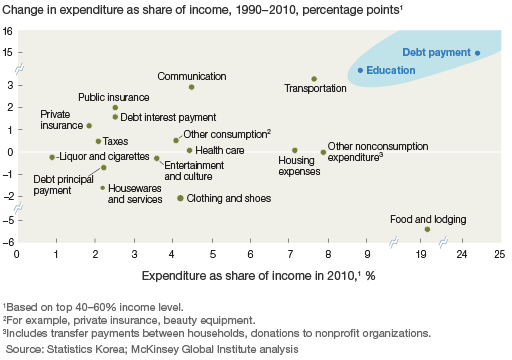
Beginning in the 1960s, South Korea has set economic-development records with a growth formula that focused on heavy-industry and manufactured exports. GDP has tripled in just the past 20 years, and South Korea became the first nation to go from being a recipient of aid from the Organisation for Economic Co-operation and Development to being a member of its donor committee. South Korea is the leading supplier of LCD screens, memory chips, and mobile phones and is the world’s number-five automaker. Yet the nation’s GDP growth is increasingly decoupled from the lives of its middle- income citizens. The number of middle-income households—earning 50 to 150 percent of median income—has fallen from 75.4 percent of the population to 67.5 percent since 1990, and more than half of middle-income households are cashflow constrained when the full costs of housing payments are counted. The squeeze contributes to trends that could affect future growth, including a plummeting personal-saving rate and one of the world’s lowest fertility rates. Beyond Korean style: Shaping a new growth formula, a new report from the McKinsey Global Institute (MGI), explores the causes of these economic challenges and makes specific recommendations for combatting them. Among the report’s findings: Read more of this post

Changing times force Taiwan to raise welfare spending

24 April 2013 Last updated at 21:05 GMT

Changing times force Taiwan to raise welfare spending

By Cindy SuiBBC News, Taipei

Working six days a week at a Taipei noodle stall, Hsu Ching-ni earns only $500 a month, not nearly enough to support her family of seven including three children, or even pay rent.

Instead, they have to survive on welfare. “I’m the only one in my family working. My husband suffered a stroke and can’t work. My parents-in-law are elderly. If it weren’t for the welfare, I don’t know where we’d be,” says Ms Hsu. The number of people like her in Taiwan is on the rise. But whereas in previous decades residents mostly depended on themselves, the government has been forced to restructure its social welfare system to help them. Read more of this post

The Rise of the ‘Aztec Tiger’: Under a charismatic new leader, Mexico is roaring toward a turnaround

April 26, 2013, 7:33 p.m. ET

The Rise of the ‘Aztec Tiger’

Under a charismatic new leader, Mexico is roaring toward a turnaround

By NICOLAS BERGGRUEN and NATHAN GARDELS

images (9)

Two decades ago, one of Mexico’s leading social critics proclaimed Los Angeles “the heart of the Mexican dream.” Pedro P. agreed, leaving behind his native Oaxaca for work as a gardener in the city’s San Fernando Valley. After 14 years as an undocumented immigrant, however, Pedro, age 44, is heading home at the end of April, drawn by an economic resurgence south of the border that has led some observers to label Mexico the “Aztec tiger.” Read more of this post

China Top Leaders Warn on Financial Risks as Rebound Falters as PSC, China’s top decision-making group, held a special economy-focused session, the first time since 2004

Chinese leaders more worried about financial risks than slower growth

Kate Mackenzie

| Apr 26 07:59 | 14 comments | Share

China’s Politburo Standing Committee, the country’s top decision-making group, held a special session yesterday to discuss the economy — apparently the first time they’ve held this sort of economy-focused meeting since 2004, according to Xu Gao at China Everbright Securities (via Bloomberg).

So what came out of it? It’s always hard to tell, but it probably wasn’t good news for anyone hoping for big stimulus measures.

The official Xinhua report is here and its headline suggests some worry at the economic growth rate. “China needs to cement its domestic economic growth momentum and guard against potential risks in financial sectors,” seems to be the key line, from the third paragraph, although it goes on to point out that Q1′s 7.7 per cent growth that had many China watchers worried was in fact higher than the 7.5 per cent official target. Read more of this post

Japan casino lobby in legalization push; market could out-strip Vegas

Japan casino lobby in legalization push; market could out-strip Vegas

7:14am EDT

By Nathan Layne and Farah Master

TOKYO/HONG KONG (Reuters) – After Singapore, Japan?

A pro-casino group of Japanese lawmakers has tapped an influential member of the ruling Liberal Democratic Party (LDP) as its leader and plans to submit legislation this year aimed at opening the world’s third-largest economy to casino gambling. Although casinos are illegal, Japanese are already active gamblers, and a pinball-like game called pachinko generates some $200 billion in revenue each year – about the same as Toyota Motor Corp. Japan is often touted as the next major casino market after Chinese enclave Macau, the world’s biggest gambling hub, which raked in revenue of $38 billion last year.

A large and wealthy population coupled with a proximity to Shanghai and Beijing has the potential to transform Japan into a lucrative gaming center, providing tax revenues to shore up the state’s ailing finances, analysts say. Broker CLSA estimates Japan’s gaming market could be worth at least $10 billion if two large-scale integrated resorts are approved – more than Singapore’s $5.9 billion and Las Vegas’ $6.2 billion in 2012. Read more of this post

Perverse advantage; A new book lays out the scale of China’s industrial subsidies

Perverse advantage; A new book lays out the scale of China’s industrial subsidies

Apr 27th 2013 | Shanghai |From the print edition

20130427_fnc48620130427_FNC488

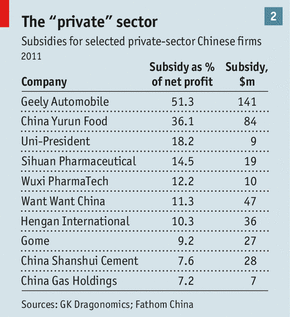
CHINA is the workshop to the world. It is the global economy’s most formidable exporter and its largest manufacturer. The explanations for its success range from a seemingly endless supply of cheap labour to an artificially undervalued currency. A provocative new book* by Usha and George Haley, of West Virginia University and the University of New Haven respectively, points to another reason for China’s industrial dominance: subsidies.

The Chinese government does not report all subsidies made to domestic industrial firms, so the Haleys plugged the holes with information from industry analysts, policy documents, non-governmental outfits and companies themselves. By looking at the gaps between end-user prices and benchmark prices, they have cobbled together numbers on many of the subsidies enjoyed by the biggest industrial state-owned enterprises (SOEs).

On their conservative calculations, China spent over $300 billion, in nominal terms, on the biggest SOEs between 1985 and 2005. This help often came in the form of cheap capital and underpriced inputs unavailable to international rivals. The glass industry got soda ash for a song, for example. The auto-parts business got subsidies worth $28 billion from 2001 to 2011 through cheap glass, steel and technology; the government has promised another $10.9 billion by 2020. The subsidies to the paper industry topped $33 billion from 2002 to 2009. All industrial SOEs benefited from energy subsidies. Read more of this post

3D printing: A new brick in the Great Wall; Additive manufacturing is growing apace in China vs “subtractive” technology of lathes, milling machines and cutting tools

3D printing: A new brick in the Great Wall; Additive manufacturing is growing apace in China

Apr 27th 2013 | BEIJING |From the print edition

20130427_STD001_0

ALTHOUGH it is the weekend, a small factory in the Haidian district of Beijing is hard at work. Eight machines, the biggest the size of a delivery van, are busy making things. Yet the factory, owned by Beijing Longyuan Automated Fabrication System (known as AFS), appears almost deserted. This is because it is using additive-manufacturing machines, popularly known as three-dimensional (3D) printers, which run unattended day and night, seven days a week.

The printers require an occasional visit from a supervisor to top them up with the powdered materials they use as their “inks”, or to remove a completed item, but apart from that they can be left on their own. They build up the objects they are making one layer at a time, as the ink is sintered into place with a laser in a way that creates little waste and can make shapes impossible to achieve using the traditional “subtractive” technology of lathes, milling machines and cutting tools. Read more of this post

Chart of the Day: Enterprising Aussies; Of those who say they are interested in becoming entrepreneurs, % who actually try to start a new business

Enterprising Aussies

Apr 26th 2013, 13:46 by Economist.com

Starting up a business down under

A NEW report by PricewaterhouseCoopers (PWC), a professional-services firm, suggests that Australia could start a lot more businesses. It predicts that online and high-tech start-ups could account for 4% of GDP and 540,000 jobs by 2033, up from 0.1% of GDP and 9,500 jobs today. The report offers signposts as to how the country might shift from mining coal to mining data. Australia has about 1,500 tech start-ups, mostly in Sydney and Melbourne. Vast untapped opportunities await in health care, an industry that will surge as the nation ages. Australia’s regulatory environment for entrepreneurs is friendly, and the country is admirably open to skilled immigration. In an annual survey of global entrepreneurship, 54% of adult Australians said they were interested in starting their own business, compared with nearly 70% of Italians. But 19% of Australians actually began the process, the highest proportion of the 21 countries in the report, whereas only 3% of Italians did so. Nonetheless, PwC frets that “fear of failure” is more common in Australia than in America or Canada, and this could be holding it back.

20130427_gdc503 Read more of this post

The cold wind of competition sweeps the legal-services market

The cold wind of competition sweeps the legal-services market

Apr 27th 2013 |From the print edition

“THE one great principle of the English law is to make business for itself,” noted Charles Dickens. These days many lawyers are struggling to do so. Few people are buying or selling houses. Divorces have been declining steadily for the past ten years. There is less crime. Legal aid is being trimmed. As a result, the proliferation of lawyers has slowed. This month the Law Society, which represents solicitors in England and Wales, announced that the number of firms and private practitioners had dropped for the first time. To make matters worse, competition is increasing.

Britain’s legal industry was once tightly regulated. Only qualified lawyers, typically operating in partnerships, were permitted to offer legal services. That changed in 2007, when the Legal Services Act allowed non-lawyers to own, run or invest in legal businesses. The first licence for an “alternative business structure”, as the new, looser arrangement is awkwardly known, was issued in March 2012. A year on, Britain’s legal market is beginning to churn. Read more of this post

WisdomTree Powers Ahead, Shares up 85% This Year; why the ETF company is one of the brightest spots in the asset management industry

April 26, 2013, 10:25 A.M. ET

WisdomTree Powers Ahead, Shares up 85% This Year

By Brendan Conway

The ascent of WisdomTree Investments (WETF) continues. This morning’s earnings report gives a few more signs why the company is one of the brightest spots in the entire asset management industry. The only publicly traded firm selling ETFs and ETFs alone reported a 53% jump in total revenue last quarter and a six-fold rise in net income. The period’s 60% growth in assets under management from a year earlier is more than twice the pace of the ETF industry’s 27% growth during 2012.

It’s not as if the company is sacrificing profitability to build up assets. WisdomTree’s average ETF advisory fee held steady at 0.54%. Costs rose, but gross margins still expanded to 72% from 63% a year earlier. Investors have responded. Shares are up nearly 85% year-to-date, including a 5% jump this morning, to $11.43.  Read more of this post

Southeast Asia’s 2015 unity dream collides with reality; “This kind of exercise – highly ambitious, short time-lines – simply works to fracture the organization further.”

Southeast Asia’s 2015 unity dream collides with reality

Thu, Apr 25 2013

By Stuart Grudgings

BANDAR SERI BEGAWAN, Brunei (Reuters) – Southeast Asian nations have quietly begun to row back on a deadline of forming an “economic community” by 2015, confirming what many economists and diplomats have suspected for years as the diverse group hits tough obstacles to closer union.

Rather than referring to the end of 2015 as a firm goal, officials at this year’s first summit of leaders of the Association of Southeast Asian Nations (ASEAN), whose 10 members range from glitzy Singapore to impoverished Myanmar, prefer to call it a “milestone” to be built on in years ahead.

In so doing, they are bowing to the reality of slow progress and even some regression on politically sensitive goals, such as eliminating non-tariff barriers and lowering obstacles to the free flow of labor in the diverse region of 600 million people. Read more of this post

Milk Smugglers Top Heroin Courier Arrests in Hong Kong

Milk Smugglers Top Heroin Courier Arrests in Hong Kong

For border officials in Hong Kong, baby formula trumps heroin.

Since the former British colony on March 1 restricted outbound travelers to two 2-pound cans each, a syndicate has been cracked and more people have been arrested for smuggling milk powder than were detained all of last year for carrying heroin.

The reason? Mainland Chinese demand for the formula, fueled by distrust of locally made food after product- safety scandals that included the deaths of at least six babies due to tainted milk. The U.K. and New Zealand are among countries that restricted milk sales as bulk purchases of brands such as Danone (BN)’s Aptamil and Mead Johnson Nutrition Co. (MJN)’s Enfamil caused local shortages.

“Most of them only have one child, and the child is the most important thing in their life,” James Roy, a Shanghai- based analyst China Market Research Group, said of Chinese parents, most of whom are subject to the government’s one-child policy. “They want to be extra careful.”

The crackdown on milk buyers gives Danone (BN), Nestle SA (NESN), and Mead Johnson an opportunity increase their market share in China at the expense of domestic rivals such as China Mengiu Dairy Co. (2319) and Inner Mongolia Yili Industrial Group Co. (600887) Read more of this post

Calpers Tops $260 Billion as It Recoups $95 Billion Loss but still short $87 billion, or about 26 percent, of meeting its long-term commitments, and has had to ask the state and struggling cities to contribute more

Calpers Tops $260 Billion as It Recoups $95 Billion Loss

The California Public Employees’ Retirement System reached a market value of $260.8 billion in assets, surpassing the high set before the global financial crisis wiped out more than a third of its wealth.

The largest U.S. pension, with half of its money in equities, passed its pre-recession high of $260.6 billion on Oct. 31, 2007, according to a posting today on its website. The fund returned 13 percent in 2012, about the same gain as the Standard & Poor’s 500-stock index.

“The fund is stabilizing and the lessons we’ve applied from the past are paying off,” Chief Investment Officer Joe Dear said by e-mail. “But as remarkable as this number is, we are long-term investors and try to not get too excited when things are good or too discouraged when things are bad.”

Calpers isn’t alone in seeing gains. The 100 largest public pensions in the U.S. had $2.9 trillion in assets in the fourth quarter of 2007, according to U.S. Census Bureau data. That dropped to $2 trillion in 2009 and rebounded to almost $2.8 trillion as of Sept. 30. Even with its gains, the Sacramento-based pension is still short $87 billion, or about 26 percent, of meeting its long-term commitments, and has had to ask the state and struggling cities to contribute more. Read more of this post

Japan’s state-backed funds take risks, but what are the rewards? Possible risks to Japanese taxpayers were on full display last year when Elpida Memory failed only three years after it was saved with a 30 billion yen investment

Japan’s state-backed funds take risks, but what are the rewards?

Thu, Apr 25 2013

By Junko Fujita and Chikako Mogi

TOKYO (Reuters) – As part of Japan’s economic revival plan, the new government has added $3.2 billion to the spending power of state-linked funds investing in Japanese companies, effectively acting as venture capitalists much to the chagrin of private equity firms.

Critics argue the government largesse – the state funds spending power has now gone up to some $34 billion – will crowd out private equity in a country that desperately needs risk-taking investors to revitalize a corporate sector struggling to maintain its global competitive edge. Read more of this post

Japans’s Scary Lesson on Slashing Interest Rates; Politicians, bankers, investors and businesspeople alike get addicted to free money all too easily and clamor for more

Japans’s Scary Lesson on Slashing Interest Rates

Christine Lagarde wants her staff at the International Monetary Fund to examine what might happen to the global economy when central banks begin to raise interest rates. She’s wasting their time.

If Japan has taught us anything, it’s that slashing rates to zero and beyond is a lot easier than returning them to normalcy. Japan is on its sixth central-bank governor since its bubble burst in 1990, and like his predecessors, Haruhiko Kuroda is doubling down on quantitative easing. Why? Politicians, bankers, investors and businesspeople alike get addicted to free money all too easily and clamor for more.

Once central banks start embracing assets such as corporate debt, commercial paper, mortgage-backed securities, exchange- traded funds, real-estate trusts and the like, monetary officials tend to get stuck. That’s especially so in nations carrying large, and growing, debt burdens. Read more of this post