Malaysian Chinese May Abandon Prime Minister Najib as Fear of Riots Repeat Ebbs

Malaysian Chinese May Abandon Najib as Fear of Riots Repeat Ebbs

Malaysian businessman Stanley Thai says he’s joining thousands of fellow ethnic Chinese citizens in abandoning support for Prime Minister Najib Razak and voting for the opposition for the first time in elections next month.

“Why are the Chinese against the government — it’s simple,” Thai, 53, owner of medical glove-maker Supermax Corp. (SUCB), said in an interview last month. “We don’t want our children to suffer what we suffered, deprived from education, from career opportunities, from business opportunities.”

Chinese, who make up about a quarter of Malaysia’s population, are growing intolerant of affirmative-action programs for Malays propagated by Najib’s alliance of parties, the most recent national poll indicates. Any mass defection by Chinese voters raises the risk of the ruling coalition’s first election loss since it was formed after 1969 race riots.

The violence of 1969 helped persuade many Chinese to back Barisan Nasional, which Najib has led since 2009, as they accepted racial preferences for Malays as the cost of peace. Thai said thinking changed when the government’s electoral take sank in 2008 with little sign of renewed social unrest. “Everyone said, ‘Wow, the time has come,’” he said. Read more of this post
Let a Billion Consumers Bloom; Subsidies to encourage consumption distort China’s economy

April 25, 2013, 12:24 p.m. ET

Let a Billion Consumers Bloom

Subsidies to encourage consumption distort China’s economy.

The 7.7% growth rate China clocked for the first three months of the year was lower than economists had expected, and now Beijing is looking to stimulate domestic consumption instead of its usual reliance on manufacturing exports and investment. Uh oh. This wouldn’t be the first time the government has gone down this route. In 2009 it rolled out a range of consumption subsidies, such as the Chinese version of “cash-for-clunkers,” to encourage new-car purchases, handouts for rural households that bought new appliances, and even a subsidy for new motorbikes. This was only part of the broader four trillion yuan ($647 billion) stimulus plan Beijing rammed through that year, but it led to some of the most positive headlines out of China’s economy, especially concerning sales of new cars.

That stimulus was less than it was cracked up to be. Consider the case of automobiles, in which roughly 6.4 billion yuan in government money subsidized the purchased of 459,000 new cars in 2010 alone. Some observers hailed this as a policy success. But subsequent events have shown that—like its American counterpart—the Chinese auto subsidy mainly stole consumption from the future by encouraging car buyers to shift forward purchases they would have made anyway. New car sales fell precipitously as soon as the subsidy program ended. Read more of this post

Are Israel’s banks using the people’s money to control the people? The issue is much more complex than haircuts and debt arrangements for tycoons

Are Israel’s banks using the people’s money to control the people?

The average Israeli’s anger toward the country’s banks is reasonable, but the issue is much more complex than haircuts and debt arrangements for tycoons.

By Guy Rolnik | Apr.25, 2013 | 1:56 PM |  2

Haircuts. Defaults. Debt arrangements. Write-offs.

The average Israeli now knows these terms as well as any banker. On radio and television, in Knesset speeches and on the beach – finance experts have been popping up and spouting argot overnight. Defaulting tycoons seem to be replacing the ultra-Orthodox as scapegoats for Israel’s social evils. Read more of this post

Brewers set out to take sake global; the ascent of Japanese whiskey

Brewers set out to take sake global

BY NORIKO KAWAMURA

APR 26, 2013

NAGOYA – Ambitious sake brewers have turned to foreign markets in an attempt to replicate wine’s global success.

Exports of sake, which is essentially a rice wine locally referred to as “nihonshu,” have been growing in recent years, and trade fairs and competition events have become common. The proponents, some of whom are motivated by an unquenchable ambition, feel ready to take it up a notch.

Banjo Jozo, a sake brewery in Nagoya, has for several years been cultivating foreign customers. It is now exporting the Kamoshibito Kuheiji brand to upscale establishments, including the Ritz Paris and a three-star restaurant. Read more of this post

Chinese restaurant owner says robot noodle maker doing “a good job!” Chinese restaurants, industry develop taste for robots

CHINESE RESTAURANT OWNER SAYS ROBOT NOODLE MAKER DOING “A GOOD JOB!”

Written By: Peter Murray
Posted: 04/19/13 8:15 AM

image1

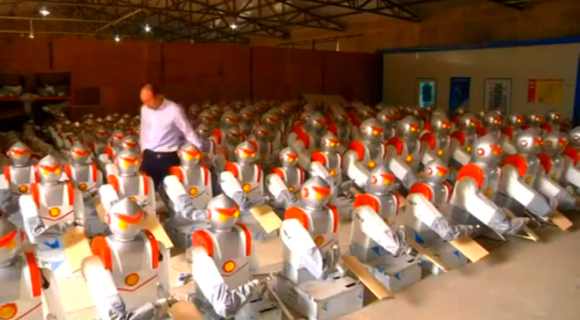
Noodle peelers should probably start looking for other things to do around the kitchen – there’s just no competing with these robots. Not only are they saving restaurants in China money in wages, they can work rapidly and tirelessly for hours.

We reported on the robots, invented by restaurant owner Cui Runguan, last August. Now, we’re hearing from another restaurant owner who has had one of the robots in his “employ” for a month. How is the indefatigable noodle-maker working out at the Jinhe Noodle Shop in Beijing? The restaurant owner, with the last name Zhao, loves it and tells China’s state-run Xinhua News Agency that “It does a good job!”

Runguan’s robots peel noodle strips from a firm piece of dough and tosses them directly into boiling water “before diners’ eyes can follow the whole process.” To Zhao and a growing number of restaurant owners in China, choosing robots over human noodle cooks is a no-brainer. While a cook doing the same job would make about 40,000 yuan ($6,400) per year, the robot cost him just 10,000 yuan ($1,600). And no human chef can work so tirelessly.

Read more of this post

Oil and Gas, Blondes and Over-Accessorized Brunettes, and Ruthless, Hard-Drinking Cowboys

Speeches by Richard W. Fisher
‘Oil and Gas, Blondes and Over-Accessorized Brunettes, and Ruthless, Hard-Drinking Cowboys’ (With Reference to Sheikh Zayed, Diana Natalicio, My Nephew Charles and President Peña Nieto)

Remarks at the University of Texas at El Paso Centennial Lecture
El Paso, TX · April 10, 2013 

130410c8

I so appreciate being here at the University of Texas at El Paso (UTEP), my first outing since returning from a trip to the United Arab Emirates. The founder of the Emirates—a collection of former “Trucial States” along the lower coast of the Arabian Sea—was Sheikh Zayed bin Sultan Al Nahyan, a wise man who had no formal education but knew of its enormous value. He said, “Education is a lantern which lights the dark alleys of ignorance.”[1]

I mention this because I cannot think of an educator who embodies this practical dictum better than Diana Natalicio. President Natalicio is a bright, shining lantern in the world of education. Actually, that’s an understatement: She is a klieg light! We are blessed to have her lead UTEP and move Texas and the nation forward on the frontiers of higher education. I am tremendously honored to be introduced by her. Thank you, Diana.

I am going to depart from my usual format today and rely heavily on slides—slides that provide a factual basis for what is going to be a dose of “Texas brag.” With its branches in El Paso, San Antonio and Houston, the Federal Reserve Bank of Dallas—the Federal Reserve’s Eleventh District—covers about 27 million people over 360,000 square miles stretching from northern Louisiana to southern New Mexico. Over 96 percent of the economic output of the district comes from Texas. Read more of this post

The Gorilla and the Maginot Line; Janet Yellen likes metaphors. This is a common trait among central bankers, at least the ones who see value in trying to explain their work

APRIL 25, 2013, 12:41 PM

The Gorilla and the Maginot Line

By BINYAMIN APPELBAUM

Janet Yellen likes metaphors. This is a common trait among central bankers, at least the ones who see value in trying to explain their work.

In 2007, she compared problems in the housing market to a 600-pound gorilla lurking in the corner of the Federal Reserve’s meeting room.

In 2010, she described the state of financial regulation before the crisis as “a financial Maginot Line that we believed couldn’t be breached.”

We all know what happened next: The gorilla broke through the Maginot Line.

She is not the most colorful of the current crop of Fed officials. That honor surely belongs to Richard Fisher, president of the Federal Reserve Bank of Dallas, whose most recent speech was titled “Oil and Gas, Blondes and Over-Accessorized Brunettes, and Ruthless, Hard-Drinking Cowboys.” Read more of this post

Southern Europe’s Recession Threatens to Spread North

April 25, 2013

Southern Europe’s Recession Threatens to Spread North

By JACK EWING

Recession1-articleLarge

An ominous sign in Spain, where the unemployment rate is a staggering 27.2 percent.

FRANKFURT — No company symbolizes German industrial might like Daimler, the giant maker of Mercedes-Benz autos and trucks. So when the company said this week that it, too, had finally been caught in the downdraft of the European economic crisis, it was an ominous sign for all of the Continent, if not the whole world.

German exporters like Daimler have been bastions of stability on a continent burdened with shaky banks, dysfunctional governments and legions of unemployed youth — not to mention the worst auto industry slump in two decades. But Daimler’s glum forecast for 2013 was the latest evidence that Germany, and other relatively healthy countries like Austria and Finland, risk falling into the recession that has long afflicted their southern neighbors. Read more of this post

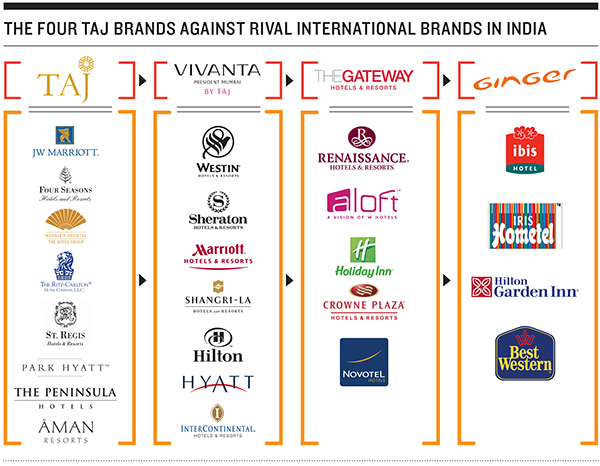
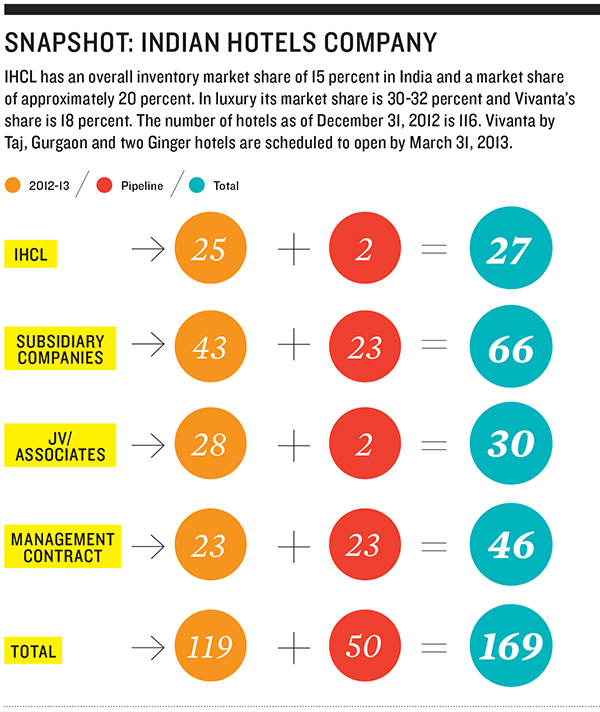
Raymond Bickson’s Revival Plan for Taj Hotels

Raymond Bickson’s Revival Plan for Taj Hotels

by Cuckoo Paul | Apr 26, 2013

Raymond Bickson is trying to change the Taj hotels’ operating model, but first the chain will have to learn to get out of its comfort zone

topimg_21589_raymond_bickson_600x400Taj Hotels.inddimg_69783_taj_hotels_newTaj Hotels.indd Read more of this post

Is Timex Suffering the Early Stages of Disruption? Amateurs can now make watches. Consumers might not want to wear your brand.

Is Timex Suffering the Early Stages of Disruption?

by Grant McCracken  |  12:00 PM April 25, 2013

In the early days of an innovation, it’s hard to tell whether we are looking at the future or just another blip on the screen.

Take the case of the Hudson Watch Company (HWC). It just got its first round of funding. From Kickstarter. It raised $115,703 from 409 backers, and will now go into production.

At this stage, the enterprise is preposterously small. (No disrespect to HWC. It’s simply a matter of scale.) We can’t believe something this tiny can tell us anything about the future. This can’t be a staging area for disruptive change.

Well, not so fast. No one at Patek Philippe has cause for concern, to be sure. But someone at Timex may. HWC may be precisely a harbinger of disruptive change. Read more of this post

CHART OF THE DAY: Chinese Politicians

CHART OF THE DAY: Chinese Politicians Are Ridiculously Wealthy

Sam Ro | Apr. 25, 2013, 2:30 PM | 1,924 | 11

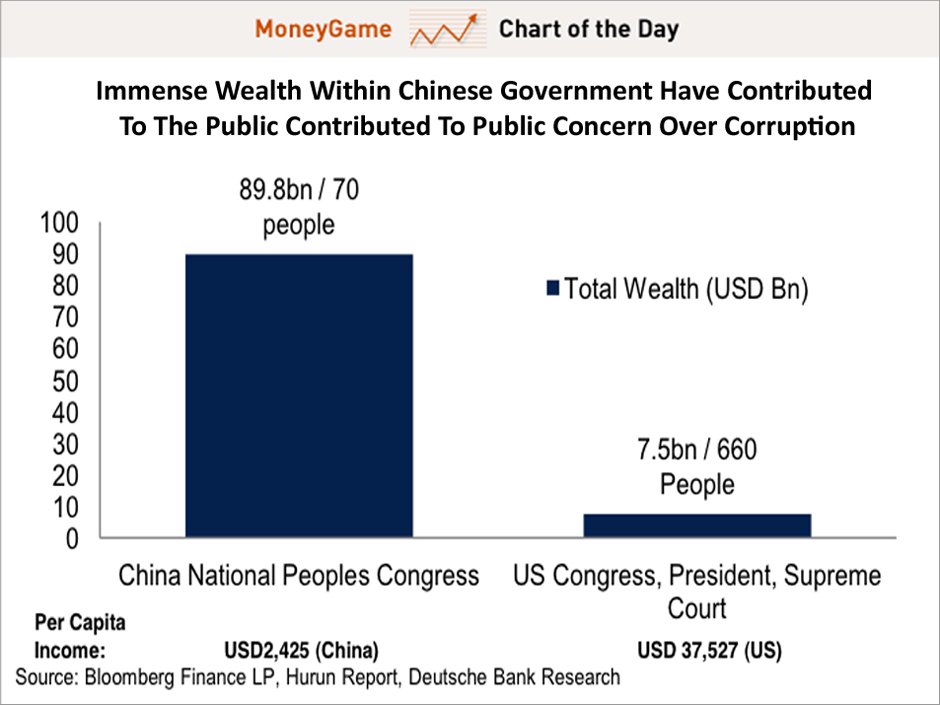
China has a major corruption problem.

“2013 will mark the most vigorous anti-corruption fight by the Chinese leadership in decades,” write the analysts at Deutsche Bank. This initiative is expected to be bad news for China’s liquor suppliers, watch-makers, and food-service industry workers.  But it’ll be a big win for investor confidence. In its new “Equity House View” report, Deutsche Bank includes this stunning chart showing how much more wealthy Chinese congressman are compared to American politicians. They cite it as a reason why so many are worried about corruption.

moneygame-cotd-042513


Chinese bond market authorities will suspend new account openings by non-bank financial institutions, the latest move in a growing crackdown on self-dealing in China’s fast-growing bond market

Friday April 26, 2013

China suspends new bond accounts

SHANGHAI: Chinese bond market authorities will suspend new account openings by non-bank financial institutions, the latest move in a growing crackdown on self-dealing in China’s fast-growing bond market, multiple sources told Reuters.

The move could effectively bar brokerages, fund companies, trusts, and possibly even banks from issuing new bond-based products to investors.

China’s main bond clearinghouse, the China Central Depository & Clearing Co Ltd, will suspend applications from trust plans, brokerages, and fund companies to establish special-purpose accounts they use to manage funds for bond-based wealth management products (WMPs), bond mutual funds, and other bond-based investment products. Read more of this post

Over the last 21 months, the SNB has expanded its balance sheet by an amount equivalent to 40% of Swiss GDP. Yet the Swiss franc hasn’t weakened

The Short Yen Trade Is The Hottest Trade In The World — But There’s One Big Risk To It

Matthew Boesler | Apr. 25, 2013, 12:55 PM | 2,901 | 2

It’s the hottest trade in the world right now: betting the Japanese yen will decline against the U.S. dollar. As part of the Japanese government’s new “Abenomics” strategy to lift the Japanese economy out of a decade of deflation, the Bank of Japan (BoJ) recently announced a massive quantitative easing program, unprecedented in scale. Investors – especially those outside of Japan – have taken this as a sign that the Japanese government and the BoJ are serious about weakening the yen and inducing a little inflation. A mini market crash caused by a fake AP tweet earlier this week showed how correlated the short yen trade is with risky assets in general right now. While the S&P 500 tanked in response to the tweet, the yen instantly strengthened against the dollar. And since so many investors are now using the cheap yen – which has already weakened considerably in recent months – to fund carry trades in other risky assets, it’s important to consider what else could derail the short yen thesis, which has become one of the most “consensus” trades on the planet.

Société Générale FX strategist Alvin Tan says the biggest risk to the “widespread expectation of lower yen over the next several quarters” is pretty simple: a global slowdown in economic growth. He uses the Swiss National Bank (SNB) as an example. Over the last 21 months, the SNB has expanded its balance sheet by an amount equivalent to 40% of Swiss GDP (the new BoJ program will fall short of that). Yet the Swiss franc hasn’t weakened. Of course, the reason for this is the ongoing euro crisis and the flight to safety into Swiss francs that has caused the currency to appreciate. So, the comparison, considering the context, is not really apples-to-apples. That is, unless you consider a scenario in which global growth enters a slowdown phase. Read more of this post

Billionaire Mark Cuban Is Massively Short The Yen; “in early December, I went and took every penny of debt that I had – with the Mavericks, and personal debt, and everything – and converted it to a yen loan at mid 80s”

Mark Cuban Is Massively Short The Yen

Matthew Boesler | Apr. 25, 2013, 4:39 PM | 10,455 | 12

Entrepreneur Mark Cuban made an interesting admission today on CNBC: he’s massively short the yen. The conversation started with a discussion on tech stocks, but then Cuban said: Honestly, I don’t jump into a lot of public technology stocks other than to have fun and trade every now and then. Where I have made my biggest trades have been in currencies, because there is a lot more transparency, and a lot more information available, than there are with stocks. It’s just a more efficient market, in my mind. CNBC anchor Scott Wapner then asked Cuban, “Now that you went there, I’ve got to ask you: what are you trading now? Are you short the yen, like everybody else?”

Cuban replied: Yeah. Actually, in early December, I went and took every penny of debt that I had – with the Mavericks, and personal debt, and everything – and converted it to a yen loan, when I think [the yen] was in the mid 80s [against the dollar]. So, I’ve been really happy with it. When the value of the currency decreases, it reduces the burden of the debt in real terms. The yen has decreased from “the mid 80s” against the dollar (when Cuban says he converted the loans) to around 100 against the dollar today, so Cuban has done pretty well on his yen trade so far.

Norway’s $720 billion oil fund to become active investor

April 25, 2013 6:06 pm

Norway’s oil fund to become active investor

By Richard Milne in Oslo

Yngve Slyngstad, chief executive: ‘As a top-five investor we would expect to have that dialogue [with the chairman]’

Norway’s oil fund is to become a more active investor by helping pick directors at companies in which it has significant stakes in a big shift of strategy at the world’s largest sovereign wealth fund.

Yngve Slyngstad, chief executive of Norges Bank Investment Management as the fund is known, is joining the nomination committee of Swedish truckmaker Volvo in a move that will see the oil fund formally participate in selecting directors for the first time.

“I think active is a fair description. We think it’s the responsibility of the larger investors to be more involved in what in the UK is referred to as stewardship and have a dialogue not just with the CEO and CFO but also the chairman of the board,” Mr Slyngstad told the Financial Times. Read more of this post

Yen Bets Don’t Add Up for Hedge Fund Giant Rennaissance Technologies; The firm’s recent challenges underscore how even hedge funds with stellar records are having a tougher time beating the market lately

Updated April 25, 2013, 6:16 p.m. ET

Yen Bets Don’t Add Up for a Fund Giant

By GREGORY ZUCKERMAN

Renaissance Technologies LLC, a hedge-fund heavyweight, has been bruised in the market’s recent turbulence.

Two of the three hedge funds that the company makes available to outside investors have suffered sizable losses this month, largely due to the big drop in the Japanese yen, investors say.

At the same time, Renaissance continues to raise cash at a slower pace than some had expected. The firm manages about $6 billion of cash for outside investors—down from about $25 billion in 2007. Read more of this post

Fed Zeroes In on Vulnerability to Rate Rise; Fed is scrutinizing the nation’s biggest banks to ensure they can handle an eventual rise in interest rates

April 25, 2013, 8:26 p.m. ET

Fed Zeroes In on Vulnerability to Rate Rise

By VICTORIA MCGRANE

The Federal Reserve is scrutinizing the nation’s biggest banks to ensure they can handle an eventual rise in interest rates, as concern grows among regulators about the risks posed by a long low-interest-rate environment.

On Thursday, a panel of federal regulators charged with identifying market risks warned that a sudden rise in interest rates could have a destabilizing effect on financial markets. The Financial Stability Oversight Council, in its third annual report, cited interest-rate risk as one of seven major vulnerabilities to financial stability.

“A sudden spike in yields and volatilities could trigger a disorderly adjustment, and potentially create outsized risks,” the council said in its report. Read more of this post

Europe’s Unemployment Problems Worsen; Southern Europe’s economic malaise echoes Great Depression

Updated April 25, 2013, 3:25 p.m. ET

Europe’s Unemployment Problems Worsen

Spain and France Both Record New Highs, Adding to Pressure to Ease Up on Austerity in Favor of Economic Stimulus

By ART PATNAUDE in Madrid and WILLIAM HOROBIN in Paris

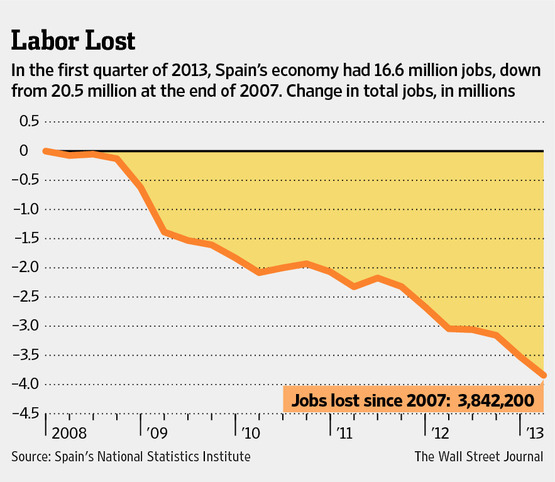
WO-AN514_SPJobs_G_20130425173904

As unemployment rises to 27.2% of the workforce, the Spanish government is about to introduce a budget that eases austerity measures. Friday’s budget will be another sign that supporters of austerity are losing the political battle in Europe as the social cost becomes too high. Unemployment in Spain and France has jumped to new highs, data showed Thursday, lending ammunition to a growing chorus calling for easing the euro zone’s austerity drive as the cure for its debt crisis because of the high social fallout.

The jobless rate in Spain rose sharply to 27.2% of the workforce in the first quarter, the highest level since records began in the 1970s. In France, the number of registered job seekers who are fully unemployed rose to more than 3.2 million, topping a previous record set in 1997. The weak figures in France and Spain, two of the biggest euro-zone economies, come on the heels of sharp rises in unemployment in March in the Netherlands and Sweden—an indication that the European Union’s northern members are also suffering from the bloc’s economic weakness.  Read more of this post

The dirty little secret among luxury goods companies is that they have been persistently overcharging their best customers in China

April 25, 2013, 1:13 p.m. ET

Luxury-Goods Firms’ Little China Secret

By WEI GU

AM-AY241_WEICOL_G_20130425144208

Makers of luxury goods have found a way to add to their profits: Charge Chinese consumers more than their counterparts in the U.S. and Europe. The WSJ’s Wei Gu tells Deborah Kan why luxury cars and fashion brands are more expensive in China. The dirty little secret among luxury-goods companies is that they have been persistently overcharging their best customers in China. With Chinese appetite for everything from expensive cars to handbags is starting to moderate, companies that count on the country as a big growth driver may have to do the unthinkable and lower their prices.

A comparison of three models from Mercedes-Benz, Audi NSU.XE +0.16% and BMWBMW.XE +1.55% shows that, on average, listed prices of luxury sedans in China are 64% more expensive than similar vehicles sold in the U.S. This looks counterintuitive, considering goods made in China are supposed to be cheaper. Read more of this post

In China, Air Quality Boosts SUVs; The big winners should include domestic players like Great Wall Motor who saw SUV sales volumes jump 90% year-on-year in February

April 25, 2013, 4:50 a.m. ET

In China, Air Quality Boosts SUVs

ByABHEEK BHATTACHARYA

AM-AY245_SUVHER_NS_20130425061206

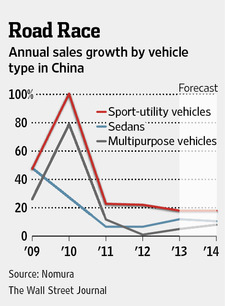
Following a run of several smog-ridden months in China, investors might be looking to bet on fuel-efficient or electric cars. In fact, it is sales of sport-utility vehicles that are soaring. The number of SUVs sold in China jumped 43.4% in the quarter ended March 31 compared with a year earlier, according to IHS Automotive. Total auto sales volumes were up just 13.8%. China’s middle class consumers see SUVs as a status symbol and view them as a safer option on the country’s notoriously dangerous roads, says China Auto Analyst Michael Dunne.

Ironically, air pollution might be playing a part too. China’s government rolled out new fuel-efficiency regulations last month aimed at the country’s air quality problem. A quirk in those rules could juice the SUV market, says Bernstein Auto Analyst Max Warburton. Fuel-economy targets based on different car weights—including easier targets for heavier vehicles—mean manufacturers have an incentive to make more SUVs, Mr. Warburton says. Something similar occurred in the U.S. in the 1980s, when more relaxed fuel-efficiency standards for heavier cars saw the big auto makers invest heavily in minivans and SUVs. The big winners should include domestic players like Great Wall Motor2333.HK +2.99% and foreigners like Jaguar-Land Rover, owned by India’sTata Motors 500570.BY +4.19% . Great Wall Motors saw SUV sales volumes jump 90% year-on-year in February, more than twice the increase in overall vehicle sales. The company boasts 35-40% of the low-end SUV market and 8% of the market overall, Nomura says. Read more of this post

How Chinese Subsidies Changed the World; Since 2008, through government subsidies, the manufacturing capacity of China’s solar-panel industry grew tenfold, leading to a vast global oversupply

How Chinese Subsidies Changed the World

by Usha C.V. Haley and George T. Haley  |   8:00 AM April 25, 2013

Last week, LDK Solar, a struggling Chinese manufacturer of solar wafers and panels, announcedthat it had missed $24 million in bond payments. This news followed the bankruptcy in March ofWuxi Suntech, the main operating subsidiary of the world’s largest maker of solar panels, after it defaulted on a $541 million bond payment.

It is no coincidence that this upheaval in the Chinese solar industry is occurring at a time when the central government’s subsidies that had financed the industry’s explosive expansion have declined even as problems in the global solar-panel market have soared.

Since 2008, through government subsidies, the manufacturing capacity of China’s solar-panel industry grew tenfold, leading to a vast global oversupply. A surge in exports of Chinese panels depressed world prices by 75%. In 2012, China’s top six solar companies had debt ratios of over 80%. Our research showed that without subsidies, these companies would be bankrupt. If the Chinese government sticks to its decision to stop funding unprofitable solar-panel manufacturers and support a revamping of the industry, more bankruptcies and restructurings are sure to follow. Read more of this post

Israelis Rise Up Against the Oligarchs, a group of 20 families that control about 50 percent of the value of the Tel Aviv stock exchange

Israelis Rise Up Against the Oligarchs

By David Wainer and Calev Ben-David on April 25, 2013

Ilyan Marshak was outraged when he heard that Bank Leumi would forgive as much as $42 million in debt owed by companies controlled by Nochi Dankner, one of Israel’s so-called oligarchs—a reference to the group of 20 families that control about 50 percent of the value of the Tel Aviv stock exchange. Marshak wanted to know why a rich man was getting a break while he worked odd jobs to pay off about 100,000 shekels ($27,600) of debt. “These tycoons are getting bargains because of their influence in our economy, and that comes at the expense of the public,” says the 28-year-old Tel Aviv resident.

Marshak was one of thousands who posted on a Facebook (FB) page titled “Bank Leumi Consumer Boycott,” after a local paper reported in mid-April that the bank had agreed to erase some of Dankner’s debt as part of a broader corporate debt restructuring. The scion of a family that made its fortune in table salt and real estate, Dankner has spent the past 15 years building his own sprawling empire, which includes the country’s biggest supermarket chain, Shufersal (SAE), and its largest mobile operator, Cellcom Israel (CEL). The deal with Leumi would have allowed the businessman some breathing room as his IDB Holding (IDBH) struggles to meet payments on about $560 million in debt. Read more of this post

Regulating China’s Shadow Banking System Isn’t Easy; Attempts to bring transparency to China’s $3.4 trillion shadow banking system are foundering, judging from a pilot program in Wenzhou.

Regulating China’s Shadow Banking System Isn’t Easy

By Jun Luo on April 25, 2013

On a morning in March, row after row of chairs in the waiting room of Wenzhou Private Lending Registration Service Center sit empty. Zhou Xiang, a manager at one of the five government-sanctioned loan brokers operating in the center, which opened in 2012, hasn’t had a single customer today. “The volume of lending is so low we ourselves won’t be here long without expanding into some other businesses,” he says.

The dearth of clients helps explain the failure of China’s year-old effort to regulate informal lending. Former Premier Wen Jiabao chose to locate the center in Wenzhou, a city of 9 million in southeastern China, after more than 80 businessmen in the area committed suicide or declared bankruptcy because they were unable to make payments on black-market loans. Brokers like Zhou match cash-strapped businesses with private lenders, draft loan contracts, and monitor monthly payments.

Wen’s goal was to impose some controls on what is a huge but disorderly market. Many Chinese savers prefer to lend their money to businesses and real estate developers, rather than letting it languish in a bank account. Estimates by UBS (UBS)put the size of the nation’s so-called shadow banking system at $3.4 trillion, equal to 45 percent of gross domestic product. In Wenzhou, almost 90 percent of families and 60 percent of companies participate in the informal market for loans, according to a 2011 survey by the People’s Bank of China. Read more of this post

In China, the License Plates Can Cost More Than the Car; None of the top 10 passenger car models sold in China are Chinese brands

In China, the License Plates Can Cost More Than the Car

By Tian Ying and Alexandra Ho on April 25, 2013

comp_shanghai18__01__630x420

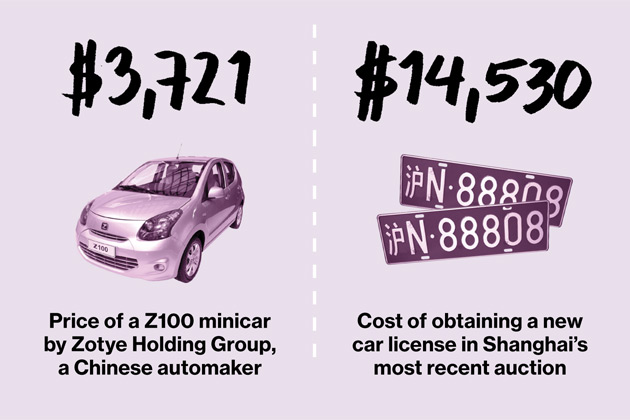
Shanghai’s busy streets teem with Buicks, Fords, Volkswagens, and Toyotas. More than 9 out of 10 cars in the world’s most populous city are made by foreign companies, and it’s not just a reflection of mainlanders’ preference for Western design. Some local automakers say the city’s license plate auctions are responsible for their weak sales. Shanghai is one of four Chinese cities that limit car purchases by imposing quotas on registrations. The prices paid at Shanghai’s license auctions in recent months—90,000 yuan ($14,530)—have exceeded the cost of many entry-level cars, the stronghold of Chinese brands such as Chery, Geely, and Great Wall. While residents with modest incomes may be able to afford an inexpensive car, the registration cost is often beyond their reach. “Whenever there’s a restriction of new car purchases through the quota system, there is always a big impact on lower-price cars like the ones we make,” says Lawrence Ang, executive director of Geely Automobile Holdings (175), whose Panda minicar sells for 37,800 yuan.

After Beijing (pop. 21 million) introduced a license plate lottery in January 2011, the combined share of Chinese brands sold there plunged by more than half, to 9.7 percent for the year, according to researcher IHS Automotive. In Shanghai, which began auctioning license plates in 1994, domestic brands made up only 8.9 percent of cars sold in 2011 (the most recent data available), less than a third the level nationwide, IHS reports. Read more of this post

Watchmakers fret over China sales slump

Watchmakers fret over China sales slump

1:26pm EDT

By Silke Koltrowitz

BASEL (Reuters) – Luxury watchmakers expect sales growth to slow this year as a recovery in the United States and buoyant Middle East demand fail to offset a China slump more deep-rooted than a temporary blip caused by anti-corruption moves.

The heads of Swatch Group’s (UHR.VX: Quote, Profile,Research, Stock Buzz) biggest brand Omega and LVMH (LVMH.PA: Quote, Profile, Research, Stock Buzz) flagship brand TAG Heuer as well as high-end independents Patek Philippe and Ulysse Nardin all said demand in Greater China had tumbled, particularly for high-end models. Read more of this post

Few $1-Salary CEOs Make a Buck as Ellison Gets $96 Mln

Few $1-Salary CEOs Make a Buck as Ellison Gets $96 Mln

The chief executive officers of software developer Oracle Corp. (ORCL) and watchmaker Fossil Inc. (FOSL) both work for a salary of a dollar or less a year. The only difference: $96.2 million.

That’s how much Oracle founder Larry Ellison really earned in fiscal 2012 when you count options awards and other extras, more than any other CEO in the Standard & Poor’s 500 Index. Fossil’s Kosta Kartsotis’ actual take-home pay: Zilch.

While CEOs with single-digit salaries are a rare breed, those who really work for nothing when other compensation such as bonuses is included are rarer still. These executives, sometimes big shareholders, only benefit if the stock rises or dividends are paid, an alignment of interests that appeals to some investors. Read more of this post

Risk of Miscalculation Over North Korea Has Grown, Dempsey Says; North Korea is “in a period of prolonged provocation rather than cyclical provocation,”

Risk of Miscalculation Over North Korea Has Grown, Dempsey Says

The risk of a miscalculation in the dispute over North Korea’s nuclear and missile programs has increased, and China takes the tensions “very seriously,” the chairman of the U.S. Joint Chiefs of Staff said yesterday.

North Korea is “in a period of prolonged provocation rather than cyclical provocation,” Martin Dempsey told reporters yesterday after arriving in Beijing April 21 and meeting officials including President Xi Jinping.

Dempsey’s visit is part of a series of high-level contacts between the U.S. and China this month to discuss issues including cybersecurity and the North’s nuclear program. Tensions on the Korean peninsula have been high since February, when Kim Jong Un’s regime tested a nuclear device in defiance of the United Nations Security Council.

“The risk of miscalculation is higher and I think the risk of escalation is higher,” Dempsey said. “They are on a path that will certainly increase risk in the region.”

China is North Korea’s largest trading partner and Beijing regards the neighboring country as a strategic buffer with U.S.- backed South Korea. In a visit to China earlier this month, Secretary of State John Kerry said China needs to “put some teeth” into restraining Kim’s regime.

“I will leave here with the belief that the Chinese leadership is as concerned as we are,” Dempsey said. “We think there is still time for North Korea’s leaders to back away from provocations and we hope they take the opportunity to do so.” Read more of this post

Thai 7-Eleven King Turns Retail Dream to Stock Nightmare; Thailand Stock Exchange to Probe Siam Makro Trades

Thai 7-Eleven King Turns Retail Dream to Stock Nightmare

Billionaire Dhanin Chearavanont’s ambitions to create Southeast Asia’s largest retailer already wiped out $2.3 billion for CP All Pcl (CPALL) investors. Now, funding the industry’s most expensive bid may put more value at risk.

Dhanin’s CP All, which runs more than 6,800 7-Eleven stores in Thailand, slid 10 percent in Bangkok yesterday — the most in more than four years — after saying it will pay $6.6 billion for discount wholesaler Siam Makro Pcl. (MAKRO) The offer is 41 percent above Siam Makro’s average price in the prior 20 days, a record premium for a retail deal in emerging Asia, according to data compiled by Bloomberg. CP All’s bid also represents the highest multiple to net income, the data show.

While Dhanin plans to squeeze suppliers for better terms and export Siam Makro’s membership-warehouse model across Asia, the limited increase to profits isn’t enough to justify the price, said Credit Suisse Group AG. Although the Bangkok-based company says it has no plans to sell new stock to fund the deal, CP All’s share price will be weighed down by concerns that it will eventually have no other option, said UOB Kay Hian Securities (Thailand) Pcl.

“CP All is going to have to do a cash call,” Alan Richardson, a Hong Kong-based fund manager who helps oversee about $110 billion for Samsung Asset Management Co., including Siam Makro shares, said in a phone interview. “The valuation doesn’t make sense. With this kind of emerging market, the potential is definitely there, but for a stock investor who looks on a time horizon of one to two years, it would be negative.” Read more of this post

Euro may only last five years, says senior German government advisor

Euro may only last five years, says senior German government advisor

The euro has a “limited chance of survival” and may only endure another five years, Kai Konrad, one of the German government’s closest economic advisers, has claimed.

“Europe is important to me. Not the euro,” said Dr Konrad.

By Jeevan Vasagar, Berlin

3:15PM BST 24 Apr 2013

In notably outspoken remarks for a senior German figure, Dr Konrad, chairman of a scientific council that advises the finance ministry, said: “Europe is important to me. Not the euro. And I would only give the euro a limited chance of survival.”

Asked whether he thought the single currency would last five years, the economist said: “A concrete period is hard to identify as it depends on so many factors. But five years sounds realistic.”

This pessimistic judgment by a senior adviser runs counter to the official German government view that the euro must be held together for the sake of unity in Europe. Dr Konrad’s remarks came in an interview with the newspaper Welt am Sonntag, on the debt crisis in Europe. Read more of this post

Changing Rules of the Road for China’s Auto Industry; Domestic car makers face a tough struggle to adapt to their evolving marketplace

April 24, 2013, 12:25 p.m. ET

Changing Rules of the Road for China’s Auto Industry

Domestic car makers face a tough struggle to adapt to their evolving marketplace.

By LARRY WANG, PAUL GAO AND AXEL KRIEGER

In many areas of the Chinese economy, from refrigerators to computers and banking to consumer goods, domestic players have captured the lion’s share of the enormous market. There is only one glaring exception: autos. Even after the government plowed billions into building up domestic champions, Chinese auto makers account for fewer than 30% of the new cars sold in China each year. This week’s Shanghai Auto Show is a good time to consider why that is and how local firms can change it.

Chinese auto makers have achieved impressive success, building their 30% market share from virtually zero 15 years ago mainly by delivering relatively inexpensive cars to a large number of first-time car buyers. They also are closing the quality gap with their international peers in surveys such as the J.D. Power and Associates Initial Quality Survey, although a gap still remains.

But their share has remained relatively flat in the past five years. This suggests they already have plucked the low-hanging fruit in the marketplace. Further success will hinge on their ability to adapt to a more sophisticated auto market. Read more of this post