Nespresso’s bitter taste of defeat in the $10bn coffee capsule market where it has a market share of roughly one-third

April 24, 2013 7:49 pm

Nespresso’s bitter taste of defeat

By Louise Lucas

Even judges, it appears, are waking up and smelling the coffee. The phalanx of patents designed to protect Nestlé’s Nespresso machine-and-capsule coffee systems has been dented by a UK High Court ruling. The decision hands consumers the option of using rival capsules made by Dualit, the British manufacturer better known for its retro toasters, in their Nespresso machines. Dualit, which spent about £1m on lawyers during the course of the 10-month legal battle, was delighted. Leslie Gort-Barten, managing director, said he already had an appointment next Tuesday with one of Britain’s big four supermarkets that could now consider stocking its capsules.

Nespresso has a powerful grip on the $10bn coffee capsule market. It has a market share of roughly one-third, according to Euromonitor, more than the next two biggest players – Green Mountain and DE Master Blenders – put together. It generates sales of just under SFr4.5bn ($4.75bn), estimates Jamie Isenwater, analyst at Deutsche Bank, and margins on earnings before interest and tax (all of which comes from pods rather than machines) of more than 30 per cent. Read more of this post

Indonesia is the world’s biggest market for one American icon: Tupperware.

April 24, 2013, 1:54 p.m. ET

Indonesia Provides a Tasty Dish for Tupperware

AM-AY223_INDOTU_G_20130424112451

‘Open your hearts,’ CEO Rick Goings told salespeople in Jakarta this month. ‘Indonesia is the No. 1 market in the world.’

By ERIC BELLMAN

JAKARTA, Indonesia—Companies from across the globe are just starting to tap Indonesia’s booming consumer sector. But the Southeast Asian archipelago already is the world’s biggest market for one American icon: Tupperware. Indonesia last year replaced Germany as the biggest market for Tupperware Brands Corp., TUP -4.14% which sells plastic containers for leftover beef stew and baba ganoush at house parties world-wide. Indonesia is likely to lead the company’s growth in Asia this year. That will help make the Asian-Pacific region the company’s biggest this year, topping Europe, South America and North America, said Chief Executive Rick Goings. Tupperware’s sales force has exploded to an army of more than 170,000 people here from only 2,000 a decade ago, riding a consumer boom in Southeast Asia’s largest economy and selling record numbers of water bottles, plastic lunchboxes and neon-green plastic dining sets.

Read more of this post

Record Carbon Plunge Means Pain for Europe’s Utilities: Energy

Record Carbon Plunge Means Pain for Europe’s Utilities: Energy

European utilities, which have lost investors money for the past three years, can expect nothing but more pain after the European Parliament rejected a proposal to support prices in the world’s largest carbon-credit market.

Germany’s EON SE, GDF Suez (GSZ) SA of France and CEZ AS (CEZ) from the Czech Republic are among power suppliers whose earnings will drop because a majority of their energy comes from wind, natural gas and uranium, meaning they will be undercut by coal-fired plants, JPMorgan Chase & Co. (JPM) said. Burning coal benefits most from cheaper carbon permits because the fuel emits about twice as much carbon dioxide as natural gas.

The European Parliament on April 16 rejected a proposal to delay the issuance of some carbon credits, or allowances, triggering a record 35 percent drop in permit prices and sending the stocks of utilities down. Falling carbon prices weaken the incentive to invest in low-emission technologies such as wind, solar and nuclear power.

“The competitiveness of our gas plants is seriously undermined by coal,” GDF Suez Vice Chairman Jean-Francois Cirelli said at a shareholder meeting in Paris yesterday. “CO2 is a major difficulty for us, and it’s a major failure of European policies.”

The continent’s biggest utilities, already struggling to increase revenue amid a stagnant economy, have to contend with a new damper on electricity prices because the market is tethered to coal, one of the most commonly used fuels for generation. Forward electricity prices, which give an indication of future earnings, dropped 3.7 percent since the decision. “Lower carbon prices will tend to reduce long-term earnings,” said Chris Rogers, utility analyst at Bloomberg Industries in London. “The weak power price environment may require write-downs at utilities.” Read more of this post

Hopes Dim for Southeast Asia Single Market by 2015

Hopes Dim for Southeast Asia Single Market by 2015

By MARTIN VAUGHAN

Bandar Seri Begawan, BRUNEI—Southeast Asia’s bid to create a single market by 2015 has bogged down, slowed by domestic political pressures in the bloc’s largest economies and alternative trade initiatives competing for policy makers’ energy and attention.

As leaders of the 10-member Association of Southeast Asian Nations gather here Wednesday, analysts say they are well behind on their goal to eliminate barriers to the free movement of goods, services and workers, with the target date just 18 months away. Read more of this post

China May Rethink Electric-Car Push; Buffett’s BYD, which prides itself as being the champion of electric cars in China, acknowledges change is coming

China May Rethink Electric-Car Push

By YOREE KOH And COLUM MURPHY

SHANGHAI—Some of the world’s largest car makers including Germany’sVolkswagen AG VOW3.XE +3.38% and Toyota Motor Corp. 7203.TO -0.72% are using this month’s Shanghai auto show to send a message to Chinese policy makers: Wake up from your electric dreams.

The big auto makers are introducing gasoline-electric vehicles and promising to build components for the vehicles here in a bid to win greater government backing for the technology amid weak demand for purely electric-powered cars.

“There is a discrepancy between the general targets and the general goals of the government and the present situation,” said Jochem Heizmann, head of Volkswagen in China. “For the next 10 years, generally plug in hybrids have a much better chance to become a relevant volume in comparison to just fully electric cars,” he added.

Toyota unveiled its new hybrid Yundon-Showanchin II, which was developed specifically for China. Toyota Chairman Takeshi Uchiyamada, known as the father of the company’s most popular hybrid Prius, said on Saturday that as China’s auto market grows “hybrid vehicles without a doubt will become a necessity.” Toyota plans to start locally producing key hybrid components by 2015. Read more of this post

Barrick Gold at 20-Year Low Turns to Thornton

Barrick Gold at 20-Year Low Turns to Thornton

April 23 (Bloomberg) -– Barrick Gold Corp. (ABX) founder Peter Munk sees a successor in former Goldman Sachs Group Inc. (GS) President John Thornton as the world’s biggest gold miner tries to reverse a 54 percent plunge in market value in the past year.

“I searched the world for a successor,” Munk, the 85- year-old chairman of Barrick, said yesterday in an e-mailed statement. “I am delighted I found John. I am confident he will take Barrick to a new level as a global player.”

Thornton, 59, faces his first annual shareholders’ meeting tomorrow as co-chairman after the Toronto-based miner has struggled with cost overruns, writedowns, and opposition to his $11.9 million signing bonus from shareholders including Canada’s six largest pension fund managers. Read more of this post

Wealthiest Americans Only Winners in Recovery, Pew Says. The recession continues for almost everyone else. “The results are entirely sensible, but depressing”

Wealthiest Americans Only Winners in Recovery, Pew Says

The U.S. economy has recovered for households with net worth of $500,000 or more, a new study shows. The recession continues for almost everyone else.

Wealthy households boosted their net worth by 21.2 percent in the aftermath of the recession, according to the study released today by the Pew Research Center. The rest of America lost 4.9 percent of household wealth from 2009 to 2011.

Pew attributed the disparity to gains during that period in the stock and bond markets, benefiting affluent households, while the housing market’s decline hit others harder. The report underscores the nation’s growing income inequality, with the top 13 percent of households recovering their losses from the 18- month recession that ended in June 2009, and the rest of the country continuing to hemorrhage wealth.

“The results are entirely sensible, but depressing,” said Richard Fry, a Pew senior research associate and co-author of the study by the Washington-based organization. “It’s a stark story of two Americas.” Read more of this post

Buddhist temples reported losses equal to about a quarter of its assets after bets in the Australian dollar and structured bonds soured.

Buddhist Temples Post Losses as Aussie, Bond Bets Sours

Koyasan Shingon Buddhism, the Japanese owner of a cluster of World Heritage Site temples founded in the 9th century, reported losses equal to about a quarter of its assets after bets in the Australian dollar and structured bonds soured.

The group had unregistered losses of 1.53 billion yen ($15 million) on financial assets of 5.79 billion yen for the year ended March 31, according to an April 23 report commissioned by the organization, based in Wakayama prefecture in western Japan. The head of the organization, Kosho Shono, resigned today to take responsibility, Kyodo News reported.

Koyasan Shingon, whose flagship Kongobu-ji temple in Mount Koya is listed as a National Treasure of Japan, started investing in 2002 in an Australian dollar fund through Nomura Securities Co., using money from member temples and followers. The association later expanded its portfolio to products including Nikkei index-linked debt, according to the report.

Holding the association’s fund managers responsible for the losses “wasn’t appropriate,” because it would have been difficult to predict the 2008 collapse of Lehman Brothers Holdings Inc., according to the report. Read more of this post

Korean chaebol haunted by ailing builders

2013-04-22 17:28

Chaebol haunted by ailing builders

By Kim Tae-jong

The nation’s major conglomerates, known here as chaebol, are facing a dilemma due to their cash-strapped construction arms.

On the one hand, they can’t simply let their troubled affiliates collapse because they would face strong criticism of acting irresponsibly. On the other, it is not easy to provide financial support as that could have a negative impact on the financial health of the entire group.

“It’s true that there is skepticism on the V-shaped rebound of the construction industry here,” said Park Hyung-ryul, an analyst at KDB Securities. “So it is obviously a burden for parent groups to take steps to revive a troubled construction arm.”

Construction firms have suffered major setbacks in recent years amid a prolonged slump in the local housing market and low overseas demand, which consequently led many of them to face liquidity crises. Read more of this post

With $5.4Bln Debt, China’s LDK Solar Sparks Fears Among Creditors

With $5.4Bln Debt, China’s LDK Solar Sparks Fears Among Creditors

04-23 18:13 Caijing

Analysts are expecting a forced restructure of LDK, de facto insolvent.The solar manufacturer defaulted on a $24 million bond last week, almost a month after rival Suntech Power Holdings Co Ltd defaulted on its bonds

The teetering of China’s renewed energy giant LDK Solar Co Ltd at the brink of bankruptcy, following a partial default on bond payments last week, has sparked fears among its creditors that they could hardly recover their debts.

Investors are vary of some of the largest creditors —Beijing Jingyuntong Technology Co Ltd (601908.SS), Jiangsu Huasheng Tianlong Photoelectric Co Ltd (300029:Shenzhen), Liao Ning Oxiranchem Inc (300082:Shenzhen), Henan Xindaxin Materials Co Ltd (300080:Shenzhen) and Henan Hengxing Science & Technology Co Ltd (002132:Shenzhen), who was collectedly owed by LDK nearly 500 million yuan with a maturity of around a year—as default risks by LDK castes doubts over the companies that already suffered huge losses.

Analysts are expecting a forced restructure of LDK, de facto insolvent, without improvement in short-term results. While banks, usually the biggest benefactors behind China’s solar makers, could be persuaded to roll out its debt, the suppliers would at any time turn to Chinese courts for the bankruptcy of LDK. Read more of this post

Asian rituals captivate cosmetics groups; Skincare accounts for 63% of the beauty market in Asia, compared with 32% in the US.

April 23, 2013 2:51 pm

Asian rituals captivate cosmetics groups

By Scheherazade Daneshkhu

When cosmetics groups’ executives survey the Asian market, it is the Korean woman’s beauty regime that gets them excited. She spends 30-40 minutes at night on skincare, using 10-11 products. That compares with the typical French woman who uses only three products in 3-10 minutes a night. The Korean beauty ritual has parallels among other Asian women, so the potential to sell multiple products is higher in Asia than in other regions. With so many creams and serums layered on the face, their weight and texture has to be lighter than that produced for other parts of the world, says Nicolas Hieronimus, head of L’Oréal’s luxury cosmetics division. Some 50 per cent of L’Oréal’s Lancôme Asian sales are for products developed specifically for the region. Some categories – such as whitening creams – do not exist in France, says L’Oréal. “There is no single model for beauty,” the Paris-based company said of the controversial products, which most of the large international cosmetics groups, including Estée Lauder and Clarins, also sell. Whitening creams have a penetration rate of 46 per cent among women in China, 78 per cent among urban women in India and only 5 per cent in the US. L’Oréal says this is because dark spots are the first signs of ageing in Asia, unlike for Caucasian women, who suffer more from wrinkles instead. “There is a genuine demand for whitening products which we respond to by offering products whose function is to eliminate hyper-pigmentation and to even and brighten the skin tone,” said L’Oréal. Asian women much prefer skincare to the other two beauty categories of fragrances and make-up. Skincare accounts for 63 per cent of the beauty market in Asia, compared with 32 per cent in the US. For cosmetics groups, that represents an opportunity to develop the market for fragrances and make-up, mainly through advertising. “China will be a three-category market like the rest of the world in years to come,” forecasts Mr Hieronimus.

Cosmetics groups move deeper into China, the world’s second-largest market for luxury cosmetics after the US

April 23, 2013 4:58 pm

Cosmetics groups move deeper into China

By Scheherazade Daneshkhu

Mrs Chen, who only gives her surname, is delighted that she can buy her favourite cosmetics in her provincial town of Zhenjiang, some 250km inland from Shanghai and close to the Yangtze River.

A beautician massages her face with serum at L’Oréal’s Lancôme counter in the gleaming Yaohan department store, as she explains: “I first heard of Lancôme through a friend and last year I saw this counter and tried products here. They make my skin feel softer.”

Zhenjiang is one of China’s smaller and less affluent “tier-3” cities, urban centres that consumer goods multinationals are targeting because of their potential for faster growth than the more saturated first-tier cities, such as Beijing or Shanghai, or even second-tier provincial capitals such as Nanjing.

China is the world’s second-largest market for luxury cosmetics, after the US, and where L’Oréal and Estée Lauder, the two biggest luxury cosmetics companies by sales, are fighting for market leadership. Read more of this post

Distress spreads in South Korea; Template that relies less on leverage needed

April 23, 2013 5:44 pm

Distress spreads in South Korea

By Henny Sender

Template that relies less on leverage needed

For many years, Japanese business people believed their economic malaise lay in a cheap South Korean won, rather than anything intrinsic to their country. Once the yen depreciated, all would be well.

The Japanese definition of well meant that consumers around the globe would cease to buy Samsung goods and turn to Japanese products instead. Now their thesis is about to be tested.

Thanks to Abenomics, massive liquidity in Japan means corporate distress there is diminishing. International hedge funds that bet not long ago on the cost of credit insurance going up for the weakest sectors, such as shipbuilding and steel, have seen the cost come down instead – at least for the moment.

By contrast, signs of distress in South Korean companies are starting to intensify. The country successfully weathered the 2008 global financial crisis but five years later, it isn’t faring as well. Read more of this post

Economists Agree: Solutions Are Elusive

April 23, 2013

Economists Agree: Solutions Are Elusive

By EDUARDO PORTER

Last week the International Monetary Fund hosted a conference of some of the world’s top macroeconomists to assess how the most intense crisis to have shaken the industrialized economies since the Great Depression has changed the profession’s collective understanding of how the world economy works.

Two things struck me about the conclave. The first was hearing George Akerlof, a Nobel-winning economist from Berkeley, take to the lectern to compare the crisis to a cat stuck in a tree, afraid to move.

The second was realizing how, after five years of coping with the consequences of the disaster, there is still so much uncertainty about what policies are needed to prevent another financial shock from tipping the world economy into the abyss again a few years down the road.

“We don’t have a sense of the final destination,” said Olivier Blanchard, chief economist of the monetary fund. “Where we end I really don’t have much of a clue.” Read more of this post

India in depth: A Japanese-style “big reset”

India in depth: A Japanese-style “big reset”

Tue, Apr 16 2013

By Andy Mukherjee

SINGAPORE (Reuters Breakingviews) – India needs a Japanese-style reset. For the country to decisively escape from its self-constructed trap of extreme economic pessimism, New Delhi needs to import the spirit of Abenomics.

The advice may appear counterintuitive, considering that new Japanese Prime Minister Shinzo Abe’s strategy of aggressive fiscal and monetary easing is the opposite of the policies India should pursue. But at its core, Abenomics is about hitting an economic reset button so that corrosive forces, which have created a lousy equilibrium of their own, are defeated, and a more virtuous economic cycle can begin.

With economic growth at its weakest in a decade, India needs a reset as badly as Japan did when it elected Abe in December last year. Finance Minister Palaniappan Chidambaram has so far focussed on structural reforms. But pruning government expenditure and allowing greater foreign participation in aviation, insurance and retail does not produce results overnight. A bold reset – such as devaluing the rupee 16 percent against the US dollar – will have an immediate impact. Read more of this post

China’s Shaken Trust; An earthquake shows the decline of confidence in the Communist Party.

Updated April 23, 2013, 5:10 p.m. ET

China’s Shaken Trust

An earthquake shows the decline of confidence in the Communist Party.

Saturday’s earthquake in Sichuan brought back traumatic memories of the much larger quake only 40 miles away that killed almost 90,000 people in 2008. So far the official death toll this time is around 200, but the government has again mobilized a massive rescue and relief effort.

A notable difference is the public response, which has revealed profound mistrust of the government. Donations to state-run charities are down and cynicism reigns online about official statements and appeals. The country has shifted under the feet of the Communist Party since 2008, which means new leaders Xi Jinping and Li Keqiangare under pressure to find ways to restore trust.

After the first Sichuan quake, there was an immediate outpouring of donations in response to the state-run media’s appeals. Yet early praise for government efforts gave way to anger as the quake exposed government corruption and incompetence. Poorly built schools collapsed, killing more than 5,000 schoolchildren, while government offices and their occupants survived. Large sums of relief money disappeared. The reconstruction enriched officials while survivors continued to suffer.

The Party’s reputation has deteriorated even further since 2009, when the advent of microblogging created a new outlet for exchanging information and opinions. A watershed moment came after the 2011 crash of a high-speed train in Wenzhou, when news flashed around the country that a two-year-old girl had been found alive in the wreckage after rescue operations were called off. Former Railways Minister Liu Zhijun is awaiting trial for taking $250 million in bribes, which given the notorious corruption in the high-speed rail program is probably a fraction of his total take. Read more of this post

‘Target’ Funds Vulnerable to Rate Rise; “People think this is safe money. Losing money in bonds is a brutal way to lose money.”

Updated April 23, 2013, 8:04 p.m. ET

‘Target’ Funds Vulnerable to Rate Rise

LIAM PLEVEN and JOE LIGHT

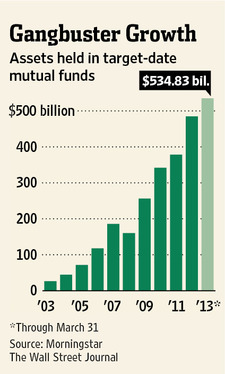
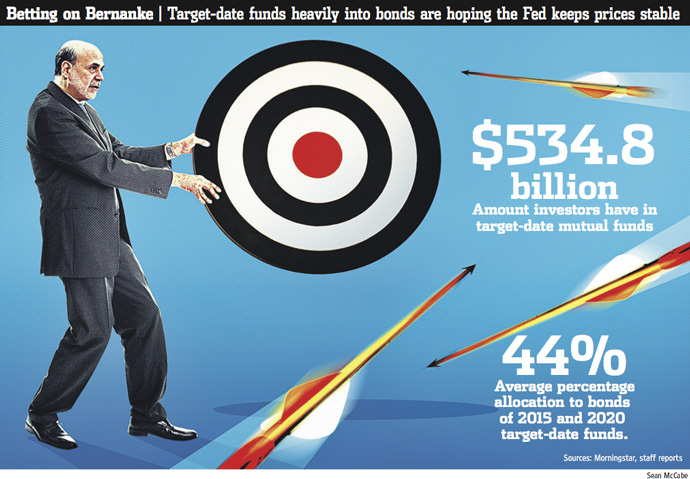
Millions of workers saving for retirement risk losing part of their nest eggs if interest rates jump. The cause for concern: target-date mutual funds, designed for investors who lack the time or expertise to balance their investment portfolios. The funds typically increase their bondholdings with the approach of the target date, which is pegged to the investor’s expected retirement year. In theory, more bonds should make portfolios safer, because bonds tend to be less risky than assets such as stocks. But if yields rise and bond prices slump, as many experts predict, the funds could suffer losses.

“People think this is safe money,” said Dave Scott, chief investment officer of Sunrise Advisors, a registered investment adviser in Leawood, Kan. “Losing money in bonds is a brutal way to lose money.”

OB-XE901_Bettin_G_20130423201402MI-BV523_TARGET_NS_20130423180021 Read more of this post

Falling Yen Sets Stage for Profit Windfall

April 23, 2013, 3:00 p.m. ET

Falling Yen Sets Stage for Profit Windfall

By MAYUMI NEGISHI And DANIEL INMAN

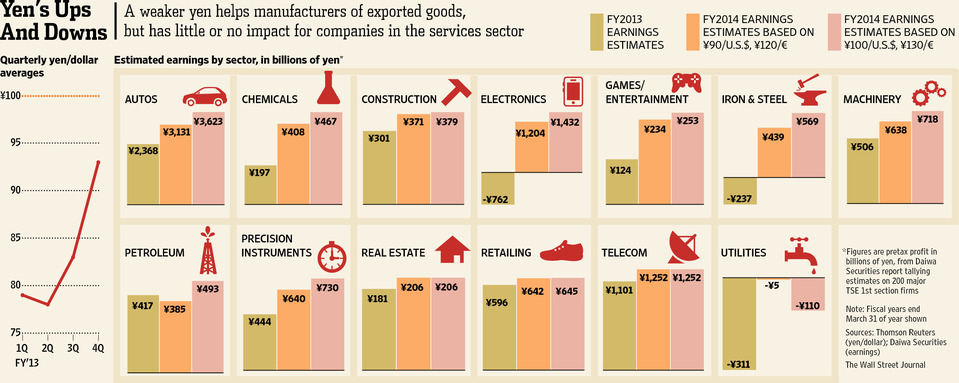
TOKYO—When Japan’s biggest companies begin to report earnings this week, they are expected to forecast the highest profits in six years and higher capital spending, raising hopes that this time, the country’s corporate recovery could have staying power.

After years of belt tightening, the yen’s recent drop is expected to propel corporate earnings to new heights. At ¥100 to the dollar—around the current level—pretax profit at the top 200 Japanese companies is forecast to rise 75% to ¥16.09 trillion ($162.15 billion) in the fiscal year that started this month, according to Daiwa Securities.

AI-CA502_JEARNS_G_20130423135405 Read more of this post

Can Abenomics Heal Japan’s Two-Decade Trauma? (Infographics)

yens

How the Wheels Came Off for Electric-Car Firm Fisker; U.S. Loans Saddled It With Factory Never Used

Updated April 24, 2013, 4:09 a.m. ET

How the Wheels Came Off for Fisker

Untested Electric-Car Firm Was Ripe for the Times; U.S. Loans Saddled It With Factory Never Used

By YULIYA CHERNOVA and MIKE RAMSEY

OB-XE904_WrongT_G_20130423201406

For a few months in 2012, Bruce Simon, the chief executive of gourmet food retailer Omaha Steaks International Inc., drove a $100,000 plug-in hybrid electric car known as the Fisker Karma. No longer.

Mr. Simon says his car broke down four times over the span of a few months. Each time, Fisker Automotive Inc. picked it up and sent it by trailer from his home in Omaha, Neb., to a dealer in Minneapolis.

The Karma was “so vulnerable to software errors, and the parts used were of such poor quality that eventually I insisted they take the car back and return my purchase price, which they did,” he says. “It’s a real shame, the car itself was beautiful.”

The near collapse of the Anaheim, Calif., company—it missed a loan payment on Monday, earlier dismissed most of its staff and has hired bankruptcy advisors—comes as affluent buyers like Mr. Simon have turned away from the once promising startup and falling gasoline prices have chipped away at demand for electric cars. Read more of this post

Soros looking set to attack Asian currencies again

Soros looking set to attack Asian currencies again

Staff Reporter

2013-04-24

George Soros may be paying attention to Asian currencies again. The currency speculator recently paid a visit to China and Hong Kong, triggering concerns of his return to the region after his large bet against the Thai baht in the late 1990s.

The hedge fund billionaire has reportedly made more than U$1.2 billion betting against the Japanese yen since November of last year.

Early this month, Soros attended an annual convention in Hong Kong organized by the Institute for New Economic Thinking, a New York City-based nonprofit thinktank he co-founded.

At the conference on April 6, Soros joked that he was ready to attack the Hong Kong dollar, in response to a question from the audience on whether Soros might be shorting the currency as his next target after the yen. Read more of this post

Bond Bubble, Or Rational Expectations? Visualizing 220 Years Of Treasury Yields

Bond Bubble, Or Rational Expectations? Visualizing 220 Years Of Treasury Yields

Tyler Durden on 04/23/2013 22:09 -0400

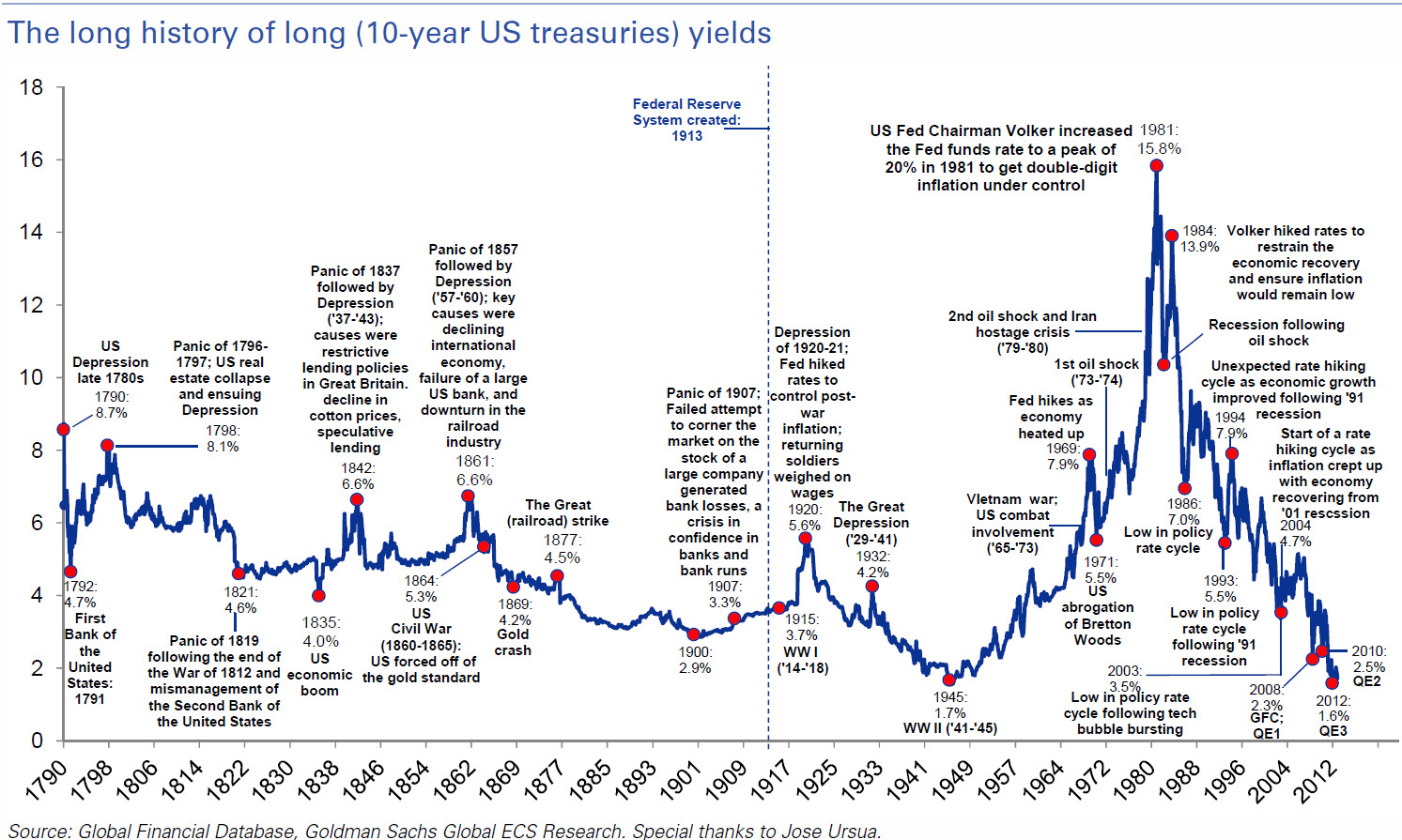
Near multi-generational low bond yields, driven at least in part (and some think in full) by the undeniably large asset purchase program (Quantitative Easing (QE)) that the US Federal Reserve has been implementing in one form or another since the 2008 Global Financial Crisis (GFC), have pushed the question of whether or not the bond market is a bubble to the front of many people’s minds. However, while the chart below of over 220 years of 10-year treasury yields shows the extraordinarily low bonds yields, they have resulted from many fundamental and rational drivers (expectations of weak economic growth and safe haven flows amid the European sovereign debt crisis) in addition to Fed purchases. So while bond prices look expensive, there is nothing particularly bubbly about the bond market today.

20130423_10Y

How to Predict the Next Big Bailout; Real estate agents who help Chinese investors buy homes abroad say the easier it is for their clients to buy citizenship, the likelier it is for the country’s economy to tip over into crisis

April 23, 2013, 6:16 PM

How to Predict the Next Big Bailout

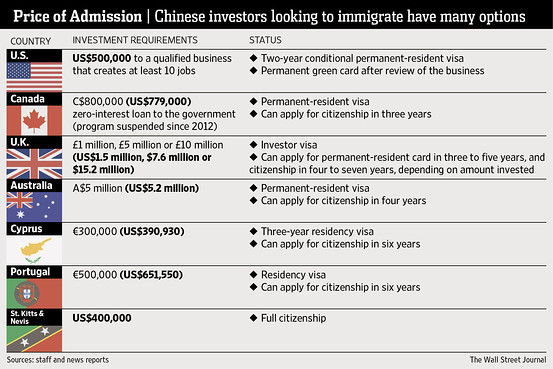
After Cyprus, who’s next to fall? Real estate agents in China have their own crude method for identifying the next domino. And it doesn’t involve number crunching banks’ balance sheets.

Real estate agents who help Chinese investors buy homes abroad say they can guess which country is facing financial ruin by the level of restrictions attached to their investment immigration programs. That is, the easier it is for their clients to buy citizenship, the likelier it is for the country’s economy to tip over into crisis.

OB-XC848_0418CR_G_20130418020456 Read more of this post

Everyone wants to be a REIT; Restyled as Real Estate Trusts, Varied Businesses Avoid Taxes

April 21, 2013

Restyled as Real Estate Trusts, Varied Businesses Avoid Taxes

By NATHANIEL POPPER

A small but growing number of American corporations, operating in businesses as diverse as private prisons, billboards and casinos, are making an aggressive move to reduce — or even eliminate — their federal tax bills. They are declaring that they are not ordinary corporations at all. Instead, they say, they are something else: special trusts that are typically exempt from paying federal taxes. The trust structure has been around for years but, until recently, it was generally used only by funds holding real estate. Now, the likes of the Corrections Corporation of America, which owns and operates 44 prisons and detention centers across the nation, have quietly received permission from the Internal Revenue Service to put on new corporate clothes and, as a result, save many millions on taxes. The Corrections Corporation, which is making the switch, expects to save $70 million in 2013. Penn National Gaming, which operates 22 casinos, including the M Resort Spa Casino in Las Vegas, recently won approval to change its tax designation, too.

Read more of this post

Reuters: How do you spell Singapore without “LKY”?

Analysis – How do you spell Singapore without “LKY”?

Sun, Apr 21 2013

By John O‘Callaghan

SINGAPORE (Reuters) – They crammed into an art cafe in Singapore and pulled no punches, deriding authoritarian officials who ruled with an “iron fist” and complaining that government ministers with million-dollar salaries were out of touch.

One woman, a middle-aged professional, got nods of agreement when she said modern Singapore’s founding father, Lee Kuan Yew, had done great things but that new ways were needed from current leaders still practising a “do-as-I-say style of parenting”.

Singapore remains regimented but the unusually frank criticism at the recent gathering, part of a government-run national “conversation” about the city state’s future, reflects the reality that this is no longer the era of Lee Kuan Yew.

LKY, as he is widely known, built the tiny Southeast Asian island into one of the world’s wealthiest nations with a strong, pervasive role by the state and no patience for dissent. Read more of this post

China says aims to banish superstition, promote knowledge

China says aims to banish superstition, promote knowledge

Sun, Apr 21 2013

By Ben Blanchard

BEIJING (Reuters) – China is struggling to get its estimated 100 million religious believers to banish superstitious beliefs about things like sickness and death, the country’s top religious affairs official told a state-run newspaper.

Wang Zuoan, head of the State Administration of Religious Affairs, said there had been an explosion of religious belief in China along with the nation’s economic boom, which he attributed to a desire for reassurance in an increasingly complex world.

While religion could be a force for good in officially atheist China, it was important to ensure people were not mislead, he told the Study Times, a newspaper published by the Central Party School which trains rising officials.

“For a ruling party which follows Marxism, we need to help people establish a correct world view and to scientifically deal with birth, ageing, sickness and death, as well as fortune and misfortune, via popularizing scientific knowledge,” he said, in rare public comments on the government’s religious policy. Read more of this post

Europe’s struggling emissions trading scheme holds valuable lessons for China

Carbon copies?

Tuesday, April 23, 2013

Europe’s struggling emissions trading scheme holds valuable lessons for China

In Europe, the privilege of emitting a ton of carbon dioxide now costs about the same as a hamburger. That was one painful takeaway from a recent New York Times article on the crisis in Europe’s market for carbon allowances, which has now gone into a noisy free fall. Already-cheap carbon prices sank to record lows last week, after the European Parliament voted on April 16 against a proposal to shore up prices by reducing the number of allowances in the Emissions Trading Scheme (ETS). It was just the latest plunge in a volatile market that has seen the price of a ton of carbon dioxide fluctuate from $0 to $40 in the last few years. Europe launched its emissions trading scheme in 2005 in an effort to raise the cost of emitting greenhouse gases and incentivize industrial polluters to switch to cleaner alternatives, such as wind, solar and natural gas. European governments convinced their companies to spend billions on investing in renewable energy projects to gain credits to offset pollution elsewhere, and many people hailed the market as a success.

But then an oversupply of carbon allowances and Europe’s terrible economic fortunes combined to drag on the market. Analysts say the price of carbon is currently too low to influence corporate behaviors, and Europe is actually seeing increasing investment in coal-fired power plants. As prices have fallen and liquidity dried up, financiers have lost interest in what once seemed to be a promising market. Analysts are debating what effect Europe’s recent failures will have on nascent cap-and-trade schemes around the world. More than a dozen governments are developing their own programs, including Australia, South Korea, California and China. Read more of this post

Paris Hit by Property Freeze as Taxes Deter Buyers

Paris Hit by Property Freeze as Taxes Deter Buyers

At least one in four Paris apartments listed by realtor Agence Etoile can’t be sold, even with mortgage rates at record lows, as buyers and sellers fail to agree on price, the company’s director said.

“I have some inventory that’s too expensive and sellers don’t want to lower prices,” Christine Perrissel said in an interview. “Buyers are just much more selective.”

Across France, an economy that’s stalled for two years, joblessness at a 15-year high, property prices near record highs and new taxes have made households reluctant to borrow to buy homes. While Europe’s debt crisis prompted banks to tighten credit, since the start of this year they’ve offered more attractive terms to lure customers and meet lending targets, after borrowing plunged in 2012.

The average home-loan rate fell 0.8 percentage point from a year ago to a record low 3.34 percent in the first two months of the year. Still, new mortgages granted in the 12 months through February slid 27 percent from a year earlier to 98.4 billion euros ($129 billion), according to the Bank of France.

New home sales plunged 18 percent in 2012 to 77,900. Existing home sales declined 12 percent to 709,000, with the drop worsening to 22 percent in the year to February. The average housing investment funded with loans represented 3.73 years of the buyer’s income in March, the lowest since January 2010, a study by lender Credit Logement SA and polling firm CSA shows. Read more of this post

Look to Japan’s ageing industrial sprawl for roadblock to Abenomics; S&P says more than one-third chance of Japan downgrade, cites risks to Abenomics

S&P says more than one-third chance of Japan downgrade, cites risks to Abenomics

Mon, Apr 22 2013

TOKYO (Reuters) – Rating agency Standard & Poor’s said on Tuesday it saw more than a one-third chance that it would downgrade Japan’s sovereign ratings because of uncertainty about whether the government’s push to revive growth and end deflation will succeed. “The continuing prospect of a downgrade arises from risks associated with recent government initiatives and uncertainty of their success,” S&P said in a report. “Japanese Prime Minister Shinzo Abe’s plan to lift Japan out of deflation and spur economic expansion–known as “Abenomics”–has three pillars: bold monetary easing, fiscal efforts to spur growth, and a strategy to induce private sector investment,” it said. “Of the three engines that Mr. Abe foresees reinvigorating the nation’s economy, so far only one, monetary easing, has kicked into full gear. The others remain idle.” S&P has an AA- long-term rating on Japan’s sovereign debt.

Look to Japan’s ageing industrial sprawl for roadblock to Abenomics

Mon, Apr 22 2013

By Yoko Kubota

TOKYO (Reuters) – For a close-up view of where Japanese Prime Minister Shinzo Abe’s economic policies could falter, skip across Tokyo Bay to the sprawling Kimitsu steelworks, once a must-see icon of Japan’s export boom. By the early 1970s, Kimitsu in Chiba had become the hub of the world’s largest steel operation. It provided the sheet metal for the first wave of Japanese cars sold overseas and the beams to build the first skyscrapers in Tokyo’s Shinjuku district, inspiring Chinese leader Deng Xiaoping on a 1978 visit to build a copycat mill in China. But last month Nippon Steel & Sumitomo Metal Corp, (5401.T: Quote, Profile, Research, Stock Buzz) fresh off a merger that created the world’s second-biggest steelmaker, announced it would shut down Kimitsu’s No. 3 blast furnace, part of a sweeping restructuring meant to shed overcapacity at home in the face of unrelenting competition from China and South Korea. “It makes no sense to revive it,” the Kimitsu plant manager, Ichiro Sato, told reporters on a tour last week. “We want to operate without bringing it back.” That same caution is echoed by Japanese manufacturers in industries from autos to electronics.

Read more of this post

Indonesia warns multinationals not to be greedy over resources

Indonesia warns multinationals not to be greedy over resources

5:24am EDT

By Dayan Candappa and Jonathan Thatcher

SINGAPORE (Reuters) – Indonesia’s president told major investors in his country’s natural resources not to be greedy, comments that suggest he is in no mood to row back on policies that foreign mining and energy firms have called a deterrent.

But Susilo Bambang Yudhoyono sounded more accommodative in remarks over a long-delayed $7.2 billion bank takeover by Singapore’s DBS Group and on the thorny issue of reducing state fuel subsidies, which are eating up a growing chunk of the government’s budget.

“My criticism to the world is that many multinational corporations take too much and do not leave behind enough for the people of those countries,” Yudhoyono told a Thomson Reuters Newsmaker event in Singapore on Tuesday. Read more of this post