Malaysia Needs to Get Off the Road to Mediocrity

Malaysia Needs to Get Off the Road to Mediocrity

In his bid for re-election, Malaysian Prime Minister Najib Razak has dispensed with all shame. Vote for me, he has essentially declared, or Malaysia will suffer “catastrophic ruin” and an “Arab Winter” of the kind that has undone economies from Egypt to Libya.

Both warnings are ludicrous — signs of how worried Najib’s National Front coalition is of losing power for the first time since 1957. They speak to the desperation of a government that has come to serve itself, not Malaysia’s 29 million people. And they are emblematic of a leader whose talk of bold change hasn’t been matched by action.

Najib’s claim is this: Giving the opposition, led by former Finance Minister Anwar Ibrahim, a chance to lead on May 5 would reverse all the gains Malaysia has made since the 2008 financial crisis. The economy would crater, stocks and the currency would plunge, and chaos would reign.

Change through the ballot box in a democracy should never be disruptive or chaotic, and rhetoric suggesting otherwise is disingenuous. Najib likes to say: “The time has come for Malaysians to make a decision.” Actually, the time has come for Malaysia’s government to grow up.

Najib’s scaremongering, some of which came out of an April 17 Bloomberg News interview, smacks of the re-election campaign run almost a decade ago by then U.S. President George W. Bush. Instead of this vote-for-me-or-you’re-in-danger appeal, Najib should scare up some headline-grabbing reforms that leave Malaysia better off in the future. Read more of this post

Borrowers in Asia dangle rebates as bait to get wealthy individual investors to buy their dollar-denominated bonds as returns dwindle to an 18-month low

Asia Banks Offer Bond Perks as Returns Dwindle: Credit Markets

Borrowers in Asia have stepped up the use of rebates to get wealthy individual investors to buy their dollar-denominated bonds, underscoring weakness in the market as returns dwindle to an 18-month low.

At least 24 percent of the deals in the region last quarter provided a monetary incentive for private banks whose clients bought the offerings, more than double the same period of 2011, according to FIL Ltd., a global fund manager known as Fidelity Worldwide Investment that oversees $248.2 billion. While the practice is legal, it’s only common in Asia, lawyers say. Read more of this post

Chinese Investors Are Reportedly Having Big Money Trouble In North Korea; As many as 100 Chinese businessmen have reportedly holed up in hotels in downtown Pyongyang waiting to recover money invested in the country

Chinese Investors Are Reportedly Having Big Money Trouble In North Korea

Geoffrey Ingersoll | Apr. 22, 2013, 5:11 PM | 2,408 | 3

As many as 100 Chinese businessmen have reportedly holed up in hotels in downtown Pyongyang, North Korea, waiting to recover money invested in the country.

Some of these businessmen may have even been deported, the Chosun Ilbo reports citing the Chongqing Daily.

This is just the most recent case of long running risky-business in the Hermit Kingdom. A Chinese beer business in the country went belly up just last week, and just last year mineral producer Xiyang Group reportedly lost 240 million yuan ($3.8 million) in a North Korean iron mine.

“The biggest mistake Xiyang Group made was to ignore the dangers of investing in North Korea,” Jiao Qiming, head of a Chinese trading company in Dandong, told the Chosun Ilbo, “Once a dispute occurs, it is impossible to beat the North Korean government.” Read more of this post

Deloitte Loses Bid to Delay SEC Suit Over China Documents of its fraudulent client Longtop Financial Technologies

Deloitte Loses Bid to Delay SEC Suit Over China Documents

Deloitte Touche Tohmatsu CPA Ltd. lost a bid to delay a lawsuit brought by the U.S. Securities and Exchange Commission seeking documents in an investigation of the auditor’s former client Longtop Financial Technologies Ltd.

U.S. District Judge Gladys Kessler in Washington today rejected Shanghai-based Deloitte’s argument that the case should be put on hold while an administrative judge considers a separate case the regulator brought against the China-based affiliates of the Big Four accounting firms.

“There is no significant burden placed on Deloitte by requiring it to litigate these two very different proceedings simultaneously,” Kessler said.

The decision may quicken the pace of litigation over the Chinese documents sought by the regulator more than 22 months ago.

The Deloitte case has been on hold since August when the U.S. sought a resolution from Chinese regulators. Chinese law bans the removal offshore of audit papers, and foreign regulators aren’t allowed to work inside the country. Read more of this post

Germany Joins Low-Speed Europe; When even Germany stops motoring, you know you have a problem

April 22, 2013, 1:24 p.m. ET

Germany Joins Low-Speed Europe

By ANDREW PEAPLE

When even Germany stops motoring, you know you have a problem.

The woes of Europe’s auto industry show no sign of abating: European Union auto sales were down 9.8% year on year in the first quarter. But within the data, there is an anomaly. In Germany, Europe’s supposed economic strongman, car sales fell 12.9% over the first quarter compared with 2012; in the moribund U.K., sales rose 7.4%. Unfortunately, Germany’s slowdown, not the U.K.’s acceleration, is the truer guide to the health of the European market.

The U.K.’s outperformance should be put in perspective. Car sales in 2012 were still 20% below their 2003 peak, despite rising 5% from 2011. The post-2007 sales slump is still affecting the market now, because it has restricted the supply of cars currently available in the second-hand market. Auction prices for cars sold in “part exchange”—when the old car is sold as part of the deal—for another rose 23% last year, according to Sanford C. Bernstein. Consumers might as well buy a new car instead of an increasingly pricey old one. With interest rates seemingly stuck at 0.5%, car sellers have been able to offer generous financing terms. Read more of this post

You can see why PwC might feel nervous about Bumi, the Indonesian coal miner and FTSE 250 constituent. The accountant signed off the June 2011 prospectus subsequently blighted by investor infighting and allegations of fraud.

Last updated: April 22, 2013 8:51 pm

Lombard: PwC’s grounds to feel anxious

By Jonathan Guthrie

Accountant signed off Bumi’s June 2011 prospectus

You can see why PwC might feel nervous about Bumi, the Indonesian coal miner and FTSE 250 constituent. The accountant signed off the June 2011 prospectus for the creation of a business subsequently blighted by investor infighting and allegations of fraud. The recriminations appear to have sensitised the auditor, whose punctiliousness has resulted in Bumi delaying its annual results and suspending its shares. This action is extremely unusual. Most companies report their numbers with clockwork regularity. Bumi’s inability to do so further undermines the credibility of a group whose board narrowly dodged removal by Nat Rothschild and other rebel shareholders in February. Suspension means there is no transparent price in the shares, leaving investors holding an illiquid investment. Trading will not recommence on the London stock market until Bumi has dispelled the doubts that PwC has over Berau, its Indonesian subsidiary. The auditor is worried that ex-executives of Berau signed contracts with suppliers and customers that were never disclosed to the parent group. Quantifying these liabilities, if any, will take too long for Bumi to meet an obligation to report results within four months of the year-end. Nick von Schirnding, Bumi chief executive, hopes to publish 2012 results in May. In June, investors should supposedly have the chance to vote on a proposal for the Bakries, a powerful Indonesian family, to buy out Bumi’s 29 per cent stake in Bumi Resources, another coal miner, in return for cash and the cancellation of their shareholding in Bumi. Will everything happen to schedule? A pessimist would say that if anything can go wrong for Bumi, living embodiment of Sod’s law, it generally does. Pressure is mounting on City advisers who brought foreign miners to list in London. Two of them, Bumi and Eurasian Natural Resources Corp, have become mired in corporate governance rows and allegations of wrongdoing. PwC is auditor to both.

Last updated: April 22, 2013 7:39 pm

Bumi shares halted amid payments concern

By Christopher Thompson

Bumi, the Indonesian coal miner founded by Nat Rothschild, has suspended its shares as it tries to account for tens of millions of dollars in payments to local landowners. Bumi said in a statement on Monday that trading in its shares would be suspended until the publication of its 2012 annual results, which has been delayed indefinitely. Read more of this post

Misuse of collateral creates systemic risk

Last updated: April 22, 2013 1:14 pm

Markets Insight: Misuse of collateral creates systemic risk

By Satyajit Das

Rather than reducing risk, collateral just creates different risks

Five years after the global financial crisis, collateral arrangements remain central to financial markets. They provide security for loans, structured as repurchase agreements or as mortgages or pledges of real estate or financial assets. In derivative transactions, collateral is lodged to secure current mark-to-market exposure.

Rather than reducing risk, as theory would suggest, collateral in practice creates different risks, for a number of reasons.

First, it shifts the emphasis from the borrower or counterparty’s creditworthiness to the collateral. Parties normally ineligible to borrow or transact in the first place are able to enter into transactions. Rapid growth in debt levels, derivative contract volumes and the shadow banking system (hedge funds or structured investment vehicles) are dependent on the use and availability of collateral. Read more of this post

Consumer Meteor Strikes China’s State Dinosaurs

Updated April 22, 2013, 9:52 a.m. ET

Consumer Meteor Strikes China’s State Dinosaurs

By TOM ORLIK

A common worry about China’s economy is that vested interests in the state sector will block reforms needed to raise household income and consumption. State-owned enterprises are certainly influential. But new technologies and demanding consumers can make them look less like all-powerful giants, and more like ungainly dinosaurs.

In telecommunications, for instance, popular web-based messaging systems like Tencent’s WeChat are a major challenge to state-owned China Mobile. WeChat has more than 300 million users, sending voice and text messages over the web.

The U.S. experience suggests carriers can be big losers when the likes of WhatsApp takes hold. In the first quarter of 2013, China Mobile’s profits grew just 0.3% year on year; the company said new technologies are eating into the traditional communications business.

Something similar is going on in banking. In the past, China’s savers had little choice beyond bank deposit accounts that offered low returns. Now, the rapid growth of high-yield investments known as wealth-management products, or WMPs, means savers have options to move their money around. Read more of this post

Big buyout firms find size isn’t all in China business; High-profile missteps tell a cautionary tale as investors lick their wounds and rethink their approach to a huge and complex market

Big buyout firms find size isn’t all in China business

Tuesday, 23 April, 2013, 12:00am

George Chen george.chen@scmp.com

High-profile missteps tell a cautionary tale as investors lick their wounds and rethink their approach to a huge and complex market

bdfklgjsdfklgj5o

Some of the world’s biggest private equity players are learning the hard lesson that size does not guarantee success when it comes to making investments in China.

Industry sources have told the South China Morning Post that US buyout giant TPG Capital recently began to sell its entire holding in a Shanghai-based leasing firm, ending a bad five-year relationship with it.

Many industry watchers described it as a textbook case of how challenging the deal-making environment in China is, despite all the upbeat news headlines.

“Apparently, TPG wants to put the story to an end,” said one source. “Everybody is more cautious than a couple of years ago when making deals in China. We’ve seen many [similar] cases, and lessons should be learned.”

TPG’s plan to exit from its investments in UniTrust Finance & Leasing Corp, formerly known as Nissin Leasing (China), came after some of its rivals ran into difficulty doing deals or managing local firms on the mainland, despite pouring money into China in a bet on business growth. Read more of this post

China’s top general said that a fourth North Korean nuclear weapons test is a possibility that underscores the need for fresh talks between Pyongyang and other regional parties

China says new North Korea nuclear test possible

April 23, 2013

THE ASSOCIATED PRESS

BEIJING–China’s top general said on April 22 that a fourth North Korean nuclear weapons test is a possibility that underscores the need for fresh talks between Pyongyang and other regional parties.

Chief of the General Staff Gen. Fang Fenghui said Beijing firmly opposes the North’s nuclear weapons program and wants to work with others on negotiations to end it. He said Beijing’s preference is for a return to long-stalled disarmament talks involving the two Koreas, China, Russia, Japan and the U.S.

“We ask all sides to work actively to work on the North Koreans to stop nuclear tests and stop producing nuclear weapons,” Fang told reporters. “We believe that dialogue should be the right solution.” Read more of this post

Why is Beijing cracking down on peaceful civil movements? By clamping down on these movements, the party’s security arm has not only turned against public interest, but also, paradoxically, against the ruling bloc itself.

Why is Beijing cracking down on peaceful civil movements?

Monday, 22 April, 2013, 8:56am

Xiao Shu

By clamping down on these movements, the party’s security arm has not only turned against public interest, but also, paradoxically, against the ruling bloc itself.

Xi Jinping’s administration is sending out very contradictory signals about its commitment to the rule of law and the fight against corruption. Since he became president in March, Xi has repeatedly called for ruling the country by its constitution and, in his own words, going after “both the tigers and the flies” of corrupt party officials.

However, barely a month after he took office, at least eight activists, including lawyer Ding Jiaxi, and activists Zhao Changqing and Li Wei, were detained for demanding transparency on government officials’ assets.

The police officers who rounded up these activists say they were suspected of “illegal public assembly”, referring to a public speech against corruption, delivered on March 31 by activist Hou Xin and three others in Beijing’s busy Xidan shopping district.  Read more of this post

China Hot Market Without Profit Seen in Pretty Lady Card; “Some may never earn a profit out of it, but they have to join the fight, as that’s the most efficient way of grabbing deposits and cross- selling other financial services.”

China Hot Market Without Profit Seen in Pretty Lady Card

By Bloomberg News – Apr 22, 2013

ijyHwUaqqczI

The website of China Citic Bank Corp.’s Ms. Magic card is displayed on a computer screen. Ms. Magic card has attracted more than three million users since August 2005, according to the Beijing-based company

Huaxia Bank Co. (600015)’s Pretty Lady credit card, co-issued with Deutsche Bank AG (DBK), entices women with triple points for cosmetics and fitness-club memberships. The Ms. Magic card from China Citic Bank Corp. (998) dotted with Swarovski crystals offers free beauty treatments and health insurance.

They’re part of a high-end competition being waged by banks for a spot in consumers’ wallets in the world’s fastest-growing market for credit cards, even as delinquencies have tripled in the past four years and profit remains elusive.

“Credit cards are the ultimate growth area and also the battlefield for banks in China,” said Rainy Yuan, an analyst in Shanghai for Taipei-based Masterlink Securities Corp. (2856) “Some may never earn a profit out of it, but they have to join the fight, as that’s the most efficient way of grabbing deposits and cross- selling other financial services.” Read more of this post

Bond Scam Uncovered in 2010 Apparently Resurfaces

04.22.2013 15:28

Bond Scam Uncovered in 2010 Apparently Resurfaces

Police arrest prominent financial executives for allegedly trading in inter-bank market through a type of account abused three years ago

By staff reporter Zhang Yuzhe

(Beijing) – Financial regulators have closed in on a number of suspects who apparently cheated in the bond market using a method that came to light in late 2010.

Police have arrested a number of prominent financial executives, including Yang Hui, managing director of the fixed-income department at CITIC Securities, China’s largest securities firm.

The scandal has attracted the attention of the highest levels of government. Vice Premier Wang Qishan, head of the Communist Party’s Central Discipline Inspection Commission, has told regulators to investigate all cases and punish the perpetrators.

The rule breakers were apparently using a tactic that involved a regulatory loophole in the bond market. The loophole was exposed by a 2010 investigation into Zhang Rui, then an official in the Ministry of Finance’s Department of Exchequer. Read more of this post

Pollution is radically changing childhood in China’s cities; “I hope in the future we’ll move to a foreign country. Otherwise we’ll choke to death.”

April 22, 2013

In China, Breathing Becomes a Childhood Risk

By EDWARD WONG

JP-POLLUTION-2-popup

Wu Xiaotian, in his Beijing apartment, has his sinuses cleared every night by a machine that pumps saltwater up his nose

BEIJING — The boy’s chronic cough and stuffy nose began last year at the age of 3. His symptoms worsened this winter, when smog across northern China surged to record levels. Now he needs his sinuses cleared every night with saltwater piped through a machine’s tubes.

The boy’s mother, Zhang Zixuan, said she almost never lets him go outside, and when she does she usually makes him wear a face mask. The difference between Britain, where she once studied, and China is “heaven and hell,” she said.

Levels of deadly pollutants up to 40 times the recommended exposure limit in Beijing and other cities have struck fear into parents and led them to take steps that are radically altering the nature of urban life for their children.

Parents are confining sons and daughters to their homes, even if it means keeping them away from friends. Schools are canceling outdoor activities and field trips. Parents with means are choosing schools based on air-filtration systems, and some international schools have built gigantic, futuristic-looking domes over sports fields to ensure healthy breathing.

“I hope in the future we’ll move to a foreign country,” Ms. Zhang, a lawyer, said as her ailing son, Wu Xiaotian, played on a mat in their apartment, near a new air purifier. “Otherwise we’ll choke to death.” Read more of this post

China Manufacturing Grows at Slower Pace as Recovery Falters “The government needs to help translate the easy liquidity conditions into real growth.”

China Manufacturing Grows at Slower Pace as Recovery Falters

By Bloomberg News – Apr 22, 2013

China’s manufacturing is expanding at a slower pace this month, fueling concern that the world’s second-biggest economy is faltering.

The preliminary reading of 50.5 for a Purchasing Managers’ Index (EC11CHPM) released by HSBC Holdings Plc and Markit Economics compared with a final 51.6 for March. The number was also below the median 51.5 estimate in a Bloomberg News survey of 11 analysts. A reading above 50 indicates expansion.

China’s stocks slumped as the data added to an unexpected slowdown in economic growth, reported last week, that prompted banks including Goldman Sachs Group Inc. to cut full-year forecasts. In Washington, central bank Governor Zhou Xiaochuan said April 20 that a 7.7 percent first-quarter expansion was reasonable and “normal,” highlighting reduced expectations after 10 percent-plus rates during the past decade.

“This paints a picture of a continued painfully slow recovery for China’s manufacturing sector,” said Yao Wei, China economist at Societe Generale SA in Hong Kong. “The government needs to help translate the easy liquidity conditions into real growth.” Read more of this post

Sichuan quake: Chinese government was warned of disaster; researcher “shared the findings with many counterparts in Beijing and Sichuan but only a few people paid any attention”

Sichuan quake: Chinese government was warned of disaster

One of China’s leading seismologists warned that a devastating earthquake would strike the exact area where more than 200 people have now lost their lives.

By Malcolm Moore, Beijing

3:27PM BST 22 Apr 2013

Professor Chen Yuntai, twice president of China’s Seismological Society, warned in the wake of the 2008 Wenchuan earthquake that the same fault line was likely to rupture again in the coming years. The warning was reported to China’s top leaders in Reference News, a daily internal briefing for the Communist party, but was not acted upon. “We collected the data from the Wenchuan earthquake and we calculated that there would be another big quake around 60 miles to the south west, which is Baoxing county,” he said.

“We gave a seminar organised by the Chinese Academy of Sciences 10 days after the Wenchuan earthquake and a reporter for Xinhua (the state news agency) wrote it up for the Politburo. “I shared the findings with many counterparts in Beijing and Sichuan but only a few people paid any attention,” he said. “I was worried because I was sure that there would be this aftershock”. Read more of this post

Asia Gravitates to Cheap Chic

April 22, 2013, 2:29 p.m. ET

Asia Gravitates to Cheap Chic

By MARIKO SANCHANTA in Hong Kong and LAURIE BURKITT in Beijing

Move over, luxury brands. For the first time in Asia, inexpensive retailers such as Zara and Uniqlo chains are growing at a faster pace than their high-end counterparts, reflecting a shift in consumer tastes and the growing dominance of “fast fashion” globally.

As China’s middle class has grown, so too has the demand for brands and stores that reflect its budget. Chen Jing, a 20-year-old in Beijing who makes 3,000 yuan ($485) a month working at a restaurant, said she regularly shops at H&M and Inditex SA’s ITX.MC +0.05%Zara. “I shop for style and look for popular brands,” Ms. Chen said.

In terms of new entrants and brands to the retail market, midrange fashion retailers are now expanding at a faster rate in Asia than luxury brands, according to a report to be released this week by CBRE, a real-estate services firm.

“This is the first time this has happened,” said Sebastian Skiff, executive director of CBRE Retail in Asia. “It’s only natural that after being here for so long [the luxury retailers] are likely to grow at a slower pace.” Read more of this post

Eurozone picture dimming, no light at end of tunnel yet even for Germany

Tuesday April 23, 2013

Eurozone picture dimming, no light at end of tunnel yet even for Germany

LONDON: An early peek this week at how the eurozone economy performed in April could cement the case for the next instalment in an unprecedented campaign of monetary easing by the world’s major central banks. A preliminary survey of purchasing executives from the 17-country bloc is likely to furnish the new evidence of economic weakness that Jens Weidmann, the president of Germany’s hardline central bank, says is needed for the European Central Bank (ECB) to cut interest rates. The composite index derived from the survey by data providers Markit is likely to be unchanged at 46.5, well below the 50 threshold denoting expansion. The eurozone economy, in short, remains dead in the water. Read more of this post

A Visual History Of All Asset Bubbles

A Visual History Of All Asset Bubbles

Tyler Durden on 04/22/2013 19:45 -0400

Maybe not all, but certainly the vast majority of the most popular asset bubbles since before even the Tulip Mania of 1637 (including the Kipper and Wipper currency debasement of the German 30 years War, circa 1621, which is appropriately enough deja vu in contemporary retrospect, only the war is missing). While it may be worth noting that all the bubbles to the right of center have been central-bank induced (except for that amulet bubble of 2006, although even that is likely debatable), we will not note it as it is quite obvious even without us highlighting this simple fact. One can only imagine what would happen to asset prices – all of them – when the world’s central banks, which are now collectively and voluntarily “all in” on reflating the biggest asset bubble of all time across all asset classes, decide to close the liquidity spigots (if ever).

Asset Bubbles

Mark Yusko’s Presentation on Japan From The Grant’s Conference

Monday, April 22, 2013

Mark Yusko’s Presentation on Japan From The Grant’s Conference

Today we wanted to highlight a presentation that Mark Yusko of Morgan Creek Capital Management gave at the Spring 2013 Grant’s Interest Rate Observer Conference.  Entitled “This Time For the Money”, his presentation focused on Japan. In it, he argued that the current rally in Japanese equities is just getting started and that there’s a lot of room to run.  This, he points out, is largely affected by “Abenomics” where the government has unveiled a massive attempt to combat Japanese deflation via aggressive monetary easing. Yusko points out that there will be winners and losers in Japan and offers some ideas.  As potential winners, he listed Toyota, Marubeni, Mitsui, Mitsubishi UFJ, Sumitomo Mitsui Financial, Mizuho, and Japan Securities Finance. As far as potential losers go, he questioned whether or not the short squeeze is over in names such as Sharp, Panasonic, Sony, and Fujitsu.  Yusko also singled out airlines and food companies as they struggled during the last reflation.  Will it be different this time around?

http://www.docstoc.com/docs/document-preview.aspx?doc_id=153808386

China needs faster financial reform to curb shadow banking risks: think tank

China needs faster financial reform to curb shadow banking risks: think tank

10:15am EDT

BEIJING (Reuters) – China must speed up market-based financial reforms to contain wild growth in shadow financing as well as the mounting risks stemming from the sector, a government think tank said in a report on Monday. Shadow banking traditionally includes activities such as pawnbroking and peer-to-peer lending but now embraces vast off-balance sheet guarantees and loans in the banking system. China needs a more liberalized interest rate regime and a unified bond market to prevent borrowers and investors from rushing to the opaque shadow banking system for new funding and higher returns, said the report made by the Chinese Academy of Social Sciences (CASS), a top government think tank. “Chinese government must step up a series of financial reforms in the near future to crimp the incentives for the blind and explosive expansion of shadow banking system,” said Zhang Ming, a researcher at CASS.

Read more of this post

New regulations will wipe out $17 billion in trading revenue for global investment banks and force some to exit the bond trading business entirely

New rules to wipe out $17 billion in bank trading revenue: report

11:53am EDT

By Lauren Tara LaCapra

NEW YORK (Reuters) – New regulations will wipe out $17 billion in trading revenue for global investment banks and force some to exit the bond trading business entirely, according to a Deutsche Bank report released on Monday. New rules being implemented in Europe and the United States will push bond and derivatives trading onto exchanges as soon as this summer, which is expected to reduce the income banks make from trading with clients. Regulations are also boosting capital requirements for banks, as well as margin and collateral requirements for clients. That raises the cost of doing business and may lead clients to trade less, Deutsche Bank analysts said in the report. Their estimate of $17 billion in lost trading revenue represents 9 percent of sales and trading revenue for global investment banks in 2012.”We think that the long-run result of these changes will be a wave of industry exits from fixed income, currency and commodities sales and trading by second-tier players,” the analysts said. “For the purposes of this report, we view all banks with less than a 6 percent market share as ‘at risk’ of exit from full-service fixed income, currency and commodities sales and trading.” Read more of this post

U.S. Stocks Dominate Global Equities the Most Since 2004

U.S. Stocks Dominate Global Equities the Most Since 2004

The combination of this month’s retreat in global equities and gains by U.S. consumer stocks has made American companies the five biggest in the world for the first time in eight years.

Exxon Mobil Corp. (XOM), Apple Inc. (AAPL), Google Inc., Berkshire Hathaway (BRK/A) Inc. and Wal-Mart Stores Inc. (WMT) are now the largest by market value, according to data compiled by Bloomberg. PetroChina Co., one of three Chinese stocks in the top five last year, slipped to No. 6. Two companies that relied on banking profits, Citigroup Inc. and General Electric Co., fell out since American firms last held the leading spots at the end of 2004.

The shift in the rankings, a barometer of investor expectations for profits and economic growth, shows increasing confidence in Federal Reserve Chairman Ben S. Bernanke’s $2.3 trillion of stimulus spending. Gains in retailers, computer- device makers and media companies have preceded increases in gross domestic product in the past as markets anticipated improving consumer demand.

“U.S. authorities have done an incredible job of maintaining the recovery and encouraging the consumer,” said Henk Potts, who helps oversee $282 billion as an equity strategist at Barclays Wealth in London. His team ranks U.S. shares as their top asset for 2013. “An aggressive policy is working. The U.S. consumer is in great shape. That trend continues to be very supportive of economic growth.” Read more of this post

In the past 11 years Australia has become one of the most expensive places to live, costlier than New York, London, Frankfurt and Singapore on everything from five-star hotels, car rentals, public transport, a pint of beer, cigarettes, jeans and an iPhone

Australia: The costs are spiralling

April 23, 2013

In the past 11 years Australia has become one of the most expensive places to live, costlier than New York, London, Frankfurt and Singapore on everything from five-star hotels, car rentals, public transport, a pint of beer, cigarettes, jeans and an iPhone.

The survey, compiled by Deutsche Bank on prices and price indices on a range of products collected largely from the internet, concludes the US is the cheapest developed country in the world and Australia and Japan two of the more expensive.

According to the survey, Sydney remains the most expensive place for a weekend away, almost double the cost of a weekend holiday in New York. To put it into perspective, New Zealand weekend getaways are 25 per cent cheaper than in New York. Read more of this post

The end of macro magic; Economists lose faith in once-trusted policies.

The end of macro magic

By Robert J. Samuelson, Monday, April 22, 7:53 AM

The International Monetary Fund recently held a conference that should concern most people despite its arcane subject — “Rethinking Macro Policy II.” Macroeconomics is the study of the entire economy, as opposed to the examination of individual markets (“microeconomics”). The question is how much “macro” policies can produce and protect prosperity. Before the 2008-09 financial crisis, there was great confidence that they could. Now, with 38 million unemployed in Europe and the United States — and recoveries that are feeble or nonexistent — macroeconomics is in disarray and disrepute.

Among economists, there is no consensus on policies. Is “austerity” (government spending cuts and tax increases) self-defeating or the unavoidable response to high budget deficits and debt? Can central banks such as the Federal Reserve or the European Central Bank engineer recovery by holding short-term interest rates near zero and by buying massive amounts of bonds (so-called “quantitative easing”)? Or will these policies foster financial speculation, instability and inflation? The public is confused, because economists are divided. Read more of this post

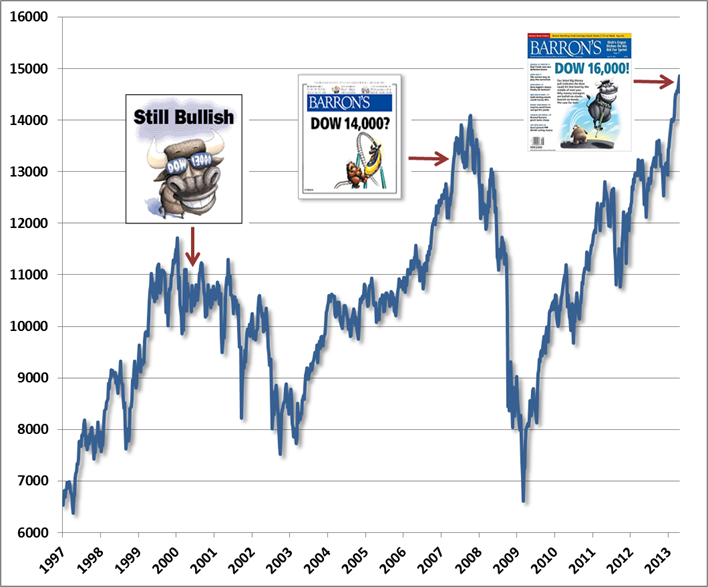
HUSSMAN: The Cover Of The Latest Barron’s Is A Screaming Sign Of A Stock Market Top

HUSSMAN: The Cover Of The Latest Barron’s Is A Screaming Sign Of A Stock Market Top

Joe Weisenthal | 39 minutes ago | 145 | 

This weekend we mentioned the latest Barron’s cover, which is about the paper’s professional investor survey, which shows record high bullishness and a widespread belief that the Dow is going to go to 16,000. John Hussman, the famously bearish mutual fund manager, sees this as screaming sell signal, as he invokes the ol’ contrarian magazine cover indicator. He writes:

The Barron’s Big Money Poll is typically bullish, on balance. This is Wall Street, after all. But variations in the tone and extent of that bullishness can be informative, especially when the consensus is extremely optimistic at new highs of mature bull markets, and defensive at new lows of mature bear markets. I can’t really throw stones about 2009, as I had my own concerns at the time (relating to the need to stress-test against Depression era outcomes, despite our favorable views of valuation). But it’s worth noting that the 2009 Big Money Poll questioned the advance from the March lows, noting “good reason not to jump in with both feet yet.” The 2003 Big Money Poll – already well into a new bull market – was bullish on balance, and up from just 43% bulls in an October 2002 poll near the market lows. Still, the 2003 poll noted “the bulls’ views have been tempered by the market’s losses in recent years. Consequently their expectations for the Dow, the Standard & Poor’s 500 stock index, and the Nasdaq Composite have been ratcheted down from past surveys.”

This certainly isn’t a criticism of Barron’s itself. I grew up on Barron’s Magazine, and will remain a devoted reader at least as long as Alan Abelson provides a worthy counterbalance to the more short-sighted views of Wall Street and the Market Lab section remains in print. Still, the Big Money Poll is most useful as a contrary indicator. Rule o’ Thumb: When the cover of a major financial magazine features a cartoon of a bull leaping through the air on a pogo stick, it’s probably about time to cash in the chips. Anyway, this chart from Hussman says it all.

wmc130422a

Danes Rethink a Welfare State Ample to a Fault

April 20, 2013

Danes Rethink a Welfare State Ample to a Fault

By SUZANNE DALEY

sub-jp-denmark-articleLarge

Robert Nielsen, 45, said proudly last year that he had basically been on welfare since 2001.

COPENHAGEN — It began as a stunt intended to prove that hardship and poverty still existed in this small, wealthy country, but it backfired badly. Visit a single mother of two on welfare, a liberal member of Parliament goaded a skeptical political opponent, see for yourself how hard it is. It turned out, however, that life on welfare was not so hard. The 36-year-old single mother, given the pseudonym “Carina” in the news media, had more money to spend than many of the country’s full-time workers. All told, she was getting about $2,700 a month, and she had been on welfare since she was 16. In past years, Danes might have shrugged off the case, finding Carina more pitiable than anything else. But even before her story was in the headlines 16 months ago, they were deeply engaged in a debate about whether their beloved welfare state, perhaps Europe’s most generous, had become too rich, undermining the country’s work ethic. Carina helped tip the scales.

With little fuss or political protest — or notice abroad — Denmark has been at work overhauling entitlements, trying to prod Danes into working more or longer or both. While much of southern Europe has been racked by strikes and protests as its creditors force austerity measures, Denmark still has a coveted AAA bond rating. But Denmark’s long-term outlook is troubling. The population is aging, and in many regions of the country people without jobs now outnumber those with them. Some of that is a result of a depressed economy. But many experts say a more basic problem is the proportion of Danes who are not participating in the work force at all — be they dawdling university students, young pensioners or welfare recipients like Carina who lean on hefty government support. Read more of this post

Tomorrow always knows: How Xiao Jianhua, founder of the low-profile but powerful Beijing-HQ Tomorrow Holdings, came to control RMB1tn

Tomorrow always knows: How Xiao Jianhua came to control RMB1tn

Staff Reporter

2013-04-22

93_1365383799x92y-154717_copy1

Xiao Jianhua, founder of Tomorrow Holdings. (Internet photo)

Xiao Jianhua, founder of the low-profile but powerful Beijing-headquartered Tomorrow Holdings, controls nearly 1 trillion yuan (US$160 billion) of assets ranging from banks to securities houses. His success is founded on his company’s ability to handle rich networks and be sensitive to market information, the Shanghai-based First Financial Daily reports.

The daily said Xiao has been quick to follow every trend in China’s economic reforms, sensing the trend in every new regulation governing securities, banks, insurers and financial leasing companies.

According to New Fortune magazine, Tomorrow Holdings controls nine listing companies holding shares in 30 financial institutions, including 12 city commercial banks, six securities companies, four trust firms, four insurers, two mutual fund companies, one futures firm and one asset management company, with total assets nearing 1 trillion yuan. Yet Tomorrow itself has been almost invisible. Read more of this post

‘Gourmet coffee prince’ Liu Minghui aims high

‘Gourmet coffee prince’ Liu Minghui aims high

Staff Reporter

2013-04-22

CFP435688414-123143_copy1

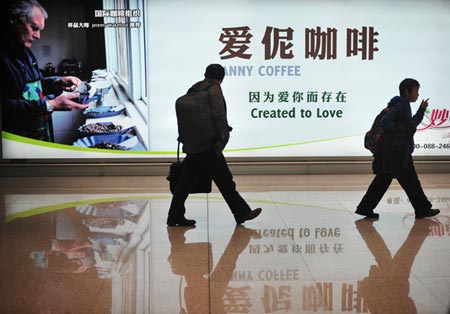
An ad for Aini Coffee. (Photo/CFP)

Liu Minghui, founder of high-end Chinese coffee company Aini Coffee, is continuing his pursuit to promote beans grown in southwestern Yunnan province and raise the company’s profile overseas. Aini Coffee opened its first store last year at the Pu’er Simao Airport, selling coffee machines and coffee beans grown in the Yunnan city of Pu’er. Liu is now seeking to create his own brand in the competitive market of coffee shop chains and instant coffee, focusing on a niche market selling high-end beans to independent coffee shops, offices and families. Opting to avoid direct competition with established brands, the company no longer supplies to Walmart and Carrefour. Liu instead advertises his products online through Taobao and Amazon. Read more of this post

Nestle’s Nespresso Growth Hit by Swiss Contender Migros: Retail

Nestle’s Nespresso Growth Hit by Swiss Contender Migros: Retail

In kitchens across Switzerland, a supermarket retailer is staking a claim on the world’s biggest food company’s growth, one coffee capsule at a time.

The popularity of knock-off coffee pods sold by Migros, the second-biggest retailer in a country with a population smaller than New York City, contributed to a slower start to the year for sales of single-serve Nespresso, said Nestle SA (NESN)’s investor relations chief Roddy Child-Villiers. Nespresso has been among the fastest-growing major brands at Nestle over the past decade.

Migros’s capsules, on sale since May, probably squeezed Nespresso’s quarterly sales growth to 8 percent, the slowest pace in the brand’s history, according to Jon Cox, an analyst at Kepler Capital Markets in Zurich. Nespresso faces increased competition throughout Europe as food companies seek to tap the expanding $8 billion single-serve segment of the global coffee market. Nestle has sued rivals after they introduced capsules compatible with Nespresso machines.

“The introduction by a big competitor locally is meaningful and local legal cases have so far not gone Nestle’s way,” Cox said. Migros’s entry could result in “flat sales” this year for Nespresso in Switzerland, which Cox estimates accounts for about one-fifth of Nespresso’s annual revenue of 4 billion Swiss francs ($4.3 billion). The country is Nespresso’s second-biggest market, according to Kepler. Read more of this post