Commodities slump sends slow ripples through world economy

Published: Monday April 22, 2013 MYT 4:26:00 PM

Commodities slump sends slow ripples through world economy

LONDON: Lower airfares, cheaper food and rising profit margins are among the benefits that should flow from tumbling oil and commodity prices – but only after a long lead time. Having poured $400 billion into commodities over the past decade, many investors are now selling. Their confidence that risky assets could only float higher on a rising tide of cheap central bank money has crumbled as the global economy fails to respond to the stimulus. Even China, an important buyer of natural resources, is slowing. Inflation, against which gold in particular is a classic hedge, is falling nearly everywhere.

Read more of this post

Hollywood blockbusters appeared poised last year to take over China’s box office, but something unexpected happened on the way to the bank: demand tapered off sharply. “They want to see films that challenge them”

April 21, 2013

U.S. Box Office Heroes Proving Mortal in China

By MICHAEL CIEPLY

LOS ANGELES — Hollywood’s global business strategy, which counts on huge ticket sales in China for high-budget fantasies in 3-D and large-screen Imax formats, is coming unhinged.

Last year, helped by a high-level deal that expanded the number of foreign films for release there, American blockbusters like “Mission: Impossible — Ghost Protocol” led the Chinese box office for 23 straight weeks, and received a disproportionately large share of their ticket sales from China.

More big releases were on the way, and the floodgates in the world’s second-largest film market appeared ready to swing open.

But something unexpected happened on the way to the bank: demand tapered off sharply. Read more of this post

Consumer Loans Surge Across Asia; Banks From Around the World Target Middle Class With Financing for Autos, Home Appliances; debt burdens relative to individual income are up to 30% higher compared with the U.S

Updated April 21, 2013, 6:38 p.m. ET

Consumer Loans Surge Across Asia

Banks From Around the World Target Middle Class With Financing for Autos, Home Appliances

By KATHY CHU

MI-BV472_ASIACR_NS_20130421183005

HONG KONG—Lenders from around the world are fueling a boom in short-term loans across Asia, helping push debt to record levels as a burgeoning middle class strives for a better lifestyle and banks look to diversify away from the slow-growing West.

Companies ranging from Citigroup Inc. C -0.13% to Japan’s big banks to a Dutch consumer-finance provider that built its business in Central and Eastern Europe are issuing credit cards or stepping up lending for cars, motorcycles and home appliances from India to Indonesia.

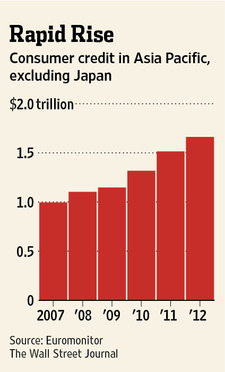
Nonmortgage consumer credit in Asia outside of Japan rose 67% in the past five years to $1.66 trillion by the end of 2012, according to data provider Euromonitor International. In the U.S. the rise was only 10% during the same period as consumers cut back on debt following the financial crisis.

The lenders are targeting Asia’s middle class, which is expected to grow by an average of more than 100 million people each year. They are pitching everything from credit cards to short-term installment loans for motorcycles and appliances. Interest rates can range from 15% for secured auto loans to as much as 40% for unsecured loans, appliances and electronics, driven by high demand for loans and little or no credit history for the borrowers. Loans are typically paid back over six months to five years. Read more of this post

Spain’s Startups Leave in Search of Venture Capital; “There’s just no culture of investing in someone’s ideas rather than real estate.”

Spanish Preference for Property Over Startups Deepens Woe: Tech

After finishing his MBA at Columbia University in New York, Luis Sanz decided not to return home to Spain to launch his Web startup, Olapic.

Sanz says he stayed in New York because his homeland lacks an entrepreneurial culture and has virtually no venture capital industry. Last year, he raised $1 million for Olapic, which helps companies collect photos posted by their customers on social-networking sites such as Facebook and Twitter.

“In Spain it’s just harder to get funded unless you’re already a big name,” said the 32-year-old telecommunications engineer from Zaragoza. “The U.S. is way more appealing.”

Olapic, which serves about 70 corporate clients ranging from EBay Inc. (EBAY) to the New York Giants football team, mirrors other startups founded by engineers fleeing Spain to start businesses in more promising locations. The exodus is crimping the country’s technology industry and threatens the long-term vitality of an economy suffering from a six-year slump and record unemployment.

The number of new businesses created in Spain annually has dropped by almost 100,000 over the past six years, to 334,516 in 2012 from 426,321 in 2007, according to the National Statistics Institute. Over the same period, more than 2 million businesses have closed. Read more of this post

Hong Kong Home Prices to Decline as Much as 25%, Bernstein Says

Hong Kong Home Prices to Decline as Much as 25%, Bernstein Says

Hong Kong home prices will fall as much as 25 percent after the government stepped up measures to curb an asset bubble and as banks raised mortgage rates, according to Sanford C. Bernstein H.K. Ltd.

The number of new apartment sales will “remain largely subdued” with developers shifting their focus to cheaper and smaller units to boost sales, analysts led by Kenneth Tsang wrote in a report today.

An index tracking home prices dropped the most in almost three years in the week ended April 14 after the government introduced its toughest yet measures to cool prices on Feb. 22. Prices could fall as much as 20 percent over the next two years, Deutsche Bank AG said in a report last month.

Cheung Kong Holdings Ltd. (1), which last month lowered prices by almost 10 percent at a project in response to the government curbs, may introduce more price cuts to boost sales, said the Bernstein analysts. The builder is controlled by Li Ka-shing, the city’s richest man. Read more of this post

Carbon-Intensive Investors Risk $6 Trillion ‘Bubble,’ Study Says

Carbon-Intensive Investors Risk $6 Trillion ‘Bubble,’ Study Says

Investors in carbon-intensive business could see $6 trillion wasted as policies limiting global warming stop them from exploiting their coal, oil and gas reserves, according to a report.

The top 200 oil, gas and mining companies spent $674 billion last year finding and developing fossil fuel resources, according to research by the Carbon Tracker Initiative and a climate-change research unit at the London School of Economics. If this rate continues for the next decade some $6 trillion risks being wasted on “unburnable” or stranded assets, according to the report, released today.

Banks, funds and institutional investors are seeking clarity from government and central banks about how greenhouse- gas emissions may affect the value of their investments. The Bank of England said last year it will evaluate whether the U.K.’s exposure to investments in polluting industries poses a risk to financial stability after a group of more than 20 investors called for a such a probe.

“If the markets carry on regardless, with the regulators looking the other away, they’re just asleep on their watch,” James Leaton, research director at Carbon Tracker, a project by non-profit Investor Watch, said in an interview in London. “The longer it goes on, the bigger the bubble will get.” Read more of this post

In Europe, Paid Permits for Pollution Are Fizzling

April 21, 2013

In Europe, Paid Permits for Pollution Are Fizzling

By STANLEY REED and MARK SCOTT

LONDON — On a showery afternoon last week in West London, a ripple of enthusiasm went through the trading floor of CF Partners, a privately owned financial company. The price of carbon allowances, shown in green lights on a board hanging from the ceiling, was creeping up toward three euros. That is pretty small change — $3.90, or only about 10 percent of what the price was in 2008. But to the traders it came as a relief after the market had gone into free fall to record lows two days earlier, after the European Parliament spurned an effort to shore up prices by shrinking the number of allowances. “The market still stands,” said Thomas Rassmuson, a native of Sweden who founded the company with Jonathan Navon, a Briton, in 2006.

Still, Europe’s carbon market, a pioneering effort to use markets to regulate greenhouse gases, is having a hard time staying upright. This year has been stomach-churning for the people who make their living in the arcane world of trading emissions permits. The most recent volatility comes on top of years of uncertainty during which prices have fluctuated from $40 to nearly zero for the right to emit one ton of carbon dioxide. More important, though, than lost jobs and diminished payouts for traders and bankers, the penny ante price of carbon credits means the market is not doing its job: pushing polluters to reduce carbon emissions, which most climate scientists believe contribute to global warming. The market for these credits, officially called European Union Allowances, or E.U.A.’s, has been both unstable and under sharp downward pressure this year because of a huge oversupply and a stream of bad political and economic news. On April 16, for instance, after the European Parliament voted down the proposed reduction in the number of credits, prices dropped about 50 percent, to 2.63 euros from nearly 5, in 10 minutes. Read more of this post

Tata Faces Crisis as $20 Billion Spent on Water: Corporate India

Tata Faces Crisis as $20 Billion Spent on Water: Corporate India

India, the world’s second-most populous nation, is doubling spending on water management to a record as conglomerates from the Tatas to Adani face shortages that the United Nations calls an impending crisis.

The federal and state governments have set aside 1.1 trillion rupees ($20 billion) for sewage treatment, irrigation and recycling for the five-year period ending March 2017, G. Mohan Kumar, special secretary in the Ministry of Water Resources, said in an interview. The nation with 1.2 billion people, which treats only 20 percent of its sewage, is pouring more money as inadequate clean water is threatening to stunt growth in industrial and farm output.

Disputes with farmers demanding rights to their irrigated land have stalled about $80 billion of investment by companies including Posco and ArcelorMittal (MT) as Prime Minister Manmohan Singh seeks to revive an economy growing at the slowest pace in a decade. Tata Steel Ltd. (TATA), India’s biggest maker of the alloy, is setting annual targets to cut water usage as two-thirds of the country faces a scarcity, H.M. Nerurkar, managing director said in an April 11 interview.

“Water availability is a very big issue and in the coming days this will be a far bigger issue,” A.P. Choudhary, chairman of Rashtriya Ispat Nigam Ltd., India’s second-biggest state-run steelmaker, said in an interview. “Water is critical for the steel industry’s growth and no company is comfortably placed.” Read more of this post

Triple A-rated Netherlands on Edge of Economic Crisis; Unemployment Surges as Home Prices Collapse

Netherlands on Edge of Economic Crisis; Unemployment Surges as Home Prices Collapse

Posted: 21 Apr 2013 12:05 PM PDT

Netherlands is underwater in more ways than one. Der Spiegel reports Underwater: The Netherlands Falls Prey to Economic Crisis

More than a decade ago, the Dutch central bank recognized the dangers of [the housing] euphoria, but its warnings went unheeded. Only last year did the new government, under conservative-liberal Prime Minister Mark Rutte, amend the generous tax loopholes, which gradually began to expire in January. But now it’s almost too late. No nation in the euro zone is as deeply in debt as the Netherlands, where banks have a total of about €650 billion in mortgage loans on their books. Consumer debt amounts to about 250 percent of available income. By comparison, in 2011 even the Spaniards only reached a debt ratio of 125 percent.  The Netherlands is still one of the most competitive countries in the European Union, but now that the real estate bubble has burst, it threatens to take down the entire economy with it. Unemployment is on the rise, consumption is down and growth has come to a standstill. Read more of this post

Canadians Surpass Americans in Net Worth, But Will it Last?

April 18, 2013, 2:30 PM

Canadians Surpass Americans in Net Worth, But Will it Last?

By Don Curren

They’ve been known to get pretty excited when a new, big-name discount retailer comes to town, but thanks to a booming housing sector, Canadians are more affluent than their American neighbors.

At least for the moment, that is.

Canada’s net worth was at a healthy 648% of gross domestic product in the final quarter of 2012, according to a report from independent economic research firm Capital Economics, which has gained something of a profile for its bearish views on Canada’s economy, and particularly its housing market.

By contrast, U.S. net worth was a more modest 550% in the same period.

The catch is that Canadians’ wealth advantage is built mostly on the big run-up in housing prices in recent years, and that’s a very shaky foundation, at least from Capital Economics’ point of view. Read more of this post

ASEAN looking a bit like ’97

ASEAN looking a bit like ’97

APR 22, 2013

This is an abridged translation of an article from the April issue of Sentaku, a monthly magazine covering Japanese political, social and economic scenes.

An economic upturn always has the potential for crisis. Members of the Association of Southeast Asian Nations (ASEAN) appear to be blessed with an economic boom. But there is a feeling of deja vu as current circumstances closely resemble those on the eve of the Asian financial crisis, which started in July 1997. Read more of this post

Yudhoyono’s Selection for Finance Minister Rattles Market

Yudhoyono’s Selection for Finance Minister Rattles Market

President Susilo Bambang Yudhoyono’s decision to opt for an acting finance minister to replace Agus Martowardojo threatens to cloud the policy outlook as Indonesia struggles to revamp its fuel-subsidy program, step up infrastructure investment and damp price pressures.

Hatta Rajasa will replace Martowardojo, who is set to become the next Bank Indonesia chief, the government said April 19. Rajasa is chairman of the National Mandate Party, a member of Yudhoyono’s Democrat Party coalition, and will also remain coordinating minister for the economy.

The Jakarta Composite Index, which has gained about 16 percent this year and reached a record last week, fell after the announcement that came an hour before the close of trade on April 19. Rajasa assumes the role as the government plan to curb fuel subsidies threatens to boost inflation that reached a 22- month high in March, adding to the burdens of an economy facing falling prices for its commodity exports including palm oil.

“The decision is quite strange — it will have a negative impact on the stock market and the rupiah,” said David Sumual, an economist at PT Bank Central Asia in Jakarta. “Indonesia needs a finance minister with a background in macroeconomic and fiscal policy, as there are so many problems in the economy.” Read more of this post

Baht Flashes Sell Signal as Prasarn Sees Froth: Market Reversal

Baht Flashes Sell Signal as Prasarn Sees Froth: Market Reversal

At least three trading patterns show Thailand’s baht, this year’s best-performing Asian currency, is poised to fall as policy makers step up warnings that its rally to a 16-year high is stretched.

The baht’s 2.3 percent advance this month pushed the 14-day relative strength indicator to 25, data compiled by Bloomberg show. A reading below 30 typically signals a reversal may occur. Trading envelope and stochastics oscillator indicators also suggest the baht’s rise has gone too far.

Central bank Governor Prasarn Trairatvorakul told reporters in Bangkok on April 19 that the baht’s advance has started to move beyond fundamentals, 10 days after he said the rally was “too fast.” Finance Minister Kittiratt Na-Ranong reiterated his call last week for the central bank to cut interest rates to deter inflows to the country’s bond market. Read more of this post

Japan Inc. Hesitates to Invest as Stocks Rally on Plummeting Yen

Japan Inc. Hesitates to Invest as Stocks Rally on Plummeting Yen

The last time Masao Namiki bought machinery for his company, Emperor Hirohito had just died, Japanese investors took the Rockefeller Center as a trophy, and a new central bank chief was about to prick the bubble economy. It was 1989.

The $1 million Namiki borrowed to outfit his workshop with computerized lathes and drills almost bankrupted him as orders from clients Canon Inc., Panasonic Inc. and NEC Corp. evaporated. As interest rates cranked up to 6 percent, crashing stock and land prices wiped out $15 trillion in wealth and triggered an economic malaise that still drags on.

The bubble, and the five recessions since, help explain why business owners like Namiki aren’t buying into investor euphoria over new Prime Minister Shinzo Abe’s campaign to end deflation. Even after the steepest five-month slide in the yen for 18 years made global companies like Toyota Motor Corp (7203). more competitive and Japan the world’s best-performing major stock market, Namiki said he’s still not ready to invest.

“If we had the orders I’d think about adding equipment, but right now the work’s just not there,” the 72-year-old said at his small factory in Tokyo’s Ota district, where he and a handful of employees have made thousands of steel molds for phones, stereos, and keyboards. “The manufacturers are still in wait-and-see mode.”

The reluctance to borrow and spend of companies like Namiki’s that don’t operate abroad and make up the bulk of Japan’s economy is the biggest threat to Abe’s plans, said Nomura Research Institute Chief Economist Richard Koo. Read more of this post

China bond executives arrested in probe into alleged skimming; Relaxed quotas could give Asian central banks taste for China bonds

China bond executives arrested in probe into alleged skimming

Thu, Apr 18 2013

* Executives from CITIC, two other firms arrested

* Alleged profit skimming via complex trading practices

* Investigation could involve other institutions

* Regulation lags bond market’s explosive growth

By Gabriel Wildau

SHANGHAI, April 18 (Reuters) – Three Chinese financial industry executives have been arrested for allegedly using complex bond trading practices to skim client profits for personal gain, state media reported this week.

Executives from state-owned CITIC Securities , China’s largest brokerage by assets, unlisted fund management company Wanjia Asset Management and Qilu Bank, a small lender 20 percent owned by Commonwealth Bank of Australia , are under investigation by the Shanghai Public Security Bureau, the official Securities Times reported on Wednesday. Read more of this post

Chinese investors short gold in London as prices tumble while the retail public buys; Tianjin Precious Metal Exchange flooded with requests from investors looking to short gold

Chinese investors short gold in London as prices tumble

Staff Reporter, 2013-04-20

Members of the public have rushed to buy gold amid the current price drop, while investors have been actively short selling. (Photo/CFP)

Chinese investors in London are increasingly short selling gold shares as the price of the precious metal has lost about 30% of its value from a year and a half ago.

The price of gold in the city hit a low of US$1,385.70 an ounce at one point on April 15, a plunge of nearly 30% from a historic high of US$1,920.38 an ounce in September 2011, according to the Chinese-language National Business Daily, which quoted an official at the research unit of Donghai Futures.

An investment consultant at Mintai Precious Metals, a member of the Tianjin Precious Metal Exchange — one of two precious metal exchanges in China approved by the State Council — said his company was flooded with requests from investors looking to short gold. Read more of this post

Rob Arnott of Research Affiliates: Most hedge funds disappoint; Funds have underperformed at a time when they are drawing more and more money from middle class retirement accounts

Rob Arnott: Most hedge funds disappoint

By Stephen Gandel, senior editor April 19, 2013: 11:51 AM ET

Funds have underperformed at a time when they are drawing more and more money from middle class retirement accounts.

rob_arnottf_2013_apr_lure_of_hedge_funds_figure1_small

Blue bar shows what happened to the portfolios risk-adjusted returns when hedge fund were added. Source: Research Affiliates

FORTUNE — Hedge funds have been a bust.

That’s how Robert Arnott, one of the nation’s most successful investment managers, sees it. That’s also the conclusion of a piece of research posted on his firm’s website this week.

The research, which is titled “The Lure of Hedge Funds,” directly refutes one of the key claims hedge funds managers make when they try to attract investors.

“There are some outstanding hedge funds, but they are considerably outnumbered by the multitudes of lousy ones,” says Arnott, who heads Research Affiliates.

Hedge funds have traditionally been investment vehicles for the rich and universities. But in the past decade or so, they have drawn more and more money from public pensions and other accounts that hold the retirement funds of the middle class. Assets in hedge funds have more than tripled in the past decade to $2.25 trillion, according to Research Affiliates.

“The results have been a disappointment, and yet asset flows continue at an astronomical rate,” says Arnott.

Part of that has to do with the sales pitch.

On the face of it, hedge funds have had a rough go of it recently. The vast majority of funds have done worse than the market for the past four years. To add insult to injury, last year even mutual funds outperformed hedge funds, which charge much higher fees than their rivals.

But hedge fund managers and the industry in general have long contended that those criticizing the funds for not having the highest returns are missing the point. They say hedge funds achieve their investment returns with less risk. You hear of the benefits of diversification, and risk-adjusted-returns. The pro-hedge fund camp argues that when you factor in the lower risk, investing in hedge funds is a better bet than just blindly putting your money in the market.

But Arnott says that’s a bunch of baloney. Read more of this post

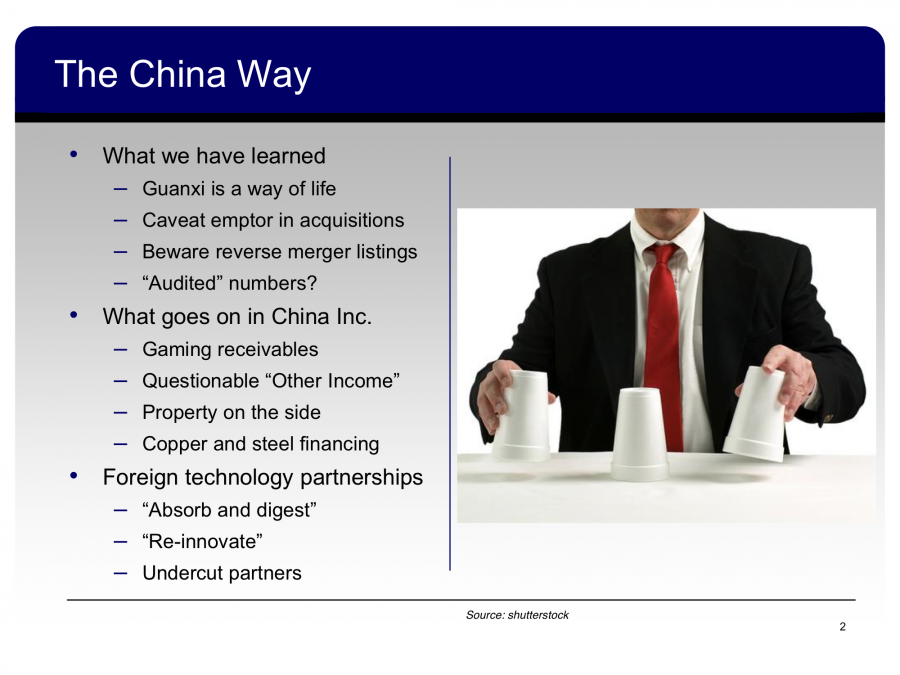
Jim Chanos’s New China Presentation Will Have You Convinced The Country Is Doomed For A Hard Landing

Jim Chanos’s New China Presentation Will Have You Convinced The Country Is Doomed For A Hard Landing

Sam Ro | Apr. 19, 2013, 12:26 PM | 58,050 | 14

Jim Chanos gave a devastating presentation on China at Mish Shedlock’s Wine Country Conference. Chanos has been bearish on China for quite a while.  However, his new presentation is particularly fascinating because it has some pretty graphic cartoons. “The cartoons/illustrations, gruesome/silly, as they are, are FROM Chinese sources!” said Chanos in an email to Business Insider.  “That’s why we put them in-so that people know that the media inside China is becoming more skeptical itself.”

the-chinese-economic-story-is-riddled-with-red-flags Read more of this post

CBRC Renews Push to Regulate Wealth Management as Credit Expands

CBRC Renews Push to Regulate Wealth Management as Credit Expands

The China Banking Regulatory Commission said it will scrutinize lenders’ wealth-management and short-term note sales, control increases in bad loans and focus on debts in an attempt to limit “severe risk.” The regulator has told banks to improve the accuracy of how they classify loans, to monitor non-performing loans and to control total lending to local government financing vehicles, according to a statement posted on the CBRC website yesterday. “The authorities are serious about the whole explosion of wealth management — and they must also be concerned at the scale of credit creation,” Michael Shaoul, chairman of New York-based Marketfield Asset Management LLC, said in an e-mail. First-quarter credit creation was about $1 trillion, he said.

Chinese banks rely on wealth-management products, which pay higher rates than regulated deposits, to retain clients who are diverting savings to other investments. The sales are transforming the stable and cheap deposit base that has supported lenders into one that is “more mobile, expensive and short-term,” creating repayment risk, Fitch Ratings has warned. The outstanding balance of banks’ wealth-management products may have been 13 trillion yuan ($2.1 trillion) at the end of 2012, compared with 8.5 trillion yuan a year earlier, according to Fitch. The pace of expansion is faster than during the 2009 credit boom and is taking place through wealth management and corporate debt-issuance systems, not through the better regulated bank-loan system, Shaoul said. Read more of this post

Here Comes the Next Hot Emerging Market: the U.S.

Updated April 19, 2013, 4:07 p.m. ET

Here Comes the Next Hot Emerging Market: the U.S.

By JASON ZWEIG

BF-AE802_INVEST_G_20130419170525

The investment visionary who coined the term “emerging markets” and helped launch the first funds to invest in developing countries thinks he has spotted what you might call the next great emerging market. It is called “the United States.”

Antoine van Agtmael is arguably the founding father of emerging-markets investing. He still is an evangelist for investing in parts of Africa, Asia, Latin America and other less-developed regions, where he thinks the future remains bright. But he believes the U.S. is at the beginning of an industrial revitalization that most analysts only have begun to recognize. Read more of this post

One Way to Time the Market; VLMAP, Value Line’s Median Appreciation Potential, is used to project where the market will be in four years

April 19, 2013, 4:59 p.m. ET

One Way to Time the Market

By MARK HULBERT

The stock market in four years’ time is unlikely to be much higher than it is now. That sobering forecast comes from a simple stock-market timing model that has an impressive track record over the past five decades. Among the more than 100 market timing strategies tracked by the Hulbert Financial Digest, in fact, this model has turned in the best performance of any in forecasting the market’s four-year return. The clear investment implication is to begin reducing risk in your stock portfolio—either by building up cash or shifting your holdings toward more conservative stocks such as those with strong balance sheets and which pay high dividends.

This market timing system is based on a single number that appears each week in the Value Line VALU -1.20% Investment Survey, the flagship publication of Value Line, a New York-based research firm. The number represents the median of the percentage gains that Value Line’s analysts estimate the 1,700 widely followed stocks they monitor will produce over the next three to five years. Over the past five years, for example, this number—known as the VLMAP, for Value Line’s Median Appreciation Potential—has been as low as 45% and as high as 185%. It currently stands at 50%. Value Line itself doesn’t endorse using the VLMAP for market-timing purposes. Though the firm doesn’t actively discourage investors from relying on this number or any of the other data that it produces, Value Line instead showcases a market-timing model that has a shorter-term focus.

Read more of this post

Congestion pushes Chinese on to their bikes

April 19, 2013 5:14 am

Congestion pushes Chinese on to their bikes

By Patti Waldmeir in Hangzhou, China

For decades under communism, owning a private car was an impossible dream inChina. Now that the dream has come true for tens of millions of Chinese, they are waking up each day to a life of traffic jams and smog. Beijing’s air pollution has been so bad recently that it has captured headlines around the world – yet the capital has far from the dirtiest air in China. More and more mainland cities can boast world-class traffic congestion, parking shortages and commuting times, auto analysts say.

Under Chairman Mao Zedong, schoolchildren were taught that these were the ills associated with capitalism, but China’s urban planners were no match for half a century of pent-up demand from first-time car buyers. The country, whose showpiece industry event – the Shanghai Auto Show – starts this weekend, is now the world’s largest car market. And it is paying the price. With more than half of all Chinese living in cities, “smog and clog” are becoming big political issues. Even washing all those cars is exacerbating the country’swater shortage, according to a report last week from a Chinese NGO. The impact is so high that some cities are even thinking the unthinkable: sending China back to its roots as a nation of cyclists. Read more of this post

1,424 listed firms in China got RMB57bn in subsidies last year

1,424 listed firms in China got RMB57bn in subsidies last year

Staff Reporter,  2013-04-20

The production line of Chongqing Iron & Steel, which got US$320 million in subsidies in 2012. (Photo/Xinhua)

The Chinese government last year provided 57 billion yuan (US$9.2 billion) in subsidies to 1,424 listed firms, with state enterprises receiving 70% of the funds.

BOE, a major flat panel display maker, took over 1.6 billion yuan (US$259 million) in government subsidy last year, when its accumulated net loss topped 8 billion yuan (US$1.3 billion), compared with total capital of 30 billion yuan (US$4.8 billion). China Ocean Service received 900 million yuan (US$145 million) last year, just a fraction of its staggering net loss of 9.6 billion yuan (US$1.55 billion).

Despite the rigorous financial screening for IPO plans, there are still over 700 firms lining up to list their shares on China’s stock market. “Share listing enables a company to raise funds by floating new shares and entitles it to various incentives from municipal governments, amounting to millions, tens of millions, or even one hundred millions of yuan,” said an executive with a listed securities firm. Read more of this post

Graduate schools stung by drop in Chinese applications

Graduate schools stung by drop in Chinese applications

Fri, Apr 19 2013

(Reuters) – Slowing graduate-school enrollments, including a 5 percent decline in applications from China for fall 2013, are hurting the revenues of many U.S. universities, Moody’s Investors Service said on Friday.

In a commentary, Moody’s said graduate school enrollments for the coming autumn term increased by just 1 percent, or the smallest increase in 11 years, according to data from the Council of Graduate Schools.

Private universities took the biggest blow, with applications from typically higher-paying international students off 4 percent. Public universities saw international applications go up 3 percent, Moody’s said.

Applications from China, the largest exporter of graduate students to the United States, were off 5 percent. Read more of this post

Luxury Slumps in Switzerland; glut of high-end developments and shrinking employment in the banking industry have led to a downturn in the upscale real-estate market

April 18, 2013, 10:45 p.m. ET

Luxury Slumps in Switzerland

A glut of high-end developments and shrinking employment in the banking industry have led to a downturn in the upscale real-estate market; slow sales at the Löwenbräu high-rise

Mobimo Tower is a luxury high-rise with units priced between $1.4 million and $7.4 million. After two years, about one-third of the residences remain unsold.

By MARTA FALCONI

When Mobimo Holding AG MOBN.EB +0.48% opened a 24-story luxury tower in one of Zurich’s trendiest neighborhoods, Chief Executive Christoph Caviezel expected the building’s glitzy condominiums to sell fast.

Snapshot: Zurich

  • Population: 380,500
  • Cost of living: Switzerland is currently experiencing mild deflation. Prices fell on average 0.7% in 2012, compared with a gain of 0.2% the year before.
  • Average high-low temperatures: January: 37.8°/26.4°F July: 77°/55°F
  • Biggest deal: Two detached houses sold for more than $32 million apiece last year.
  • Notable neighbors: Singer Tina Turner lives along the Gold Coast of Lake Zurich. Swiss bank UBS board member Rainer-Marc Frey reportedly bought a condo in the Mobimo Tower.
  • Conversation pieces: Zurich West, where the Mobimo Tower and the Löwenbräu high-rise were built, was formerly the city’s industrial center. Now it’s peppered with bars, restaurants and boutiques. Cultural events are often hosted in refurbished industrial sites. The Gold Coast along Lake Zurich has lured wealthy residents drawn to its quiet neighborhoods and stunning water views. The area got its nickname from the evening sunshine that bathes the area year-round.

Two years later, a third of the Mobimo Tower’s 53 units remain unsold even though they sport panoramic views, high-end fixtures and access to an on-site health club. Mobimo hopes the condominiums, which reportedly cost between 1.3 million and 7 million Swiss francs ($1.4 million and $7.4 million), will be sold by the end of 2014, a year later than previously expected.

Poor sales at the $268 million tower, its flagship property, have prompted the Lucerne, Switzerland-based developer to scrap plans for a similar luxury complex on the shores of Lake Zurich. Mobimo has already sold the land earmarked for that development, which was planned for a sun-splashed area dubbed the Gold Coast.

“It makes no sense to build more apartments in the high-price range,” Mr. Caviezel said in an interview.

Mobimo and other Swiss developers have been caught by a sudden swing in Zurich’s real-estate market. A glut of high-end developments and shrinking employment in the banking industry have hit high-end real estate hard. Efforts by the central bank, which began requiring banks in February to put an additional 1% of mortgage-related exposures aside as part of a capital cushion, are also weighing on the market. The Swiss franc is little changed compared with other currencies.

The shift has come fast for Zurich, which has been among the world’s most buoyant markets for several years. Historically low interest rates—about 1.5% for a five-year, fixed-rate mortgage—and an influx of wealthy foreigners helped push prices of upscale condominiums to nearly $2,000 per square foot, according to analysts at Credit Suisse CSGN.VX +1.03% . Confident that prices would keep rising, buyers often committed to purchases before construction of a site was completed.

Now condominium prices in the canton of Zurich, which houses Switzerland’s biggest city and the country’s financial hub, are slowing. Condo prices rose 6.5% last year, but that was down from 9.4% the previous year and 7.1% in 2010, according to Wüest & Partner, a property consultant. Analysts at Credit Suisse say price growth will “slow considerably” this year, although it will remain positive.

Properties listed for $2 million or more stayed on the market for more than 90 days in the fourth quarter of 2012, compared with more than 60 days in the third quarter, according to Wüest & Partner.

“The golden times of the last two or three years are gone now,” said Thomas Rieder, a senior economist at Credit Suisse, who says slimmer paychecks in the financial industry have weighed on the market. “It’s not so easy anymore to sell property at any price you want.”

PSP Swiss Property, PSPN.EB +0.96%a Zug-based developer, is also struggling to complete sales in its Löwenbräu high-rise, a 20-story tower built on the site of a former brewery and just down the road from the Mobimo Tower.

Though sales opened nearly three years ago, roughly 22% of the complex’s 58 units remain empty. PSP even chopped the tower’s glamorous 6,028-square-foot penthouse in two, hoping the smaller units would be easier to sell. So far, neither of the condominiums has found a buyer.

PSP CEO Luciano Gabriel said his company wasn’t planning to cut prices yet but acknowledged prices in the luxury segment have been “not very realistic.” PSP is shifting back to commercial developments, its historic strength.

Allreal, ALLN.EB +0.90% a developer with commercial and residential properties in the greater Zurich area, is also changing tack, moving back to the midlevel residential market after a luxury project overlooking Lake Zurich struggled to attract buyers. Just seven of the project’s 23 units have sold, despite a desirable location in the leafy village of Meilen, about 10 miles outside of the city center.

“Looking back a few years, such a project would have been sold out in no time,” said Matthias Meier, a company spokesman. Allreal also has another luxury project along the shore of the lake that will be completed in 2014. Prices for condos there go from about $1.4 million to $5.2 million.

Mobimo, too, is refocusing on projects that will appeal to middle-class Swiss families, a move that means a lower price point. The company is working on a complex of 50 apartments in Zurich that will likely sell at about $1,000 per square foot, roughly half the price tag for luxury developments.

Mr. Caviezel, the Mobimo chief executive, says he’s bracing for a more challenging environment. With tighter credit and fewer high-paid banking jobs, he says it will take longer for the company to sell out its big projects. Amid regulatory changes in the banking industry, UBS, UBSN.VX +3.23% the country’s biggest bank by assets, has reported that its head count in Switzerland fell to about 22,400 as of the end of last year, from roughly 23,200 in 2011. Credit Suisse, too, has cut jobs as it restructures its operations, reducing head count world-wide by 2,300 jobs during past year.

“We’ve been a little bit spoiled in the past, with apartments that could be sold even before they were finished,” said Mr. Caviezel. “Now it takes more time.”
Low-interest-rate environment exposes seniors to fraudsters; “Right now, because of interest rates, the fraudulent sellers aren’t having any issues finding a buyer who wants to believe the lie.”

Low-interest-rate environment exposes seniors to fraudsters

By Ylan Q. Mui, Friday, April 19, 2:37 AM

Senior citizens are being lured into riskier investments — and often outright scams — as carefully laid retirement plans have been scuttled by five years of low interest rates.

Government regulators and advocacy groups say unscrupulous dealers are taking advantage of a growing fear among seniors that they will run out of money in their final years of life. That’s in large part because many seniors have parked their cash in safe investments, such as government bonds, where returns have barely kept pace with inflation. As a result, their savings are stagnating as their life expectancy grows — and that is making many older Americans increasingly desperate.

In Georgia, state regulators nabbed a man last year who bilked seniors out of nearly $16 million by promising to generate high returns with investments in foreign currencies. In South Carolina, regulators are pressing charges against a former insurance agent who they say was able to scam 17 people out of more than $1 million by advertising certificates of deposit with returns of just 4 percent. A similar scheme in Virginia attracted more than $11 million from seniors hoping to beat bank interest rates that have fallen below 1 percent.

“What we really have now is a combination of the fraudulent seller with the needy buyer,” said A. Heath Abshure, commissioner of the Arkansas Securities Department and president of the North American Securities Administrators Association. “Right now, because of interest rates, the fraudulent sellers aren’t having any issues finding a buyer who wants to believe the lie.” Read more of this post

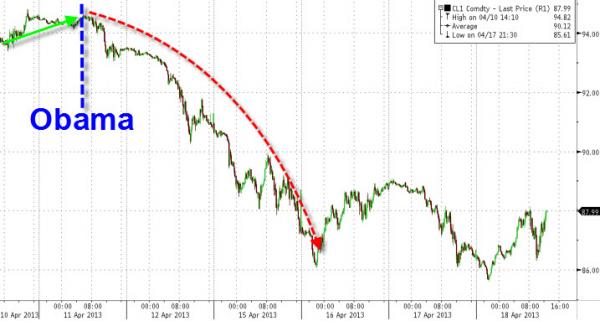
What Exactly Did Obama Say To Wall Street’s CEOs Last Thursday at 11am ET? S&P 500, Gold and Crude Oil All Peaked at 11am

What Exactly Did Obama Say To Wall Street’s CEOs Last Thursday?

Tyler Durden on 04/18/2013 22:06 -0400

Correlation is not causation; but coincidence means you’re on the right path. Looking at the charts of Stocks, Commodities, and Precious Metals, we wonder just what it was that President Obama said at his 11am ET White House meeting last Thursday… Equity markets soared out of the gate on the 11th. Jobless claims beat expectations handily (shaking off the previous week’s concerns) and all was well in the world… until just after 11am ET (when the CEOs of Wall Street’s big banks – for no apparent reason – met with President Obama)… and this happened… Gold also peaked at just after 11am ET… as did Crude oil… So what did Obama tell them?

20130418_obama1_020130418_obama2_020130418_obama3_0

Cola Wars, China Style

04.19.2013 14:47

Cola Wars, China Style

The government and a private company are battling in the market – and in court – over the country’s favorite soft drink

By staff reporter Qu Yunxu

1366353947877857

(Guangzhou) — Eighteen years ago, a Hong Kong businessman named Chan Hung-to took a sip of an herbal tea produced by a government factory in Guangzhou and tasted the future – a beverage that he imagined could be the Coca-Cola of China. The sweet, cold drink called Wanglaoji herbal tea is an acquired taste, a blend of seven medicinal herbs and flowers, including honeysuckle, mint and chrysanthemum. Chan succeeded in making it China’s favorite drink. After licensing the tea’s name and recipe, he took it out of its dowdy green package, put it in an iconic red can with a bold golden logo and spent millions of yuan on massive marketing campaigns. By 2009, it was outselling even Coke in the country. Now, Chan and his erstwhile government partners are locked in a series of bitter trademark battles. While the court hearing for the latest lawsuit is waiting to be held, the real story of Wanglaoji may be that winning in the marketplace is more important than winning in court. But whether Chan can maintain market share if he loses the rights to use the bright red can design is a question worth billions of yuan. Feng Zhimin, a senior executive at Chan’s firm, says they are almost ready to throw in the towel on legal action. “If we lose this case again, there is no justice. We will give up,” he says. Read more of this post

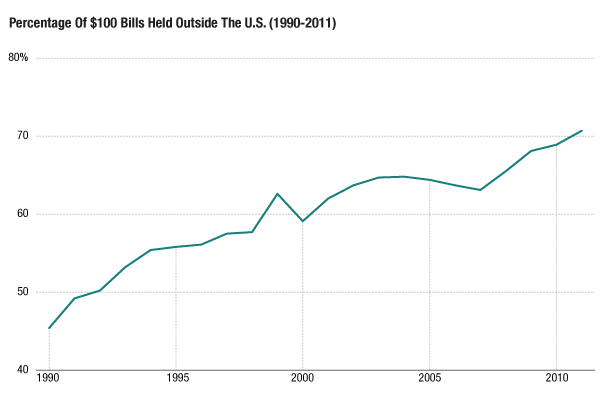
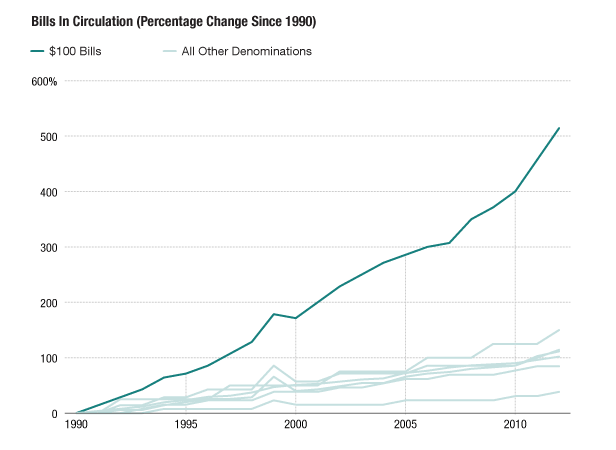
Two-thirds of all $100 bills live outside America

Most $100 Bills Live Outside The U.S.

by JACOB GOLDSTEIN, April 17, 201312:00 PM

images (8)

The world loves the U.S. dollar.

When, say, a South African businessman buys supplies from China, he pays in U.S. dollars. When central banks hold foreign reserves, they favor dollars. And, all over the world, when things start to get crazy, people start putting $100 bills under the mattress. In fact, as of 2011, roughly two-thirds of all $100 bills were held outside the U.S., according to anestimate by Ruth Judson, an economist at the Fed.

pm-gr-dollardollarbillaway-616

pm-gr-dollardollarbill-616 Read more of this post

Snoozebox (ZZZ), portable hotels made of stackable containers that have housed fans at events, has gained 55 percent since its IPO last May, outperforming European hoteliers such as Accor and InterContinental

Snoozebox Portable Hotels Conceived in Misery of Rain at Le Mans

images (7)

When Ignis Asset fund manager David Clark first heard of Snoozebox (ZZZ), portable hotels made of stackable containers that have housed fans at events such as the Le Mans 24-hour car race, he wanted to kick himself. Instead, he made sure Ignis was the biggest investor. “When I first came across it I had ‘duh’ moment,” Clark said in a phone interview. “It doesn’t take a genius to figure out the numbers of places that hold events but don’t have the accommodations for people to stay in.” Ignis now holds 14 percent of Snoozebox Holdings Plc’s shares.

Snoozebox, which transports rooms equipped with flat-screen TVs, Wi-Fi and running hot water to sporting and music events across the U.K. and beyond, may almost triple its revenue this year, said Simon French, an analyst at Panmure Gordon & Co., who recommends buying the stock. The London-based company may report 5.4 million pounds ($8.3 million) in sales for 2012 when it releases earnings April 23, he said.

The stock has gained 55 percent since its initial public offering last May, outperforming European hoteliers such as Accor SA (AC) and InterContinental Hotels Group Plc. (IHG) The MSCI Europe Hotels, Restaurants and Leisure Index has advanced about 14 percent. The shares rose 8.3 yesterday after Snoozebox said it won a contract to supply accommodation for 1,350 personnel at the G8 summit in Northern Ireland in June. Chief Executive Officer Robert Breare said the trick is to transport — by air, land or sea — 40 to 400 prebooked rooms that are placed steps from the action. Read more of this post