Australia: Crackdown on shadow banking after a spate of failures among finance companies that accepted debentures, including the $660 million collapse of Banksia last year

Crackdown on shadow banking

April 19, 2013 – 2:23PM, Clancy Yeates

The financial regulator is proposing tougher rules on non-bank finance companies that accept retail deposits after a string of collapses in the “shadow banking” sector. In new proposals published today, the Australian Prudential Regulation Authority said it would restrict companies that operate outside the Banking Act from using terms such as “deposit” and “at call” accounts. Currently there are no restrictions on use these phrases by finance companies, which are regulated much more lightly than banks. Under the proposed changes, APRA said it would remove an exemption that allows finance companies to use these terms, to avoid confusion among retail investors. It also said it would require debenture products to have a minimum maturity of 31 days. The crackdown comes after a spate of failures among finance companies that accepted debentures, including the $660 million collapse of Banksia last year.

Yoshinoya Japan slashes beef bowl prices

Yoshinoya slashes beef bowl prices

KYODO, APR 19, 2013

Yoshinoya Holdings Co. on Thursday cut prices for its mainstay “gyudon” beef-on-rice bowls to take advantage of eased restrictions on beef imports from the United States. The relaxation of strict import curbs in February is allowing the stable procurement of cheaper beef suitable for gyudon, the company said. Yoshinoya slashed beef bowl prices by ¥100 to match its two biggest rivals — Zensho Holdings Co.’s Sukiya chain and Matsuya Foods Co. — which are currently charging ¥280 for a standard bowl. The price of a large bowl dropped by ¥40 to ¥440, while the extra large bowl fell by ¥90 to ¥540. The price cuts are expected to produce about 30 percent more customers and a 15 to 20 percent boost in sales, the firm said. Prices for other ingredients, however, are starting to rise, thanks to Prime Minister Shinzo Abe’s “Abenomics” policies. Players in the fast-food industry say that lower gyudon prices are the key to winning market share.

nb20130419a3a-870x547

Buffett’s China BYD mulls leaner, greener “re-birth” plan

Exclusive: China’s BYD mulls leaner, greener “re-birth” plan

Thu, Apr 18 2013

By Norihiko Shirouzu

SHANGHAI (Reuters) – BYD Co, one of the better known Chinese brands thanks to a stake held by billionaire U.S. investor Warren Buffett, may stop making conventional gasoline-fuelled cars within two years and focus on ‘new energy’ battery models as part of a “re-birth plan” to arrest a slump in sales.

Shares in BYD, which once harbored long-term ambitions to be as big as Toyota Motor Corp, have tumbled by almost three quarters since a late-2009 peak, as net profit crumbled to just 81.4 million yuan ($13.15 million) last year from 3.8 billion yuan four years ago. Read more of this post

Is Pepsi better off without Pepsi? The slowing drinks business is seen as a drag on Pepsi’s growing snacks business

Is Pepsi better off without Pepsi?

By Gina Chon @GinaChon April 18, 2013

Did Pepsi CEO Indra Nooyi throw activist investors a bone today? During the call to discuss the company’s latest earnings, Nooyi said Pepsi is exploring “sensible opportunities to unlock incremental value through meaningful structural alternatives.” “Unlocking value” and “structural alternatives” are sometimes the jargon words used when considering a breakup.

Whether Pepsi, which makes an array of soft drinks, energy drinks, and snacks, goes that far remains to be seen. Nooyi said she won’t discuss the plans until next year. But she did note that the cola category, which includes Pepsi’s namesake products, has been tough as people drift away from sugary drinks for health reasons. That has brought down the performance of its North American beverage business.

Activist investor Ralph Whitworth of Relational Investors is among (paywall) the shareholders who have been pushing Pepsi to do something about its slow-growing beverage unit. One suggestion is separating that drinks business into an independent company. Investors are continuing to press for this, according to sources.

The slowing drinks business is seen as a drag on Pepsi’s growing snacks business. Today’s reported earnings beat analysts’ estimates because sales went up of products like Lays potato chips, Doritos, and Stacy’s pita chips. That gives investors even more ammunition to push for a breakup. Whitworth has discussed a separation of the North American beverage business with Nooyi in the past. Read more of this post

Putin’s friends now own 88% of Russia’s Facebook

Putin’s friends now own 88% of Russia’s Facebook

By Simone Foxman and Gideon Lichfield 9 hours ago

Censorship or investor war? That’s a subject of debate in Russia, after a fund managed by a Russian businessman with close ties to the Kremlin acquired 48% of the country’s largest social-networking site, V Kontakte (“in touch”), which is similar to Facebook.

On Wednesday, two of the founding investors in V Kontakte sold their shares to investment fund United Capital Partners. UCP is headed by Ilya Shcherbovich, a board member at the state-owned oil giant Rosneft, which makes him an ally of Russian president Vladimir Putin.

The remaining 52% of the company is controlled Pavel Durov, the 28-year-old founder of V Kontakte. Durov actually owns only 12% of V Kontakte’s shares, but last year, online firm Mail.ru handed him control of its 40% stake of the company’s shares. Mail.ru is controlled by Alisher Usmanov, another Kremlin buddy and Russia’s richest man. It’s unclear if this agreement between Mail.ru and Durov can be reversed, though Durov says his control of the stake doesn’t expire (link in Russian). Read more of this post

110 million defective condoms in Ghana: the latest example of China’s dangerous counterfeit trade

110 million defective condoms in Ghana: the latest example of China’s dangerous counterfeit trade

By Gwynn Guilford @sinoceros April 18, 2013

China’s $250 billion knock-off trade doesn’t just mean fewer handbag sales for LVMH, or a hit to the DVD sales market. It can also have potentially lethal consequences.

Take, for example, counterfeit condoms, 110 million of which the Food and Drugs Authority of Ghana has impounded over the last week due to poor quality. Testing revealed the condoms to have holes and break under pressure. It also found that they were unusually small and insufficiently lubricated.

And those hole-riddled, flimsy, undersized condoms were made in China, the FDA confirmed Tuesday, identifying Henan Xibei Latex Company Ltd. as the manufacturer. (Here’s the company’s Alibaba.com profile, should you be in the market for defective protection). On top of that, Yenghana reports that the leaky condoms are counterfeit, and that the purported manufacturer, BeSafe, has never sold its products in Ghana.

This isn’t the first time that a Chinese company has been implicated in selling faulty or knock-off condoms. They’ve been bedeviling global public health officials for more than a decade (examples here, here, here and here). Read more of this post

Going local: Japanese carmakers turn to Chinese parts for China market; “Things like the endurance of an auto part are very hard to check unless you actually apply them in cars on the road.”

Going local: Japanese carmakers turn to Chinese parts for China market

Thu, Apr 18 2013

By Kazunori Takada

SHANGHAI (Reuters) – When Nissan Motor Co Ltd (7201.T:Quote, Profile, Research, Stock Buzz) was preparing to launch the Venucia marque with its China venture partner two years ago, it sourced more components locally to keep costs down – and was sent mislabeled parts and sun visors that melted in the heat.

The quality of Chinese-made car parts has since improved and, facing tougher competition in what is now the world’s biggest autos market, Nissan and its Japanese rivals Toyota Motor Corp (7203.T: Quote, Profile, Research,Stock Buzz) and Honda Motor Co Ltd (7267.T: Quote, Profile, Research, Stock Buzz) are having to increase the locally made content in their cars.

This is a big step for Japanese automakers that have built a global reputation for quality through close relationships with known and trusted suppliers, many of whom they own and control and with whom they jointly design and develop components. Read more of this post

Longest Retirements Fuel Pressure for Singapore Remodel; “The emphasis is no more on the people. I feel that the government is not improving our lives.”

World’s Longest Retirements Fuel Pressure for Singapore Remodel

Singaporean Richard Mui joined the ranks of the world’s longest-living retirees when his career ended in 2010. Three years on, the 54-year-old can no longer afford to pay his father’s medical bills, and worries about putting his two children through university.

Almost half a century after independence, Singaporeans now live the most number of years after leaving the workforce, according to the Global Sunset Index of 68 countries compiled by Bloomberg. In the world’s sixth-most expensive city, 41 percent of more than 1,000 residents surveyed by HSBC Holdings Plc (5) said they haven’t saved for retirement, with nearly half of them blaming living costs for hampering efforts.

“The standard of living has improved, but the cost of living, we’re feeling the pinch,” said Mui, who’s made S$4,000 ($3,240) in the past six months as a part-time taxi driver, compared with S$12,000 a month at digital-storage device company SM Summit Holdings Ltd. before a corporate takeover put him out of a job. “The Singapore government is one of the richest in the world but yet the people don’t feel they are rich.”

Mui’s experience encapsulates the economic success that forged Southeast Asia’s only developed nation, as well as the challenges emerging after decades of policies emphasizing self- reliance over state-funded welfare. An aging population and voter demands for more government aid for the poor and elderly have put pressure on Prime Minister Lee Hsien Loong to boost social spending even as growth slows. Read more of this post

Women Cash In on Dakota Oil Service Needs to Sustain Boom

Women Cash In on Dakota Oil Service Needs to Sustain Boom

Amanda Kieson gets calls at 2:30 a.m. to collect urine samples from workers involved in accidents in western North Dakota’s oil industry. The 33-year-old mother of two says she opened her testing service two years ago to get a part of the economic bonanza engulfing the region.

“I love my business, which is weird because, you know, with what we actually have to put up with,” Kieson, the owner of Badlands Occupational Testing Services, said in a phone interview. The company in Watford City has grown to six employees and 24-hour service from demand for post-accident reports and pre-employment drug screening. “We are busy all the time.”

While men dominate the manual-labor jobs on the rigs, women are exercising entrepreneurial zeal in opening services ranging from oil well geology to occupational testing to day care and medical clinics in western North Dakota. Local authorities and company executives say the women — and the businesses they’re creating — are needed to sustain the economic boost.

“There are great opportunities for women,” Kathy Neset, 57, the president of Neset Consulting Service Inc., said in an interview. “Whatever skill you have, we need it in western North Dakota.” Read more of this post

Australian regulator fires warning over property advice for SMSFs (self-managed super fund) to borrow to invest in property; “We do not want to see SMSFs become the vehicle of choice for properties brokers.”

Regulator fires warning over property advice for SMSFs

April 19, 2013

Max Newnham

The Australian Securities and Investments Commission on Thursday released a report from a self-managed super fund taskforce it set up to look at risks in the sector. The report focused on the quality of advice given to people setting up SMSFs. Although the study showed most advice given was adequate or better, there were problems relating to funds borrowing to invest in property. Read more of this post

Australian dairy farmers cut out the middleman; “Coles and Woolworths have such a degree of market power that it makes it difficult for suppliers to make a return”

Dairy farmers cut out the middleman

April 19, 2013 – 1:33PM

Tim Bale’s dairy farm barely broke even in six years as mergers of processors and competition between supermarkets Coles and Woolworths pushed down milk prices. So 14 months ago, he decided to cut out the middleman.

“The milk processors would do a deal with Woolworths and then come back to us and drop our price,” he said. “So I wrote to Woolworths and said, ‘We can sell you milk here that’s better than what you’re getting.”

Farmers in Australia’s $4 billion dairy industry are striking direct deals with supermarkets that control 80 per cent of the country’s grocery sector, as a drive to sell milk for $1 a litre squeezes profits. That’s threatening milk processors Kirin Holdings, Parmalat, and Fonterra Cooperative.

“Coles and Woolworths have such a degree of market power that it makes it difficult for suppliers to make a return,” said Nick Green, a spokesman for Australian Dairy Farmers, a group representing both processors and farmers. “Any industry is unsustainable if it’s only barely breaking even or making a loss.” Read more of this post

VW Recall Highlights Perils of Too Much Success in China

VW Recall Highlights Perils of Too Much Success in China

Volkswagen AG (VOW), Daimler AG (DAI) and Bayerische Motoren Werke AG (BMW) posted record 2012 sales fueled by demand in China. This year, that growth is at risk as the government in Beijing steps up scrutiny of the automakers and media outlets question their quality.

VW last month recalled 384,181 vehicles in China after state television featured complaints about vibrations, loss of power and sudden acceleration in Golfs and other cars. China Central Television also reported that BMW, Audi and Mercedes owners experienced dizziness from asphalt in their vehicles.

“Of course we take the concerns in China very seriously and are investigating the matter,” Joachim Schmidt, sales chief at Mercedes, said last week. Yet he said he was surprised by the complaints. “The components we use have been thoroughly tested before and we use them in vehicles across the globe,” he said. “You would assume that customers outside China might notice something similar.”

The reports come as Chinese authorities have vowed to unmask producers of low-quality or dangerous goods. While Chinese companies haven’t been spared scrutiny, foreigners are frequent targets. In the past year, China Central Television has reported that McDonald’s Corp. sold chicken wings past their sell-by date, Carrefour SA (CA) mislabeled lower quality chicken as premium, and Apple Inc. failed to replace the back covers of iPhones after repairing electronics inside. All have issued apologies and offered fixes. Read more of this post

China Luxury Jet Sales Set to Surge Amid Xi’s Austerity Drive

China Luxury Jet Sales Set to Surge Amid Xi’s Austerity Drive

President Xi Jinping’s austerity drive is not dissuading Chinese private jet buyers.

Customers may buy about 40 private jets this year in China, compared with 27 ordered in 2012, amid a surge in wealth, said Richard Koe, managing director at Hamburg, Germany-based Wingx Advance Gmbh, a business-aviation data company. General Dynamics Corp. (GD)’s Gulfstream is among companies expanding in the country, home to 336 private planes already.

The number of billionaires in China may overtake Germany within the next year, and climb to No. 2 in the world, according to Wealth-X, a Singapore-based company, which collects data on high net worth individuals. Surging demand for planes that could cost about $65 million apiece contrasts with Xi’s vow to rein in on extravagant spending.

“There is wealth to support a much larger fleet,” said Koe. “The development of infrastructure and economic growth are encouraging demand for private jets in China.”

China may become the world’s third-biggest private-jet market by as early as 2022, from a rank below 25 now, Koe said in an interview in Singapore April 17. Xi’s push against “flamboyant” spending will do little to deter the rising demand in the country, he said. Read more of this post

Dutch Recession Woes Haunt Rutte as Deficit Breach Persists; “The increase in unemployment is alarming”

Dutch Recession Woes Haunt Rutte as Deficit Breach Persists

Record unemployment in the Netherlands is compounding Dutch Prime Minister Mark Rutte’s dilemma on how far to push austerity measures needed to curb the country’s deficit.

Consumer confidence due today and statistics on house prices, consumer spending and manufacturers’ confidence next week will confirm just how far the slump has damaged sentiment in the euro-area’s fifth largest economy. Data yesterday showed the jobless rate reached an 18-year high of 8.1 percent in March, with 643,000 people out of work.

Rutte’s coalition government agreed on a four-year, 16 billion-euro ($21 billion) austerity package in October and will decide later this year on additional measures of 4.3 billion euros for 2014. The Netherlands, in the throes of a housing- market slump and facing its third recession since 2009, has breached the European Union’s deficit limit of 3 percent of gross domestic product limit since then.

“The increase in unemployment is alarming,” Sweder van Wijnbergen, a professor of economics at the University of Amsterdam, said in an interview. “The Dutch government has to reduce its deficit, so cannot be an engine of growth. Business investment isn’t likely to pick up before a recovery, so it can’t lead us out of the recession either.” Read more of this post

ANZ Seen Bolstered by Unwinding $2 Billion Asian Bet; “If you can’t solve the ROE puzzle, pack up. It’s very easy to throw capital at it. It’s another thing to get a decent return.”

ANZ Seen Bolstered by Unwinding $2 Billion Asian Bet

After spending more money on acquisitions across Asia than any domestic rival, Australia & New Zealand Banking Group Ltd. (ANZ) would do better for its shareholders by unraveling some of that wager.

ANZ has spent at least $1.95 billion since 1999 on Asian deals, landing minority stakes in banks and brokers from China to Indonesia, according to data compiled by Bloomberg. The holdings — now valued by ANZ at $3.64 billion — have proven less lucrative than ANZ’s own operations there and selling them would reverse a strategy that has defined the bank since 2007.

With little chance ANZ will ever have management control to improve the performance of some of the Asian assets, the Melbourne-based bank’s stock has trailed Australian peers in the past year, said BBY Ltd. New rules requiring the bank to set aside more capital against the foreign stakes are making them even less appealing, said Morningstar Inc. ANZ’s return on equity is projected to slip below all three of its major domestic rivals by 2015, analysts’ estimates compiled by Bloomberg show.

“They should just sell them,” Brett Le Mesurier, an analyst at Sydney-based stockbroker BBY, said in a phone interview, referring to the minority stakes. “It makes no sense. It’s alright if it’s a road to somewhere, but we’re not seeing much evidence of that. Shareholders are running out of patience.” Read more of this post

Wall St. Redux: Arcane Names Hiding Big Risk; Investments that were vulnerable in the last financial crisis and believed to be gone for good have largely escaped new rules that were made to prevent another crisis

April 18, 2013

Wall St. Redux: Arcane Names Hiding Big Risk

By NATHANIEL POPPER

CMBS

The alchemists of Wall Street are at it again.

The banks that created risky amalgams of mortgages and loans during the boom — the kind that went so wrong during the bust — are busily reviving the same types of investments that many thought were gone for good. Once more, arcane-sounding financial products like collateralized debt obligations are being minted on Wall Street.

The revival partly reflects the same investor optimism that has lifted the stock market to new heights. With the real estate market and the economy improving, another financial crisis seems a distant prospect. What’s more, at a time when the Federal Reserve has pushed interest rates close to zero, the safest of these new investments offer interest rates almost double that paid by ultrasafe United States Treasury securities, according to RBS Securities, which was involved in such instruments in the past.

But the revival also underscores how these investments, known as structured financial products, have largely escaped new regulations that were supposed to prevent a repeat of the last financial crisis.

“All of this seems like a fairly quick round trip,” said Manus Clancy, a managing director at Trepp, a research firm that focuses on commercial real estate. “You are seeing a fair number of sins being forgiven.” Read more of this post

Fitch sees gold prices falling over next 2-3 years

Published: Friday April 19, 2013 MYT 12:39:00 PM

Fitch sees gold prices falling over next 2-3 years

KUALA LUMPUR: Fitch Ratings sees gold prices falling over the next two to three years as sentiment towards the metal changes.

“While prices could recover quickly if worries over the eurozone rise further, our base case is for prices to fall over the next two or three years,” it said on Friday.

The international ratings agency said reports that Cyprus could sell a significant volume of gold may have triggered the sharp drop in prices, “but we believe the fall represents a changing sentiment towards the metal”.

Fitch said changes of this type tend to have a snowball effect as investors head for the exit, and “we therefore expect prices to continue falling over the next two or three years”.

However, it said this trend could be temporarily reversed, if investors become more concerned about the outlook for the eurozone. Read more of this post

Chairman of China Jianyin Investment Securities Jumps to Death in Beijing’s Finance Street; State-owned investment co refutes online speculation that the death was tied to heavy losses incurred by gold investments

04.18.2013 17:39

Banker Jumps to Death in Beijing’s Finance Street

State-owned investment company China Jianyin Investment Securities Co. said the chairman passed away for health problems

By staff reporter Yang Lu

(Beijing) – In an apparent suicide, a high-level executive of a state-owned investment company leapt to his death in downtown Beijing.

Wang Shiqiang, 60-year-old chairman of the board of supervisors for China Jianyin Investment Securities Co., appeared to have jumped to his death on the afternoon of April 16 from the top of the office tower that houses China Jianyin.

In an issued statement, China Jianyin said the suicide was due to personal issues in Wang’s life, refuting online speculation that the death was tied to heavy losses incurred by gold investments. It is yet unclear how much risk exposure China Jianyin has to gold futures.

The company published an obituary on its website two days later which said Wang “passed away from health problems.” Read more of this post

The detention of two bank weights in China due to murky off-balance sheet deals in the interbank market has propped expectations that the country will soon start overhauling the market

China may Soon Start Clean-up in Interbank Bond Market

04-18 15:31 Caijing

The People’s Bank of China is expected to launch a campaign to rectify interbank bond market, as soon in May

The detention of two bank weights in China due to murky off-sheet deals in the interbank market has propped expectations that the country will soon start overhauling the market which has developed at an unconventional speed for nearly two years.

Zou Yu, a Shanghai-based fund manager at Wanjia Asset Management, which oversees three bond funds, was detained and under investigation for alleged holdings of others’ bonds without transferring ownership in the interbank market, Chinese media said.

Fixed-income executive director at CITIC Securities Yang Hui was taken away by authorities after being accused of illegal deals regarding Class C bond custody, also a grey area in interbank market trading. Read more of this post

Suntech’s bond default crisis worries dim sum bond investors; Global Bio-Chem Technology Group recently failed to honor its liability for bonds issued in Hong Kong following a technical issue

Suntech’s crisis worries dim sum bond investors

Staff Reporter, 2013-04-19

The ongoing reorganization of the debt-ridden Chinese solar power company Suntech could have an adverse effect on the Hong Kong dim sum bond market, Guangzhou’s 21st Century Business Herald reports.

The dim sum bond market refers to an offshore debt capital market for bonds denominated in the Chinese currency, the renminbi.

Many investors are increasingly concerned that Suntech’s financial troubles could signal a downward trend that may also hit the issuers of their bond investments.

The biotechnology company Global Bio-Chem Technology Group recently failed to honor its liability for bonds issued in Hong Kong following a technical issue. Though the company’s assets redeemed its bonds and avoided a domino effect in the market, many investors still fear the worst. Read more of this post

China’s 2020 consumer is in a town you’ve never heard of; “I don’t save at all. Why should I?”

Insight: China’s 2020 consumer is in a town you’ve never heard of

Thu, Apr 18 2013

By Melanie Lee

ZHENGZHOU/CHONGQING, China (Reuters) – Wearing a floral brocade cardigan and toting a Huawei smartphone, Guo Qian, 22, gushes over her latest purchases on Taobao, China’s largest e-commerce platform. As an administrative worker, Guo makes only 3,000 yuan a month and spends most of it.

Not only does she spend nearly all of her own money, Guo also fritters away most of her father’s 1,000 yuan monthly pension on trinkets and clothes on Taobao. “Sometimes I feel guilty using his money, so I buy him some clothes.”

Guo, a Zhengzhou native, already owns an apartment – her parents helped finance the purchase last year – and is on the upward climb to join China’s burgeoning middle class.

As Beijing tries to engineer a crucial macroeconomic shift– toward more consumption and less investment, the crucial “rebalancing” China’s new leadership is committed to, and the rest of the world is counting on — it is young consumers like Guo Qian who may hold the key to the transition.

Raised in an era of unprecedented prosperity, Guo, like many other members of what is known as the `post-80s’ generation (anyone born after 1980) has a very different answer than her parents when it comes to a central economic question: whether to spend the money she has, or save it?

“I don’t save at all,” she told Reuters. ” Why should I?” Read more of this post

Thailand’s Farmer-Friendly Rice Subsidy Backfires; The Thai government is sitting on a loss of at least 80 billion baht because of the generous price it’s paying Thai farmers for rice

Thailand’s Farmer-Friendly Rice Subsidy Backfires

By Bruce Einhorn on April 18, 2013

Until last year, business was good for Charoen Laothamatas, the president of Thai rice exporter Uthai Produce. With Thailand dominating the global market for rice exports, Uthai enjoyed strong demand. In 2012, though, Charoen had to cut his workforce by 40 percent. The culprit: a Thai government policy that pays local farmers vastly inflated prices for their rice. While the government sees the program as a way to boost rural incomes, the policy has made Thai rice uncompetitive against rice from Vietnam and India. Before the new policy went into effect, Uthai exported 200,000 tons to the U.S., China, and Hong Kong. This year, he says, “we will be lucky if we get 80,000.”

Charoen’s troubles are related to the political challenges the kingdom has endured since a military coup ousted populist Prime Minister Thaksin Shinawatra in 2006. The current premier is his sister, Yingluck Shinawatra, and in 2011 she decided an easy way to cement her party’s grip on power was to win over farmers by paying above-market prices for their rice. “I earn more and have higher savings thanks to the program,” says Groon To-Chai, a 67-year-old farmer from Nakon Sawan province in central Thailand who says his monthly income has jumped by 50 percent, to 30,000 baht ($1,000). At $571 per metric ton, Thai rice is now much more expensive than Vietnamese and Indian rice. Read more of this post

Why More Extreme Foods Are Creeping Onto Menus; America’s $161 billion fast-food industry has embraced rich, fatty, gooey extreme foods to grab diners’ attention. Reactions have ranged from, “Oh my God, why?” to “Oh my God, why not?”

Why More Extreme Foods Are Creeping Onto Menus

By Susan Berfield and Venessa Wong on April 18, 2013

comp_fastfoodchart17_950_pop

For Americans who haven’t been to a state fair recently or who are unacquainted with Paula Deen’s style of Southern comfort food, this may come as a surprise: Some people make sandwiches with doughnuts. Now a doughnut sandwich is available for a lucky (or brave) few at none other than Dunkin’ Donuts (DNKN). The chain is testing a Glazed Donut Breakfast Sandwich—there’s a pepper fried egg and cherrywood-smoked bacon inside—in about a dozen stores in the Boston area.

“We’ve seen our customers buy doughnuts in the summertime to bring to the family cookout and put burgers on them,” says Dunkin’ executive chef Stan Frankenthaler, who runs the chain’s test kitchen. “We make sandwiches for ourselves on doughnuts.” Trying out the salty-sweet treat with customers seemed natural. Reactions to the doughnut sandwich, Frankenthaler says, have ranged from, “Oh my God, why?” to “Oh my God, why not?” Read more of this post

Trading houses go cool on commodity prices. And trading house executives believe the latest decline in prices has some way to run.

April 18, 2013 6:18 pm

Trading houses go cool on commodity prices

By FT Reporters

For the head of one of the world’s biggest commodity trading houses, Ernest Hemingway nailed the state of agriculture markets with his description of Switzerland: “a small, steep country, much more up and down than sideways.” Alberto Weisser, chief executive of Bunge, told the FT’s Global Commodities Summit in Lausanne this week this was particularly true of the last five or six years. The prices of many basic foodstuffs have gyrated sharply. Indeed, right now almost all commodity markets, including agriculture, are headed swiftly down the mountain slopes. And trading house executives believe the latest decline in prices has some way to run.

Commodities Read more of this post

Chinese President Xi Jinping’s Taxi to Nowhere

Xi Jinping’s Taxi to Nowhere

Beijing’s taxi drivers are most notable for two characteristics. First, they know and love their politics. Rightly or wrongly, they tend to consider themselves among the city’s most astute analysts of what’s happening behind the Communist Party’s many closed doors. Second, they have an almost supernatural capacity to recognize gullible passengers whom they can plunder with longer-than-necessary rides (while telling tales of the city’s powerful).

Thus it comes to pass that Guo Lixin, formerly an anonymous Beijing cabbie, set off a Chinese media firestorm on Thursday in China by fooling two of the Communist Party’s most prominent media outlets into believing that Chinese president Xi Jinping waved down his taxi for a ride to a hotel.

As recounted by Guo to the Ta Kung Pao newspaper (the story has since been deleted), the Chinese Communist Party’s mouthpiece in Hong Kong, Xi, accompanied by an unidentified man (a guard perhaps), waved down Guo’s taxi far from his official residence on March 1. He didn’t identify himself, but rather, like any other civic-minded Beijinger, chatted with the driver about the ever-present smog. Read more of this post

Heavily indebted companies are going public at the fastest clip in years

April 18, 2013, 8:06 p.m. ET

IPO Investors Conquer Fear of Debt

By TELIS DEMOS And MATT JARZEMSKY

Debt is no longer a four-letter word among investors in initial public offerings.

Heavily indebted companies are going public at the fastest clip in years, as low interest rates ease buyers’ fears about the prospects for stocks whose issuers are burdened with IOUs. Read more of this post

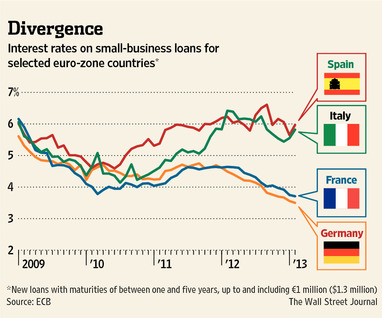
Credit Crunch Broadens European Business Rifts; large swaths of European small and midsize businesses—which employ three-quarters of the euro zone’s workers—have received precious little of this €1 trillion liquidity

Updated April 18, 2013, 9:16 a.m. ET

Credit Crunch Broadens European Business Rifts

By DEBORAH BALL And ILAN BRAT

Central banks around the world are flooding the market with liquidity in order to spark growth in the global economy. But that hasn’t helped Spaniard José Blasco. Banks have cut credit lines to Mr. Blasco’s sofa-bed maker Confortec SL to €100,000 ($131,000), compared with €500,000 several years ago. And while the Spanish state now borrows at around 5%, the 22-employee company would need to pay as much as 14% to get a bank loan—an option Mr. Blasco rejected. Over the past three years, the European Central Bank has pumped €1 trillion of cheap loans into the euro zone’s financial system, helping shore up banks and sending government borrowing rates spiraling downward. Yet large swaths of European small and midsize businesses—which employ three-quarters of the euro zone’s workers—have received precious little of this liquidity. And instead of reviving growth, the money has deepened the fault lines that separate Northern and Southern Europe, as well as big companies and small ones. “The financial system is not working, and financing is like any other raw material for industry,” Mr. Blasco says. “It’s not fair. Companies are paying for the mistakes of politicians and the financial system.”

MK-CC494_CRUNCH_NS_20130417201810 Read more of this post

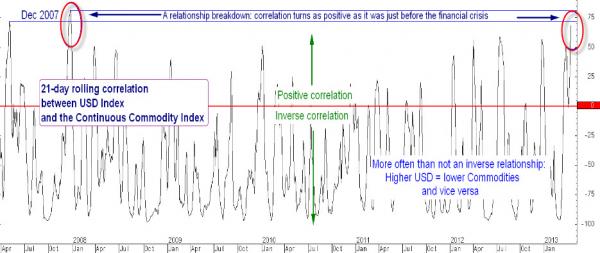
When Gold And Stocks De-Correlate: The last time the commodity/USD relationship broke down to such an extent was just ahead of the 2008 equity market decline

When Gold And StocksDe-Correlate

Tyler Durden on 04/18/2013 13:40 -0400

The structural collapse in paper gold prices has been met a seeming ‘money-on-the-sidelines’ flourish of investors looking to buy the physical asset. However, when asset relationships break-down so significantly, as gold and stocks have in the past 90 days, one has to take a step back and think “what changed?” As the chart below shows, the last time the correlation between stocks and gold was this negative, things did not end so well for the high-valuation equity momentum chasers… And just for fun, from Barclays’ Jordan Kotick, the last time the commodity/USD relationship broke down to such an extent was just ahead of the 2008 equity market decline.

20130418_Corr_020130418_Corr1_0


Li Ka-Shing’s Striking Port Workers Lose Jobs as Protest Widens

Li Ka-Shing’s Striking Port Workers Lose Jobs as Protest Widens

Some port workers at Li Ka-shing’s Hong Kong terminals were told they will lose their jobs, as a three-week strike over wage demands at the world’s third-biggest container port escalates.

Global Stevedoring Service Co., one of the contractors which employs the workers, said today it’s unable to meet the wage demands or continue operations because three quarters of its staff are on strike.

“This is one of the worst scenarios we had expected when the strike was started,” said Cheung Chi-ming, 52, a stevedore who works for another contractor. “I’ll have to continue fighting as we have no way out.”

Dozens of the workers have pitched tents surrounding Li’s 70-story Cheung Kong Center in the business district after a protest march yesterday as government mediators struggled to narrow the differences. The strike, which prompted shipping lines to divert vessels to Shenzhen, China, from the city’s harbor, is the biggest revolt against the 84-year-old Li, who is Asia’s richest man and is nicknamed “superman” by the local media for his investing prowess.

Contract workers of Li’s Hongkong International Terminals Ltd. were offered a 7 percent raise by their employers, the company said in an e-mail yesterday, compared with the demand for a 23 percent increase. Read more of this post

McDonald’s Japan to Boost Burger Price First Time Since 2008 by much as 25 percent next month

McDonald’s Japan to Boost Burger Price First Time Since 2008

McDonald’s Corp. (MCD)’s Japan business will raise some prices by much as 25 percent next month, the fast food chain’s first increase on burgers in the country since 2008.

Hamburger prices will go up to 120 yen from 100 yen and cheeseburgers will rise to to 150 yen from 120 yen in Japan in May, McDonald’s Holdings Co. Japan Ltd. said in a statement today. The hikes are part of the company’s plan to boost profitability, it said.

McDonald’s is raising the prices after the Japanese unit reported a 12 percent drop in operating profit last year. Fewer discounts drove March same-store sales 3.6 percent lower at the local business, the 12th consecutive monthly decline. Read more of this post