The interbank repo effect and gold; the gold sell-off could be related to a squeeze on collateral which forced firms to find funding substitutions at short notice including gold-based

The interbank repo effect and gold

Izabella Kaminska | Apr 18 15:05 | Comment | Share

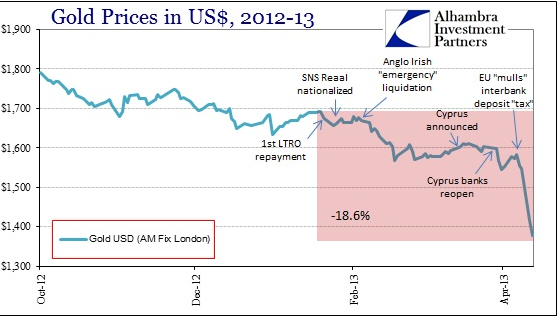
Here’s an interesting thought. Could the gold sell-off be related to a squeeze on collateral brought on by a series of very different bank crises in Europe, starting with the SNS Reaal nationalisation and Anglo Irish emergency assistance operation and culminating with the Cyprus crisis? It’s a theory being considered by Jeffrey Snider, chief investment strategist, at Alhambra Investment Partners. The basic point being, when you haven’t got anything to repo and funding becomes tight, gold is likely to sell-off in anticipation of further banking and asset problems. This time the effect may also have been magnified because of the changing nature of the bailout game.

Screen-Shot-2013-04-18-at-15.04.12 Read more of this post

BitCoin Exchange BitFloor Shuts Down

BitCoin Exchange BitFloor Shuts Down

Tyler Durden on 04/18/2013 08:55 -0400
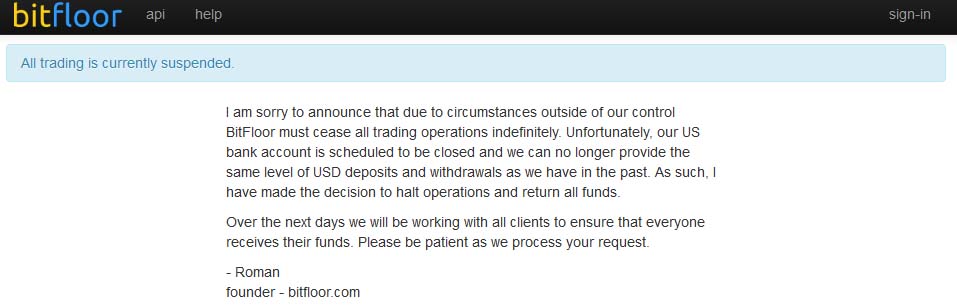
In an amusing development, one of the key alternative BitCoin exchanges, BitFloor, has just announced it is forced to shut down immediately. It is amusing, because one of the primary reasons attributed by the BTC pundits for the recent crash from $260 to $50 was errors and faults in the primary bitcoin exchange MtGox. Well, with alternative exchanges forced to shut down, this may mean the only “faulty” marketplace will sees it monopoly power increase further. It is also ironic because as BitFloor disclosed it “can no longer provide the same level of USD deposits and withdrawals as we have in the past.” Whatever happened to decentralized, and unencumbered by legacy fiat currencies?

bitfloor Read more of this post

The battle for the Swiss soul; “If you can’t trust a Swiss banker, what’s the world come to?” asked James Bond in the 1999 film “The World is Not Enough”.

Special Report: The battle for the Swiss soul

2:16am EDT By Emma Thomasson

ST. GALLEN, Switzerland (Reuters) – “If you can’t trust a Swiss banker, what’s the world come to?” asked James Bond in the 1999 film “The World is Not Enough”.

It has come to this: Swiss banks, under pressure from countries such as the United States, France and Germany, have been giving up their secrets, in some cases handing foreign tax authorities the names of their account holders. To avoid being blacklisted by the Organization for Economic Cooperation and Development, the Swiss government has agreed to share more information with foreign authorities hunting tax cheats.

The foreign assault has opened up a huge rift inside the fiercely independent Alpine nation.

Some bankers, as well as many academics and centrist and left-leaning politicians, think the country should bow to the inevitable and abandon strict secrecy. The pragmatists include big banks like UBS AG and Credit Suisse Group AG, which argue that to survive they have no choice but to surrender more information about their customers and close the accounts of those who won’t come clean. Read more of this post

Taxi Driver Tale of President Xi Jinping’s Incognito Ride Causes Stir; “If you take a cab, you’ll hear about lots of pressing problems.”

Taxi Driver Tale of Xi Jinping’s Incognito Ride Causes Stir

A taxi driver’s claim that he gave President Xi Jinping a ride last month was one of the most popular topics on China’s Internet today, with readers comparing it to the secret trips made by emperors centuries ago.

“Has anyone ever told you that you look like General Secretary Xi?” the driver, Guo Lixin, told his fare last month, according to a story today in Hong Kong’s Ta Kung Pao newspaper. “You are the first taxi driver to recognize me,” the passenger was quoted as replying.

The account in the pro-Beijing Ta Kung Pao was dubbed a tale of “weifu sifang,” or “traveling incognito,” a phrase used to describe emperors’ secret excursions in China’s dynastic period. In an indication that the story was sanctioned by China’s censorship apparatus, it was posted on the official website of the Beijing government and China.org.cn, published under the State Council Information Office.

“Every provincial and country leader should learn from Xi Jinping,” entrepreneur Xue Manzi wrote to his 11 million followers on Sina Corp.s’ (SINA) Weibo service today. “If you take a cab, you’ll hear about lots of pressing problems.” Read more of this post

Nestle reported its slowest first-quarter sales growth since 2009 on a deceleration in emerging markets; “It seems rather odd to us that Nestle claims to be holding or growing its market shares in the region.”

Nestle Has Slowest 1st-Quarter Sales Growth in Four Years

Nestle SA (NESN), the world’s biggest food maker, reported its slowest first-quarter sales growth since 2009 on a deceleration in emerging markets and amid lower prices in Europe.

Sales rose 4.3 percent excluding acquisitions, divestments and currency swings in the three months through March, the Vevey, Switzerland-based maker of DiGiorno pizzas said in a statement today. That fell short of the 4.7 percent average estimate of 21 analysts surveyed by Bloomberg. Volume increased 2.3 percent, the slowest growth since the third quarter of 2011.

Nestle said sales were hurt by “softening” in certain emerging markets, which it would not identify, compared to last year. Revenue grew 4.4 percent in the Asia, Oceania and Africa region, below analysts’ estimates and less than half of the 11 percent growth in the same quarter last year. The miss in Asia, Oceania and Africa was the “real stand out” in the results, according to Jeff Stent, an analyst at Exane BNP Paribas.

“This is not what people own Nestle for,” Stent wrote in a note to clients. “It seems rather odd to us that Nestle claims to be holding or growing its market shares in the region.” Read more of this post

Is Australia Next in Competitive Currency Debasement? Ross Garnaut, one of the authors of the float of the Australian dollar 30 years ago, warns RBA may have to cap dollar

Is Australia Next in Competitive Currency Debasement?

Posted: 17 Apr 2013 04:00 PM PDT

Japan, the US, the UK, Switzerland, China, and even the EU with the LTRO (and upcoming hinted at rate cuts) are all in on competitive currency debasement.
The question at hand is “who is next?” How about Australia?
The Sydney Morning Herald reports RBA May Have to Cap Australian Dollar Read more of this post

The Success Story of Shriram Transport Finance

The Success Story of Shriram Transport Finance

by Shishir Prasad | Apr 18, 2013

R Thyagarajan’s Shriram Transport Finance has kept investors and shareholders happy, several times over. He spells out the small secrets of his huge success

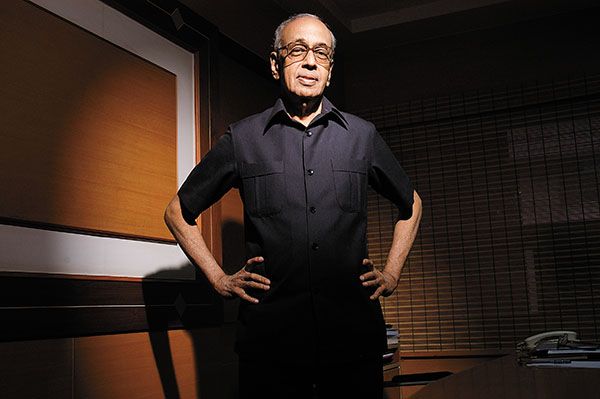
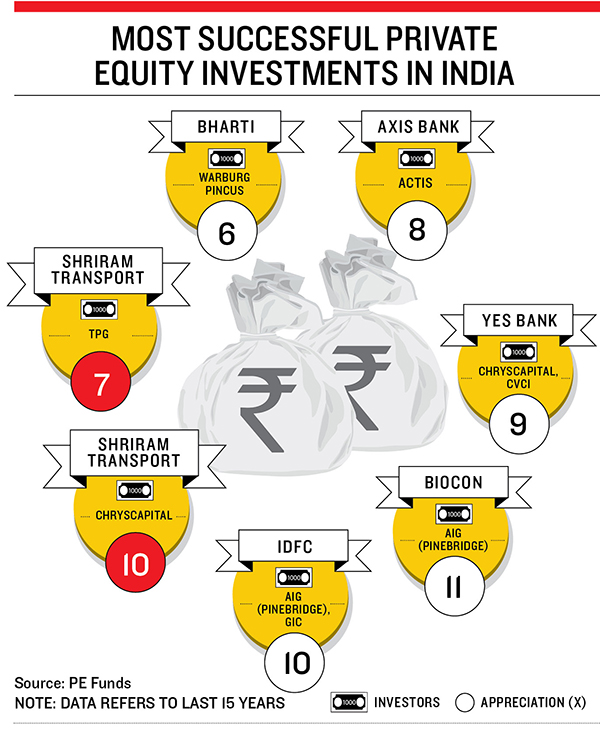
Entrepreneurs create wealth, for themselves and for those who invest money or sweat in their labours. The man who has been held up as icon for wealth creation in liberalised India is Sunil Mittal: Bharti became a world-class organisation in just about 15 years, and the firm that invested in it, Warburg Pincus, made close to six times the invested amount and a profit of almost $1 billion. Though no other company has delivered such a large amount of profits, there are at least five other companies that have delivered huge returns for investors (see graphic). However, there is one firm that is special even within this small club: Shriram Transport Finance has delivered large returns for not one but multiple investors; ChrysCapital made 10 times its investment a few years ago, and TPG made seven times its investment a few weeks ago when it sold its stake in the company. Consider this: Over the past decade, Shriram Transport’s share price has gone up a mind-boggling 70 times, while Bharti Airtel’s has gone up about 25 times. Sure, the two businesses are very different. But if Bharti’s is tricky with regulatory risks, Shriram’s—which started off with financing the small truck owner—is no less treacherous. Ashish Dhawan, earlier with ChrysCapital and now with Central Square Foundation, believes the secret behind Shriram’s success is the formidable R Thyagarajan. He built the company through internal accruals and debt over 20 years before accepting any private equity. By then, his processes were rock-solid. Dhawan points to two key things Thyagarajan did to make this risky business work: “Shriram’s field officers know their customers and their needs really well. Thyagarajan also put in a system where the person who acquired a customer was the one who also collected the money from him.” These are important things, but even more crucial is Thyagarajan’s approach to business itself, which is a mix of the earth and the pragmatic. This is what the 70-year-old had to say about his approach. Not having a cellphone is a beginning.

topimg_21585_r_thyagarajan_600x400img_69689_shriram_transport Read more of this post

Ramesh Tainwala plans to sell Samsonite suitcases to small towns. Along the way, he’s creating an entirely new business model, thanks to the global partner’s policy of local autonomy

Samsonite Goes Beyond Metros With Project Pappu

by Samar Srivastava | Apr 18, 2013

That’s the code name for RAMESH TAINWALA’S plan to sell Samsonite suitcases to small towns. Along the way, he’s creating an entirely new business model, thanks to the global partner’s policy of local autonomy

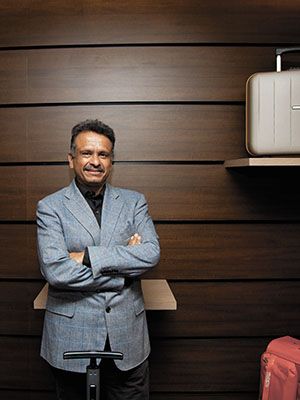
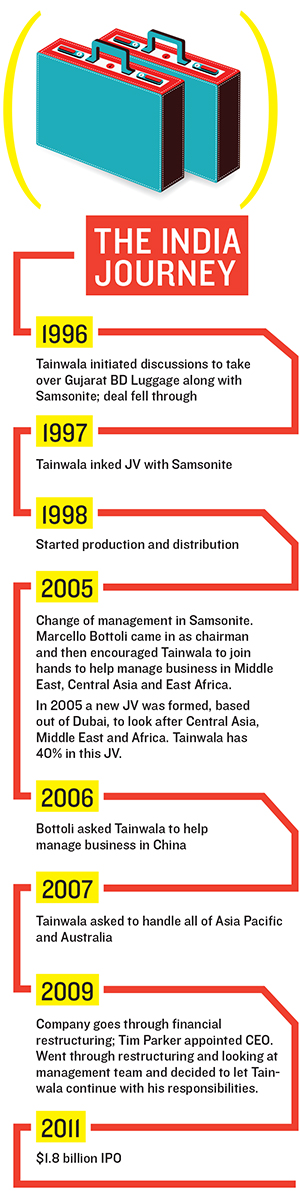
Deep in Samsonite’s product development centre in Nashik, Maharashtra, the outline of a vast new project is taking shape. It’s a project that has the potential to change the fortunes of the company. If successful, it would significantly accelerate growth in India and could be replicated in other developing markets. Here’s what Samsonite is up to: The company, which has so far aimed at attracting the urban affluent user, will now also open a second front. It plans to woo the rural and mass market consumer with the help of a cheaper product. Code named Project Pappu, it aims to create a set of luggage options that cost as low as $50 (Rs 2,750). These would sell in places like the neighbourhood furniture store and clothing stores—not the usual places where people buy luggage. Leading the charge is Ramesh Tainwala, who has a 40 percent stake in the company’s business in India, the Middle East and Africa. He’s also an executive director on the board.

Samsonite.inddtopimg_21547_ramesh_tainwala_300x400

Samsonite.indd Read more of this post

Keep calm and carry on in India’s slumping car market

Analysis: Keep calm and carry on in India’s slumping car market

Wed, Apr 17 2013

By Henry Foy and Aradhana Aravindan

MUMBAI (Reuters) – Don’t tell Hironori Kanayama that investing almost $500 million in a market enduring its worst slump for 12 years is a questionable business decision. Honda Motor Co’s (7267.T: Quote, Profile, Research, Stock Buzz) India head sees only one way forward: Keep calm and carry on.

Global carmakers such as General Motors Co (GM.N:Quote, Profile, Research, Stock Buzz) and Volkswagen AG (VOWG_p.DE: Quote, Profile, Research, Stock Buzz) that have between them poured billions of dollars into factories, product development and marketing in India’s once-booming car market are now struggling as slow economic growth, high interest rates and rising fuel prices keep their target customers from parting with their cash.

Still, automakers like Honda say they can only grit their teeth and continue to invest – or risk missing out on what experts expect to be the world’s third-biggest car market by 2020 and a foothold in an emerging global small-car export hub. Read more of this post

Brazil begins tightening cycle as it raised interest rates for the first time in nearly two years to combat fierce inflation

Brazil begins tightening cycle to combat fierce inflation

Wed, Apr 17 2013

By Alonso Soto

BRASILIA (Reuters) – Brazil raised interest rates for the first time in nearly two years on Wednesday, starting what is expected to be a modest tightening cycle to counter surging inflation that threatens to wreck a weak recovery in Latin America’s largest economy.

The central bank hiked its benchmark Selic rate to 7.50 percent from an all-time low of 7.25 percent. The move, expected by most economists, follows growing public uproar over rapid price increases and mounting political concerns as Brazil approaches a third year of lackluster growth in the runup to the 2014 presidential election.

The decision by the bank’s monetary policy committee, the first rate hike since July 2011, was not unanimous. Two of the bank’s 8-member board, known as the Copom, voted to hold the rate steady.

The central bank’s decision statement said that high inflation across a variety of goods and services made a monetary policy response necessary. Read more of this post

Malaysian Prime Minister Najib Warns Anwar Malaysia Election Win Spells Disaster

Najib Warns Anwar Malaysia Election Win Spells Disaster

Malaysian Prime Minister Najib Razak, whose coalition faces its biggest challenge in 55 years, said the election offers a choice between a reforming government that’s boosted growth and a fractious opposition that could bring “catastrophic ruin” for the country.

“Change, if not managed in a way, can lead to a disastrous outcome,” the 59-year-old leader said in an interview yesterday in Putrajaya, the country’s administrative center outside of Kuala Lumpur, ahead of May 5 polls. “Countries that have been going through Arab Spring, now many people are saying it’s Arab Winter, because the dividends for the change they expected have been very disappointing.”

The ruling Barisan Nasional coalition is battling a revitalized opposition led by former Finance Minister Anwar Ibrahim. Najib is under pressure to regain some of the ground lost in the last poll in 2008, when the coalition had its closest victory since independence from Britain in 1957. Both have pledged to tackle corruption, with Anwar demanding an end to cronyism and monopolies in what he called a peaceful “Malaysia Spring” in 2011.

Barisan Nasional, also known as the National Front, is fielding new candidates in one-third of parliamentary seats in a bid to woo voters who cite entrenched corruption and living costs among their most pressing concerns. Former Prime Minister Abdullah Ahmad Badawi and Economic Planning Unit chief Nor Mohamed Yakcop are among veteran politicians making way for fresh blood. Read more of this post

In the Mood for Some Perky Jerky? The World of Caffeinated Snacks; Food products packed with caffeine are growing quickly, with U.S. retail sales up 49% to $1.6 billion since 2008

April 17, 2013, 7:55 p.m. ET

In the Mood for Some Perky Jerky? The World of Caffeinated Snacks

By JULIE JARGON

PJ-BN791_CAFFEI_G_20130417175337

Loud Truck Energy Gummi Bears contain caffeine, B vitamins and other supplements.

The wait for the caffeinated marshmallow is over. In fact, with giant cups of coffee already a national obsession and energy drinks ascendant, companies are exploring whether there might be a viable caffeinated version of almost everything short of a roast suckling pig. This is a world where DoubleKick caffeinated hot sauce, Perky Jerky caffeinated beef or turkey jerky and Wired caffeinated waffles all exist. Large, well-known brands have joined small startups in trying to get a piece of the market for so-called energy products. Frito-Lay Inc., a subsidiary ofPepsiCo Inc., PEP -1.44% launched Cracker Jack’D Power Bites in Cocoa Java and Vanilla Mocha flavors late last year. The Jelly Belly Candy Co. was at the forefront of this trend when it developed caffeinated Extreme Sport Beans in 2007.

The success of caffeine-laced energy drinks like Monster and Amp has demonstrated the appetite for products that deliver a boost. Food products packed with caffeine, though still small compared with energy drinks, are growing quickly, with U.S. retail sales up 49% to $1.6 billion since 2008, according to Euromonitor International. Read more of this post

Miners Miss Out on the Golden Age

April 17, 2013, 1:58 p.m. ET

Miners Miss Out on the Golden Age

By LIAM DENNING

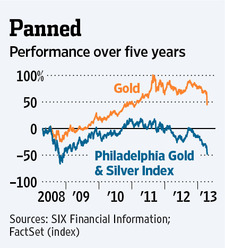
For gold miners, the past five years should have been similar to what tech companies experienced in the late 1990s. Back then, the Internet promised a brighter tomorrow; in recent years, it felt more like there might not be one at all. Such fear suits gold, and it is still up 45% over five years, despite the recent slide. Not so the gold miners, who supposedly offer leveraged exposure to price moves. The Philadelphia Gold & Silver index, down by almost half on a five-year view, is now back to where it was in December 2008. In other words, four years or so of subsequent gold fever may as well have not happened.

MI-BV406_GOLDHE_NS_20130417174504 Read more of this post

Founders Cash Out, but Do Workers Gain? As more entrepreneurs approach retirement, many are choosing to sell their companies to their employees, rather than outside buyers

April 17, 2013, 7:02 p.m. ET

Founders Cash Out, but Do Workers Gain?

U.S. Employee-Owned Firms Top 10,000, With More Expected as Owners Retire; Critics Point to Potential Drawbacks

By ANGUS LOTEN

Mandy Cabot wants to make sure the shoemaking business that she and her husband built over the past 20 years remains in good hands after they’re gone. The 58-year-old co-founder of Dansko, a West Grove, Pa., company with more than $150 million in annual sales, says she fears that selling to a competitor, or a private-equity firm, would result in layoffs or other cost-cutting measures. So last February, the couple transferred ownership of the business to its 180 employees. By “keeping it in the family” and giving workers a real stake in its future, Ms. Cabot says she hopes the company will keep going strong for years to come. “This is our baby, but at some point we have to cease being parents and become grandparents,” she adds. As more entrepreneurs, like Ms. Cabot, approach retirement—about 30% of the nation’s business owners are 55 or older, according to the U.S. Small Business Administration—many are choosing to sell their companies to their employees, rather than outside buyers.

Known as employee stock-ownership plans, or ESOPs, the move is being embraced by smaller firms, especially those struggling to find buyers during the weak economy. Under typical plans, an owner’s interest in a business is bought out, in part or in whole—often through a bank loan—with the stock being held in trust. Employees then cash in their shares as they retire. Read more of this post

P&G, Big Companies Pinch Suppliers on Payments

April 16, 2013, 10:55 p.m. ET

P&G, Big Companies Pinch Suppliers on Payments

By SERENA NG

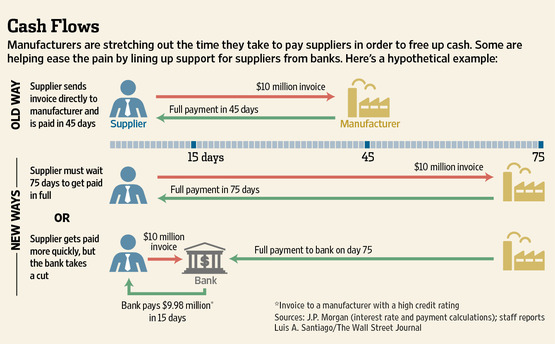
Procter & Gamble Co. PG -1.30% is planning to add weeks to the amount of time it takes to pay its suppliers, a shift that could free up as much as $2 billion in cash for the consumer products giant, people familiar with the matter said. P&G could use that cash to fund investments in new factories overseas or to help pay for stock buybacks. That added flexibility, however, will come at the expense of the companies that supply P&G with materials or services. The suppliers will have to tie up more of their own cash in receivables or eat the interest costs charged by banks to bridge the gap until P&G pays its bills.

P1-BL148_SQUEEZ_G_20130416191505

The move highlights how America’s biggest companies continue to build on the aggressive cash management practices they adopted in the wake of the credit crisis. What began as a way to preserve cash when markets dried up a few years ago has become a means of freeing up money to fund expansions, buy back stock and support dividend payouts at a time of lackluster sales growth and shrinking profit margins. Read more of this post

Heading off a China-style Subprime Mortgage Crisis; This debt is worrying not only because of its size. Worse, it is not transparent and we don’t know how it will be handled.

04.17.2013 18:27

Heading off a China-style Subprime Mortgage Crisis

The risk from ballooning local government debt is enormous, and to address this problem the government must learn to play its proper role

Warning of local governments’ high exposure to bad debts, the credit agency Fitch recently downgraded China’s long-term local-currency rating from AA– to A+. Officials should take note: the downgrade underlines how closely international markets are watching developments in the country.

Local government debt is nothing new, but the amount has been modest – until recently. The government’s pursuit in 2008 of a 4 trillion yuan stimulus package has pushed debt levels sky-high. The continuing growth of the shadow banking system is also a source of hidden risk.

Just how big is the debt? The National Audit Office says local governments had 10.7 trillion yuan of debt at the end of 2010. The National People’s Congress budget report, meanwhile, said principal repayment of local government bonds last year totaled 200 billion yuan. Some experts estimated a rise last year of 1 to 2 trillion yuan. Even based on conservative estimates, local government debt may now exceed 12 trillion yuan.

This debt is worrying not only because of its size. Worse, it is not transparent and we don’t know how it will be handled. Particularly of concern is the tendency of Chinese officials to let political expediency override economic sense. Read more of this post

China CITIC Bank Caught Up in Financial Fraud Case Over Wealth Management Product (WMP) Sold By Bank Employee

CITIC Caught Up in Financial Fraud Case – Economic Observer Online – In-depth and Independent

1366171113598

Photo: Protestors hold up a banner calling for the return of their money 
Source: China Internet Information Center
Apr 17, 2013
Translated by Liu Jingyue

Frustrated customers recently protested in front of a branch of China CITIC Bank in Zhengzhou. The protestors were calling for the return of a total of 40 million yuan that they had invested in a wealth management product (WMP) that they say was sold by an employee of the bank in 2011. Details of the case were reported by China Internet Information Center (中国网) yesterday. According to the report, employees at a branch of China CITIC Bank in Zhengzhou, the largest city in the central province of Henan, sold unauthorized financial products without the permission of the bank to 110 customers. Guo Wenya (郭文雅), the former vice director at the branch sold the WMP to several customers in 2011, promising returns that were 10 times what customers would earn if they parked their money in ordinary deposit accounts. Guo is reported to have used the money to make high-interest rate loans that were not paid back. Read more of this post

A Closer Look At Today’s German Stock Market Flash Crash; Egan-Jones Downgrades Germany From A+ To A, Outlook Negative

A Closer Look At Today’s German Stock Market Flash Crash

Tyler Durden on 04/17/2013 19:46 -0400

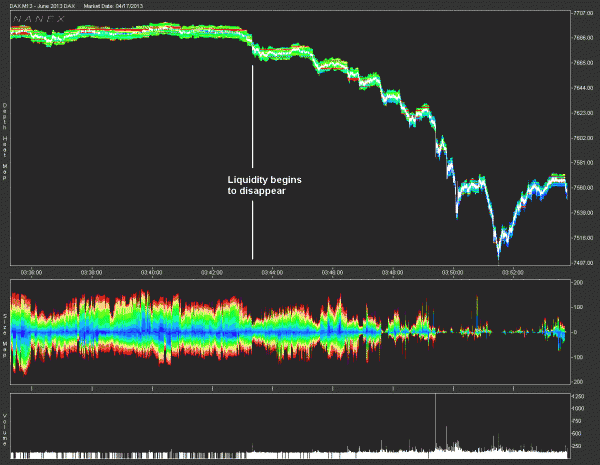
While most of the US was in deep REM sleep, the Germany stock index, the DAX, had a flashback to May 2010: starting at 3:44 am EDT, in the span of 6 minutes or much faster than the gradual drop that led to the US flash crash from three years ago, the DAX went from well and solidly-bid to having zero liquidity… and dumping nearly 200 points in the process. Whether it was rumors of a (subsequently validated) rating agency downgrade, or just an algo testing its quote stuffing ability, the moves showed vividly that when the current rosy paradigm shifts abruptly and violently, all those hoping to be the first out of the door and hit the sell button, simply won’t be able to do so. Because sadly there is no such thing as a free “4 year long zero volume levitation” – one must always pay the piper in the end.

Charts below from Nanex: June 2013 DAX Futures Depth of Book. Shouldn’t demand increase as prices drop? Only if it is demand for physical gold it seems.
20130417.fDAX_.M13_0

Egan-Jones Downgrades Germany From A+ To A, Outlook Negative

Tyler Durden on 04/17/2013 15:41 -0400

4/17/2013: Federal Republic Of Germany: EJR lowered A+ to A (Neg.) (S&P: AAA) (3413Z GR)

Although Germany’s credit metrics are respectable, the country has exposure to its banks and the weaker EU members. Deutche Bank has adjusted shareholders’ equity to asset near 2% and might need EUR 100B of support. Via the ECB’s Target 2, Germany is owed EUR700B of which perhaps 50% is collectible and then there is the banks’ southern EMU exposures. Germany’s debt to GDP was 80.6% as of 2011. However, increasing Germany’s debt by EUR500B raises the adjusted debt to GDP to 100%. The deficit to GDP of .8% is reasonably strong. Unemployment is 6.9% but will probably rise as global economies continue to show weakness. The positive (EUR16.8B) balance of trade (per GFSO) and the positive EUR5.59B current account (per the OECD) help. Inflation has been moderate at 1.4% (per GFSO). Chancellor Merkel continues to resist calls for EU bonds (shared liabs.) and money printing and is pushing for fiscal controls and the seniority of bailout funding. Germany is likely to be outvoted by other ECB members and therefore will have greater prospective exposure. Watch for the EFSF and the ESM morphing into banks (thereby depressing eventual recoveries) and a rise in the number of euros. Watch progress on the EU banking union. We used the IMF’s data for Germany’s debt which is greater than Eurostat’s data.Downgrading.
China’s Animal Apocalypse Spreads To Dogs

China’s Animal Apocalypse Spreads To Dogs

Tyler Durden on 04/17/2013 15:24 -0400

First it was floating dead pigs, then ducks, then black swans, then mass chicken exterminations, then fish, and now more pigs and also a brand new entrant to the Chinese animal apocalypse: dogs. AP reports that hundreds more pigs have been found dead in China – this time together with dozens of dogs. “A total of 410 pigs and 122 dogs were discovered in homes and at farms earlier this week in a village that comes under Yanshi city’s jurisdiction in central Henan province, authorities said Wednesday. The city’s propaganda office said that the deaths were being investigated but that they suspected they had to do with nearby chemical factories. The factories have been ordered to suspend production and help police with a criminal investigation into the incident, according to a report on a Henan provincial news website.” One would assume that something is responsible for these mass animal  deaths, and one of these years, not the propaganda office, but someone actually accountable (so not CNN) will report what it is. Although we are not holding our breath, which if one were to live in Beijing, would not be a bad idea.

No poisonous gases have been found in tests on the air around the village and its drinking water has met quality standards, said the report, which the propaganda office confirmed. Local authorities said the deaths have nothing to do with any epidemic or the H7N9 bird flu virus that has recently spread to humans. Last month, more than 16,000 dead pigs were found in rivers that supply water to Shanghai. The dumping has not been explained, though police had been cracking down on the illegal sale of pork products made from dead, diseased pigs.  Read more of this post

Buffett Mocking Gold Sidesteps Slump As He Bets on Stocks

Buffett Mocking Gold Sidesteps Slump As He Bets on Stocks

Investors including hedge-fund manager John Paulson faced losses this week as gold suffered its biggest rout in three decades. Warren Buffett told them there were better places to put their money.

The billionaire chairman of Berkshire Hathaway Inc. (BRK/A) cautioned against investing in the metal in February 2012, when an ounce sold for more than $1,700, because it’s not productive like a farm or company. Gold fell 14 percent to $1,348.21 in the two trading days through April 15, the biggest decline since 1983, and wiped out almost $1 billion in Paulson’s wealth. Prices rebounded to $1,384.71 at 10:51 a.m. in New York today.

“What motivates most gold purchasers is their belief that the ranks of the fearful will grow,” Buffett wrote last year in a letter to shareholders. “During the past decade that belief has proved correct. Beyond that, the rising price has on its own generated additional buying enthusiasm, attracting purchasers who see the rise as validating an investment thesis. As ‘bandwagon’ investors join any party, they create their own truth — for a while.”

Buffett, 82, has said his preference is to build Omaha, Nebraska-based Berkshire by investing in companies, such as chemical maker Lubrizol Corp., which he bought in 2011. Since his comments about gold, his firm has struck a deal with Jorge Paulo Lemann’s 3G Capital to take HJ Heinz Co. private, acquired more than two dozen daily newspapers, bought retailer Oriental Trading and added to its $87.7 billion stock portfolio. Read more of this post

IMF Sees Some Corporate Debt Unsustainable in Parts of EU

IMF Sees Some Corporate Debt Unsustainable in Parts of EU

As much as 20 percent of non-bank corporate debt in the weakest euro-area economies is unsustainable and may force companies to cut dividends and sell assets, dealing further blows to investor confidence, the International Monetary Fund said.

Businesses (SXXP) in Italy, Spain and Portugal have the largest “debt overhang,” according to the IMF’s Global Financial Stability Report released today, which analyzed 1,500 publicly traded non-financial European firms. Strains in the corporate sector may in turn hurt banks’ asset quality, the report showed.

“Firms in the euro-area periphery have built a sizable debt overhang during the credit boom, on the back of high profit expectations and easy credit conditions,” the IMF said. Now they “face the challenge of reducing the debt overhang in an environment of lower growth and higher interest rates, in part related to financial fragmentation in the euro area.”

European policy makers are struggling for ways to give companies in the so-called periphery access to affordable credit even after the European Central Bank’s plan to purchase bonds of debt-burdened countries. The IMF report defined the periphery as Cyprus, Greece, Ireland, Italy, Portugal and Spain. Read more of this post

Mongolia Says Rio Mine Audit Seeks Answers on $2 Billion Cost Overrun

Mongolia Says Rio Mine Audit Seeks Answers on $2 Billion Overrun

Mongolia said it’s undertaking an audit of Rio Tinto Group (RIO)’s Oyu Tolgoi operation as it seeks to understand the reasons for an alleged $2 billion cost overrun at the mine where output is due to start in June.

“We are checking procurement documents and expenditures,” Finance Minister Chultem Ulaan told reporters yesterday in the capital Ulaanbaatar. “No one understands why the project has gone $2 billion over budget, so we are checking this.”

The $6.6 billion Oyu Tolgoi mine will be the largest contributor to Mongolia’s economy and is estimated to account for one-third of the nation’s gross domestic product by 2020. The government’s audit team is studying what equipment was bought for the mine and its cost, said Ulaan. The operators of Oyu Tolgoi have brought in a foreign auditor, he said. Read more of this post

Goldman Traders Cede Tokyo Party Bar to Google-Apple Invasion

Goldman Traders Cede Tokyo Party Bar to Google-Apple Invasion

By Takahiko Hyuga and Terje Langeland – Apr 16, 2013

The champagne used to flow at Heartland, the bar in Tokyo’s Roppongi Hills complex that drew bankers from the Japan headquarters ofGoldman Sachs Group Inc. (GS) and Lehman Brothers Holdings Inc. upstairs.

“Every day, there was a party,” said Mai Shioya, the 39- year-old manager, who started in May 2008 before the global financial crisis that led to Lehman’s bankruptcy.

Bankers in well-cut suits would come in about 5 p.m., hand bartenders corporate credit cards and let their friends charge drinks to the tab until 2 a.m., said Michio Nakamura, 45, who’s been running events and entertainment at Heartland since its opening as part of the famed Roppongi Hills development in 2003. After the financial crisis, many disappeared, cutting revenue by 30 percent, Shioya said.

“Those customers and that age have gone,” she said.

The void is being filled by a new group of bar patrons: information-technology workers. While financial firms have cut staff in Japan, technology companies have boosted hiring, and as bankers vacated offices at Roppongi Hills, companies including Google Inc. (GOOG) andLenovo Group Ltd. (992) moved in. As early as this month, Apple Inc. (AAPL) will also make the complex its home in Japan, two people familiar with the plan said in January. Read more of this post

Tech-savvy Vietnam coffee farmers brew global takeover; Most Vietnamese coffee farmers can tell you the price of the beans, the second most traded commodity in the world after oil, in their sleep

Tech-savvy Vietnam coffee farmers brew global takeover

Most Vietnamese coffee farmers can tell you the price of the beans in their sleep. -AFP

Wed, Apr 17, 2013
AFP

Buon Ma Thuot, Vietnam – Most Vietnamese coffee farmers have never heard of a double tall skinny latte, but they could tell you the price of the beans that go into one in their sleep.

From high-tech Israeli irrigation systems to text message updates of global prices for the commodity, coffee farming in Vietnam’s Central Highlands has come a long way since the French first introduced the bean over a century ago.

“I used to carry my coffee to market by bicycle,” said 44-year-old farmer Ama Diem. “Now I check the bean price on my mobile phones” before making the trip.

By texting “CA” to the number 8288 from any Vietnamese mobile phone, farmers almost instantly receive a message with the London prices of Robusta coffee beans and the New York price of Arabica beans from a data supply firm. Read more of this post

The Cypriot government plans to sell part of its gold reserves within the next months, Finance Minister Haris Georgiades said

Cyprus Central Bank Must Approve Gold Sale, Finance Chief Says

The Cypriot government plans to sell part of its gold reserves within the next months, a decision that needs to be approved by the country’s central bank, Finance Minister Haris Georgiadessaid.

“The exact details of it will be formulated in due course primarily by the board of the central bank,” Georgiades, 41, told Bloomberg TV’s Ryan Chilcote in an interview in Nicosia. “Obviously it’s a big decision.”

Cypriot President Nicos Anastasiades is trying to unlock 10 billion euros ($13.2 billion) of loans from the euro area and the International Monetary Fund. To do so, he must come up with a further 11 billion euros through measures including a tax on bank deposits of more than 100,000 euros at the country’s two biggest banks and the sale of assets and gold.

An April 9 debt assessment by the European Commission said Cyprus had committed to selling about 400 million euros of “excess” gold reserves, prompting gold futures to fall the most in five months. In response to the disclosure, the Central Bank of Cyprus said it wasn’t considering a sale. Read more of this post

Minxin Pei: China’s Dream World; Political slogans, however high-sounding, become stale when their purveyors fail to make good on their promises

China’s Dream World

Minxin Pei is Professor of Government at Claremont McKenna College and a non-resident senior fellow at the German Marshall Fund of the United States.

16 April 2013

CLAREMONT, CALIFORNIA – Ruling elites almost everywhere – whether in democracies or in authoritarian regimes – believe that clever sloganeering can inspire their people and legitimize their power. There are, of course, crucial differences. In functioning democracies, government leaders can be held accountable for their promises: the press can scrutinize their policies, opposition parties are motivated to show that the party in power lies and cheats. As a result, incumbents are frequently forced to carry out at least some of their promises.

Autocratic rulers, by contrast, face no such pressures. Press censorship, repression of dissent, and the absence of organized opposition allow rulers the luxury of promising whatever they want, with no political consequences for failing to deliver. The result is government of the sloganeers, by the sloganeers, and for the sloganeers. Read more of this post

China has over-invested in itself: IMF official; The government has extracted money from the population to help pay the huge cost of maintaining its rapid growth

China has over-invested in itself: IMF official

Staff Reporter, 2013-04-17

China has over-invested its resources domestically, according to a report by Li Yiheng, chief representative of the International Monetary Fund in the country.

Domestic investment has accounted for about 50% of China’s GDP, which is far higher than the 12%-20% average found around the globe, said the report. The situation is primarily due to large investments by the government to try to overcome the negative effect of the global financial crisis during the period 2007-2011.

Though the over-investment will not immediately cause a crisis, the government should keep an eye on the possible negative effects, said Li, adding that loans made for the purpose of investment projects will become a burden on the nation’s population.

The country’s outstanding economic growth was the result of long-term large-scale investment over the past 20 years, said Li. The government has extracted money from the population to help pay the huge cost of maintaining its rapid growth and has only recently tried to slow down investments and promote local consumption, said Li. Read more of this post

Asia slowly losing its luster – Nomura

Asia slowly losing its luster – Nomura

By Prinz P. Magtulis (The Philippine Star) | Updated April 15, 2013 – 12:00am

MANILA, Philippines – Strong economies in the Asian region are slowly losing their luster as the low interest environment here and abroad is beginning to cause some problems, an investment bank said.

“We are becoming more concerned that Asia’s once solid economic fundamentals are deteriorating,” Nomura economist Rob Subbaraman said in the bank’s Asia Economic Monthly report. Read more of this post

Europe Car Sales Plunge 10% as Germany’s Decline Hurts VW

Europe Car Sales Plunge 10% as Germany’s Decline Hurts VW

European car sales dropped 10 percent in March as declines at PSA Peugeot Citroen (UG), Ford Motor Co. (F) and Volkswagen AG (VOW3) and a plunge in Germany put the industry on pace for the fewest annual deliveries in 20 years.

Registrations fell to 1.35 million vehicles last month from 1.5 million a year earlier, the Brussels-based European Automobile Manufacturers’ Association, or ACEA, said today in a statement. First-quarter sales dropped 9.7 percent to 3.1 million cars.

A recession stemming from the European sovereign-debt crisis has led to 12 percent unemployment in the 17 countries sharing the euro, the highest rate since records began in 1995. Four of Europe’s five biggest car markets shrank last month, with the steepest drop at 17 percent in Germany, the region’s largest economy and home to producers such as VW and Bayerische Motoren Werke AG (BMW). The region’s sales declined for an 18th consecutive month, the ACEA said. Read more of this post

New Publisher Authors Trust: Themselves; Self-publishing is expanding beyond first-time writers who can’t get deals, as big names like David Mamet are choosing this route

April 16, 2013

New Publisher Authors Trust: Themselves

By LESLIE KAUFMAN

When the Pulitzer Prize-winning playwright and author David Mamet released his last book, “The Secret Knowledge: On the Dismantling of American Culture,” with the Sentinel publishing house in 2011, it sold well enough to make the New York Times best-seller list.

This year, when Mr. Mamet set out to publish his next one, a novella and two short stories about war, he decided to take a very different path: he will self-publish.

Mr. Mamet is taking advantage of a new service being offered by his literary agency, ICM Partners, as a way to assume more control over the way his book is promoted.

“Basically I am doing this because I am a curmudgeon,” Mr. Mamet said in a telephone interview, “and because publishing is like Hollywood — nobody ever does the marketing they promise.”

As digital disruption continues to reshape the publishing market, self-publishing — including distribution digitally or as print on demand — has become more and more popular, and more feasible, with an increasing array of options for anyone with an idea and a keyboard. Most of the attention so far has focused on unknown and unsigned authors who storm onto the best-seller lists through their own ingenuity. Read more of this post