China’s Cities Drag Feet on Home-Price Curbs: Mortgages

China’s Cities Drag Feet on Home-Price Curbs: Mortgages

All real estate markets are local, says the industry axiom, one that China’s central government is painfully aware of as its efforts to rein in home prices are undermined by uncooperative municipal authorities.

Former Premier Wen Jiabao, in his final endeavor to make housing affordable, set an April 1 deadline for higher down payments and interest rates for second-home loans in cities with “excessively fast” price gains and ordered stricter enforcement of taxes on sales. Thirty-five provincial-level cities responded with measures insufficient to curb prices that climbed 150 percent from 2003 to 2012.

“The local governments are just making a gesture to show they are following the orders,” said Ding Shuang, a senior China economist with Citigroup Inc. in Hong Kong. “Some of the targets are almost like jokes. The government’s enforcement of policies will be compromised.” Read more of this post

Warehouses Win Investors as Unsung Internet Heroes

Warehouses Win Investors as Unsung Internet Heroes

The growth of Internet shopping in Europe is luring investors such as Axa Real Estate and Blackstone Group LP (BX) to the cinder-block world of warehouses, where yields are beating showy storefronts and sleek offices amid a space shortage.

“Net effective rents could grow by as much as 20 percent over the next four years,” Philip Dunne, president for Europe at San Francisco-based Prologis Inc. (PLD), the world’s largest warehouse owner, said of the company’s portfolio in the region. “In wider Europe, with a population bigger than the U.S., we have four-and-a-half times less modern product. That gives you some sense of the scale and opportunity for growth.”

Europe needs 25 million square meters (296 million square feet) of new distribution and storage warehouses in the next five years, about 11 percent of existing modern space, to keep up with Internet sales growth, Jones Lang LaSalle Inc. said last month. The assets generate annual income that’s 2 percentage points higher than offices and shops in Europe relative to their value and a lack of space will lift prices, said Remy Vertupier, manager of the Logistis fund run by AEW Europe, a unit of Paris- based Natixis (KN) Global Asset Management SA. Read more of this post

Paulson Gold Bet Loses Almost $1 Billion; Paulson started the year with about $9.5 billion invested across his hedge funds, of which 85 percent was in gold share classes.

Paulson Gold Bet Loses Almost $1 Billion: Chart of Day

iOnFR8etscao

Hedge-fund manager John Paulson’s wager on gold wiped out almost $1 billion of his personal wealth in the last two trading days as the precious metal plummeted 13 percent.

The CHART OF THE DAY shows gold’s tumble since the start of the year has cut his riches by $1.52 billion on paper, including about $973 million in the rout that began on April 12 and continued with today’s 9.3 percent drop. Paulson started the year with about $9.5 billion invested across his hedge funds, of which 85 percent was in gold share classes. Read more of this post

Does China Really Want a Nuclear Japan and South Korea? The potential for an atomic arms race in East Asia is real. Beijing must realize this

April 15, 2013, 7:28 p.m. ET

Does China Really Want a Nuclear Japan and South Korea?

The potential for an atomic arms race in East Asia is real. Beijing must realize this.

By BOB CORKER

North Korea’s increased belligerence has alarmed the U.S. and its allies and heightened tensions in the Asian-Pacific region. As usual, though, the hand-wringing in Washington, Tokyo, Beijing and Seoul isn’t accompanied by any new ideas on what to do to solve the perennial problem of Pyongyang and its illicit nuclear weapons program.

Most problematic, perhaps, is that nothing has altered the strategic calculus of China—the most influential player with respect to North Korea, and the one without which it is hard to see a resolution. Read more of this post

Australia Must Wean Itself From China; “I’m fed up with this government telling me, over and over, how lucky we are, how everyone is jealous of Australia. We need less talk and more help dealing with rising prices, and more progress creating new and better paying jobs.”

Australia Must Wean Itself From China

Viewed from afar, even the bad news in Australia looks pretty good. Unemployment reached a three- year high last month and is now all of 5.6 percent. Leaders such as U.S. President Barack Obama and French President Francois Hollande would kill for such a number. Australia has avoided a recession for 21 years, boasts a budget remarkably close to surplus and continues to enjoy low inflation. On any economic report card, the country deserves a string of A’s.

That stellar performance should make Prime Minister Julia Gillard a shoo-in for another term, right? Oddly, the prospects for Gillard’s Labor Party in September elections appear to dim with each new batch of economic data. Less than 30 percent of Australian voters are satisfied with the prime minister — her weakest numbers since September 2011. (Only 35 percent are satisfied with opposition leader Tony Abbott, according to a Newspoll survey published in the Australian newspaper on April 9.) Economic insecurity ranks as the main concern among voters. A reminder was delivered yesterday, when China reported slowing growth, sending Australia’s main stock index down the most in a month.

“I’m fed up with this government telling me, over and over, how lucky we are, how everyone is jealous of Australia,” Laurie Bracker, a 34-year-old insurance agent, said in Sydney last week. “We need less talk and more help dealing with rising prices, and more progress creating new and better paying jobs.” Read more of this post

Jakartans struggle to cope with city’s air pollution

Jakartans struggle to cope with city’s air pollution

20130416.103215_filephoto_afp_airpollution

Despite its poor air quality, many people living in Jakarta choose – or perhaps have no choice – to stay in the capital. -Jakarta Post/ANN
Tue, Apr 16, 2013
The Jakarta Post/Asia News Network

INDONESIA – Despite its poor air quality, many people living in Jakarta choose – or perhaps have no choice – to stay in the capital.

After leaving Jakarta for Bali for about a year for work, Devi Agustina, who moved back to the capital earlier this year, could not ignore the deteriorating quality of the air in Jakarta. “After living in a place like Bali, you realise how much you lose while living in Jakarta,” she told The Jakarta Post recently. “I miss Bali’s blue skies every time I see Jakarta’s polluted air.” Read more of this post

Demographic sands shift under Malaysian elite; Recalcitrance seems to have been woven into Malaysia’s success story as a nation

Demographic sands shift under Malaysian elite

BY:ROWAN CALLICK, ASIA-PACIFIC EDITOR 

From:The Australian

April 16, 2013 12:00AM

RECALCITRANCE seems to have been woven into Malaysia’s success story as a nation.

Mahathir Mohamad’s extraordinary spell as prime minister from 1981 to 2003 is just a part of it.

From Australia’s perspective, Malaysia has been a leading example of Asia’s inexorable progress towards a form of middle-class prosperity – while its leadership style has been from time to time decidedly edgy, especially when the ruling class has appeared to be on the ropes.

The country has been led in the 56 years through independence from Britain by Barisan Nasional – a coalition of 13 parties dominated by the United Malays National Organisation – and its predecessor coalition.

Malaysia’s next election, on May 5, is heading towards a tighter finish than the country has seen in decades. There is even a prospect – still somewhat remote – that Prime Minister Najib Razak’s BN might be defeated by the People’s Alliance Coalition (Pakatan Rakyat) led by charismatic former deputy prime minister Anwar Ibrahim, which combines his own People’s Justice Party, the Pan-Malaysian Islamic Party (PAS) and the Democratic Action Party that has recently attracted the lion’s share of ethnic Chinese voters. Read more of this post

The Psychology of Small Packages; More Foods Try Smaller Wrapping; Deciphering the Cues That Make You Eat More or Less

Updated April 15, 2013, 8:04 p.m. ET

The Psychology of Small Packages

More Foods Try Smaller Wrapping; Deciphering the Cues That Make You Eat More or Less

By SARAH NASSAUER

Did you really eat that many cookies?

Packaged-food makers might know the answer, even if you don’t. Aware that people snack a lot throughout the day, they continue to introduce new packaging that encourages consumers to eat their food anytime they have an urge to nibble, what some executives have dubbed “hand-to-mouth” eating. The psychology behind how this affects eating behavior is complicated. Sometimes small amounts of food could drive you to eat more. There are cues savvy snackers can detect.

Hershey Co. HSY -0.13% learned that individual wrappers on bite-size candy were getting in the way of people eating candy in certain settings, like in the car. The company responded with Reese’s Minis, a small, unwrapped version of its classic Reese’s Peanut Butter Cup, in a resealable bag. It facilitates “I-can-pop-one-in-my-mouth, on-the-go type of behavior,” says Michele Buck, senior vice president and chief growth officer for Hershey.

PsychologySmallPackages041513 Read more of this post

Blank cheque IPOs sprouting in Malaysia; Firms with no profit, revenue or assets entice with plans to buy corporations

Blank check IPOs bring hope and caution to Malaysia

Sun, Apr 14 16:59 PM EDT

By Yantoultra Ngui and Elzio Barreto

KUALA LUMPUR/HONG KONG, April 15 (Reuters) – Malaysia’s bull market is seeing a type of initial public offering, still fairly new to Asia, that takes a special kind of company public: one with no profits, revenues or assets.

Cliq Energy Bhd last week became the second such firm – known as a special purpose acquisition company (SPAC) – to list in Kuala Lumpur and three more are preparing IPOs. The spurt comes after Malaysian equities rose for four straight years, including a banner year for IPOs in 2012, and as investors anticipate a jump in mergers and acquisitions in Southeast Asia.

But SPACs have historically been high-risk, high-reward investments. Some U.S.-listed SPACs have performed well and built market value, while others have failed to make any acquisition and were forced to delist.

“If the historical experience in the U.S. is any indication, it should provide a warning sign that these investments may not turn out to be particularly good ones,” said Stefan Lewellen, a SPAC expert who authored a study on U.S. SPACs at Yale University. Read more of this post

Gold’s Plunge Turns New York’s Diamond District Upside Down; “We currently have a line selling precious metals. I think it is type of paranoia. They are expecting gold to hit even lower than it is, and everyone is trying to get it in as fast as they can.”

Apr 15, 2013

Gold’s Plunge Turns New York’s Diamond District Upside Down

By Michael Casey

Few businesses have been impacted more by gold’s rollercoaster price ride in recent years than the 2,600 independent firms jammed into New York’s bustling Diamond District.

And since Friday, with the international price of gold falling more in dollar terms than in any previous two-day period since at least 1974, the activity on this crowded strip on 47th Street between 5th and 6th Avenues has gotten a little crazier. Gold dealers and their customers, accustomed to buying and selling according to the so-called “London PM fix” — the second of two daily benchmark prices set by a group of London bankers — had to adjust their reference prices by the minute as a plunging real-time market left them exposed to losses.

Roni Rubinov, proprietor of New York Gold and Silver Refiners, was forced to turn away one regular customer who’d come in toting a plastic bag of gold rings, necklaces and watches. The trading price was then at $1,370 per ounce, $25 less than the London fix, on which he had based his own delivery commitments for the day to larger wholesale refiners. By the end of trading Monday, the front-month April contract had settled on the Comex division of the New York Mercantile Exchange at $1,360.60 an ounce, down 9.4% on the day to mark a 13% decline in two days. “But I have a lot,” the man said. “Can you at least do half?” Since he was a regular customer, Rubinov, who owns both a gold dealing business and a pawnbroker, said he could have bought at a $5-per-ounce loss, but not at $25 down. He advised his customer to sit on his merchandise and wait for the price to come back at a later date. The man left, a despondent look on his face. Read more of this post

Gold’s Decline Rattles Some Small Investors’ Faith

April 15, 2013, 4:56 p.m. ET

Gold’s Decline Rattles Some Small Investors’ Faith

By MATT DAY

Gold’s two-day swoon has shaken even some of the metal’s most diehard fans.

Throughout gold’s 19-month rough patch, small investors – those who buy gold coins, or own shares in exchange-traded funds that buy the metal – were one group that never lost faith.

Gold coin sellers clogged the airwaves with advertisements making the case that there has never been a better time to buy. Newsletters from self-proclaimed gold-market experts proliferated, as did financial products designed to capitalize on interest in the metal. U.S. Mint gold coin sales hit a record high in January, even though gold prices were down 11% from record highs hit in August 2011.

Some of those buyers say they’re having second thoughts this week. A wave of selling that hit the market Friday morning accelerated when the market reopened Monday. During the two days, gold futures lost 13% of their value, falling $203 to $1,361.10 a troy ounce on the Comex division of the New York Mercantile Exchange. Monday’s $140 drop was the largest in 30 years. Read more of this post

Investor Jim Rogers Says Gold Needs Correction, Isn’t Buying Yet as it hasn’t dropped enough; Indians Defer Gold Purchases, Betting Bear Market Set to Deepen

Investor Jim Rogers Says Gold Needs Correction, Isn’t Buying Yet

Gold, which tumbled into a bear market last week, is in need of a correction, according to investor Jim Rogers, who said that he’s not buying the commodity yet as it hasn’t dropped enough. “This may be the correction that gold needs,” said Rogers, chairman of Rogers Holdings. “If it goes down enough, I will start buying it,” Rogers told reporters in Singapore today, without identifying a level. Gold extended losses to the lowest level in two years today after investors cut holdings in exchange-traded products as the U.S. recovers. Rogers, who foresaw the start of a commodity rally in 1999, has previously backed bullion to rally as central banks boosted their balance sheets to stimulate growth. Bullion for immediate delivery fell as much as 3.9 percent to $1,425.75 an ounce and was at $1,436.10 at 3:55 p.m. in Singapore. Prices tumbled 5 percent on April 12, taking losses to more than 20 percent since the record close in September 2011 and meeting the common definition of a bear market. Rogers said in April 2006 that a boom in energy and raw- material prices would help drive gold to a then-record $1,000, without giving a timeframe for that forecast. In July 2007, Rogers said that he wasn’t selling his gold position even though there were too many speculators backing further gains. In October 2009, Rogers said that gold may top $2,000 in the next decade, citing the printing of money. In August 2011, Rogers said while he wouldn’t buy more gold “right now,” the metal was still poised to rally to $2,000 “over the years.”

To contact the reporters on this story: Chou Hui Hong in Singapore at chong43@bloomberg.net; Glenys Sim in Singapore at gsim4@bloomberg.net

Indians Defer Gold Purchases, Betting Bear Market Set to Deepen

Gold buyers in India, the world’s biggest consumer, are delaying purchases in a bet that the bear market in bullion will deepen, according to the All India Gems & Jewellery Trade Federation.

“People are expecting prices to drop more as the sentiment in the market is weak and selling pressure remains,” Chairman Haresh Soni said in a phone interview from New Delhi. The price volatility is discouraging buyers, he said. The federation represents about 300,000 jewelers nationwide. Read more of this post

Slovenia’s plan to sell shares in state-owned companies failed to ease investor concern that the country will become the next euro-area nation to need a bailout

Slovenia Asset-Sale Plan Fails to Ease Debt Squeeze Concern

Slovenia’s plan to sell shares in state-owned companies failed to ease investor concern that the country will become the next euro-area nation to need a bailout. Slovenia’s default risk rose to a six-month high and bond yields hovered near records as the country prepares to tap markets this week. Prime Minister Alenka Bratusek’s April 12 announcement of plans to sell stakes in companies, including a bank, looks like an effort to stall rather than to obtain financing, according to Milan Smiljanic, head of trading at Perspektiva d.d.

“There is skepticism that they are only buying time and will try to fix debt problems, avoiding privatization,” Smiljanic said by e-mail from Ljubljana. “There are no bank bidders at the moment.” Slovenia, the European Union’s fourth-smallest economy, is trying to avoid becoming the sixth euro-area state to seek a bailout after international lenders agreed to help Cyprus. The government will sell 500 million euros ($654 million) in 18- month Treasury bills at an auction in two days as it tries to shore up confidence that it can recapitalize its ailing banks without seeking outside assistance. The cost of protecting Slovenian debt against non-payment using credit-default swaps rose to a six-month high today, advancing six basis points to 375, according to data compiled by Bloomberg. A basis point is 0.01 percentage point. Read more of this post

From Bad To Worse – European Non-Performing Loans In Context

From Bad To Worse – European Non-Performing Loans In Context

Tyler Durden on 04/15/2013 10:41 -0400

Europe remains in a critical state – despite the protestations of its leadership and the indications of its nepotistic bond markets.Unconventional monetary operations have enhanced liquidity, but have done little-to-nothing to solve the real issue – insolvency. As Jassaud and Hesse note, vulnerabilities remain; as reliance on central-bank liquidity is still high especially for banks in peripheral countries. Assets continue deteriorating and remain on banks’ balance sheets, weighing on profitability. Non-performing loans (NPLs) in EU banks continue to soar, drastically outpacing loan growth. Since 2007, loans to the ‘real’ economy have decreased by 3% while NPLs increased by almost 150%, i.e., €308 billion in absolute terms. This trend shows no sign of reversal, reflecting the continued macro deterioration in parts of the EU and the absence of restructuring (until the new ‘template’). During the last European Banking Authority recapitalisation exercise, 30% of the increase in capital ratio was reached by reducing risk-weighted assets, of which one third came from risk-weighted asset ‘recalibrations’ – i.e. from rotations among the peripheral bonds that (while ultimately risky) are deemed risk-free by the ECB. For a sense of just how absolutely dire the situation is (and entirely unsustainable) across the entire Eurozone, the following chart shows thecurrent ratio of NPL-to-Total-Loans relative to Dec-2007… As ever, credit creation inflated asset prices and provided the cushion for an increase in liabilities (and never a bubble is seen) but once the bubble in asset prices begins to deflate, reality sinks in and the liabilities remain (large as ever). Thus the central bank inspired cycle of credit boom and bust continues – until, of course, there is no capacity left (and no gold to transfer).

20130414_NPL

BOJ Finds Inspiration in a 1930s Iconoclast Korekiyo Takahashi

BOJ Finds Inspiration in a 1930s Iconoclast

By Michael Schiltz – Apr 11, 2013

iqRywO9t3qDw

Korekiyo Takahashi, left, in an undated photo, had a long career in public office, including stints as Japan’s finance minister in the 1930s. Source: Library of Congress, Prints and Photographs Division

The Bank of Japan has decided to take bold action to reverse the nation’s economic decline.

The bank’s governor, Haruhiko Kuroda, announced a “new dimension in monetary easing,” vowing to double the purchases of government bonds and expand the monetary base. The BOJ also formally adopted a previously announced two-year target of 2 percent inflation. Quantitative easing will be the bank’s core business for the near future, a strategy that resembles the Federal Reserve’s response to the collapse of Lehman Brothers Holdings Inc.

The BOJ’s actions also mark a return, at least partly, to the unorthodox efforts of Japan’s finance minister in the early 1930s, Korekiyo Takahashi, who was praised by Fed Chairman Ben Bernanke for “brilliantly rescuing Japan from the Great Depression through reflationary policies.” Read more of this post

Chinese industry caught in vicious circle of over-production

Chinese industry caught in vicious circle of over-production

Staff Reporter, 2013-04-15

Chinese industries are caught in a vicious circle of over-production and loss, owing to conflicting government policies and expectations, according to the Guangzhou-based 21st Century Business Herald. The country’s producer price index dropped by a total of 1.9% this year due to overproduction, which includes a 5.6% slump in ferrous metals and a 2.6% fall in non-ferrous metals sectors. The country’s steel industry produced 2.2 million tonnes of steel per day in February, which was a historic high and will ultimately drive up annual production to 800 million tonnes. The record production came despite most producers operating at a loss. Aluminum production increased from 24 million tonnes in 2011 to 26 million tonnes in 2012, yet only 20 million tonnes were sold in 2012. The slump in prices caused by overproduction has prompted the government to close outdated and inefficient plants, especially those which were producing iron, steel, electrolytic aluminum and coke. Despite closing plants a different government agency has contrarily offered to subsidize electricity for the non-ferrous metal industry, especially in aluminum factories which use electricity in production. Read more of this post

Which Country’s Gold Will Be Sold Next?

Which Country’s Gold Will Be Sold Next?

Tyler Durden on 04/15/2013 08:05 -0400

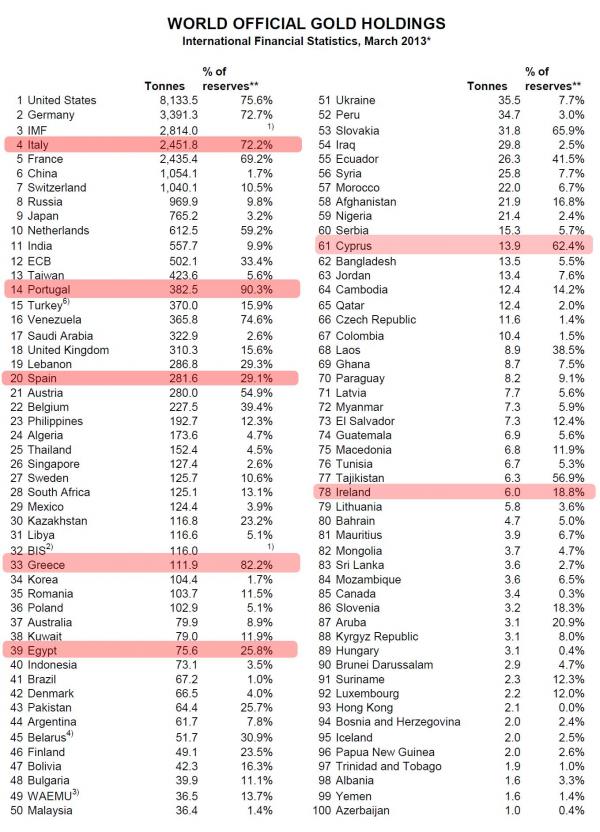
The first time the Status Quo/Troika tried to force a (not so) stealthy gold confiscation on an insolvent European country was back in early 2012, when as part of the most recent Greek bailout MOU, it was disclosed that “Greece’s lenders will have the right to seize the gold reserves in the Bank of Greece under the terms of the new deal.” However, the public outcry was so loud that the Troika had no choice but to shelve its plans and proceed with a full scale bondholder restructuring instead. Fast forward to last week, when Europe’s appetite for physical gold came back with a bang, this time as part of the Cyprus “Debt Sustainability Analysis“, and subsequent comments from Mario Draghi, demanding that tiny Cyprus, whose opposition, already weakened by the confiscation of uninsured deposits would be far less vocal than Greece’s, sell off €400MM, or virtually all of its sovereign gold, over 10 of its 13.9 total tons, to cover the excess costs of its ever ballooning sovereign bailout. So who’s next? It remains to be seen, although we are certain there will be a very clear correlation between the next country to see its gold “purchased” by the status quo, likely some time in the next 1-3 months, and the amount of total non-performing loans on said country’s bank balance sheets. The usual suspects are presented below. And, in the parlance of Goldman Sachs, these countries better scramble to sell, sell, sell now before gold hits 0, or maybe even goes negative.

sovereign gold_0

Canadians losing faith in economic “miracle”

Analysis: Canadians losing faith in economic “miracle”

1:16am EDT

By Louise Egan and Andrea Hopkins

OTTAWA/TORONTO (Reuters) – Factory worker Nelson Claros has little time for talk of the Canadian economic miracle.

The 50-year-old was laid off last year from his job of 22 years at a bus-assembly plant northwest of Toronto, and has since applied for 130 jobs. His best offer: A job at $12 an hour, half his previous wage and not enough to pay his bills.

“Really there is a recession right now. They don’t call it a recession, but the companies are closing, there are a lot of layoffs. How can this be a miracle economy?” he asked.

It wasn’t supposed to be like this. Canada’s recovery from a mild 2008-09 recession was quick and job-filled, and the country added nearly 900,000 jobs to take the jobless rate to 7.2 percent from 8.7 percent at the depths of the downturn. Read more of this post

Wells Fargo is slashing an approved list of money managers and investment vehicles that its stockbrokers market to the firm’s wealthy clients, a change of direction that has rattled the third-largest U.S. brokerage network

Exclusive: Wells Fargo cuts approved list of money managers

1:46am EDT

By Jed Horowitz

NEW YORK (Reuters) – Wells Fargo & Co is slashing an approved list of money managers and investment vehicles that its stockbrokers market to the firm’s wealthy clients, a change of direction that has rattled the third-largest U.S. brokerage network.

Executives said the clampdown protects clients from exposure to a plethora of investment models that have received little oversight. It will also reduce the firm’s risk at a time when litigation and compliance costs are rising industry wide. Read more of this post

World Bank Says East Asia Should Consider Stimulus Withdrawal to curb the risks of asset bubbles and inflation

World Bank Says East Asia Should Consider Stimulus Withdrawal

Asia’s emerging economies should consider reining in monetary stimulus to curb the risks of asset bubbles and inflation as policy easing in developed nations spur capital inflows, the World Bank said.

Demand-boosting measures that helped sustain growth “may now be counterproductive,” the Washington-based lender said in its East Asia and Pacific Economic Update released today. “As the global economy recovers, an emerging issue is the risk of overheating in some of the larger economies,” it said in a release accompanying the report.

The International Monetary Fund warned last week that risks from the easing policies of central banks around the world are increasing as the Bank of Japan (8301) joined its counterparts in the U.S. and Europe in unleashing monetary stimulus to end 15 years of deflation. Gross capital inflows into the East Asia and Pacific region surged 86 percent in the first quarter from a year earlier, the World Bank said in its report, adding to pressure on inflation and asset prices.

“Near-zero interest rates and new and protracted rounds of quantitative easing in the United States, European Union, and Japan are inducing large capital inflows into emerging markets including in East Asia,” the World Bank said. “The risk of an asset boom in the markets, in which global liquidity spills over is emerging, with asset valuations moving ahead of fundamentals and possibly a correction down the road.” Read more of this post

Made-in-Asia Luxury Sheds Fake Image Challenging Vuitton

Made-in-Asia Luxury Sheds Fake Image Challenging Vuitton

For decades, made-in-Asia luxury has been shorthand for “fake.” Now, companies from South Korean bag maker Couronne to Malaysian dressmaker Farah Khan are making a case for homegrown chic.

Couronne, Khan and brands such as Woo, a Shanghai-based producer of silk scarves, are winning clients with products that can rival goods made in Europe. Their growing popularity, amid slowing sales at Louis Vuitton and other European brands, shows how demand is changing in Asia, with consumers favoring fresh designs over ubiquitous logos. The trend may lead to more acquisitions in the region as companies such as LVMH Moet Hennessy Louis Vuitton (MC) SA and PPR SA (PP) seek to boost growth.

“Luxury brands of the 21st Century can come out of anywhere,” said Uche Okonkwo, executive director of consultancy Luxe Corp. For consumers who increasingly value craftsmanship over provenance, “what’s important is that a product is made by the best hands using the best materials.” Read more of this post

Hong Kong Pollution Reaches Severe Level as Pollutants Trapped

Hong Kong Pollution Reaches Severe Level as Pollutants Trapped

Hong Kong’s air pollution index reached the “severe” level for the third time this year, triggering a government warning, as the lack of air flow trapped pollutants in the city.

The Air Pollution Index (HKAICEMA) reached 203 at both the Central business district and the Mong Kok roadside-monitoring stations as of 11 a.m. local time, according to the Environment Protection Department. The index last registered similar readings in March.

“The high air pollution incident is caused by the trapping of pollutants,” the Environmental Protection Department said in a statement on its website today. “Air quality will start to improve gradually later tomorrow” after the wind picks up, according to the statement. Read more of this post

Bird Flu to Dead Hogs Curb China’s Soybean-Import Demand

Bird Flu to Dead Hogs Curb China’s Soybean-Import Demand

An eight-year surge in soybean imports by China, the biggest buyer, may come to an end this year as feed consumption drops following a bird-flu outbreak and the discovery of thousands of dead pigs floating in a river.

Imports, which more than tripled from 2004 to 59.2 million metric tons in the year to Sept. 30, will probably fall to 58 million tons this year, as consumers, wary of infectious diseases, shun poultry and pork, according to the median of a Bloomberg survey of four crushers and three analysts in China. Feed is mostly made with soybean meal and corn.

China’s 60 cases of H7N9 flu virus infections and 13 deaths are raising the specter of the 2003 global pandemic of severe acute respiratory syndrome that killed 774 people. Imports of soybeans plunged 21 percent in the 2003-2004 marketing year and an outbreak of H5N1 virus in 2006 also led to the slowest growth in shipments since the SARS outbreak.

“We believe this new avian flu will cut at least 500,000 tons of soybean-meal demand in the immediate future,” said Liu Xianwu, general manager at researcher China Cereals & Oils Business Net. “Soybeans will come down because at the current level, Chinese crushers don’t make money,” he said April 12. Read more of this post

India Convertible Sales Halt as Funds Bleed on Defaults

India Convertible Sales Halt as Funds Bleed on Defaults

Convertible debt sales in India have halted as investors shun the notes in Asia’s worst- performing stock market, with defaults extending 2012’s record.

Issuance of bonds that can be exchanged for shares was zero in 2013, compared with $600 million in 2012 and a record $7.5 billion in 2007, according to data compiled by Bloomberg. That’s the slowest start since 2000, the data show. Convertibles returned 0.27 percent last quarter, the worst performance in the Asia-Pacific after Singapore’s 0.8 percent loss, Barclays Plc indexes show. The region’s average return was 3.8 percent.

“Convertibles are generally issued in bull markets, when there is lot of appetite for equities,” U.R. Bhat, director at Dalton Capital Advisors India Pvt. in Mumbai, said by telephone on April 11. “There is no appetite now. Investors are not optimistic about the equity markets because the economic indicators are not good.” Read more of this post

N. Korea Celebrates Founder’s 101th Birth Anniversary Amid Heightened Tensions

North Korea Celebrates Founder’s Birth Amid Heightened Tensions

North Korea marks the 101st birth anniversary of state founder Kim Il Sung today, after the U.S. reached an agreement with China, Japan and South Korea to try to coax the reclusive regime back to talks.

“We’re prepared to reach out,” U.S. Secretary of State John Kerry said yesterday in Tokyo at the conclusion of an Asian tour that left the door open for a U.S. meeting with North Korea’s leader Kim Jong Un. Any meeting would have to be at the “appropriate moment, appropriate circumstance,” he said.

Kim early today paid his respects at the Kumsusan Palace of the Sun, which houses the tomb of both his grandfather Kim Il Sung and his father Kim Jong Il, the official Korean Central News Agency reported. Diplomats are now focused on whether Kim will mark the April 15 anniversary by testing another missile or nuclear device.

North Korea has repeatedly said the region is on the brink of war since its February nuclear test — the third at its Punggye-ri underground site — prompted stronger United Nations sanctions and the U.S. and South Korea began their joint annual military exercises last month. Read more of this post

Commodities: Tougher times for trading titans; Reaping the supercycle: the top 20 trading houses have posted almost $250bn of net profit over the past decade

April 14, 2013 7:46 pm

Commodities: Tougher times for trading titans

Reaping the supercycle: the top 20 trading houses have posted almost $250bn of net profit over the past decade

By Javier Blas

If you want to raise $10bn quickly, you need to know who to call. When Igor Sechin, chairman of Rosneft, decided to buy TNK-BP and create the world’s biggest listed oil producer, he faced a problem: banks would not be able to provide the full $55bn required.

So Mr Sechin went elsewhere. Late last year, he phoned two of the world’s trading titans: Ian Taylor and Ivan Glasenberg, the chief executives of Vitol and Glencore. In a matter of weeks, the trading houses offered a $10bn loan that the state-owned Russian company guaranteed with future supplies of crude. Vitol and Glencore were financing one of the largest deals in the history of the oil industry. “We have never seen the trading houses embarking on a deal of this scale,” says a banker who helped to put together the contract. “We are in new territory.” Read more of this post

Datuk Hashim, CEO of SME Corp Malaysia: Time to transform and win big

Time to transform and win big

Published: 2013/04/15

“If you’re really in love, appearances aren’t important. The best house is the one you build in each other’s heart.” 

Yu-jin, Winter Sonata

COMING from someone who is not blessed with good looks, flawless skin and model figure, of course, I would agree with Yu-jin! The South Korean drama series “Winter Sonata” has created a viral effect of sorts as an Asian modern classic drama since it made its debut about a decade ago. I am sure the beautiful melody of its ballad “From the Beginning until Now” still haunts most of us, as it does to me, till this day. Needless to say, people of all ages, not just the makcik and the aunts are tuning in to South Korean television dramas that have flooded the local market. Last year, K-Pop star Psy also introduced the world to his “Gangnam Style”, which went viral in August. The song, which was released in July as the lead single of his sixth studio album, debuted at number one on South Korea’s Gaon Chart. In September, “Gangnam Style” was recognised by the Guinness World Records as the most “liked” video on YouTube. By the end of 2012, the song had topped the music charts of more than 30 countries, including Australia, Canada, France, Germany, Italy, Russia, Spain and Britain. As of April 1 2013, the music video has been viewed more than 1.5 billion times on YouTube and it is the site’s most watched video, surpassing that of Justin Bieber’s “Baby”.

All these successes came from what used to be a third-world country torn by conflict with its former northern state. How did the Koreans do it? As we can clearly see, apart from technology and innovation that forms the pillar of strength of the South Korean economy, the country has also begun to tap into the creative industry and recognising its entertainment and cultural strength as one of the best-selling products. The diversification and resiliency of the South Korean economy is brought about by their domestic companies, largely their SMEs, which forms 99.9 per cent of enterprises in the country, providing 88 per cent of employment and contributing 47.6 per cent to national production.  Read more of this post

Shanghai Chicken Served With Blood Shunned as Bird Flu Spreads

Shanghai Chicken Served With Blood Shunned as Bird Flu Spreads

By Bloomberg News – Apr 14, 2013

Wu Liangui left Shanghai’s Xiao Shaoxing restaurant with a delicacy his daughter wants him to avoid. Inside a plastic box were slices of white-cut chicken, traditionally served rare so that blood seeps from the bones.

“My daughter says I am committing suicide,” the gray- haired 65-year-old said. “But I really enjoy a dinner of chicken and rice wine and I won’t be giving it up easily.”

Wu was one of a few customers still buying Xiao Shaoxing’s specialty after the H7N9 strain of bird flu killed 13 people in China, including nine in Shanghai. Sales of white-cut chicken at the seven-decade old eatery have dropped to about 100 servings a day from as many as 600 before the outbreak, according to deputy General Manager Chen Zhiqiang, who said that in his 30 years at the restaurant he’s never seen demand fall as much.

“I fully understand,” Chen said. “I wouldn’t dare eat chicken either if I didn’t work here.” Read more of this post

The riddle of Europe’s single currency with many values; The euro is not worth the same across the region – Spain and Germany have different currencies

April 14, 2013 6:36 pm

The riddle of Europe’s single currency with many values

By Wolfgang Münchau

The euro is not worth the same across the region – Spain and Germany have different currencies

AEuropean Central Bank survey shows that households in northern Europe have a much lower net wealth than those in southern Europe. Average German net assets per household are just under €200,000, while they are €300,000 in Spain and €670,000 in Cyprus. No, this not a typo.

German newspapers screamed that poor Germans are bailing out rich Cypriots. This interpretation is wrong but the truth behind these counter-intuitive findings is even more disturbing. What the survey shows is not wealth differentials but the de facto exchange rates between the eurozone economies. They are not measures of net wealth but of imbalances. And they are enormous. Read more of this post

Surging price of food blamed for anxiety disorder; Families with a household income of less than HK$10,000 a month are eight times more likely than others to suffer from inflation-linked anxiety

Surging price of food blamed for anxiety disorder

Winnie Chong

Monday, April 15, 2013

Families with a household income of less than HK$10,000 a month are eight times more likely than others to suffer from inflation-linked anxiety.

The finding by the Chinese University of Hong Kong points to food prices as the main worry among 84.8percent of 5,000 respondents to a survey who believe varying degrees of anxiety are set off by inflation.

One out of five with a family income of less than HK$10,000 month experience anxiety. And the risk of “generalized anxiety disorder” in those affected significantly by inflation is 7.9 times higher than for other income groups. Read more of this post