China’s smallest province – Hainan – became the first to defy the central government by declaring it has no intention to impose curbs on the property sector; “Our real estate market will fall apart if new cooling policies are implemented”

Hainan throws cold water on home curbs

Monday, April 15, 2013

China’s smallest province – Hainan – became the first to defy the central government by declaring it has no intention to impose curbs on the property sector.

“Our real estate market will fall apart if new cooling policies are implemented,” a local official told Shanghai Xinmin Evening News yesterday. Read more of this post

Singapore property market: From boom, to blowing bubbles

From boom, to blowing bubbles

Singapore’s property market has been framed as a success story. Prices have moved inexorably up since 2005 despite several rounds of cooling measures.

8 HOURS 45 MIN AGO

Singapore’s property market has been framed as a success story. Prices have moved inexorably up since 2005 despite several rounds of cooling measures.

The intervention of cooling measures is indicative that the Government has concerns that the market may be overheating, but also reflects political considerations from Singaporeans who feel they are being priced out of the “Singapore Dream”.

Property forms the largest asset within each household balance sheet. Judging by news reports of packed showrooms, it would seem that most Singaporeans feel positive about the future of the property market. Is the optimism justified or are they headed for a fall? Read more of this post

German ‘Wise Men’ push for wealth seizure to fund EMU bail-outs, marking a radical new departure for EMU crisis strategy

German ‘Wise Men’ push for wealth seizure to fund EMU bail-outs

Two top advisers to German Chancellor Angela Merkel have called for a tax on private wealth and property in eurozone debtor states to force the rich to fund rescue costs, marking a radical new departure for EMU crisis strategy.

Prof Bofinger told Spiegel Magazine that it was a mistake to target deposit holders in banks, the formula used in the EU-IMF Troika bail-out for Cyprus where those with savings above €100,000 at Laiki and Bank of Cyprus face huge losses

By Ambrose Evans-Pritchard

7:55PM BST 14 Apr 2013

Professors Lars Feld and Peter Bofinger said states in trouble must pay more for their own salvation, said arguing that there is enough wealth in homes and private assets across the Mediterranean to cover bail-out costs. “The rich must give up part of their wealth over the next ten years,” said Prof Bofinger. The two economist are members of the Germany’s Council of Economic Experts or “Five Wise Men”, a body that advises the Chancellor on major issues. There is no formal plan to launch a wealth tax but the council is often used to fly kites for new policies.

Prof Bofinger told Spiegel Magazine that it was a mistake to target deposit holders in banks, the formula used in the EU-IMF Troika bail-out for Cyprus where those with savings above €100,000 at Laiki and Bank of Cyprus face huge losses. “The canny rich in southern Europe just shift their money to banks in Northern Europe to escape seizure,” he said. Read more of this post

The Secret To Sweden’s Brilliant Economic Comeback

The Secret To Sweden’s Brilliant Economic Comeback

Michael Moran, GlobalPost | Apr. 13, 2013, 9:20 AM | 8,250 | 49

STOCKHOLM, Sweden — As recently as the early 1990s, the idea that Sweden could be a model of anything except socialism gone awry would have been laughable.

Sweden’s debt-to-GDP was staggering when compared to other advanced industrial nations, topping 70 percent in 1992 and headed ever upward. Nearly 60 percent of all economic activity was generated by either government or government-owned enterprises. Meanwhile, the full employment mantra of its socialist model was coming apart at the seams as government simply could not borrow or print enough money to bridge the gap. The Swedish jobless rate shot from less than 2 percent in 1988 to more than 10 percent in 1993. Even renowned global brands — Saab, Volvo and Electrolux — were failing. By 1993, Sweden’s banks were effectively bankrupt.

But Sweden today barely resembles its former self. As the Economist magazine wrote last year, “The streets of Stockholm are awash in the blood of sacred cows.” A century of pursuing political neutrality and aggressive egalitarian socialism has more recently been leavened by economic reforms and market liberalizations, lighting a fire under the economy. After a modest dip during 2008, the economy has outperformed the US and even Germany since. Most importantly, the growth has not led to the kind of spike in income inequality that accompanied growth spurts in many other western countries since the 1980s. Sweden’s reforms caused inequality of income to grow over the past 20 years. As measured by the Gini coefficient, the world’s standard measure of household equality, Sweden went from a .21 to a .25 – still the best in the developed world. For the US, the numbers are staggering. From a Gini rating of .31 in 1975, the current ranking (adjusted for taxes and benefits) is .38.

How did Sweden do it? The answer is a mix of carefully introduced competitive pressures on services previously run by government, from schools to health to pensions, and an intelligent and forceful response to a banking crisis in the early 1990s that had a lot in common with the one that followed the collapse of Lehman Brothers. Read more of this post

‘Every excuse in the book’: When insurance companies don’t pay up

‘Every excuse in the book’: When insurance companies don’t pay up

Garry Marr | 13/04/13 | Last Updated: 13/04/12 2:12 PM ET
It’s the fear every consumer has buying insurance. When it comes time to make a claim, your insurer will have some reason not to pay out.

Garry Marr: In Canada, the dependence on this expensive source of credit is a closely guarded secret

The doomsday scenario isn’t just fantasy, it’s reality, say many people who fight insurance companies on a regular basis.

The issue was highlighted this week when a Saskatchewan judge awarded Luciano Branco $5-million, saying the actions of his insurance companies established “a pattern of abuse” — Justice Murray Acton noting he wanted to send a message to the industry.

The case could be a template for anyone paranoid about getting his or her claim cashed out. Read more of this post

Venture capitalists rethink big bets on China amid dismal returns

Venture capitalists rethink big bets on China

By Peter Delevett, San Jose Mercury News

Posted:   04/14/2013 09:32:20 AM PDT

20130414__story_ab9ff7cf-4325-4af4-a947-a5096d7070c1~p1_200

Two years ago, it was one of the hottest areas in tech investing. Venture capitalists were lining up to throw money at it. But now, after disappointing IPOs, investors are fleeing. Social networking? Nope. China. In the past few years, virtually every venture shop worth its salt set up operations in the Middle Kingdom, home to one of the world’s fastest-growing economies and a billion-strong consumer marketplace. Defying the decades-old maxim that venture capitalists wouldn’t invest outside a 30-minute drive of Menlo Park’s Sand Hill Road, firms here and elsewhere rushed to join Chinese venture houses or send homegrown partners to China. But last year, venture capitalists largely abandoned China, in large part because of underwhelming stock offerings by Chinese firms on both domestic and U.S. exchanges. Read more of this post

The naivety of US investors stands out in a new academic study that highlights their sometimes dismal decisions about investments

April 14, 2013 3:07 am

Many US pension investors are gullible

By Ellen Kelleher

The naivety of US investors stands out in a new academic study that highlights their sometimes dismal decisions about investments.

Research from two University of Pennsylvania professors shows the mistakes Americans commit when they move money into their 401k retirement plans are numerous. They range from under-investment and making poor choices about how to diversify portfolios, to paying expensive fees to pick up underperforming mutual funds.

The study by Profs Jill Fisch and Tess Wilkinson-Ryan, to be published soon in the University of Pennsylvania Law Review, is the latest exposé of Americans’ terrible investing habits.

It follows a study by the regulator, the Securities and Exchange Commission, of financial literacy levels in the country last year, which came to the pessimistic conclusion that many US investors fail to understand concepts such as inflation, diversification, investment costs and compound interest.

Almost as unsettling, investors taking part in the Penn study found it difficult to identify and avoid inferior mutual funds. The results also reveal that “naive” diversification strategies drove many of their decisions about which mutual funds to buy. “Our study raises particular concern that investors and employers as well do not understand what they are supposed to do in investing for retirement,” write Profs Fisch and Wilkinson-Ryan. Read more of this post

Billionaire John Paulson lost more than $300 million of his personal wealth on his gold bet, as the precious metal fell to its lowest price in almost two years

Paulson Loses More Than $300 Million as Gold Declines

Billionaire John Paulson lost more than $300 million of his personal wealth on his gold bet, as the precious metal fell to its lowest price in almost two years.

Paulson has roughly $9.5 billion invested across his hedge funds, of which about 85 percent is invested in gold share classes. Gold dropped 4.1 percent today, shaving about $328 million from his net worth on this bet alone.

Gold tumbled and entered a bear market after falling more than 20 percent since August 2011, bringing more bad news for 57-year-old Paulson, who has struggled with poor returns for the past two years. He told investors last year that his $700 million Gold Fund would beat his other strategies over five years because the metal was the best hedge against inflation and currency debasement as countries pump money into their economies. The fund slumped 28 percent this year through March, a person familiar with the matter said this month. Read more of this post

When Shareholder Democracy Is Sham Democracy; There are 41 publicly traded companies with directors who lost their elections last year. Despite these votes of no confidence, they stayed in their posts

April 12, 2013

When Shareholder Democracy Is Sham Democracy

By JAMES B. STEWART

Two weeks ago, I argued that it was hard to imagine a more compelling case for ousting directors than the one posed by Hewlett-Packard.

It turns out there are many stronger cases — 41.

That’s the number of publicly traded companies where directors actually lost their elections last year, meaning that more than 50 percent of the shareholders withheld their votes of approval. Yet despite these resounding votes of no confidence, they remained in their posts. Read more of this post

Tan Sri Andrew Sheng: What is New Economic Thinking? Schumpeter’s great insight about capitalism is that there is creative destruction. He only restated the old Asian philosophy that change is both creative and destructive. But out of change comes new life.

Saturday April 13, 2013

What is New Economic Thinking?

THINK ASIAN, By ANDREW SHENG

LAST weekend, over 400 top economists, thought leaders, three Nobel Laureates and participants gathered in Hong Kong for the fourth Annual Institute for New Economic Thinking (INET) conference, co-hosted by the Fung Global Institute, entitled “Changing of the Guard?”

So what was new?

In the opening session, Dr Victor Fung, founding chairman of Fung Global Institute, quoted Henry Kissinger as saying, “Americans think that for every problem, there is an ideal solution. The Chinese, and Indians and other Asians think there may be multiple solutions that open up multiple options.”

That quote summed up the difference between mainstream economic theory being taught in most universities and the need to build up a new curriculum that teaches the student to realise that there is no flawless equilibrium in an imperfect world and that there is no “first-best solution”.

Instead, what is important is to teach the aspiring economist to ask the right questions, and to question what it is that we are missing in our analysis. It is important to remember that theory is not reality, it is only a conceptualisation of reality. Read more of this post

Why Leave Job in Beijing? To Breathe

April 12, 2013, 4:55 p.m. ET

Why Leave Job in Beijing? To Breathe

By LAURIE BURKITT and BRIAN SPEGELE

BF-AE763_CPOLLU_G_20130412171803

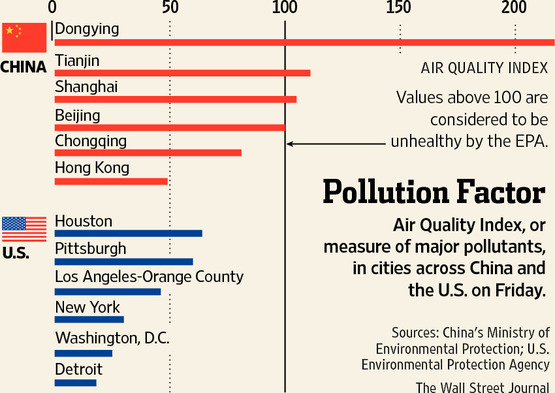
As China struggles with air pollution s, some believe the air inside may not be cleaner. Louie Cheng president of PureLiving China, an indoor environmental consulting firm, talks about toxic pollutants, your home and what you can do to get rid of them.

BEIJING—After Beijing’s air-pollution readings soared in January, local executives for German auto maker BMW AG BMW.XE -2.36% received bad news: several candidates for midlevel expatriate jobs withdrew their applications.

“They called and said they no longer had the support of their families,” said Kirk Cordill, managing director and CEO of BMW Group Financial Services China. Read more of this post

The Bond Market Can’t Be This Easy to Beat—Can It?

April 12, 2013, 5:29 p.m. ET

The Bond Market Can’t Be This Easy to Beat—Can It?

By JASON ZWEIG

BF-AE757_INVEST_G_20130412221423

Bond managers are suddenly looking superhuman.

Investors have handed nearly three-quarters of their new fixed-income investments to bond pickers over the past year, as $230 billion has poured into actively managed bond funds, while just $63 billion has gone into bond index funds.

Why are the same investors who have turned their backs on stock pickers showering money on bond pickers?

Past performance, of course. Last year, 79% of intermediate-term bond funds—which hold a mix of government and corporate bonds maturing in five to 10 years—beat the comparable bond index, according to S&P Dow Jones Indices. Read more of this post

Energy: More buck, less bang; As oil companies venture further into remote areas in search of the world’s remaining reserves, their costs have soared

April 11, 2013 7:06 pm

Energy: More buck, less bang

As oil companies venture further into remote areas in search of the world’s remaining reserves, their costs have soared

By Sylvia Pfeifer and Guy Chazan

The Bob Douglas will be a giant, a drillship big enough to carry two helicopters, cope with 10,000 feet of water and still manage to pierce the earth’s crust another 30,000 feet.

It is under construction at Ulsan, Hyundai Heavy Industries’ shipyard on the southeastern tip of the Korean peninsula. When it goes to work later this year, its owner, Noble Corporation, will charge $618,000 a day for its use – more than twice what it costs to hire an Airbus A320 for a month.

The new vessel is far more advanced and better-equipped than its predecessors, the result of heavy investment – it can cost upwards of $600m to bring a state-of-the-art drillship to market. But just 10 years ago the best-equipped offshore rigs would have cost one-third what Noble is charging.

Oil exploration has always been an expensive business. Yet even for an industry used to multibillion dollar capital budgets, costs have been rising at a troubling pace, as the Bob Douglas illustrates. Analysis by Bernstein of Europe’s integrated oil companies found their costs soared by 10 per cent last year. Read more of this post

The Complete Chartpack Of The Top Global Themes For The Next Five Years

The Complete Chartpack Of The Top Global Themes For The Next Five Years

Tyler Durden on 04/12/2013 17:45 -0400

The investment environment is changing at a rate that’s representative of global economic imbalances, fund flows, and geopolitical risks. We believe this decade will continue to witness greatly increased volatility and instability in the economies of the world and the global financial system. Very few past models are still valid (and most have been proved ’empirically’ in real-time to be entirely fallacious). Such a situation has contributed to the extreme uncertainty that currently prevails. Our guiding principle is to help investors understand and navigate through all the complexities of an unstable, inflation-prone world. The following ten themes will be key drivers of financial market performance over the next 1 to 5 years.

  • Theme 1 WINTER OF OUR DISCONTENT – The Long-Wave decline
  • Theme 2 BUBBLE IN SAFETY – The US bond market top
  • Theme 3 LORDS OF FINANCE – The coming loss of central bank indpendence
  • Theme 4 SUPER SAD TRUE LOVE STORY – Europe (Break-up)
  • Theme 5 MRS. WATANABE – Japan
  • Theme 6 RICHISTAN – The rise of the Asian consumer
  • Theme 7 DEVIL TAKE THE HINDMOST – Currency games
  • Theme 8 SUPERMONEY – Precious metals
  • Theme 9 THE RICHEST MAN IN BABYLON – Iraq
  • Theme 10 WHEN MONEY DIES – The great social disorder

World at a glance

In the investment world, anyone who foresees and understands the trends, who is openminded, and who keeps emotions at bay,

The structural backdrop for a global macro strategy

  • Developed economy governments are insolvent
  • The process of deleveraging and global rebalancing is underway
  • Outsized dislocations from “non-economic” policy actions
  • The loss of central bank independence with likely unintended consequences
  • Ongoing battle between deflation and reflationary forces
  • Shorter and more volatile economic cycles that are globally synchronized
  • Drop of confidence in policymakers, institutions and the “system” at large
  • Increased risk of geopolitical tensions and social conflict
  • Market prices only reflect fair value by accident and in passing

“The social object of skilled investment should be to defeat the dark forces of time and ignorance which envelope our future.” – Lord Keynes

Bitcoin fans put brave face on price fall from $266 to $54, taking it back to its level before a surge in internet and media interest that began in late March

April 12, 2013 7:41 pm

Bitcoin fans put brave face on price fall

By Stephen Foley in New York

Adherents of the virtual currency Bitcoin are picking up the pieces after their holdings collapsed in price, and vowing to continue growing the Bitcoin economy despite the volatility and illiquidity bedevilling activity.

The price of a single Bitcoin peaked at $266 on Wednesday, double its price a week earlier, and then slumped to a low of $54 on Friday. That takes it back to its level before a surge in internet and media interest that began in late March.

The price collapse hit not just speculators but also merchants who sold goods or services for Bitcoin at the peak.

Tony Gallippi, founder of Bitpay, which processes transactions for merchants, said about half his customers keep their income in Bitcoins, rather than immediately cashing out, and so would have lost money on transactions. Bitpay’s 5,000 merchants include gold and silver exhanges, electronics businesses and even a car dealer. Read more of this post

Tokyo Disneyland, now 30, still casts spell; Park keeps loyal fans, adds new ones by keeping its magic fresh

Tokyo Disneyland, now 30, still casts spell

Park keeps loyal fans, adds new ones by keeping its magic fresh

BY KAZUAKI NAGATA

APR 13, 2013

p3-disney-a-20130413-200x200

Tokyo Disney Resort, comprising Tokyo Disneyland and Tokyo DisneySea, celebrates its 30th anniversary Monday with no signs that its magic spell has worn off, as figures show the wildly popular venue lured a record 27.5 million visitors in fiscal 2012, which ended in March.

While some theme parks built over the past 30 years, including Universal Studios Japan in Osaka and Huis Ten Bosch in Nagasaki Prefecture, have struggled to make a profit, Disney operator Oriental Land Co. has dominated the industry and aims to attract even more visitors this year.

Industry observers attribute the Disney success to instilling in visitors a sense that they are in dreamland — a place they will seek to return to again and again. Read more of this post

A renowned Chinese food maker’s proposal to pay shareholders a dividend in the form of its own products – seame powder – has stirred great public curiosity online

Proposed dividend payment in sesame powder ridiculed

Updated: 2013-04-11 14:45

( Xinhua)

BEIJING – A renowned Chinese food maker’s proposal to pay shareholders a dividend in the form of its own products has stirred great public curiosity online. Nanfang Black Sesame Group Co Ltd, known for its cereal-like sesame powder, decided to provide 12 cans of the stuff as a dividend for every 1,000 shares registered before Thursday. Read more of this post

China’s money supply passes RMB 100 trillion (US$16.7 trillion) for the first time, over one and a half times the number in the United States

China’s money supply passes US$16.7 trillion

Staff Reporter, 2013-04-12

China’s central bank has said that the country’s basic money supply reached 103.67 trillion yuan (US$16.7 trillion) as of the end of March, up 15.7% from a year earlier. It is the first time the supply has exceeded 100 trillion yuan (US$16 trillion), according to ifeng, the website of Hong Kong’s Phoenix TV. The nation’s money supply stood at 97.42 trillion yuan (US$15.7 trillion) at the end of 2012, one and a half times the number in the United States, said the website. The supply has grown to more than six times the nation’s 2002 volume, raising concerns over the possibility that the currency has been over-printed. The total money supply was 31.12 trillion yuan (US$5 trillion) as of the end of March, up 11.9% from a year earlier. The amount of cash actively traded in the market was 5.57 trillion yuan (US$899 billion), up 12.4% from a year earlier.

Skin care cream Pehchaolin is making a comeback in China after Peng Liyuan, China’s first lady, presented an assortment of products from the previously out-of-fashion brand as State gifts during her foreign tour with President Xi Jinping

Speeches and cream on foreign tour

Updated: 2013-04-13 01:40

By XU JUNQIAN in Shanghai ( China Daily)

180373d28c1012d28bd407 Read more of this post

From bust to boom, how Kate Swann transformed one of Britain’s oldest companies WH Smith

From bust to boom, how Kate Swann transformed WH Smith

After an extraordinary decade at the helm of WH Smith, Kate Swann is preparing to say goodbye to a retailer that has been transformed.

whsmith_2366273b

By Graham Ruddick, Retail Correspondent

8:15PM BST 11 Apr 2013

WH Smith is one of Britain’s oldest companies and began life in 1792 as a small shop in Little Grosvenor Street, London.

Its unique mix of stationery, entertainment, books, and confectionary made it a high street institution, but by the time Swann arrived in 2003, the company was on its knees, outmanoeuvred by supermarkets and the internet. Read more of this post

Who Says Innovation Is Dead in Age of Crazy Cheesy Crust

Who Says Innovation Is Dead in Age of Crazy Cheesy Crust

Move over hamburgers and fries. Here come the sweet-chili chicken wraps and bacon-filled tater tots.

Looking to lure Americans with the coolest new menu item, Burger King Worldwide Inc (BKW)., McDonald’s Corp. (MCD) (MCD) and Red Robin Gourmet Burgers Inc (RRGB) (RRGB). and others are turning up the heat in their test kitchens. At the same time, classically trained chefs, looking for more regular work hours and higher pay, are no longer snubbing large chains. The result has been an arms race among eateries to create the most exciting new foods to attract consumers and boost sales.

“Over the last 12 to 18 months, you’ve seen a lot of innovation,” Eric Hirschhorn, Burger King’s vice president of global innovation, said in an interview. The Miami-based chain last year introduced 57 new items, the biggest menu overhaul in the company’s history and more than twice as many as in 2011, he said. In March, the Whopper seller rolled out bacon-filled tater tots for $1.99. Read more of this post

Australia’s Woodside shelves $45 bln Browse LNG project, the strongest sign yet that the country’s energy construction boom may be peaking

Updated April 12, 2013, 2:57 a.m. ET

Woodside Shelves Browse LNG Project

By ROSS KELLY

SYDNEY—Woodside Petroleum Ltd. WPL.AU +3.17% said Friday it has shelved an onshore gas-export project in Australia estimated to cost over US$40 billion to build, the strongest sign yet that the country’s energy construction boom may be peaking.

Natural gas from the Browse development, which also counts Royal Dutch ShellRDSB.LN -0.21% PLC, BP BP.LN -0.82% PLC and Asian companies as shareholders, will no longer be piped to a processing facility at James Price Point on the Western Australia state coast, Woodside said in a statement Friday.

The decision means a development of one of Australia’s biggest natural gas resources will be pushed back by at least two years, increasing the risk it will have to compete for customers with anticipated gas export projects in North America and East Africa. Woodside and its partners can submit new development plans to regulators, but securing approvals is often slow and time-consuming. Read more of this post

American Dream Eludes With Student Debt Burden: Mortgages

American Dream Eludes With Student Debt Burden: Mortgages

Luke Nichter of Harker Heights, Texas, said he’s not a renter by choice. The Texas A&M University history professor’s $125,000 of student debt means he has no hope of getting a mortgage.

Nichter, 35, who’s paying $1,500 a month on loans for degrees from Bowling Green State University in Ohio, is part of the most debt-laden generation to emerge from college. Two- thirds of student loans are held by people under the age of 40, according to the Federal Reserve Bank of New York, blocking millions of them from taking advantage of the most affordable housing market on record. The number of people in that age group who own homes fell by 4.6 percent in the fourth quarter from the third, the biggest drop in records dating to 1982.

“Student debt has a dramatic impact on the ability to buy a house, and to buy the dishwashers and the lawnmowers and all the other purchases that stem from that,” said Diane Swonk, chief economist of Mesirow Financial. “It has a ripple effect throughout the economy.”

The issue is being exacerbated by an explosion in the $150 billion private market for student debt with interest rates for some existing loans surpassing 12 percent. Unlike mortgage holders, borrowers have little hope of refinancing at lower rates. Interest on some new federal loans is set to double to 6.8 percent in July if Congress doesn’t extend the current rate, as they did last year. Read more of this post

Cyprus bailout cost surges from €17.5bn to €23bn – larger than the size of the country’s economy; The Cypriot developments came as Portugal was disclosed to be facing a second bail-out

Cyprus bailout cost surges to €23bn

The financial crisis ravaging Cyprus deepened on Thursday after the cost of the country’s bail-out surged from €17.5bn to €23bn – larger than the size of the country’s economy.

cyprus_2534002b

A demonstrator burns a European Union flag outside the parliament in the Cypriot capital, Nicosia Photo: AFP

By Bruno Waterfield, in Brussels

7:29PM BST 11 Apr 2013

Cyprus will have to find an €6bn extra to contribute to its own bail-out, less than a month after the original EU-IMF deal was agreed, putting the already teetering economy in danger of collapse and further endangering large bank depositors. It also emerged that the government in Nicosia has agreed to sell gold reserves to raise around €400m to help finance its part of its own bail-out. The Cypriot developments came as Portugal was disclosed to be facing a second bail-out. Read more of this post

Consultants to Banks Are Sharply Questioned on Independence

APRIL 11, 2013, 10:21 AM

Consultants to Banks Are Sharply Questioned on Independence

By BEN PROTESS

A multibillion-dollar consulting industry came under the spotlight in Washington on Thursday, as lawmakers questioned the quality and independence of companies that guide banks through regulatory scrutiny.

At a Senate Banking Committee hearing, lawmakers contended that the consulting business was fraught with conflicts. While banking regulators rely on consultants to help clean up financial misdeeds like money laundering and foreclosure abuses, the companies remain on Wall Street’s payroll.

“Consultants have a financial incentive to do things to attract repeat business,” Senator Sherrod Brown, the Ohio Democrat leading the hearing, said to a panel of regulators who testified. Read more of this post

Analysis: Japan’s big “Abenomics” gamble: how to tell if it’s paying off; “The question is whether Abenomics will lead to increased competitiveness of the Japanese economy”

Analysis: Japan’s big “Abenomics” gamble: how to tell if it’s paying off

Thu, Apr 11 2013

By Tomasz Janowski

TOKYO (Reuters) – Debating the merits of “Abenomics” is much like talking about a new miracle diet or a life-saving drug: there are many skeptics, but very few who wouldn’t want to see it work.

A stronger Japanese economy would help global growth and make domestic problems such as ageing and runaway debt more manageable, so it is no wonder many people give Prime Minister Shinzo Abe and his economic plans the benefit of the doubt.

So far, Abe’s heady cocktail of massive money printing, public spending and promised pro-growth reforms has sent Tokyo stocks to five-year highs and kept his support at 70 percent – unheard of for a leader already more than three months in power.

But ultimately even well-wishing observers will want to be assured Abenomics is delivering the desired rise in economic activity: better jobs, wages and sustained growth Japan has not seen for two decades. Read more of this post

EU Sounds Alarm on Spain; Portugal to Request Extension on Bailout Loans; Momentum Seen Slipping in Madrid; Slovenia, France, Italy Also Raise Concern

Updated April 10, 2013, 2:00 p.m. ET

EU Sounds Alarm on Spain

Momentum Seen Slipping in Madrid; Slovenia, France, Italy Also Raise Concern

By MATINA STEVIS

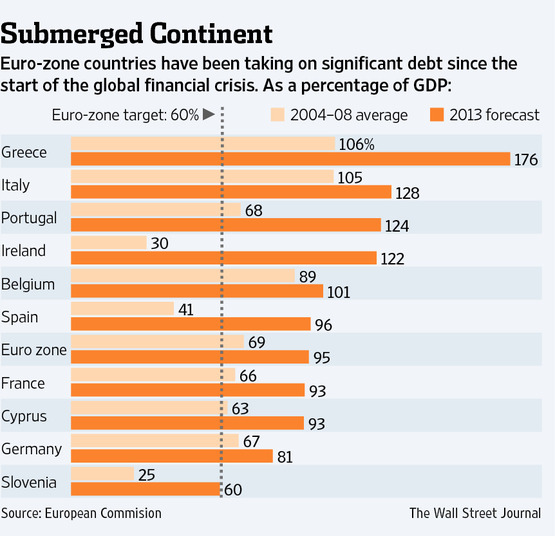
BRUSSELS—Spain’s efforts to rein in spending and improve its economic performance are running out of steam despite much work yet to do, the European Commission warned Wednesday in a report that also singled out Slovenia as a potential trouble spot. “Spain should…maintain the reform momentum” to deal with “formidable challenges ahead,” Commissioner for Economic and Monetary Affairs Olli Rehn said after presenting an annual health check of the competitiveness of several countries in the European Union.

WO-AN345_EUCOMP_G_20130410181206 Read more of this post

In Japan, Politics Propels a Stock Market Rally

In Japan, Politics Propels a Stock Market Rally

By Nick Summers on April 11, 2013

mf_japanchart_inline

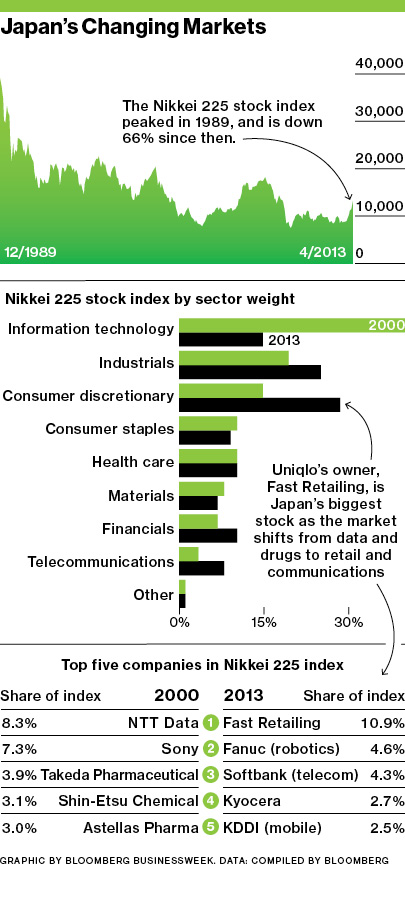
“Let’s do it,” Yoshihiko Noda, Japan’s prime minister, said Nov. 14, during a political debate with his opponent Shinzo Abe. Noda meant that it was time to dissolve parliament and hold a new election. Investors heard it as the kickoff to a rally that hasn’t stopped, with the Nikkei 225 stock index gaining more than 50 percent and returning the market to levels not seen since before the 2008 financial crisis. The Nikkei’s best performer since Nov. 14, with a 194 percent gain through April 10, is Tokyo Tatemono, a real estate developer. Nomura (NMR), the $445 billion financial-services company, has advanced 146 percent.

Politics and prices are deeply entwined in the rally. Abe and his Liberal Democratic Party won a landslide victory in December on the strength of his “Abenomics” stimulus proposals, which aim to jolt Japan out of decades of lethargy. Even at a four-year high of just over 13,000, the Nikkei is worth only a third as much today as it was at the end of 1989, when Japanese corporations seemed poised to take over the globe. What felt like a permanent recession followed, with years of deflation and anemic growth. Read more of this post

Two Firms Amass Much of World’s Copper Supply

Updated April 11, 2013, 10:06 p.m. ET

Two Firms Amass Much of World’s Copper Supply

Commodities Traders Pay to Divert Shipments From Other Warehouses; Manufacturers Worry About Access

By MATT DAY

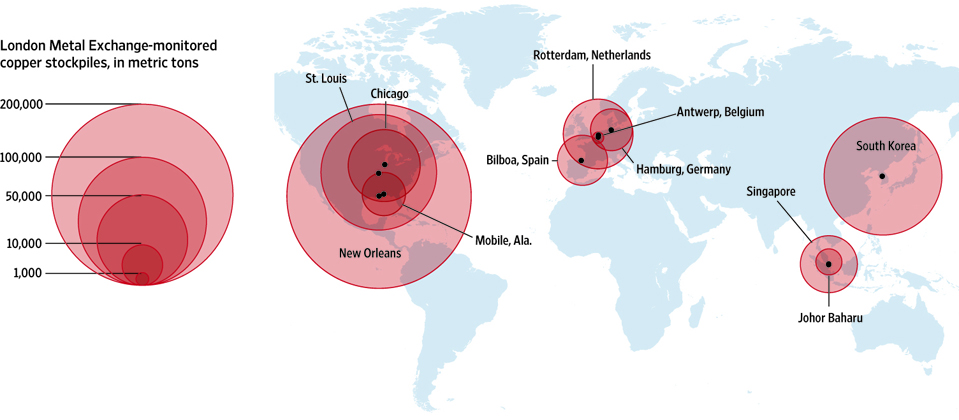
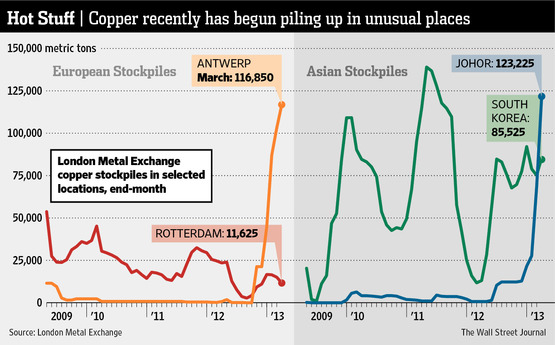
Two major commodities-trading firms have amassed much of the world’s copper supplies in their warehouses, partly by paying to divert shipments away from other storage hubs, traders and analysts say.

Red Alert: Some trading firms have stashed the world’s copper supply in warehouses in New Orleans, Antwerp and Johor. The moves have sparked worries about the possibility of delayed deliveries and higher costs for industrial consumers.

This concentration of copper supplies has sparked concerns among industrial consumers of the metal. Some manufacturers and builders say they are worried that those stockpiles of copper—which is used in goods including automobiles, circuit boards and plumbing fixtures—could prove tough to procure if demand were to pick up sharply or output from mines were disrupted.

TAYLOR_TEMPLATEMI-BV316_COPPER_G_20130411170905 Read more of this post

Mainland Chinese are the fastest growing tourist population in the world, spending $102 billion in 2012

April 11, 2013, 9:31 a.m. ET

China’s Travelers Bring Gifts Abroad

By WEI GU

AM-AY030_WEICOL_G_20130411055120

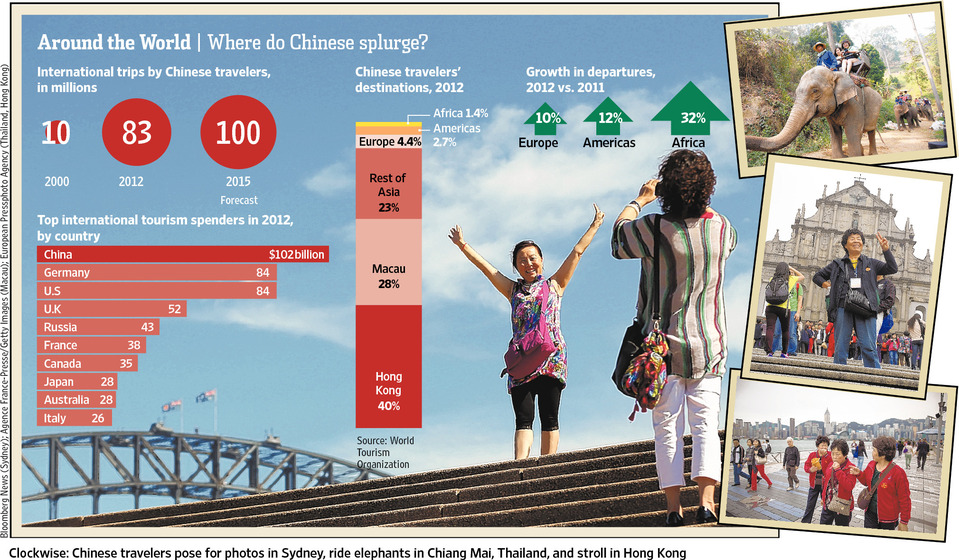
Mainland Chinese are the fastest growing tourist population in the world, spending $102 billion in 2012. The WSJ’s Wei Gu tells Deborah Kan how spending patterns are changing as more Chinese travel abroad.

Bad air, a new strain of bird flu at home and easier visa rules in countries like Japan and the U.S. are adding to the incentives for Chinese to take an overseas holiday.

Those who do will join the millions of Chinese tourists already remaking the global travel industry.

Chinese travelers have become the world’s top source of tourist spending, according to the World Tourism Organization, with outlays of $102 billion in 2012. That flood seems likely to keep swelling. Less than 3% of China’s 1.4 billion people are passport holders, according to China’s Ministry of Public Security. By contrast, U.S. Travel Association figures show, 30% of Americans and 75% of Britons are.

As the Chinese numbers climb, there will be some surprising winners and losers. Read more of this post